Commentary on the text “Ellam Ondre”
A continuation of the text “All Is One. Ellam Ondre” by Saint Subramanya.
The topics of the following chapters will be “God” (Chapter 3) and “Ego” (Chapter 6).
The Nature of God and the Superintelligent Power
“Who is God? God is He who transcends everything visible to us. One might think that, since He transcends the world, there is no connection between Him and the world. But in reality, there is not a single atom that is not connected with Him. Furthermore, what does ‘transcending the world’ mean? After all, the world includes both us and all the objects we perceive. In other words, the world can be said to consist of animate beings and everything inanimate. What should we call the One who created these two groups? Of the two, we consider conscious beings to be superior. We may suppose that the One in question belongs to the category of the highest beings known to us, but the power of our intellect is insufficient to conceive of anything beyond this. Is that not so?”
As one secular scientist said, to suppose that the entire universe evolved from a chaotic explosion is equivalent to supposing that you gathered a pile of metal, threw a grenade into it, and that the explosion produced a Boeing 747. This scientist went on to develop a theory that led him to conclude that there must be an intelligent power that is supremely organized, supremely conscious, supremely intelligent, and beyond human perception. All human creative powers and all human wisdom are but a faint glimmer of this superintelligent power.
Most theorists in modern physics, especially at its more advanced levels, are inclined to acknowledge this superintelligent power. In our tradition, this superintelligent power is called the one Sphere, the supreme Source, the supreme Intelligence, or the nature of Mind. When we say Mind, we mean that this superintelligent power has the nature of consciousness; moreover, we explicitly indicate that this superintelligent power is not external. It is inherent in us; it flows from within each of us. Therefore, we say that we follow the tradition of Advaita—that is, we recognize this power not somewhere outside us, but as the very essence of our “I”; thus, we are entitled to call it the nature of Mind.
The Transcendence and Immanence of God
“For the One who created us transcends us and cannot be defined by us. Since He transcends our intellect, He is said to transcend everything. That is precisely why He is called ‘Kadavul’ (literally, ‘something that passes beyond, overcomes’)—a transcendent being.
Although this God cannot be known by us, it cannot be said that He is completely incomprehensible to us. He reveals Himself to us in a certain way. And this Grace of His is enough for us. Whatever qualities He may possess, we do not need all of them. He shows us only those whose knowledge frees us from suffering. He has no reason to reveal more of His Power to us than is necessary to remedy our shortcomings in our present state. After all, God knows what we need. Moreover, He is within us. However boundless His grandeur may be, He has a shore upon which we can land.”
The term “God,” as well as the arguments and philosophical concepts that describe this superintelligent power, should not be understood literally, but metaphorically and allegorically. In other words, they are merely a hint of the ineffable power that is present. But if we merely think about it at the level of the mind or concepts, these judgments will be inadequate; they will be eternalistic. We can truly gain insight into the nature of the superintelligent power only when we ourselves change our level of awareness. We must change our karmic vision, our degree of awareness, and then this superintelligent power begins to reveal certain things to us. For example, we begin to perceive global energies and the deities who control them, whose existence we had never even suspected before.

The Hierarchy of Superintelligent Powers
Ordinary people are too preoccupied with themselves, so they cannot see these global energies. As a wealthy person whose power and possessions are growing begins to establish contact with local authorities, then with the rulers of the country, and, if his power and wealth grow even further, with the “powers that be,” so too does a yogin, accumulating inner wealth and gaining mastery over his mind, begin to establish contact with supramental forces. He begins to see that these supramental forces have always naturally existed and will continue to exist. Just as an ordinary person is unaware of worldly power structures because he is too immersed in his own petty affairs, so too is a novice practitioner unaware of these supramental forces. But a yogin who has gained control over the mind begins to discover them.
He sees them as deities governing:
- the forces of nature, elements, divisions of time, lokas, and worlds
- various classes and groups of living beings, ethnic groups, and countries
- the cardinal directions, continents, and localities
- mountains, rivers, and local spirits
- planets, the solar system, galaxies, and metagalaxies
- universes and meta-universes
These supramental forces, which have their own functions surpassing the human mind, truly exist. Some supramental forces are responsible for overseeing ethnic groups, clans, and lineages; others oversee nations and peoples, meaning that they function on a more global scale. Still others oversee a particular sphere of human activity, for example by patronizing a certain art form, profession, or branch of science. Others control certain elemental processes associated with the cardinal directions. Still others control processes related to time and chronal effects. Yet others create, sustain, and destroy universes.
Thus, all of Being is permeated by supramental, global forces. If our spiritual vision begins to open, we can observe them. However, when we begin to explore supramental forces, we discover that they are limited, that they themselves are subject to something even more global and transcendent than they are.
When these supramental forces are asked questions, they say: “We are subject to the one First Principle. And before this one First Principle, even the greatest among us tremble. Even they cannot say that they have comprehended It. Even the greatest creators of universes, compared with whom a human being or a planetary system is but a speck of dust, worship It in profound amazement.”
This great First Principle is the one Sphere, the Supreme Mind, the nature of Mind. It is the natural state (sahajya) of all living beings. All living beings emerge from It and return to It, just as iron filings are drawn to a magnet.

Reincarnation, the life and death of living beings, and destiny are also governed by deities. The deities measure out each person’s karma, the degree of his guilt, his sins (if he identifies with those sins), and the extent of his merits, and direct each living being to the world (loka) that he deserves. The deities also determine a living being’s lifespan, death, or immortality. We cannot say that we are alone in this world and can do whatever we want in it. Global supramental forces are everywhere. Depending on his level, a yogin may follow these forces, establish favorable relationships with them, receive their blessings, pacify and subdue them, or recognize them as his own “Self” (this is the highest way of interacting with them), self-liberate them, and regard them as completely nondual.
In the Advaita tradition, all these higher global forces are regarded as manifestations of one’s own “Self,” since in Advaita it is customary to view everything, even the greatest of forces, as a manifestation of the mind. However, to recognize these global creative forces as his own “Self,” a yogin must truly expand his consciousness and reach the very depths; he must reveal the core of these creative forces and fully reunite with them. Otherwise, he will always remain dependent on them and will always be below them in level.
The Story of Nachiketa and the Teaching of Yama
The “Shvetashvatara Upanishad” tells the story of Nachiketas. His father, who was a Brahmin, cursed Nachiketas for disobedience and sent him to Yama. This happened after the Brahmin performed a ritual during which he offered cows and fruit as gifts to the gods. Nachiketas possessed discernment and saw that his father was offering cows that were no longer in their prime—that is, old cows that gave little milk. He understood that the sacrifice would not be successful, so he wanted to prevent it. He kept interrupting the ritual with the words: “Father, to whom will you offer me?” And when he asked this question for the third time, the Brahmin grew angry and said: “I will offer you to Yama so that you stop disturbing me!” Since the Brahmin, possessing brahma-tejas (the great yogic power of tapas), had carelessly uttered these words, they could no longer be taken back. The sankalpa had been expressed during the ritual and began to come true: Nachiketas went to Yama for three days. In other words, he spent three days in a state of clinical death in the bardo.
After a long wait in his subtle body, he finally met the god Yama. But the god Yama saw that, thanks to Nachiketas’s merits, the time had not yet come for him to leave his body, so he began to speak with him:
— You have waited a long time for me, showing humility, so I offer you wealth, luxury, and good fortune. Return to your body.
Nachiketas said:
— Tell me, do you have anything that liberates one from death?
Yama pondered and said:
— Very well, I will give you magical powers and knowledge of the Vedas. You will be able to recite them by heart and will possess magical powers, influence, and authority. I will give you these gifts.
Nachiketas said again:
— Do you have a gift that liberates one from death? Something that grants knowledge of everything?
Then Yama said:
— You ask a difficult question, boy. Even we have doubts about these matters. But I will tell you something.
Yama was an awakened being—that is, a Buddha whose service consists in assigning living beings to different worlds after their death. He said:
— I liked your questions. Moreover, the ritual of offering gifts was a test. But because you are steadfast in your desire to receive the highest knowledge and have rejected all temptations, you are worthy of receiving this knowledge.
After this, Yama instructed Nachiketas about the Supreme Mind and gave him a direct introduction. He said:
— All the gods, even I, tremble before this great, universal Mind. It is Brahman. It is your own nature. It is neither round nor angular, neither colored nor colorless, neither internal nor external. It is formless and yet has form. It is neither male nor female. It is both manifest and unmanifest. It is visible, yet hidden. It moves and does not move.
After three days, Nachiketas returned to his body. Upon his return, he was enlightened and could teach his father, who was a Brahmin, because he had received this knowledge from the god Yama himself while in the bardo.

Sat-Chit-Ananda: The Qualities of God
“What is this divine shore known to us? These are the attributes of God called sat, chit, and ananda (Being, Consciousness, Bliss). Sat (Being) is that which cannot perish and exists eternally. Sometimes the question arises: ‘If there was once a time when He did not exist, then who destroyed Him? And who created Him? Therefore, there must be an indestructible source of all things subject to destruction.’ The one who possesses immortality is God. His indestructible nature is sat (Being).
Next, what is chit (Consciousness)? It is that which possesses Knowledge—absolute Knowledge. Unlike our changeable knowledge, nothing obstructs it. There is neither disorder nor error in the actions it performs. It is knowledge itself, pure and simple.”
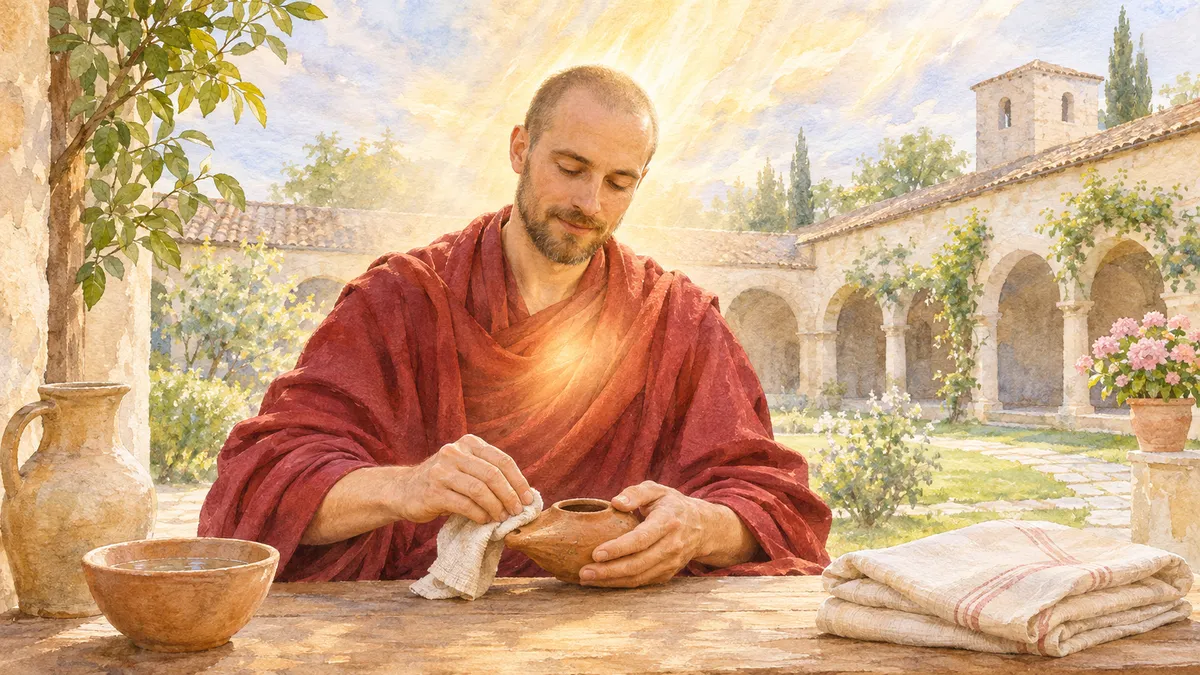
A monk is one who is constantly immersed in contemplation of God. Whatever he may be doing, he thinks of God every second, day after day. His hands perform their work, while his mind is directed toward God. Moreover, he is immersed in contemplation of God, of the Absolute Mind, not arbitrarily, but in a particular way—precisely as stated in sacred scripture: he is immersed in continuous contemplative presence.
In dualistic traditions, people converse with God, worship God, pray to Him, or ask Him for something. But in our tradition, we contemplate Him with naked awareness. This is our inner practice; that is, we do it not through reflection and philosophical concepts, but by entering a special state of consciousness. This path is the most direct; all other paths are merely preparation, an antechamber. One who speaks about God or reflects on Him mentally purifies his mind, but this is not enough, because he must move on to supramental perception, since God is incomprehensible to the conceptual mind (manas). One who prays to God will someday arrive at non-duality, where the one who prays and the One to whom prayer is addressed are one. He will come to experience identity. One who worships Him will someday arrive at the vision of complete non-duality, at a new awareness in which worship and the worshipper are one. Therefore, we say that the path of non-dual contemplation, the natural state, is the highest. It is the culmination, the summit, the “cream” of all spiritual paths.
Of course, we should not delude ourselves. We will not be able to master this path merely by saying, “This is the highest path, and I follow it.” The highest path is the most difficult, because it is extremely subtle, like the edge of a razor. This means that great concentration and diligence are required of us; we need understanding, discernment, and intuitive insight into the path of contemplation. Even if we understand something intellectually, we will not be able to embark upon this path. Otherwise, one might think: “I do not speak about God, nor do I think about Him.” It is assumed that “I do not speak” because I contemplate and have already gone beyond what can be spoken of; “I do not think” because I look directly at Him, because I am in Him every second, while to think is to limit Him.
Divine Order and the Law of Karma
“Our knowledge needs His help and, until that help comes, remains mired in disorder and error. Very often, He enlightens us by saying: ‘Your knowledge is bound up with chaos and delusion.’ And how orderly even inanimate objects are in His creation!
Many must have heard the parable of the valuable lesson an atheist received when he mocked the order of the world, reproaching God: ‘Why did He create such small fruits on such a large tree as the banyan?’ When we need to make some use of a particular material object, we do so with a certain thought, chit, already in our minds. But can an inanimate thing perform work that belongs only to unlimited knowledge? No, that can never happen. Therefore, it is said that God is also chit (Consciousness).”
The Absolute Intelligence does not govern the world directly; the Supreme Mind is separate from manifestation. Governance occurs not directly but indirectly, through the law of karma and through deities, although at the subtlest level even the law of karma and the deities are the play of the Absolute Intelligence. We can either enter into harmony with this play or be in dissonance with it. If we eliminate our ego, our hopes, expectations, and attachments, we come into closer harmony with this play. If we have egoic claims and attachments, then, on the contrary, we fall out of harmony, we are in dissonance with this play and are rigidly conditioned by the law of karma. And the law of karma is the generation of certain causes and the reaping of their effects. There is nothing that is not a consequence of our own causes and actions.
Why does suffering arise? It arises because a person does not wish to accept the world as it is and immerse himself in the center of the natural state. A person has selfish claims on which he places too much hope, and when they collapse, he suffers.

The State of Turiya and Types of Samadhi
“Only one who has attained the state of turiya, who sees all objects as one, knows that true state of God, Being-Consciousness-Bliss, as it is. Exactly how this knower unites with God can neither be expressed in words nor heard with the ears. It can only be experienced and realized. And there are ways to attain such realization.”
What is this method? This method is called “the attainment of samadhi.” In particular, it is the samadhi we are speaking about, namely sahaja samadhi. Sahaja samadhi is the highest of all types of samadhi, except, of course, for the attainment of sarupa samadhi, when the elements of the body dissolve. Of all types of samadhi (savikalpa, nirvikalpa, and sahaja), sahaja is the highest. In sahaja samadhi, the yogi is naturally immersed in unity with the universal Self, with the universal global Mind, even while acting, speaking, seeing, doing, and performing actions. This is the highest attainment in spiritual practice.
Savikalpa samadhi provides the experience of separation from the body—the experience of the bardo and other worlds. Nirvikalpa samadhi provides the experience of dreamless sleep, the unmanifest. Many of our more experienced monks experience savikalpa samadhi. It is more difficult to say when it comes to nirvikalpa. As for sahaja, of course, it is even more difficult. Nevertheless, some are steadily moving toward it, drawing nearer. Others are still only dreaming of it.
Full sahaja samadhi arises as the result of a long struggle to maintain contemplation, success in savikalpa, and clarification of the unmanifest in nirvikalpa samadhi. Savikalpa corresponds to dreaming sleep, while nirvikalpa corresponds to dreamless sleep and the fourth state (turiya). Sahaja samadhi unites them all within itself.

In other words, a yogi abiding in sahaja samadhi lives as though in a dream. He sees the world through the eyes of dreamless sleep. His causal body, which lives in dreamless sleep, has been activated, but it manifests here, in ordinary vision.
In this regard, three categories of yogis, or jnanis, are distinguished. The first can maintain this state only during meditation. The second can maintain it in everyday life, but there is a limit to how long they can do so. The third can maintain it even when faced with great suffering or pleasure, even when seeing astonishing things. They are as though intoxicated, or like a child who is unaware when its mother feeds it at night. They are immersed in this state at all times, and therefore, even while acting, they do not act. Even while among various objects, it is as though they are not among them. They have no dualistic judgments and no clinging whatsoever.
The Necessity of Effort on the Spiritual Path
“God has no name; there is only the name we have given Him. He has no form; there is only the form we give Him. There is nothing wrong with this. For is not every name His name? Is not every form His form? What is sound without Him? What is form without Him? Therefore, in the absence of true knowledge of Him, you may, in order to remember Him, give Him a name and clothe Him in a form as you wish. To expect Grace from Him without making any effort of your own is an utterly futile pursuit.”
You may refrain from making efforts only once you have mastered the art of effortless contemplation. Until then, the yogi’s entire life is a struggle: a struggle for meditation, a struggle against selfishness, against the kleshas, against laziness (tamas), against the various sensual desires that tempt one, against one’s own fixed ideas, against worldly attachments, obstacles, karmas, and so on.
It would be naive to think that as soon as we say, “I am a follower of the path of non-effort,” we will immediately master the path of effortless contemplation. Effortless contemplation is revealed only when we have sufficiently mastered mindfulness and contemplation and have eradicated the gross manifestations of our “I,” when we have reached the point at which the “great decision” to enter contemplative non-action is made—that is, when our ego, our “I,” has already begun to dissolve almost completely. Until then, one must make tremendous efforts to succeed in spiritual practice, because the ego does not wish to surrender so easily. Even after years of meditation, a yogi or monk may remain limited by his own “I.”
Ancient Methods of Combating the Ego
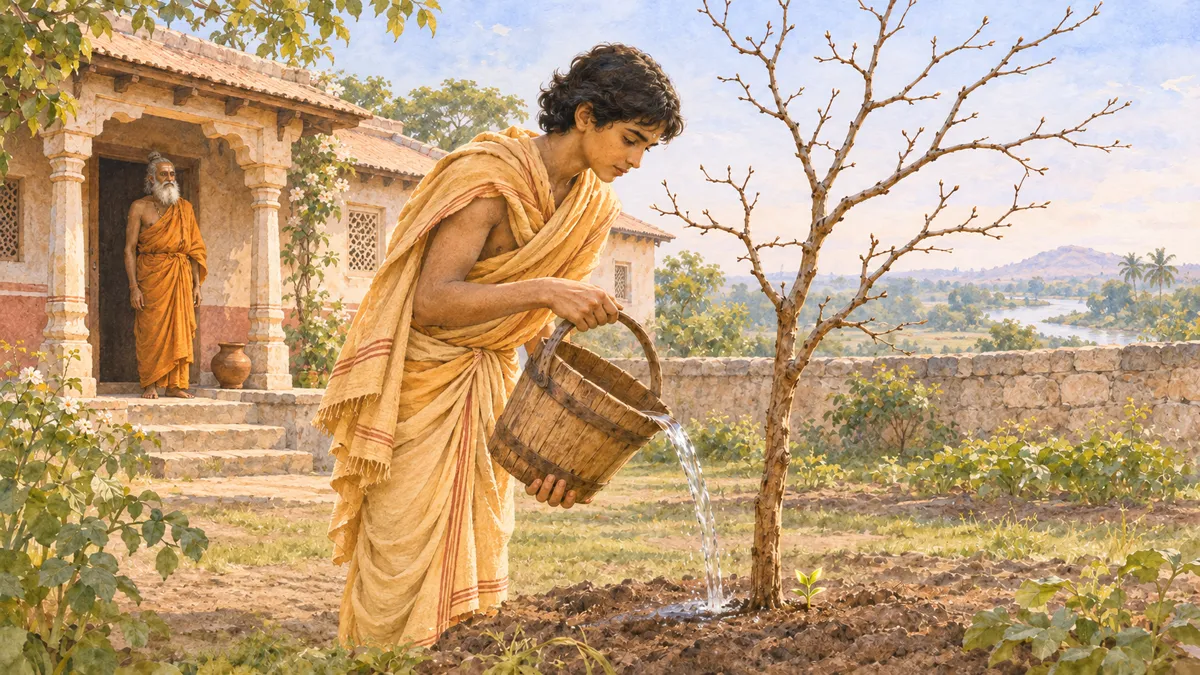
I have read ancient Russian monastic rules. In them, the struggle against the ego and obedience were elevated to the status of the highest law. For example, one novice was given the following service by his holy father: for seven years (seven years!), every day he stood at the gates, bowed to everyone entering and leaving, and asked, “Pray for me, for I am mortal.” Another novice was instructed by his spiritual father to plant a completely dry tree and water it for three years, saying that after three years the “fruit of obedience” would grow. A third novice was given the following task: for a long time, he used his own hands to clean up the elder’s (an old monk’s) excrement. This was Saint John of Damascus. Then his spiritual mentor ordered him to go to the city where he was known and respected and engage in trade there on behalf of the monastery—that is, the most ordinary of occupations. A fourth novice was given the following tasks by his spiritual father: he would weave a mat, and his mentor would come and unravel it, after which the novice would weave it again. A fifth novice was given his spiritual mentor’s torn vestment to mend. When he had mended it, the mentor would tear it again, and the novice would mend it again—and this continued many times. A sixth novice was often driven away from meals with abuse by his spiritual brothers, the senior monks; he often went hungry—this was how his humility was trained. This is the “fruit of obedience.” Yet another novice was humiliated and reproached by his spiritual mentor for seventeen years. He said, “If my ego had not been humiliated and reproached for seventeen years, I would not have received the grace I needed.” In other words, he later recalled it as a great spiritual grace.
Saint Dorotheus had a disciple named Dositheus, whom he subjected to severe trials until his death. How? He gave him utterly foolish, utterly absurd tasks, and did so in a dubious tone, fully displaying his lack of seriousness. Another person could easily have become confused and refused to follow such instructions, but this novice carried out every instruction with great joy. One might say that Saint Dorotheus was almost joking with this novice, while the novice, in complete earnestness and without even losing his bhava, did everything exactly as he should. Later, the elder admitted that he had failed to lead him into temptation and that he had passed every trial with dignity.
Thus, when the false “I” and the egoistic will were cut off, the monk opened himself to a new vision of reality—beyond the ego. One who clung to the ego could not pass such trials, could not become truly holy; the path to awakening was closed to him.
These methods may seem highly radical even to many monks, while for yogis of the pashu category they are fundamentally impossible to practice: within the first few minutes they would fall into great confusion, because their ego is accustomed to manifesting and expressing itself, accustomed to meaning and goal-oriented activity. In other words, it is accustomed to seeing things in its own way, so any disruption of its karmic vision completely “pulls the ground out from under its feet.”
Sahaja Samadhi as Absolute Obedience
Only when we can completely detach ourselves from this ego, from the will that limits us, do we have the right to say that we have come even slightly closer to the natural state. Before that, we were nowhere near it, because the state of sahaja samadhi is a state of complete obedience of manas to the Atman, and of the personal ego to the Absolute. Obedience to someone or something external, such as a person, does not count. The elders imposed such external acts of obedience simply as a method; it was training. They tried to teach the disciple to subdue his relative “I” and submit it to the absolute “I.”
Sahaja samadhi is the absolute obedience of the personal “I,” the small ego, to the Absolute. If something external is taken to be the Absolute or endowed with form, then training takes place, as in the case of the elders. This training strips away all layers, all egoistic and fixed ideas, dualistic notions, accumulated experience, discrimination, and pride—everything that prevents one from truly letting go of oneself and surrendering to unconditional contemplation of the Absolute. These methods are no different from those of the ancient siddhas, such as the methods of Marpa or Tilopa.
Overcoming the Limitations of the Will
When we contemplate, we are severely limited by our dualistic notions and our will. In the human world, will is generally seen as something good and positive because it enables us to achieve a great deal, and will is very important in yoga. However, if one identifies with the will, it becomes a stone blocking the door to enlightenment. This does not mean that the will should be discarded altogether, but one must cease to identify with it, because the will is the root of the false ego; it is precisely what prevents a yogi from letting go of himself and entering effortless presence, the state of sahaja. The will must be developed. A yogi must possess a strong, transcendent will, yet he must remain free from its dictates. It should not tell him what to do; rather, he should tell it what to do and use it as he wishes. In other words, at the moment of self-surrender, of letting go of oneself, disidentification from the will takes place: we cease to identify with it and begin to identify with something more universal—with that which transcends the will. And only the primordial Self, the Absolute Mind, transcends the will.

Service as a Spiritual Practice
I am inclined to have monks engage in creative service. However, creative service is available only to those capable of abiding in a state close to sahaja samadhi. If such a state is absent, identification with one’s internal data occurs, and then such service will only hinder one’s practice. Therefore, a yogi first performs obedience. Obedience means that you cut off your own self, subdue the ego, and cut it off.
The work you do in the monastery is also your practice, if you approach it correctly. It should be regarded specifically as a process of sadhana, as spiritual training, as obedience. Your spiritual development depends on how correctly and well you perform it, with the proper attitude; conversely, mistakes in service hinder spiritual development.
Obedience means that you teach your ego to listen to the true Self. Service is also a path of self-surrender, of serving the higher powers, the Absolute, and the Three Jewels, which embody the Absolute. Through service, you enter non-action through action. It is difficult to enter non-action through contemplation or meditation; this takes many years. But if you engage in service correctly, this will reveal itself to you when, amid your actions, you enter non-action.
If you contemplate while moving, uniting your consciousness with your movements, remain unattached to the fruits and results, act without selfish motivation, do not cling to your own discernment and to the experience acquired through service, and dedicate all your actions to all living beings, who embody the Three Jewels, then you enter contemplative non-action. But if you do none of this, then you are merely working off the prasad, and that is the weakest way to engage in service.
Service develops will and one-pointed concentration. If, while serving, you do not exercise will or one-pointedness and do not overcome yourself, but instead follow the path of personal comfort, then, of course, you will achieve no result. You will encounter a tendency toward compromise in retreat; at the slightest difficulty, your mindset will always be: “My comfort matters more, no matter the cost.” But if you understand the principle of one-pointedness, self-surrender, and will, you can easily transcend yourself, and then direct this power of self-transcendence inward; the same power will manifest in sadhana, meditation, and other practices.
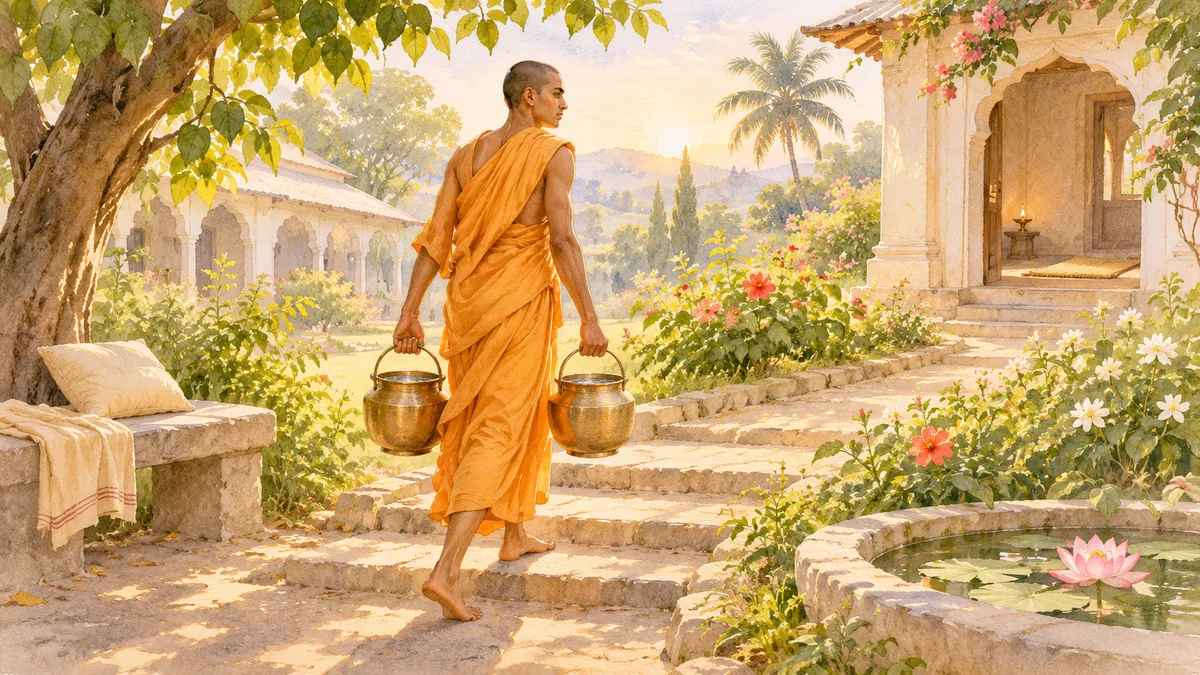
When you engage in proper service for a long time, the seeds of white karma accumulate, while the seeds of black karma are worked out. Then a moment comes when only a pure state, pure samskaras, remains within you. You suddenly begin to feel that you are entering contemplative non-action, that your ego has submitted, and that the universal light of the great Self has begun to unfold. Only by interacting properly with objects during service can you discover this principle of non-action and approach sahaja samadhi.
Supreme Resourcefulness Without Attachment
External interaction during service is always difficult to understand because it can be perceived in a worldly way. However, during external interaction, you must remember these principles, contemplate, and enter non-action through action. Then your contemplation will unite with your conduct, your conduct will become an expression of the View, and all your actions will become flexible, pure, self-liberated, and harmonious because they will arise from the true Self.
The siddhas describe this principle as follows: “Supreme resourcefulness without attachment.”

Once such supreme resourcefulness without attachment has been attained, a yogi may express or manifest himself as much as he wishes, because it will no longer be his own expression. His expression and manifestation will be the manifestation of his true Self, and selfish motivation will never be woven into it.
A Total Approach to Service
When you have the right attitude toward service, you have a total approach. A total approach means that if you have a broom in your hands, you sweep with it totally; if you have a pencil in your hands, you work with it totally. Your mind does not wander anywhere; you give yourself completely to the process you are engaged in, you respect this process, you do not allow yourself to neglect it, and you bring an element of contemplative presence into every action. If you are empty, you are able to do this. If you separate yourself from the situation and do not bring an element of contemplative presence into it, then it ceases to be service and becomes, for example, merely a compromise with the monastery’s rules. But bringing an element of conscious action and contemplation into any activity is far more beneficial when you are able to enter non-doing. You simply cannot allow yourself to do something badly, wrongly, defectively, incorrectly, incompetently, or profanely. You cannot allow yourself to be disharmonious in relationships, to disrespect the rules you follow, or to come into conflict with others. In other words, you manifest yourself in the highest way everywhere; you manifest yourself as a master. You take the diversity of situations into account, and you perceive each situation very deeply. There is no distance between you and the situation because you are empty. Your own “self” is not selfish; it is absolute. You do not identify with the ego, with the small “self” that compels you not to accept the situation, to separate yourself from it, and to insist on a dualistically limited position.
Different Approaches to Spiritual Practice
As I have already described, in ancient monasteries a novice was given the following assignment during the first six years: obedience, humility, and concentration on service. In fact, this is a very rigorous practice because there are no “treats” for the ego, such as asanas for the body, highly complex theoretical teachings, and so on.
Think about whether you would be able to proceed solely along the path of obedience if you were deprived of such “treats,” which are actually very important in our understanding. For how long? How long would you last? It is not easy; it is a very rigorous practice from which siddhas and saints emerge. Only a very few were able to follow it genuinely for a long time.
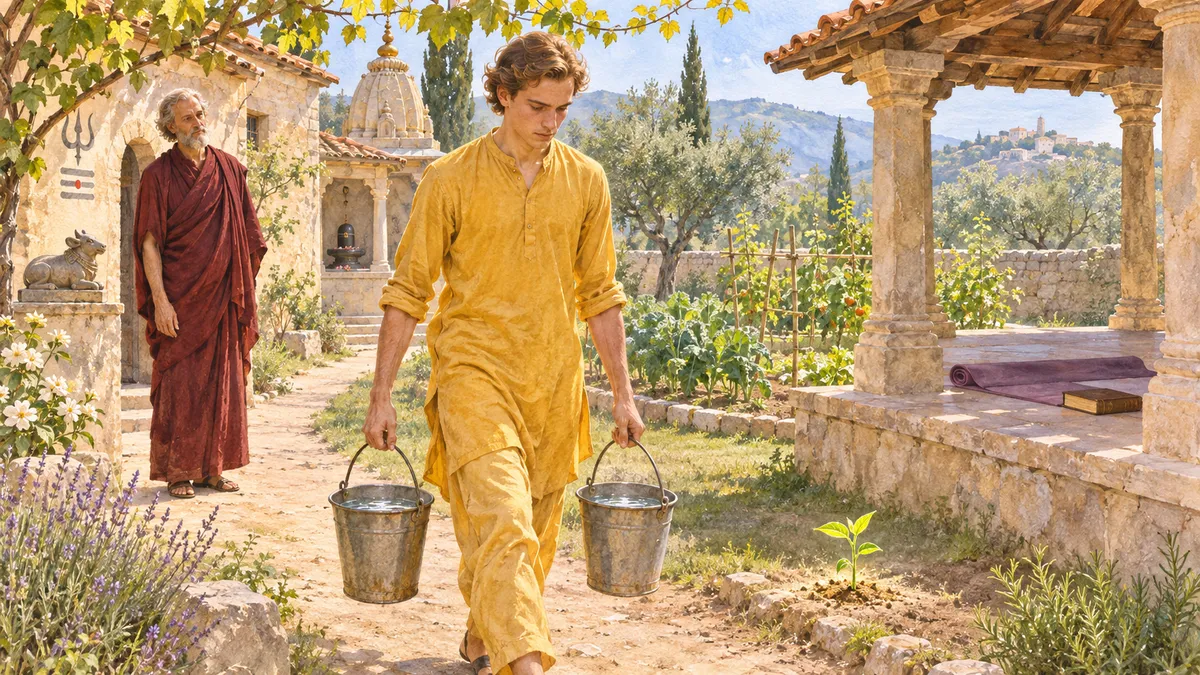
Our monastery takes a different approach. My approach is that a disciple should be thoroughly trained, given many techniques, and taught contemplation; the disciple should be trusted to begin discerning for himself where the ego is and where it is not. I am inclined to stimulate the creative consciousness of disciples.
Nevertheless, when looking at the methods of these saints, one should understand why they acted this way. It was not without reason. They understood how deeply the “self” must be cut away, and how much this “self” restricts and obscures the true state. True humility comes only when you understand that you have nothing and that there is only God, and this is the most difficult practice. Yet it is also the shortest practice, the shortest path in spiritual life. The ego should not be destroyed, since it will be useful in spiritual practice. However, the mind must be detached from its bondage to the ego and reoriented toward the Absolute.
True Humility
Once I saw a dharma guardian reprimand a brahmacharini. She said to him, “What, am I supposed to do namaste now? Fine, if you please.” I thought, “Well, is that humility?” In other words, inwardly there was a maha-ego, an enormous, full-blown ego. Perhaps this monk is even junior to you, or you do not like him, or you think you are better at meditation than he is, but genuine humility is a state in which you see something greater than yourself in this monk; you yourself have decided to see everyone this way, or your teacher has instructed you to do so. You see his sanghati, you respect something within him, and this attitude allows you to treat him with respect even when you see his shortcomings. Such respect extends to all living beings. It must extend to novices, to laypeople, even to cats and dogs. This is true humility.
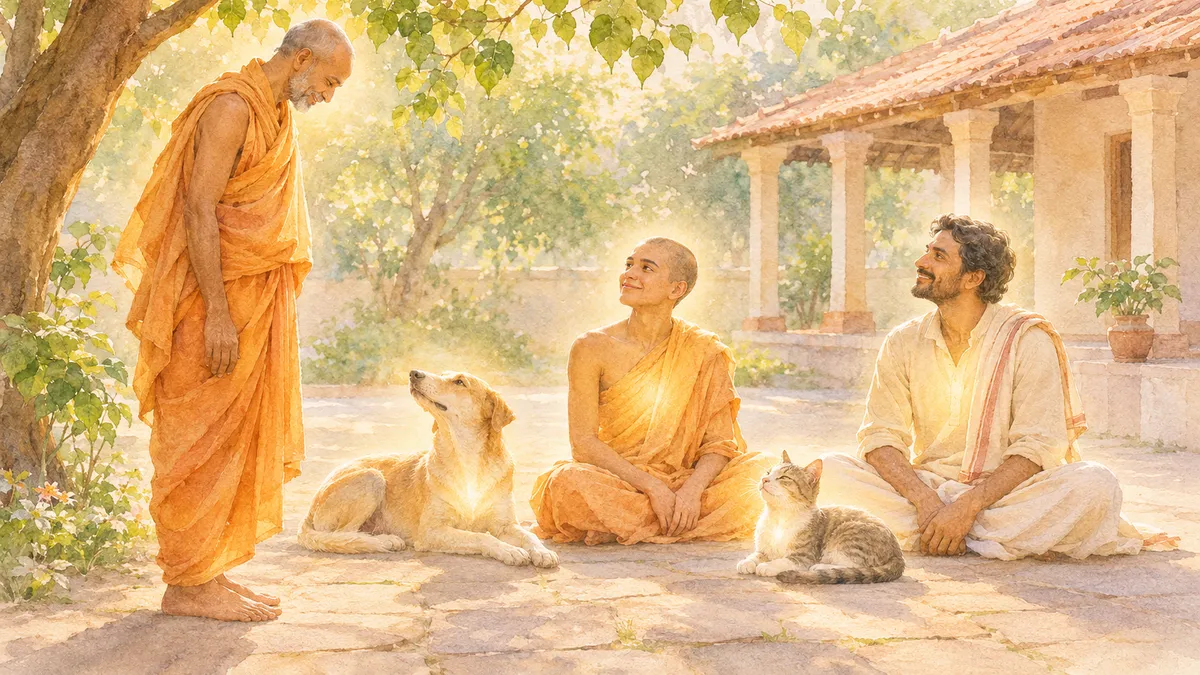
When one monk came to his spiritual teacher, he said:
“Father, I constantly remember God. Have I attained the level of holiness?”
His spiritual teacher replied:
“This is only the very beginning. When you see yourself as lower than every creature, then I will say that there has been some progress.”
“Seeing yourself as lower than every creature” means seeing the Absolute in every living being and acknowledging the supremacy of this Absolute over the false “I,” curbing the ego’s prideful impulses arising from its own selfish perception.
True humility in tantrism and Anuttara Tantra is certainly not self-abasement—by no means! It is not associated with feelings of guilt or sin, so we should not cultivate these feelings within ourselves or engage in self-abasement. On the contrary, we should nurture openness, self-liberation, and divine pride. However, these qualities are possible only when we understand that the false “I” must be completely subdued; it must submit to divine pride, the Supreme Mind, and then we will abide in true contemplation.
One saint used to criticize his disciple very harshly. One day, the disciple came to him with a plea and asked:
“Why do you dislike me so much? I am no different from the others.”
The saint said:
“What makes you think I dislike you? I care for you deeply. Do you think criticism is bad for you? It is bad for your ego. And the fact that you suffer because of it shows that you need it.”
Then he called his best disciple and began berating him even more harshly. The best disciple merely bowed and said:
“Bless me.”
The saint said to the first disciple:
“You see, he does not suffer from my criticism. To him, my criticism is like a blessing. When you begin to see my criticism as a blessing, I will stop criticizing you as well.”