

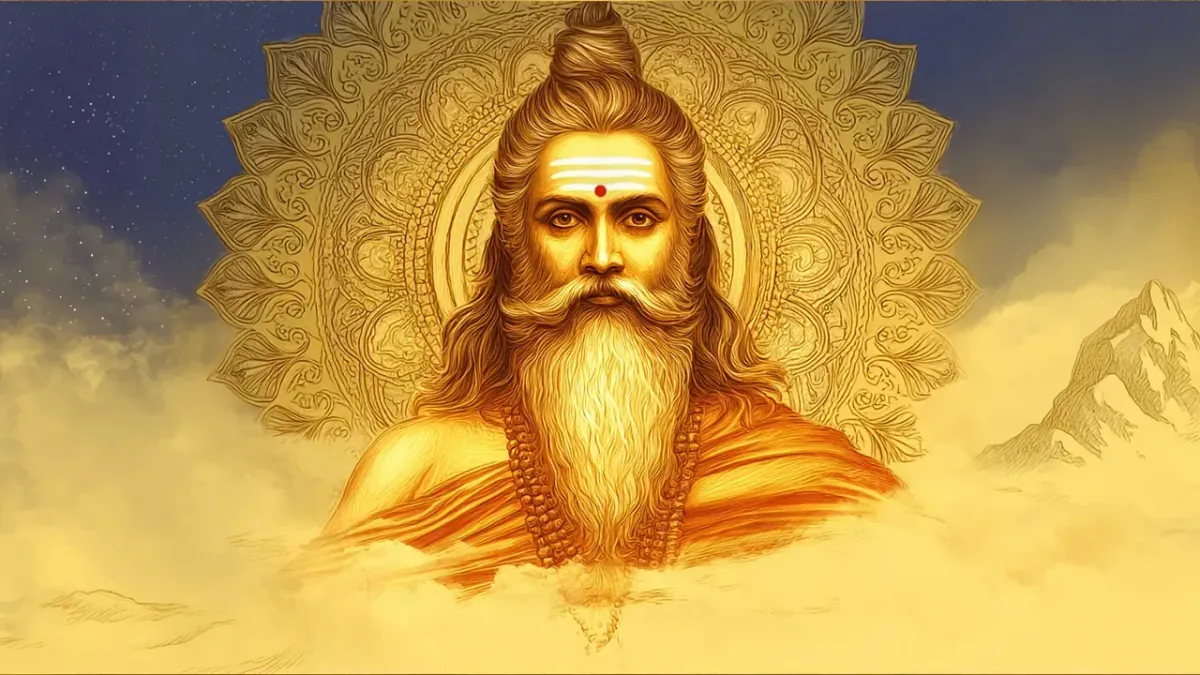
The philosophy of non-duality can change the perception of reality. This is exactly what Rishi Vashistha taught, one of the progenitors of humanity, whose name our institute bears.
Tradition and Spiritual Succession
Vashistha was the mentor of many great sages of antiquity. His teaching on the nature of reality and methods of liberation formed the basis of many spiritual traditions of India.
Swami Vishnudevananda Giri Maharaj gave his blessing for the creation of the institute in 2019. His disciples, karma-sannyasis, founded an educational center that connects ancient monastic tradition with modern learning technologies. The institute holds a state license for additional education and today unites several hundred students from different countries.
The Tradition of the Siddhas and Advaita Vedanta
The institute's educational program is built on the basis of traditional training for sannyasi monks in the ashrams of the Swami Vishnudevananda Giri lineage. This system has proven its effectiveness over centuries in preparing practitioners. The program covers three main traditions:
Advaita Vedanta — the philosophy of non-duality, teaching the unity of individual consciousness and absolute reality.
The Tradition of the Siddhas — the teaching of perfected yogis who possess methods of direct comprehension of truth and work with subtle energies.
Shaivism and Anuttara Tantra — tantric practices and higher teachings on the nature of consciousness.
Educational Program
The full cycle is designed for 12 courses. The first two courses introduce the fundamentals of Sanatana Dharma — the eternal tradition of spiritual knowledge. From the third to the fifth course, students study Advaita Vedanta in depth. From the sixth to the ninth courses, the program covers Shaiva Siddhanta, one of the branches of Shaivism. The final three courses are dedicated to Anuttara Tantra.
Theory
Each course includes about 250 theoretical questions, divided into 24 weeks of study. Questions are provided in electronic format. Every four weeks, students undergo an online credit interview. Sacred texts of the tradition are studied independently. Based on the results of each course, the student writes a treatise on a chosen topic.
Practice
Great attention is paid to practical yoga classes and training. Students master skills of concentration, meditation, contemplation in movement, and working with inner energy (Kundalini Yoga, Prana Vidya) in accordance with the teachings of the Siddha tradition, Advaita Vedanta, Shaivism, and Anuttara Tantra.
The practical program includes:
- Yoga sequences
- Breathing exercises (Pranayama)
- Mantra yoga
- Meditation
- Ritual practices
For each practice, a standard and a self-maintained accounting system are established. Deepening and refinement of methods are carried out during retreats — practice in solitude according to a schedule. The duration of retreats increases as students progress through the courses.
Connection with India
Representatives of the institute have maintained friendly relations with various ashrams and universities in India for many years. This living connection with the source of the tradition allows for the maintenance of the authenticity of knowledge transmission.
The institute develops international cooperation with the "Bharatiya Vidya Bhavan" educational center in Delhi and regularly organizes pilgrimage tours to the holy places of India and places of power across Europe and Asia.
Areas of Activity
In addition to education, the institute conducts several areas of work:
Educational Outreach — spreading knowledge of the ancient traditions of India among modern seekers of truth.
Research Work — studying sacred texts and the philosophical systems of the tradition.
Translations — translating sacred scriptures from Sanskrit and other Indian languages into Russian, making ancient wisdom accessible.
Pilgrimages — organizing journeys to holy places where practitioners can touch the living tradition.
Technologies and Results
The institute possesses a powerful educational portal with all the tools for distance learning, a system for evaluating theoretical knowledge and practical skills, as well as a web application for yoga practice.
Many graduates of the institute become yoga instructors and teachers, continuing to pass on the tradition further.
