

Commentary on Sri Ramana Maharshi’s text “Be As You Are,” chapter “The Nature of God”
“Question: God is described as manifest and unmanifest. It is said that He includes the world as part of His Being?
Maharishi: Before deciding questions concerning the nature of God and the world, know yourself.
Question: Does my self-knowledge include knowledge of God?
Maharishi: Yes, because God is within you.
Question: What, then, stands in the way of my knowing myself or God?
Maharishi: Your wandering mind and perverted way of life.”
Theology, or scholastic reasoning about God, is highly developed in Christianity, in Catholicism. In medieval Europe there were the greatest thinkers, such as Augustine, Origen, Meister Eckhart, who created a vast number of theories substantiating the nature of God, the cognitive capacity of man, the extent to which man possesses free will on the path of knowing God, and the extent to which this free will is absent.
However, Maharishi says here: “Before deciding such questions, know yourself.” In other words, when we try to discuss the absolute Truth through concepts, we make a mistake from the very outset. When we think of this absolute Truth as being outside ourselves and try to describe it with our thoughts, we are already, from the very beginning, in an erroneous state. One of the rules of laya yoga says that everything must be reduced to the mind. This means that, paying no attention to any concepts, even such great ones as God, one must seek that which is beyond concepts— Consciousness. Otherwise, we risk getting bogged down in an intellectual understanding of God. We risk creating a certain intellectual God who has nothing in common with true Reality. All great theological theories are thoughts; that is, in fact, they are conditioned by concepts. And when you try to speak with the authors of these theories about what lies beyond these thoughts, they will feel that their theories are being destroyed. The saints affirm that until we overcome the plane of thoughts and go beyond concepts in order to discover that which is incomprehensible and not grasped by human logic, we will not truly even touch what is called God. We cannot count on even the slightest knowledge. Therefore the saints say that, despite all theories, there comes a moment when you begin to feel God as your own consciousness. From this moment the teaching of laya yoga begins.
Religious people usually become attached to thoughts and concepts, especially if these are concepts of God. For them these are very precious concepts, and therefore they are ready to stand for them to the death. This is how religious strife arises. But these are only mental constructs that unsuccessfully attempt to describe absolute Reality. Yet none of them has ever managed to describe absolute Reality with complete success. We, however, from the very beginning take a lenient attitude toward concepts; that is, we use them, but we do not intend to give our lives for them. We cannot reject concepts; we have no aversion to them, because it is convenient to use them. To reject thoughts and concepts means to generate non-acceptance of them, that is, some kind of attitude. The principle “to reduce everything to the mind” means that we seek the source of all concepts and discover that it lies within ourselves: “The one who thinks about God is I.” If we want to know absolute Reality, we do not need to think about it; we need to find this “I.” Looking intently, we must understand precisely what the “I” is.

Ramana says here that every person is God, only having forgotten this, not understanding it, lost in reflections. A person has not yet attained the depth of consciousness and such clarity as to recognize his divine nature, and therefore he has become lost in reflections. Nevertheless, no one can deprive God of His divine origin, His birthright, even if He has become lost in reflections. It is like when a crown prince is born: he cannot lose his inheritance if he is the only heir, because one cannot introduce a law that would have retroactive effect. In the same way, the saints say that even if a living being has become lost in illusions, nevertheless his divine birthright cannot be disputed by anyone. Even if he experiences suffering and abides in the thick of delusions, he has never lost his divine origin.
The Nature of the Personal God
“Question: Is God a person?
Maharishi: Yes, He is always the first Person, the I, constantly standing before you, but because you give preference to the worldly, it seems that God has withdrawn from you. If, however, you cast everything aside and seek only Him, then He alone will remain as the I, the Atman.”
The concept of a personal God is misunderstood by many. Some say that it is easier for them to perceive God in the form of Jesus Christ or the cowherd Krishna, that it is more natural for them to establish a relationship with a certain person, and therefore they worship a personal God. However, the saints say that these methods are suitable for the spiritually underdeveloped. This is not something I am saying myself, but a literal quotation from one of the greatest saints, who attained the rainbow body. Laughing, he said: “If you want to embrace your own projections, you may do so, but know that they are merely parts of your own mind, and not something external.” Saints deliberately make such shocking statements in order to lay bare the nature of absolute Reality.
In fact, there is nothing bad about practice with form. We also use form. However, what matters is how we relate to it. There are two fundamentally different attitudes toward form: duality and nonduality. Duality implies considering oneself the subject and the form one worships the object. However, Shankara fundamentally held this position: “One who worships an external form without understanding that it is one with his mind falls into yet another illusion.” Why? Because this is another subtle ignorance, a subtle duality. Such a person cannot attain liberation. Those who worship deities in duality fall into illusion or dependence just as animals become dependent on people.
The second way of relating is the understanding of indivisibility, of unity. When we see a certain divine form, of course, admiration arises in us, or a feeling of reverence, a sense of the sublime. And when we abide in unity, this means that we recognize this divine form as a manifestation of our own pure energy, of our own “I.” There is no distance between us. At the same time, it should be noted that there is no egoistic pride here. We do not think: “I am Brahman, and these gods are nothing at all.” When we contemplate, we understand nonduality in the true sense. We respectfully regard the subtle states of mind manifested as deities, yet we recognize them as manifestations of our own consciousness, because they are our most exalted feelings, our most exalted energies.
Another approach to the personal perception of absolute Reality lies in simple presence. We understand that this person is ourselves, and therefore, when we personally experience nonduality, we enter into deep contact with this absolute Reality. When we contemplate, when we are in presence, then we begin to feel it as that which manifests within our personality, as something global and profound that begins to dissolve our personality until it is completely dissolved.
When we have experiences of bliss, clarity, or emptiness, they all seem to belong only to us. But in fact, at that moment we are simply touching the ocean of boundless consciousness. At that moment we come into contact with the great transcendental universal cosmic field of consciousness and for a time experience flashes of this universal field of consciousness. Then we say: “I had the experience of the third dhyana,” or “I had an experience of emptiness.” But ignorance still remains in us; we say: “I experienced this.” In fact, we came into contact with this global field of consciousness, and for a time our illusions were removed.
In Buddhism, the word “God” is not used at all; it speaks only of nirvana, and when describing it, qualities are used only from the standpoint of negation (“neti”). From the point of view of Advaita, absolute Reality is described both in terms of “neti” (the absence of anything) and “iti” (the presence of something). Many say that there are differences between a positive description of absolute Reality and its negation. In fact, this is said by those who have not read the scriptures very much or who are too fixated on their own school. In the Pali canon of Sthaviravada there are sutras that speak of the Atman, and there are sutras that speak of a single consciousness. Since these sutras are very ancient and authoritative, despite the fact that they fully convey the idea of Vedanta, Buddhists could not ignore them. Another Theravada canon, however, denies it. Mahayana and Vajrayana Buddhism speak of the luminous Mind that permeates all forms. If you compare this with the scriptures of the Upanishads, there is no difference here. Finally, the highest teaching in Buddhism is the Nyingma Dzogchen, which corresponds to the laya yoga of anuttara tantra.

If we trace the history of how both Bon and Nyingmapa Dzogchen appeared in Tibet, it is roughly as follows. Bon shamans, during the time of their decline, when their king fell seriously ill, invited Indian Shaivite yogis. They invited three siddhas, one of whom could divine, the second could heal and cut stone with a feather, and the third could fly. They came, healed the king, and made a great impression on the Bon shamans. They also expounded the doctrine of Advaita Vedanta. Thus, stupas with tridents and the swastika appeared in Bon. And then Bon underwent a reformation: they assimilated the teaching of Advaita Vedanta into themselves and greatly elevated themselves because of this. Local Tibetan Buddhists also began adopting the teaching of Advaita Vedanta, declaring it their highest school. After some time, the king of Tibet, Shivaot, seeing that the teaching which had begun to spread in Tibetan Buddhism differed from the familiar schools of sutra and tantra, declared it heretical and even wanted to ban it. Therefore, the texts of Anuttara Tantra, which speak of the great perfection of spontaneous realization, began to be hidden. Many criticized Tibetan Anuttara Tantra as a non-Buddhist teaching, but as a mixture of Bon and Hinduism that came from India. In reality, it is Advaita Vedanta, the laya yoga of the Upanishads, and the teachings of the siddhas that penetrated into Tibet.
Atman as God
“Question: Is God apart from the Atman?
Maharshi: The Atman is God. ‘I am’ is God. Such a question arises because we are attached to the ego. It will not arise if you hold to the true ‘I,’ for It does not want and cannot ask anything.”
Atman literally translates as self. The feeling of “I” within us is this very God. When we are attached to the ego, we feel ourselves to be apart from absolute Reality; one could say that we have never left it, but we are far too attached to our own notions. And what are we constantly doing? We are simply examining our notions. It is as if there were an altar or very beautiful images behind us, but we were sitting with our backs to them. Then even if there is something wondrous behind us, we simply sit with our backs to it and see nothing.
“The question will not arise if you hold to the true ‘I,’ for It does not want and cannot ask anything. If God were apart from the ‘I,’ then He would have to be a God without ‘I,’ and that is absurd. The God who seems to a person not to exist is the one and only existent, while the individuality considered to be real never (in truth) exists. The sages say that the state in which one’s own non-being (shunya) is known is the one magnificent supreme Knowledge.”
The holy elder Joseph the Hesychast of Mount Athos wrote to his disciples: “When I am continuously engaged in noetic practice, I am God by grace.” From the point of view of Christianity, this is heresy. He says: “I am God by grace.” Such a statement perhaps corresponds more to a Hindu saint than to a Christian. However, the experience of all saints is similar. Ultimately, when the false “I” is dissolved through the practice of contemplation and self-surrender, we discover that absolute Reality is manifesting in this body, and moreover, apart from this absolute Reality there is nothing.
Overcoming the Idea of Separateness
“Now you think that you are an individual, that there is a Universe, and that God abides outside the cosmos. Therefore there is the idea of ‘separateness.’ It must go, for God is not separate from you or the cosmos.”
When we think that we are an individuality, this is the greatest delusion. That is the whole point. When we are an individuality, we need something, we experience desires. I do not mean only desires connected with the needs of the body or the need for food, protection, and so on. I mean psychological needs. We feel ourselves to be in need of many things besides bodily needs. Bodily needs, for example prasada, shelter, clothing, are very easy to provide for. Psychological needs are the need for an interlocutor, for knowledge, for psychological security, for the satisfaction of illusions, desires, and everything else. Why do we experience psychological needs? Because we perceive ourselves as an individuality. But the saints say that individuality is precisely that mara which keeps us in illusions. If the idea of separateness goes away, then all psychological needs disappear at once. This does not mean that we have no needs at all; it is simply that we possess such enormous potency that we can satisfy the needs of others. If we are an individuality, then we suffer, cry, dream, and fantasize. But if separateness has gone, then we are God, we include everything within ourselves. What, then, can we do? What desires and needs can we have if we possess boundless happiness? The most we can do is share with others. The problem lies precisely in this separateness.
The saints abide in such great bliss that it is difficult even for an ordinary person to imagine it. With mind and body they feel: “How happy I am! It is indescribably wonderful! What a pity that others do not see this. How unhappy they are, how tired and preoccupied they are. This nectar falls from the sky, and upon them as well; it is beneath their feet, it is gold and diamonds on the trees and walls. But they are as if blind. How poor they are! How wretchedly they live! I must do everything possible to open their eyes to absolute Reality.” The saints think: “Although this nectar is both above and below and underfoot, and although living beings drink it and bathe in it, nevertheless they seem not to notice it. Instead of dancing in continuous, mad joy and singing while abiding in sahaja samadhi, they remain in their thoughts, dreams, sufferings, and so on.”
One who has dissolved his individuality, in whom the feeling of separateness has gone, has no more questions; he has only answers. He has no personal needs, but a desire to help others. He has no desire for psychological security, communication, an interlocutor, friends, or anything else, because he sees nothing except himself and the absolute Truth, and the “I” and the absolute Truth are merged.
God as the Universal Source
“Thus, God lives not only in the heart of everyone. He is the support of all, the source of all, the universal abode and the final end. Everything comes from Him, abides in Him, and ultimately dissolves in Him. Therefore, He is not apart.”
Even if you have not yet mastered contemplation, faith in this absolute Source is necessary. If you have no faith, but only egoistic aspiration or determination, you must be a very courageous person. If you have no understanding, but you practice asanas, pranayamas, and concentration on your own inner data, on your own determination, like some desperate person, you may eventually attain realization. However, you have nothing else to rely on, and when your will fails (and it will inevitably fail someday), when your ego makes a mistake in something, you will have nothing left; therefore you too, as a practitioner, may fail. But if you have strong faith, you will never fail as a practitioner, because it depends neither on external conditions nor on your personal qualities. When we combine determination and faith, we are fully armed with dharma.

Until contemplation has been mastered, faith, one might say, is unconscious, blind. But when contemplation has been mastered, then faith is your experience of presence beyond concepts; then you already clearly realize the object of your faith. You know that it is your own awareness and nothing else. You do not doubt and do not look for it anywhere else except in awareness itself. Your faith is no longer faith, but certainty in understanding.
“Question: I understand, Brahman, of course, is indivisible.
“Maharishi: The essence is that Brahman is everything and remains indivisible. It is always realized, yet a person is not aware of this and must come to such knowledge. Knowledge implies overcoming the obstacles that hinder the discovery of the eternal truth that Atman is identical to Brahman. These obstacles, taken together, form your idea of separateness, as individuality.”
The Nature of Individuality and the Obstacles on the Path
When do such obstacles arise? When does this idea of individuality arise? When concepts come into play, when there is reliance on formed experience. And when concepts and formed experience come into play, contemplation is lost. If contemplation is not lost, then concepts do no harm. However, if there was no contemplation, or there was, but it is lost, then the idea of individuality arises.
Practice comes down to eradicating the idea of individuality. Not to eradicating individuality itself, but to eradicating identification with it, to understanding that individuality as such never existed. In fact, this is more difficult than we think. Even when we control individuality very strictly, it tends to manifest very subtly and slip out from under our control. Individuality manifests through evaluations and judgments, through rational activity that relies on past experience.
If right now a huge golden mandala, three by five kilometers in size and entirely made of gold, appeared in space, you would feel admiration; you would think: “This is amazing! This is divine, this is some wondrous sign!” However, at that moment it is simply your formed experience that comes into play. You know for certain that this is a good thing, because you have already assimilated what is good and what is bad for you. But in the absolute sense there is neither good nor bad. If something bad, unattractive appears, you will certainly evaluate it as a sensation of something bad, wrong, unattractive. If you see the corpse of a decomposed cat or dog, you will think: “This is bad, foul.” Why? Because you already have criteria for evaluation based on past experience. However, the saints say that when the corpse of a cat or dog becomes a mandala for you, when you see everything as absolute, then you will erase your formed experience.
The Story of Asanga and Maitreya
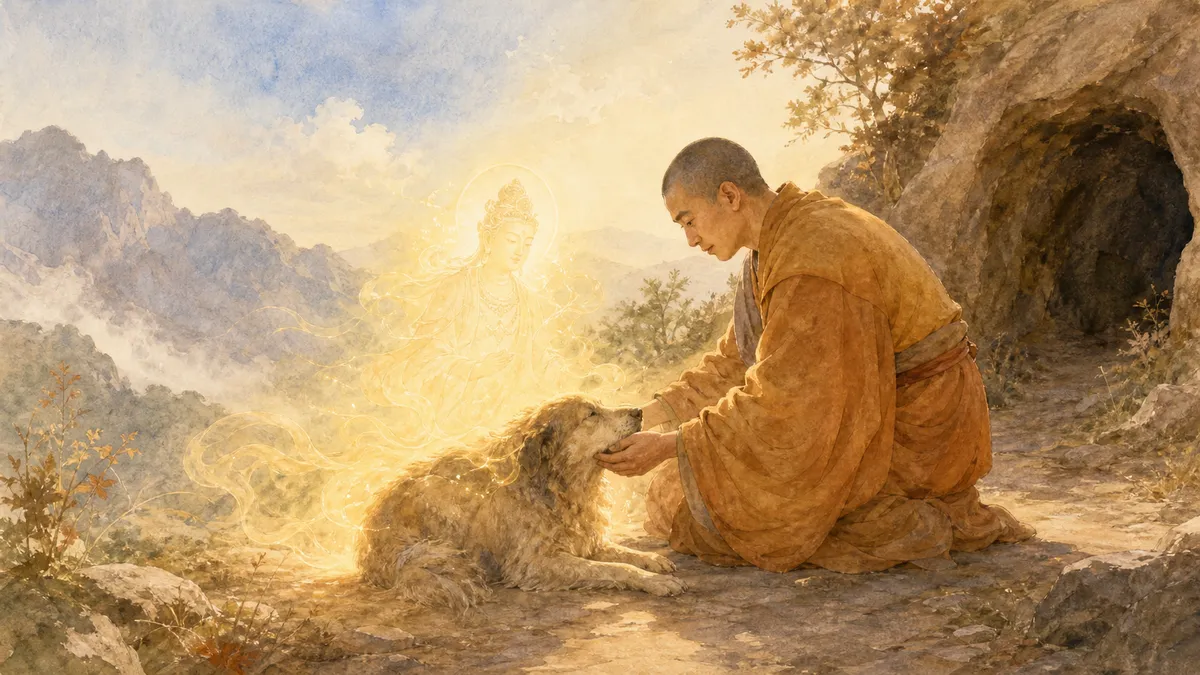
Asanga prayed and meditated on Maitreya in the Himalayas, reciting mantras for twelve years. Maitreya did not appear to him, despite the fact that he had been practicing for twelve years. In despair, Asanga left his retreat place and went to the market. There he saw a dog whose wound was festering, and there were worms in the wound. He thought: “The wound needs to be healed. But if the worms are pulled out, they may be harmed.” Then he began licking the worms with his tongue so as not to harm them and to heal the dog’s wound. Suddenly the dog turned into Maitreya, who said:
“Well, at last you were able to see me!”
Asanga was indignant:
“I recited mantras and practiced for twelve years, and you did not even give a hint of yourself. You have no compassion!”
Maitreya replied to him:
“I was always with you; I tried to show myself to you, but you did not notice me. I appeared to you in one form, then another. But your duality did not allow you to see me. And even now you noticed me in the form of a dog only because your discrimination between pure and impure had disappeared; you attained such compassion that you were able to lick the worms from the dog’s wound so as not to harm living beings. Therefore only now was I able to manifest.”
In other words, Asanga generated pure vision. Thanks to his practice, he cut off the discrimination between pure and impure. He overcame all duality within himself, and only then was Maitreya able to manifest in his mindstream.
Pure Vision and Overcoming Duality
When we say that the pure and the impure must be equalized, it does not mean that a mandala should be seen as the corpse of a dog. Rather, in perception, the corpse of a dog becomes as wondrous as a mandala. Everything becomes perfect, everything becomes absolutely wondrous.
At first we understand that only certain things are perfect, wondrous, and pure: for example, a mandala, spiritual practice, the experience of samadhi, and so on. Neutral things are ordinary everyday things: work, washing dishes, chopping wood, communication, and so on. There are also foul things — those that lie beyond the boundary of our human energy: suffering, fear, pain, death, demons, spirits, illnesses, dirt, poisonous insects, and so on. We have a clear gradation of one and the other. When we smell incense, these are wondrous things. The smell of prasad is neutral. Foul smells are what is perceived as impure.
However, when we abide in true contemplation, everything gradually becomes balanced within us, everything becomes wondrous, pure, and perfect. Therefore it is said: “For a true practitioner, every mountain is Kailash, every forest is Vrindavan, every monk is Buddha, every sound is the sounds of mantras, every action is the lila of the deities.” We do not deliberately instill such a vision in ourselves; rather, it happens spontaneously, naturally, when, abiding in contemplation, we eliminate clinging to our concepts. It is already so right now, but our fixed mind stubbornly divides reality into this and that. We persist in our duality.
When we are trained in liberation, deva-bhavana begins to grow within us. Deva-bhavana is the elevated feelings of purity, grandeur, devotion, self-surrender, incomprehensibility—all at once—the feeling of the absoluteness of everything, of every millimeter in the Universe. Then suddenly we begin to feel that all ordinary things are immersed in Absoluteness; we simply did not see it before. Consequently, their external qualities play no role whatsoever.
A Scientific Understanding of the Absolute Nature
If you have studied a little theory of physics, then you can understand even from this point of view. All things consist of atoms, and atoms consist of elementary particles: neutrons, positrons, quarks. These elementary particles consist of hypothetical particles. That is, every object is a microcosm, a micro-universe. All things, from the point of view of physics, are incomprehensible— they are infinity. In the same way, the macrocosm is also infinity. The Earth is a speck of dust in the entire galaxy, and the galaxy is a speck of dust in the whole vast expanse. And all of this seems to float amid both inner and outer infinity. Compared with this infinity in which all things float, including ourselves, secondary qualities play no role.
From the point of view of physics, all objects possess the nature of light and radiate energy. This is precisely what quantum physics speaks about. But the rishis of the Upanishads discovered this long before quantum physics, so there is nothing new in it. Pure vision is the recognition of the quantum wave nature of all things. We perceive them no longer through the prism of our own judgments, the division into pure and impure, liked and disliked, right and wrong, but from the point of view of such an absolute nature.
Atman as the True Nature of God
“Question: Is God the same as Atman?
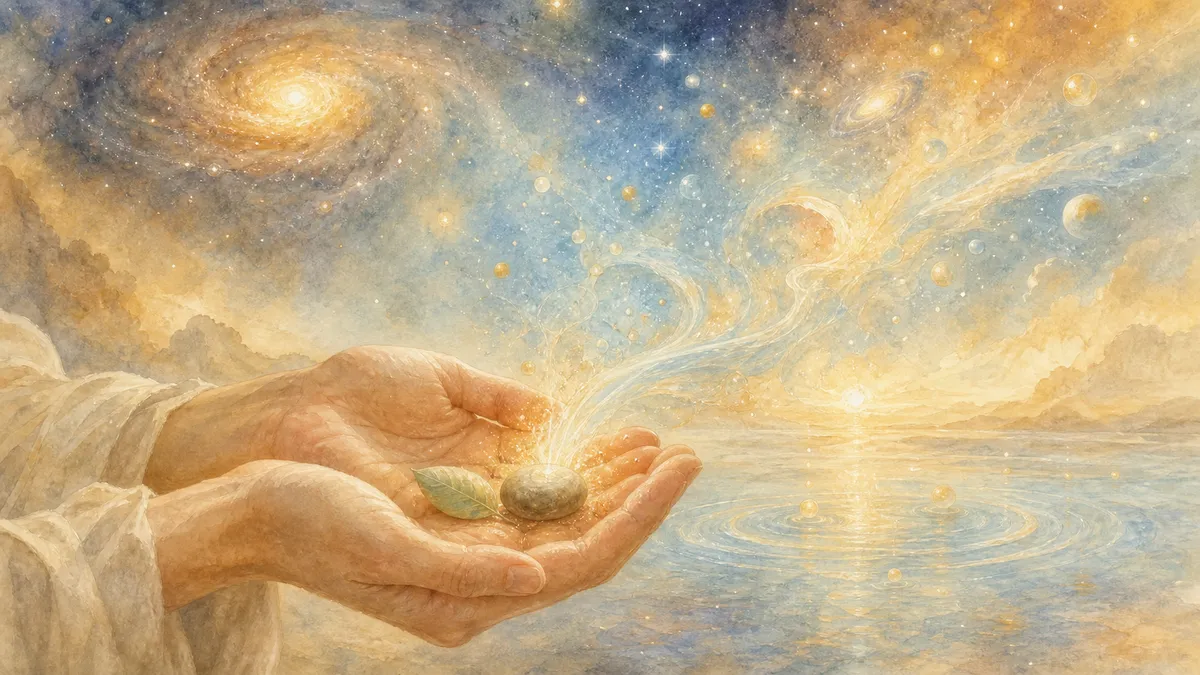
Maharishi: Atman is known to everyone, but not clearly. You always exist. This Being is Atman. “I am” is the name of God. By knowing Atman, God is known. In essence, God is nothing other than Atman.
Know that you are the perfect shining light that not only makes the existence of the Kingdom of God possible, but also allows it to be seen, like some wondrous heaven. This knowledge alone is jnana. Therefore, the Kingdom of God is within you. The boundless space of turyatita, which will suddenly shine forth in all its fullness within the Heart of a supremely prepared seeker during the period of perfect absorption of the mind as a fresh and previously unknown experience, is the rarely attainable and true Shiva-loka, shining with the light of Atman.”
When will we be able to recognize this perfect shining light? When our continuous awareness, being sustained, begins to expand. When we manage to concentrate on it in such a way that it acquires depth. Then suddenly we begin to marvel at this awareness and its depth. Then nothing more needs to be done, because this depth by itself dissolves all our habitual impressions.
When we are not in contemplation, the world appears coarse and ordinary because we ourselves are ordinary. But when we are in contemplation, everything becomes absolute. What does “everything becomes absolute” mean? It means that the walls give teachings, cows sing bhajans, and in the kitchen Buddha prepares prasad.
