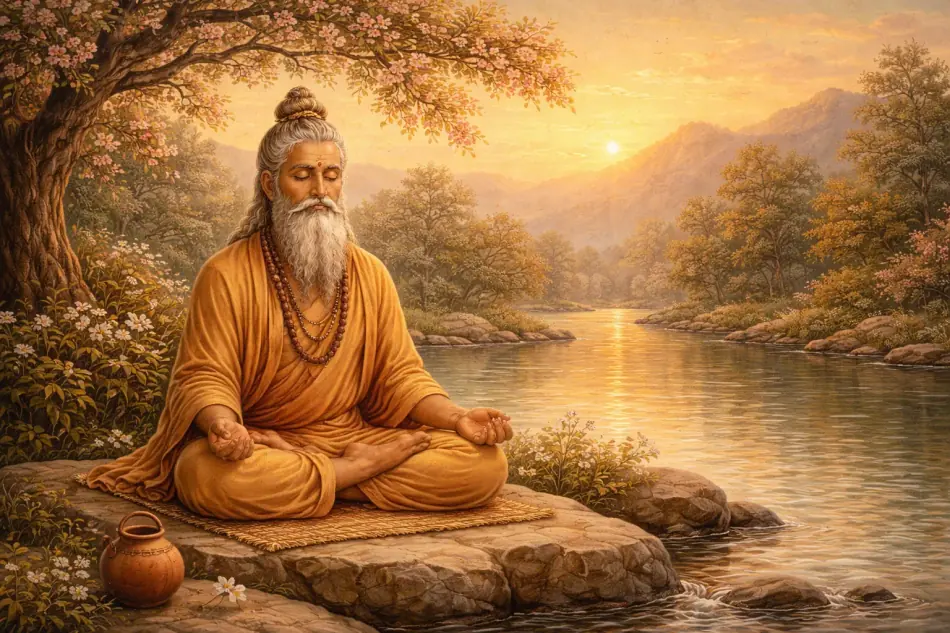
Commentary on the text “Brahma-vichara Upadesha”
We continue to examine the teaching of Brahma-vichara. It belongs to the section of Shambhavi-mudra, or space, from the teaching of Prajna-yantra. Prajna-yantra means the Universe of Wisdom, the mystical pattern of Wisdom, the mystical diagram of Wisdom. This is a section of the Teaching of Laya-yoga associated with awareness (jnana) and the training of contemplation. It is a very important section; it is the “king” of the entire Teaching, while the other sections, such as Shakti-yantra (the teaching of energy), Nidra-yantra (the teaching of dreams, the subtle body, and other dimensions), Nada-yantra (the teaching of sound), and Jyoti-yantra (the teaching of light), are the servants and ministers of this “king.” Prajna-yantra is the trunk of the tree of the Teaching; the roots of the tree of the Teaching are abiding in the natural state, abiding in the “three freedoms.”
If we imagine the structure of the Teaching as a tree, then the roots of this tree are the “three freedoms,” its trunk is Prajna-yantra, its branches are Shakti-yantra, Nidra-yantra, Nada-yantra, and Jyoti-yantra, while the leaves and flowers of this tree are various additional methods.
The Roots of the Teaching: “The Three Freedoms”
The roots of the Teaching of Laya-yoga are the “three freedoms.” The “three freedoms” mean complete non-conditioning in body, speech, and mind. The “three freedoms” mean that, abiding in natural awareness, we are not limited by anything; we are free to act one way or another, and it does not matter how we act if we remain in a state of profound awareness. This is a very important principle, since the movement of the Siddhas of Sahajayana, which took shape thousands of years ago, was precisely a protest movement against the dominance of rituals and magic in Tantric and Hindu practice. The Siddhas of Sahajayana taught that reality cannot be understood through methods, actions, conceptual limitations, or philosophy. The principle of Sahajya is the direct, immediate experience of nonduality.
The Siddhas of Sahajya (Sahajayana, in Buddhist terms) taught that awareness is what matters, while external actions of body, speech, and mind, the corresponding ritual practices, forms of behavior, and wearing particular ritual clothing are unimportant. The Siddhas of Sahajayana were a special class of holy avadhutas who behaved like madmen, since they relied primarily on inner awareness and only secondarily on techniques, practices, ritual methods, and so on.
The teaching of the “three freedoms” gives us the greatest hope of following the spiritual path without restricting ourselves in any way, following it spontaneously and listening to the voice of joy that comes from within. That is, first and foremost, we listen to the inner spontaneity of natural awareness, and secondly, we perform techniques, ritual practices, methods, and so on; even if you do not perform them, this is not a problem from the standpoint of the principle of Sahajya. But if you perform many techniques and rituals, recite mantras, wear a particular type of clothing, and perform worship, yet have no practice of awareness—in other words, if you do not abide in this spontaneity—then you have nevertheless failed to enter the dimension of the Teaching of Laya-yoga.
Suppose, for example, we take one person: he will be dressed in ritual or ascetic clothing (a loincloth, a skin), wear large prayer beads, sit in the lotus posture before an altar, perform complex ritual practices and visualizations, recite mantras, and hold his breath, but if he does not abide in natural awareness, then he has failed to enter the dimension of the Teaching of Laya-yoga. If we take another person, he may be sitting in a café in ordinary clothes, drinking Pepsi-Cola, listening to Philipp Kirkorov, but he will be working with inner awareness; then he is a true laya-yogi, a true practitioner of Jnana. Of course, I am exaggerating somewhat, but nevertheless, this is precisely how things are, since, above all, the principle of the “three freedoms” implies that we must care about inner awareness, abiding in natural awareness, and contemplative presence. All external things will fall into place by themselves through this; that is, first and foremost, we focus on the principle of inner awareness, and secondly on all external things. There is no escaping external things; one way or another, they are always present. Nevertheless, they are subordinate and secondary, but we often tend to forget this and become fascinated by rituals, external forms of worship, and methods of practice instead of paying attention to inner awareness. This is a fundamental point in the Teaching of our particular tradition, the school of Sahajya.
The Structure of Prajna-yantra

The section of the Wisdom Teachings (Prajna-yantra) is divided into three parts: the teaching on contemplation, the teaching on the principle of divine pride, and the teaching on space (Shambhavi-mudra). We study and practice these three sections throughout our lives because they are very important for understanding. If one enters the Teaching of Laya Yoga, one must thoroughly understand these sections. They have nothing to do with speculative philosophy; they are practical sections that speak only about how to engage in practice and contemplation in order to eliminate one’s ignorance.
The section on contemplation includes the teaching on sankalpas. Sankalpas are a practice in which we engage in contemplation while holding a certain attitude within. This method is also called Vaishnavi-mudra. When we hold something within, for example, the intention to see the world as an illusion, a dream—that is a sankalpa; or when we concentrate on the feeling of “I”—that is also the practice of sankalpa.
The Prajna-yantra Teaching also includes various methods, concentrations, meditations, remaining in contemplation while in motion, integration, and uniting with various emotions and experiences. Usually, the study of the Teaching of Laya Yoga through the Prajna-yantra practice course begins precisely with the teaching on contemplation. We need to understand well what Mind is, the nature of Mind, what it means to remain in a thought-free state, what place thoughts have, and how to work with them.
The next section is connected with the teaching of divine pride. Divine pride is a term that can sometimes be misleading if we do not understand it quite correctly. It teaches us how to meditate on the Absolute. When we meditate on the great Upanishadic saying “Aham Brahmasmi”—the quintessence of the Vedantic tradition—we develop a special perception of the world imbued with divine majesty. We meditate on this principle of divine grandeur until all our egoistic dualistic concepts dissolve into this state. This is a great practice, and its results manifest even in the material dimension. One who succeeds in this practice can, as a rule, change their social status to a higher one and transform their destiny into a higher state, because we integrate with the dimension of the world of the gods (divya-bhava).
The section on space (Shambhavi-mudra) is connected with meditation on the qualities of the Absolute and on space as one of the principal methods. Brahma-vichara, which we will examine now, belongs to this section.
Returning to Our Original Nature
The Teaching has a rather sophisticated structure and numerous methods; however, the entire structure and all the methods are intended only for convenience and understanding. In reality, all sections of the Teaching speak of just one thing: how to remain in our original nature. Why are so many methods and such skillful means necessary? Because we have strayed very far from our original nature, and even when we hear about it, it is not so easy to return to it—we are very far from it, having seriously strayed away. Our original nature—Sahajya, the Supreme Source, God, Brahman, the Absolute—these are identical concepts. All that is necessary for us is to learn to return to this nature.
What prevents us from returning to our nature? It is ingrained ignorance. Such ignorance is unreal; it is an error, and therefore our entire view of the world, at the center of which stands our ego based on bodily identification (deha-bhranti), is also an error. In Sanskrit, it is called precisely that—deha-bhranti, the error of bodily identification, while the perception itself is called avidya.
In order to free oneself from ignorance, one must become a jnani, that is, an entirely different being. A jnani is not a human being, although they have a human body; they have realized their identity with God, their unity with the Absolute. A jnani may walk, sleep, eat, or speak just like an ordinary person, yet their inner realization is entirely different from the structure of an ordinary person. If there were such an X-ray that could illuminate and reveal it, you would see this.

For example, a sick person and a healthy person may look identical outwardly, but if an X-ray is taken, the difference in their bones or tissues can be seen. It is similar with a jnani and an ajnani: if it were possible to illuminate the mind of a jnani, we would see nothing there, only emptiness. If we look at the mind of an ordinary person, there is ego (ahamkara), that is, a certain complex, a conglomerate of social imprints, ideologies, inner self-reflections, memory, the conceptual mind, the logical apparatus, upbringing, and ideas about oneself. This complex is an inner tyrant that has convinced us that we are it. This inner tyrant dictates what we should do, when to experience certain emotions, in which situations to give in to ambition, what to consider good, what evil, what pure, what impure, and imposes its goals, meanings, and values on us.
But the paradox is that we are precisely not this being. We are not this being at all; this being is merely a working instrument. Yet at some point, a mistake of identification occurred, and this working instrument, possessing its own artificial intelligence, enslaved our awareness, charmed it, beguiled it, misled it, and convinced it that it itself was us. Do you understand what the paradox is? The ego convinced us that we are it, and since we are it, we are forced to gratify it, follow its whims, look at the world through its eyes, and experience the entire complex of limitations and suffering that it experiences. The ego convinced us that we are the body, and since we are the ego and the body, we remain subject to limitations and duality, forced to suffer, be born and die, and experience obscured states. This is the tragedy of samsara. In reality, this is not so at all.
Liberation from the Inner Tyrant

The process of Jnana Yoga means liberation from this inner tyrant. As long as we do not have control over the ego and are identified with it, it truly is an inner tyrant that forces us to suffer and has convinced us that we are it, although we are completely free by nature. We are like space, beyond time; we are not the body and are beyond the mind, emotions, and national, religious, gender, ancestral, and other limitations. We are transcendent in relation to all this, but the ego convinced us of the opposite, and thus we lost our freedom.
The practice of Jnana Yoga consists in beginning to hone our discernment—the discerning wisdom—and, through discernment, separating the ego from pure awareness. It is like having a jug of dirty, murky water that needs to be distilled, with pure water separated from scale and dirt; for this, a filter is needed. If you do not have such a filter, you will not be able to purify the water. The role of such a constant filter is played by discerning wisdom (viveka) and contemplative practice. When we engage in contemplative practice, it is as though we are filtering this water, purifying it of impurities.
The saints say, not without reason, that the greatest evil spirit is the ego (ahamkara), and we must purify ourselves of identification with the ego, purify ourselves of identification with the working instrument that led us into great delusion. It is its nature to be limited and to mislead. Rather, this is not its fault but our misfortune—our subtle awareness is very inexperienced; as contemplators, we are very inexperienced, and upon contact with the energies of the ego, we became too identified with them.
The practice of Brahma-vichara consists in becoming convinced, through philosophy and discernment, that the ego and Atman, our Higher Self, are two entirely different things. Once we have become convinced of this, we must now learn to distinguish and separate them through personal experience.
Brahma-vichara is a method in which we meditate directly on the qualities of the Absolute. We do not meditate on the feeling of “I” or on certain parts of the mind; instead, we meditate directly on Brahman, the transcendent Reality.
Instructions on the Practice of Investigating Brahman
What is said in the “Brahma-vichara Upadesha”—the instructions on the practice of investigating Brahman?
“When I make plans, solve problems, develop theories,
and unravel the puzzles of this life,
I do not think of them at all,
but of Brahman, the Eternal, Incomprehensible, Immortal One,
who is hidden within, and thus
I never fail in my undertakings.When I interact with students, friends, parents,
and guests, I do not think of them,
but of Brahman, the One without a second,
the Magnificent One, full of Glory,
who is their essence,
and thus, honoring Brahman in them,
I never experience attachment,
jealousy, anger, or hatred.”
The distinctive feature of a jnani is that he does not experience the feelings characteristic of ordinary people or the ego. It is impossible to anger, frighten, distress, or affect a jnani’s emotional state, because he constantly meditates on the other side of reality. Even amid the thick of events, he meditates on the Absolute, on absolute qualities, and even when he plays certain roles in this world, he does not develop emotions toward this world, attachments, or anything of the sort, because this so-called world does not exist for a jnani; it is like an illusion, a dream, a mirage, an echo in the mountains, a second moon—something unreal.

If you go outside at night, look up at the sky, and press on your eyes, instead of one moon you will see two moons in the sky, but we all know that there are not two moons—there is only one moon. For a jnani, this world is like the second moon that appears when one presses on one’s eyes with one’s fingers. A jnani does not particularly worry about this second moon. Why is that? Because from the perspective of Advaita philosophy, there is only one Brahman, the Absolute, and everything that appears—people, trees, clouds, animals—is in reality not people, not trees, not clouds, and not animals. It is one single Essence—Brahman; it is important to understand this.
From a dualistic point of view, it seems as though I came to this congress and you came to it as well; we came to look at one another—you listen, and I speak. If you think this way, then you are not a jnani; you are an ajnani. And how does a jnani think? He thinks like this: “In reality, there is neither me nor others. There is only Brahman, and everything that happens is His play (lila).” We are one single Essence, one single meta-organism. There is no “I,” no “you,” no me, no you; no one does anything—Brahman is playing with His energies. One unified meta-organism spontaneously manifests its plays. Moreover, in such a state of vision, there is not even anyone to declare this. Brahman would not say, “I am Brahman, and I manifest my plays”; He already knows this—He simply plays. Such a divine play is called lila.
When we enter a deep state of awareness, the world, with its cause-and-effect relationships and other people, disappears; the dimension of divine play (lila) emerges, and anything at all can happen in this dimension. Then it is not two people who meet; the Absolute meets Itself, recognizing Itself in different bodies. It is not two minds or two egos that communicate: the Absolute communicates with Itself; It is simply playing. It does not need this communication, yet the play takes place through the spontaneous self-perfection of Its energies.
“When I see the Sun, I do not think of the Sun,
but of Brahman, who is the essence of the Sun,
just as water is the essence of all rivers, lakes, seas, and oceans;
therefore, sunlight is always a blessing from Brahman for me,
from the One who is the source of all light,
while being neither light nor darkness Himself.When I see a battle in which people, fighting
and sparing no effort, give their lives for their ideals,
I do not think of the battle,
but of the unseen Brahman—the source of all ideals,
the One, eternal, indestructible, immortal,
who, while playing, amuses Himself with the battle.When I see enchanting paintings and forms,
I do not think of them, but of Brahman,
formless and without features,
having neither color nor size,
who is hidden within them.”
Naked Awareness and the Sage’s Vision
Such vision is not characteristic of an ordinary person; it is characteristic of a sage who constantly remains in a state of contemplative awareness. If you approached an ordinary person and asked, “Well, can you see Brahman, hidden within?” he would say, “I can’t seem to see anything.” An ordinary person, looking at a mountain, sees only a mountain; looking at a woman, sees only a woman; looking at a painting, sees only a painting and nothing more.
Through the practice of contemplation, we learn to enter another, subtler dimension; for this, we must learn to abide in naked awareness. Naked awareness is when we look at the world directly, bypassing the mind and reflection, without making evaluations or judgments. There is peripheral mental activity connected with the conceptual mind (manas), but immediately beyond thoughts there is a state beyond concepts.

If we manage to understand how to move beyond the peripheral activity of thoughts, establish ourselves in this state beyond concepts, and remain there for some time without evaluating or thinking, while thoughts move at the periphery but we are not with them, directly perceiving like a child who has not yet been taught reflection: how to think and evaluate, this is the beginning of this state. Then, little by little, we begin to be cast into the state of the inner center.
When we see reality from the state of the inner center, through this inner center we suddenly begin to intuit that within us there is a space of awareness, and outside us there is also a space of awareness, and that first and foremost we are united with all objects, people, and beings through this space of awareness.
The Space of Awareness as the Ocean of Being
This space of awareness is the essence of everything we see. It is primary, while names, forms, and objects are not so important. In this space, all names, forms, and objects are as if suspended; they seem to float, just as boats, barges, oil tankers, bulk carriers, aircraft carriers, torpedo boats, and small Kawasaki boats float in the ocean—but they are not the ocean. All of them share a certain common unity through the ocean, while the ocean itself is the most important.
Saints often compare this space of awareness to such an ocean, while living beings—people, gods, demons, spirits, organic and inorganic beings—are waves of this ocean. These waves constantly change their configuration, appearing and disappearing, but the ocean does not disappear.
The state of ignorance begins when we do not understand this: we look at the waves but fail to notice the ocean. Then we interact with one another as waves and think: “I am a limited wave, I exist on my own, I am outside the ocean,” and we think that the other is also something separate, outside this ocean. This is an error based on bodily identification (deha-bhranti). Thus, although all people are one ocean, having fallen into such obscuration, intoxication, and samsaric identification, identifying themselves with a separate wave, they experience all the consequences of such a limited state.
The Jnani’s Song of Seeing Brahman in Everything

“When I hear enchanting melodies,
music that caresses the ear, I think not of it,
but of Brahman, soundless,
the One who is the source of all sounds.When I write poems, teachings, and books,
I think not of them or of writing,
but of Brahman,
of that which cannot be expressed in thought, cannot be described in words,
and which is their secret essence.When I speak about myself, saying ‘I,’
I do not think of it as ‘I,’
I think not of myself, but of Brahman,
in whom there is no me at all,
no personality, no name, no birth,
no death, no actions, no fruits of actions,
results, or consequences,
no karma,
no samsara, no Nirvana,
no Liberation, no bondage,
thus,
no one can understand who I truly am,
except those who see as I do,
being me.When I argue, I think not of the argument,
but of Brahman,
who, while playing,
manifests through the argument,
and thus I am invincible in debates.When I discuss the affairs and problems of this world,
I do so sometimes out of compassion for others,
and sometimes merely out of a sense of mischief,
but in reality I see no world at all
and think not of it, but only of That which is Eternal, always One,
Brahman, which is within,
which itself is this world.When I fall asleep and dream,
I think not of dreams,
but of Brahman,
which is the essence of both dreaming and waking,
and then all my dreams disperse,
revealing their pure essence—the radiance of Brahman.When I observe Time,
I think not of it, but of Brahman,
of that wondrous, eternal,
timeless Being where there are no seconds,
minutes, hours, years, yugas or kalpas,
where there is neither future, nor present, nor past,
of that which is the essence of Time,
and then its nature becomes clear to me.When I observe my mind,
filled with diverse thoughts and ideas,
I think not of it, but of Brahman, which is its true foundation,
ever pure, free,
eternal, incomprehensible,
and thus my mind is always pure and clear
and never misleads me.When I make decisions,
give my word, promises and oaths,
I think not of them, but of that Brahman which is their true essence,
and is always free from everything,
thus all my words and promises are firm, unbreakable like a diamond, and are always fulfilled.When I become acquainted with various teachings,
I think not of them,
but of Brahman, which is their source,
thus I know any teaching perfectly
even before I have become acquainted with it!

When I look at disciples,
I think of Brahman, shining,
incomprehensible, already shining within them,
and thus the disciples naturally awaken,
through the power of their connection with me alone.When I study sacred books,
I think not of the sacred books,
but of Brahman, to which they all point,
which is hidden within them,
and which, playing through them, manifests itself.
Therefore, the essence of all the sacred books in the Universe
is known to me even before I have read them!When I see repulsive,
terrible or unpleasant things,
I think not of them at all, but of Brahman,
ever pure, unstained, of that
which is the unconditional good for all,
and thus I abide in the single “taste” of all phenomena,
seeing everything as the pure play of the Absolute.When I see pleasant, alluring,
enticing, enchanting things,
I think not of them,
but of Brahman within them,
completely free,
of the One who is beyond all attachments,
likes and dislikes,
and thus I command all desires,
becoming their ruler, king and master.”
The state of a jnani, the jnani’s view of the world, as I have already said, differs greatly from the view of a person in ignorance. The way to attain supreme happiness and rid oneself of ignorance and suffering is to become a jnani oneself. One need not become a Hindu, Buddhist or anyone else; one must become a jnani. A jnani is the pinnacle of any religious practice. It is a dimension where all separation disappears, where all religions, all philosophies, all concepts disappear—everything disappears.
Of course, religions are very important on the relative level; they point the way and lead to this level, but this level itself is transcendent, having nothing to do with the conceptual mind, logic, concepts, teachings, name or form. All of these are its play, but it itself is transcendent. Transcendent means that it lies beyond them, beyond their reach. The state of a jnani is a state in which the yogin sees the world through the eyes of natural awareness, contemplative presence, rather than through ordinary eyes.

The Nondual Perception of a Jnani
If we look at the world through ordinary eyes, we lose energy, and our mind falls under conditioning. When perceiving an object through the eyes, transporting prana emanates from us; we touch the object on the energetic level. This is a consequence of duality: whenever there is perception, there is always duality. For example, there is me and there is a bell; I am me, the bell is the bell; I am the subject, the bell is the object, and between us there is the process of perception. There is the jnata, the jneya and jnana—that is, the knower, the known and the process of knowing. This is a trinity. The whole of samsara consists of this trinity: subject, object and the process of interaction and perception—the knower, the known and the process of knowing (jnata, jneya and jnana).
A jnani sees the world in an entirely different way; for him, neither duality nor trinity exists. For him, there is no object and no subject; there is a process of nondual perception that cannot be defined. Why is this so? How does a jnani abiding in sahaja-samadhi or contemplation differ from an ordinary person? He differs in that a jnani does not look with his eyes or evaluate with his mind; he does not see with the physical heart, but with the spiritual one. The Spiritual Heart is the Atman. If we want to become jnanis, we must learn to look at the world with this spiritual Heart.
The Practice of Abiding in One’s True Nature
What does it mean to look at the world not with the eyes or the mind, but with the spiritual Heart? It means abiding in one’s true nature. What does it mean to abide in one’s true nature, and how can it be found? Abiding in one’s true nature means finding the difference between the conceptual mind and essential consciousness. Immediately behind thoughts there is a state where there are no thoughts, yet we are present and awareness is present. We must find this point.
Having relaxed, we should observe our thoughts for a while and shift the focus of awareness to this point. Then we will see that thoughts move along the periphery like a news ticker. This mind is like a computer or mechanism that produces habitual phrases of identification, but we ourselves are deeper than the mind. We should begin from this point. Once we have found it, we should relax and simply look at the world from this point: you are looking from the depths—not from the mind and not from thoughts. When something happens, you should remain at this point.
For example, the sound of a bell: if you look at it from the mind, ripples and chaotic thoughts will arise as you perceive the sound, but if you look from this point, you will see that this point is unattainable. Even if certain thoughts appear on the periphery, you have no evaluations, no mental labels, no judgments; you perceive directly.
The jnani’s view of the world is a view from the spiritual Heart; there is no selfishness, pride, ambition, or suffering in it, because all of these are functions of the ego and the mind, while you are looking deeper—this is pure, naked, exposed awareness.
Developing the Inner Witness
Contemplative practice begins with penetrating this naked, exposed awareness. Once we have entered it, we must recognize this naked, exposed awareness as something very important, like the light of a pearl, and strive not to leave it. Although the ego and the mind will provoke, distract, or entice us, we must hold to this principle of naked, exposed awareness, because it is the path to Liberation and Enlightenment through the methods of Jnana Yoga. Of course, this is not the end; it is only the very beginning, but taking this first step is extremely important.
Once we have taken it, we must simply establish ourselves in this naked, exposed awareness. You will feel as though someone has brought your consciousness into focus: you used to see everything blurred and indistinct, but now it is as if you have acquired a lens that allows you to see everything with great clarity. You will feel as though a distance has appeared between you and objects, as if some inner witness and observer has emerged and does not go away.

Emotions, crying, joy, tears, ambitions, and pride will still continue on the periphery, but you will suddenly discover that for the first time you are not absorbed in them, that there is a certain witness, an observer of all this, who has nothing to do with it, who sees various games of the mind, ego, and energies taking place on the periphery, while you yourself are not in them.
As this inner witness and observer grows and becomes stronger, you will discover that it has its own separate, independent existence, that this inner space of awareness is silent and quiet and possesses its own self-existence. Within you, it may lead a separate life of its own and, smiling ironically, watch the emotions, the movement of thoughts, selfishness, and everything else.
You will no longer experience emotions as you do in ordinary life, but will witness them. Witnessing means that you acknowledge and notice: “Yes, there is anger, but I am not anger. Yes, there is fear, but I am not fear. Yes, thoughts and evaluative judgments arise, but I am not thoughts.” Little by little, this state—“I am not in thoughts; I am not in judgments”—will intensify and grow until this space of inner awareness completely fills you, and you become free from everything that is being experienced.
The Path from Samsara to Nirvana
“When anxiety,
sadness, longing or despondency
arises in my mind,
I think not of them,
but of Brahman, who plays within them,
full of bliss—Ananda,
overflowing with bliss, joy and happiness.
Thus, I am always and everywhere happy,
regarding even despondency and longing
as Brahman’s adorning play.”
This inner witness, this inner space, is the beginning of experiencing Brahman within us. When we witness this space rather than emotions, feelings or experiences, it means that we are gradually learning to recognize the foundation, the source of this world—God, Brahman, who underlies everything.

This process of shifting the focus of awareness from emotions, the conceptual mind and external objects to the space of witnessing awareness is extremely important. Whether we are able to do this or not determines whether we will follow the path of samsara or the path of Nirvana, whether we will be born in future lives in order to suffer again, be reborn and experience the effects of karma, or whether we will not be born again but will be freed from karma and move toward complete Awakening.
A jnani lives in such a way that his life becomes a constant recognition of Brahman residing within the space of this awareness. The discovery of the inner observer, the witness and the space of inner awareness in itself is not yet realization; these things should not be confused. To attain realization, one must still travel a long and difficult path, because the transcendent Reality, Brahman, lies in the very depths of this space of awareness. Nevertheless, if you have found this space of awareness, you have touched upon the right path, and you must continue to hold to it.
From the jnani’s point of view, this very space of inner awareness nullifies many phenomena of this world associated with logical and conceptual thinking: emotions, selfishness, pride, hatred, anger and ambitions, because we begin to understand that the issue is not about these things; others have nothing to do with it at all. The issue is not with the world—it is with me. The mind begins to turn inward—the true process of self-inquiry (vichara) begins.
We understand that everything depends on how deeply I can remain in awareness; in other words, there are no problems, only poor awareness. When we think that there are problems, it means that we are deluded. In reality, there are no problems at all—there is only weak awareness and strong awareness. Strong awareness leads to happiness; weak awareness is samsara and suffering. For a jnani, the whole purpose of life is to strengthen and deepen this awareness, revealing the transcendent reality that lies within it.
“Thus, throughout all the days of my life,
everywhere and always,
wherever I may be,
whatever I may do and whenever I may do it,
whether eating, drinking, experiencing, speaking,
writing, hearing, smelling or seeing,
reading, touching, thinking or feeling,
including this very moment,
EVERYWHERE AND ALWAYS I THINK ONLY OF BRAHMAN!You should do the same, O disciple!”
A true jnani, of course, does not think about Brahman. One may think about Brahman in preliminary practices and analytical meditations, but authentic meditation on Brahman is not reflection; it is direct abiding at the very center of natural awareness. Concepts and logical definitions are no longer needed. It is enough to remain in this state, deepen it, go further, diving deeper and deeper into this inner ocean; but to make the meaning clear, it is said: “I think about Brahman.”
True jnana is contemplation without thinking, without logic, without notions, without concepts. Direct Being, abiding as Brahman, when you experience yourself as Brahman—this is the best meditation on God, the best contemplation of God.

Trials on the Path of the Jnani
In the course of such meditation, we will have to untie the sixteen knots of ignorance, pass through quite a few stages, and each time our ego will encounter obstacles. We should not think that everything will proceed smoothly. During meditation on God, our ego will suddenly remember and assert its rights; it may rebel, become frightened, and say: “But what about me? I will disappear, I will dissolve. If I continue plunging into this ocean of silence, what will remain of me?”
It will summon various desires and begin tempting you: “Stop, don’t hurry, you haven’t experienced so much yet. Don’t hurry to dissolve; I may still be useful to you. Look how many delicious things there are.” If it fails to seduce, beguile, or tempt you, it will resort to something else—it will begin frightening you, summoning inner demons, and lying. And once again you will have to make a choice: continue along the path of your awareness, free your consciousness from all this, deepen it, or succumb to the ego’s tricks?
If the ego fails at either of these, it will try to bribe you: it will give you fame, honor, money, wealth, and pleasures as a natural expression of your inner energy. If you fall for this, you will lose the Light of inner awareness, but if you continue your practice uncompromisingly, you will feel that none of this has power over you, that you have gained inner strength, wholeness, and emptiness, that you have learned to abide in non-doing, and that the games of this world no longer concern you.
Then the ego will strike you where it hurts most: it will seize upon your attachments and say: “You have a family, you have children, you have a world, you have a homeland, you have love. Don’t abandon us.” It will begin playing upon the most subtle strings of your soul, and once again you will have to choose between illusion and reality.
Parting with Illusions
At first, you may become frightened, because this will carry a cosmic chill, such a universal “nothingness” that you will wonder: “Perhaps it is still too early for me; perhaps I have overestimated my strength to practice Jnana Yoga and pursue Enlightenment? After all, samsara is not as bad as they say—at least, that is how it seems to me.” Rest assured, you will go through this more than once. Again, you will have to make a choice, and in the process of making such a choice, something else will once again be cut away.
At first, it will seem to you that you are only losing and gaining nothing, but as your practice progresses, you will see that you are losing nothing. The only thing you lose is your illusions, and the process of parting with illusions is truly painful. Why? Because these illusions have become firmly attached to us; we ourselves think that we are these illusions, and when we part with an illusion, we think that we are parting with ourselves, with a part of ourselves, some inner organ or part of the body.

But as you become more firmly established in self-inquiry and naked awareness, you will see that this process becomes increasingly joyful. These illusions no longer hold you so tightly, and parting with them is not painful but pleasant. When you cross this boundary and feel that parting with illusions is a joyful thing, that is a certain level of realization. Then nothing will hold you back any longer; you will joyfully climb this radiant summit and see that you are losing nothing—not love, not relationships, not perception.
On the contrary, it will be as though a veil has fallen from your eyes, and you will be able to feel, see, and love everything even more deeply, because there is no longer anyone who feels, no ego—you yourself have become emptiness. There will no longer be anyone who experiences this; or rather, there will be, but there will be no identification with it—it will simply be an apparatus, an instrument.
Awakening the Inner Abyss
And within you, an unfathomable depth, an abyss, will begin to awaken—one that you will not even want to discuss with others, because you know that if you merely reveal this abyss, nothing will remain of the other person, nothing at all—not even a wisp or a feather. You will think: “Should I tell another person about this abyss if they are not asking and are not ready to part with their illusions? Should I show it to everyone?”
Then you will carefully guard this inner abyss, because it will be your most important inner secret. You will entrust it only to those who are ready for it, who are truly seeking the path to Awakening, and you will give it to them in measured doses, not all at once, just as a child is gradually told about adult life.

This abyss implies very serious spiritual work. If an unprepared person approaches it, they will simply experience shock, because God, the Absolute, is a shock to the ego. The ego must fall prostrate, kneel, become still and silent when this manifests—it can do nothing else.
Learning to Live with the Abyss
Little by little, the jnani learns to live with this abyss. At first, they do not know how to live with it and think: “I must enter samadhi for the rest of my life or remain silent for the rest of my life, live in the mountains, near cats and dogs, far away from people,” because this abyss is so inconceivable and vast—how could it possibly fit into all of this? Anyone who finds themselves near it will be devoured by this abyss: either they will become enlightened or they will run away.
At first, the jnani’s mind is like a plunging waterfall, as Tilopa writes in his song about Mahamudra, but as the jnani remains in this abyss, they learn to live flexibly. They gradually train themselves to play within it, and then they can learn to manifest this abyss in such a way that it remains invisible to others and visible only when they choose. They do not tame it—it is impossible to tame it; one must adapt to living with this abyss anywhere. This is called the jnani’s flexibility, mastery and cultivation.