Gayatri Mantra: The Key to Developing Awareness and Buddhi in Laya Yoga
22.11.2026
0 мин. чтения
0
Share
copy
search
add
share
For us, in the contemplative practice of laya yoga, the principle of developing awareness is very important. When we practice contemplation and exercise awareness, we use a part of our consciousness called buddhi. Buddhi is a very important principle for us when we engage in contemplation. All sankalpas, self-liberation, naked awareness, integration, and sahaja-samadhi are performed through the principle of buddhi. Another name for the teaching of laya yoga is buddhi yoga, that is, the yoga of awareness. Therefore, the Gayatri Mantra is important for developing awareness.
Buddhi has a twofold nature. One side of buddhi is connected with the conceptual mind (manas); it looks outward, so to speak. The other, higher side of buddhi looks inward; it is connected with Atman. All the grandeur of the Absolute, of Atman, is reflected in buddhi as in a mirror, which is why the principle of the nature of Mind is often associated with the principle of the mirror. For ordinary knowledge, which arises as intellect or perception through the five sense organs, to become true, it must be illuminated by the light of buddhi. Therefore, we say that the principle of awareness must always be present.
The Goddess Gayatri and Her Origin
The Gayatri Mantra is very important for revealing the principle of buddhi. Gayatri is simultaneously a poetic meter that can encompass many different mantras of this class, and the goddess Gayatri herself, personifying the power of this mantra.
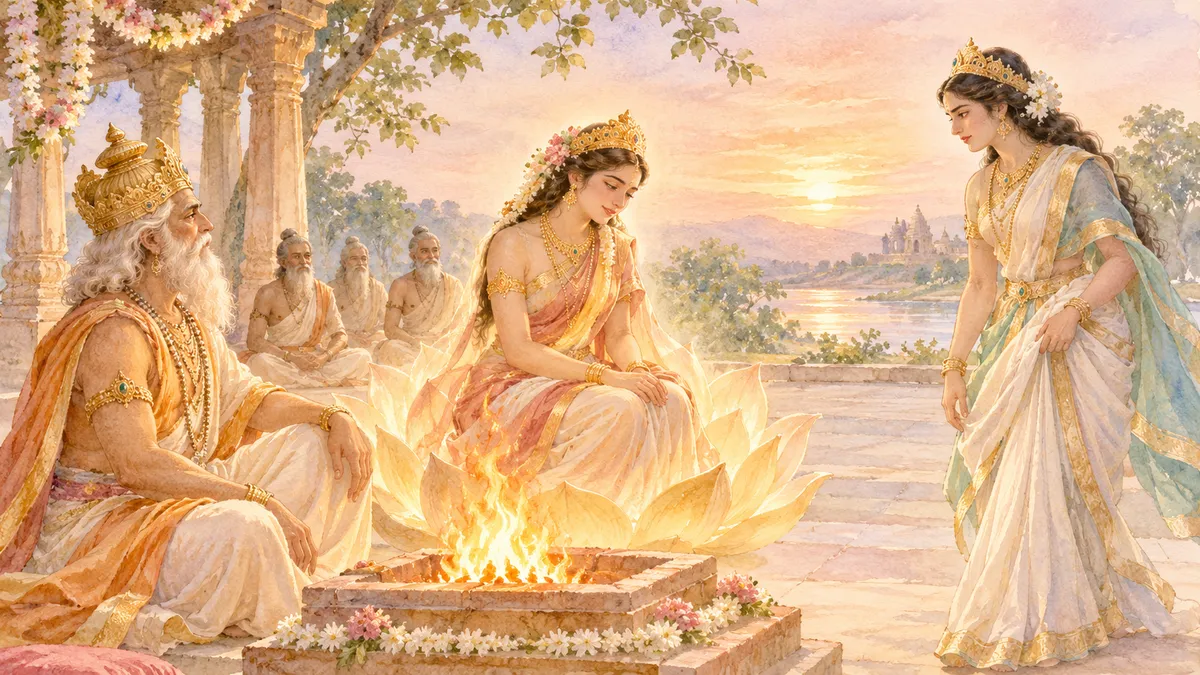
There is a story describing how the goddess Gayatri appeared. It is said that Brahma once decided to perform a great sacrifice. He summoned many rishis, siddhas, and brahmins and was supposed to arrive there with his consort Saraswati. But since Saraswati, as a female deity, was taking a long time to get ready, and the time for the sacrifice to begin had arrived, Brahma decided not to wait for her. Through the power of his yoga-maya, he created another deity from his own shakti, Gayatri, and began the sacrifice. When Saraswati arrived, she was beside herself with rage upon seeing that Brahma had created another consort for himself. But since Gayatri received Saraswati with humility, it is said that they eventually became friends.
What is the meaning of this myth? Gayatri is considered the shakti of the Absolute itself. It is said that if a person seeks to invoke the energy of the manifestation of will and power, they invoke Lakshmi. If they need to invoke the energy of creativity and knowledge, they invoke Saraswati. If they seek to avoid misfortunes or invoke strength during severe trials, they invoke Kali. And if they seek to know the energy of the Absolute itself (Ishvara), they should invoke Gayatri, since she is the direct bearer of this shakti.
The Text and Meaning of the Gayatri Mantra
The Gayatri Mantra is translated as follows:
“OM, blessings to the earthly, subtle, and heavenly worlds,
We meditate on the radiant light of Savitar,
May it illuminate our intellect (or ‘may it enlighten our intellect’)!”
Savitar personifies the divine glory of Ishvara.
Gayatri is very important for developing the principle of buddhi and the principle of awareness. That is why it is constantly heard among us. We recite it every day and before our sessions, thereby trying to invoke the light of Savitar’s enlightenment into our buddhi, into our awareness.
The Gayatri Mantra contains a very profound mysticism. It is said that only the rishis who revealed it can comprehend its power.
“The word Gayatri literally means ‘that by singing which salvation is attained,’ where ‘ga’ means to sing and ‘tri’ means to save. Another form of the word ‘Gayatra’ is etymologically interpreted as ‘that which protects individual souls,’ where ‘gaya’ means individual souls, jivas, and ‘tra’ means to protect.
Thus, the very meaning of the word points to the supreme goal of spiritual practice—salvation, or liberation—as well as to the supreme power of the mantra, capable of protecting the one who practices it.
The primary purpose of the Gayatri Mantra, in which the sadhaka addresses God as the radiant light of supreme Consciousness with the words ‘May it illuminate our intellect,’ where the word ‘intellect’ means buddhi, is precisely to reveal this supreme principle within a person.”
We invoke the power of enlightenment, Anugraha, which manifests through the deity of the Sun, so that it may descend into our intuitive consciousness (buddhi) and illuminate it. Essentially, if we engage in contemplation, we are constantly practicing the Gayatri mantra, that is, engaging in contemplation. Being present is the same as praying while following the Gayatri sadhana. Conversely, when we recite the Gayatri, we invoke the same light that we invoke during contemplative presence.
“It is also important that the practice of the Gayatri mantra ensures a gradual and progressive unfolding of consciousness. This is precisely why the ancient rishis made the Gayatri mantra an obligatory part of daily religious practice. The primary task of a person who has embarked on the spiritual path and seeks to realize their true nature is not to attain liberation, for that is the work of more than one lifetime, but to eliminate their ignorance, which consists in a distorted perception of the world. This requires the purification and reorganization of all the lower vehicles of consciousness so that the seeker of truth may have subtler instruments for working on the higher spiritual planes.”
It says here that the initial task is not liberation, but the elimination of ignorance. Liberation is a strategic objective, while the tactical objective, or minimum program, is the elimination of unawareness—that is, of what prevents liberation.
The Nature of Maya and Working with Inner Energy
What is unawareness?
All energy is maya. External energy is also called mahamaya, that is, energy—the great illusion, the great bewitching force that acts upon the mind. But in addition to external energy, there is also an inner energy called atma-maya. Atma-maya is our subtle bodies.
Everything is clear with external energy—it is what we perceive through the five indriyas, that is, everything we smell, touch, see, and hear; it is very powerful because it makes the mind turn outward. But besides external energy (mahamaya), there is also inner energy (atma-maya), which is the subtle causal body, the subconscious—something with which people are not familiar at all. Consciousness is bewitched by these two energies; it is immersed in maya, in illusion, in a state of unawareness because it is not awakened but seized by these two types of maya.
A yogi needs to activate the light of the buddhi in order to gradually begin subduing the inner energy. For now, they cannot subdue the external energy at all, except perhaps by working on a tractor or something similar; there is no question yet of our being able to subdue external energy through consciousness. At a certain level, the siddhis of parasat-tarka logic, of course, begin to operate, but we are not considering that level for now. For the time being, a person can subdue the inner energy, that is, it is necessary to purify atma-maya.
This happens because we begin to develop within the buddhi a certain subtle, conscious part. This is the principle of sahaja-spanda: some subtle part of our consciousness begins to actively act as a vehicle for the buddhi. Through contemplation, we activate the subtle higher circuits of our consciousness and open what is called the meditative channel of connection with the Atman (dhyana-vahini). It is precisely through this meditative channel of connection with the Atman that the light of the buddhi begins to pour onto the subtle bodies, and then the inner energy (atma-maya) gradually begins to be purified and transformed.
Transforming Maya into Yoga-Maya
When it gains sufficient strength, this inner maya becomes purified or transformed; it appears in the form of clarities that manifest as five types of wisdom. Then, little by little, it also begins to transform external reality, freeing us from the dependencies of this world. When it begins to transform external reality, it manifests as siddhis—in this case, it is called yoga-maya.
To put it more simply, yoga-maya is external magic, the illusion of the external world, while atma-maya is the inner magical space, and when it is purified, we can project it outward. This manifests as siddhis and the ability to transform the external world, purify external reality—for example, to turn the world into a mandala, into a pure dimension, becoming the deity at the center of this mandala. But this is possible only when we have a great deal of inner clarity and inner awareness.
We draw information and all clarity solely from within, without depending on external circumstances. With the help of this information, we are able to transform our surroundings, our pranas, our body, and everything else; to influence time, space, the five elements, and the various manifestations of the five universal forces (jnana, iccha, kriya, svatantrya, and other shaktis). All this happens because we master the inner atma-maya. And it begins to submit to us only when the principle of buddhi within us is attuned and active—that is, when part of our mind is turned inward and we constantly absorb the spiritual light emanating from buddhi, accumulating inner shakti, when our mind is focused and attentive rather than scattered.
The Sacredness and Power of the Gayatri Mantra
“This is the light of buddhi, whose awakening is fostered by the practice of the Gayatri mantra. If, through persistent practice of Gayatri japa, a person sincerely strives toward the light that can come only from within, special tensions are created in their aura, opening a channel for the descent of the divine power of the higher planes into their consciousness.
The Gayatri mantra is considered the most sacred and most powerful mantra of the Vedas. This universal mantra-prayer is first mentioned in the Rigveda, and then in all the other Vedas, as well as in the tantras. Many sages and rishis speak of its significance. Initiation into Gayatri is the first initiation leading to awakening and knowledge of the Atman.
The Sandharva Agama states: ‘For this reason, worship of Gayatri should precede worship of any other deity.’
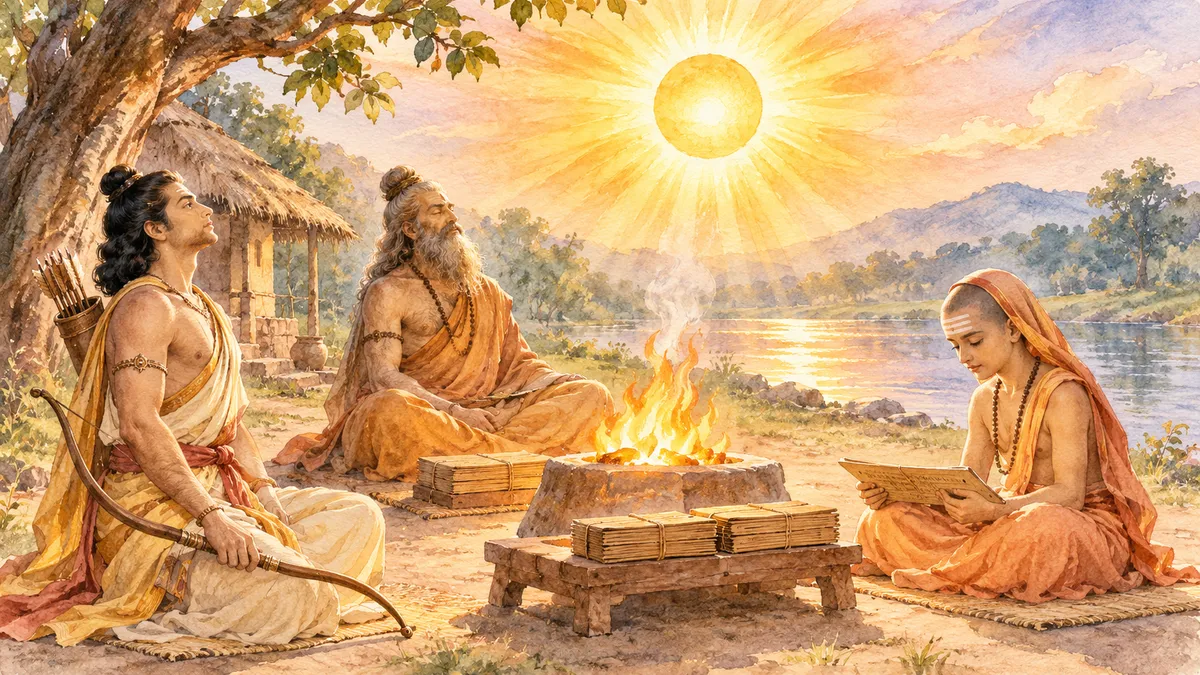
It is believed that this mantra, which is connected with the energy of the Sun and possesses extraordinary power, was revealed to humanity by the rishi Vishvamitra. It was through the power of this mantra that he became a master of all sciences and was able to create a replica of the existing universe. With the help of this mantra, Shri Rama consecrated his arrows, making his weapons invulnerable. The great Adi Shankara studied this mantra at the age of five, and then, using its interpretations, by the age of fourteen had comprehended everything contained in the Vedas.
Gayatri is the only mantra recited in the Kali Yuga. As the yugas unfold, the other (lower) mantras awaken. Gayatri is the mother of all the Vedas. Only the rishis, and they alone, know everything that can be known about Gayatri.
There are twenty-eight types of Gayatri, and each rishi chooses one of them, that is, specializes in a particular form of knowledge in the form of their own vijnana. For example, there is only one rishi who knows the complete form of Gayatri—Brahma-Gayatri. All rishis receive the energy of the Sun because they recite the Gayatri mantra. The sound produced by the primordial movement through which Brahman’s concealment by self-revealing maya took place is pranava-shabda, or OM. Gayatri is the result of the unfolding of pranava, which is why it is now so revered and sacred. Meditation on it opens the door to the highest spiritual life.”
Pranava-shabda is the primordial sound of creation, OM, which emanates from unmanifest Brahman—the primordial vibration (spanda) as a result of which the subtle forms of the universe and the subtle forms of the elements begin to unfold. From OM, Gayatri begins to unfold as a spiritual principle. This does not mean that it unfolds specifically in a phonetic or sonic form. It means that Gayatri unfolds as the principle of buddhi, the principle of awareness.
There is a saying: “All the Vedas are contained in Gayatri, Gayatri is contained in OM, and everything is contained in OM.”
The Universality and Essence of Gayatri
“This mantra is intended for all people without exception, regardless of their caste, religion, place of residence, or level of development. It contains the quintessence of all the Vedas, which is why it is truly called the mother of the Vedas (Veda-Mata). Just as the essence of the Vedic teachings is contained in the Upanishads, the essence of the Upanishads is contained in the Gayatri Mantra. Each of the four Vedas proclaims one fundamental truth: “Prajnanam Brahma” (Consciousness is Brahman) — the Rigveda; “Aham Brahmasmi” (I am Brahman) — the Yajurveda; “Tat Tvam Asi” (You are That) — the Samaveda; and “Ayam Atma Brahma” (This Atman is Brahman) — the Atharvaveda. When these four truths are united, the Gayatri emerges.
It is said that if it is recited regularly, its effect will be as beneficial as reciting the Vedas themselves. Being the mother of the Vedas, the Gayatri Mantra is capable of bestowing knowledge on all three levels: the intellectual, the intuitive, and the transcendent level of direct realization.
The immense significance of the Gayatri Mantra is affirmed in one of the most important rites of Hinduism — upanayana.”
Whenever you hear the Gayatri, you should always remember its meaning. And we will continue studying the mysticism of the Gayatri, since there are plans to build a Gayatri temple and create her five-faced murti. We will continue immersing ourselves in this mysticism; it is very profound and has great significance for us, since we follow the tradition of buddhi, and buddhi is our specialization. We are masters not of hatha yoga, not of kundalini yoga, not of bhakti yoga, but specifically of buddhi yoga. Laya yoga is above all buddhi yoga; it is the yoga of awareness, which is why the principle of buddhi is extremely important to us. And the deity Gayatri is also very important for the development of this principle.
The Iconography of the Goddess Gayatri
How is the goddess Gayatri depicted? She is depicted with five heads, five faces, and ten arms — this form is called pancha-mukha. She sits on a lotus, with her five heads positioned at the center of the solar disk. Being Ishvara’s shakti, she simultaneously possesses the attributes of all three goddesses. She is Brahmani (the consort of Brahma, that is, Saraswati), in which case she holds an alms bowl (kamandalu) and prayer beads. She is Vaishnavi (Lakshmi), in which case she holds a conch, a discus, a mace, and a lotus. At the same time, she is Rudrani, representing the aspects of Durga and Kali, expressed as a third eye, a crescent moon, and a battle-axe. Her two front hands display the varada mudra and the abhaya mudra (blessing and protection).
The five faces of Gayatri correspond to the five parts of the mantra, the five pauses in the mantra:
The first part is OM
The second part — “Bhur Bhuvah Svaha” — points to the three worlds
The third — “Tat Savitur Varenyam” — means “upon that desirable Savitar”
The fourth part — “Bhargo Devasya Dhimahi” — means “we meditate upon the divine light”
The fifth part — “Dhiyo Yo Nah Prachodayat” — means “may he illumine our intellect”
These five faces of Gayatri Devi reflect the energies of Ishvara himself and point to the five types of prana, the five elements, the five tanmatras, the five koshas, the five organs of knowledge (jnana-indriyas), the five organs of action (karma-indriyas), the five types of universal shakti, and the five types of kriya-shakti (the power of creation, preservation, concealment, destruction, and enlightenment).
It is believed that when you need to activate the buddhi and enhance clarity, you should turn to the goddess Gayatri and invoke her simply by reciting this mantra, in order to restore awareness, the light of clarity, inspiration, and the channel of connection with higher states, and to activate dhyana-vahini.
For us, this mantra is heard four times a day. At these times, you can simply remember it and attune yourself to its sound. This is also very auspicious.