

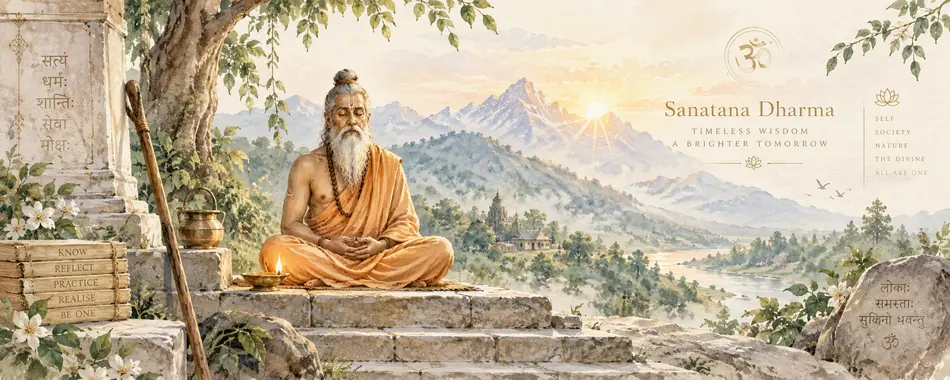
The process of spiritual training is not a simple matter; it is a difficult matter. But it is necessary because, as Babaji said: “Without training, you cannot even learn to ride a bicycle, let alone live a spiritual life.” Teaching exists, knowledge exists, and the opportunity to attain and realize them also exists. But mastering them is not easy; it requires a combination of many circumstances.
Just as martial arts schools exist, masters exist, training halls exist, kimonos and black belts are sold, yet few people become champions. It requires a great deal of inner work, many, many years of self-discipline; one’s entire life is self-discipline. When I practiced martial arts as a child, every training session was a test for me, an overcoming of myself. Because at the end of it, you would enter a state of vairagya, a deep “even taste,” and think: “Do you really need this?” This went on for several years, almost every day. It changes your life, of course. Every day, you reflect on your choice and reaffirm it. This is how mastery is born.
Mastery and Tapasya
Mastery is born from tapasya, always from tapasya. Without tapasya, mastery is impossible. The same is true in spiritual life. Training is tapasya. You must sacrifice many things, but it is worth it. As a result of tapasya, we change, transform, and acquire many qualities.
This does not mean that you will attain Enlightenment. You may not attain Enlightenment for many years, but at least you will acquire mastery, and mastery will increase your chances of Enlightenment. Mastery does not grant Enlightenment; nothing grants Enlightenment—not techniques, not mantras, not religion, not philosophy. Even tapasya does not grant Enlightenment. To say that something grants Enlightenment is mistaken; Enlightenment happens, it is grace. It is bestowed; it comes as the result of self-surrender.
No sadhana, no effort can grant Enlightenment, and mastery does not grant Enlightenment. But mastery solves many problems; it increases, significantly increases, the likelihood of Enlightenment, your chances. At the very least, it frees you from uncontrolled rebirth and bad karmas and reliably gives you the opportunity to be reborn in higher realms. We are not talking about Enlightenment; we are talking about mastery. But if you want to attain Enlightenment while bypassing mastery, most likely it will be nothing more than empty words.

Upaya and Prajna
Mastery is necessary; mastery is expressed by the term “upaya,” method. One must master the method. Enlightenment is prajna; prajna is beyond methods, beyond definitions, beyond effort. When we enter deep awareness, what can we say—what method could there be there, what words could there be there? It is emptiness beyond subject, object, thoughts, and concepts; this is prajna, but it must grow, it must grow endlessly.
That small prajna, a certain degree of understanding, cannot save one from samsara, make you a saint or Brahma the Creator, or liberate all of samsara. It is not difficult to enter into a small understanding of prajna; even a child can experience a non-conceptual state, even without sadhana; even worldly people experience fleeting samadhis. But this gives nothing, it is useless; it does not eliminate the kleshas, dissolve ahamkara, dissolve karma, or dissolve the memory of the subtle body. Because it is a small experience. What can a small experience do?
Sometimes people experience something and think that it is something very great. But the memories of the subtle body remain, prarabdha karma remains; a small experience will solve nothing. The task is to make a small experience great, and this is where method, upaya, is important.
View and Conduct
The practices we perform—Nidra Yantra, Pure Land Yoga—all of these are practices of conduct, a method. This is not wisdom; it is method, conduct, the lower boundary. There is an upper boundary, the summit—that is the view, nonduality, prajna—and there is a lower one—that is conduct, method, upaya, the absolute and the relative. They must not be confused. View and conduct must not be confused; one must understand how they differ.
When we speak of the view, of wisdom as the summit, then we simply need to be in silence, simply remain beyond concepts. There is no need to talk about anything, no need to discuss methods, no need to evaluate, no need to create any relationships within duality. It is inexpressible. We simply need to remain. There is not even any need to communicate. Communication is an obstacle here; it is superfluous. How can one communicate in the state of the view? There you are completely alone; you are alone, no one exists. Even the Guru and you are one there, not two; you merge. All the devatas merge into one. Nothing can be said in this state. This is the view, this is wisdom.
But you will not be nourished by wisdom alone. Because such is the nature of reality: there is always conduct, method, and the manifestation of energy. The relative dimension also exists; one cannot say that there is only emptiness, only the Absolute, at least not at this stage of development. When we speak of the relative, conduct, method, and sadhana come into play here, while all dualistic relationships are excluded.
Sometimes someone says: “But this is separation; one must remain in nonduality and see everything nondually. It is wrong to separate the view and conduct.” One can only wish you success—very well, do not separate them. But what will you do? If such separation exists, you cannot do anything about it: your body is already divided, your mind is already divided. The point is not to separate, but not to separate. This is precisely why we practice. Remaining in the view while skillfully working with the method, with the relative, as a form of play—only then can true nonseparation be realized.

Otherwise, you will encounter contradictions. Because if you are not going to separate, then be ready for great vairagya: renounce the body, do not separate. Let stones, soup, and poison all be the same; do not separate. Turn off your judging mind; do not separate. But no one can do this. You will have to count rubles, buy a ticket to Russia, and divide things into Russia and India. You will have to do all this; you will not be able not to separate. You will have to distinguish between life and death, strive for life, and avoid diseases and everything that adversely affects the body. You will have to separate. Such is your karma, such is the function of this world. You will have to turn on your judging mind, no matter how much you may wish otherwise.
When we work with the method, we learn to do this correctly, not because we seek to separate reality. Rather, the method is the art of acting correctly within nonduality.
Learning the Method
When we work with the method, the learning process is important. It is impossible to teach enlightenment; no one can teach it, no one can give it to you. But the method can be learned, and sadhana can be learned. It is impossible to study enlightenment; it is not something one learns. Learning is the ego, a function of the mind. Enlightenment exists in and of itself, and we merely recognize it as that which is and has always been. One can learn siddhis, magical rituals, the technology of meditation, energy management—all of this must be learned—but this is not learning Enlightenment; it is creating the conditions for Enlightenment. These are different things. They must not be confused. “Then why take exams and study mythology, Ayurveda, and the texts—is this not leading to Enlightenment?” I say, “It is not.” They ask, “Then why do this?” It increases your probability. It increases the probabilities.
When we speak of Enlightenment, there are no guarantees, no promises; no one can give it to you. We can speak only of probability. This process is not linear but probabilistic.
Suppose you spend a year in retreat. One cannot say that this will give you Enlightenment; you may spend a year in retreat and there may be no Enlightenment at all. But if you do spend it there, I would say that the probability of attaining Enlightenment will increase by about ten percent. Three years also provide no guarantees. You may sit in retreat for three years and remain an ordinary person. Some have successfully spent three years in retreats and later became businessmen, returning to an ordinary life. But statistics show that if you complete three years in retreat, your probability of awakening will also increase.

Spiritual realms are not about guarantees or linear logic; they are about probability. All we can do is draw probabilities toward us.
