

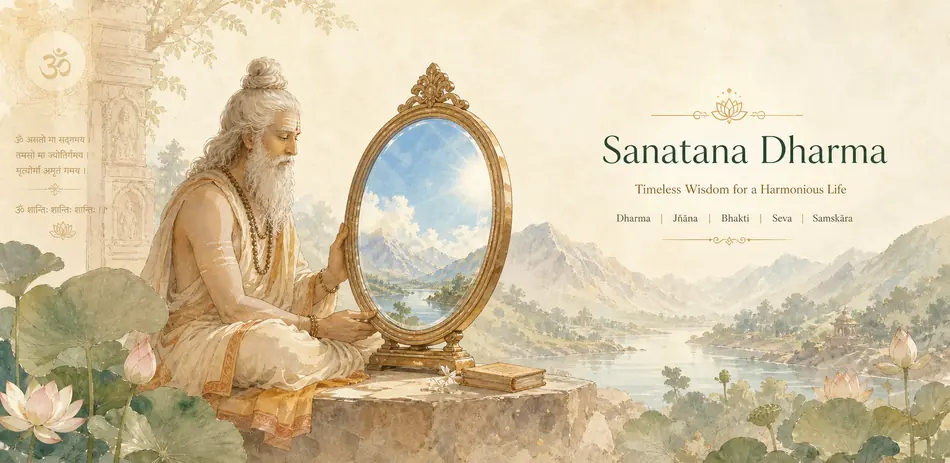
Realize that the world is only an image in the mirror of consciousness. Cultivate contemplation of “I am.” Abide as pure Being and thus free yourself from the delusion that the world is real.
We often say that the world is a manifestation of our consciousness. The world is created by consciousness, namely by a particular karmic vision. If the karmic vision is impure, then the world it creates will also be impure. When we say “impure,” this refers to the relative dimension. In the absolute sense, of course, we should regard everything as pure. In the absolute sense, dividing things into pure and impure is itself a kind of impurity, so it is better to practice the view in which we regard everything as pure. However, in the relative dimension, we say that there are impure and pure karmic visions. Impure vision leads to suffering in samsara, while pure vision leads to liberation. And we do not confuse the two, knowing that some beings have realized Buddha-nature, while others remain subject to their karma.
Brahma’s Creative Power and the Manifestation of the Universe
Thus, the visible universe is the result of the manifestation of Brahma’s creative power. It appears real and permanent because the power of his intention proceeds from a very high level of the natural state and is extremely potent.
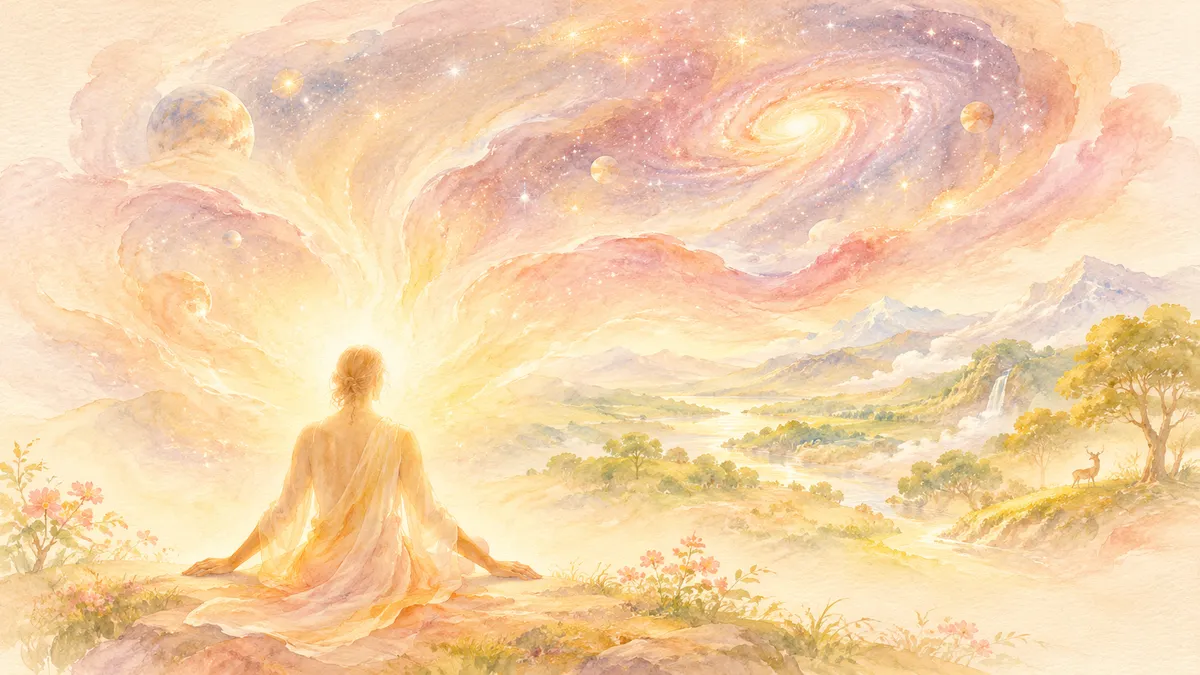
When we say that the world is a manifestation of our mind, we do not mean our superficial consciousness, but the world of our fundamental Mind, which is the great foundation of all that exists. It is something universal; it is the Absolute itself, and therefore this Mind contains immense creative powers that are personified as the deities Brahma, Vishnu, and Shiva. Therefore, upon hearing that the world is a manifestation of our mind, we cannot thoughtlessly assume: “My mind is something insignificant, and therefore the whole world is not significant either.” First of all, in its depths our mind consists of deities, mighty creative powers of which our superficial consciousness is not even aware. If it were aware of them, it would simply be shocked by the might of these creative powers. For example, in the bardo, when all one hundred vrittis are laid bare from the channels, one hundred luminous manifestations of deities appear. In other words, energy is released from the channels, and these enormous deities appear with attributes and ornaments, with or without consorts, in a radiance of light. This is the manifestation of these energies. At that point, a living being can actually discover these energies.
Thus, Brahma is the subtle universal creative energy of our higher Self, acting from the level of the causal body. The universe is the result of the convergence of the subtle creative energies of both Brahma and billions of people over thousands of years. That is why it appears so real, and its laws seem immutable and insurmountable. Nevertheless, it is merely the result of the manifestation of sankalpa—the will, the universal creative power of our higher Self.
Dattatreya says the following on this subject:
“The existing creation is a mental projection of Brahma, or Hiranyagarbha, the creative entity appointed by the willpower of the primordial being.”
Once, a disciple asked:
“What, then, is this universe?”
I answered him:
“It is your mind.”
He expressed doubt:
“My mind is so small, while the universe is something incomprehensible.”
I said:
“It was your mind in the aspect of Hiranyagarbha that conceived all this. Your mind in the aspect of Hiranyagarbha is so powerful that you cannot even imagine how powerful it is.”
Dattatreya says:
“Do you not understand that this world is the result of Brahma’s desire? It appears real and permanent because the primordial desire is so powerful.”
The Earth and the universe are a kind of collective creative visualization into which both the energy of the universe’s creative power and the will of billions of people and generations have been invested, along with their inner subtle creative powers of consciousness, which are personified as deities.
When we say that this world is Brahma's sankalpa (intention), we do not mean that the deities are something separate from our consciousness. To think so is to depart from Advaita toward dualism. We say that the deities are the powerful creative forces of the universe. Nevertheless, these deities are manifestations of our Self. It is our mind that is personified in the forms of deities; at its core, this mind represents immensely powerful creative forces.
Dattatreya says:
“I say that this world is merely a fiction, an imagining.”
Karma as a Binding Force in the World of Illusions
In this world, karma binds and holds us. First, imagine that you entered a dream and the energy of that dream was extremely rigid. You realize that it is a dream, but you do not yet have sufficient shakti (power) to free yourself from its laws. What binds us in the world of illusions? It is the subtle creative power of Hiranyagarbha, the creative power of the universal Self. For example, it manifests as the law of karma, as the universal laws of creation, causality, time, and space. In accordance with it, the collective karma of humanity is formed—the karma of millions of generations accumulated in the subconscious and in the world of form—and, finally, our personal karma, which fits into the collective karmic vision of the human world. These are impressions, samskaras, mental imprints on consciousness from past lives and this life, social conditioning, patterns of upbringing, personal experience, sins, merits, and so on. And in order to free ourselves from the world of samsara, we need to develop a powerful intention (sankalpa) that would transcend all these bonds. It is like a rocket that, in order to escape Earth's gravitational pull, must attain not the first cosmic velocity, but the second and third.
For example, if you think that you are practicing the path of liberation, but deep down you still harbor certain compromises, this means that your power of intention is insufficient, and therefore you will not be able to attain liberation. I do not mean a situation in which you genuinely cannot do something; rather, I mean that your heart is not fully devoted. After all, it sometimes happens that a person has a deeply devoted heart but cannot do something because they have not been trained.

Through the power of your contemplation, you must break free from maya—the subtle creative force that envelops the consciousness of all living beings. This means that you need to generate a very profound sankalpa, which is why teachers are always instructed to test how strong their disciples' faith is, how firm their resolve is, and to what extent their sankalpa can manifest. Such boundless sankalpa can be cultivated through anything. Even if you practice neither asanas nor pranayama and engage only in service, or even if you mindlessly follow instructions for the sake of some goal, you are developing your sankalpa. In other words, the point is to cultivate such an absolute sankalpa.
Why is it said that the world is a creation of our mind? Imagine that a person is sitting in meditation and begins to daydream. At first there was empty space, then people and relationships appeared, and afterward he became completely absorbed in this vision and found himself among them. Then he entirely forgot that he had been sitting and meditating and began to act within this vision as though it were real. Only when the spiritual Teacher saw how deeply he had become entangled in this illusion, entered his mind in a subtle body, thoroughly reprimanded him, and forced him to return to his body did he end this misguided meditation. When the disciple returned from his fantasies, he saw that nothing had happened: only his physical body had been sitting in the lotus position and dreaming. Nevertheless, in the universe that he had invented with his mind, he had already managed to acquire friends, attachments, and various concerns. You should view this universe in the same way. The only difference is that grosser elements are present here.
The Power of Intention and Its Limitations
Why can we not immediately change this world by generating the corresponding intention if this world is a product of our consciousness? Because the world generated by the intention of a single living being cannot significantly influence humanity’s shared karmic vision of the world or maya, the creative forces of the universe, since the power of that being’s intention is negligible—unless that person possesses immense power of consciousness. This is because an ordinary person’s intentions arise from the superficial layers of manas; moreover, the person lacks deep faith in their own sankalpa, and therefore it cannot manifest.
It is said that the world becomes what you grow accustomed to seeing in your thoughts and conceptions. This assertion is supported by yogis materializing objects that they envision in their imagination and desire to obtain.
Why should extraneous information be avoided? Because yogic power weakens and may even be completely lost when you absorb something that contradicts your sankalpa. Suppose you are thinking about how to contemplate properly, attain liberation, and practice meditation. You direct your mind toward the teaching, but then you think, “I need to relax, read a worldly book, watch a film.” At that point, your sankalpa is lost, your intention suffers a setback and diminishes, and your yogic power drops sharply, so you have to start all over again. To become free from samsara, you need to generate a very strong, one-pointed, and continuous sankalpa toward contemplation, mindfulness, and the practice of meditation.
How can intention be materialized through the willpower of sankalpa? Dattatreya says:
“As for your willpower, it is suppressed by the maya of the creative forces, but when this obstacle is overcome through the methods of yoga, your willpower will also become effective.”
Even if a person receives numerous transmissions of teachings from the Master, but does not possess such sankalpa, their own willpower is suppressed by the power of maya. This is why the teachers of old often refrained from giving instructions right away. Before giving instructions, they taught the disciple how to develop such immense sankalpa and willpower. They knew that the instructions would work only when such boundless sankalpa was present. Unfortunately, today much of this happens in reverse. Numerous lectures are given, and people listen with pleasure, believing that they are practicing the Dharma. But when the Master leaves, people go back to their own affairs while waiting for the next visit. At best, they occasionally donate something in appreciation of a well-delivered lecture. This, of course, also provides some help to living beings in samsara; however, it is more likely a path to the heavens of passion or to a better worldly life, rather than a true path to liberation.
If you approach the Master and ask, “Master, how can I personally and genuinely attain liberation? Do you have any instructions specifically for me, rather than for the general public, where you do not give specific recommendations?” the Master will tell you, “You must change. You must develop immense sankalpa and cultivate strong qualities: concentration, the cutting off of desires, and others. You must work on yourself very seriously.” Then the Master will directly transmit to you a deeper Dharma that applies specifically to you. The Master never imposes the Dharma. He believes that if someone asks how to practice while retaining certain attachments, that is their personal affair; but if they truly wish to advance further, they should be told what this entails.
Methods for Materializing Intentions
Dattatreya explains how intentions should be materialized:
“To make your thought effective, you must forget all your old associations, so that the new concept persists until the old one is blocked.”
For our consciousness to become effective, we need to forget all our old identifications until the new state displaces all the old associations.
When you practice pure vision, over the years it should displace impure vision. Over the years, the four immeasurables should displace anger, hatred, envy, and attachment. Over the years, contemplation should displace absorption in thoughts, concepts, and emotions. In time, sattva (radiance) should displace all tamas. If years pass and your radiance does not displace tamas, you need to seriously analyze your practice, identify the gaps, and find a way to eliminate them. The state of the boundless mind, like the sky, the boundless Source, should displace the idea of aham-dehasmi (I am this body); drop by drop, it should force this slave out of consciousness. The state of self-surrender, humility, devotion, and samaya should displace egotistical pride, absorption, and mercenary interests. The accumulation of merit should displace the old impure karmas accumulated during worldly life.
Thus, the new concept will block all the old ones. By concept, we mean our new image of ourselves. It is said: “We become what we think about.” This is like a chrysalis turning into a butterfly. Essentially, all we need to do in the monastery when becoming monks is to think of ourselves in a new way from morning until evening. Here we train to cut off the thoughts we previously had about ourselves and learn to think about ourselves and the world in a new way, until our perception of ourselves, the world, and the Absolute is completely transformed.
An intention is powerful if it is not obstructed by some previous intention that would otherwise destroy it. Our intention is often obstructed by a previous intention—that is, one we accumulated earlier while in a state of karma. By and large, our most important sankalpa is, of course, neither visualization nor mantra. This sankalpa is not connected with a construction of the mind; otherwise, it would no longer be laya yoga. Our meditation is, first and foremost, meditation on the primordial Ground, on the Supreme Source; therefore, it is not mental but contemplative. Nevertheless, when we begin to practice it, previous intentions arise that may destroy it. For example, we contemplate or practice, but in a past life other intentions were created that now influence our contemplation. Therefore, we need to continue purifying ourselves and practicing contemplation until all previous intentions have been self-liberated, suppressed, purified, and eliminated.

Suppose that when we become angry with someone, our previous intention was the desire to fight someone. If we had developed it rather than suppressed it, it would have led us to hell. When we become attached to someone, if we did not block and self-liberate this tendency, it would lead us to become mired in the attachments of the human world.
Dattatreya says:
“Creative intention is effective only when it is strong and filled with will. In this way, even great things can be accomplished.”
Our intentions, service, practice, performance of all sadhanas, and contemplation must be filled with our will and be strong. If your intentions go astray, if the most insignificant things can shake your mind, this indicates a complete absence of sankalpa.
Therefore, we read the following text: “Whatever the path to enlightenment may be, I vow to follow it to the end. However great the suffering of living beings may be, I vow to help them. However numerous the kleshas may be, I vow to eradicate them.” You should always remember what you read when you become monks. This is your intention, which should accompany you throughout your life.
The intention of an ordinary being does not manifest because of its weakness and superficiality; therefore, to master creative powers, one must practice concentration of thought or unwavering contemplation.
The Nature of Time and Space
“Time, space, and gross creations manifest in accordance with the images conceived by the person who imagines them.”
Our entire universe, including time and space, is not something absolute; these are merely the laws of maya created within a particular karmic vision. There are countless other spaces and ways in which time can flow. When Milarepa took shelter inside a yak horn to escape the cold, the yak horn did not grow larger, nor did Milarepa become smaller. This means that Milarepa generated his own karmic vision, possessing a very powerful sankalpa, and was able to introduce it into the karmic vision of this world; that is, he created his own universe, in which space was different.
“The relationship between space and objects, between time and events, corresponds to how you yourself perceive them. There are no intrinsic relationships between them.”
This should be understood deeply. Right now, there are worlds where the universe is heading toward destruction; there are worlds in which Satya Yuga prevails; there are unmanifest worlds; and there are worlds in a state of pralaya. They all exist within the karmic vision of the beings that generate them—that is, the gods (Brahmas) who give birth to universes and govern them.
Everything visible is the result of the interaction between the state of consciousness and the karmas in the channels that form karmic vision.
Disciples used to visit a certain yogi, and some of them saw him as a flame, some as water, and others as a deity. They asked him why this happened. He replied, “This happens because of the relationship between your channels, your mind, and my energy. There is nothing permanent about it.”
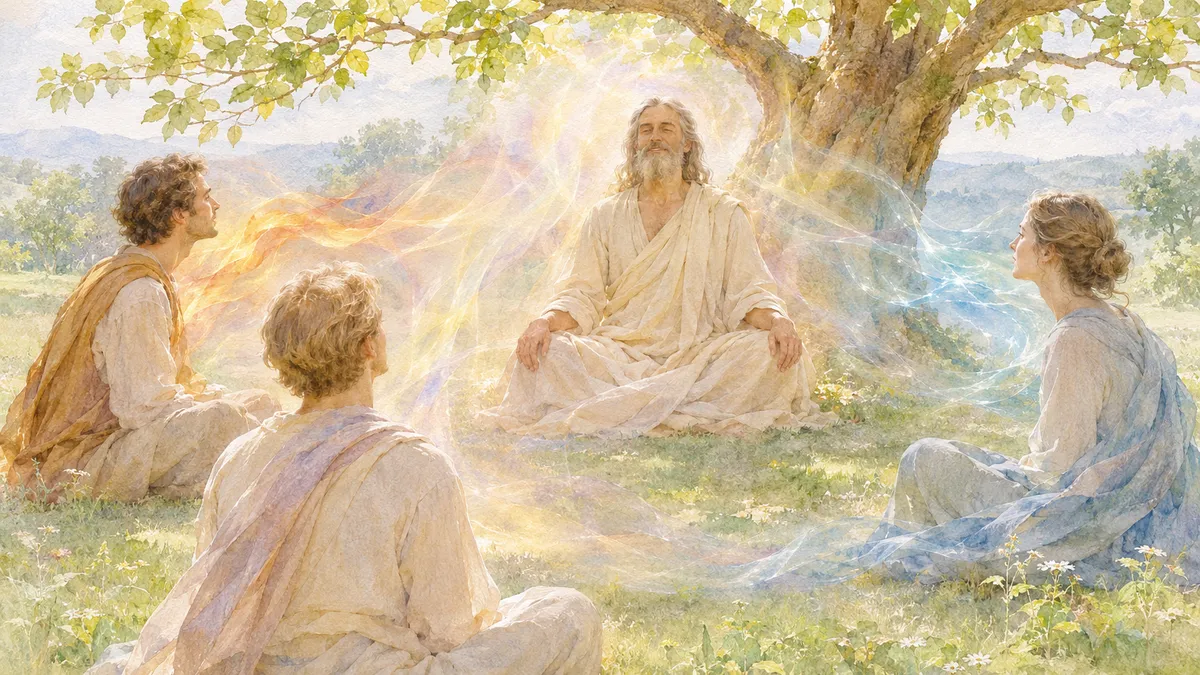
It can be said that any person can be viewed from different perspectives. For example, a mother who is not a practitioner will see even a highly advanced monk or an enlightened being only as her son. In her karmic vision, he cannot be anyone other than her son, because she sees him from a different perspective. If another monk looks at this monk, he may appear to be a high-level practitioner. If a saint looks at him, the saint may see him as a manifestation of a deity or an incarnation of some saint. If a monk of equal attainment looks at him, he may seem simply like a Dharma friend with whom it is interesting to practice. And all these different perspectives exist simultaneously.
Karmic Dimensions and the Nature of Reality
In the same way, various kinds of karmic dimensions exist simultaneously in the universe, and they are entirely valid because they depend on the beings that generated them. But in the absolute sense, no karmic vision is real, because only the Ground that generates them is real. Various images appear in a mirror, but the mirror itself does not belong to those images. The images are merely an illusion on the surface of the mirror. Thus, the entire visible universe is external only to the ego, but not to the higher Self. The deep mind, the Ground, is like a screen, while objects are like images projected onto it.
Dattatreya goes on to say:
“The Supreme Intelligence plays with the universe while always remaining the unaffected witness of its creation.”
Lila—the Causeless Play of the Absolute
Our deep awareness is unaffected by anything manifested. The nature of the absolute Self has no purpose other than the play itself; therefore, every manifestation of energy is a spontaneous expression of this energy of the Absolute. Play (lila) is the most fitting description for it. Lila (vilasa) is the spontaneous manifestation of universal energies. Our higher Self spontaneously manifests these energies while remaining unaffected by them; therefore, all creation is unconditioned by causes and effects. It can be said that everything visible is the causeless play of the energy of the Absolute.
The universe is the causeless play of the higher Self, the Great Source, its creative manifestation. The world of manifested things is the play of the energy of the Universal Source. Nevertheless, although this Source is never tainted by them, it is inseparable from them, just as the sun is inseparable from the rays of light. It is simultaneously separate from and inseparable from them. This simultaneous separateness and inseparability is described by the term achintya bheda-abheda tattva. This term is especially popular in Shaiva Siddhanta and Vaishnavism. Achintya denotes the inconceivable identity of two in one, the separateness of primordial consciousness and its simultaneous presence in all energies. The Primordial Source is inseparable from these energies and at the same time unaffected by them.
An enlightened siddha yogi perceives and experiences everything as the play of the energies of the Supreme Self, which is his own Self. It is said, “Until you see the entire world as the play of the energies of your own Self, you cannot claim to have realized the Absolute.” All existence is encompassed within his own Self and is an expression of the spontaneous perfection of that Self, the Absolute Intelligence, the primordial Ground of all things; therefore, the saint experiences his Self as inseparable from the Absolute.

When a yogi sees the external world, the entire universe, as a playful manifestation of his own creative energies, he is undoubtedly liberated and is a jivanmukta. One who is unable to perceive it in this way cannot be regarded as liberated. At first, this is experienced only at the level of consciousness. In other words, you may understand it with your mind, but you have no control over these energies. Then, gradually, control even over the energies arises. The power of your consciousness can bend karmic vision, space, and time, and alter much within these energies.
I could say a great deal about how the power of consciousness manifests in the external world.
The Difference Between Lila and Krida
The yogi experiences the creative, eternally enchanting, ever-fresh, exhilarating, overflowing fullness of the total energy of being, as though he had initiated a cosmic game with the entire universe. Such an experience is called lila. Very often, when disciples hear the term “lila,” they think it means being unseriously spontaneous, taking life lightly, and nothing more. This, too, is part of lila, but lila is a far deeper and more comprehensive concept. It is said that only the Creator can engage in lila, because the entire universe is his lila. All living beings participate in lila not of their own free will, and such involuntary lila is called “krida,” that is, a conditioned and partially constrained game. It is also a game, but it has its limitations.
One might say that, from the very beginning of spiritual practice, we must acknowledge that all of this is indeed lila and that we are involved in it. Even liberation is also the lila of the Absolute. That is, the Absolute has initiated, for example, a lila involving a monastery, samsara, and the suffering of living beings.
Nevertheless, we have not yet fully entered into resonance with this lila and still remain in the state of krida (lila governed by the law of karma). Therefore, inwardly, our view must be truly bold—the view that everything is lila—while our conduct must be meticulous and take the law of karma into account; then there will be no contradictions. We gradually enter into resonance with this lila, as it were, freeing ourselves from the conditioned game (krida), until lila truly manifests in full. This is a very lofty, transcendent view with which we must gradually integrate.
The State of Full Realization
When this state is realized, there is neither illusion nor ignorance, neither kleshas nor obscurations, neither vasanas nor attachments. Everything is pure, spontaneously perfect, inconceivable, and infinite. Then the yogi’s conduct is truly spontaneous, while his energy experiences the fullness of all perceptions and is inseparable from the universal Source. He abides in the state of the “great wind.”
Once, while a laywoman and I were driving through Moscow, she asked me, “What are awareness and enlightenment?” I replied, “They are the complete severing of everything.” Then, turning the steering wheel, she said, “But you still have to continue your lila!”
True lila can continue only in the purest state of consciousness, one that is in no way bound by karmas, when karmas and samskaras have been released to play freely as the adornment and creative play of the Absolute.

Two Dimensions of Perception
When we are in a completely transcendental state and lila is fully realized, it does not matter whether you receive the body of a deity, a donkey, or a demon, for everything is inseparably connected with the Absolute. The Absolute can play in every body, but until this lila is fully realized by us, it truly matters greatly what body we receive in the next life and with which world we connect our sadhana. Therefore, we simultaneously acknowledge two dimensions. The first dimension is absolutely pure: we say that the whole world is a manifestation of the energy of the Absolute, of its play. The second is the dimension in which we say that limitations and karmas also exist. The second viewpoint is lower, while the first is the highest and transcendent. We must orient ourselves toward the first while proceeding from the second.
One saint put it this way: “Trust in God, but do not forget to tie up your camel.”
