

Every day, we clear away old cause-and-effect relationships and generate new, pure ones; we cultivate awareness and create our future drop by drop, day after day. This is a controlled process of liberation, and the impressions we have created during the day are extremely important. It is essential to conduct an analysis before falling asleep, reviewing the impressions accumulated throughout the day. Such an analysis should leave your soul satisfied that you have accumulated enough pure, wholesome impressions—this is very important at the end of the day.
It is like an accountant or merchant calculating the proceeds after a day of trading: he must end up with a profit, not a loss. In the same way, we sum up the day and calculate what we have accumulated during it, and over the course of that day we should accumulate a great many wholesome impressions.
For example, sandhya-upasana—the impressions created by invoking God—if you perform it in an inspired state during simple Guru Yoga, you will experience an elevated state. The Gayatri mantra, Brahmananda Gayatri, the Brahma Gayatri mantras, contemplation of space—you will have insights and revelations. In other words, you perform the morning sandhya and receive three revelations. One revelation about Ishvara during the Pancharatna Pramana Mantra (prostration). Another revelation about Dattatreya. The third revelation about space during bhuchari mudra—the contemplation of space—or shambhavi mudra.
You attend the sutra and receive another revelation. One during the Datta Stotra, another during the Saraswati arati, and a third simply arising from the atmosphere itself. That makes six revelations in the morning. At the service meeting, while listening to the manager and practicing pure vision, you receive the darshan of the deity Vishvakarman through the manager’s body, and of Lakshmi at the same time. You receive a revelation about seva, acceptance, carrying out the divine will, non-doing, and karma yoga—what it means to act without an actor, without a doer, and how to transform karma into divine play. That already makes nine revelations, and the service has not even begun yet.
Then the service begins—and there may be a veritable cascade of insights. You have only just started doing something when the manager comes and says, “None of this is needed. Something else is needed”—a revelation about cutting off expectations and attachment to the fruits and results, as well as about preconceived patterns of how things should be done.
Two revelations per hour during service are possible; or, when you grow tired of doing something, you remember divine grace and continue. Thus, if seva lasts five hours, that is ten revelations plus the six from the morning—sixteen revelations in total. And at lunch, visualization and making an offering to Dattatreya—the seventeenth revelation: how food is transformed into nectar. Seva. Mahashanti—and during mahashanti, the double limit brought a breakthrough into dhyana; or, if it is not mahashanti but agochari mudra, nasikagra drishti, contemplation, and opening the mind wide—that is the eighteenth revelation. Then arati again, visualizing the eight key moments during arati—the nineteenth revelation. Satsang—there are a couple of insights; sitting well—the twentieth and twenty-first. Bhajan mandala—the twenty-second. You can have one for each bhajan, but at least one over the course of them all. You go to the temple, prostrate yourself—five temples, five revelations, five insights, one in each. You visualize and recite a mantra—twenty-seven. You lie down in shavasana and say a prayer before dream yoga—the twenty-eighth revelation.
Then you sum up the day: you received twenty-eight flashes of the spirit, twenty-eight revelations. But it does not necessarily have to be twenty-eight—someone may receive one hundred and thirty-five. Someone else may receive none at all—that depends on you, on your horoscope and your upayas (methods). But in general, if you practice correctly, you conclude the day by recognizing that you experienced many elevated bhavas, many elevated impressions, and many insights; that you were constantly moving toward God, that you were seeking God, that you did not live this day in vain; or that you served God, lived in self-surrender, surrendered yourself, and understood how to surrender to Him—which is the same as seeking God. You understood how to remove yourself; or you contemplated within the threefold sankalpa and went deeper; or you remained in pure vision in the depths of samaya, entered the solemn majesty of divya bhava, and saw your samaya brothers and sisters in their purity. You immersed yourself in the four immeasurables; there may be various fleeting samadhis. All these are diverse experiences—anubhava, rasa, divine revelations experienced by a yogin. Or causeless ananda, or experiences of antar tapasya and antar yajna (inner worship). Or revelations during transformation. It all depends on the type of sadhana you practice.
Or even if you simply abide in a pure, exalted state, with exalted thoughts and exalted impressions—it is simply the experience of self-liberation. As you fall asleep, before drifting off, you draw a line under the day: “Here are my twenty-eight insights, or thirty-one revelations, for today. Not a single impure thought. The circle of the day was not broken; the circle of the day was completed.” And this was not merely with some degree of attentiveness, but with full-fledged remembrance of emptiness; at times, even self-illuminated remembrance itself broke through, and you fall asleep transformed, with a prayer and a deep sense of satisfaction that the day went well, that the sadhana was successful, and that instead of accumulating karma, you accumulated abundant merits of the body, merits of speech, merits of the mind, and merits of sadhana.
Spiritual Capital and the Causal Body
These merits then flow into your inner bank, your inner repository. Ashaya is the accumulated storehouse of karma, hidden samskaras, and vasanas—your own archive preserved in the causal body.
In your causal body, you have deposited twenty-three divine revelations into your account. This becomes your spiritual capital, your revelation, with which you can then pay throughout the entire cosmos, buy your way out of the lower worlds, pay for entry into heavenly abodes, make offerings to saints, and receive blessings. This is your universal currency—sattva, pure sattvic energy. Every day, a wise sadhu accumulates this spiritual capital: these insights, revelations, and exalted pure states (bhavas). These may be moments of clarity concerning the understanding of the teaching or very subtle aspects of contemplation. They may be energetic breakthroughs in the energy body. This means that, as a seeker of God, you have lived the day correctly: it has purified your old karma and brought you new merit. This is the life of a sadhu, life on the path of moksha-dharma.
The Abode of the Universe
That in which the power of self-awareness shines, the cause of the creation, sustenance, and dissolution of the entire multitude of worlds, is called the abode here. That in which the transcendent power known as the power of self-awareness (vimarsha-shakti), which creates the diversity of worlds, abides is Brahman (the Supreme Shiva). This is the abode of the world.
All fourteen worlds of the Vedic universe are created by vimarsha-shakti, but vimarsha-shakti itself (the second tattva) abides in the first tattva. The first tattva is Shiva, or Shiva-tattva. This is Brahman itself—the abode of the entire universe. The universe does not exist by itself, separately from this abode, with its own geographical coordinates and time. The entire universe emerges and is generated by divine will from this abode. Vimarsha-shakti generates the universe, but prakasha-shakti (the first Shiva-tattva) generates vimarsha-shakti (the power of self-awareness).
Only a pure mind can comprehend this abode; a clouded mind, beset by flaws, cannot comprehend it. And what does a pure mind mean? It means that one’s view is free from extremes based on dualistic notions. Contemplation is open and abides in non-fixation, while conduct is natural and does not violate the samayas.
When we possess these three, it means that we have a pure mind capable of comprehending this abode: anga (the soul) comprehending linga (God). Anga and linga unite.
The Path of the Vira Yogin
One who can do this is called a vira, vira sadhu, or vira yogin. “Vi” means the skill, the art of uniting Shiva with Shiva, while “ra” is the state of pleasure arising from this process during practice. In other words, this is a sadhu—a follower of Shiva or the path of liberation—who experiences bliss from the process of uniting the soul with God. All our practices are attempts to unite the soul with God (anga with linga), and yoga is the connection of the soul with God. We become vira when we begin to experience bliss from this process and try again and again to practice, for example, japa, contemplation, atma-vichara, the threefold sankalpa, shambhavi mudra, and mindfulness. These are attempts to unite anga and linga—the soul (jiva) and Shiva.
At some stage, we perform them simply out of a sense of duty, out of a desire to apply the method, but when bliss arises from these attempts, we become vira. Another interpretation of the concept of vira is as follows: “vi” is the state of illusion (vikalpa), of the mind’s fabrications, while “ra” is the destruction of illusion, when the illusions generated by our mind are destroyed in the process of self-liberation and contemplation. To wrest ourselves and our mind from pashu-bhava and bring them into vira-bhava is the yogin’s task on the path of liberation, so as to realize this receptacle (Shiva-tattva)—the receptacle of the entire universe. There is nothing in this universe that is not contained within this all-encompassing receptacle.
Chit-Shakti and the Power of Self-Awareness
That in which the power of self-awareness (chit-shakti) manifests both as the faculties of cognition and as the seed of the universe is called Brahman (the Supreme Shiva).
Brahman possesses chit-shakti (the power of consciousness). The entire universe is chit-shakti-vilasa (the play of this universal Shakti).
Just as the moonlight that illuminates all objects is constantly present in the moon, so too the power of self-awareness is constantly present in Brahman, in the form that he has given it by his will.
Discovering one’s own vimarsha-shakti, one’s own chit-shakti, means discovering one’s own power of self-awareness. This is a great mystery. It is precisely on the basis of the power of self-awareness that living beings hold their status in the cosmic hierarchy. Some become gods, others animals, and still others humans. What is the reason? The reason lies in the difference in chit-shakti and vimarsha-shakti.
The letter “a” is Shiva, and the letter “ha” is Shakti. Brahman consists of Shiva and Shakti; it is one, as indicated by the word “aham.”
When we say “I,” in Sanskrit it is “aham,” the union of Shiva and Shakti, of Atman and the five sheaths—this is the “I,” this is “aham.” Through investigation, we discover that this union may be bound to samsara or awakened. In the latter case, such people are called siddha-purusha or mukti-purusha.
Transformation of the Three Bodies
What does this mean? It means that the physical body (vishva-jiva) is transformed; that is, the soul in the physical body and in all material manifestations is called vishva-jiva. When it is transformed, it renounces material objects, and its relationship with material objects changes. What does this mean? Attachment to material objects disappears, evaluative judgment falls away, and perception shifts to the pure vision of external objects, without attachment arising. The transporting prana that flows from the eyes to objects and from the ears to objects returns inward.

As a result, the winds fill the sushumna, the prana is transformed, and the physical body also enters the process of transformation. The chakras and channels are purified, the knots are untied, and all this is called tyaganga, the transformed vishva-jiva (the soul in the physical body).
Then, when we perform transformation into a deity, meditation, and mantra yoga, the taijasa-jiva is transformed. Taijasa-jiva is the jiva living in the astral dimension (the soul living in the astral dimension)—the subtle body. When it is transformed, this is called bhoganga. Bhoganga means that the old subtle body has been destroyed and a new body arises; depending on the degree of purity, it is also sometimes called the impure illusory body. Bhoganga means that even in dreams we perform japa, contemplate, accumulate merit, visit temples, and carry out conscious actions. This means that even in dreams, even in the subtle body, we do not follow our karmic tendencies.
Finally, there is the causal body. When our causal body is purified and the old causal body is destroyed, the subtle bijas in the subtle body disappear, the regions of light are purified and no longer contain our future karmas—this is called yoganga (the transformed prajna-jiva), the purified causal body. A purified causal body means that there is the space of self-awareness and bliss, and the soul identifies itself with this bliss and space. Yoganga means “anga” and “linga,” that is, Shiva and jiva have finally united; the individual “I” and the universal Brahman unite—this is called yoganga.
These three intermediate states—tyaganga, bhoganga, and yoganga—are the causes and seeds for attaining the three enlightened bodies. Tyaganga becomes siddha-deha, bhoganga becomes pranava-deha or maya-kaya, and yoganga becomes jnana-deha. Thus, the soul abides in different states. The soul in the waking state is now the vishva-jiva; “vishva” means embodied in the material realm, in the material dimension, in the body. In the dream state, it is the taijasa-jiva, and in the state of deep sleep, it is the prajna-jiva. The moment we seek God and reunite nondual consciousness with this jiva, it enters the process of transformation.
The Yogi as the Atman of the Entire World
Having attained the supreme “I” (ahanta), which represents the stable union of Shiva and Shakti, the yogi who has become Brahman shines as the Atman of the entire world. Just as the leaves and flowers of a banyan tree are present in the tree’s seed, so the entire world is present in the seed of the heart of the supreme Atman.
Thus, the yogi shines as the Atman. As a result of what does the yogi shine as the Atman? He shines as a result of the innate joy of his own mind as it unfolds—manana-kalpita-sahaja-anandam. As a result of all his kleshas having subsided into his own nature, he begins to experience the nondual, ineffable sense of brahma-aham-bhava—this is called anirvachaniya (inexpressible in words). The inconceivable experience of Brahman allows him to easily free himself from the pairs of opposites (dvandva). Abiding in the single “taste,” freed from the pairs of opposites, he drinks the nectar of renunciation (tyaga-amrita). “Tyaga” means renunciation resulting from tapas, “amrita” means grace, nectar, and he becomes equal to everything, identical with all things (sarva-sama). He realizes his inner nature as niranjana (immaculate, unstained).

The Unstained Body
One whose great form is not subject to the limitations of place, time, and so forth, and who consists of consciousness and happiness, is here called the “unstained body.” The enlightened yogi is the Atman of the entire world. His form is consciousness. The world (samsara) does not stain him, just as smoke leaves no trace in the sky.
Thus, an enlightened yogi is one who has transformed and purified his three bodies and revealed at least one awakened body. Having at least one awakened body means that the dimension of turiya has been realized in him either in the waking state, in the subtle body, or in the causal body. He drinks from or stands beneath a waterfall of ambrosia, beneath shaktipat, beneath grace. The expression “Sarva Sarva Atmakam” means universal interconnectedness, that is, everything that exists is the essence of everything else—this is how his consciousness perceives it. Until we stand beneath the waterfall of ambrosia, overcome dvandva (the pairs of opposites), and attain at least some minimal single “taste,” it is difficult for us to experience universal interconnectedness. Universal interconnectedness means that consciousness unites us with all living beings; there is no longer any division between self and others, and we can feel others as ourselves. We can feel the external world as a manifestation of our “I”; we can feel unity with the stars and planets, and a connection with all living beings.
Pure Consciousness and Perfect Methods
There are neither prescriptions nor prohibitions, neither vacillations nor subconscious desires. The yogi has become pure consciousness and has freed himself from the natural inclination toward activity.
To become pure consciousness and free oneself from the natural inclination toward activity—what is this, who can say what it is called, which mala is it? Yes, karma-mala. A perfect means is required. Sakari-karana is a perfect method or a perfect means. The perfect means is abiding in the nature of Mind. If we have properly attuned ourselves to and discovered the nature of Mind and remain in it, then, as the saints say, “Nothing more is needed.” We simply need to leave everything as it is and abide in the nature of Mind. The nature of Mind itself is a perfect means of purification, a perfect method for dissolving dualistic karma. If we confidently abide in the open and unrestrained state of the nature of Mind and have no doubts, then all our fears leave us, all our desires, ambitions, and illusions leave us, and we no longer doubt. We cherish it like a magical jewel.
If, however, we are not certain about the nature of Mind and manana has not yet been sufficiently well performed, we must sustain ourselves through constant upayas.
There are many upayas, and one must understand which upaya to apply, when, and depending on what circumstances. For example, the yoga of the illusory body (ishta-devata yoga) is a powerful upaya that supports the natural state. Moreover, the very context of the practice of illusory body yoga presupposes that we perform it only from the experience of emptiness, from the natural state. Illusory body yoga implies that we have already realized a certain level of nonduality of natural awareness, because it is impossible to create an illusory body while abiding in a dualistic state.
Contemplative Sankalpas and Waterfalls of Ambrosia
The perfect means are contemplative sankalpas, Shiva Sankalpa, followed by Shakti Sankalpa, and the yogi must master all of them one after another, work through them, and receive their darshan. Each sankalpa carries its own darshan; it conceals its darshan through the power of the spiritual grace contained within it, hidden in it by gods and saints. Great power of grace is concealed in every sankalpa, and if you have received it as a transmission from the Guru and practice it, sooner or later you unpack this information package, and it pours down upon you. This is what is called amrita-dhara (a waterfall of ambrosia).
You begin practicing pure vision, practice it little by little, and a waterfall of ambrosia pours down upon you: you gain a genuine experience of pure vision, and all your dualistic notions concerning judgments of others disappear from the mind forever.
You begin practicing atma-vichara, and another waterfall of ambrosia pours down, concerning your own identity and self, the nature of consciousness, and the world. Thus, each sankalpa pours forth its own waterfall of ambrosia. Shiva Sankalpa pours forth a waterfall of ambrosia associated with consciousness (the first tattva), Brahma-aham-bhava. Shakti Sankalpa pours forth a waterfall of ambrosia associated with the second tattva (divya-bhava). Ultimately, these two waterfalls merge and become mukti-bhava (the experience of liberation).
Just as space divided among pots is not actually divided, so too Brahman, assuming many forms in accordance with its forms, is not actually divided. Just as space is immutable and indescribable, so too is Brahman, but consciousness is its distinguishing characteristic.
The Divine Nature of Consciousness and the State of Kevala Shivam
Consciousness, the principle of awareness, the nature of Mind—this appears to belong both to our soul and to our psychology, yet at the same time it is the principal attribute of God from which everything proceeds. The yogi devotes himself entirely to investigating the divine nature of consciousness. When he dedicates himself to investigating the divine nature of consciousness, he experiences kevala shivam. Kevala shivam means “only Shiva alone exists.” It is the state in which “Shiva alone exists,” and there is not even anyone there to say, “I am Shiva,” because “I am Shiva” is also something superfluous—the “I” is superfluous here. “Only Shiva alone exists, while the ‘I’ does not exist at all”; if one is to speak of the “I,” it is only in the context that it is Shiva, but Shiva tells no one about himself, for he has no one to talk to; he is alone. He has no need to say, “I am Shiva”—after all, you do not say to yourself, “I am me”; it is already obvious that you are you, and saying so would be meaningless, which is why Shiva does not speak to himself. This is the state of kevala shiva (“only Shiva alone exists”).

Another corresponding experience is that of maha-bhogi (the great enjoyer). Shiva is the ultimate enjoyer, the ultimate recipient of all sacrifices, all sensory pleasures, all energies, and all perceptions. When we understand this, we feel ashamed to enjoy anything without Shiva. We understand that this enjoyment does not belong to us—it belongs to him; he is the ultimate enjoyer, and we want Shiva to enjoy, not ourselves. This means that we have understood something in this world. We understand that if Shiva within us enjoys, then we too, by his grace, will be happy; but if we enjoy without Shiva, there will be no grace, and without grace this enjoyment will not work out, bringing neither benefit, happiness, nor satisfaction.
Akinchanya and the Path to the State of an Avadhuta
When a yogin realizes all this, the sense of akinchanya gradually grows within him. Akinchanya is an ending. In Russian, it is “ending”; in Sanskrit, “akinchanya.” Akinchanya means the highest degree of devotion to God. This means that when you attain such a supreme degree of devotion that Shiva alone exists and he alone is the great enjoyer, all your samsaric karmic processes come to an end; the great ending arrives. Then the yogin gradually outgrows his human dimension, all the limitations of the mind, and all karmic patterns, and becomes an avadhuta. Avadhuta is the highest stage of sannyasa.
I once asked a lay disciple, “How does he see his seva, in what role?” He said, “I want to be an avadhuta—what other role, what other seva could there be?” “All right, be an avadhuta.” Fifteen years passed; he worked, changed women and wives, and made plans. I asked him, “So, how is being an avadhuta going?” “It is still difficult.” We cannot simply declare, “I want to be an avadhuta”—it does not depend on our desires. It depends on our tapas. It is not something we can declare and then be; it is something for which we must perform seva, purifying sadhana, and tapasya, and which we must become. It may be our view, but it cannot be our conduct at the present moment—it is the result of transformation. We must earn it, nurture it within ourselves, and realize it. It is a very high degree of sannyasa. To be an avadhuta, one must first become a sannyasi of the initial category, an ordinary sannyasi.
An avadhuta is Dattatreya; an avadhuta is Brahmananda; an avadhuta is Shripada Shri Vallabhacharya. There are avadhutas who are not as great, but they too have realized the highest state. So, what does “avadhuta” mean? “A”—free from the snares of desire, pure at the beginning, at the end, and in his heart, and always abiding in happiness. “Va”—one who has rejected all aspirations, whose speech is benevolent, and who lives in all living beings. “Dhu”—one whose body is covered with ash and whose mind has been destroyed by nondual contemplation (meaning the dualistic mind), who is pure and free from methods of both concentration and meditation; that is, one who abides in sahaja samadhi, which no longer needs supports in the form of concentration and meditation (dharana, dhyana, nirmukta). “Ta” means one who is steadfast in contemplation of reality, “tattva-chinta”—one who always investigates absolute reality, steadfastly abides in divine reality, is devoid of all other thoughts and efforts, and is free from tamas and ego; one who never thinks of anything but the supreme reality and never strives for anything else.
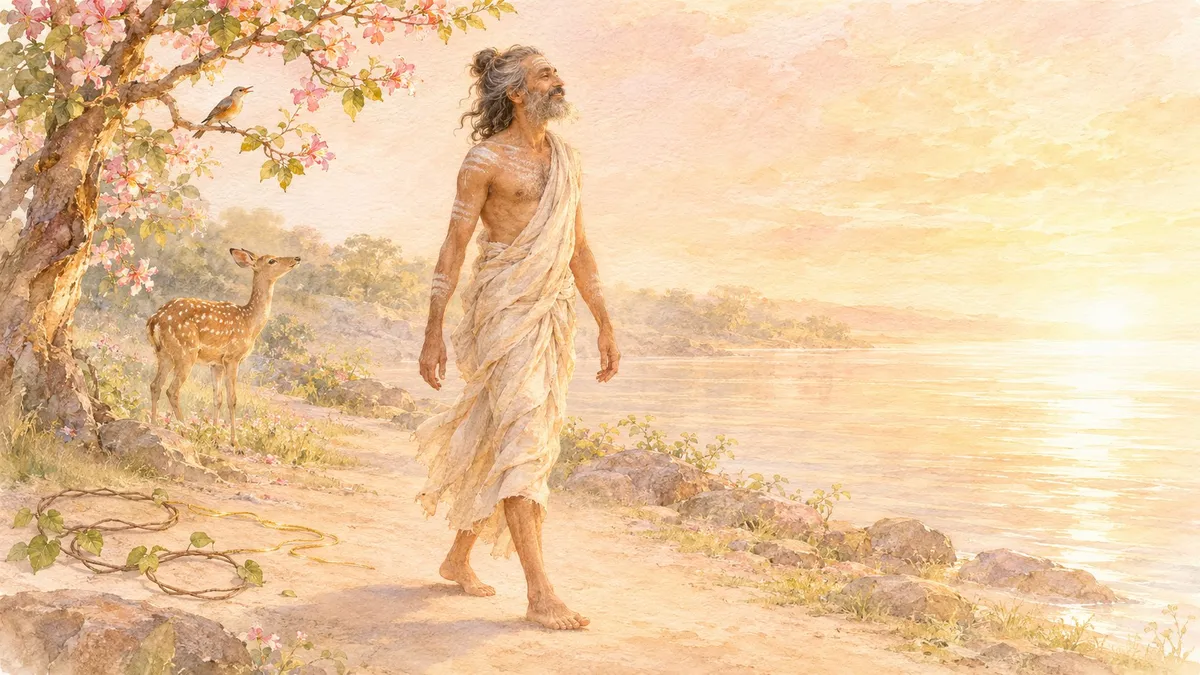
There is neither a divine form, nor a human one, nor an animal one, nor any other. It is said that a yogin who has attained liberation while still alive assumes any form.
Thus ends the sthala “the one who is not defiled by the body.”
The Sthala “The One Who Is Unaware of Himself and Others”
How can one who has completely dissolved into the splendor of non-duality, into the incomprehensible Brahman-Consciousness, know oneself and others? Yogis become one with the supreme Shiva-Brahman, consisting of pure consciousness. It assumes all forms. It is the eternal truth, the supreme space. When unity is attained, there are no erroneous notions of differences between “I” and “you.” There is neither union (yoga) nor separation, no fabricated ideas about the knower and the object of knowledge, neither bondage nor liberation, no conception of oneself as a deity and so on, neither happiness nor suffering, neither knowledge nor ignorance, no notion of better or worse, neither above nor below, neither in front nor behind, nothing either far or near. For such great saints, how could there arise the foolish joke of awareness of oneself and others?
Divided awareness, which separates “I” from “others,” is nothing more than a foolish joke, yet living beings constantly suffer because of this foolish joke, and for them it is no joke at all, but the very real solidity of samsara, which brings great suffering.
Developing Vimarsha-Shakti
How do we advance along the path of this awareness? We strive to remove concepts, especially impure ones, to free our minds from concepts and abide in awareness beyond concepts. Once awareness beyond concepts has become established, we acquire a certain vimarsha-shakti (the power of self-liberation). After that, we must hold on to this vimarsha-shakti and apply it always and everywhere. For example, when we encounter dualistic notions of the mind, karmic desires, or tendencies, we must constantly remember and renew our vimarsha-shakti so that it dissolves within us everything that should be dissolved.

Gradually, vimarsha-shakti gains strength, becomes divinized and spiritualized by descending grace, and becomes flexible. Flexible means that at any moment we can manifest vimarsha-shakti in relation to any object or any situation. In such a case, it is said, “Any situation is the path and is suitable for practice,” or, “Any posture is suitable for contemplation.” Previously, our vimarsha-shakti may have awakened only after several hours of concentration, meditation, or japa, and remained only in a thought-free state during mauna, while sitting in sukhasana or siddhasana; and as soon as we stood up, ate, walked, or spoke, vimarsha-shakti disappeared and the power of self-liberation was lost. But now our power of self-liberation depends on nothing and is with us at all times. This is progress on this path.
Next, the yogi must temper the power of self-liberation. Vimarsha-shakti is trained just like the muscles of the physical body, but to do this, we must apply it constantly, and to apply it constantly, we must remember it constantly. When we remember it continuously, then at the moment of any action or any perception, our power of self-liberation (vimarsha-shakti) comes first, followed by the action or perception. If our vimarsha-shakti is delayed, then the action will not be self-liberated, nor will the perception.
For example, there are currently debates on the internet about where the moon has disappeared to. No one has seen the moon for a week. People are saying in all seriousness that there is no moon in the sky. People from Germany, America, and Australia are already corresponding with one another about it in all seriousness.
Others say, “Read your school astronomy textbook; it explains the phases of the moon. It is simply a new phase, the new moon: the crescent is not visible, and after a while I will bring the moon back for you.” That is what they say, and if you lack self-liberation, you absorb any piece of news, and it takes hold of you. The news colors your mind; first comes the news, and only then your vimarsha-shakti—it lags behind. Or you have some experience: the sun rises in the east, and you admire the sunrise, and only afterward does vimarsha-shakti unfold. This is the impression of the ordinary dualistic mind. But if you possess vimarsha-shakti, the power of self-liberation, the power of clarity, of discerning emptiness and the light of non-duality, comes to the fore first, followed by the perception of the sun or the news that the moon has disappeared somewhere.
In the first case, any news, any perceptions are imprinted on the mind and leave indelible impressions upon it; like carvings in stone, they remain for a very long time. But when your vimarsha-shakti is active, they are like ripples on water: they do not take root. Whether it is a bad or good thought or word, it does not take root, does not form experience, does not become your karma, and does not produce karmic reactions. This is self-liberation through the generation of vimarsha-shakti.
A Sadhu as a Generator of Vimarsha-Shakti
A sadhu, if he is a true contemplative, is a continuous generator of vimarsha-shakti; he is an accumulator of vimarsha-shakti (the power of self-liberation). This power is invisible, but when he applies it in certain situations, it can become visible. For example, if you find yourself in a dream and certain events occur within it, as soon as you enter a deep state of awareness, the dream dissolves. You freely transform the dream or, from the dream, immerse yourself in the state of light.
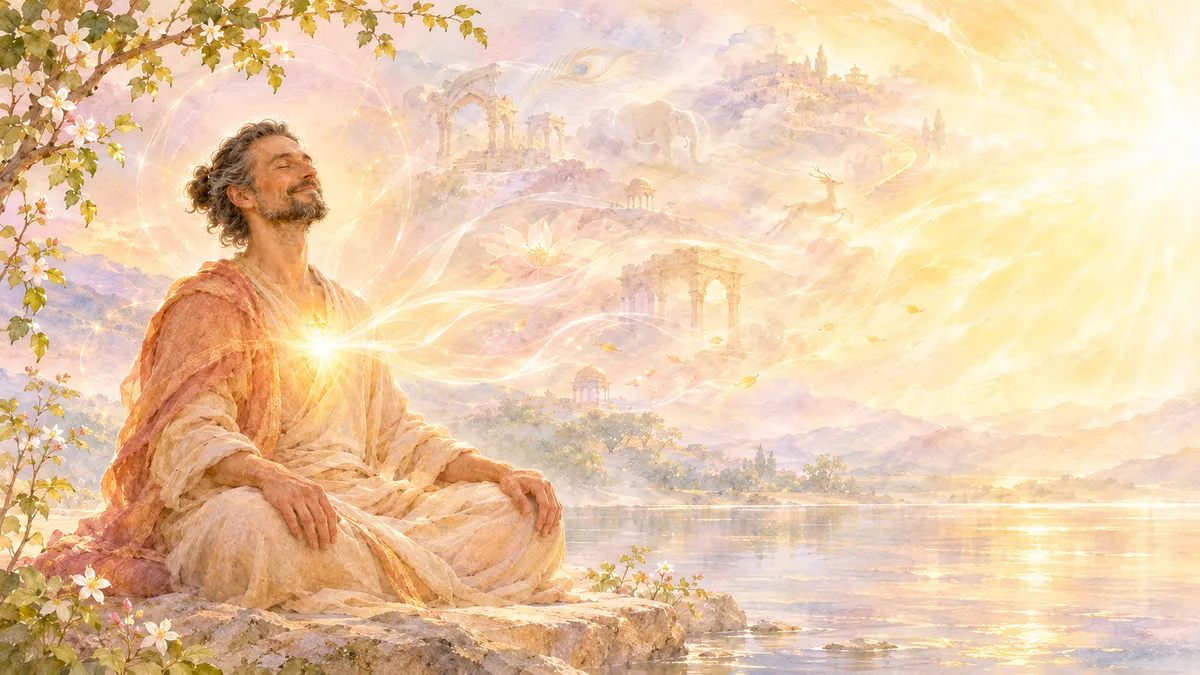
Leaving dreams and entering the light, then emerging from the light through a seed syllable, visualizing an illusory body and a pure land, becoming enthroned as a deity upon a lotus throne in the palace of the pure land, and then once again dissolving all this through the power of vimarsha-shakti, immersing oneself in the light once more and deepening the qualities of that light—the yoga of the illusory body is built entirely upon the use of vimarsha-shakti. Therefore, yogis who have mastered it are free from birth in any of the worlds of samsara; they dwell in the dimension of light and form an illusory body at will in any world. All this is the action of vimarsha-shakti (the power of self-liberation and self-awareness).
Conversely, one who does not possess the power of vimarsha-shakti is overwhelmed by various other, coarser shaktis. For example, the shakti of the five elements of nature, the shakti emanating from obstructing planets (grahas) and spirits (vighnas), the shakti of one’s own karma, and the shakti generated by the energies of one’s own body.
The yogin has immersed himself in radiance unlimited by place and time; therefore, he is aware of neither himself nor others. This state is known as the sthala of “absence of awareness of oneself and others.”
Thus ends the sthala of “the one who is aware of neither himself nor others.”
