


“My Lord! This is the wonder of wonders!
When I looked upon Your radiant feet, they blinded me with the brilliance of countless suns. But when I embraced them, they were as tender as the gentle rays of innumerable moons.”
What does it mean to look upon the feet of God, which blind us with the light of millions of suns? This is a metaphor, but behind the metaphor lies a reality, and it is very important for us to understand what spiritual reality Sri Ramalinga is speaking of. What does it mean to look upon the feet of God? Where are His feet? What are His feet?
We look upon the feet of God when we discover within the stream of our consciousness something transcendent, something beyond the five sheaths. As long as we remain within the five sheaths, we cannot see the feet of God.
The feet of God are not the body, nor are they prana or the astral body. We cannot say, “My subtle body slipped out of the physical one, I left my cell and saw the feet of God.” Nothing of the sort. Any saint will tell you: those are not the feet of God. You may become a skilled sorcerer or occultist, but you have not seen the feet of God.
The feet of God are not the mental body. You may see an angel, a deity may descend to you in radiance, but these are not the feet of God. Everything may seem utterly real—the heavens may descend to you—but these are not the feet of God; this is still the mental sheath. You may experience an unprecedented expansion of consciousness and feel, “I am the cosmic spirit,” but even this is not yet the feet of God. This is the causal body; these are your sheaths; this is all still you.
It is still you and your karmas, and where there is you with your karmas, the feet of God are not yet present. But when you pass through all of this, through the five sheaths, you will behold boundless, unprecedented, indescribable consciousness, filled with light. It does not depend on wakefulness, dreaming sleep, or dreamless sleep; it is turiya, the fourth state, and this may be called the feet of God.
The Upanishads describe five spaces; these descriptions of the spaces are a secret, a key pointing to the feet of God. Guna-rahita-akasha—the space without qualities. Tattva-akasha, surya-akasha, maha-akasha, and param-akasha. Ramalinga describes these five spaces as we approach the feet of God, and they blind us with their dazzling radiance.

Why do they blind us? Because the “I” is still there, karma is still there, the ego is still there, and it trembles and fears this radiance. You may glimpse this radiance, open yourself to it for a moment, but then you will recoil—the “I” is not ready; this is transcendent, something incredible. I cannot remain near it even for a second; I am not yet pure, I am not yet holy. You will recoil from it—it will blind you. But again and again you will hold on to it, remember it, purify your heart, and sooner or later you will be able to stand at the feet of God. To stand in the hope of seeing not only the feet, but also the face. This is what Ramalinga says.

Embracing the Feet of God
“As I contemplated them, losing myself, their sweetness was like honey mixed with milk, but when I embraced them, they were as tender as the gentle rays of innumerable moons.”
What does it mean to embrace the feet of God? It means to unite with this divine Light, to merge with it, to surrender oneself. It is impossible to embrace the feet of God and remain as before—a personality, an ego. The one who embraces the feet of God disappears; the price is the disappearance of our ego. Complete self-surrender, complete submission, the complete severing of all clinging, attachments, illusions, and concepts.
To embrace the feet of God, one must be ready; one must renounce the material world, renounce all hopes placed in the material world, renounce all hopes placed in one’s own ego—in the idea that I am so beautiful, strong, skillful, wealthy, and charming. One must look upon all of this as an illusion, as nothing. Only then do you gain the right to embrace the feet of God.
This is the lot of saints; no one is ready for it right away. We prepare ourselves by gradually purifying ourselves throughout our lives. We must renounce all ambitions, renounce all claims, and repay all our karmic debts—and everyone has accumulated quite a few of them. These debts merely wait and slumber, thinking: all right, he is now under the guru’s jurisdiction; we cannot approach him, we are frozen and cannot act. But we will wait: as soon as he turns toward the material world, as soon as he makes a mistake, we will demand full payment from him.
These debts slumber in a sadhu’s subtle body, and an experienced sadhu knows this. He is always vigilant, always on guard; he is no fool. He does not allow himself to succumb to emotions or follow his mind. He knows: my karmic debts are sleeping, and the moment I become distracted, the moment I show weakness, the moment I display my selfishness, I will be presented with the bill and immediately become a slave to karma. But a true sadhu is always vigilant.
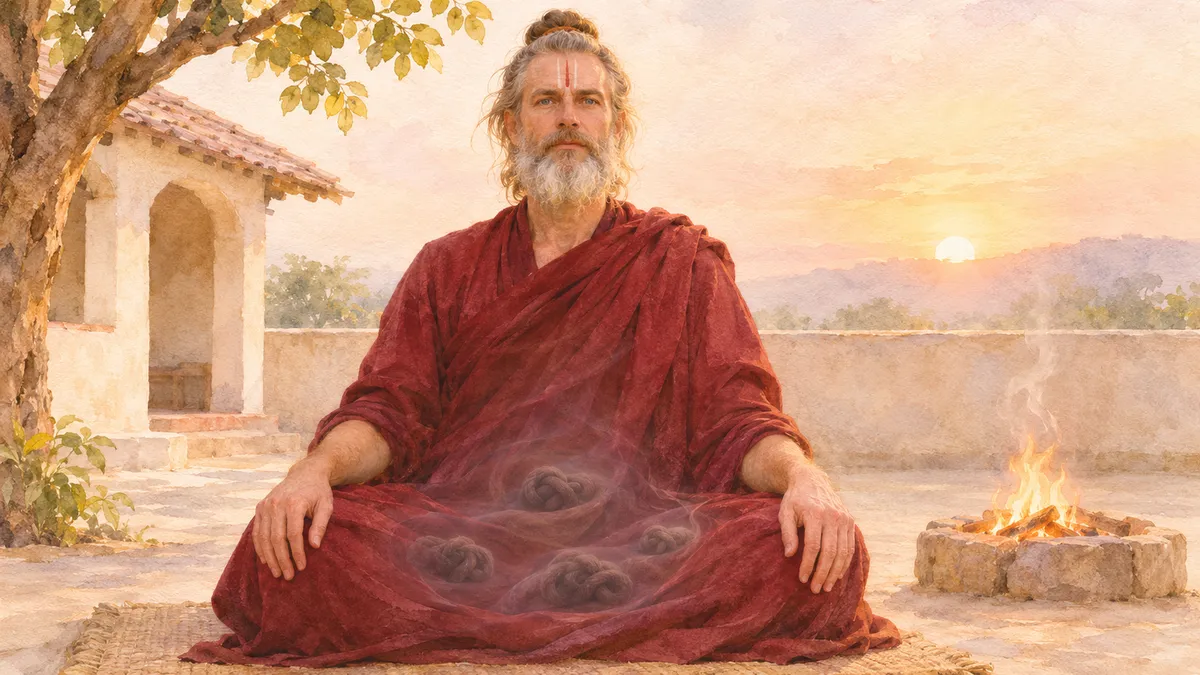
Always be vigilant, always be on guard, no matter what is happening outside. Someone insults or scolds you, bows at your feet, gives you gifts, or, on the contrary, treats you with contempt as though you were dirt—what difference does it make? What concern is it of yours? Is that what you came here for? If you call yourself a sadhu, regard everything as pebbles or dirt. Regard gold in the same way, as your guru teaches. And whenever something happens, simply recall these instructions—what difference does it make? Your task is to realize God.
If you have embarked on the spiritual path, your task is not to find a new attachment or a new lover—there is plenty of that in the world—not to find new wealth, assert your ego, display your authority, demonstrate your power or charm, or prove yourself. You must be true sadhus within. If you have this strength and understanding within you, nothing external will be able to provoke you. You always remember your path: that you must embrace the feet of God, and this is the most important thing. And you will always strive to embrace those feet of God.
Acquiring Spiritual Merit (Sukriti)
To catch even a fleeting glimpse of God’s feet, to gain some spiritual experience, one needs sukriti. What is sukriti? It is spiritual merit. There is also dushkriti—a collection of sins, sinfulness, the accumulated potential of sinfulness. Sukriti comes from “kriti,” meaning action, while “su” means good. When we do something good and beneficial for dharma, for the sangha, for sadhus, for saints, we accumulate sukriti, spiritual potential.
There is punya, and there is papa. Papa consists of sinful actions; they cause us to accumulate dushkriti—sinful potential, sinfulness. Punya causes us to accumulate sukriti; punya is a good action. But sukriti does not refer to just any good actions; it specifically means spiritual merit. It is precisely that which increases our divinity, our spiritual good fortune. It is not good worldly karma. One could say that it is a particular tattva that characterizes our spiritual capital.
What are spiritual merit and spiritual good fortune? For example, understanding sacred texts well; possessing an innate faith that does not need to be cultivated, because it is naturally present; always distinguishing truth from falsehood, both externally and within oneself; finding a guru and a good teaching at the right time; comprehending the meaning of the sacred scriptures while reading them; controlling the senses and the mind; and having a connection with sadhus, deities, and saints—all this is sukriti. In other words, sukriti is a store of spiritual virtue, piety, and spiritual good fortune.
Sukriti, spiritual merit, may be acquired consciously or unconsciously. Conscious merit is called gyata-sukriti, while unconscious merit is called agyata-sukriti. For example, suppose someone digs a well near a village, and everyone drinks from that well. He has accumulated good worldly merit. This is not a sinful act; it is a virtuous act performed for others. He has accumulated positive karma, but it cannot yet be called sukriti. However, if there is an ashram nearby where sadhus live, or especially if a saint lives there, and they begin drinking water from that well, then sukriti begins to take effect. He has unconsciously accumulated this sukriti. He dug the well simply as a good deed for the village, but a saint drank from it, and karmic reactions began to accrue to him; his sukriti began to increase. It is said that even if a dog runs around a temple, barking and frightening everyone away, if in doing so it scares off a robber, then it too unconsciously accumulates sukriti.
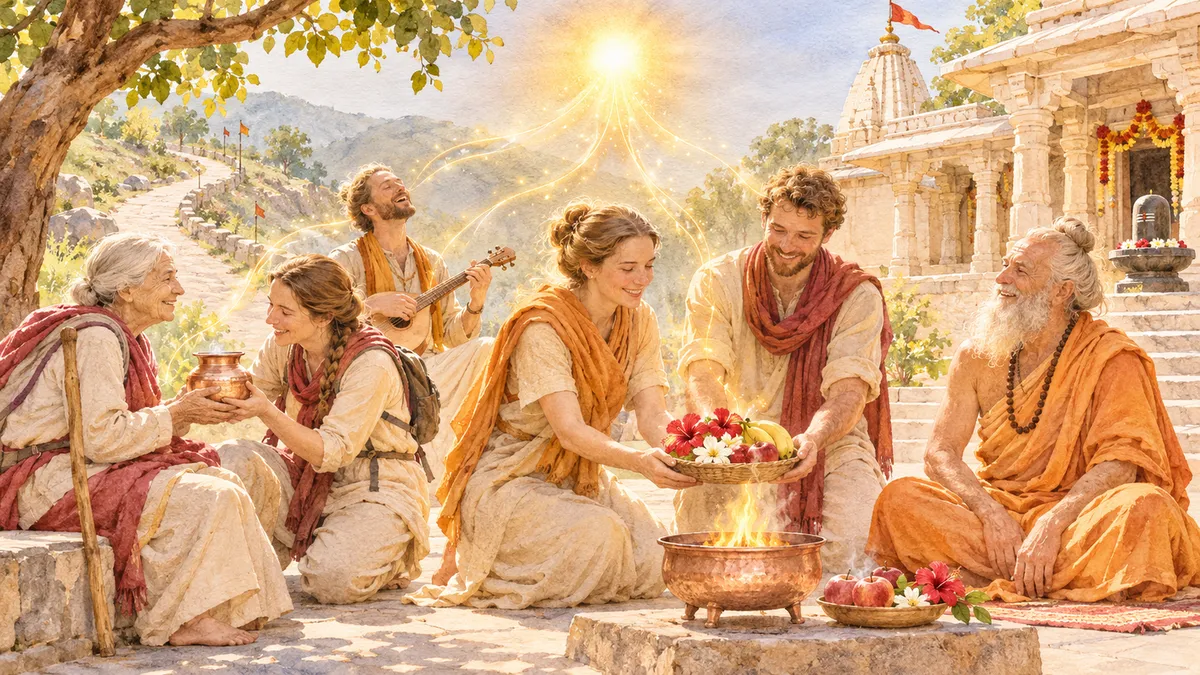
Conscious sukriti accumulates when we experience moments of spiritual service and the merit of spiritual fellowship. Generally speaking, good karma is easy to acquire, but sukriti, good sukriti, is difficult to acquire. Sukriti arises through connection with deities and sadhus. Moments of spiritual fellowship, when an elevated experience arises during a bhajan mandala, collective practices, or the invocation of saints, also increase sukriti. Pilgrimages, offerings... Sukriti can be called Divine power. Saints and siddhas are those who possess great sukriti. Worldly people are those who do not possess great sukriti, or may have no sukriti at all.
Temporary and Eternal Sukriti
There is naimittika-sukriti, temporary sukriti; it is transient, arising and passing away. There is nitya—eternal, permanent sukriti. Temporary merit can be acquired, but it can also be spent; eternal, nitya-sukriti never disappears. It is inherent in divine, transcendental beings, siddhas, and gods; it is not inherent in human beings. Temporary sukriti can arise as a result of spiritual practices, and it can manifest as karma-sukriti, jnana-sukriti, bhakti-sukriti, or yoga-sukriti.
For example, you practice yoga and accumulate a certain spiritual potential, but then you may spend it. You practice contemplation, but it has not yet become firmly established within you, so you may spend that as well; all of this is naimittika-sukriti. Nitya-sukriti is inherent in divine beings. Nitya-sukriti is realized as a result of divine blessing.
A man read the Mahabharata and then the Ramayana, where he read that Ravana had abducted Sita. He was overcome by great doubts, reflected on it, and came to his guru in tears and with many doubts. He said, “If Ravana abducted Sita, does that mean she had such bad karma? Does that mean Sita is not a holy deity? She is Rama’s wife, an ordinary woman, and then her bad karma caught up with her and Ravana abducted her.” His guru said, “Read the Kurma Purana. What does it say there?”
The man read the Kurma Purana, and it says there that Ravana could not even touch the real Sita. The Sita he took was Maya-Sita. Before he abducted Sita, she entered the fire, passing through the protective canopy that surrounded her; Maya-Sita emerged from that fire, and Ravana, lacking true wisdom, did not see the transcendental Sita. He took Maya-Sita and seized her. This Sita was created specifically for the manifestation of Rama-lila; had she not been created, Rama-lila would not have manifested. And she remained with Ravana for an entire year.
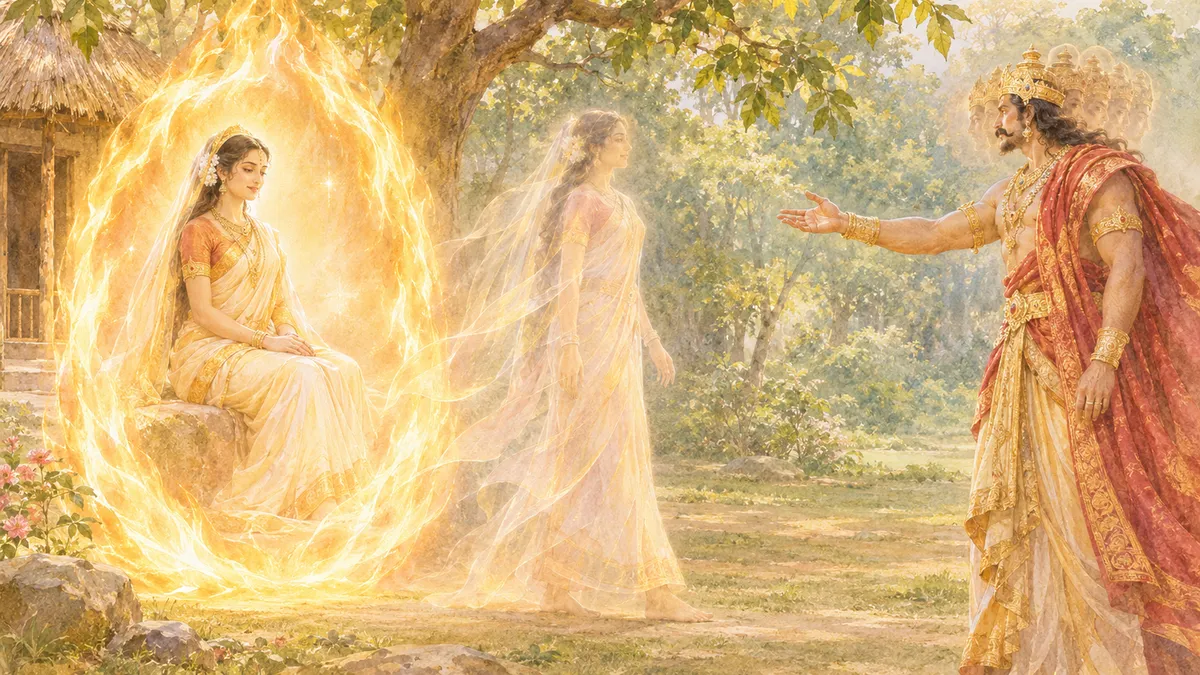
Everyone knows that when Rama defeated Ravana, he said, “Since Sita spent an entire year with Ravana, in a demonic family, she might have become impure, defiled.” In Vedic society, matters of purity were held in the highest regard, and even personal feelings of kinship could not be taken into consideration here. It is said that, as a test, Sita entered the fire and emerged from it, proving that she had not been defiled and was pure. And when she entered the fire, it was Maya-Sita who entered it, while the transcendental Sita, who had never disappeared and whom Ravana could not even touch, emerged from the fire.
One could say that Sita was a multidimensional being, and one Sita, like her quantum copy, went to serve Ravana, to participate in Ravana’s lila. The other Sita, in an alternate universe—the original transcendental Sita—always remained pure, and she was reunited with Rama. Ravana could never touch her. This is an example of what nitya-sukriti is. Nitya-sukriti means “it can never be spent.” It cannot be touched; it cannot be obscured or defiled. Temporary sukriti can be destroyed, while nitya-sukriti is inherent in divine beings. Therefore, even when they act, they do not act.
The Power of Sukriti
To acquire the ability to see God, we need sukriti.
Sukriti is continuous spiritual merit. Right conduct, right thinking, sadhana, service to sadhus, self-control, observance of samaya, invocation of divine beings—all of this contributes, as it were, to the accumulation of sukriti. Sukriti can be transferred, but not eternal sukriti, not nitya-sukriti; rather, temporary sukriti, naimittika-sukriti, can be manipulated. It is like a bank account: if I have a thousand dollars on my card, I can send it to you, and you can fly to India.
Some saints sometimes bestow part of their merit, transferring it to certain people and offering them sukriti so that they may advance spiritually along the path. Naimittika-sukriti can also be lost if a person makes a mistake. For example, one may have accumulated yogic sukriti through the power of tapas, but then curse someone, and all the accumulated tapas, all the sukriti, is spent on that curse through this foolish act.
Once, a saint blessed a dying man through the power of prayer. When the dying man approached the gates of heaven, demons came and began demanding some kind of payment from him. Suddenly, he saw a glowing pouch appear beside him, and an angel appeared and said that the saint who had blessed him had sent him this glowing pouch: take a little from it and pay the demons. He did so, and they let him pass. And wherever he encountered various demonic checkpoints, he took a little from the pouch and paid the demons, and in this way he reached heaven—the pouch was enough. This is an example of how sukriti can be distributed.

Sometimes black magicians or sorcerers do the opposite: they take part of the sukriti from one person’s destiny and give it to another in order to improve that person’s destiny at someone else’s expense, or they take it for themselves. But spiritual sukriti—the spiritual power you accumulate through self-surrender—is never destroyed.
We begin by accumulating temporary sukriti: through right living, we accumulate temporary spiritual merit and strive to behold the feet of God, striving to attain the transcendent in order to acquire eternal nitya-sukriti, which will never be exhausted. Nitya-sukriti is associated only with blessings; it does not come from the ego or the personality, it cannot be taken away or transferred. It is pure divine Grace; it is Anugraha. Nitya-sukriti is connected with the concept of “lila.” Those who live in nitya-lila—the infinite divine play—such as Brahma, Vishnu, Shiva, Narada, and the siddhas, possess nitya-sukriti. And Ramalinga describes this transition to the divine state, in which merit is never exhausted.
Becoming a Divine Servant
“As I contemplated them, losing myself, their sweetness was like honey mixed with milk. When You, my Lord, mercifully placed them upon my bowed head, my entire being—my body and soul—was immersed in immortal amrita.”
When the Lord places His feet upon our head, we feel His presence. Even if you have no extraordinary experiences, visions of light, or anything of that kind, but your heart is purified, your awareness deepens, and dualistic notions dissolve, then it can be said that you are close to His feet and intuitively find them. It is believed that one who has found the feet of God is somewhere at the stage of conception. Even if you have no profound meditative experiences, but continuously abide in conscious presence, it can be said that you are always walking around the feet of God—you are performing parikrama, and sooner or later you will fully grasp and behold them.
“For the sake of Your poor servant, You wearied those lotus Feet, coming here in eternal glory, and blessed me with Your grace.
O Lord who dances in the heart of reality!
The wonder of wonders is Your great grace bestowed upon Your poor servant.”
Awakening and liberation are always grace, and Ramalinga calls himself a “poor servant.” Ramalinga, one might say, is very rich in spiritual gifts, incredibly rich, yet he calls himself a “poor servant,” because before God’s riches, even the greatest saint or deity is poor. He is a “servant” because he has surrendered himself completely to the divine will.
The Path of Divine Service
Each of us, if we aspire to know God, must try to consciously become a divine servant, a conduit of the divine will. Not a resistor or a semiconductor, but a pure conductor, the purest possible conductor, and when you succeed in this, you will continuously receive divine blessings. Eventually, you will discover that Self-knowledge is awakening in your heart, while the body and mind should naturally be servants of the divine Self. The mind should never be king; it should be a minister or servant.
All living beings in this world are slaves to their ego, slaves to their mind. But a sadhu is one who brings about a revolution and frees himself from the power of the ego and the mind. Such a revolution is called the taming of the mind.
There are four signs that the mind has been tamed: you are happy in any place, with any food, in any clothing, and in any situation. If you are happy under all four conditions, then it can be said that your mind has been tamed to some extent and that you are no longer its slave. If the room is ten degrees, you are happy; if the room is forty degrees, you are happy as well. The body may not be very happy, but inwardly you do not suffer. This means that you are no longer a slave to the mind.
But if someone can make you lose your temper, if you are easily intimidated or, conversely, embarrassed, or if someone can arouse disgust, hostility, dejection, self-flagellation, self-abasement, or, conversely, pride in you—if someone can play upon the subtle strings of your soul or entice you—then you are a slave to the mind. A sadhu is one who strives to free himself from the power and dictates of the mind. On the one hand, the mind is a conglomerate of pranas, the conceptual mind; on the other hand, it is the entire universe of samsara, because the mind, too, is infinite. One can become the master of this mind only by breaking through into the state of “no-mind,” into the consciousness of God.
The Story of Savitri and Satyavan
There is a story about Savitri and Satyavan. One day, through her tapas, Savitri, Satyavan’s wife, learned that her husband was destined to die. They went into the forest to gather firewood, and she was already watching him closely when he said, “My head hurts for some reason; let me lie down.” She was already prepared for this. He lay down and rested his head on her lap, while she wondered what to do. At that moment, the servants of Yamaraja came to take his soul. But because she herself was spiritually strong, pure, virtuous, and possessed a vast store of sukriti, they could not approach and take him away. They complained to Yamaraja, and then Yamaraja himself appeared in person.
He said, “Holy woman, let me take him. This is Brahma’s law, and I am doing my duty, so do not hinder me.” She said, “Yes, this is your duty; you may take him.” And he led him away. But as he was leading away his soul, he saw Savitri following him. He said, “I came to take him, not you. Why are you following me? Your time has not yet come; you must not come here.” She said, “But if I am a devoted wife, then I must follow my husband, and nothing can stop me.”
Then Yamaraja became concerned that the law might be broken. He said, “Go away.” She said, “I will not.” And he could do nothing to her; she continued following her husband. He said, “Very well, let me grant you a blessing, and then you will leave.” She said, “Very well. My parents are already old and blind; may they regain their sight.” He said, “Very well, I grant you this blessing.”
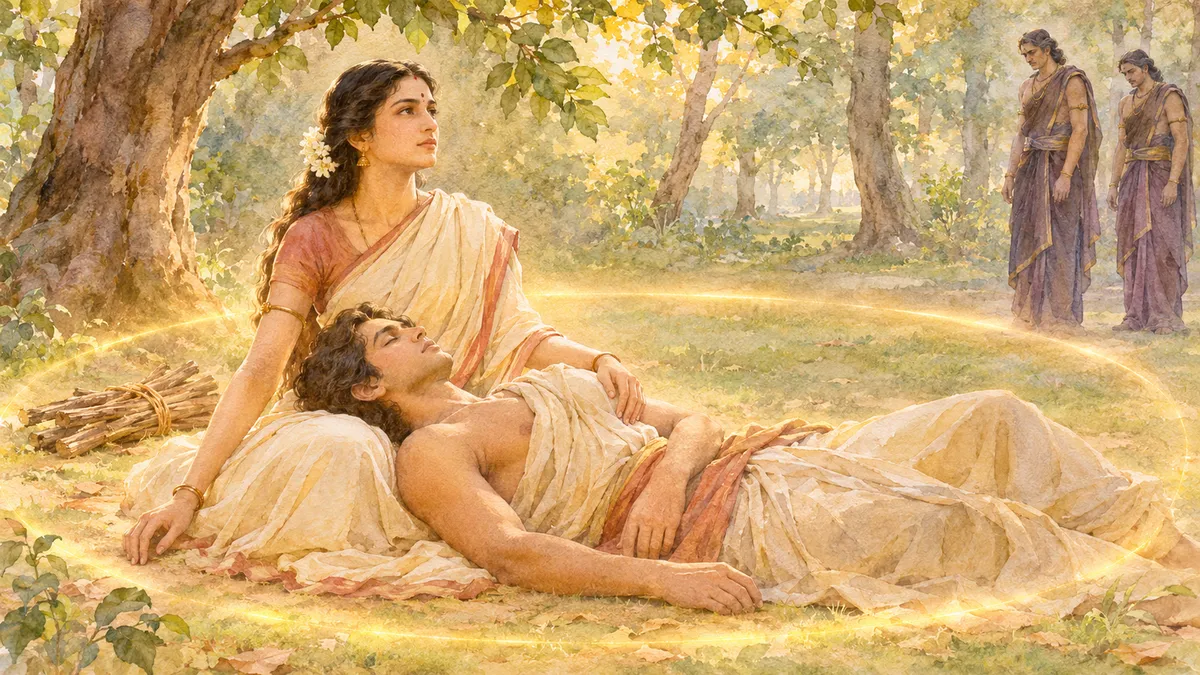
After a while, he looked back and saw that she was still following him. He asked, “What else do you want?” She said, “I am not satisfied.” He said, “Ask for a blessing that will satisfy you, and then you may go.” She said, “Very well. My parents unjustly lost their kingdom (she was of royal lineage). Restore their kingdom to them, and then I will be satisfied.” He said, “Very well, they shall regain their kingdom.”
After some time, he looked back and saw that Savitri was still following him. He said, “You are following me again, although I have already granted you a blessing.” She said, “I am still not satisfied, because if I do not have the company of good people, and if I have no children, I will be unhappy, and who will need me? I will be a widow in this world, and in India the fate of widows is a very unhappy one.” He said, “Very well, what do you want?” She said, “I want one hundred sons.” He said, “Very well, you shall have one hundred sons.”
As soon as he said this, she replied, “Look, Yamaraja, I am a chaste wife, faithful to my husband. You have granted my parents the blessing of having one hundred grandsons and me the blessing of having one hundred sons, but how can I have them without a husband?” He fell into thought... He had granted the blessing without thinking.
And then he said, “I must go to a higher authority—to Brahma, the Creator—so that he may review the matter and make a decision; I can no longer decide this here.” And he went to Brahma for approval, and Brahma said, “Since you have given such a blessing, you can no longer take it back, and since she is renowned for her piety and cannot have a hundred sons by anyone other than her husband, you will have to release Satyavan.” Thus, Yamaraja had to release Satyavan. Satyavan came back to life and regained consciousness. Such is the power of tapas, the power of devotion, and the power of sukriti.
The Elimination of Suffering Through Divine Grace
“Truly, I am infinitely happy!
For I am at the merciful Feet of my Lord, who dwells in the very heart of reality. He has taken away my suffering and granted me refuge.
He taught me how to open the door into the heart of things and behold Him there.”
When we surrender to the divine Source, it cleanses our hearts of the impurities of material desires and eliminates our suffering. Our suffering is eliminated because the light of divine grace cleanses our eyes, and we begin to see all the illusions that had previously held us captive. We discover that suffering did not exist in and of itself; it existed due to a particular cause. This cause was twofold. On the one hand, there was innate ignorance, and on the other, our karma.
At first, Anugraha, the light of divine grace, eliminates innate ignorance, and we realize that we were mistaken. We were mistaken about many things. We considered ourselves to be the body; we lacked pancha-kosha-viveka and could not even discern the Atman analytically. We considered the world to be real; we did not know about the structure of the Vedic universe or that the world is multidimensional. We did not know that our present life is the result of our past actions and past karma, and we were identified with our ego.
When this light of divine grace eliminates this ignorance, all of this becomes clear to us. And this realization arises within us: My God, how foolish I was, how deluded I was, how could I have acted so selfishly, how could I have been so insensitive, how could I have caused others to suffer through my selfishness, how could I have failed to seek God, how could I have failed to think of God, how could I ever have thought about so many foolish and unnecessary things?—it strikes us like lightning. How could I have been selfish and attached, confined to the mind, a slave to concepts, a slave to my emotions?—a profound repentance arises within us because we lived wrongly for such a long time.
But on the other hand, at the same time, great joy arises: what happiness! On the one hand, I was foolish, but that is no longer really me; it is all in the past, it is another, former self, while I am different now. And I am indescribably fortunate—what happiness that I have discovered the Dharma, the sangha, the guru, the scriptures, and the practice, that I have discovered the divine within myself, and that I have finally understood what wisdom is in this world. What happiness that I have awakened! Such a sadhu no longer walks—he sings; he is always leaping and dancing for joy. If he is not leaping and dancing, then he has not yet reached this point.
In the face of this happiness, all everyday troubles and personal relationships pale into insignificance; all of that is trivial, because this happiness leads to nitya-sukriti, infinite eternal merit, and to an entirely new eternal life. No material things or relationships can lead a person astray anymore; everything external that we do is now simply like a game, a variety of lilas. This eternal happiness can no longer be shaken; a person may be naked, barefoot, and hungry, yet he will still leap and dance for joy. For he acquires imperishable capital, such wealth that can never be squandered, provided that one handles it properly.
Finding True Refuge
“The Lord does not accept the songs of those who do not seek Him in His omnipresence. But He graciously accepts my songs, the songs of His poor, stammering servant.
He also accepts the songs of those who have made nonviolence their inviolable rule, who do not take the lives of others or partake of flesh. Despite my flaws and shortcomings, the Lord does not reject me.
How happy I am! For I am at the merciful feet of my Lord, who has taken away my suffering and provided me with refuge.”
Ramalinga says, “The Lord took away my suffering and created a refuge.” These two processes always go together. If it is true sharanam (refuge), your suffering disappears. If you are suffering, it means you have not yet reached true refuge. Whenever you take true refuge, you are free from suffering; you always have ananda (joy), regardless of what you are engaged in or what you are doing—whether there is a retreat or no retreat, all that is secondary. If you have true refuge, you always hold on to the feet of God—this is the meaning of sharanam—you never let go of them, and all your suffering disappears.
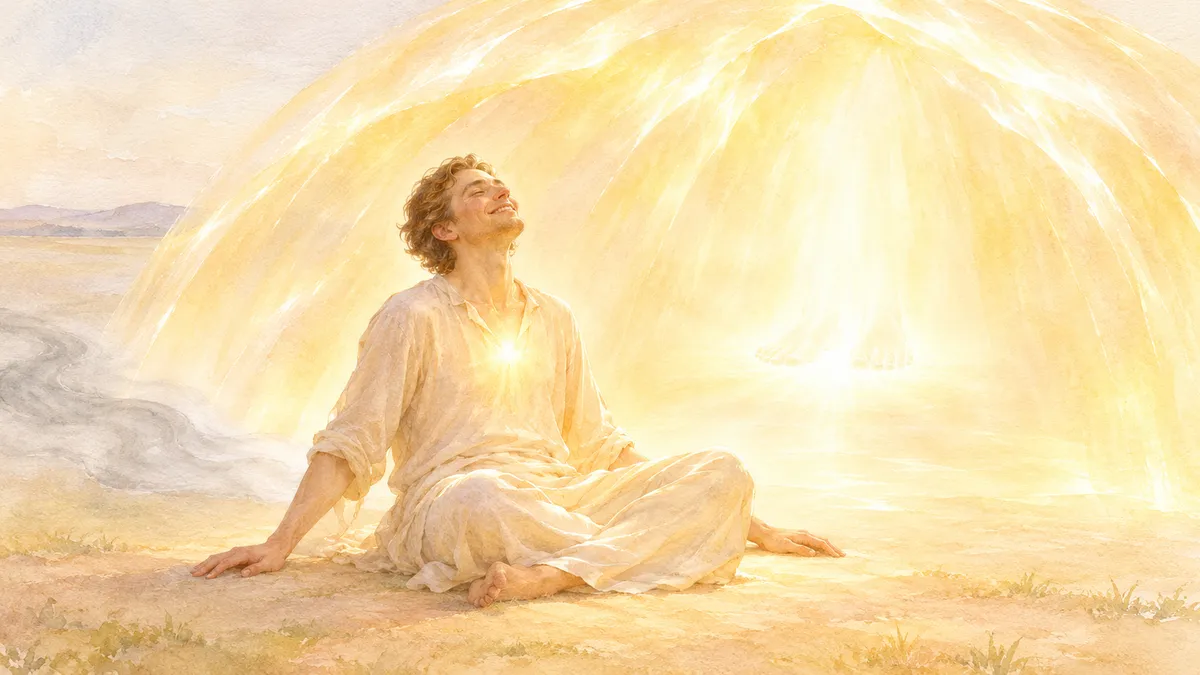
Whether your svadhisthana chakra is blocked or not, whether you have attained the first or second dhyana or not, whether you travel in the subtle body or have never seen anything other than the physical in your entire life, whether your dosha is kapha, vata, or pitta—none of this matters. Do not get hung up on minor details; hold on to what is most important—God—and the main thing is sharanam, refuge, faith. Sharanam, true refuge, will take away all your suffering. There is the Refuge Tree—it is the key, the channel—but true refuge itself has no name and no form. Through the saints, through the Refuge Tree, we reach its essence, and this true refuge takes away all our suffering.
Whether you have a spouse who is a karma sannyasi with wonderful qualities, or you are a single mother, none of this matters. Whether you are a monk or a novice, whether you have a high status in service or not—all these are secondary conditions.
The most important thing is sharanam. You must hold on to this refuge; if you do, all your suffering disappears, because God is the supreme holder of all the powers, all the wisdom, and all the energies of the universe. As soon as you begin to hold on to Him, He bestows gifts upon you, because boundless generosity is inherent in Him. It is like someone whose father is the head of a multinational corporation: it costs him nothing to give his child a hundred million dollars for ice cream every day. If you hold on to God, God does not begrudge blessing you and pouring the nectar of amrita, of Anugraha, upon you. Every day, every second, God’s reserves of amrita never run out. It is not a question of God; it is a question of your orientation toward God, a question of your refuge—sharanam.
