

We begin by developing the right motivation. You must believe in the Teaching you practice; if you do not believe, it is pointless. One of the right motivations is faith: to give rise to faith, constantly reaffirm it, and constantly strengthen it. Without faith, nothing is possible.
If you do not trust a taxi driver, you will never get into his taxi, thinking: “Where will he take me?” If a warrior does not believe in his own strength, he will not win the battle; he will be killed in the first few minutes. He must believe that he will win. Faith is the foundation. If a sorcerer does not believe in his magical spells, they will not work. If you do not believe in the Guru, his blessings are useless. Therefore, the foundation of everything is always the arising of faith.
Of course, true faith does not come immediately, but only after years of reflection, practice, and analysis. Nevertheless, we always give rise to the intention to attain such faith, because without it progress is impossible. The entire world rests on faith.
One man said: “I am an atheist; how can I practice the Teaching?” But if you are an atheist, you cannot practice the Teaching, because practicing the Teaching presupposes the presence of faith. In that case, I tell people: “Then imagine yourself as a believer. All of this is mind: however you regard yourself, that is what you will become. You need to understand that an atheist has no future—that is the point. A believer has a future; an atheist does not. He will become entrenched in his atheism and arrive at emptiness, at the realization that his life is meaningless. After death, he will see how mistaken he was, how he held false views and deluded beliefs.
A Historical Perspective: From Materialism to a New Paradigm
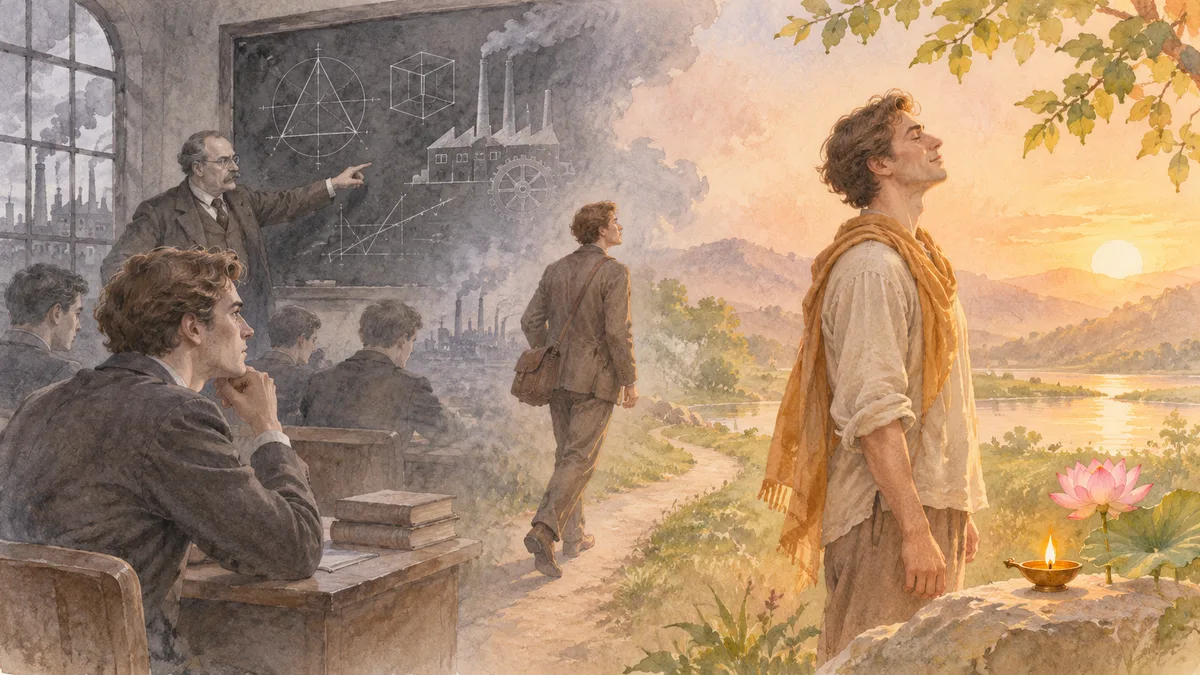
In the nineteenth and twentieth centuries, faith was not popular: the flourishing of science, technology, and positivist philosophy—all of this took an aggressive stance toward faith, and faith was declared blind, while materialistic science was proclaimed the pinnacle of human progress. Professors with shining eyes taught us dialectical materialism, debunking the foolish superstitions of old women who believed in God; cosmonauts would say: “I have been into space and I did not see God there.”
Unfortunately, it is such bad karma of ours that we lived in that period and received such an upbringing; this means that we had insufficient merit: we grew up under communist education, studied in communist schools, followed the philosophy of communism, dialectical materialism, militant atheism, and so on. Frankly speaking, none of this is very good, but on the other hand, we received the lesson of precious human birth; we understood that such an option exists and how valuable dharma is.
We embarked on a search and freed ourselves from false views and false perceptions, arriving at faith in dharma, spiritual practice, faith in God, and the aspiration for Liberation. We understood that materialistic beliefs are a dead end—a dead end in terms of meaning and values; they are the sleep of the soul, the sleep of the mind, a childish state in which you perceive nothing but matter. Having experienced such a sad communist ideology as well as spiritual searching, we can appreciate the Teaching of dharma; perhaps sometimes even appreciate it more than those who have had it from birth.
For example, in India, practicing dharma means going with the flow: there are temples everywhere, holy people everywhere, and it is normal. But practicing dharma in a European country means, in a certain sense, going against the flow; you have to pay a high price for it. This was especially true in the past; now it is not so, and perhaps times will come when dharma will flourish. Twenty years ago, if you said that you were a yogi and professed the philosophy of Advaita Vedanta, you would encounter great incomprehension from society and would have to choose: either society or Advaita Vedanta; one or the other. But gradually, the inertia of thinking in materialistic countries is changing thanks to the spread of dharma; people are embracing the meanings, values, and truths of the teachings of Yoga and Advaita Vedanta, and this is very gratifying.
Thus, everything begins with faith. Such faith must be cultivated, because it does not simply arise on its own; one must reflect deeply and pray to attain it, appealing to the holy ones for such a blessing. A faithless person, one of little faith, or one plagued by doubts is very unstable on the spiritual path; he does not know where to direct his mind.
Quantum Physics and Vedic Wisdom
In the twentieth century, there was an expression, “blind faith”; people said: “Man is blind; he believes because he does not understand the phenomena of nature.” He was afraid of thunder and needed some explanation so that he would not become depressed, so he was told that it was the god of thunder roaring and frightening everyone. This was how people of faith were portrayed. In reality, of course, this is a misconception. The achievements of quantum physics in the twenty-first century showed that all the truths of Vedic philosophy, all the truths of religion, are correct and true, but they were not understood in the eighteenth, nineteenth, or twentieth centuries by people with a materialistic mindset.

The twenty-first century changed humanity’s outlook. People saw that soulless technocratic progress was a path to self-destruction and ruin. In the twentieth century, materialists devastated the environment; the two most terrible wars were unleashed by people with a materialistic, atheistic mindset who did not believe in ideals, did not believe in saints, and denied the authority of sacred texts. The most godless and most inhumane wars were unleashed by people with a materialistic mindset. Nuclear weapons were also used in this century.
The wretchedness and dead end of materialistic progress, the wretchedness and dead end of a technocratic civilization not inspired by higher values—these were shown to people, and people began to wonder whether it was possible to live this way: “We have ruined the environment; we have wars and conflicts; we have reached a dead end in physics because materialistic physics has ceased to provide answers to the phenomena of this world; we have encountered paranormal phenomena and have been unable to explain them.”
A different way of thinking began to stir in the minds of many people, and they began to discard the truths that had been considered immutable in the twentieth century: materialistic philosophy, the denial of religion, and a contemptuous attitude toward it. They began to analyze and develop a new paradigm; today, the new paradigm does not contradict religion. It says that the world is consciousness, that the world consists of will and faith.
The teachings of quantum physics borrow principles from Advaita Vedanta. David Deutsch, Karl Pribram, David Bohm, and other scientists and philosophers, while developing their incredible theories describing the physics of chaos, the physics of quantum entangled states, and the physics of attractors, use the terminology of Advaita Vedanta and see that the saints of antiquity had long operated with similar categories; the only issue was that the human mind was not ready to perceive them and understood them incorrectly.
Today, outstanding scientists speak in approximately the same terms as outstanding saints; there are no contradictions between science and religion. The world is beginning to turn toward dharma, and the word “Faith” is becoming popular and returning. We are finally beginning to understand: “Yes, not everything is determined by the mind; not everything can be known logically and rationally; some things are determined from a deeper level; materialistic science cannot describe every phenomenon. Materialistic science is merely one narrow cross-section of the phenomena of this world—Newtonian physics, the physics of solid bodies. Where we introduce the aspect of time, the theory of relativity and Einstein’s physics emerge. But when we move into an even higher state, the physics of chaos, quantum uncertainty, and probability emerges, and the observer comes into play.”

In the physics of solid bodies, the observer is irrelevant: e = mc² regardless of who is looking. In Einstein’s physics, much already depends on who is moving at what speed. In quantum physics, everything is determined by the observer. A person looks and opens a tunnel into reality, and quantum processes proceed in one way; the Universe branches along one course of events, according to one scenario. Another person observes, and their consciousness changes reality.
Quantum physics arrived at the conclusion that the observer cannot be excluded from physical processes and experiments; the observer is part of the process—it is consciousness, that is, the subject, the human being. It finally proved that there is no reality outside consciousness. Reality exists only because there is a subject, consciousness, an observer who distinguishes and sustains it; the observer is a logical part, a link in this chain. And once there is an observer, we make a sharp leap from matter to consciousness, while consciousness operates according to different laws: it is stochastic, probabilistic, irrational, illogical, multivariate, and ambiguous.
The linear physical world is unambiguous, but in consciousness everything is ambiguous, multivalent, and nonlinear; quantum processes take place there, and it follows different laws. Having understood this, scientists began to say: “If you believe, then your consciousness follows one set of processes, opens one tunnel of reality, and brings to life a chain of certain variant universes; but if you do not believe, it follows another. Therefore, everything is determined by belief; everything lies within consciousness.”
The Principle of Samaya
When we have generated the right motivation and attempted to generate faith, it is important to remember the principle of samaya. The principle of samaya is extremely important. Samaya must be maintained, purified, and remembered every day. Samaya is a sacred connection with the Teaching, the dharma, and the Teacher with whom we practice. For those who do not know the principle of the fourteen samaya vows, I recommend studying them. It is very important to maintain such a connection, purify it, and not violate it, because the highest Teachings are transmitted only through samaya, through the samaya connection.
The samaya connection can be compared to a connection in new technologies: via Bluetooth. If we establish such a connection—I confirm access to my mobile phone, and you do as well—a connection arises between us, and we can exchange SMS messages or MMS messages. I can send you a bhajan or a mantra, and you will receive it on your mobile phone if you have configured the settings and enabled such a connection. The samaya connection means that we establish subtle settings within ourselves: then the Guru sends, you receive, and it manifests in you as well; but if such settings have not been configured or the connection is blocked, the Guru may send, but you cannot receive anything. Information technology is an example of what happens in spiritual life; these are similar processes.

The first four samaya vows are as follows:
The first is to remain in harmony with the spiritual Teacher, to perceive them with pure vision, and not to enter into conflict;
The second principle is to remain in harmony with the Teaching, to respect it, revere it, and value the Teaching that you practice;
The third principle is to remain in harmony with your samaya brothers and sisters (with the sangha), to respect the people with whom you practice, to see them with pure vision, and if this harmony is disrupted, to restore it through purification, repentance, and so on;
The fourth principle is to have compassion for all living beings and not cause them harm.
These are the four main samaya vows; you should remember them so that they are always with you. The Teaching on the fourteen root vows is found in the first volume of the book “Radiance.”
When you become a disciple, you take a vow to observe the fourteen root samaya vows; this is truly important. There are also other principles, for example, not revealing the secret of the Teaching to those who are not ready for it or to whom it should not be revealed; not insulting women, and so on.
When we generate the right motivation, have faith in the Teaching, and reaffirm our samaya connection, this means that before the transmission of the Teaching we have configured the necessary settings; everything is ready for us to receive the message given by the Guru.
When you relate to a spiritual Teacher, always perceive them with pure vision. It is believed that before accepting a spiritual Teacher, you may evaluate them critically, but once you have accepted them, you should regard them with pure vision—as a manifestation of the Absolute, as Dattatreya. Ideally, you should regard yourself and others with pure vision as well. This is the ABC of the Teaching, the elementary principles of dharma that operate in all the teachings of Hinduism and Tibetan Buddhism, as well as in tantric teachings; every teacher will tell you this. In short, respect the samaya connection, respect the Teaching, respect your brothers and sisters in the dharma, and always maintain pure, elevated relationships.
Samskara-Shuddhi: Purification of Mental Imprints
Having generated the right motivation, let us proceed to the practice. Today I want to transmit to you an important practice called samskara-shuddhi. Samskara is a memory, an imprint in the field of consciousness; shuddhi means purification; samskara-shuddhi is the purification of mental imprints.
The world is determined by how we see it and what we think about it. There are people who see the world similarly to you, and there are others who see the world differently. You probably understand that the universe looks different to a Muslim fundamentalist and to you; the universe also looks different to a materialist atheist and to you. There is no single vision of the universe, but rather many tunnels of reality, many visions.

The world through the eyes of a crime boss and the world through your eyes or those of a philosopher-scientist are two different worlds: entirely different meanings, values, and goals. And if we take different classes of beings, is the world through the eyes of the god Indra and the world through your eyes one world or not? These are also two different worlds. Why is there such a difference in perception? Because within us there are different perceptions, different consciousnesses, different memories, and different karmas; it is impossible to see the world in the same way.
Those who see the world in the same way gather together; they feel a kinship. People inclined toward politics gather together; people inclined toward sadhana gather together; people inclined toward criminal activity gather together; people inclined toward extreme views seek out those who are like them. Everything is determined by a shared consciousness.
The Multidimensionality of Perceiving Reality
When I say that the world looks different to everyone, I give the following example. There is a wedding, and it cannot be said that a wedding is an unambiguous phenomenon; if we think it is unambiguous, we will present ourselves incorrectly because we will fail to take the observer and participant into account. A wedding through the eyes of the bride is one thing; a wedding through the eyes of the bride’s parents is another; a wedding through the eyes of the groom’s friends is a third. These phenomena differ in significance depending on who plays what role. And a wedding through the eyes of the pig being roasted for the wedding is something entirely different. The phenomenon is one, but the points of view are completely different, depending on who observes it.

Or take a woman. To her husband, a woman is one thing; to her father, she is his daughter; to her subordinates, she is their leader; and to a child, she is simply a loving mother. And if she practices the Teaching of Anuttara Tantra, someone worships her, seeing her as a deity; to someone, she is a deity. The person is one, but the evaluations are completely different depending on who approaches her. One sees a mother, another a boss, a third a subordinate, a fourth a sister, a fifth a lover, and a sixth a goddess. She is one, but there are so many evaluations.
It cannot be said that one phenomenon is just one thing; any phenomenon is ambiguous and multidimensional, and depends on the observer, on the one who gives the evaluation. Everything is determined by our consciousness; karmic perception is determined by our consciousness.
Karma as the Basis of Perceiving the World
Karma is samskaras, impressions in the subtle body; it is our memories. The nature of the impressions and memories in our subtle body determines how we see the world. The karmic perception of ordinary people is one thing; the karmic perception of the gods sees the world as sacred, luminous, joyful, majestic, and exalted, while the karmic perception of the asuras sees the world as a world of struggle, intrigue, and constant clashes.
If you smile at an asura, he thinks: “All right, he’s smiling—what is he plotting?” And if you start justifying yourself, saying, “No, I’m not plotting anything,” he thinks: “Aha, he’s making excuses; there is a sense of guilt, so he must definitely be plotting something.” If you look coldly, he will think: “He is maintaining his composure; he wants to hide something; there must be some trick.” If you look angrily, he thinks: “This is a challenge.” He simply has this kind of perception; he will interpret anything you do in this way.

And a hell being will see a threat; it will think that you want to harm it, destroy it, or kill it. And how will a hungry ghost see things? Whatever you do, it will think: “He is mocking me,” and will experience this state.
And how will the deity (devata) see it? It will see your smile and think: “Oh, the Absolute itself is blessing me”; if you are in a state of equanimity, it will think: “This is Shiva-Dakshinamurti, abiding in samadhi, giving darshan of equanimity”; and if you are in an angry state, then: “The darshan of cutting off all hopes. What a blessing—such a perfect siddha can integrate wrathful energies.” The deity will always interpret it in an auspicious way.
Pure Vision as the Foundation of Spiritual Practice
There was a saint named Neem Karoli Baba. No matter whom he sat down at the table with or spoke to, he would say of them: “Oh, this is a great saint.” Once, a man who liked to drink sat down at the table, and he said: “A great saint!” Everyone asked: “Baba, why do you say that?” He replied: “Every saint was once a sinner and then became a saint; and every sinner is a saint in the process of becoming one. I already see the saint in him. Why shouldn’t I say so?”
Pure vision is when you see the deity in another person; you do not pay attention to their body—it is all just a shell: skin and bones; you do not pay attention to their mind—it is merely concepts. You see their essence, and the essence is always divine; it cannot be non-divine, because the world is divine, because there is nothing that is not divine at all.
Ignorant people in samsara, in maya, are deceived by shells: skin, bones, thoughts; they are deceived by words, failing to see the essence. But a sage is never deceived; for them, the shell is unimportant. Brahmin or kshatriya, caste, level of education, chandala, dog-eater, untouchable, intelligent or foolish—for them, everyone has the deity within. They immediately perceive the absolute essence; they cannot be deceived.
Karma as Imprints in the Subtle Body
Karma is imprints in the subtle body, memories that determine our karmic vision. An asura has one set of imprints, while a deity has another, which is why they see the world differently. Our memories hold us back. If you have a sense of shame, constraint, fear, guilt, limitation, self-abasement, and you cannot express yourself, it is your karma, your past memories, that are holding you back. Bad actions are bad memories; good actions are good memories.

Memories identify us with a certain tunnel of reality. They can be compared to a photo archive or photo album in our inner computer; each of us has such a photo archive, and it is precisely memories in the form of samskaras, past imprints, and mental traces that determine our self-esteem, our sense of the world, our basic meanings and values, and our future. We are the way we are now because of the memories within us.
If you had the memories of a Wehrmacht soldier fighting in the Second World War, you would now be completely different and would not be sitting here. But we are the way we are now because our memories are the way they are, and the logic of our lives moves forward and is determined by what our memories are like. Whatever is in our archive governs us. The principle is this: we cleanse bad memories, while encouraging and accumulating good ones.
Manifestations of Bad and Good Imprints
If we have bad memories—that is, many negative imprints, or samskaras—then in this life there will be:
an unattractive appearance, a repellent outward appearance
the fate of a loser, poverty
poor artistic taste, low social status
many illnesses, troubles, and constant depression
emotional suffering, negative emotions
undeveloped abilities; learning is difficult
a coarse materialistic consciousness, disharmonious relationships
living in an area with a poor landscape or in a poor country with an unstable regime
delusions (bhranti), an erroneous vision of the world
constant errors in assessing situations in reality
a narrow outlook, little knowledge about the Universe
a lack of understanding of the fundamental laws and principles of the Universe
much impure vision and impure thought
self-doubt and low self-esteem
many coarse desires, coarse manners, uncouthness
lack of ethics and self-control over emotions and thoughts

The subconscious attracts similar friends and life partners, the souls of similar children incarnate, a certain world is formed, and a loka, an environment, takes shape. The upper chakras are closed; it is unusual or even unpleasant to think about God or the meaning of life; it is difficult to develop faith and meditation; one’s thinking is narrow; and in one’s personal life there are quarrels, infidelity, disharmony, betrayal, and insults.
Why does this happen? They say it is bad karma. Where does this karma come from? These are memories, mental imprints from the past; in other words, our photo archive contains such mental imprints, and they lead us into such a perception of reality and into such a tunnel of reality. There are wealthy people whom others envy. There is no point in envying wealthy people: they have accumulated such imprints, and now their imprints are creating such a tunnel of reality. Suffering people have accumulated other imprints; their memories shape their destiny. This must be understood.
If your imprints and memories are good:
pleasant appearance, beauty of form
good fortune in life, a happy destiny
a life of luxury or prosperity, or at least abundance
high social status, the respect of others
a good education, robust health, longevity
no obstacles, great vitality
the ability to recover oneself
breadth, global outlook, refinement, and depth of thought
philosophical thinking, a tendency to meditate
thinking about God and the laws of the Universe, moving toward Liberation
many talents, creative abilities, or siddhis
The subconscious attracts similar people into one’s surroundings, and such a person has a wonderful environment around them.

If we take any talented, brilliant scientist, his life takes place among talented, brilliant scientists; he has accumulated many memories and imprints from past incarnations in which he devoted his life to science (or he may be a star, a creative person, or an artist). These are his past memories, from when he was a gandharva in Indra-loka and accumulated many divine merits; they are now continuing to unfold.
A person has refinement, subtle ethics, aesthetics, and graceful manners; in other words, they are well brought up and have few coarse desires. Their desires are creative in nature; even if they experience them, they do not empty or dull them, because these desires are an experience of energy rather than something base. They are respected by those around them; their relationships are characterized by harmony, love, compassion, purity, and trust; they have wonderful relationships with others.
Their life takes place in a beautiful area, and they easily encounter the Teaching and the Dharma if they have such memories. But if they do not have memories of encountering the Dharma, they live a harmonious, beautiful materialistic life but do not move toward the Dharma. They have the beginnings of pure vision, which they subconsciously understand, and divine pride—in other words, many inspiring thoughts, projects, and plans that arise from their clarity. These, too, are accumulated memories in the repository of inner tendencies.
Purification of Samskaras as a Path to Liberation
We must understand that our karma is determined by samskaras. Liberation from karma comes at the level of thoughts and memory, not at the level of the gross physical body and not at the level of the pranamaya kosha. Even if you train the physical body well, do many asanas and much pranayama, and have a high level of prana, if your samskaras are not purified and there are many bad memories and negative tendencies in the subconscious, you will still be a suffering person with a high level of prana.
Your high level of prana will lead to disharmony, or you may be visited by negative thoughts; this prana will only intensify them and cause agitation of the mind. This also happens. For example, a person seriously practices complex pranayama techniques for many hours, prana rises, impure memories emerge, and then they stop practicing and run to the city to satisfy their desires, driven by those memories.
The task is to purify these memories. On the one hand, we must purify them through the practice of disidentification and contemplative presence. Contemplation must be so deep that it penetrates the subconscious and purifies the records of the chitta archive (the Akashic archive). The space of our subtle body is filled with such records; they should be purified.

For example, if your computer contains a lot of incorrect, negative, or disgusting information that you downloaded carelessly, or that was delivered to you by a virus, the computer will work poorly and experience glitches; its memory will be overloaded, and some programs will conflict. Then all these files simply need to be deleted.
When you purify the records of this subconscious archive, then even upon reincarnation, at the judgment of Yama, Yama and Chitragupta (Yama’s secretary), who review the subconscious archives, will have nothing to bring against you; everything will have been erased. They will want to examine your samskaras, but there will be emptiness there, or only deities. Freedom from karma is when Chitragupta and Yama have nothing to present as a claim or bill against you upon reincarnation—all the files have been deleted.
Seeing Memories and Working with Them
Deities and even good clairvoyants among human beings can see your memories, the flow of samskaras. To do this, one must concentrate and enter the subtle body; then one can see a stream of flashing images and gain an approximate understanding of what is stored in that person’s soul. This is similar to taking someone else’s mobile phone or computer and looking through the downloaded photographs—everything is visible there. In the same way, all these records exist in our subconscious.
If you see that a person has many beautiful memories, very subtle and beautiful slides, you can understand that their life in this world is also wonderful. But if they have many gloomy, disgusting impressions, you can understand that in this life, too, they are obviously not living particularly well; they have many obstacles, illnesses, or problems.
All obstacles, illnesses, failures, and disharmony in material life arise because there is impure, incorrect information in our subconscious; it is precisely this information that controls and attracts all of it.
Accumulating Merit and Practical Methods
What is the accumulation of merit? It is the accumulation of good impressions. Purifying negative impressions is samskara-shuddhi; accumulating merit is creating new, good, and correct impressions. If you have few good impressions, are ill, and want to recover, there is a method: distribute food, or save fish that are about to be killed, or birds; release as many fish or birds as your age.

If a person is ill and is fifty years old, it is recommended that they release fifty birds or fifty fish. If they do this, the illness may disappear completely. What happens? Good deeds—good impressions, good memories—attract other versions of reality; on the physical plane, the elements become harmonized and healing takes place.
It happens that we try to solve these problems but do not understand that the source of our problems lies in the subconscious. If we learn to work with the subconscious, with subconscious images and samskaras recorded in memory, and change them, then we can transform any of our problems for the better.
The World as a Manifestation of Consciousness
The world around us is determined by the workings of our consciousness. People often say that the world is a manifestation of consciousness, but not everyone understands the mechanism. It is precisely this: there are memories, records in the subconscious; they prompt us to perform actions, attract kindred people with the same vibrations, and determine our self-esteem and perception of the world (bhava).
For example, in my stream of consciousness there are certain memories. It is precisely because these memories exist, because they were accumulated earlier, that I am the person standing before you now. If I had different memories, perhaps I would not be here before you. I have memories of past lives, when I was a king in a European state; an incarnation of a siddha; a military commander in the Mayan civilization in the city of Chiaoa, delivering a narcotic drink to residents for rituals; an Egyptian official, a favorite of an Egyptian queen; a Tibetan practitioner; a worldly lama, a local leader in Buryatia; chosen for coronation in the country of Nepal or Bhutan, but never crowned due to a revolution that broke out; a wandering sadhu with magical powers; a priest-politician in Rome; an ace pilot of a spacecraft involved in various conflicts (star wars); an incarnation of a siddha on a vimana, concealed as the head of a vimana; a Guru in India, repeatedly practicing various teachings.
These memories determine the present life. You, too, have many memories, and they determine your life; it is just that these memories are deeply hidden, like a locked photo archive to which you have no access or only limited access. It will be unlocked when your ajna chakra is opened.
Nevertheless, if you perform samskara-shuddhi, you gradually draw closer to these photo archives and can work with them. The method of samskara-shuddhi is very important; it is the purification and transformation of memories.

Creating Pure Spaces
For example, Divya Loka. Divya Loka is created by specific people according to the principles of high spirituality, high ethics, high culture, and high technology. Those who have similar memories are drawn to such a world and take part in it. This is an example of how people with similar karmas create a loka, a space.
If many people learn to purify their memories, they will come together and may transform the earth into a beautiful, wondrous, flourishing world, into a pure country, and the world outside will also change, because the karmic vision of people will determine a new world. We will begin working with the method after the break.
