

Question: Guru, please explain why we, as consciousness, cling so desperately to our old patterns of thinking, desires, and so on, knowing in advance that sooner or later we will have to leave all this behind, and that there is no prospect of attaining worldly happiness, love, and bliss. Spiritual experiences do occur, and we have the opportunity to compare the worldly and the spiritual, yet, as a rule, preference is given to what is small, miserable, and painful.
Perhaps you are the one who should know best why you cling so desperately. The fact is that there is a veiling power called “maya” or “mahamaya.” It acts continuously. And even if we practice diligently, this power acts even more diligently. We may practice twenty hours a day, while it acts twenty-four hours a day without interruption. And until our awareness begins to surpass this veiling power, the tendencies of consciousness will always be obscured and fall into illusion.
Therefore, when you practice, you are fighting not only your ego and your limitations—you are challenging the very universal power, mahamaya or tirodhana-shakti, whose task is to plunge living beings into illusion. This is its game, in which you participate against your own will.
There is another power—Anugraha-shakti. It is the enlightening power that helps the yogin. The yogin strives to secure its support and constantly invoke it into his life. Essentially, there is always a battle between the obscuring, veiling power that plunges the mind into dreams and generates new fantasies, and the enlightening, liberating power—Anugraha-shakti. Depending on whose side we take, the resulting vector directs us toward one of these powers.
Everyone must understand that no living being will simply part with its fantasies and dreams of the mind. For example, if you approach a person on the street and say, “You are immersed in dreams of the mind,” they are unlikely to simply accept it; they may even become indignant. This would confirm that the dreams of the mind are active and that fantasies strongly limit consciousness and hold it tightly. But if you approach a saint and say, “You are immersed in dreams of the mind,” he will humbly reply: “I know, but I am trying to work with them. Perhaps I have not succeeded yet.”
The first sign of awakening is understanding that the veiling power, fantasies, and dreams of the mind exist. This is mahamaya—the great power of illusion that enchants the consciousness of all living beings. It is precisely because of this great power that everything known as the world, samsara, and the universe exists.
In India, Parliament banned the screening of the film The Matrix, saying that the film had borrowed the Vedic concept of maya, Atman, and Brahman and used it for its own artistic purposes. Indeed, one can say that maya, the veiling power, is a gigantic matrix in which all living beings reside. It has no intention of simply releasing the beings who inhabit it. In other words, the yogin who strives for liberation must fight for it.
On the other hand, there are other forces in the universe: the power of creation, the power of maintenance and stability, the power of dissolution, and the power of enlightenment (Anugraha-shakti). The yogin secures the support of such forces on his spiritual path.
Question: How should one understand who Shiva is?
In the absolute sense, he is Parabrahman itself. He is also the deity responsible for the guna of tamas, a Tantric deity, and the patron of all yogins. He is your own awareness. Depending on your level of consciousness, you may perceive Shiva in one way or another.
Question: How should one relate to medicine and modern science from the standpoint of the teachings of Laya Yoga? Can they be rejected on the grounds that they are unnecessary?
No, they should not be rejected. Everything has its place. It is important to understand what is primary and what is secondary. Science deals with its own field. In the relative dimension, this field is beneficial. Why reject it? Contemplative presence does not conflict with anything and can unite everything. We can all place things at the service of the spiritual path so that they may be beneficial.
Allopathy and modern medicine do not conflict with the natural state. The main thing is to know what to apply and when, since each thing may have its own place. When you board a train, you do not ask yourself: “Should I use magical powers and teleport, or should I buy a ticket after all? Would that be worldly or not? Or is traveling by train inconsistent with yogic principles?” You use technological achievements without a second thought and without the slightest hesitation. It is natural. There are no contradictions. The main thing is to understand what is a relative method and what is wisdom.
In the ancient Vedic civilization, science was not separated from spiritual life. Worldly sciences were part of the greater spiritual knowledge of the path to enlightenment and were regarded as a supplement.
The Nature of Creation and Suffering
Question: If this world was created by the power of Brahman’s perfect will, why are there so many worlds and beings suffering in this creation?
We view creation from our own perspective as a kind of linear system, a kind of diagram, thinking that the creator has the same mentality as we do. That is, if we were to make something, it would be straightforward, linear, clearly defined, rectangular, with everyone always being well. Everyone would walk as if on a string, following our ideal plan. Everyone would be happy.
But the consciousness of Brahma the creator differs from the human mentality, since human consciousness is linear, meaning that it thinks within narrow categories. The consciousness of Brahma the creator is highly multivariate, stochastic, and probabilistic. It is not linear; it implies multiple levels and contains an element of probability.
When creators at the level of Brahma create worlds, they grant freedom to their creations, such as humans and other beings. Therefore, people are endowed with free will. Free will means that higher forces do not interfere with human will, allowing a person to seek the path on their own. It is through this that they attain maturity. In the process of such searching, a person often misuses their free will. They make mistakes and, as a result, suffer themselves. On the other hand, they gain experience and learn. It is precisely free will that leads to the emergence of suffering worlds and beings. Due to inexperience, people often misuse their free will and choose a karmic vision in which there is suffering. However, this is part of the divine play and part of the divine plan for the development of living beings.
Another part is that Brahman, when creating living beings, manifests various forces. For example, the enlightening force—Anugraha-shakti. Some beings are carriers of this force, and then the opportunity arises to put an end to the suffering of beings. For example, they encounter teachers, spiritual books, and so on.
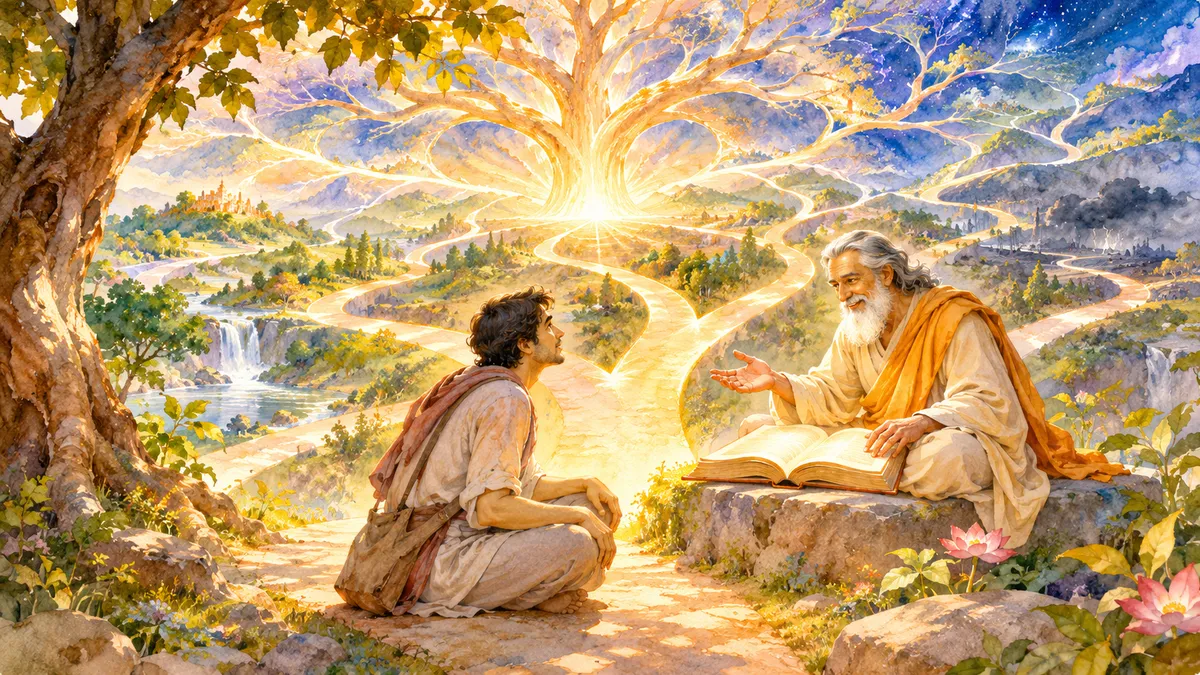
In other words, this world is neither linear nor unambiguously predetermined; rather, it is probabilistic and stochastic, containing multiple possibilities. It is a complex, self-organizing, open system with constant bifurcations. This system is not in equilibrium. A bifurcation means probabilistic branching points where event branches occur, created by the will of living beings themselves. In other words, there is nothing permanent or rigidly defined in the universe; rather, the world is a complex, constantly changing holographic fractal that can be influenced by living beings themselves.
Spiritual Practice in Different Worlds
Question: Many spiritual teachers claim that God-realization and complete realization are possible only on planet Earth. Even gods who wish to advance are forced to incarnate here, on Earth. Is this true or not? How can a yogi practice and attain the highest realization?
When considering spiritual questions, we must always understand that questions concerning spiritual life are very complex and ambiguous. Spiritual practice is like a multifaceted crystal that simultaneously casts many reflections.
It is said that progress is more favorable on Earth and that even many gods are forced to incarnate on Earth. On the other hand, there are pure lands where, as it is said, a person attains liberation within five hundred years without interrupting their life or being reborn. Those who did not manage to attain realization during that lifetime are reborn in a pure land, a magical world created solely by pure consciousness, inhabited only by practitioners.
There are many such pure lands. For example:

- Shiva-loka, Mount Kailash
- Goloka Vrindavana
- Shvetadvipa (the White Island, the pure land of the god Narayana)
- The pure land of Padmasambhava
- The pure land of the god Maitreya (the Tushita heavens)
- The pure land of one of the saints—Gorakshanath or Dattatreya
All of these are specific local areas of reality, equal to our universe. Some of them are small, equal in size to our Earth. However, they contain no gross, decaying elements—mrityu-tattvas. They contain divine elements—divya-tattvas. These elements are subtler than those in the human world. There is no element of earth or element of water; the bodies of living beings consist of light. Living beings in these lands are always immersed in joy, purity, harmony, and love. There they can constantly engage in practice without being distracted by providing for themselves or solving material problems.
It is believed that only highly evolved souls can progress in the higher worlds and develop awareness to the full realization of nonduality. Souls of a lower rank are unable to progress in the higher worlds. They need gross experiences, which is why they have to be reborn in the human world, even if they lived as gods for some time.
For example, a person with many desires comes to a monastery. The energy in the monastery is very even and calm. Everyone is in awareness; everyone knows what each person is doing. There is no conflict, no disharmony, no excitement. No one competes or argues with anyone else. Everything is very good. All the inner work is done within and is imperceptible. There are no external irritants, because an experienced practitioner no longer needs them. Everything is very harmonious.
But if a person’s gross desires have not yet been worked through, they feel that this is a “bland” environment for them. They need excitement, an experience. They still need to grab hold of something somewhere in samsara, get hit over the head by it, become terrified, repent, cry, and turn to it again. And then they feel, “I am living, I am progressing.” But here there is no progress; everything here is unclear. It is not clear what the monks are engaged in internally, because every advanced monk is a deity residing in their own world, in their own clarity, in their own universe. They are not engaged in ordinary relationships, but in traiya-sankalpa. Such a person thinks: “For now, I need to experience some worldly experiences; I would be better off progressing there.”
The same thing happens when a person is unable to maintain awareness and develop in the divine worlds. They need some harsh, wrathful energies, and so they are reborn in the human world on the advice of one of the senior spiritual guides in that world.
The Nature of the Higher “Self” and the Absolute
Question: Please explain: are the higher “Self” of a particular person and the Absolute, Brahman, one and the same?
Yes, they are one and the same. The entire philosophy of Advaita is based on understanding the identity of the jivatman and Paramatman, and of Paramatman and Parabrahman. If I said that they were not one and the same, I would contradict the philosophy of Shankara. But I cannot contradict it, since I myself hold the same views.
The point is that the ego, the “I” of a particular person, ahamkara, is an illusion, a delusion arising from false identification. In reality, it does not truly exist. It is like seeing a rope at night, but mistaking it for a snake and being afraid of that rope all night. But if a person who knows the road comes along, knowing that a rope always lies here and periodically terrifies travelers at night, they could say, as they pass this place, that it is not a snake at all, that there is no need to fear it—it is simply a rope. Did the snake disappear? No, it did not disappear; only the illusion of the snake disappeared. There was no snake to begin with.
Individual existence, ahamkara, the ego, is the same kind of snake that never existed. Yet it causes many different problems and sufferings.

At the same time, the philosophy of Advaita does not deny ahamkara or the manifestation of the ego. In fact, the ego, individuality, personality, ahamkara, is a complete instrument for the manifestation of the will of the Absolute. It does not need to be denied. The yogic ego must develop. In the process of spiritual practice, your best qualities of the yogic ego should develop. In other words, you become more intelligent, developed, intellectual, harmonious, and wise. Nevertheless, you do not identify with this, because all your qualities arise from awakened awareness, and in awakened awareness itself there is no such state.
In other words, we develop and nurture ahamkara as a perfect instrument and apparatus for action in the relative world. On the absolute level, of course, they are one and the same. Multiplicity is an illusion, a delusion. There is only unity. But when, from within unity, we recognize multiplicity as a playful manifestation, as the creative expression of Shakti, such multiplicity can be entirely acceptable.
One must understand the difference between multiplicity as an eternalist concept and multiplicity as an ornament, as a play of creative manifestation arising from nonduality. If we accept multiplicity as an eternalist concept, this means that we adhere to dvaita, the dualistic concept. And any dvaita, any duality, is always an illusion, since samsara consists precisely of duality. But if we recognize multiplicity not as an eternalist concept, but as a creative manifestation of the Absolute arising from nonduality, then such playful multiplicity is the creative diversity, the probability of the Absolute. This is already lila (play) and the manifestation of the mandala.
One must understand the fundamental difference between multiplicity in dualistic teachings and multiplicity in the teaching of Advaita. Many people, not understanding this principle, criticize the teaching of Advaita, believing that the nondual vision takes away diversity from the manifested world. Nothing could be further from the truth. On the contrary, it develops it, allowing one to look at diversity from nondual consciousness. This is a fundamental point.
Collective Consciousness and Divine Governance
Question: Is the collective consciousness of people a part of Brahma’s consciousness delegated to govern each individual person and other parts of the Earth and the universe?
A part of Brahma’s consciousness is delegated to deities empowered to govern. Collective consciousness does not exist by itself; it is always someone’s consciousness. For example, there are deities who patronize particular teachings, while other deities patronize particular sciences, cultures, and arts. The task of still other deities is to maintain balance in the Universe, the Solar System, or on Earth. The task of other beings is to direct the development of animals and plants. And the collective consciousness of a family, ethnos, nation, species, or race is always the consciousness of some deity. It is through deities that the Creator’s authority is delegated.
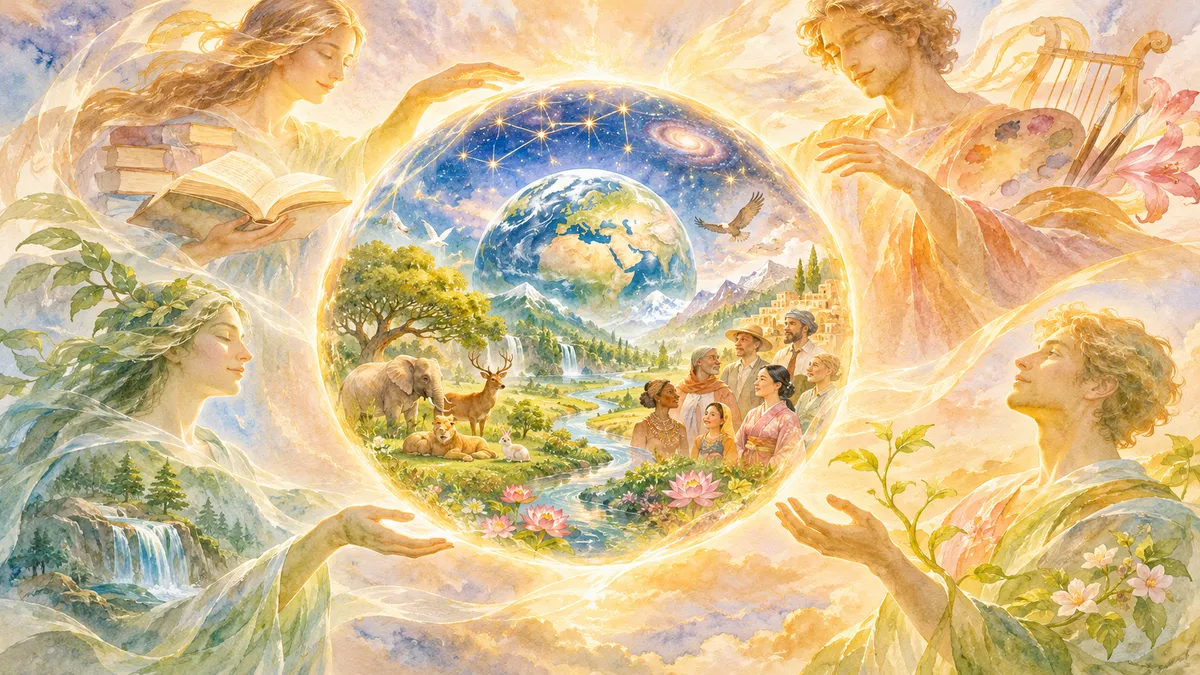
But from the absolute point of view, the Creator, the deities, and the manifestation of consciousness are in fact an illusion; they are manifestations of the same Brahman. There is only one infinite consciousness, and the eternalist assumption of multiplicity is not the path of awakened vision. If we believe that the deities and even the Creator exist as some self-sufficient beings or personalities outside our consciousness, this means that we have failed to understand the sublime perspective of Advaita. All of this is a manifestation of the same “I.” There is only one infinite consciousness. Deities and humans, spirits and demons, hells and heavens are different reflections that exist within this one infinite consciousness.
Question: Is it possible to perform certain meditations, such as Mahashanti, while lying down?
Of course, you can try. When sitting, your legs become numb. This takes you out of the meditative state. However, it is better to perform them while sitting, because if you practice while lying down, prana circulates in such a way that there will be no result. The only exception may be Mahashava Mudra. It is performed while lying down, but one must master it well.
Three Aspects of Spiritual Practice: View, Awareness, and Action
Thus, there are two basic concepts or dimensions when we speak of action: lila and karma. As you know, the teaching has three principal aspects: view, awareness, and action. During this retreat, we tried to understand what the view is.
When, on the intellectual and nonconceptual levels, we awaken clarity and gain an understanding of self-recognition, the perfection and purity of the Supreme Source, and an intuitive understanding of the principle of Advaita, it is said that we have mastered the view. To master the view means to recognize the Supreme Source, the nondual Brahman, in all manifestations.
If you have mastered the view, this still does not guarantee that you have the correct awareness. After all, the view relates more to a philosophical, intuitive vision. It is like a brief flash, when we suddenly understand something.
Awareness is when you try to remain continuously within the view, when you sustain the view without interruption, when your view becomes part of your life.
And finally, action is when you manifest in the relative what you have understood and realized, when certain changes occur in the relative dimension. Let us suppose that your awareness has developed, and you consciously decide to do something in the relative dimension based on your wisdom.

For example, take the siddhas. What do you think, do siddhas live the same kind of life as ordinary people, or not? They live a completely different kind of life. And what is the difference? Their view and awareness are different, and their values are entirely different. This means that their awareness and view have permeated them so deeply that this has penetrated to the external level—to the level of behavior and action.
Two Ways of Acting: Karma and Lila
When we speak of action, there are two ways of acting. The first is when we act in an unawakened way, and the second is when we act in an awakened way. The unawakened way of acting is called karma. Karma arises from the false center—the ego—from the sense of being the doer and of doing. Lila (play) arises from the natural state, from egolessness, from the state of non-doing.
Karma, karmic action, is always attached to results. If you act in a state of play, you have no attachment to results. The play itself (lila) is the result; at every point of action, you are satisfied—this is the crucial point.
As a rule, karmic actions lead to the accumulation of new imprints (samskaras), to the generation of new causes and effects. If, however, you act in a state of play, this leads, on the contrary, to the burning of samskaras and the revelation of divinity within yourself.
Karma takes place in impure karmic vision, in samsara, that is, from an obscured state. All karmic actions arise from deluded action. Enlightened play (lila), by contrast, takes place in the mandala, in a pure dimension where everything is always perfect, divine, and pure.
Karmic actions arise from a mind conditioned by fixed beliefs. They are carried out from past memory, which is a collection of frozen imprints. Play arises from clarity flowing from contemplative presence. It is a spontaneous response.

From the perspective of behavior or action, the yogin’s task is to move increasingly out of karma and into lila (play).
Transformation at the Level of Action
Every time you act unconsciously and selfishly, you are in a state of karmic action. At the same time, when you are in a state of contemplation and awareness, opening yourself to the universal forces of enlightenment, you are in a state of play.
At the relative level, practice must also manifest. If you have been practicing for a long time, but no transformation is taking place at the relative, external level, this means that some inhibition is arising at the level of action and behavior; in other words, enlightened deeds are not developing.
When the view and awareness gain strength, our actions also begin to become enlightened. It cannot be that we attain a perfect view and perfect awareness while our behavior and actions remain obscuring, binding us, selfish, or arising from dualistic vision.
Therefore, to practice means to move out of karma and enter into play. To enter into play, into divine lila, means to begin living in a completely different way, to open oneself to the universal forces of enlightenment, allow them to pass through oneself, and manifest enlightened deeds.
Expanding the Boundaries of Service
Whenever we engage in something, it is always connected with our ego. We tend to engage in what is pleasant for us. We ensure our survival or serve our circle of close people. We serve precisely these energies as we understand them through our dualistic ideas.
But when our actions become enlightened, we begin to expand the boundaries of our “I” and see that serving narrow, mercantile interests does not correspond to the universal course of things. The universal course of things (rita) means entering into interaction with global, greater energies.
The higher a person is on the spiritual plane, the more majestic their spirit, the greater the energies they serve:

- A small-minded person serves their own “I” or a narrow circle
- A person with a broader outlook serves their city and their native region
- A person with an even greater personal scale serves their nation. They think: “The nation and I are one, therefore I am a servant of this nation.” They serve a lofty idea and dedicate their life to the nation
- A person with an even broader awareness no longer distinguishes between peoples or religions, but serves all of humanity and the entire Earth. They believe: “The Earth, humanity, and I are one and the same, so the problems of humanity, its suffering or achievements, are also part of my life.”
- Finally, a person with an even broader awareness serves not only the Earth but all living beings. They believe: “The entire world, the entire universe, samsara, the hells and heavens, hungry ghosts and gods, other universes and galaxies—all of this is me, it is my soul.” And they serve on such a scale
The broader the scope of your service, the broader your personality and the more global and expansive your enlightened deeds. The principle of the game (lila) means constantly remaining in such expansion at the level of action. If there is no change in your value-based motivation at the level of action, if your meaning-forming vector does not expand, this means that awareness and insight do not carry over into action and do not penetrate your behavior.
From Karma to Mission
Ultimately, our unpurified karmic actions, arising from the ego, must be completely purified and transformed into what is called a “mission.” A mission is not inherent to a human being. A mission is always inherent to a deity. A mission means that some energy descends and spreads. This means that an enlightened being or deity comes to a place where there is no light of awareness. Its mission is to bring this light.
As a rule, all deities always carry some kind of mission; that is, they do not act without purpose, and they have no karma that would compel them to act as ordinary people do. They are completely free. They consciously accept a mission as service to a particular energy.
Leaving karmic actions behind and beginning enlightened deeds is always based on the principle of mission. For example, a doctor does not live in the hospital where they work. There is no need for them to go to the hospital, nor do they experience any particular joy when going there, but they enter it because they have a mission to heal. Or a UN representative who monitors human rights has a mission when visiting a prison—to check whether human rights are being observed. They themselves are not required to be in prison, they are not interested in it, and no one is restricting them, but they come there with a higher purpose—to alleviate the suffering of other people.
In the same way, when you accept a mission in this world with the aim of alleviating suffering or clarifying the level of consciousness of those who are here, you begin to move out of the karmic dimension conditioned by your own small “I” and enter the state of a deity, the state of divine play.
Divine Play and the Will of the Absolute
Divine play (lila) means that the Absolute manifests directly through your actions. Karma means that the Absolute manifests through your actions indirectly, by way of mediation; that is, in addition to enlightening forces, a veiling force manifests, and through your actions you also channel the veiling force (tirodhana-shakti). Playing and accepting a mission like a deity means that you become a conduit for enlightening forces; in simpler terms, you begin to carry out the will of God through direct vision. Karmic actions are also, in a certain sense, the will of God, but a different one—it is the will intended for living beings whose consciousness is obscured.
The will of God is not some fixed, unambiguous, linear concept. One could say that God has many wills, an infinite number of wills. One cannot say: “This is the will of God, and this is not.” Whoever says this is most likely taking too much upon themselves in terms of interpreting the will of God.
The Absolute manifests itself as iccha-shakti, which is the will of God. And since iccha-shakti manifests without limits, one can say that God has an infinite number of wills. Sometimes they even contradict one another. This is connected with the fact that the karmic perception of living beings differs. Each person understands the will of God in accordance with their own karmic perception.
Each perception corresponds to one particular type of will. There is no single predetermined plan of the Creator, as many often imagine, because the creator is an extraordinarily complex, highly multifaceted, supremely self-organizing consciousness that simultaneously possesses an unlimited multitude of such plans. But by the will of God, speaking specifically within our karmic perception, we mean that which most directly leads to awakening and the realization of nonduality. When we move beyond karmically limited actions and enter the game (lila), this is the manifestation of the will of God specifically for our karmic perception.
Question: “The term ‘divine ego’ is used. Can egoism really be divine and non-divine?”
I have not heard us use such a term. Perhaps you read it somewhere? In fact, one should not attach too much importance to words and formulations. Everything is divine, even the ego. Why shouldn’t the ego be divine? And what is not divine? It is simply the very moment of identification that obscures our divinity from us.
Most likely, when the term “divine ego” is used, the higher Self is meant. Ego simply translates as “I.” This “I” may be divine or not. But when we speak about the ego, we more often say that the ego is identification with ahamkara, with an individual personality. Such identification is not divine in the sense that it is a certain limitation of our consciousness that plunges us into suffering. But from a higher perspective, even such identification is part of the divine play. It is part of the veiling power, which can also rightly be called divine.
