Before we begin the transmission, I would like to explain what transmission is and how to work with it. The principle of transmission is very important to us in the teaching, and when we study, I constantly emphasize: preserve the lineage of transmission and keep it pure, adhere to the lineage, and cherish the transmission.
Why do teachers so often emphasize the necessity of transmission?
The point is that the Vedic teaching as such, as well as the teaching of the siddhas, is apaurusheya, meaning non-human and divinely revealed. When we follow it, we make the decision to trust it. We decide to trust the saints of the lineage and the spiritual teacher. This means that we open ourselves to the teaching and place great hopes in it. With the help of this teaching, we want to save our soul, attain liberation, free ourselves from illusions, enter the transmission of the teaching, and shape our future.
When we follow the teaching, the principle of transmission means that we receive it from someone, such as a spiritual teacher. The spiritual teacher did not invent it in his spare time or read it in books; rather, he in turn received it through the lineage of disciplic succession from his spiritual teacher. They received it from their own spiritual teachers, and thus this chain can be traced back to the creator god himself or the unmanifest Absolute.
This principle of the lineage is very important. It is said that the gods bless only those who follow the lineage. For example, you can see the images displayed here. This is the Refuge Tree. It is the so-called lineage of transmission, or parampara—the chain of disciplic succession.
Three Levels of the Lineage
It comprises three levels. The first level is divyanga. Divyanga refers to deities. The lineage includes deities, that is, those who have never been human and who dwell in their exalted realms. These are the seven Kumaras: Sanaka, Sananda, Sanatsujata, Sanatana, Sanatkumara, and others. They are seven virgin deities who have never incarnated as humans and who were born from the mind of Brahma, the creator god. These are the Kumaras, the original transmitters of pure spiritual knowledge, who are also called Shiva’s elder brothers because, according to the Vedas, they are believed to have been born before him.
Next are the Saptarishis, or the seven rishis—the great seers among the ancient sages. Rishi literally translates from Sanskrit as “seer.” And all the ancient rishis possessed vision. This refers not only to their clairvoyance, but primarily to their vision of reality as it is. Among these rishis are renowned sages revered in our tradition: Vasishtha, Vishvamitra, Gautama, Bharadvaja, and Atri, the father of Dattatreya. The rishis are recipients of this knowledge from the Kumaras and from the god Brahma himself.
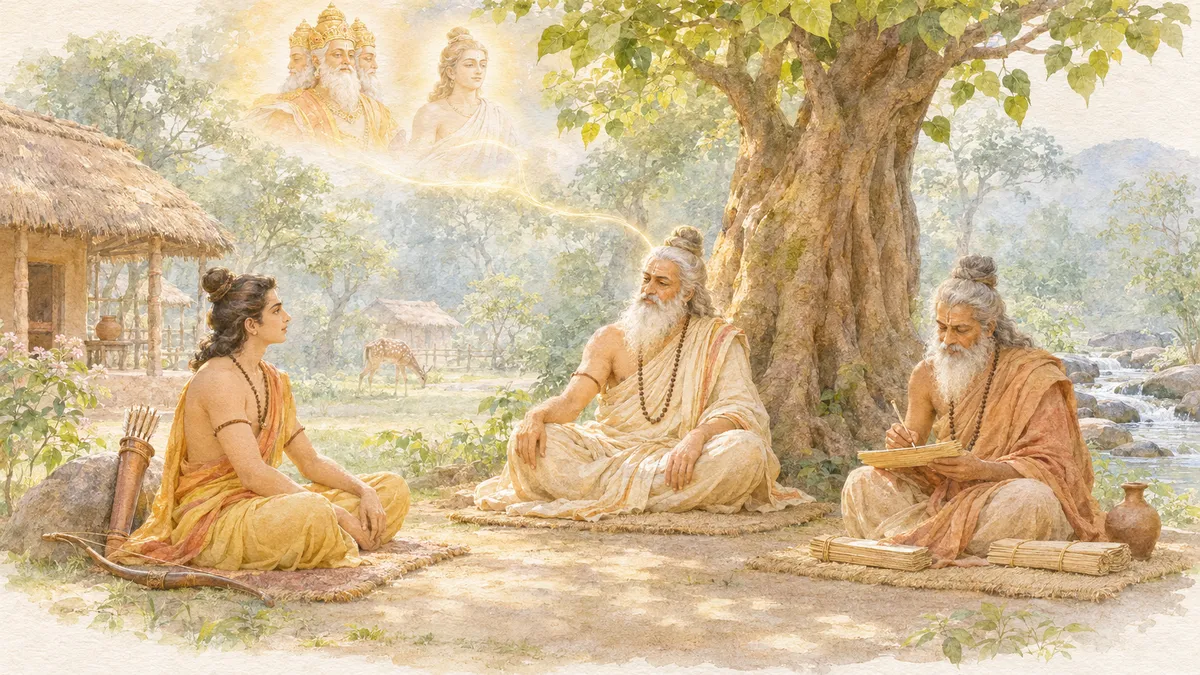
For example, we have the text “Yoga Vasishtha,” on which I have offered some commentary. This text reveals the foundational philosophy of Advaita Vedanta, its very basis, including, for example, the philosophy of reflection. How did the “Yoga Vasishtha” come into being? Vasishtha gave instructions to King Rama, and Valmiki recorded them. Before instructing King Rama, Vasishtha himself had received these teachings from Sanatkumara and the god Brahma. Thus, the instructions you are reading now are direct teachings, as if a great Kumara or Brahma himself had given them to you. This is the meaning of the purity of the lineage. It means that we do not introduce limited human vision into it, because we believe that human vision is insufficient to answer the questions of life and death or reveal the great mysteries of the universe. We believe that human knowledge is utterly insufficient, so there is no point in relying on it in divine matters. Human beings are ignorant of such matters. The gods are knowledgeable in divine matters, as are those who have received their knowledge from the gods through the lineage of disciplic succession.
If we rely on limited human knowledge, we will most likely attain neither liberation, enlightenment, nor immortality. All of this may remain beautiful dreams and fantasies because the teaching is unfathomably profound. This unfathomable depth comes precisely from realized divine beings, not from humans. Thus, this is the divyanga lineage, that is, the divine lineage of the teaching.
The next lineage of the teaching is called “siddhanga.” Siddhanga means that this teaching was received by the siddhas—the great saints of antiquity: Saint Dattatreya, Saint Gorakshanath, Saint Matsyendranath, who are part of our lineage, the holy rishi Tirumular, rishi Bogonathar, Charpatinath, and siddha Jalandhari. We mainly follow the tradition of the nine Nathas, chief among whom are siddha Matsyendranath and siddha Gorakshanath. We rely on their vision, philosophy, alchemical methods, inner work with energy, concentration on the chakras, contemplation, and so forth. The vision of the nine Nathas, particularly Matsyendranath and Gorakshanath, fully embraces the philosophy, wisdom, practice, and vision of the divine beings and is then transmitted to us as human beings in a more adapted form. This is siddhanga, the lineage of the siddhas’ teaching.
Finally, there is a lineage called “manushya,” that is, the human lineage. It is transmitted by people of flesh and blood who lived or are living in this world, from one spiritual Teacher to another. At the end of this lineage stands your humble servant, the spiritual Teacher Swami Vishnu Dev. As you practice, you likewise enter this lineage of power. Someday you, too, may be depicted here, provided, of course, that you receive authorization. For authorization to represent the lineage, and especially to teach others, is not so easy to obtain. It requires the spiritual Teacher’s permission, his confirmation of your level of realization, and the conferral of the appropriate symbols or signs. All spiritual schools operate in approximately this way. When a disciple has received sufficient training and their signs, karma, and destiny are favorable enough for them to transmit the lineage further and continue developing the teaching lineage, the Teacher analyzes their subtle body, their progress in practice, their wisdom and understanding, and then draws up astrological data. Or, if he does not need this, he simply analyzes their subtle body through the power of his meditation, observes their abilities, and decides to transmit the lineage to them and grant them the rights and authority to continue spreading the teaching specifically from that lineage.
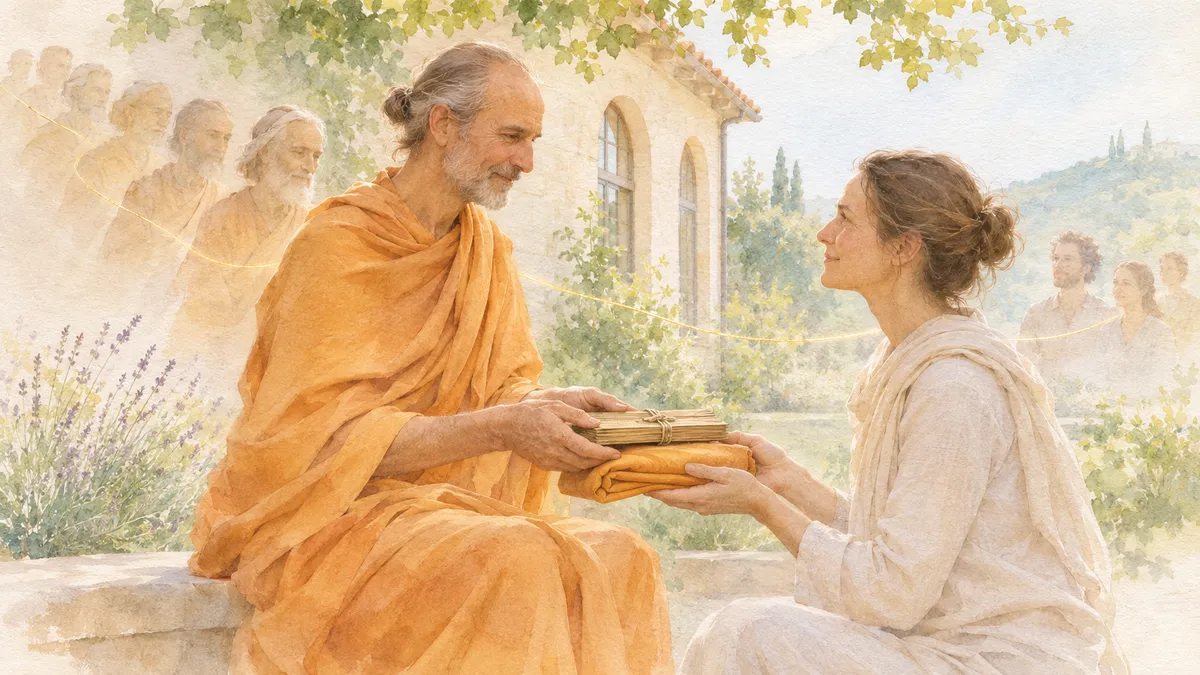
This means that such a person is a transmitter of undistorted, pure knowledge from the ancient lineage of saints. It is precisely in this case that the precious teaching begins to work and is transmitted without distortion. Then it benefits a great many people. Then all those who follow it and observe samaya can receive signs of genuine realization. This is very important, since our future and our life depend on our gaining benefit and signs of realization through practicing the teaching. For example, the state of samadhi, realization of the illusory body, complete awakening to nonduality and the single “taste,” or even attainment of the rainbow body—these are all different signs of spiritual realization. For these signs to arise, we always say that it is very important to observe the principle of transmission and what is known as the samaya of the teaching. That is, the samaya of the teaching is connected with fulfilling our obligations toward the teaching. Obligations toward the teaching mean respecting the principle of the teaching, applying it in one’s life, and transmitting it without distortion.
For example, if someone practices a teaching without the principle of samaya and without the principle of transmission, I will always say that they are, of course, free to do so. But I myself would never practice such a teaching. There is simply no point in it. It is like picking up the first book you come across and doing the practices in it. But what guarantee is there that this particular teaching will work or that it is the correct teaching? One cannot be certain of this. And one should never entrust one’s life to the first teachings one happens to encounter. The lineage guarantees that we are entrusting our spiritual life to something highly authoritative, something tested over millennia, something that always works. Our main task is to try to preserve it in the same purity and transmit the spirit and method of the teaching without distortion. Only then will it work.
Therefore, all saints always say (there is even, I believe, one of Milarepa’s songs about this):
“It is useless to follow a teaching that has no lineage; it is useless to follow a Teacher who has not recognized his own mind; it is useless to become a disciple if you have no samaya and no faith in the spiritual Teacher.”
I believe Milarepa had every right to say this, since he was an outstanding spiritual master. And we always heed the opinions of enlightened masters.
Thus, the principle of the lineage of transmission means that we treat the teaching with great respect and trust, knowing that it is like the apple of our eye and the heart within our breast. And that it is precisely through it that we attain realization. It is then that our samayas are said to be pure.
The Principle of Samaya
The principle of transmission is also connected with the principle of samaya. Samaya is the sacred bond between teacher and disciple. All spiritual teachings are always transmitted precisely when such a sacred bond exists. If the sacred bond has not arisen or does not arise, then it is, of course, premature for someone to call themselves a disciple. Such a person should not rush to call themselves a disciple, because the state of discipleship is precisely a state of relationship with the teacher and the lineage of transmission in devotion. The state of discipleship also always entails the ability to observe the fourteen vows.
Avoiding the fourteen root downfalls is a way of practicing the tantric teachings without ever making mistakes. These fourteen root vows are what make us practitioners, disciples, and samaya brothers and sisters—that is, disciples of the same teacher.
Observing the fourteen root vows is even more important than certain other very important things. I think that, after the unified samaya of contemplation, observing the fourteen root vows is the most important thing in the world. It is even more important than undertaking retreats and performing techniques. If a person observes samaya and does not violate the fourteen root vows, or at least purifies them, then even if they do not perform any techniques or meditations, sooner or later they will still attain awakening. They are still in the right stream, and their intuitive awareness grows. But even if a person has an excellent, masterful command of pranayamas, mudras, asanas, and concentration on the chakras, but does not observe samaya, does not even know about this principle, or neglects these vows, they may encounter serious obstacles in their spiritual life. At the very least, they will attain no realization, and at worst, they may even develop major problems in their spiritual life that will follow them into their next life. And all saints attach great importance to the principle of samaya.
It is believed that the teacher is obliged to explain the principle of samaya to the disciple and teach them how to observe and purify samaya. There was an ancient siddha who, I believe, was named Humkara. He was a Tibetan siddha who lived a thousand years ago. He once wrote these lines:
“I can subdue and overcome all demons except those who violate samaya.”
He says that those who violate samaya are like demons who are difficult even to subdue or overcome. To subdue and overcome does not mean defeating them physically in some way. It means awakening their awareness and clarifying their minds. That is why the principle of samaya is so important.
It is believed that if a teacher initiates a disciple who does not share the samaya into advanced practices and methods, that teacher is engaging in futile actions. Moreover, such initiations may even create obstacles for the teacher.
The Fourteen Root Vows
What, then, are the fourteen root vows or commitments? They are not external vows in which you commit to observing something, such as not eating a certain food or doing a certain thing. They are inner commitments primarily associated with the principle of the sacred teacher-disciple bond. Rather, they are connected with the spiritual attitude that the disciple commits to maintaining.
The relationship between teacher and disciple always involves transmission, inspiration, and retransmission. For such a transmission to take place, the disciple’s mind must be receptive, expansive, and open. If the disciple’s mind is not receptive, expansive, and open, then, of course, such transmission is useless; it does not work. It is precisely for this purpose that these principles and rules, known as the principle of samaya, were developed.
What do they consist of? First, it is believed that once a disciple has become the disciple of a particular teacher, they should perceive the teaching, the teacher, themselves, of course, and the sangha with pure vision; that is, they should strive to see all of these as exalted and pure. They should also not contradict the teacher or the teacher’s instructions, because being a disciple means precisely following these instructions. Not contradicting them means being spiritually attuned to the teachers’ instructions or to the teacher. This is the first principle.
The second principle is not to contradict the teaching given by the teacher. It is assumed that if a person calls themselves a disciple, they share the teaching being transmitted to them and regard it as a great treasure.
The third principle is not to come into conflict with other disciples, one’s samaya brothers and sisters. One should not come into conflict with fellow practitioners; that is, one should always maintain harmony in relationships. Relationships should be built on pure vision, mutual support, love, harmony, and respect.

Often, a disciple may be able to observe the principle of samaya toward the teacher and the teaching; this is not so difficult. But sometimes they find it difficult to uphold the principle of samaya toward fellow practitioners. However difficult this may be, it must be upheld. It is believed that relationships among practitioners should always be highly respectful. Otherwise, if such relationships are not established, a person will be prone to rivalry, quarrels, and ill will. Such a spiritual life will yield nothing but obstacles.
These are the first three principal root vows:
- complete trust in the teacher
- complete trust in the teaching
- harmonious, loving relationships with tantric brothers and sisters
The fourth root vow is the vow of compassion. This vow concerns not harming anyone. For example, causing harm or failing to protect someone—all of this constitutes a violation of the principle of the vow of compassion.

The fifth root vow concerns sexual energy in the body. Suppose you practice anuttara tantra but do not take care to preserve your sexual energy and, while practicing kundalini yoga, expend your vital essence. This weakens your sexual energy and means that you have come into conflict with the teaching. You will not be able to obtain the fruits of spiritual practice.
The sixth root vow concerns one’s attitude toward one’s own and other spiritual schools, teachings, and systems. It is believed that denigrating or condemning any spiritual system constitutes a root downfall. This, of course, applies to your own teaching as well as to other teachings. It is assumed that one should always treat all teachings with respect, even if one does not share their views.
The seventh commitment is the promise not to reveal secret teachings to those for whom they are not intended. For example, if you have received transmission into a particular practice, this means that the practice should not be explained to people who are not practitioners, are not disciples, or do not belong to the lineage. This is not because we are reluctant to share the technical aspects of the practice, but because the practice is transmitted strictly within a specific context. If you are not permitted to transmit it, this should be taken very seriously.
The eighth commitment concerns the physical body. If we regard our physical body as impure and base, this is called the eighth root downfall. For example, there was once a lay brahmachari, a temporary practitioner, who did the following. While in a bathhouse, he experienced lust and thought that it was inappropriate for a practitioner, especially a vira yogi, to be overcome by such base feelings, and that something had to be done about it immediately. He filled a dipper with hot water, almost boiling, and poured it over himself. The lust vanished at once. He thought that one should act according to the principle: if your eye tempts you, pluck it out; if your hand tempts you, cut it off. But in fact, the tantric attitude is different. It is said that the body should be regarded as pure and should never be harmed, subjected to excessive torment, and so on. Of course, desire must be controlled, but you should not regard the body as a source of trouble, misfortune, or harm, nor should you harm it in any way—this is the essence of this principle.

The ninth root downfall is to have doubts or hesitation about tantric practice once you have become a practitioner. For example, you are given an initiation, but you think: “Perhaps this is a good practice, or perhaps it is complete nonsense. Perhaps it helps, or perhaps it does not help at all.” In other words, once you have become a practitioner or disciple, it is assumed that you have complete trust in what you receive and do, and that you regard it as highly important.

The next root downfall concerns vision or view. This is the so-called adoption of extreme views: nihilism and eternalism.
What is nihilism? For example, you have heard the philosophy of Advaita, or heard that everything is maya, an illusion, or you have had a certain experience. You begin to think: “Everything is emptiness, all of this is an illusion, nothing matters.” And you begin to neglect the relative dimension, thinking: “The Teaching is emptiness, samayas are emptiness, transmissions are emptiness, and practice is also emptiness. Everything is emptiness; there is no need to practice anything.” Thus, you enter into this nihilistic denial. This is called nihilism. It is like a kind of disease.

Extreme Views: Eternalism and Nihilism
Eternalism, by contrast, is the other extreme view. This is when you take everything to be real and think: “Brahman is something verbal, conceptual.” Or you imagine: “This world is real, it does not depend on consciousness, and it always exists on its own.” This is a kind of naive acceptance of the teaching or practice as something external, without understanding its unity with the principle of consciousness.
These are two extreme points of view. In fact, this is a way of perceiving reality with the mind or through the prism of the mind. A teacher of the Zen tradition held a retreat in St. Petersburg on meditation practices similar to Mahashanti. A month later, one of his lay disciples had a powerful experience of emptiness. He went and gave away all his money, possessions, and furniture to his friends. And when people asked him, “What are you doing?” he laughed and said, “All of this is emptiness.” But if we cling to emptiness, if we turn emptiness into yet another fetish, then even such an experience of emptiness is a delusion. It is also nihilism.

When another teacher heard his disciple say that everything was emptiness and saw that he had fallen into a nihilistic state, he painfully grabbed him by the nose and pulled hard. The disciple cried out, “What are you doing?!” The teacher said, “If everything is emptiness, why are you so upset?”
The Remaining Root Downfalls
The twelfth root downfall is refusing to teach sincere people who come with faith to receive the teaching.
The thirteenth root downfall is related to practice: it occurs when, during practice, one fails to transcend the division into pure and impure and clings to dualistic perception. These are more specific matters. For example, during an initiation you are shown a wrathful deity, but you do not like its appearance because you have fixed ideas about deities. You think, “Surely a deity must be beautiful and pure,” but when you see a deity in some wrathful form, you think, “This is something terrible.” This is precisely a manifestation of clinging to dualistic vision.
Finally, the fourteenth root downfall is disparaging women mentally or verbally. This is connected with the practice of Kundalini Yoga and the practice of prana-shakti. Since this arises from impure or obscured vision, it serves as an obstacle to practice.

Purification of Samayas and Their Importance
All these root vows or violations are called downfalls, and they are ranked in precisely this order of importance. When there is some lapse in the samayas or even a violation of them, a mature disciple always knows that they must be purified and that either repentance or purification must be performed, depending on the transgressions committed.
It is like a virus infecting your computer: to remove and destroy the virus, you need to run an antivirus program. Because if you continue working with the virus present, you will not be able to work properly; there will always be errors.
When the principle of samaya is observed, you can truly benefit from the teaching.
It is believed that if a person deviates from the samayas for one month, this is called “non-observance.” If it continues for one year, it is called “undermining the samaya,” and considerable effort is required to purify it. If it continues for two years, the samaya is destroyed. And purifying it requires tremendous effort. In particular, the texts state that a disciple must sincerely offer everything most precious to them in order to restore the principle of samaya. Finally, if the samayas are not observed for more than three years, this is considered a collapse—that is, something that completely destroys the spiritual connection. After three years, such a spiritual connection cannot be restored.

It is believed that once we have entered the path of the Anuttara Tantra teachings, observing the samayas is very important, since they continue not only in this life but also in the next. That is why I always tell students: “Be mindful of the principle of samaya and always uphold it; never violate it. First and foremost, this is necessary for your own sake.” It is said: “There is no enemy worse than broken samayas.”
When the samayas are observed, students practice and receive signs of realization, and harmony prevails in the sangha. You understand the algorithm of the teachings and apply it in your life. The teachings manifest for you with great success. Signs of realization appear.
Often, when a yogi practices but does not achieve any spiritual success or encounters obstacles, they are advised to purify their samayas or analyze how pure their samayas are. Perhaps some problems arose somewhere without their awareness.
The Single Samaya of Contemplation
Finally, there is the highest kind of samaya, called the “single samaya of contemplation.” The single samaya of contemplation means that we enter a non-conceptual state of awareness that unites all kinds of samaya and consists in maintaining non-dual awareness. It is believed that when we maintain it, we observe all the samayas simultaneously. Therefore, the highest principle of samaya is to be aware, to remain aware always and everywhere. Such awareness itself guarantees that we are proceeding along the path of practice without deviating from it.
So, I hope that everyone present here understands the principle of transmission and the principle of samaya.

Let us begin by answering some questions:
Question: Is the transition to another version of the universe the result or the cause of eliminating samskaras?
That is exactly so. The universe is created because the mind contains samskaras—mental imprints, mental patterns. Samskaras determine karmic vision. For example, if you had any mental imprints in childhood, whether positive or negative, they fundamentally affect your consciousness, and your karmic vision develops in accordance with such imprints. Conversely, when we eliminate certain imprints and free ourselves from the influence of these traces, consciousness shifts to another version of events, to another karmic vision, and this is also manifested on the physical level.
If a person experienced psychological trauma in childhood caused by their parents or by certain events in life, this means that the event will constantly and subconsciously influence their entire life from the past, determining their destiny—for example, as a failure or as someone with a particular complex—and accordingly, they will always shift their consciousness into a particular karmic vision. This karmic vision will form in such a way that it attracts corresponding energy. That energy will determine their external relationships, and they will become even more convinced that this is indeed who they are. And all of this happened because, at a certain moment, there was an imprinting—the impressing of a particular karmic trace. This is why the law of karma exists. In other words, the law of karma is nothing other than the impressing of a negative karmic trace upon the field of one’s consciousness. And what is repentance? Repentance is when you penetrate deeply into the subconscious and destroy this karmic trace, dissolving it and self-liberating it.
Our past influences us more than we realize. In fact, everything we are is our past. If we had the past of gods, we would live entirely differently and have an entirely different mentality. But it is precisely our past that determines our life. And what is our past? It is the various imprints impressed upon our consciousness. Traditionally, in yoga, these impressions are called “karmic traces” and “mental imprints.” They are also called “samskaras” and “vasanas.” On a subtler, causal level, such impressions are also called “bijas”—the subtlest spheres of luminous space that contain, in embryonic or seed form, the future events of our destiny that may unfold. The task of spiritual practice is to burn away all these samskaras and purify the bijas so that the seeds of new lives can no longer sprout in our consciousness.
In psychotherapy, there are often cases when a patient is placed under regressive hypnosis and allowed to relive past imprints in consciousness, such as past lives. And under guidance, if the psychotherapist is talented, the person is allowed to change something in those imprints—for example, to erase negative imprints, that is, to self-liberate a samskara. When this happens, it turns out that after some time the person's health improves. If they were suffering from a psychosomatic illness, it disappears without a trace, even without treatment, because the data have been replaced at the level of the subtle body, at the level of samskaras, and the energetic, etheric body immediately restructures itself along with the physical body, and the illness disappears. This shows how our negative actions affect not only our lives but also our health.
For example, a person who kills animals cannot have a favorable destiny or a long life, because killing animals means giving them the right to kill you as well, or at least attracting the corresponding energies. Sooner or later, such a person will suffer from various illnesses because negative imprints in their subconscious, like time bombs, will affect them. This refers to cases where the person kills animals directly. Likewise, any negative actions condemned by society, the community, and morality, actions commonly regarded as vile or bad, always generate negative imprints. Why? Because the person committing them evaluates them negatively in their heart; they know that these actions are negative, so they generate negative vibrations within them. And since they are neither self-liberated nor a siddha, nor a deity at play, their subconscious allows this imprint to pass through, and at the subtle level it alters their vision.

Krishna, for example, was a being of a different level. He could participate in wars and take away other men's wives, yet he got away with everything because he was a deity; he had no negative imprints, no traces remained in him, and for him all of it was lila, divine play. He was like a child who sleeps and, while dreaming, does not know whether his mother has fed him or not.
A yogin who abides in the natural state is self-liberated in the sense that, whatever they do, negative imprints cannot penetrate their consciousness, because everything in their vision is pure and perfect. But with ordinary people who do not know how to self-liberate these imprints, this is of course not the case, and so they bear full responsibility for their actions. But when we purify samskaras, we transition to a different vision, a different course of events.

Question: Ensuring immortality of the lower and intermediate levels presupposes the absence of a global or even a sufficiently significant natural cataclysm on Earth. How will the matter of the entire Earth change when humanity attains the vibration body and the light body?
There is currently a great deal of talk about 2012 and all sorts of troubles that may arise that year. Anything is possible. We are observing an imbalance in the environment and in the five elements—this is indeed the case. Some saints have said that this is a manifestation of what is called mahakranti, that is, a major problem related to the five elements falling out of balance.
Raising the spiritual level and changing karmic vision always affect the external world. The universal elements become harmonized if our consciousness deepens and becomes purer. In places where saints live, the universe manifests favorably, and the elements manifest favorably. Where people have pure consciousness, the earth yields crops, spirits create no obstacles, the weather is always favorable, and there are no earthquakes, because consciousness determines life, existence, and the external world. The more people attain greater purity of consciousness, the purer the world will become, and it will begin to transform into a mandala, into a pure divine dimension, into a controlled reality.
Will all of humanity attain the vibration body and the light body? That is unlikely, of course, because everyone is at their own evolutionary level, and achieving this collectively is fundamentally impossible. However, it is entirely possible for a large number of people to raise their spiritual level. A transformation of the material elements is also possible.
There are two types of material elements: divya-tattvas and mrityu-tattvas. Divya-tattvas are divine subtle-material energies, while mrityu-tattvas are unstable elements that disintegrate. We live in a universe woven from mrityu-tattvas, that is, from unstable elements that are constantly transforming into one another; therefore, they are difficult to rely on and are not eternal. Unlike our universe, the elements in the universe of the gods are stable because their universe is created from subtler consciousness. For example, in the human world, cataclysms occur, people fall ill and die, global warming or cooling takes place, and the elements are not controlled by consciousness—all these are manifestations of mrityu-tattva. But the deeper and more spiritualized the consciousness of a large number of people becomes, the more manageable reality begins to be, because we create reality through our karmic vision.

The task of practitioners is to transform the unmanageable reality around us into a manageable one, into what the teaching calls a mandala. At present, unfortunately, the world around us is not a mandala, at least not ours. It is Brahma’s mandala. Brahma has perfect mastery over his energies and governs time, space, and the elements. He is like a skilled programmer who creates a virtual reality, populates it with living beings, grants them intelligence and free will, but prefers not to intervene. He creates system administrators who oversee this virtual reality and occasionally adjust it. If something needs to be corrected, they bring about some phenomenon, but they do not interfere because they take into account the free will of the characters inhabiting the virtual reality.
To transform the world into a mandala means to make reality manageable through the power of consciousness. And this is possible only when the power of our consciousness grows, when we spread this depth and luminosity of consciousness, and when it encompasses a large number of people. If only a small number of people possess luminosity and depth of consciousness, then one can hardly speak of a manageable reality. This will happen only if the luminosity and clarity of consciousness spread.
Question: What does time look like? (a child’s question)
You can show the child photographs of their grandmother as a child, as a young woman, in adulthood, and in old age. Time can be seen only through change and modification.
Question: If the great siddhas dissolved into the clear light, then they attained immortality on the subtle planes, but not on Earth. And what about those yogis who attained only enlightenment—did they not preserve their self-identity or immortality?
The great siddhas dissolved into the clear light and attained immortality on all planes, since such a level presupposes the realization of the three bodies: siddha-deha, pranava-deha, and jnana-deha. This means that from the state of primordial light, it is possible to project any body—for example, the gross body of a human being or the subtle body of a deity—or not to project one at all.
The yogis who attained only enlightenment, of course, preserved their self-identity. Enlightenment itself presupposes the preservation of self-identity. When you hear about immortality, it is not for the enlightened or for siddhas; they have no need of it. It is for those who are mortal. For siddhas and awakened beings, there is no death. For siddhas, even life is an illusion. But if I were to tell you that neither your life nor your death exists and therefore there is nothing to worry about, I doubt that this would inspire you so much that you would immediately believe all of it. For ordinary people, both life and death exist, so they need longevity practices and so on. If we are unattached and self-liberated, possess uninterrupted consciousness, and regard the body as no more than a garment that can be removed, then that is another matter.
Question: In connection with the subject of immortality, who is Grabovoi?
You can read what he says about himself. He is a person who possesses supernatural abilities.
Question: If, upon rebirth, the soul changes bodies as one replaces old clothes with new ones, then why do we need artificial clones and the like? Perhaps the Creator’s design is not so bad after all? After all, together with the body we rid ourselves of old baggage, entrenched habits, and attachments, and upon being born we get a chance to start everything anew, albeit with our old samskaras?
The question is not whether the Creator’s design is good or bad. The point is that our spiritual evolution, even immortality programs and our personal efforts, are also part of the Creator’s design. Or do you think the Creator acts somewhere far away? We ourselves are the Creator’s design. Our will, our plans and programs, and their development are all part of that same design. The Creator unfolds His program through us. There is a saying: “God has no hands but yours. God has no will but yours.” Moreover, I can say that the immortality program is the Creator’s design for humanity. Our immortality program proceeds under the blessing of Shiva Mahamrityunjaya—the conqueror of death. I received a direct blessing for this program.
The question is not whether this is good or bad, or whether we are discarding the body as if it were trash. If that is what you believe, it is your legitimate right, because you have free will and freedom of choice. But the point is that thinking this way means failing to take many things into account.
Death as the Absence of Free Will
If you possess complete freedom, that is one thing. For example, you are free to live or die: if you wish, you live; if you do not, you die. It is your choice. But death is the absence of choice. Mortality is the absence of your free will.
In other words, it is very much like a piglet that is about to be slaughtered and roasted before a wedding. Does anyone ask it? Who is interested in its opinion? It is simply taken, slaughtered, and roasted. Likewise, no one asks a human being either. It is simply an inexorable law of prakriti imposed upon them by nature; it is an atavism.
Death is a shameful vestige, an atavism of humanity, a kind of legalized execution for the entire human race. Death is not inherent in gods, saints, or highly accomplished siddhas. Divine races do not die; they are immortal. Only lower beings experience breaks in consciousness and lack control over matter and consciousness. The issue here is not death. The most important issue is free will and choice, the issue of controlling the five elements and one’s own body.
I think each of you knows that when your parents grow old and ill and lose their mental faculties toward the end of their lives, it is not good; and when you become ill and grow old, there is nothing good about that either. It happens beyond your control. And if you were to say to someone hooked up to a ventilator, “Don’t you think you would be better off getting rid of this trash—this body?”, they would hardly support your idea or find your words encouraging. They would think you were saying entirely the wrong thing and would not want to hear it.
And when your grandmother is suffering from old age and illness, and you say to her, “It’s all right, don’t worry! You’ll simply get rid of this trash. It’s no big deal. You’ll be given a new, good body,” that would hardly make her happy, because all of this is happening against her will. Even if good things happen, perhaps even something beneficial, but the person does not participate in them, then there is no choice or free will involved.
For example, suppose someone says to you, “You are going to engage in spiritual practice,” grabs you, and places you against your will in a retreat, in padmasana. You will scream, and they will tell you, “It’s all right, this is good for you.” They will force you to listen to lectures and say, “You will rid yourself of bad karma; you will be purified. This is very good.” But that would be a crime; you would be committing an act of violence against human free will.
In the world of the gods, free will is taken very seriously. The Creator also takes free will into account. And when a person grows old, falls ill, and dies, it is likewise an act of violence by gross nature (prakriti) against the human personality and their body. The person is not taken into account as a personality, as an individual; they are not asked. If they have free will, then they can indeed choose such a path and say, “Yes, perhaps it is time for me. I am tired of being here. I want to cleanse myself of this entire burden and move into another body.”
Thus, the most important principle is that the question of immortality is, above all, a question of free will and your freedom of choice, as we attempt to make the situation with the physical body and the elements more manageable.
The Reality of Rebirth
As for rebirth, you do not know what rebirth is. If you did, you would not speak that way, because rebirth is a very serious matter. You do not know what you will be reborn as in your next life. You will not necessarily be reborn as a human being or a deity. You may end up in the body of a dog, a cat, or a hell being, because you do not control this process: the bardo state—the intermediate state, or antarabhava—is an uncontrolled state.
And the inexorable forces of nature, the deities, the lords of karma will not ask you where you would like to be reborn or show you price lists with a choice of destinations. Here, too, you have no freedom of will. If you are a siddha who controls reincarnation, if you are lucid in dreams and can freely change them, and remain aware in dreamless sleep, then that is another matter; this does not apply to you, because you can control your rebirth.
But when it comes to most people, there is no guarantee that you will be born human; there is no guarantee that in your next life you will not be born as the eighth child in an African family and die of some illness in childhood. There is no guarantee! That is why the saints say, “This precious human birth is intended for Self-realization in this lifetime.”
There is no guarantee that you will not remain somewhere in an intermediate state for ten thousand years, because time flows differently in the astral world, and for spirits a hundred or a thousand years is a short period. All these processes remain unknown and beyond our control for now.
The Preciousness of Human Birth
The teaching on the preciousness of human birth says that being born human and encountering the Dharma is a great rarity, a tremendous and unique opportunity. This life is extraordinarily unique and must be cherished. The opportunity to realize yourself, the opportunity for spiritual transformation right now, in this very body, rather than at some other time, is a precious, unique chance. For there are no guarantees regarding the circumstances of your next life.
The siddhas always teach that the matters of rebirth, the preciousness of human birth, and reincarnation should be approached with great scrupulousness, care, and reverence. These matters are not as superficial as they may seem. They are much deeper.
As for artificial clones and other such things... This has not yet been conceived or manifested by us, and it does not depend on us. These are objective processes that take place regardless of whether we want them to or not. Humanity is developing in accordance with its own course of evolution. We can simply notice and reflect these things earlier than others.
Questions related to the immortality program are supplementary; they are not intended for beginners. I try not to discuss these matters with beginning practitioners, because until the nature of Mind has been revealed and certain things have been understood, they may create an inaccurate impression of the teachings of Laya Yoga. It is very important to be guided by the teachings of the siddhas and the principle of samaya. If you are guided by them, deep vision arises within you.
The Wisdom of the Siddhas
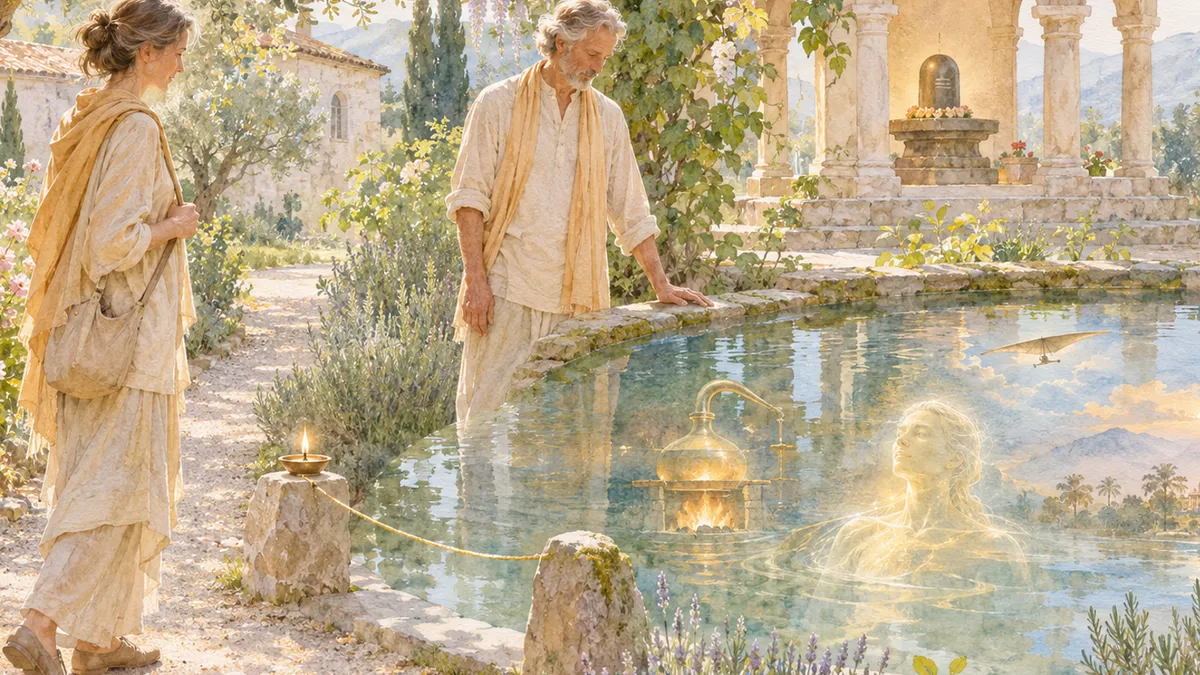
The siddhas were unfathomable beings. Their personalities manifested in a remarkably multifaceted way. To understand them, one must enter their state and comprehend their grand and profound design. For example, there are stories about the holy siddha Boghanathar, who was an alchemist, invented an airplane and a parachute in his time, and traveled to China, India, and Jerusalem. He is an unfathomable figure.
He created a special device and described it in his tantra, by means of which the spirits of the dead could materialize and appear before the living in physical bodies. Other siddhas even said that it was too early to show people such technologies. In the world of the gods, in the world of the siddhas, there are many wondrous things that are completely incomprehensible to us. And when we hear about them and try to approach them, we must do so very carefully and cautiously, through the principle of samaya.
The Great Transition into the Mandala of Pure Vision
So, we will now proceed to the topic of the lecture.
We usually say that the purpose of practice is to attain the three freedoms: freedom of body, speech, and mind. Mind corresponds to space, speech corresponds to time, and energy corresponds to the external body. Attaining these three freedoms means that we reveal the natural state and unite it with these categories. At present, we have only limitations of time, space, and energy, but no freedoms.
Deities or great gods have no limitations, because they abide in the state of “one taste.” For example, they may possess boundless energy; for them, there are no limitations of time, and they can also manifest throughout limitless space. We have yet to attain this freedom.
What does it mean to attain these three freedoms? It means mastering not only the nature of Mind, the principle of contemplation, awareness, and the natural state, but also the universal energies, forces, and shaktis that emanate from this nature of Mind.
The Principles of Purusha-Prakriti and Shiva-Shakti
You have probably heard that Sankhya Yoga has the principle of Purusha-Prakriti, while Tantra has the principle of Shiva-Shakti. This is the same as earth and heaven in Taoism. These are two polar principles representing awareness and energy. They are also called prajnana (primordial awareness) and prakriti-pradhana (material energy as the foundation). To practice the teaching means to reveal both of these principles: awareness as well as the energy that flows from it.
There are teachings that seek to reveal awareness alone and take no interest in energy. Examples include certain Theravada Buddhist traditions and the Zen Buddhist tradition. They are primarily concerned solely with realizing awareness, with attaining the Dharma body, which is like space. These traditions hold that revealing the principle of awareness is entirely sufficient and constitutes complete awakening.
The Tantric tradition views these matters somewhat differently. It holds that both awareness and the principle of energy must be revealed. The teaching you practice is precisely Tantra (Anuttara Tantra). The word “tantra” contains two elements: “tanoti,” meaning “expansion,” and “trayati,” meaning “liberation.” Thus, the word “tantra” can be translated as salvation through the expansion of the mind and consciousness and the liberation of energy.
In the Tantric teaching, importance is attached to purifying energy, enlightening it, and interacting with various universal energies. The Absolute has two aspects: one is associated with consciousness, while the other is associated with manifestations and energies. If we say that the Absolute is only consciousness, only the unmanifest, only emptiness, this means that something is lacking in the Absolute. It means that the Absolute has no dynamic, manifest aspect and no energy. This would mean that the Absolute is somehow deficient and incomplete.

However, the teaching of Anuttara Tantra says that the Absolute manifests in every aspect. Its consciousness and energy are everything, the fullness of being. Therefore, mastering material energies is the next stage after we discover the principle of awakened consciousness.
The Teaching of Shakti and Universal Energies
The teaching on energies is especially well developed in the Shakta tradition. There are six main Tantric schools: Shaiva—the followers of Shiva; Vaishnava—the followers of Vishnu; Shakta—the followers of Shakti; Bauddha (Sugatas)—the followers of Buddhism; Surya—the followers of the path of the Sun; and Ganapati—the followers of Ganesha. Anuttara Tantra, as the teaching of the siddhas, does not identify itself with any particular school of followers; it encompasses all paths.
However, regardless of which tradition, apart from Bauddha, a yogi belongs to, it is most often said that there are three principal universal forces (shaktis):
jnana-shakti—the power of wisdom and knowledge
iccha-shakti—the power of will
kriya-shakti—the power of action
These should not be regarded as abstract metaphysical categories. These shaktis (forces) manifest in your mind.

For example, when you meditate, you activate jnana-shakti (the power of knowledge) within yourself; when you practice concentration and exercise willpower, you activate your iccha-shakti (will); when you do something or create, you activate your kriya-shakti (the energy of action), which in turn is divided into five lesser shaktis:
- the power of creation (srishti)
- the power of preservation (sthiti)
- the power of destruction or dissolution (samhara)
- the power of concealment (tirodhana)
- the power of enlightenment (anugraha)
Thus, the energy of action is fivefold.
There are also other types of shakti:
svatantrya-shakti—the energy of absolute freedom
sankalpa-shakti—the energy of divine will, also called iccha-shakti or sveccha-shakti
aishvarya-shakti—the energy of divine power

All these energies permeate our lives, and we encounter them constantly. For example, if a person has a weak will and their intentions are poorly realized, they are said to lack sankalpa-shakti or iccha-shakti. If a person occupies a high position, they are a conduit for aishvarya-shakti—the power of divine authority. If a person has the ability to perform various actions successfully, they are said to be a conduit for kriya-shakti; this energy acts through them.
If you explain the teachings to others or draw images of the enlightened body, speech, and mind—that is, images of deities, mandalas, and yantras—then anugraha-shakti, the power that enlightens consciousness, is said to flow through you. Thus, there is an infinite number of energies in the universe that operate continuously.
Absolute and Relative Shakti
Traditionally, shakti in the absolute sense is considered to be beyond all limitations, to be the Absolute itself in its active aspect. But on the relative level, shakti is often called a goddess, or Devi, and is said to be feminine in the sense that feminine nature is energy itself.
It is believed that there is a supreme shakti, or purna-shakti, as well as partial manifestations. Purna-shakti refers to the highest types of energies, such as jnana-shakti (the power of knowledge), iccha-shakti (the power of universal will), and kriya-shakti (the power of universal action), which are also called Kali, Durga, Lakshmi, Saraswati, and Parvati.
There are partial manifestations of energy known as amsha-rupini. They signify some minor hypostasis, some partially localized energy. They are depicted as minor secondary deities: Dakini, Rakini, Lakini, Kakini, Shakini, and others.
In the human body, purna-shakti is our kundalini energy, which moves through the central channel. But besides kundalini energy, there are also minor energies that move through the side channels, the surface channels, or the petals of the chakras. These minor energies that awaken in the chakras are called amsha-rupini, or secondary energies. Purna-shakti, the supreme energy, is believed to infuse these minor secondary energies—amsha-rupini.
The Mandala as a Pure Dimension
Attaining liberation means establishing contact with these energies and gaining the ability to control them, to make them inseparable from one’s own consciousness, and to manifest them in a pure dimension. When a person can manifest them in a pure dimension and unite them with their natural state, they are said to be endowed with certain extraordinary abilities and powers. When these extraordinary abilities and powers become sufficiently numerous, pure, and sublime, such a yogi is said to create a mandala.
A mandala is a pure dimension created by the power of a yogi’s mind. Any beautiful form that vividly arises in a person’s consciousness can be called a mandala. A mandala is the pure essence, the deity of any object. The principle of the mandala is symbolized by a circle. A circle is a perfect form in which all points are equidistant from the center. The center signifies the natural state, while all the points signify the peripheral energies connected with the natural state. Mandalas arise from the yogi’s consciousness by analogy with a circle.
When a skilled composer creates a musical work, this is an example of their soul manifesting in a pure dimension; they create, as it were, a prototype of a mandala. When an artist paints a beautiful picture, when beautiful images emanate from them and completely surround them, one can say that, like a deity, they surround themselves with pure manifestations. When they arrange an exhibition of their paintings in a gallery, one can say that they have created a mandala. Deities do the same thing, only on a higher and more universal level.
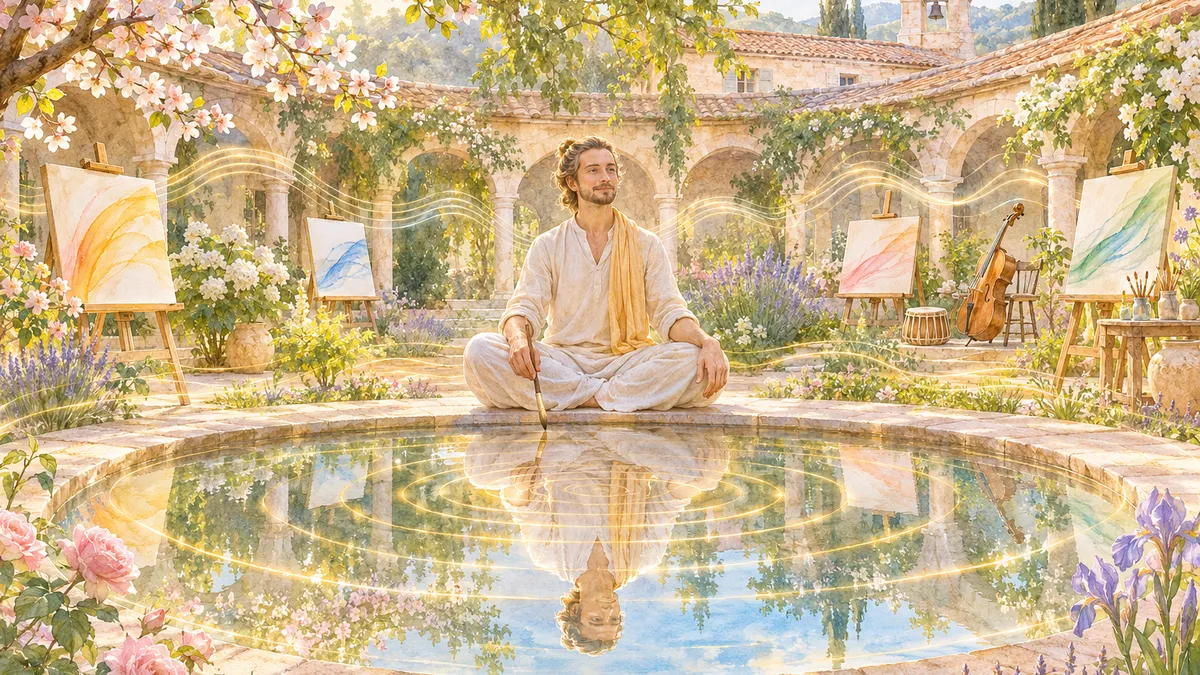
The mandala we create depends on the level of our consciousness. The higher the level of consciousness, the more universal and profound the mandala. A mandala is the environment of a deity, created by its energies.
In the human world, any complex structure or system is also a mandala. For example, there is the mandala of our body. If our clarity is sufficient to govern the elements of this body, this mandala flourishes; that is, our body is always healthy, gives us positive experiences, and causes no problems. And the person who stands at the center of this mandala as its ruler is its mandaleshvara, that is, its supreme lord.
There are other mandalas: a home, a family, a computer, a nation, a state, a Dharma center—all these are different manifestations of worldly mandalas, and a person acts as the mandaleshvara within such a mandala. Of course, this is a mandala in pure vision. And if the mandaleshvara—that is, its supreme lord, the person who creates it—possesses ability and clarity, such a mandala flourishes. But if the mandaleshvara has not resolved their own problems concerning the nature of Mind and their clarity, such a mandala is often in disharmony or causes problems for them.
For example, a spiritual community, a Dharma center, or a monastery are examples of higher-order mandalas. Such mandalas are complex self-organizing systems created by consciousness.
Transcending Duality: The Natural and the Artificial
People who abide in duality often divide this world. They say that one thing is natural, while another is artificial, implying that it is something improper, ungodly, or wrong. But in reality, there is neither the artificial nor the natural in the world. Nature is considered natural, while what human beings make is considered artificial. But in fact, everything is natural; it is simply that human beings sometimes do not know how to create as well as nature does.
Human beings themselves and their creations are also something natural. And what human beings make, if they develop their clarity, also becomes natural over time. There is no duality here. Even smoke-belching factories and artificial industrial plants are also part of the greater plan for the development of the mandala. Human beings simply cannot yet create mandalas as skillfully as the gods.
For example, the human body, like nature, is a mandala created by the gods. This is a high order of creativity. Human beings do not yet possess enough clarity to manifest such a high order of creativity, which is why what they create is still often inferior to nature. But as their clarity deepens, human beings can manifest themselves in the same way, like the gods. And then what they make and create is auspicious, positive, pure, and divine.

Creating a Mandala Through the Development of Awareness
From the standpoint of realization, our ultimate goal is to create such a mandala. For example, a pure land is analogous to such a mandala. It is possible to create a mandala only if you develop your awareness and govern your energies. If consciousness is undeveloped and the energies are not governed, then, of course, such a mandala cannot be created.
Likewise, a pure land can be created if it is brought into being through the collective intention of awakened, spiritually inspired people. I often tell my students: “We ourselves create the world and the reality in which we will go on living. No one will create it for us. Through our awareness and our actions, we can create the world in which we will continue to live. And to do so, we simply need to make the necessary efforts.”
Three Types of Mandalas: Peaceful, Joyful, and Wrathful
Mandalas can be peaceful, joyful, or wrathful:
Peaceful mandalas are dimensions dominated by sattva-guna, where everything is calm and auspicious
Joyful mandalas are dominated by raja-guna, movement, and activity
Wrathful mandalas are dominated by tama-guna
Sometimes you may see deities depicted in peaceful forms—this is an example of a peaceful mandala. Saints who bless you are filled with sattva and serenity. But sometimes deities can be seen in other forms—they are in constant motion and manifest fiercely. Tongues of flame surround them, or they are adorned with a necklace and a bowl made of skulls—this is an example of a wrathful mandala.

Sometimes one may see naked deities enjoying sex or something else, or simply joyful deities—such images in Tibetan iconography are called yab-yum, or the shakti principle. This is an example of a joyful mandala, a joyful manifestation of deities. All this is connected with the different energies manifested by the mandala. Sometimes a person who does not understand this principle may see wrathful deities and even become frightened of them.
Embracing All Energies: A Story About Wrathful Deities
Once, a very long time ago, a man came to the ashram and saw an image of a goddess with severed human heads around her neck; in one hand she held a small axe, and in the other, a sword and a bowl of blood. He became very frightened and said, “I follow the principle of nonviolence; I am not going to worship demons. Deities should be beautiful and pleasant, bringing peace to the soul. But these are some kind of monsters or vampires; they have nothing in common with deities.”
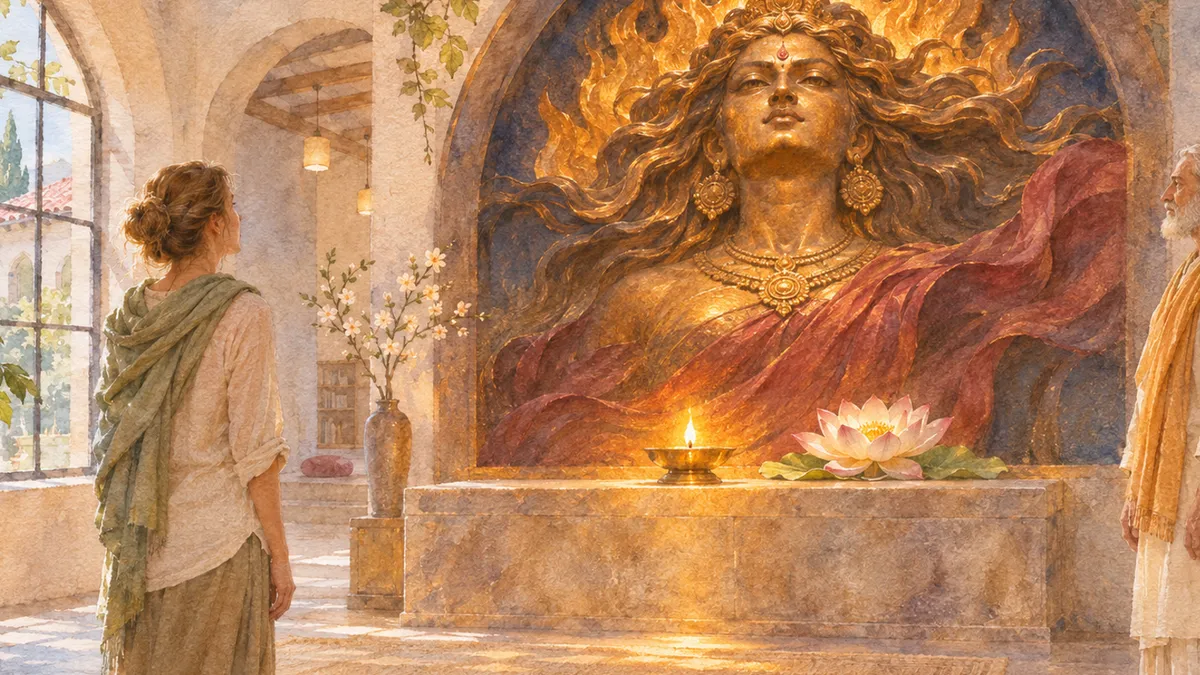
I had to explain to him at length that the tantric point of view is not as simple as it seems. The fact is that these deities are not some external beings, but a reflection of ourselves; they are energies that exist in our bodies. There are different energies within our bodies. If we were to say that our bodies contain only pure, auspicious, beautiful energies, that would be a delusion.
Within us there are energies that are sometimes even quite harsh; there are neutral energies, and there are auspicious ones. When we acknowledge only one part of our energies and ignore another, it means that we deny some part of reality, and our vision is fragmentary. And if we deny some part of reality and have a fragmentary vision, we will never attain the holistic view inherent in enlightenment.