

Commentary on the text “Yoga Vasistha,” Chapter 6, “On Liberation.”
O holy one, listening to your wise words, the world that seemed to be outside lost its materiality, and my mind came to a halt.
When we read texts about Rama’s enlightenment, we read texts about our own possible enlightenment, about our own possible future. The lineage of transmission, the sacred texts, are very important because they show us the path that must be followed step by step.
Imagine this situation: there is an impassable swamp, a bog, and you need to cross it. A group of people is walking; in front is a guide, everyone has sticks, and he says: “I will go first, and you follow me step by step in order to get through this swamp. Be attentive, do not look around; if you sink, we will pull you out.” Samsara is likened to a swamp; we follow the guide, and in this case the guide is the Refuge. One must proceed very attentively, step by step, until we reach solid ground. When we reach solid ground, we can relax; there it is no longer possible to sink, there we can walk without sticks, without supports. But as long as we have not yet reached solid ground, this is very important—this is the principle of Refuge.
For us in this case, the “Yoga Vasistha” is the guide, and Rama’s awakening indicates which path to follow. There is a great deal of philosophy in this world, a great many teachings, many original thinkers. If we look at the entire history of Western philosophy: Plato, Aristotle, Socrates, Epicurus, Democritus, Diogenes—moreover, in those times everyone lived in accordance with his philosophy; that is, Diogenes really lived in a barrel. Epicurus indulged in Epicureanism, corresponded to his philosophy, just like the ancient sadhus. Back then society did not yet control people so much; it allowed them to live as they wished. And there were very many thinkers: Aquinas, Descartes, Spinoza, Kierkegaard, Nietzsche, Freud, Fromm, Berdyaev, Schopenhauer.
But for us, what is especially important are precisely those views of life, those views of the world, that led to liberation, that bestowed the path of enlightenment. This is the meaning of Refuge, of the lineage of transmission—we try to adopt the viewpoint of the saints, and this is very important.
The Loss of the World’s Materiality
O holy one, listening to your wise words, the world that seemed to be outside lost its materiality, and my mind came to a halt.
How can we make the world that seemed external lose its materiality? For this there is a traditional formula, which goes: “The entire external world must be immersed in the indriyas.” This means that one’s consciousness, which is aware of the external world, must be drawn inward—this is called pratyahara, like a turtle drawing in its limbs—and one must understand that we perceive objects with the help of the jnana-indriyas.
Then the indriyas must be drawn even deeper, into the manas, allowing the indriyas—the perceptions of sight, hearing, smell, touch—to feel their dependence on consciousness and to be drawn into the manas, into the mind, the consciousness by which we perceive everything. Then consciousness must be drawn in even deeper—the manas should be drawn into the buddhi. It turns out that the manas too, the mind that perceives, feels, evaluates everything, is controlled by a higher organ of awareness, thought, and spiritual reason.
This is something within us that in itself is non-evaluative, yet evaluates everything; it itself is beyond judgments, yet it generates excellent, high-level judgments, like our inner aware witness, our inner conscience—all this is buddhi, that which truly knows within us. This subtle consciousness is nourished by the light of the higher “I,” the Atman. The next withdrawal that must be done is to draw the buddhi into the Atman; even the buddhi is not independent. The buddhi depends on the higher, pure, immortal, awakened “I.”
This instrument begins on the outside, then moves inward, and this moment of crossing the boundary, when the external becomes the internal, is very important—then the world begins to lose its materiality.
It is also expressed as the well-known five-part formula: reduce the world to the mind, the mind to emptiness, emptiness to clear light, clear light to non-duality, and non-duality to bliss.
This is a formula of the tantric tradition; it approaches from a slightly different entry point, but it is the same thing. The first formula is Vedantic, the tradition of the Vedas and the Upanishads; the second is Tantric, the tantra of the mahasiddhas. We must reflect on both of these formulas in order to understand this mechanism, how the external world must lose its materiality.
View as the Strategic Direction of the Mind
Rama goes on to say: “My mind has stopped.” The focus of our consciousness is always somewhere; it is like a certain point of focus toward which our mind is directed. It is very important to establish, to observe the mind, where it is directed, and to establish its main strategic direction. Then to understand how the tactical part of the mind should interact.
The mind has a strategic part and a tactical one:
- The strategic part we call — view (jnana-drishti)
- The tactical part we call — conduct (kriya)
- And what lies between them is contemplation
It is important to understand where to direct the strategic part; we must not make a mistake in this — this is the view (jnana-drishti). Often, by view one means the worldview of the philosophy of Advaita Vedanta, formulated in the “Vedanta Sutra,” in the principal Upanishads, in the “Avadhuta Gita,” shaped by Sri Shankaracharya with his commentaries on the “Vedanta Sutra,” and the Upanishads of the Mukhya canon. In an intellectual, philosophical sense, this is so; this very view is the main one for us.
But in practical terms, the view is your concrete experience of where to shoot the arrow of consciousness; and one must know the texts, but that is not enough. For example, if you read many texts on archery, that will not make you an excellent archer; you will still miss the target if you are not taught how to hold the bow and how to release the arrow.
In the practical sense, the view means understanding very clearly, without any doubts, in what direction my mind should move, at what point it should become established, where to shoot the arrow of consciousness. Therefore it is said: “The mind is like an arrow, and Brahman is like the target.”
On the basis of the scriptures, we must draw certain conclusions and understand personally, for ourselves: where God is, what he is like, what his qualities are, where he abides, what my connection with him is — and then shoot the arrow of consciousness so that it reaches the Absolute. There are many personal questions here that we must resolve. These are not philosophical questions — philosophical questions can be perfectly resolved at the level of the mind; every novice can write a good treatise on philosophy. This is an existential question, that is, a question of our understanding and experience, of how we personally skillfully shoot the arrows of consciousness.
Then we begin the search, and we undertake a certain search in order to understand where to direct the arrow of our consciousness, where the strategic direction of my mind should be.
Love for God as the Foundation of the Spiritual Path
How should I be aware of and contemplate the absolute truth, how should I love God correctly? It turns out that I must love God, because you cannot search for a long time for what you do not love — it is impossible. Will you, out of a sense of duty, for years, having left home, observing rules, following tradition, do what you do not like? It is impossible. Out of fear — it is impossible for long. No one can do difficult things for a long time if they are not forced; and no one is forcing you.
Voluntarily giving up the joy of life to do what you do not like is impossible. You must love it, you must be devoted to it with all your heart, with all your soul; otherwise your enthusiasm and aspiration will not last long. There may be an initial surge: “Oh, enlightenment, oh, liberation, oh, the Guru is so good, the monks are so good, the teaching is so wonderful, and I want it.”
Yes, this can happen — some winds, karmas, something resonated, the heart began to beat — for a year, two, three, five. But this is not enough to go on for an entire life; something deeper is needed. Here the question arises: “Do I love God?” or “Do I really love him so much as to dedicate my life to him?” — because there are many other things in the world that people love. “This is very good; maybe I should love someone else, or something else” — this is the ego; it can always send such little worms of doubt if you have not become established in the correct view.
Then it becomes a big question, because you cannot direct your mind toward something that you do not passionately love. It must be your passion, something that attracts your entire being, that you recognize as absolute values, for the sake of which you can sacrifice a great deal.
When you have understood that this is exactly how you love God, but you still lack the understanding: “Where is he, then? Yes, I understand that I love him so, I understand that I aspire so much, but I still have to find him.” It is like greatly striving for some thing, and you are very sure that it is exactly what you need, but you still do not know where to look for it; that is, you lack focus, clarity; you need a telescope in order to see it.
It is not enough to love Him—that is, to love, to strive passionately toward Him—that is one side; the second side is that focus is needed, one must understand exactly where to find Him, how to unite with Him, and this is what the view is. Then methods are given, showing that precisely with the help of this method you can set this focus correctly, you can find that toward which you strive so much.
When we become assured of our love for God, it is said that we have faith, that we have Refuge, and one must begin with it. One should not begin with acrobatic asanas, one should not begin with the most complex visualization techniques or any tantric mantras. All of this must begin with faith, with unwavering vajra faith that does not waver, with the cultivation of faith.
Therefore, the tradition of the ancient school is such that a disciple comes to a teacher and receives nothing at the beginning, that is, nothing at all. Not in the sense that seminars and retreats are held, transmissions are given, and he comes, and the teacher says to him: “Live here, stay, remain for a little while, we’ll see, we’ll get acquainted; there is a lot of work in the cowshed, after all you need to eat something, to live.” This is like Marpa said to Milarepa: “I will either provide for you or teach you, but not both at once. If you want, I will feed you, stay; or I will teach you, but then you must earn something for yourself.”
The Experience of Non-Duality
I am infinitely calm, I perceive the world as it is, as infinite consciousness stretching endlessly before me. All my doubts have disappeared. I am free from attractions and aversions.
One could say that Rama experienced the stage of conception, or realized at least the fourth ground of wisdom. Although it is difficult to determine; surely there were experiences, intensifications, culmination, and establishment in them. Perfect faith combined with the ability to direct one’s mind and to discern where one’s mind should be directed produces a result. This result is pratibha (illumination).
At first our mind is illuminated by non-dual understanding: “So this is the true essence of God, so this is my true pure essence” — and such illuminations are called fleeting samadhis. We need to accumulate many such fleeting samadhis; once is not enough, because in order to study the sun, you must see it constantly. It is not the case that the sun came out from behind the clouds, you saw it, and that was all: “Now I know the sun.”
You know that it is round and orange, but scientists look at the sun through a telescope for years, studying flares, cyclicality, magnetic activity. In the same way, we must become specialists in studying the sun of the Absolute, and there must be very many such flashes.

Sooner or later, illumination grows into insight, when we penetrate the nature of God, penetrate the nature of the Absolute deeply enough. When we penetrate the nature of the Absolute deeply enough, it changes us, because you cannot deeply penetrate the nature of the Absolute without changing yourself—this knowledge changes you as well. Your dualistic notions dissolve, your idea of the ego also disappears, because you understand that the nature of the Absolute is also within you, it is your own nature, while the ego is not your own nature.
A revaluation of values, a shift of the focus of understanding from the ego to the Absolute—this is important. When one day you realize: “I am walking around here, doing something, I am a person, my name is so-and-so, but I am this vast, infinite pure consciousness which at some point comes into contact with the body, but has no relation to it at all; it kind of uses the body and seems to be focused, but I am something completely different, so great, incomprehensible, pure, and perfect that it barely even comes into contact with this world; it is entirely separate.”
When illumination grows into insight, this is the full-fledged stage of conception, and after that gestation takes place. Insight can be expressed in other words as enlightenment. Enlightenment means that we have established a connection with the divine Source, we have eliminated ignorance concerning the understanding of the Absolute.
The Path from Enlightenment to Liberation
We have not yet eliminated karma; karma is also present, that is, all the subtle realms of samskara and the realms of the subtle world are also present, because liberation has not yet occurred. But enlightenment means that we have established a connection with the divine Source, we have gained insight into its nature, including as our own. We have an uninterrupted, stable interconnection; at least this is the first, initial enlightenment.
Now a certain path of enlightening grace must be traversed so that our karmas dissolve, so that liberation may be realized, because in the subtle body there are vasanas, samskaras, and vasanakshaya (the destruction of vasanas) is necessary.
There is a mental apparatus, the apparatus of the ego (antahkarana), and manonasha (destruction) is necessary: identification with this mental apparatus, and its complete remaking. One could say that this is both destruction and identification, and the destruction of the old mental apparatus itself into a newer one. It is similar to changing an operating system — it is not that you do not identify with the mind, while still having such a rigid, conditioned, conservative mind. The conservative mind must also be destroyed, but the very function and capacity of the mind is not destroyed; it becomes clearer.
So, according to Vidyaranya in the “Vedanta Panchadashi,” there are three conditions for liberation:
- Enlightenment (boddha, pratibha, udyama)
- Vasanakshaya (destruction of vasanas)
- Manonasha (destruction of the old mental apparatus and identification with it)
Establishment in the Higher Consciousness
I have become established in the essence, the higher consciousness, and I am happy; I am Rama, in whom the worlds have found their Refuge. Reverence to myself, reverence to you. Mental limitations have ended; the intellect has ceased all actions. I see myself as all-in-all. When I think of the past, I laugh at the foolish ideas of duality that I had. All this is thanks to your words, the spiritual instructions that are full of nectar.

When a person sees through to his true nature, he sees through to the nature of God within himself, and he laughs at his old notions. In the traditions of different schools there is a saying: “If several years pass and you do not laugh at yourself, it means you are not growing” — and more than once you will laugh at your old ideas about spiritual life, about yourself, about saints, about the universe, about God.
Laughter means the realization of absurdity, the realization of complete unreality, the realization of the fiction of our old ideas, the realization of the foolishness that lies behind them. A good sadhu, roughly speaking, once every five years realizes all the foolishness and absurdity of his old ideas, completely revising them — this is normal. In Zen there is even a saying: “If you have not seen a person for three days, get to know him anew” — but for three days one must meditate very well.
In three days there is such spiritual progress that he has been reborn inwardly anew. In my observation, about five years are needed, adjusted for Kali Yuga. This is like replacing an operating system or like replacing an old iPhone model with a newer one. If you take the first iPhone and the seventh “S,” then, of course, the first one looks funny overall; it looks like a parody, like some kind of technological misunderstanding, it takes a long time to load, yet in its time it was considered: “Oh, an iPhone” — after all, compared with “Motorola,” “Nokia,” with all those buttons, it was considered something outstanding. We observe roughly the same thing when a new understanding grows within us: we receive a new-generation mental apparatus of awareness, compared with which the old one looks ridiculous.
This awareness is connected with a close experience of God, with a close standing before the supreme Source, with the enlightenment of all subtle, karmic structures, mental structures, the illumination of the subtle bodies, the deepening of pure vision, sacred vision, the single “taste,” and the unfolding of the potential of inner divine greatness. God (the divine Source) becomes ever more important and central, while the ego becomes ever less central. Devotion to God, love for God, awareness of God become an increasingly important part of the soul.
Anger, attachment, ignorance, lust, greed, pride, envy — all kleshas, all obscured states, all unsatisfactory states — are pushed to the periphery, lose their power, and are also transformed. Some fade away; others, having discovered emptiness, simply lose their power and dissolve; and still others, possessing a certain force behind them, are completely transformed into pure deities, into playful energies and adornments.
The Transformation of the Soul and Unity with God
The main feeling becomes the desire to be with God, devotion to God, love for God, the desire to serve God, the desire to be near God, to be in God, and the awareness of one’s unity. The energies that arise from the awareness of this unity also manifest as completely pure, empty, playful, nondual.
Then, after some time, you find yourself in an amazing world, in an amazing dimension, in a beautiful and pure world. It turns out that the soul can live in a world of happiness, success, constant good fortune, joy, harmony, purity, beauty, love, transcendence, globality, vastness, the experience of light, different levels of samadhi, blossoming, beauty, refinement, exaltedness. Various excellent qualities begin to blossom many times over in all directions of the soul like flowers.
Such blossoming of excellent qualities means that your kleshas, obscurations, begin to disappear and transform — some disappear, while others reveal themselves as wisdoms. Pure luminous, sattvic qualities manifest, and the proportion of the soul in terms of sattva, rajas, and tamas changes. Sattva increases extraordinarily, tamas decreases, rajas decreases, and those that remain are also transformed.
Then you suddenly discover that it is possible to live in a beautiful vision of the world, that it is possible to live in deep awareness of the world, that it is possible to live in a detached, very pure state, always with God, always near God, bathing in the rays of His mercy and love, in the deepest awareness. Your only goal, your only desire, your only mission is to remain, to abide and deepen, and to be a conduit for what has been revealed to you. A conduit for that world of holiness, the world of radiance, the world of love, the world of divine bliss, divine beauty, and deep awareness and play.
Liberation from Social Bonds and the Unfolding of Samadhi

There are no longer any duties in this world, no bonds, no ambitions, no desires, no debts to anyone. There is nothing left except the connection with God — all social debts fall away like dry leaves from a tree, and all attachments and desires also leave such a person. What remains is abiding in the divine Source, which leads ever deeper along the path of knowing God and divine love. Deeper along the path of sahaja-samadhi, nirvikalpa-samadhi, svarupa-samadhi — the secret paths of samadhi begin to unfold.
It turns out that we begin to recognize that samadhi is the normal way of perceiving the world, that it is the only normal way of perceiving the world, especially sahaja-samadhi. The most natural thing is to be in samadhi; not to be in samadhi is a perversion, it is unnaturalness, it is the darkness of consciousness, it is neurosis, and therefore all people are neurotic because they do not realize samadhi.
All these relationships, attachments, ambitions, pride — these are forms of such a deluded mind made ill by samsara. All divine beings, all saints are normal — they are divinely normal, not trivially normal in a human sense. They are normal in the divine, because to be divine is normal, because the world is divine from the very beginning — it is holy, it is pure from the very beginning, and this is normal, while to be samsaric is abnormal.
We free ourselves from all these abnormal dimensions of the mind, and accordingly our karma also leaves us, because karma was built on the fact that we saw the world abnormally, that we were not in sahaja-samadhi. Social debts, social duties, human attachments, ambitions, ego — can they exist in sahaja-samadhi? Among saints, in Dattatreya — no, of course not.
Serving God as the Nature of the Soul
Only one thing remains — service, but it is not a debt or an obligation; it is voluntary tapasya accepted by the soul. Sometimes it is tapasya, and sometimes it is the result of natural spontaneous self-giving without any motivation, by virtue of the nature of the soul.
Serving God is eternal nityatva; it is its nature. This is called neither karmic debt nor conditioning — the eternal nature of the soul is service to God, until the soul has completely dissolved in God. When the soul fully dissolves in God, this service is replaced by the principle of the spontaneous manifestation of awakened energies; that is, the Absolute manifests, radiates energies from itself, and these energies spread spontaneously by virtue of their very nature.
They turn into souls, into living beings, into illusory bodies, and they believe that they serve God from their relative point of view. For God, for Brahman, this is the spontaneous manifestation of illusory bodies. For example, right now we are a spontaneous manifestation, we are the illusory bodies of the Absolute Ishvara. But since we do not identify ourselves with Ishvara, we do not think so — we consider ourselves separate people, yet we try to serve God from our dualistic positions.
Vasishtha’s Instructions on Overcoming Duality
While still living in this world, I am also in the world of light. Thanks to the rays of light emanating from your enlightened heart in the form of words of the highest wisdom, I am immersed in supreme bliss here and now.
Vasishtha continued:
— O Rama, you are dear to me, therefore I shall tell you of the truth once more. Listen attentively. Listen, although in order to do so you must assume the existence of multiplicity. Your consciousness will expand, and the truth that I explain will save from suffering even those who have not yet fully awakened.
Vasishtha says: “Listen to me, although in order to do so you must even assume the consciousness of multiplicity.” Rama apparently realized not only conception, but also the stage of birth, perhaps the fourth or fifth ground of wisdom. At these stages, on these grounds of wisdom, there is no multiplicity, no duality, no longer any subject, no object, no subject-object relations. There is only one experience of the unified Absolute; accordingly, the process of cognition is complete, and everyone loses the status of a seeker and attains the new status of one who has found.
The very fact of communication also becomes absurd—if you have realized the whole unity, then what is the point of communication? It is like coming up to a mirror and saying, “Hello, how are you?”, exchanging remarks—it is absurd.
All saints realize this absurdity; they find it very amusing to communicate, because they see themselves in every person, as if they are talking to themselves at the essential level. But they overcome this absurd state, consciously suppress their laughter by force of will, put on a serious face, engage the mind, and perform their duty. They communicate with disciples, discuss serious problems, and so on, supposedly.
In the same way, Vasishtha recommended that Rama temporarily overcome this state for the benefit of other living beings, so that Rama would again allow the state of duality. Then there is Rama, there is Vasishtha; Rama is the eternal disciple, Vasishtha the eternal teacher; between them is the play, in dialogue, of discovery, of knowing the truth, of asking questions. Thus this lila continues, the “Yoga Vasishtha” is written, and other living beings can derive benefit from it—this is the only meaning in all of this.
The Sense Organs: Enemies or Friends
As long as a person does not understand, he adheres to false notions of what the body is, and his own senses become his worst enemies. On the other hand, the one who possesses self-awareness and knows the truth enjoys the friendship of his senses, satisfied and pleasant; they do not destroy him.
In an erroneous state of mind, the sense organs are bandits, enemies that take away our life force, that take away our perception. The objects of the senses are very impressive; the sense organs transmit strong impressions to the mind; the mind, lacking devotion to the inner center, goes outward, clings to objects, and at that moment—snap-scratch. It falls into a cage, into snares; it becomes dependent on the objects of the senses and loses its freedom. It feels that it has been caught, but it can do nothing, because the prana has already gone out and attached itself to the object.
Thus it is said that the sense organs rob a person. To rob means to take away nityatva (the sense of eternity), because it is not very consciously realized, it is not deep. It takes away purnatva (the sense of wholeness, divine fullness and completion). It takes away svatantriya (the sense of complete divine freedom), sarvajnatva (the sense of omniscience)—all of this exists, but in a very subtle state.
If the mind were not distracted, then, nourished by these feelings, sooner or later it would attain an enlightened state. But the sense organs rob it. Yet saints can enjoy the sense organs—they do not cause them any harm. That is, when an awakened one looks at the sun or at the clouds, and when the unawakened look, they look differently. In the case of the unawakened, the sense organs rob; in the case of the awakened, the sense organs provide offerings for the maha-yajna, for the great sacrifice into the fire of awareness.
Maha-yajna: The Great Sacrifice of Perception
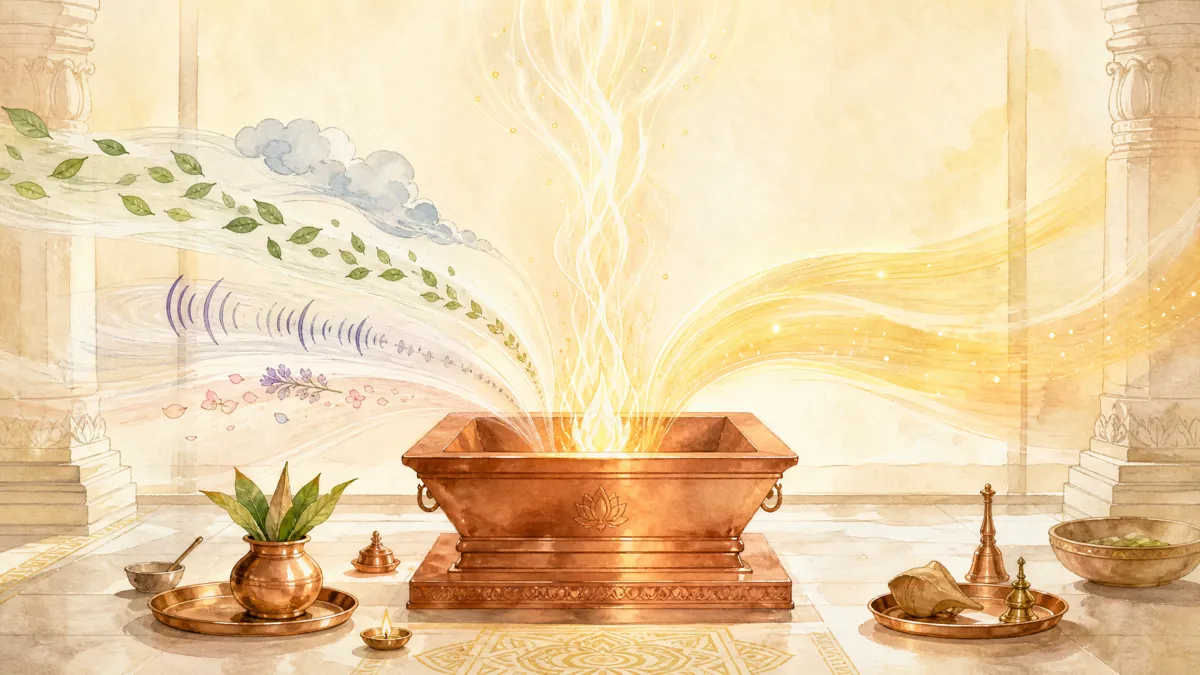
In the cauldron or kunda of the body and mind, a maha-yajna (great sacrifice) takes place, or in the crucible of prana and mind, an alchemical transformation occurs. What does this mean? Maha-yajna means that at the moment when the awakened see clouds, trees, other beings, sensory perception, or hear, see, smell, touch, or taste, these are directed not to manas (not to the mind), but to buddhi and the Atman — they are offered, sacrificed, dissolved, and self-liberated.
At the same time, instead of going outward after the mind, the winds go inward, the mind goes inward, and the winds go inward, and in the chakras, instead of blockages, there arises the experience of empty bliss. The pranas fill the sushumna — that is, a fundamentally different type of relationship with the perceived universe. And then brahma-ananda does not diminish, since no one is robbing it; the sense organs do not rob it. Purnatva, brahma-ananda, sarvajnatva, svatantrya, nityatva — the highest qualities of the Absolute — are not lost; rather, the bliss of the Absolute only deepens, only increases, because its experiences simply receive additional impulses of energy.
Energy arises through interaction with Prakriti, with the energy of the outer world; therefore sahaja-samadhi is not negation, it is the consciousness of all-acceptance, but not sensual worldly all-acceptance — rather, all-acceptance in God, the consciousness of a single “taste” and immersion in ananda.
Higher Consciousness and the Body
One who has nothing but aversion toward the physical body and its functions, of course, does not enjoy them and therefore suffers. Higher consciousness is not affected by the body, and the body is in no way connected with higher consciousness. They are like light and darkness. Higher consciousness, which transcends all changes and distortions, does not come into life and does not depart, whatever happens, happens to this body, which is inert, foolish, unconscious, limited, mortal, and ungrateful.
Higher consciousness does not come and does not go. We have a number of false, mistaken concepts, for example, the concept that we came — came means were born. We believe that we were certainly born, and that we live, and we have a birth certificate that says this, and there is the testimony of the mother, the parents, who say that we were born. This is an axiom in the human world — no one doubts that we were all born, and that we all live, and that we are ourselves precisely because we were born, and if we had not been born, none of this would exist.
But why, then, do masters again and again tell their disciples: “You must discover your face before birth”? This means that before we were born, there was some face of ours — it was the face of awareness. This is our true face, unlike the body, mind, and ego, which, having been born, were brought up and created by our efforts.
The consciousness that existed before birth was not born, and at the moment when we reveal it, when we realize it as our own, we understand that of course we received a body, but it is as if we were not quite born — that this consciousness is neither born nor dies; it always exists, as it were, and it is an illusion that it was born. The mind that perceives this consciousness can enter the body, the subtle body — yes, but this essential consciousness is always by itself, and even now it is also by itself.
To the extent that we realize it, to the extent that we identify ourselves with it — on this depends our enlightenment, our liberation, because liberation is precisely to become free from everything born. From everything that has the habit of being born and dying. The mind, the subtle body, and the physical body have the habit of being born and dying, but free infinite consciousness does not have such a habit. It has the habit of always being free and not binding itself to inert matter.
The Path to Natural Abidance in Consciousness
To recognize this consciousness within oneself and separate it from the five sheaths, to feel at ease in it — not as if, straining ourselves, we somehow reach some peak of meditative experience once in twenty years, but so that we effortlessly feel natural in it, as though we have always been it. In it we speak, walk, converse, play, eat, work, as though for us this is the most ordinary thing. This is the path of saints like Rama, which Vasishtha teaches — the path of sahaja-samadhi of Laya Yoga, the path of sahaja-samadhi of the maha-siddhas.
In the beginning, we must make effort, apply our will, and we must try very hard to purify ourselves and gain the experience of this consciousness—without effort, this is impossible. But as we progress, such ease and freedom will increase. It must become our new personality, our new character, our new natural essence. And the perception of a person who has never experienced it and that of one who feels at ease and free in this infinite consciousness differ very greatly, like the perception of extraterrestrial beings and humans.
The Nature of Infinite Consciousness
But how can this body understand infinite consciousness through feeling or reason? After all, if one is seen as reality, the other is not seen.
People often speak of “consciousness” and “infinite.” Consciousness means that it is present within us as something most subtle and knowing, that it is distinct from matter, distinct from the body. Infinite means that it has no limitations, no end, no boundary, no middle—it is extended and limited by nothing.
However, infinite consciousness has many aspects, many attributes, because it is divine—divinity possesses countless, an infinite number of attributes; therefore this infinite consciousness can be described both as divine consciousness and as pure, blissful, as the essence of being, and many other definitions are given in the Upanishads. We should not associate it only with the principle of extension, because Brahman includes the entire spectrum of energy, the entire spectrum of states that we have experienced and have not experienced.
