The Path to Freedom: Renunciation of Ego and Desires in the Yoga Vasistha
12.10.2026
0 мин. чтения
0
Share
copy
search
add
share
Commentary on the text “Yoga Vasistha,” “The Story of Manki”
Vasistha continues to instruct Rama. He says:
“When wisdom is attained through one’s own efforts and the company of the wise, this apparent world does not proliferate in consciousness. Notions arise in consciousness and, when an opposing notion arises, undergo radical changes. The complete abandonment of all notions or ideas is freedom, and such renunciation is possible only when the pursuit of desires has ceased. Notions and ideas gradually cease to arise and proliferate in a person who resolutely refuses to attach meaning in their mind to words—both to the words of others and to words arising in their own mind.
The abandonment of the sense of ego is the cessation of ignorance. This alone, and nothing else, is liberation.”
The Nature of Samsara and Liberation
When we ask the questions, “What is liberation? Liberation from what? What is this bondage?”, the answer arises: “Liberation from samsara.” Then we ask another question: “And what is samsara?” One might answer: “Samsara is the external reality in which we are born, suffer, and die; the cycle of birth and death in which we are involved in bodily subject-object relations.” But if we investigate more deeply what this samsara actually is, everything comes down to the mind, to consciousness, because samsara is a phenomenon of consciousness. There is no samsara outside our consciousness. Just as when a clairvoyant sees the dream world, that world exists only in their mind, nowhere else; that world exists only in their psychic consciousness.
Just as a dreamer sees the dream world and that world turns out to be within their mind, in the same way samsara turns out to be within our own mind; it always comes down to the mind. But when we begin to investigate the mind, we see that samsara existed because of the ego. And when the ego is investigated more deeply, no ego as such is found; it disappears. It is precisely with the disappearance of the ego that samsara also disappears. From the very beginning, it was something unreal, something imagined.
If a person dozes off and begins playing certain roles in a dream, then no matter how long they play them, from the very beginning it was all merely their imagination. In the same way, samsara is the imagination of our ego, nothing more. No matter how much one reflects on it, this is a very shocking truth.
Two Types of Illness and the Necessity of Self-Realization
Nevertheless, Vasistha says:
“For all embodied beings there are two types of illness: the first pertains to this world, and the second to the other world. For illnesses associated with life in this world, uncomprehending people try to find a cure while their lives have not yet ended. But there are no such cures for illnesses associated with life in the other world. There is no hope of curing them in the other world, because there are no such cures there either. If a person cannot find a cure for the terrible illness called ignorance in this world, undoubtedly they will not find a cure after leaving this world either. Therefore, do not waste your time trying to find useless cures for the problems associated with your life in this world. Through self-realization, free yourself from the problems of your future life. There is no time to waste, because life grows shorter with every moment.
If you do not lift yourself out of this mire of pleasures, you will not be able to find any other cure. The fool mired in pleasures can expect sorrow and misfortune. Just as the strength of an adult is already manifest in the energy of childhood, the fullness of perfection (nirvana) begins with effective self-discipline or the renunciation of the pursuit of pleasures. The course of life of one who knows the truth flows in harmony, while the course of a fool’s life is full of rapids and whirlpools.
Universes arise in infinite consciousness like bubbles on the surface of the ocean. But they are not different from unconditioned existence. Brahman is beyond all description and does not even have a ‘nature’ that can be conceived; therefore, it is foolish to suppose that the manifestation of universes is its nature! Creation, the world, the movement of consciousness, and so on are merely words without meaning.”
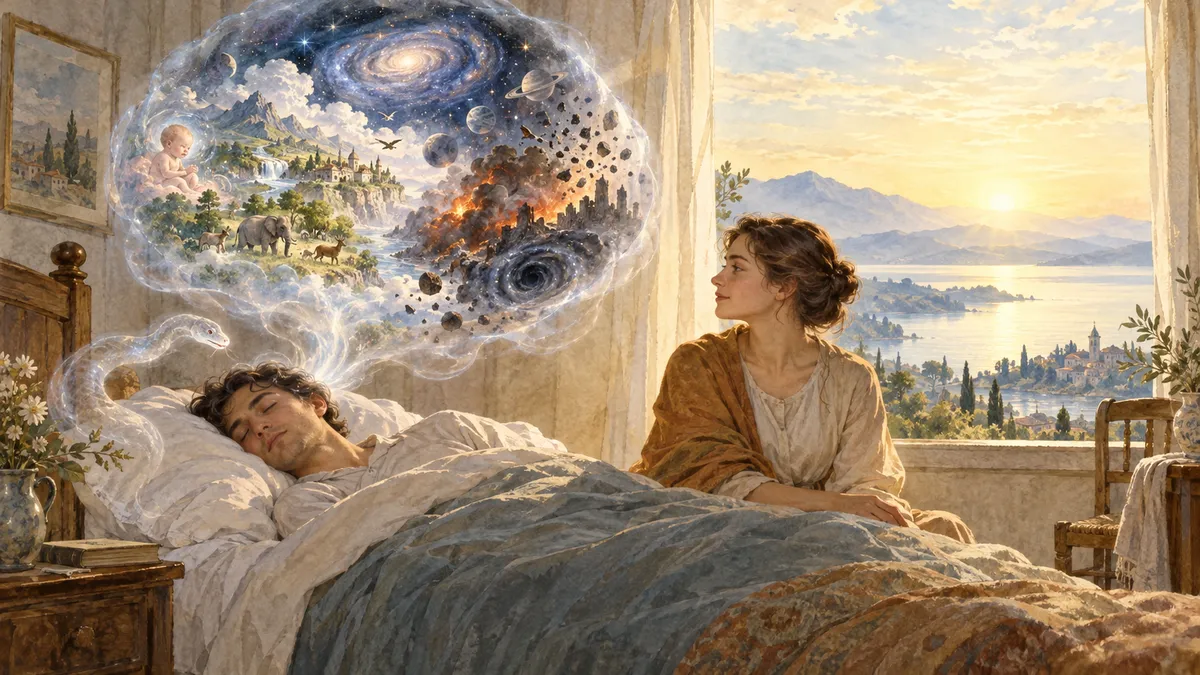
In fact, even the creation of universes, when we speak of the active aspect of the Absolute, is merely a set of concepts arising in our human consciousness, in our karmic vision. For the Absolute, there are no such things as creation and destruction. They exist only for us—human beings endowed with karmic vision. It is as if someone dreamed that a snake had bitten him. Upon waking, he approached another person and asked, “Were you bitten by a snake too?” The other person might say, “Those were your dreams; I saw nothing of the sort.” In the same way, the creation, destruction, and maintenance of the universe are also particular dreams of the mind.
The Nature of Desires and Their Source
Vasistha then says:
“One who has desires undergoes pleasant and unpleasant experiences. If there is a desire to be rid of the affliction of such experiences, the only way to do so is by relinquishing desires.”
Relinquishing desires itself entails searching for their source. Desire itself, when not conditioned by the simple nature of the body, is nescience, a manifestation of ignorance. There are desires conditioned by the nature of the body. These are the desires to eat and sleep—that is, something natural; they cannot be rejected, since these desires form the basis of life. But other desires are connected not with the nature of the body, but with the mind, with the ego. And it is precisely these desires that are manifestations of nescience. Renouncing these desires is possible only by investigating their nature—the source from which they arise.
Unitary Consciousness and the Illusion of Separateness
Vasistha continued:
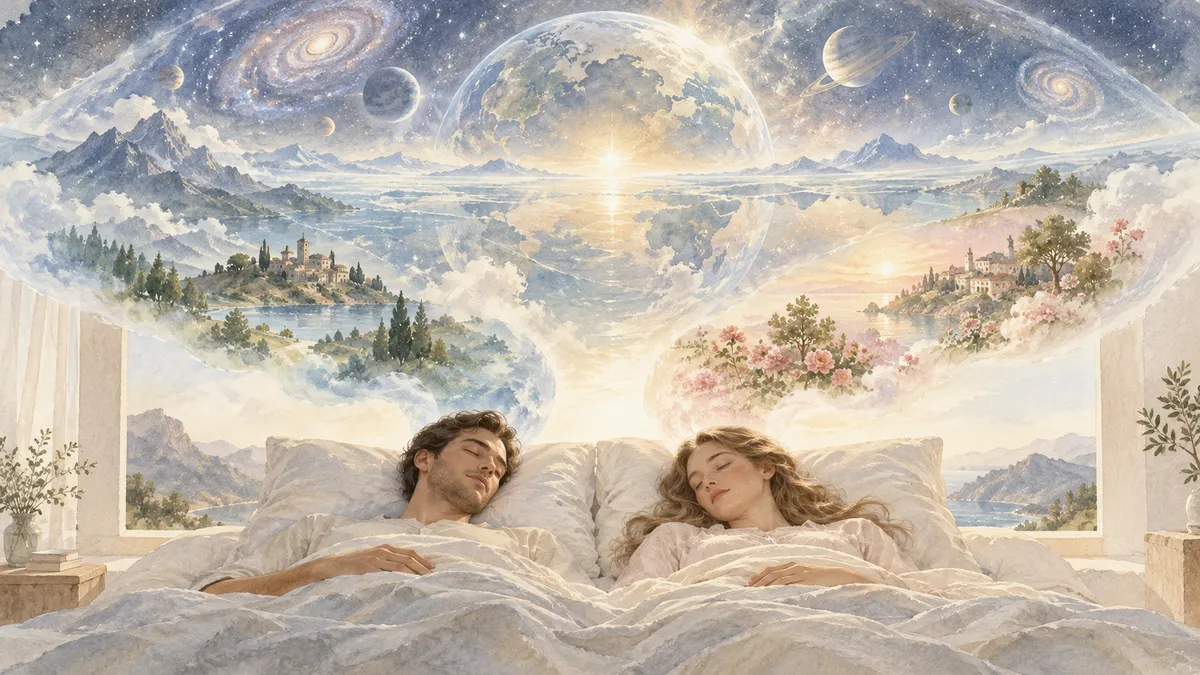
“In supreme consciousness there is no delusion that ‘I’ and the ‘world’ exist. Who invented these expressions and superimposed them upon pure nothingness, which is boundless tranquility? There is neither ‘me’ nor the ‘world,’ nor even ‘Brahman.’ All these are merely words. The only reality is boundless tranquility. Since it is everything, there is no differentiation within it and no one who experiences it. Definitions are devised for the purpose of instruction. The sole truth is consciousness, and only this consciousness exists. But just as the dreams of two people sleeping in the same bed differ, and it is impossible to see another person’s dream, so each person’s understanding and inner experience are individual and unique.
There is no doubt that consciousness, as consciousness, is aware of everything in the universe. Therefore, I am this consciousness; I, the world, and all the objects within it are no different from consciousness. Unitary consciousness appears as many, but because of ignorance and the extraordinary subtlety of consciousness, it is not seen as such. This consciousness sees the universe within itself as though the universe had form, although in reality it is formless. All distinctions, such as conscious, unconscious, and so forth, though unreal, are used only for instruction.”
In the absolute sense, all this is only unitary consciousness, which knows no distinctions.
“The notion of ‘I’ arises in Brahman accidentally (like a crow landing on a palm tree and a coconut falling from it, without any causal connection between the two). In truth, I am Brahman, the world is Brahman, and there is neither end nor beginning. Therefore, is there any reason to suffer or rejoice? Since God is omnipotent, some objects appear conscious and others unconscious. But no such division exists in Brahman.
The experience of duality is bondage, and liberation is the relinquishment of the experience of duality. When it is abandoned, all divisions between the observer (subject) and the observed (object) cease. Movement in consciousness is regarded as creation; and when this movement is seen as false and nonexistent, nirvana remains. Brahman is unconditioned and immutable. The entire universe is the absolute Brahman, without any divisions.”
Pratibimba-vada: The Theory of Reflections
Vasistha then continued:
“Infinite consciousness, O Rama, exists everywhere and therefore appears to move from one part of the universe to another in the blink of an eye. Whatever activity you may be immersed in, remain in unconditioned consciousness. The characteristic of ignorance is that it disappears when investigated; if it can be seen and observed, it becomes knowledge. Thus, ignorance does not exist, and undoubtedly there are no divisions in consciousness.
Brahman alone exists, as though it were the world, one and yet seemingly divided, pure and seemingly impure, full as though empty, empty as though full, moving as though motionless and vice versa, unchanging as though changeable, calm as though restless, real as though unreal, conscious as though inert, the Self as though an object, the non-Self as though the Self, eternal as though fleeting, unknowable as though knowable, evident as though hidden in darkness—and although Brahman is all existence, it is difficult to see.
The Infinite is unconditioned and therefore does not appear to exist in any particular place. In it there is no distinction between the doer, the action, the instrument, and the cause. It exists as everything, always and everywhere. It is invisible, though directly before you. In it there is no distinction between consciousness and inertia.”
Even an unconscious stone and the consciousness of a deity are, in essence, one and the same.
Vasishtha says:
“I am, and I am even the notion ‘I am not,’ and if there is someone else, that too is I.
All these universes seem to exist in infinite consciousness, although no such appearance or division is possible within it. It is as though consciousness wished to see itself and thus became its own mirror, in which it reflected itself without any such intention.”
This is Vasishtha’s famous philosophy, known as “pratibimba-vada” (the theory of reflections).
“Thus pure existence becomes its own inert reflection—the universe. Infinite consciousness itself is known as the world.
All substances or material creations arise within it; they exist in it, and they dissolve into it. The entire world is a picture, and consciousness itself is the pure, colorless paint with which this world is painted. Objects appear to be created and destroyed, but consciousness is eternal and unconditioned. Although thousands of worlds seem to arise in consciousness, it remains calm because it has no intention to create, just as a mirror is unaffected by the numerous reflections seen within it. This infinite consciousness is the involuntary and unintentional (non-)cause of the appearance of the present world and future worlds. When it opens its eyes, worlds arise, and when it closes its eyes, worlds disappear.”
But it does not itself create them.
The Practice of Integration and Self-Liberation
Vasishtha continues:
“Just as children’s fantasies are unreal to me but real to the child, so there is no creation in my consciousness. Since forms, vision, and the intellect that perceives them are pure consciousness, it alone exists, not the universe. I do not experience the sense of ego and so forth, but I am aware of the existence of pure consciousness or perfect tranquility. Know that even these words of mine are pure consciousness, and that this dialogue exists only in the space of your own consciousness.
In the supreme state, desires do not arise. The wise one, free from desires, acts as though made of wood. He experiences pure nothingness within and without; to him, the world is like a hollow reed. One who is not enchanted by this world and whose heart delights in cosmic existence abides in boundless tranquility and has crossed this ocean of samsara. Having transcended desire and abandoned latent tendencies or mental conditioning, say what must be said, touch what must be touched, taste various flavors, behold various scenes, and smell various fragrances.”
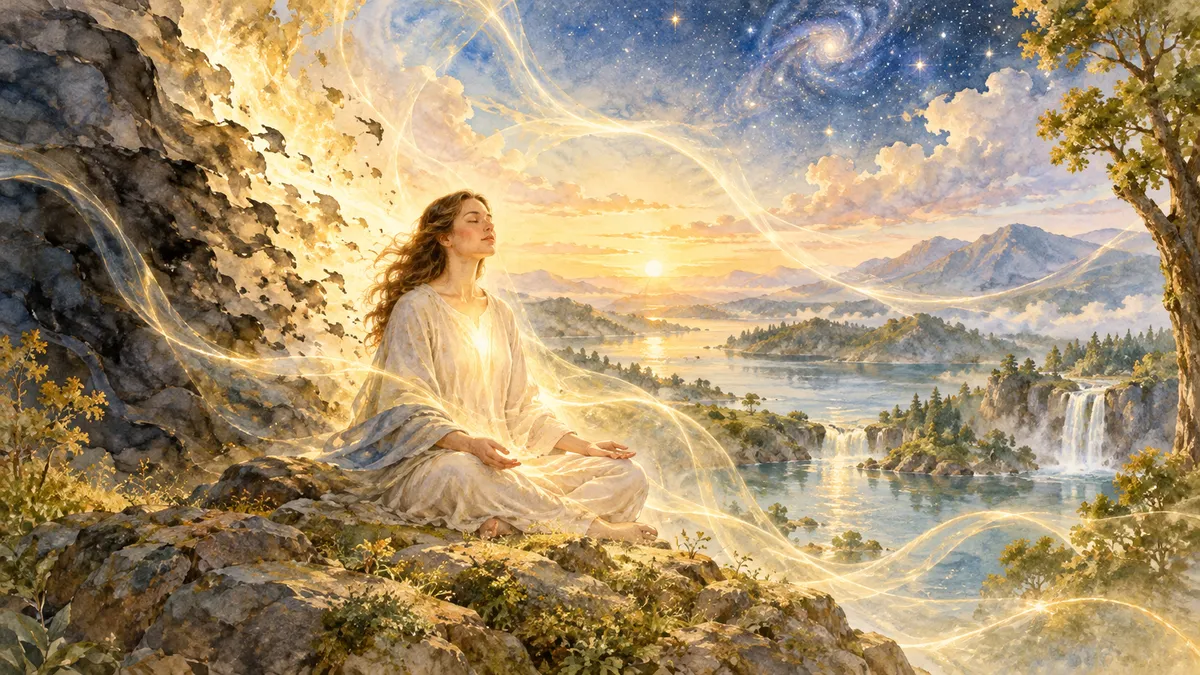
Vasistha instructs Rama in the practice of abiding in natural awareness and integration. Integration means allowing the senses to remain open, wide open. We unite with all experiences as they are, bringing the factor of awareness into them. Through such union, all experiences self-liberate. They self-liberate not through renunciation or rejection, nor through visualization or other practices; rather, this happens spontaneously through abiding in the natural state.
Self-liberation means that the senses cease to function in their former way. Objects cease to function and exert influence in their former way. The dualism, the dichotomy between “self” and “not-self,” disappears. Now the “self” also encompasses “others.” I am the table, the tree, the earth, and the stone. All of this is my greater body when I abide in contemplation. There is no longer any conflict between me and reality because I am integrated into reality. Then everything that happens in reality happens within the field of my own consciousness. It is I myself. There is no attachment to anything, only boundless love, bliss, and awareness.
Why does attachment arise? When you look at something, an imprint is created in the mind. And when you look at it many times, the mind desires those imprints to be repeated. It then contracts and enters a state of attachment. But in a state of integration, regardless of what you perceive, look at, or feel, no attachment arises, because instead of contracting, the mind remains wide open and constantly abides in the Source. Then, upon contact with external sensory objects, there is no transporting prana flowing out of you. Normally, transporting prana carries a subtle wind from consciousness, and then the object is, as it were, touched, producing a sensation in response.
For example, if you integrate well while listening to music, you may feel the subtle vibration of the music arising in space, around your ears and eardrums. Then, if your sensitivity deepens, you will see how the music resonates in your anahata chakra. It is precisely anahata that is connected with sound. And this vibration in the anahata chakra literally touches your subtle body if the music is of a high level—this is exactly how you feel it. Then you can no longer say whether the music is flowing from the speaker, from the instrument, whether it is in your ears, in the anahata chakra, in your astral body, or even in your consciousness. It is a single nondual process in which there is no distinction between you and the music. This is precisely why the practice of the bhajan mandala is valuable as a contemplative practice of integration.
This is precisely how all sensations and objects are perceived. There is no longer any prana that draws your consciousness away when you perceive external objects. Since your mind is wide open and you abide in the Source, the perception of objects is not a problem. You abide in the Source, the object abides in the Source, and the process of interaction also abides in the Source. You no longer have any limitations associated with your own body. The entire universe abides within you. The whole world is your body. Accordingly, if the whole world is your body, there is no attachment whatsoever.
The True Cessation of Desires
Vasistha goes on to say:
“Only by understanding the insubstantial emptiness of the objects of sensation can one be freed from the affliction of desires. The arising of desire is suffering, and the cessation of desire is supreme bliss; there are no sufferings or pleasures comparable to them, even in heaven or hell. The mind is desire, and the cessation of desire is liberation—this is the essence of all the scriptures.”
True liberation is the cessation of desire resulting from integration and self-liberation.
If someone has learned to suppress desires simply through willpower, by blocking them, this still does not guarantee that the latent karmic tendencies have been burned away or that the desire will not arise again. For example, a person has overcome attachment and decides: “That’s it! I am uprooting attachment from my heart. I am already tired of it.” As long as the external environment remains favorable, this attachment does not, indeed, cloud their mind. But if they stop there and think that they are already free from attachment, this still does not guarantee that they will attain liberation, because the environment may change, their mind may also change, and then the attachment that was merely removed without resolving the underlying problem may arise again.
True victory over attachment, however, lies in an entirely new worldview. A worldview in which attachment cannot arise in principle is abiding in the source of all attachment. It is as if, having found very pure water from a spring, you are no longer drawn to drinking water from a puddle; it simply makes no sense.
In the same way, when we immerse our consciousness in the Source through self-inquiry, attachment simply cannot overtake us. We see that it is mere childishness, that being attached is actually quite ridiculous, that it is immaturity, and we will never fall into this immaturity again.
The Gradual Path of Overcoming Desires
Vasishtha then says:
“If desire cannot be brought to an end through one’s own efforts, then it is undoubtedly strong and cannot be overcome by anything else! If you cannot overcome desire completely, then deal with it gradually. A traveler does not grieve over the long road ahead, but takes one step after another. Desire alone is samsara, or the apparent world, which is the continuation or projection of one’s own desire; non-perception of it is liberation.”
Many unconsciously believe in this world, in evolution, in progress, and so on. These exist on a lower level, but in reality this world is merely a desire, just like a desire in a dream. And one can attain a high stage very quickly simply by getting rid of this desire. To get rid of this desire means to look into its root and find its source.
Vasishtha says:
“Desire alone is samsara, or the apparent world, which is the continuation or projection of one’s own desire; non-perception of it is liberation. Therefore, one must strive diligently to overcome desire; everything else is useless. Why study scriptures or listen to teachers’ explanations to no avail? There is no liberation without the cessation of desires! If someone finds that they cannot overcome desire through their own wisdom, will studying scriptures or receiving a teacher’s instructions help them? When this agitation caused by desire subsides, Self-realization is attained with very little effort. Therefore, let everyone strive by any means to overcome desire, which is the seed of birth, old age, and death. With the arising of desire, bondage arises; and with the cessation of desire, bondage ceases. Let the seed of desire be burned in the heart by the fire of tranquility, equanimity, and self-control.”
Vasishtha once again instructs Rama:
“Yoga is liberation from the poison of desires.”
The Nature of Desire and How to Overcome It
What do we mean by desire? Desire is the binding of the mind, the contraction of the mind, and its clinging to something as a result of an incorrect perception of the object. It can be any desire: from the egoistic desire to be liked by others and to look good in their eyes, to the desire for ordinary everyday things or the desire for attachment. The moment the mind narrows and fixes upon certain objects, resulting in clinging, this is called desire.
The objects themselves are not desires. Experiences and sensations of objects are not desires either. Desire is the loss of awareness of infinite consciousness at the moment of contact with objects. It is precisely the contraction of the mind when perceiving or experiencing any objects that is the great problem.
A sage does not experience worldly desires, even when immersed in sensual pleasures. But the mind of a fool, even if he performs ascetic practices or remains in strict seclusion, may be overflowing with desires. The difference lies in whether there is subtle discernment of the source of desires, whether there is trust in this source of desires, and whether this source of all desires is a transformative force.
Vasishtha says:
“Even if you desire to possess something, there is nothing but the supreme consciousness. What is there to desire? Consciousness is subtle, like space, and indivisible; it is itself the world. How and what can you desire? There are no objects that can be desired.”
Advaita as the Pinnacle of the Spiritual Path
You should know that the Advaita worldview is the pinnacle of philosophical thought. It is a transcendent philosophy and teaching for people with highly developed abilities, because the moment you come into contact with it, it changes everything within you. Coming into contact with the philosophy of Advaita is a fearless, direct path that makes it possible to attain realization in a single lifetime.
This path consists in gaining and understanding. This very understanding opens up a new world, a new vision, and new knowledge for us, and allows us to build our lives on the basis of this new vision. No matter how long you study this understanding, it always remains an unimaginable mystery to you; you can never grow accustomed to it. No matter how much you study it, you always feel reverence as you do so. Gradually becoming imbued with this understanding is the way out of samsara and the process of becoming a deity.
Consciousness as the Creator of Reality
Vasishtha says:
“What you think about for a long time is what you see.”
Our consciousness materializes. This world only appears to be independent of consciousness; it only appears to exist on its own. In fact, we ourselves are the creators of this reality.
Vasishtha says:
“If a person thinks for a very long time that there are two moons in the sky, after some time it will indeed be so: two moons will appear in the sky. One simply needs to think about it for a long time.”
He also says this interesting thing:
“Perhaps there will not be two moons in the vision of other people, because they do not think that way.”
But in this person’s vision, two moons will appear in the sky. Why is that? Because there is no single world shared by everyone. Each person lives in their own reality tunnel, and creates it through their own vision.
Instructing Rama, Vasishtha says:
“You see what you think about for a long time. Understand that, just as in a dream, when you think about something for a long time, you begin to see it all around you in the dream. Likewise, in this world, reality is reconfigured when you concentrate on something. What you think about for a long time is what you see.”
The Practice of Contemplating the Divine Nature
If we understand this principle, the practice becomes clear.
Abiding in awareness, we think for a long time. And what do we think about? We think: “I am Brahman; I am the supreme Source.” Day by day, we grow into the vision of the deity; we become accustomed to being a deity, accustomed to pure vision, to the single “taste.” We constantly think about this if we truly contemplate. Of course, someone may not think about it at all. But I, for example, certainly do, and I recommend that you do as well. I know that everything depends on me: whatever I conceive will come to be. If I do not think about it, nothing will manifest.
When we say “I think,” this does not mean that you create an intellectual construct; otherwise, it would be the lowest kind of thinking. By thinking here, we mean bhava, contemplation, and abiding in the proper state of mind.
Thus, day after day, month after month, year after year, we constantly think that we are a deity. We think “Aham Brahmasmi” now, three years from now we think “Aham Brahmasmi,” and twenty years from now we still think “Aham Brahmasmi.” And over the years, we discover that this formula, “Aham Brahmasmi,” comes alive and begins to unfold; reality gradually changes, and we change. We see that, from a dry formula, it becomes such a transcendent, all-encompassing, and majestic experience that all our ideas about ourselves are transformed.
The Three Foundations of Divine Vision
We become accustomed to being a deity. We think this way day after day, maintaining divine pride (divya bhava) and pure vision. We think: “This world is a mandala, all events that occur are lilas, and the people around us are deities.” Again, we do not think this intellectually, but at the level of vision. We also contemplate the single “taste” (samarasya): “The pure and the impure—all this is a manifestation of the One. All of it is one.” And we strive to perceive things in this way.
These three categories—divine pride (divya bhava), pure vision (shuddha vidya), and the single taste (samarasya)—are precisely the states we cultivate within ourselves day after day, year after year.
Understanding the Nature of Deities
Over time, we begin to understand that we as human beings, our self-esteem, and our perception have begun to change, and that we are no longer what we once thought ourselves to be. We begin to gain a subtle understanding of the laws of the gods, their vision, and their way of thinking. For example, whereas the state of a deity was once completely unknown to us, we gradually begin to recognize that deities possess presence and that they all abide in mystical consciousness.
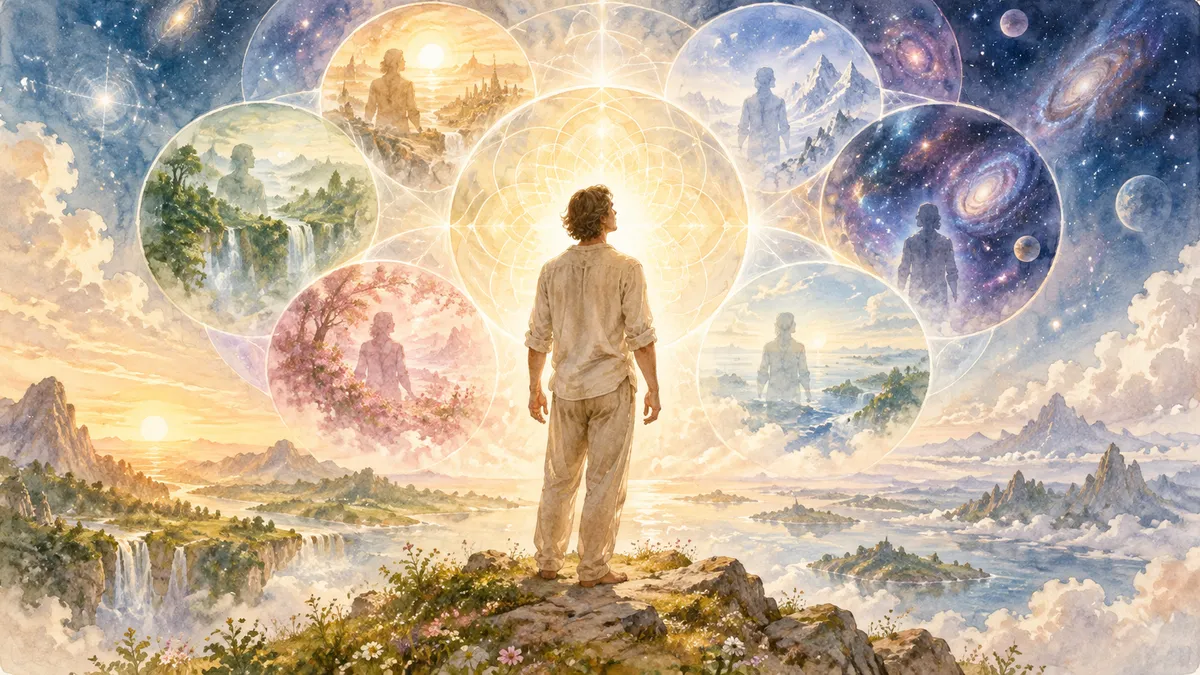
Each of them lives in their own reality tunnel, in their own universe, in a mandala. Through the power of their minds, they create the world in which they live. They have no ordinary worldly relationships; rather, all their relationships are founded on samaya, a sacred bond. Deities do not have a single body but many; they possess numerous bodies. Deities abide not only in one reality but in many realities, and they can choose their reality. Deities are always immortal; time and space have no power over them. Deities do not act; they play, and the law of cause and effect does not affect them. Deities are overflowing with bhava, divine mysticism, and a sense of grandeur.
All this is revealed to us as we become established in the state of divine pride and pure vision.
The Ultimate Realization of Brahman
Ultimately, we come to the conclusion that even the state of a deity is a pure state beyond which there is something still more transcendent. It is Brahman itself as pure consciousness. And when we become established in this, continuously thinking in this way and abiding in the state of Advaita, suddenly, at some stage, we come to the conclusion: “This is indeed how it is; I have never been anyone else. This is indeed how it is; the world has never been anything else. And what I used to think about myself was a profound delusion.”
Advaita
Consciousness
Liberation
Samsara
Ego
Brahman
Aham Brahmasmi
Pratibimba-vada
Yoga Vasistha
Author Гуру
Read 26 times
Articles
Vidya AI
Search
Lectures
November 3, 2026
Mantra of the day
ОМ САДРЩАЙА НАМАХ ОМ Видящему равно – поклонение!
Auspicious Times(Rome)
Brahma Muhurta:
04:54 - 05:49
Abhijit Muhurta:
11:33 - 12:14
Sayam Sandhya:
16:43 - 17:24
Mokshada Ekadashi (6 November)
Ekadashi of liberation. Helps to achieve spiritual enlightenment.