


Commentary on the “Yoga Vasistha”
I pray you, tell them who Rama truly is.
Vishwamitra said to everyone:
Rama is the supreme incarnation of God. He is the creator, protector, and savior. He manifests himself in different ways: sometimes as a fully enlightened being, and sometimes as an ignorant person. Truly, he is the god of gods. All deities are his partial manifestations. Blessed is King Dasharatha, whose son is God Rama himself. Blessed is Ravana, whose head will fall at Rama’s hands. O sage Vasistha, I beseech you, bring him back to normal bodily awareness.
Vasistha said to Rama:
O Rama, now is not the time for rest. Arise and bring joy to the world. As long as people are still not free, a yogi should not completely dissolve into awareness.
As long as people are not completely free, a yogi should not completely dissolve into awareness. This must be remembered so that, when we enter the process of dissolution, we recall that it is not yet proper for us to dissolve. You laugh, but the time will come when you will have to remember this. You will have to remember the commitments and vows you have made, just as I once remembered mine. For when you approach emptiness, nonduality, samadhi, there will no longer be a single reason to hold you back. Consciousness may become so enchanted by this state that it will wish to enter the unmanifest emptiness and never emerge from it again.
This does not mean that you will leave the body. You may remain in the body, but while in the body you will want to abide in the emptiness of the unmanifest and enjoy a kind of private, personal happiness of emptiness. On the one hand, this is great bliss, but on the other hand, it is also a halt in spiritual development. Then the yogi must find at least one reason that would keep him from doing so. And he remembers: I made commitments, I took vows to help other living beings carry out the divine will. I made a commitment not to dissolve. Therefore, perhaps I will retain ahamkara, manas, buddhi, and chitta, and turn them into instruments of play for carrying out the divine will.
This is how all wise sadhus act. When they are able to do this, they protect themselves from falling into the state of pralaya-kala, from enjoying the lesser nirvana, and proceed to the practice of sahaja samadhi. They bring turiya into the dimension of jagrat. When you feel the desire to dissolve, it means that you have attained turiya. And you want to enter turiya; you want nothing else. You have no concern whatsoever for jagrat, for svapna, for this world, or for anything else. But here the Yoga Vasistha says that you must bring this consciousness into jagrat. The suffering of living beings, the ideals of the bodhisattvas, and the ideals of saving others provide the motivation for this.
Question: In the Yoga Vasistha, there is a story about the sons of Indu. There are ten sons, and they did not return. Is that also an option?
That is also an option, but not for you.
And in what way is jagrat turiya better than the path of the sons of Indu? What is its advantage?
Obviously, the brothers of Indu passed through all these stages without getting up. They passed through all these stages, jagrat turiya and so on. Still, the point is not activity; activity is merely a pretext for motivation. The point is the ability to bring turiya into waking consciousness, to bring it to the very forefront of the material world. If you succeed in doing this, then you are following the path of Laya Yoga, the path of sahaja samadhi; you are doing everything correctly.
And your activity of saving others, helping others, and freeing them from suffering will occur naturally. It cannot fail to occur if you bring turiya into jagrat. It is impossible; it is like the sun—it cannot help but shine, for such is its nature. The nature of turiya is also to shine. As soon as you bring turiya into jagrat, it will shine and manifest these qualities. These qualities will naturally help others, even without your conceptual involvement. Evidently, the brothers of Indu accomplished this without moving.
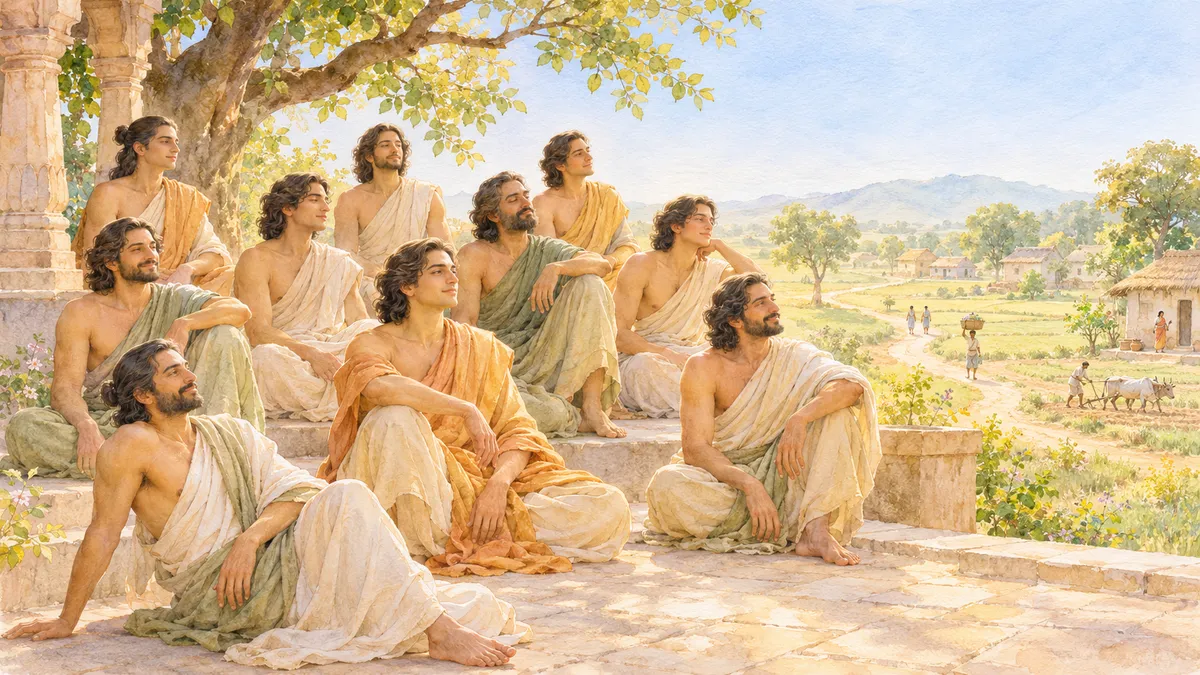
Rama remained deaf to these words. Therefore, Vasishtha entered his heart. Prana began to move within Rama, and his mind began to function. Individual consciousness in the form of inner light illuminated all the nerve centers of his body. Rama opened his eyes, saw Vasishtha before him, and said: “There is nothing that I must or must not do. However, your words should always be heeded.” Having said this, Rama bowed his head at the sage’s feet and proclaimed: “Listen, everyone: there is nothing higher than Self-realization. There is nothing higher than the teacher.”
Divine Reality
Rama said: there is nothing that I should do. This was because he had realized the qualities of Ishvara within himself and attained the experience of the higher tattvas. What are these qualities?
Svatantrya is absolute freedom of will, the absolute sovereignty inherent in Shiva.
Purnatva is the absence of any desires, complete self-sufficiency within oneself.
Nityatva is transcendence of the impermanence of time.
Sarvakartritva is the ability to do everything, the ability to be a great doer. There are no restrictions imposed by the law of karma on action or the doer, and there are no obstacles to action. Kriya-shakti operates unhindered.
Sarvajnatva is omniscience, all-knowingness; there is no limitation in knowledge, no sense that there is something I do not know. All knowledge is within me.
Vyapakatva is the ability to transcend niyati, the kanchuka that limits consciousness in space.
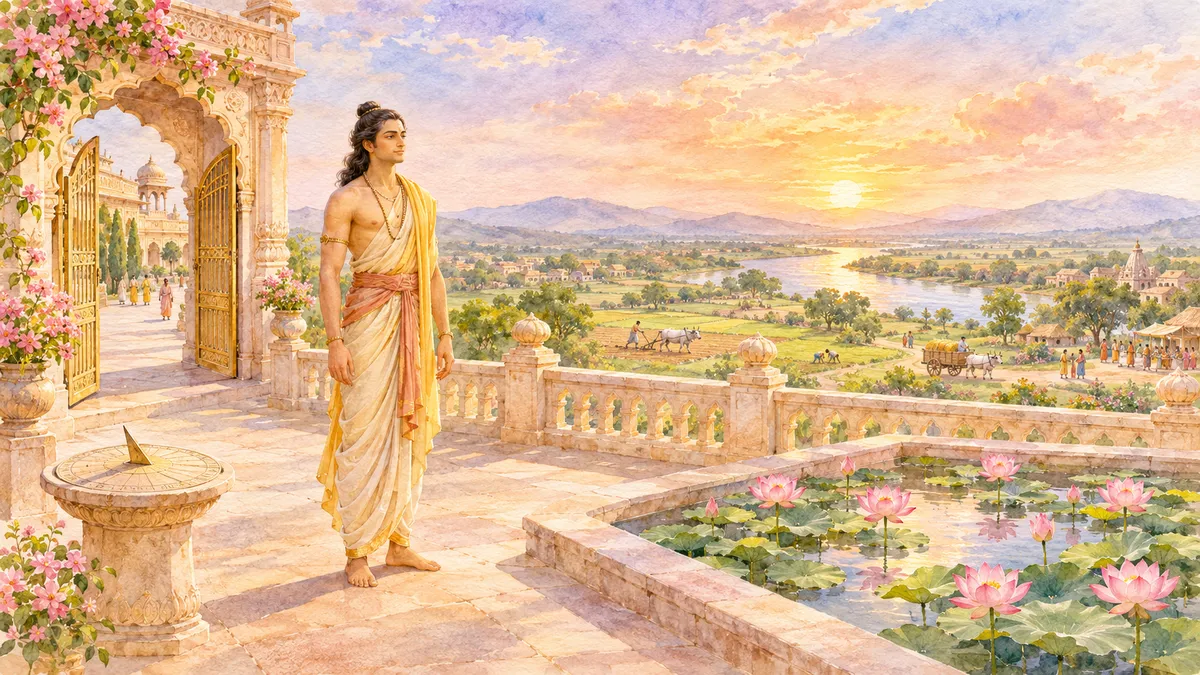
When these qualities are experienced, this is complete realization, the attainment of one of the highest tattvas. Rama realized all these tattvas within himself. Therefore, he was a God-man. Rama is considered an avatar. Having become a God-man, he nevertheless continued to fulfill his dharma on Vasishtha’s advice. This is why his life story is called Ramlila. Ramlila means “Rama’s play”; it is no longer Rama’s life, but his play.
Play differs from life in the same way that acting in a performance differs from real life. It may seem that all the same actions are taking place, with the same intensity of passion; the villains behave similarly, good people behave the same way, and the main character undergoes the same experiences, but it is all make-believe. The actors are expressive, but in reality it is a play, and the entire situation is merely a series of scenes in this performance. In fact, all of it was devised by the director. Entertainment.
Rama’s life is Ramlila. Rama is a manifestation of God’s playful activity intended to impart a certain dharma and certain qualities to people. When the gods were discussing Rama’s behavior, one of them said: in my opinion, he has become too attached to his Sita. Another said: do not say that; he is an avatar of God and cannot be attached to her, but he is playing his role. Another god said: we shall test that now. Possessing vigraha-siddhi and rupa-siddhi, the ability to manifest any form, he transformed himself into the form of a woman identical to Sita. Having transformed, Sita came to Rama. He said: here I am, your Sita; there is no need to defeat Ravana, let us go home. Rama simply walked past without even paying attention to her. He knew that this was a god who had assumed that form, and he had no attachment even in this regard; he knew that he had to play his role on this divine stage. Rama could not be deceived.
Play, lila, differs from ordinary consciousness in that it unfolds in divine grace, in the dimension of the higher tattvas. Shiva-tattva and Shakti-tattva are present within it—that is, bliss and consciousness; it also contains awareness of the divine will, Sadashiva-tattva, as well as jnana-shakti, awareness of Ishvara-tattva. It does not arise from subject-object states, but from the state of unity between the world and the mind. From the state of “I am all this.” Consciousness plays within itself, within its own I-am awareness.
Lila has no motivation conditioned by karma, no fruits or results that must be achieved and appropriated. Lila has no defeats or victories. It is itself victorious. Any defeats are also victories; victories are victories too. But, in essence, it is transcendent in relation to victories and defeats. Therefore, there are no winners or losers either. There are only fools, those who do not understand lila, and sages, those who understand lila and participate in it. Fools are called mudhas, and they experience karma. Sages are called jnanis, siddhas, and various other beings, vijnana-kalas, mantra-maheshvaras, and so on. In general, siddhas, devas, and mahadevas.
The divine play is a manifestation of God's own Shakti. Realizing the world as lila, abiding in the dimension of play, is in itself a path to Liberation. It is precisely the failure to recognize the divine play in all activities that causes the soul's bondage. When we do not recognize the divine play, we see only karma; karma affects our mind, karmic reactions arise in the mind, and we reap karma-phalas, the results. Conversely, when we see only the divine play, karmic reactions do not arise, and karma-phalas are not reaped.
Therefore, the art of enlightened action that Vasishtha offered to Rama is the art of divine play. It cannot even be called an art; rather, it is wisdom that comes as realization. This is the path of divine play. Our task is to recognize everything as divine play and become a divine player in the Absolute's divine play. Not an actor or a doer, but a player.
How does play differ from ordinary life? It has excitement. It takes place in an elevated state of consciousness. Because it has no material motives, only subtle ones; it always involves probability and a wide range of variations. There is no attachment to fruits and results as such. To recognize the divine play is higher still.
Why do so many people simply become addicted to games? Because they sense the divine tattvas. A person goes and takes all his money to a casino and loses it, knowing that he will lose, yet he cannot help himself. Some people become absorbed in computer games. There are chess players who live entirely for chess; they faint during tournaments. Their minds work intensely; they are so engrossed that they want nothing—neither family, nor children, nor work. They are interested only in chess, spending eight or twelve hours every day at the chessboard. Fanatics. All these are reflections of the true divine play. Every manifestation of play is a reflection of the divine tattvas. The divine tattvas are so attractive. But in the human world, they intersect with people's impure karmas and turn into casinos, chess, hockey, sports lotteries, and so on. Pure tattvas intersect with impure ones.
Our task is to learn to perceive the divine play in all everyday actions, to learn to recognize the play of pure tattvas, and to realize ourselves as divine players as well, without becoming involved in karmic relationships based on causes and effects. How can this be done? If we abide in self-surrender and contemplation, the vision of divine play will arise. When we see the divine play, we penetrate to the very essence of the universe. We see the play of divine tattvas behind the outer forms of people and all situations. Therefore, the Tantric practice of pure vision entails regarding everything as a manifestation of the play of the ishta-devata.
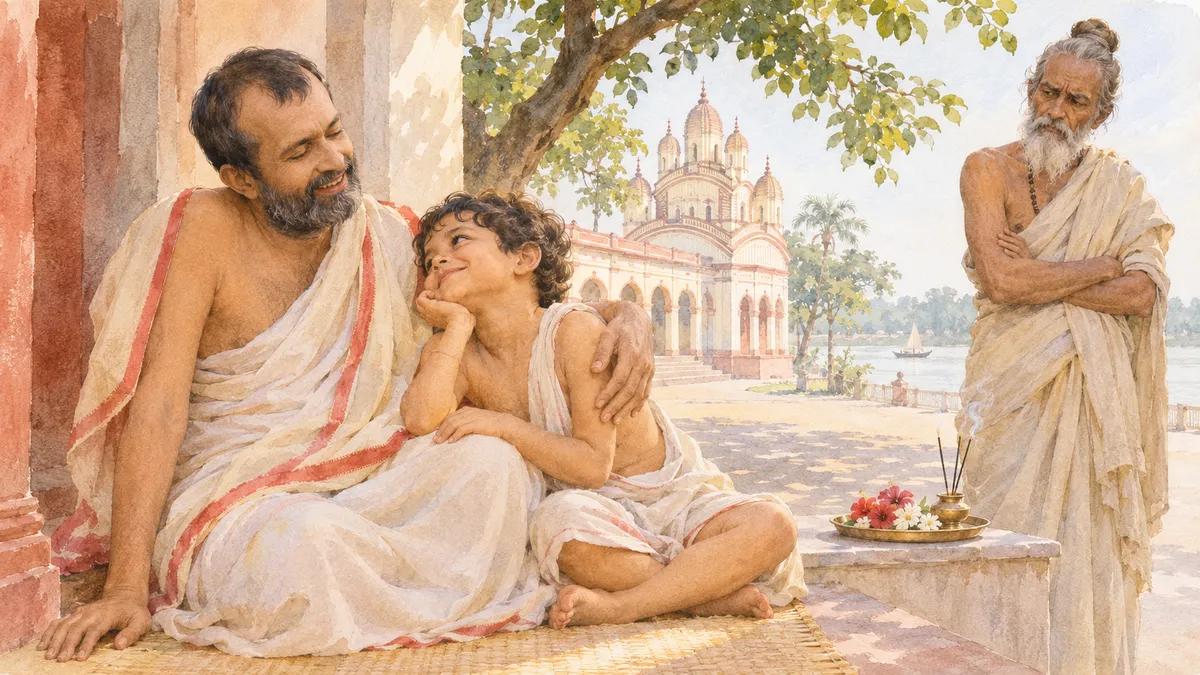
Ramakrishna once worshipped the deity Rama. This deity was entrusted to him by a sadhu. This sadhu had worshipped the deity for twelve years, but for some reason it was more favorably disposed toward Ramakrishna. It would come to Ramakrishna but would not come to this sadhu. The sadhu was deeply offended: he fed it and offered incense and flowers, yet this deity, Ramlala, the deity Rama in the form of a boy, would come to Ramakrishna. Ramakrishna spoke and played with him; the deity would appear on the subtle plane, and Ramakrishna would place him on his lap. The sadhu was offended and said, “I make offerings to you and recite prayers, yet you come to play with him and do not come to me.”
Ramakrishna described how this boy would sometimes follow him everywhere, as children usually do, and ask various questions. Sometimes, when he was denied something, he would puff out his cheeks and take offense. Ramakrishna had a vatsalya-rasa, a parental relationship, with this deity. Sometimes the boy disliked something. But overall, Ramakrishna and this deity always shared a great friendship. Wherever Ramakrishna went—to the temple or somewhere else—the boy went with him, yet he would not come to that sadhu. Why? Because the sadhu had a callous heart. The deity in the form of a boy did not like that. Ramakrishna, on the other hand, simply loved him unconditionally.
Question: What about these lilas with deities? Many saints describe games with Krishna and Rama, who come to them. Do these lead to anything in terms of realization? Because Ramana Maharshi said: discard everything, all duality, and seek the Self.
I also say: discard all of this.
How should one respond to such things?
Tantric worship presupposes that if you worship an ishta-devata, you can see it on the subtle plane. But if you stop at the subtle plane and begin to establish a relationship with the ishta-devata as a form and a name, then at most this can lead you to salokya-mukti or samipya-mukti—to dwelling in the loka of your deity. A deity on the subtle plane can lead you to that deity’s paradise. Or it can lead to your always being among that deity’s companions, with your soul beside it. But in fact, this is not our ultimate goal. We must transcend the form of the chosen deity, break through to its essence, and its essence is nondual. Therefore, upasana in the spirit of Anuttara Tantra and upasana in the spirit of dualistic teachings are different. But Ramakrishna practiced upasana in the spirit of Vishishtadvaita, in the spirit of duality.
All the assembled sages and celestial beings offered flowers to Rama and blessed him. Then they left the assembly. I have told you the story of Rama, O Bharadwaja. Through the practice of this yoga, you will attain supreme bliss. One who constantly listens to the dialogue between Rama and Vasishtha attains realization of Brahman.
Rama asked:
When a person abandons action and the desire to perform action, the body dies. Can a living being exist in such a state?
Vasishtha replied:
The abandonment of mental limitations and notions is possible only for a living being, not for the dead. What is a notion or mental activity? It is merely the sense of ego. When this is realized to be nothing, the sense of ego is abandoned. A notion created within by external objects is called mental activity. When this notion takes on the characteristics of “nothing” or emptiness, it disappears.
The Practice of Recognizing the Divine Play
How can we learn to recognize the divine play? First, we must understand that the divine play is already here; we cannot create it anew through practice. The issue is that we do not see it. We see a karmic situation, whereas in reality it is the divine play. Any karmic situation that appears karmic to us is actually the divine play; we simply do not see it.
Why do we not see it? There is a deficiency of vision, a flaw in our vision—not physical, but spiritual. Just as a cataract in the eye impedes sight, so a flaw in spiritual vision prevents us from recognizing lila, the divine play. When we eliminate this flaw, for example, the vision of the divine play naturally arises by itself, even if we do not know the philosophy.
When we contemplate with naked awareness, without evaluations or judgments, we move closer to seeing the divine play. When we abide in self-surrender, in the renunciation of the ego, we also move closer to seeing the divine play. When we bring natural awareness into every aspect of life, we likewise begin to discern the divine play. When we are unconscious, by contrast, the divine play is not seen. Therefore, the key is to strengthen awareness, and to deepen self-surrender and faith, and then the divine play will become visible. When we act in the spirit of karma yoga, in the spirit of self-renunciation, the divine play is also visible.
The divine play means that behind any manifestation we can see the play of divine forces—and nothing else. It means receiving grace from every situation, receiving darshan from every event that occurs, enjoying it, and abiding in wisdom and nondual consciousness. The divine play means: I am inseparable from God, and the external world is not separate from me in God. The divine play means that everything happens in God. The divine play means that I abide in God, and everything that happens, happens in divine Consciousness. And therefore it is grace-filled, auspicious, and liberating. If we engage the mind, the divine play is not visible. If we remove the mind and begin to contemplate, the divine play reveals itself.
Question: The sacred books say that the divine play is spontaneous, paradoxical, irrational, illogical, absurd. Like a game. But when there are Vinaya and samaya in one’s life, there are so many rules—how can all this be reconciled? Because everything becomes so serious; there are certain obligations and responsibilities. There is the relative world, where there are transgressions and karmic consequences. How can one preserve the spirit of divine play without discarding or denying the rules of the Vinaya? How can one, while playing, see through it all, and while observing the rules, discern the element of play?
Action Without Ego and Recognition of the Divine Play
Act without ego. Act with awareness. For the egoless state, it does not matter what is happening; it discerns the divine play everywhere regardless. The Vinaya is also divine play. What is wrong with it? Samaya even more so. Traffic regulations too. If you act without ego, in contemplation, you will flawlessly recognize it everywhere. You will recognize it in domestic codes and in military regulations. You were given three extra duty shifts for wearing non-regulation clothing in the army—lila. If you are without ego, you will see lila in this. Shiva Bhairava himself came to show you your lack of impeccability in the mandala of the army. He has come—accept it. These are the kinds of games played here.
There are different kinds of games. A king was overthrown by his subjects, who staged a revolution—that too is divine play. Shiva Mahabhairava showed the king how to govern his people impeccably, and what happens when one is not impeccable. These are different games; the point is that our ability to recognize them is limited. But we must deepen this ability. And how? Only by surrendering to God, only by deepening our presence.
Even certain wrathful things are also games. But our dualistic mind is capable of recognizing play only within a very narrow range; go just a little beyond it, and we are no longer capable of doing so—it is already beyond our understanding. We must expand our capacity. We must remember that God plays many different games. But when we see through them, we truly deepen our vision of the divine and attain liberation.
Liberation is nothing other than a transition into a world in which nothing exists except the divine play. All phenomena are manifestations of the divine play. It is a transition into such a world, where there are only divine games. This means that we need to deepen our consciousness and cut off the ego’s judgments to such an extent that we can recognize this play in everything, always and everywhere.
Pure Vision as the Key to Recognizing the Play
Besides awareness, another key to this is pure vision. For example, someone gives a bribe to an official. In impure vision, it is a bribe, while in pure vision it is an offering to a deity. A klesha is transformed into wisdom. It is another matter if the official is punished by a higher-ranking official: in pure vision, this is the wrathful darshan of a senior deity. This too must be recognized through pure vision.
But when we abide without ego, we can recognize pure vision and play in everything. Play is always pure; there are no impure games. If something is impure, then it is not play; it means you have failed to recognize it—it is karma. Play takes place only in the pure, higher tattvas. To recognize the play means to transform the impure tattvas into pure ones, to transform impure vision into pure vision. Our ability to subjectively transform any situation, any perception, into pure vision, into pure tattvas—this is our self-liberation.
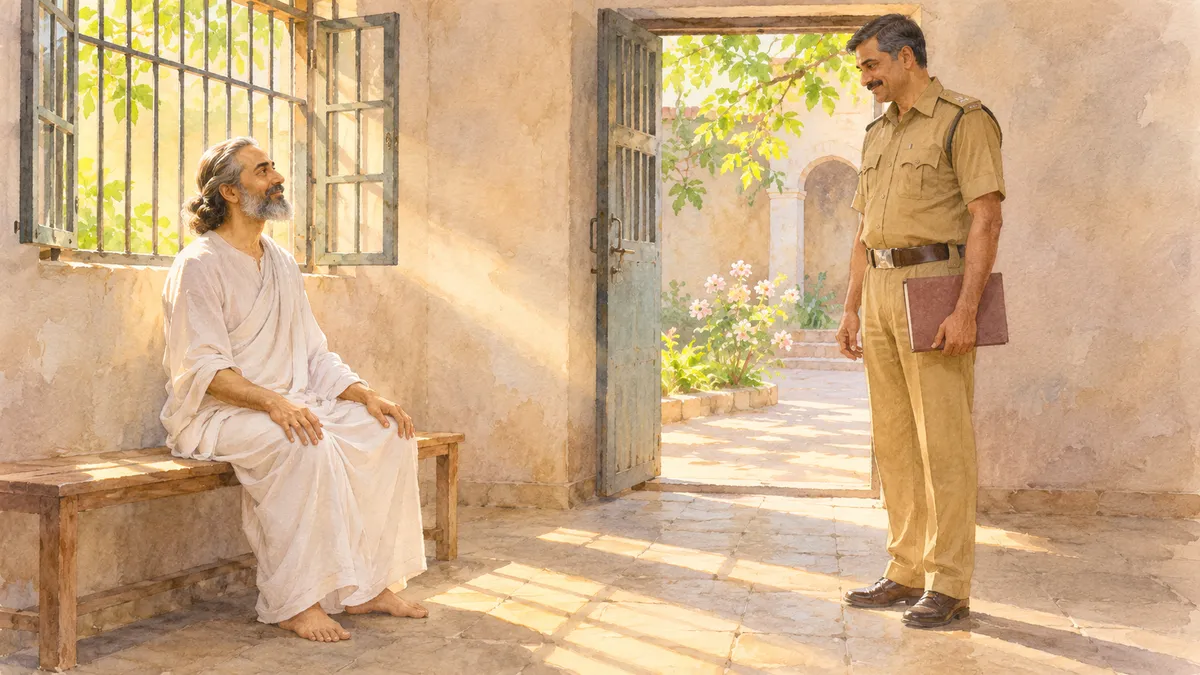
Question: Suppose a saint is imprisoned, for example, but he abides in pure vision. Yet the police officer who imprisoned him is not enlightened, and for him all of this is real. Can the saint give him his pure vision as darshan, so that he attains self-recognition and also perceives himself through pure vision? Can the saint’s vision be transferred into the relative world?
If it is a powerful vision, this is possible. If it is weak, probably not. A weak vision that does not possess great power will remain only within the saint’s consciousness. It does not affect those around him; it is only for the one who is himself its source. But for him it remains pure regardless; he does not lose it. If it is powerful, then it is transmitted and projected—onto the police officers and onto anyone else. This too can happen. Then the situation changes on the physical plane as well. Therefore, the powers of various gods and saints are also powers to transmit pure vision into the material world. When the pure vision of the divine play is transmitted, it manifests in the material world as the flourishing of the divine, as the manifestation of the pure tattvas.
Renunciation of Memory and Concepts
Memory is a concept, and therefore the wise say that it is better to remember nothing. Memory encompasses both what has been experienced and what has not been experienced. Let go of the memory of what has or has not been experienced. And remain in awareness, like a half-awake child. Just as a potter’s wheel continues to spin by inertia, continue to live and act without sustaining any concepts, without the activity of the mind, which has now been completely transformed into pure sattva. I say with my hands raised to the sky: renunciation of concepts is above all else. Why do people not listen? How powerful delusion is. Under its influence, even one who holds the precious gem of Self-realization in his hand does not relinquish delusions. The non-perception of objects and the arising of concepts are the highest good for you; this must be experienced.
The non-perception of objects and the renunciation of concepts are the very essence of the practice of natural awareness and self-liberation. This does not mean not perceiving objects at all—for example, not seeing or not hearing. Nor does it mean completely abandoning the use of concepts. It means changing our attitude toward perception and concepts in such a way that they are relinquished. Renunciation can be negative or positive. Positive renunciation is the method of Anuttara Tantra. “Anuttara” means the highest, the highest Dharma, the highest path to God. This is the path of Shiva.
The renunciation of the perception of objects occurs when, against the background of perceiving objects, we are able to discern the subjective consciousness of the witness-observer, expand the consciousness of the witness-observer to the dimension of space and presence, and shift the focus of consciousness to the space of the witness-observer’s presence, so that the external object ceases to be primary in our perception and its role diminishes. Then, while in the state of the witness-observer, we shift the focus of our perception to the divine Source against the background of seeing the object. The vision of the object remains, but only at five, fifteen, or thirty percent. When the perception of the Supreme Source, the perception of God, fills seventy percent of our consciousness, we are able to abide in the higher tattvas.
The renunciation of concepts is the same, except that here, instead of external objects, there is an internal object, and that internal object is a concept. For example, any idea, any object in our mind, any image of the subtle world is a concept, a vikalpa. When we stop following concepts in the same way, we cultivate within ourselves the witness, the inner consciousness, the inner observer, and reveal it as space. Contemplating it as space, discovering the Supreme Source, the divine tattva, we direct our consciousness toward it and surrender all concepts, surrender the perception of objects. This is the renunciation of concepts, abiding beyond the mind.
Abiding beyond the mind means that concepts no longer have power over us. People are usually ruled by concepts, by their minds. That is why they are said to be slaves of the mind, trapped in the mind. Renunciation of concepts means that we do not allow concepts to color our intellect—not a single concept. We play with concepts as a child plays with toys in a sandbox. Instead of following a concept, being colored by it, and being subjected to its meanings, implications, and the logic of the flow of concepts, we instantly release their divine essence from them. We discover their empty essence, release God from every concept, and then the very power and logic, the karmic meaning of the concept, is annihilated. Instead of following concepts, we instantly turn the mind toward God, abiding in non-conceptual awareness. Then every concept reminds us of God.
Stories About the Wisdom of the Avadhuta
Before attaining Enlightenment, Chaitanya was a pandit who studied Sanskrit, grammar, vocabulary, phonetics, prosody, and various grammatical disciplines. He was a good pandit. When a pandit who had come from Bengal wanted to compete in skill and erudition, he was told that there was a young pandit named Chaitanya. This pandit had written a great many books and interpreted Sanskrit very well. When they met, the visiting pandit treated Chaitanya with disdain because he was still very young. He recited some verse to Chaitanya and immediately gave eight commentaries on it, singing them spontaneously. He was a great pandit. To quote shlokas in Sanskrit and spontaneously compose six commentaries on each one at once, from six different points of view, spontaneously, on any shloka—this is vak-siddhi, the siddhi of Saraswati.
When Chaitanya heard these verses, he praised the pandit but said that a certain shloka contained minor grammatical flaws. He pointed out, from memory, the flaws in this shloka and that one, quoting the passages to which they related. The pandit was astonished because no one else could have told him such a thing. And Chaitanya did it spontaneously. He praised him and showed respect for his status, while at the same time hinting at certain flaws. Also spontaneously. And he offered his own comments, simultaneously and spontaneously, three times as many as the pandit had. The pandit was simply amazed that Chaitanya possessed such powers of learning. Chaitanya was a true pandit endowed with vak-siddhi, the siddhi of Saraswati.
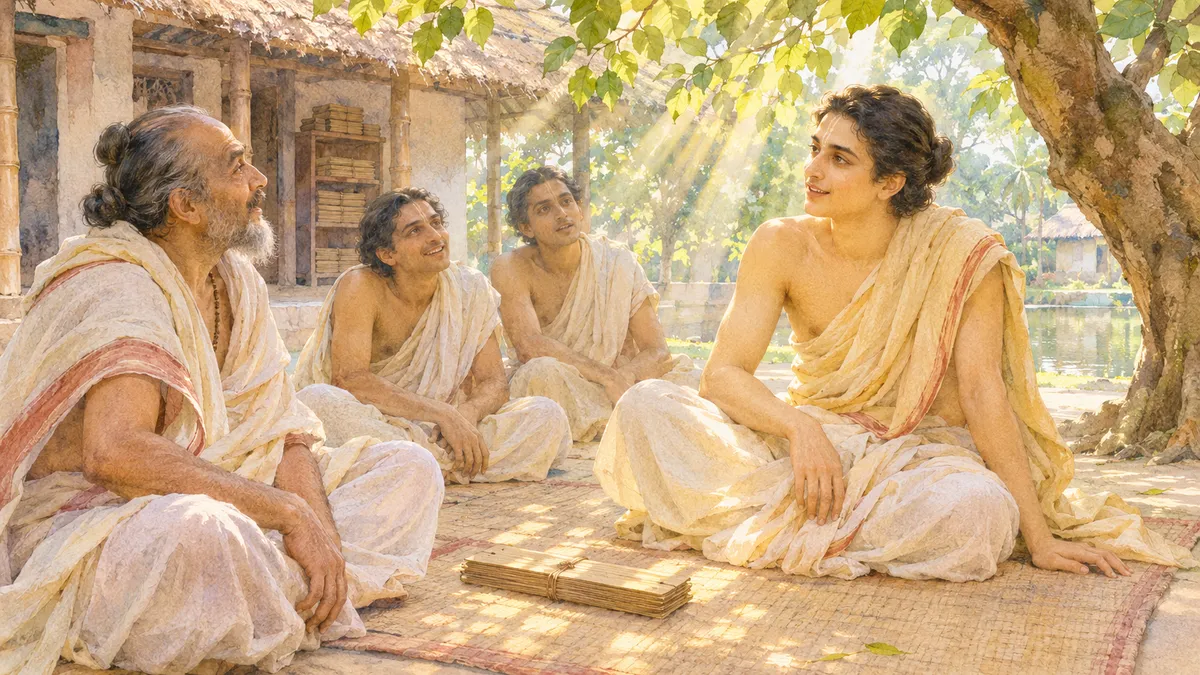
Nevertheless, when he awakened, he cast aside all learning, all grammar, all intellect, and began to speak only of God. When another pandit came to talk with him about grammar, Sanskrit, poetry, and the rules of versification, Chaitanya, using logic and his own knowledge, kept talking to him about God. He said that this grammar led to Krishna, while these grammatical principles led to God. Through the most outlandish logical constructs, through grammar—he traced everything back to God, so that he did not even allow the pandit to say a word, because all grammar and logic led to only one thing, to God alone. The pandit was shocked because he did not know how to argue with Chaitanya. Chaitanya completely shattered all his notions. Such is the wisdom of an avadhuta.
Once, when an illiterate man came to a master, he asked, “What do you advise me to do?” The master told him, “Read the Bhagavad Gita.” Very well. But he was illiterate, and he thought, “How can I read if I am illiterate?” Yet the guru had said that he must read the Bhagavad Gita. He found the book, sat down in the temple, and decided to read it. Since he did not know Sanskrit, he even held it upside down as he read. Every day he diligently came, sat before the deities, looked into the book, and seemed to read it—or at least tried to read.
Some monks passing by would say, “Have you seen that odd fellow? He sits down here, opens the Bhagavad Gita upside down, and reads it for hours. Come, we’ll show you.” He sat there like that and read. They began to laugh at him, and eventually word of it reached the guru of that temple. They called him: “Guruji, you must see this. There is a strange man here who reads the Bhagavad Gita every day, but he holds it upside down.” When they arrived and the guru came as well, he asked, “Why do you read the Bhagavad Gita in such a strange way? You cannot read anything like that—it is upside down.” The man said, “It makes no difference to me whether it is upside down or not; I cannot read anyway. But when I think of Krishna, tears well up in my eyes, and I cannot do anything else. I simply sit before the book like this; that is all my reading.” The guru said, “You see, he is the only one who truly reads the Bhagavad Gita.”
In a state of devotion to God, concepts and notions are unnecessary because divine wisdom can be perceived directly. This is what it means to relinquish concepts. When our faith and heart are pure, we easily relinquish concepts. We penetrate to the very essence from which concepts arise.
Action Without Attachment to Results
If you remain tranquil in your own consciousness, you will realize that, compared with it, even the state of an emperor is like dust. When a person has decided to reach a certain place, his legs carry him there without any mental activity. Act like those legs and perform the actions required here. Act having abandoned the desire for reward or for the fruits of your labor, without being motivated by pleasure or gain. In this way, the objects of the senses will be devoid of craving, yet will remain what they are. Even when a feeling of pleasure arises from interacting with objects, let it lead you back into consciousness.
Perceiving the external world as divine play is a process of contemplative presence in union with objects. It is a vision of divine grace. Recognition of the divine play can occur on different levels.
First, there is the recognition of the external world as divine play. For example, something happens, a dog runs by, a car drives past—you must recognize divine play in all of this. A dog bites someone; goods are being sold. You can recognize divine play in this if you try to see the situation purely. If your vision is impure, you will not be able to recognize the divine play. The key to recognizing divine play is pure vision. Pure vision immediately reveals to us the mandala of divine play, and we enter it.
Then we must recognize the divine play in acts of perception. We see colors, hear sounds, smell scents, and perceive forms. We experience sensations: warmth, tingling, bliss, pain. Something is unpleasant to our body, our eyes, ears, sense of smell, or sense of touch. If we apply pure vision to perception, we are able to recognize the pure play within perception.
Finally, there is inner recognition. Various experiences arise in the stream of our mind: images, sounds, visions, thoughts, bhavas, and states of mind. We must recognize the divine play in all of this, see it purely, return to the Source, and dissolve everything in the Source. This is the way to relate to inner objects.
Thus, the external world, the intermediate world of perception, and the inner world of the subtle body must all be recognized as divine play. It is not that we create or invent something. In fact, all of this is already divine play. Various kinds of shakti in the mind, shakti in the indriyas, and the shakti of the gross mahabhutas, the five elements, are at play. But when we remove the mind, we also become convinced of this.
Recognizing the world as divine play always leads to recognizing the Source from which this divine play emanates, because divine play itself is the play of shakti, the play of the various tattvas. But there is always one who generates and produces this play—the supreme player. Therefore, recognizing the play inevitably leads to recognizing the player. Recognizing the play and the player is recognizing God and his shakti, his energies. This is what it means to abide in the mandala of pure vision. This is the way to bring turiya into the jagrat state.
Why is this so important? Because this is the highest realization. If you recognize turiya in dreamless sleep, turiya within turiya, in nirvikalpa samadhi—although one must still reach even that—and if you recognize turiya in the dream state but do not recognize it in jagrat, your realization has not yet been fully accomplished. Only recognizing turiya in this relative world, in this relative state, is true realization. This is connected with recognizing the divine play and the player. It means that samsara no longer has power over you. Even when reborn among gross material objects, you will not act in a conditioned way; you will act as a siddha-deha, a siddha-kaya, a perfect illusory body of wisdom within the mandala of divine play, as a manifestation of the divine player, the Absolute.
Bringing Contemplation into Everyday Life
Do not strive for the results of action, and at the same time do not remain inactive. Or be committed to both. Or to neither. Let it unfold as it will.
The following situation often occurs. People who practice well meditate in retreats, and they experience good dhyanas, profound experiences of light and clarity, a stable posture, kundalini experiences, the projection of the subtle body, and journeys to other worlds. Everything goes well during the retreat: there is fullness of attention and contemplative presence. The bell rings, the schedule ends, the retreat vows are relinquished, and ordinary, so-called life begins—service, relationships, life itself. Suddenly, the same problems that existed before the retreat begin again. The same difficulties in relationships return, the same difficulties in perceiving one another and interacting; once again the world bears down upon you, samsara bears down upon you, and the mind becomes clouded.
A person wistfully recalls the days when they flew on wings in meditation and soared like Garuda, almost in enlightened states, and simply dreams about when the next retreat will take place and how to make it there without suffering any losses. Why is this so? And why do difficulties, mistakes, suffering, the transcendence of suffering, and conflicts arise in everyday life? Because people overlook the fact that it is also possible to work with this world. Awareness must be brought into this world: here it is, the divine play, happening right now, and one must learn to perceive it in the relative world, in everyday life, right now.

Any situation is suitable for contemplation. All games are perfect, and the divine play never ends. On the contrary, in the waking state, one must refine the perception of the divine play in everyday life, in jagrat. Our task is to learn to perceive any situation, any experience in the relative dimension as divine play, in pure vision.
True Freedom from Desires
The desire to do or not to do binds; the absence of such desire is liberation. In truth, there is neither “must” nor “must not.” Everything is pure being. Let your mind know neither one nor the other. Always remain what you are. Awareness of “self” and “mine” is the root of suffering. The cessation of such awareness is liberation. Do what you like.
What is the criterion for determining whether or not you recognize the divine play in everyday life? If you recognize it, you receive divine grace, you receive darshan, anugraha, and abide in exalted states, in the pure tattvas. Your pure vision is not lost; on the contrary, it deepens. This means that you have succeeded in recognizing the divine play.
If you do not recognize it, you fail to remain in pure vision; you receive no divine grace, and only your conditioned state deepens. Therefore, if something happens and you have not felt divine grace in what is happening to you, it means that you have failed to recognize the divine play of what is occurring, within or without. But if you have succeeded, divine grace comes, and pure vision deepens.
Thus, situations themselves are secondary causes, while our attitude toward situations, our work, and our recognition are what matter most in perception. But if we do not remember this, external situations seem to be the main thing. We fail to understand that our work with situations and our perception of a situation are what matter most. Pure vision and the perception of divine play are interconnected. Pure vision and the perception of anugraha are also interconnected.
Struggling with the Habit-Bound Mind
The mind is highly habitual, highly mechanistic, and often worldly. It will remain worldly for a very long time, so when it perceives ordinary situations, it begins to wonder and doubt whether it should perceive them through pure vision or, after all, view them in a worldly way. Yes, the guru said something; this seems to be divine play, seemingly perceived through pure vision, but the mind’s habitual pattern and stereotype are such that it is still inclined to perceive the situation in a worldly way.
If we perceive situations in a worldly way, we do not receive grace, our pure vision departs, and as practitioners we lose awareness and therefore energy, leaving us at a disadvantage. But who gains the advantage? Our habit-bound mind. Here the mind acts not as a friend but as an enemy, as one who betrays and lets us down. This is because it has its own stereotypes and wants to act according to them.
There is a saying: you cannot teach an old dog new tricks. The mind is an old dog; it does not like anything new, and pure vision and play seem like new tricks to it. It thinks: what kind of tricks are these? I know everything here; I have lived for a long time, I understand everything here, and I know what this is. It divides and ranks everything. It wants neither pure vision nor divine play; it has no need of them. It is habit-bound and wants to live according to its stereotypes. Retraining the mind is not easy, but it is necessary.

Manas and ahamkara participate in this conspiracy of the mind. Ahamkara provides support, while manas simply pushes one toward stereotypical thinking. But buddhi is an advocate of pure vision, of seeing the divine play; buddhi loves to be aware, to practice, and to analyze. It is the only practitioner within us. It is your ally.
Once, when Empress Catherine asked a Russian military commander whether we had any allies, he replied: Empress, our only allies are the army and the navy. In the same way, a sadhu’s ally is his buddhi, his only ally. It seeks pure vision and the recognition of the divine play.
Spiritual Choice in Every Situation
When we encounter a situation, this choice is always present, and we must side with buddhi, the spiritual intelligence. Meanwhile, the mind will tell us that we do not like it, or it will act according to habitual patterns and stereotypes. With the help of buddhi, we must strive to see the situation through pure vision and perceive it as divine play. Then the blessing will come.
We make this difficult spiritual choice: either to identify with the situation and suffer in a worldly way, or to look at it differently and receive grace from it. Which is more beneficial for us? We must choose the side that brings us divine grace.
For example, a police officer fines a driver on the road. If the driver is a monk, the monk may become angry, especially if the police officer makes unfair demands. But he can also take another side—the side of pure vision, of divine play. The deity of akasha, the space element, the guardian of the roads, has decided to bestow a blessing in this way, but before receiving the blessing, one must make an offering to him. He is hinting that he wants an offering. If I give him an offering with a pure heart, he will bless me—such is the play. I will see these blessings in everything; I will see the divine play.
Someone might think: if you keep playing along like this all the time, you will be paying fines at every turn, and the worldly mind will resist this. That is not quite so. If you take the side of pure vision and perceive the divine play, this very vision will protect you from problems in samsara. The number of fines will decrease; people will stop fining you. Because you will be bringing others into a state of grace.
Question: Can pure vision be developed to such an extent that a police officer will not only refrain from wanting a bribe, but will instead offer to help?
Yes, it can. Or you simply may never encounter one. Yes, it is possible.
But surely a bribe is a kind of sin.
There is no such rule in the Vinaya. It is not a violation of the vows. One needs to have a little wisdom here. Theft, yes. We are not stealing; we are giving. If you stole something, that would be a violation of the vows. But a bribe is merely an example. It could be something else. It is simply that bribery in the samsaric world—corruption and the fight against corruption—is currently a very prominent issue. The principle is this: view absolutely everything purely. Then God Himself will protect you from any impure situations or lead you into pure vision. They simply will not arise on your path.
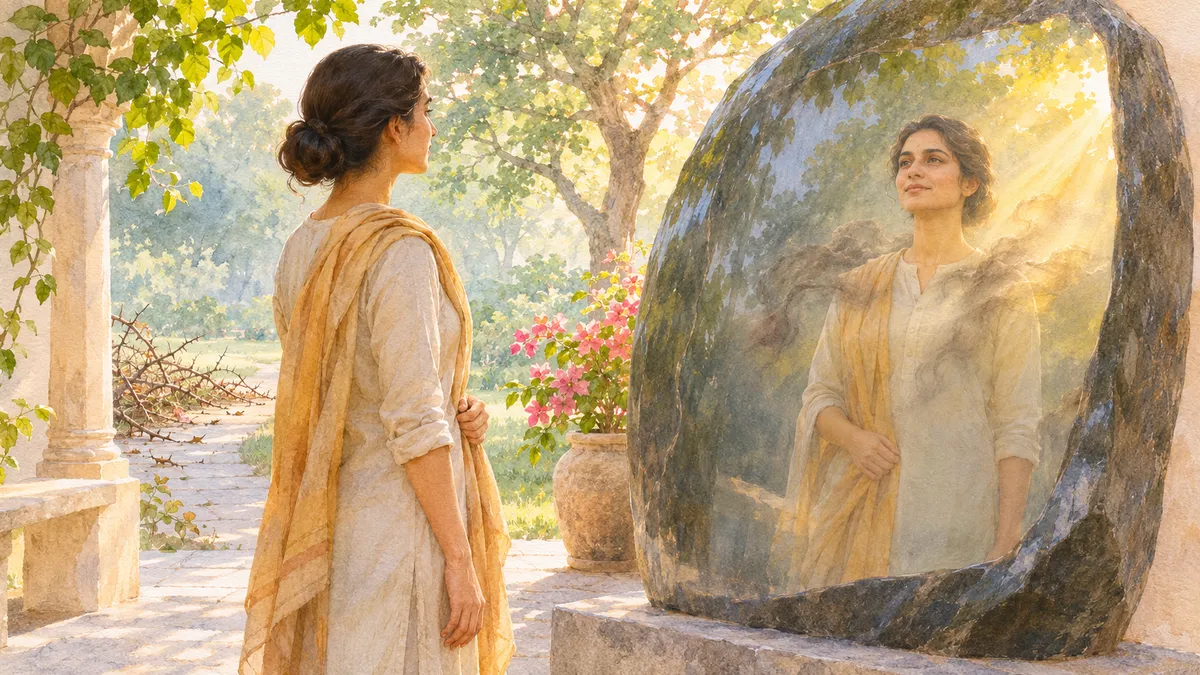
Shiva himself does not punish. Like a mirror, Shiva reveals particular limited aspects of the soul’s consciousness and then reflects them back. This is connected with the fact that he himself once had these limitations.
Recognizing the Play with a Delay
Does it make sense to recognize the play after a delay?
How much of a delay? Six months, a year?
Less. Suppose you review the day that has passed: you can repent, or you can say, “But it was all just a play.” In this way, you can change your vision after the fact.
Yes, you can do that too. In that case, you can play it safe. First repent, just to be sure, then view it as a play, and view the repentance itself as a play as well. A playful attitude is the essence of the view. Repentance, however, can be part of one’s conduct. Better late than never. The very perception of divine play shifts the situation into the dimension of pure vision. It is as though we discover an inner wisdom that allows us to see the play where we could not see it before.
It is like this. You look at a situation, and it is unpleasant. But suddenly you remember: this is a performance; I am sitting in a theater watching a play, so I simply need to enjoy it. Then the situation is no longer unpleasant; it is a dynamic performance by the actors. You then evaluate it differently. What expressiveness! What a concept behind the script! What a climax, what a plot twist, what a finale! You now view the situation in a completely different way. You no longer feel like a suffering participant in the situation and no longer pass judgment. After all, no one watching a play becomes angry and says, “What a scoundrel that king is!”—everyone accepts the king. Nor do they judge the bandit, saying, “What a scoundrel that bandit is!” They simply enjoy the play.
Do not watch horror films; watch sattvic films. When your power of self-liberation increases, you will be able to watch any films, but not now. Because your mind will be affected by these tattvas.
I am talking about life. You may choose not to watch movies. But you cannot choose not to watch life.
I am also talking about life.
About life. Life already throws plenty of horror movies your way. Because if you encounter horror movies in real life, your consciousness is not yet ready.
Gradual Progress in Spiritual Practice
What is meant is to perceive everything that happens in life as a divine play. Absolutely everything. But to begin with, pray that the script brings you only comedies, or, at worst, melodramas, but not horror films or crime thrillers. Better yet, religious films—Vedic religious films.
The logic of spiritual life is that we proceed gradually: first, we establish ourselves in sattva and realize turiya in sattva; then, from the state of turiya and sattva, we embrace rajas and apply the ability to see the divine play to rajas. When we have completely mastered rajas, we extend our ability to see the divine play to tamas as well, including its harshest manifestations. Even then, we can see the play of wrathful deities. Such is the logic. But we do not begin with rajas or tamas.
There are people who call themselves radical Vira Shaivas, Shaivites; they begin with tamas and rajas. They immediately want to worship Shiva with wine and meat, sacrifice animals in cemeteries, smoke marijuana and make offerings without possessing the necessary breadth of consciousness, and immediately perform various Tantric practices: these include munda sadhana, shava sadhana, stri sadhana, and others. They try to practice with tamasic and rajasic energies when their consciousness is not broad enough even for sattvic ones. This is called starting at the wrong end.
We, on the other hand, proceed by establishing ourselves in sattva, in the vision of the divine play, and in sattvic energies; we establish turiya in this vision and then extend it to rajasic and tamasic energies. There are practices of drashta yoga in which you contemplate various objects and strive to see them purely. The practices of contemplation are extended to animals, anthills, people, and suffering. You try to bring them all into pure vision.

Vasishtha’s Teaching on the Nature of Action
Vasishtha continued: “Just as an army made of clay remains nothing but clay, so the entire universe is nothing but pure nondual consciousness. When only this nondual consciousness exists, what is the object, and by whom is it experienced? Outside this consciousness, there is nothing that could be called ‘I’ or ‘mine.’”
Rama said: “If this is so, O holy one, then why must one renounce bad actions and perform good ones?”
Vasishtha replied: “But first tell me, O Rama, what is action? How does it arise, where is its cause, and how is its source destroyed?”
Rama said: “Surely, O holy one, that which must be destroyed must be eradicated at the root. As long as the body exists, action also exists. It is rooted in the apparent world, in samsara. In this body, actions proceed from the organs of action. A mental habit is the seed of the organs of action. Acting through the senses, it is capable of comprehending what lies at a great distance. The senses themselves are based on the intellect, the intellect on individual consciousness, which is conditioned consciousness. And this, in turn, is based on the unconditioned, which is therefore the foundation of all this. Brahman is the foundation of the unconditioned. Brahman itself has no foundation whatsoever. Thus, all actions are based on individual consciousness, which regards itself as a real object and thereby creates actions. If this does not occur, that in itself is the supreme state.”
Vasishtha said: “In that case, O Rama, what should be done and what should not be done? The mind continues to exist as long as the body lives, whether the embodied being is ignorant or enlightened. How can that which is called individuality be abandoned? But one should abandon the erroneous notion ‘I am the doer’ and simply perform actions appropriate to the situation. With the awakening of the inner intelligence, the perception of the world ceases, and psychological freedom, or non-attachment, arises. This is known as liberation. When object-oriented or conditioned perception is abandoned, serenity and peace remain, known as Brahman. The perception or awareness of objects is called action, which then expands into the apparent world, samsara. The cessation of such perception is liberation. Therefore, O Rama, one should not renounce actions as long as the body lives. Such renunciation gives significance to action. And that which has significance cannot be abandoned.”
There are people who renounce actions. They feel that if they begin to act, they are drawn in and become involved, that actions entice them. They feel that by acting, they lose their inner awareness, inner center, and inner integrity. This happens because of inexperience. They then make a decision: I will renounce actions so that they do not lead me astray. It is as if a person is ill and a doctor prescribes a diet: no sweets, no this, no that, and the person gives up those foods. But then the person recovers, yet the memory of the illness has become so deeply ingrained that even after regaining health, the person is afraid to eat those foods.
Our task is not to renounce action outwardly, but to renounce action inwardly: to renounce action, the doer, the desire to obtain the fruits and results, and the positioning of oneself as the mahabhogi, the supreme enjoyer. When we cease positioning ourselves as the mahabhogi, the supreme enjoyer, this entire construct—action, the doer, and enjoyment of the fruits and results—also collapses. For underlying all these actions is the concept of the “I” as the mahabhogi, the one who enjoys, who is the center of enjoyment, who acts for the sake of enjoyment.
Then we can act, but we will no longer become involved. For it is not action itself that carries us away, but the desire to be the mahabhogi, to enjoy through action. For example, when actions take place but we do not seek enjoyment, they do not carry us away or lead us astray, and we do not lose contemplation and awareness. It is precisely those actions in which we are personally and selfishly interested that carry us away and lead us astray. There is nothing obstructive in disinterested actions; they do not interfere with contemplation.
Thus, by abandoning the concept “I am the mahabhogi,” the supreme enjoyer, the ultimate beneficiary and recipient of the benefits of actions, we free ourselves from the problem of action. Then the problem of action disappears, and action itself smoothly transforms into non-action. Non-action itself is within, while outwardly it manifests as playful activity. This is lila. We begin to approach the dimension of lila, the divine play.

Non-action, the abandonment of the concept “I am the mahabhogi,” the supreme enjoyer, the understanding that the supreme enjoyer is Shiva alone, the Absolute alone, Dattatreya, and the renunciation of the fruits and results lead us to leave behind these complex relationships, karmas, karmic reactions, and results altogether. We discover ourselves in the free dimension of the divine play, which continuously blesses us no matter what happens. This closely resembles the life of divine beings. Of course, it resembles it only as a faint reflection, but it is movement in the right direction.
The Nature of Perception and Liberation
Rama asked: “If that which exists cannot cease to be, and that which does not exist cannot come into existence, then how can the sensation of perception turn into non-perception or the absence of sensation?”
Vasishtha replied: “It is true: that which exists cannot cease to be, and that which does not exist cannot come into existence. Perception and non-perception are also easily attained. The very word ‘perception,’ as well as that which it denotes, is generated by delusion and ignorance. Therefore, suffering arises from them. Abandon the awareness of perception and become established in the awareness of supreme wisdom. The latter is nirvana. Good and bad actions cease when it is realized that they do not actually exist. Therefore, one must investigate, inquire, and observe the basis of action until it is destroyed. Just as everything that grows from the earth is not different from the earth and is inseparable from it, so too, that which arises from consciousness is inseparable from that consciousness. Fluidity is inseparable from liquid. Likewise, in Brahman there is no division between mind and consciousness. The action called awareness arises without cause in this consciousness. Therefore, it does not exist, being inseparable from consciousness. Action has its basis in the body, which is based on the sense of ego. If the perception of the sense of ego ceases, action also ceases. Thus, the basis of action is destroyed.”
The basis of action is destroyed when we perceive action non-egoistically. To perceive non-egoistically means to perceive not from an individual point of view, but from the point of view of the contemplator, the sakshi, the witness, the observer, from the point of view of pure vision. For the division into pure and impure is a property of ahamkara, the ego, and chitta. Perception in pure vision, however, is a property of buddhi and the Atman.
For example, how can this be applied in practical life? There are two matajis. They do not always see eye to eye; they make complaints against each other, and one of them dislikes something. In ordinary egoistic vision, one may see some negative situation, some people arguing, some nonsense. One may react negatively to it and get drawn into these disputes oneself.
Or one can see it through pure vision. In pure vision, two goddesses are playing—a play of two goddesses, a perfect play. One can receive grace and even marvel: just look at what a flawless play it is. They even behave in such a way that you would never guess they are goddesses. Just like ordinary people. They do not even bat an eyelid; they imitate ordinary people completely, displaying all the kleshas, everything just like people. What perfection, what mastery.
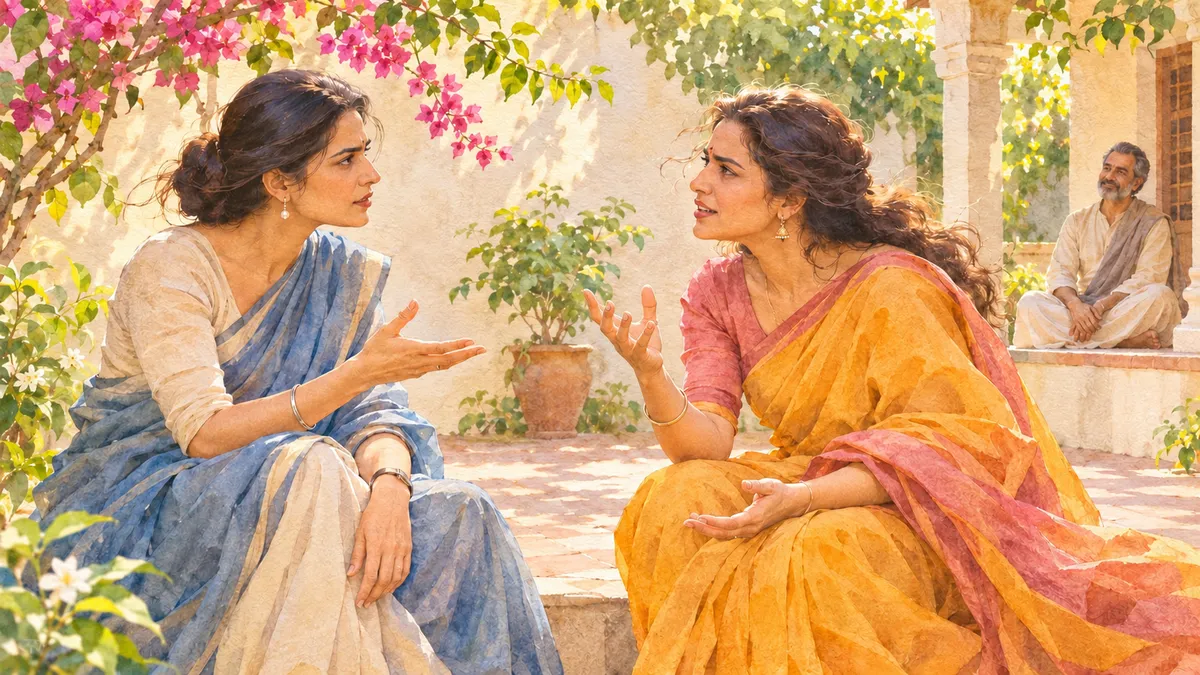
When you see it this way, you will feel the blessing. You will no longer be drawn into this conflict; your value judgments will evaporate, and you will simply enjoy the divine play. From this vision, you can even intervene in this conflict and resolve it easily, reminding these two goddesses that they are goddesses and that all of this is a play. And they themselves will think: so this is all a play, and we are goddesses. They will laugh and go their separate ways. And there was no conflict at all; there was the dynamism and expression of genuine divine play. You saw it, it manifested, and impure vision evaporated. That is how it really was.
Question: That is how it actually is. Pure vision is not something we have made up.
Exactly. It is simply our lack of faith and our adherence to patterns and worldly stereotypes that prevent us from seeing it. We constantly forget.
Question: If I see everything through pure vision, as the play of deities, then by playing along with these two goddesses in this situation, for example, why should I try to resolve it if, on the contrary, I can add my own expression and continue enjoying this play while seeing everything purely?
If you play along in pure vision, then this pure vision must necessarily resolve the situation by itself. It is not a question of why. The very nature of pure vision harmonizes everything.
Question: So trying to intervene while thinking that I am now going to solve the problem would already be impure vision.
That would already be a manifestation of the ego. If you act without ego, from pure vision, you will have no motives arising from the mind; you will be guided by the higher tattvas. And the higher tattvas are grace. Grace will be transmitted without the ego’s involvement, and grace transforms everything into pure vision, into play; the situation is resolved and laid bare as the truth visible to all—the divine play.
Question: When we lived in Divya Loka, there was such a situation involving two matajis, and Vishvadeva was passing by and laughed so heartily. With such divine laughter. And you know, the situation was resolved.
There you have it.
Question: I was very grateful to Vishvadeva for that.
One who sees can simply laugh, and the situation will change. That is so.
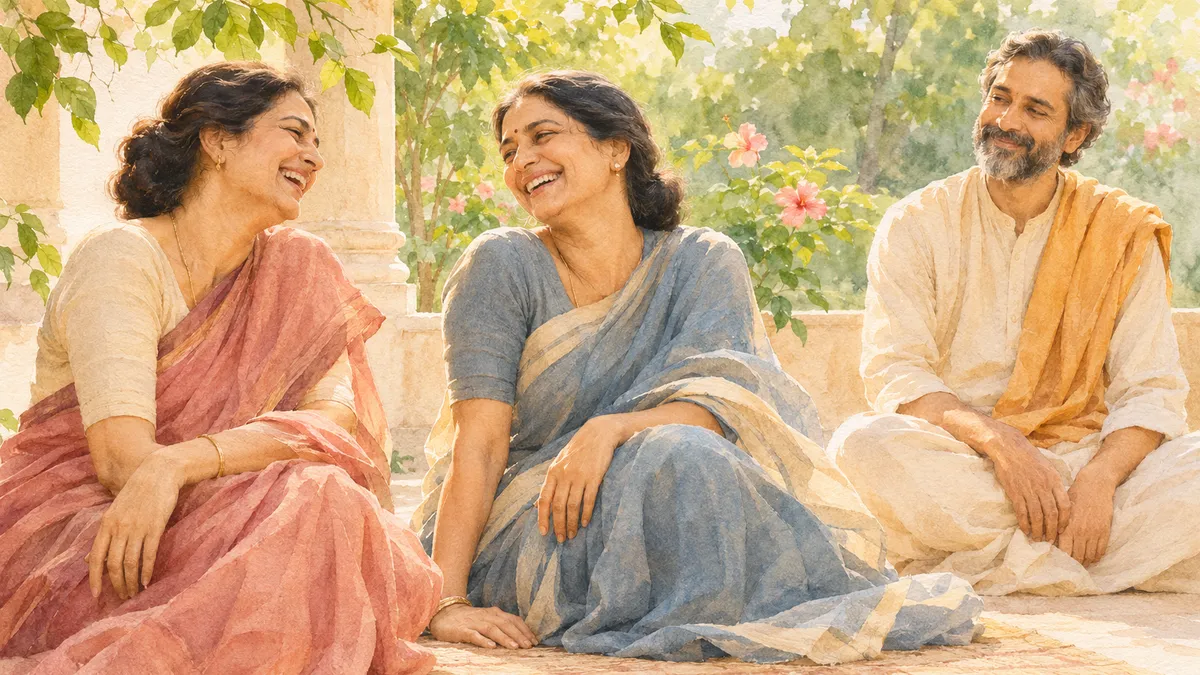
Question: So he saw this in pure vision?
I think that is how it was. Exactly so.
In any situation, we must be able to shift ourselves into pure vision, and then this pure vision will also shift the external situation into pure vision. Pure vision means different tattvas, a different destiny—everything is different. It is seemingly the same, yet everything is under grace. The descent of grace, the experience of grace—this is the goal and meaning of our sadhana.
