


Commentary on the text “Yoga Vasistha. Chapter 6. On Liberation”
“The seed of the external world is the sense of self-importance, for this tree of the external world grows from the sense of egoism. The sense organs and objects of perception, the various forms of conditioning, heaven and earth with their mountains and oceans, the divisions of time, all names and forms—these are the different parts of the tree of the external world.”
The body is a physical mechanism, but it is governed by the subtle body: the mind (manas), buddhi (intellect), ahamkara (ego), and memory (chitta) as the repository of mental tendencies—all this constitutes the fivefold antahkarana. It is like the software of our soul. We must understand its nature in order to free ourselves from it. How can this be done? By dissolving it. And when we dissolve it through awareness, meditation, vichara, viveka, and vairagya, this is called antahkarana-laya-chintana, the dissolution of the inner instrument. But first, we must understand how it works so that we can cease to be its slave.
The ego, ahamkara, antahkarana—this software mechanism can be likened to an implanted chip that takes the place of our authentic soul. It gives us certain advantages, certain functions (the ability to count, find our bearings, and make judgments), but in reality it obscures our Divine essence. It was designed as an instrument, but it has become a “dictator.” At best, its role should be that of a “minister,” yet it constantly claims the right to be king. This instrument has taken complete possession of us and occupies an undeserved position, suppressing the king’s authority. The latter can be likened to a little boy who is still young and understands nothing about affairs of state, while a cunning minister has cleverly taken everything into his own hands and rules ostensibly on the king’s behalf. We must strip this minister (the ego) of power and dissolve it in order to enthrone the king (Atman, the true “Self”).
To do this, one must first investigate the nature of ahamkara, and then cultivate an inner observer capable of observing ahamkara, manas, chitta, and buddhi without identifying with them. Then one must discover the Supreme Source from which ahamkara and the entire inner mechanism (antahkarana) arise. After discovering this Source, one must become established in it through contemplation and samadhi; then the process of antahkarana-laya-chintana will begin.
But what should one do if there is no samadhi, no contemplation? It can be dissolved in another way—through humility, worship, a spirit of devotion, self-surrender, obedience, and the taming of the mind. Whenever you do not follow what, due to karma, you are inclined to follow, but detach yourself from it and show humility, you become free. When you follow it, you do not become free but continue your karma.
Liberation from the Power of Antahkarana
When you become so liberated that the soul becomes empty and you feel that neither joy nor sorrow, neither censure nor praise can do you any harm, this means that your antahkarana (mind, ego, memory) has ceased to have power over you. The soul of a jnani, a saint, a sage, a sadhu who has freed himself from the power of antahkarana is empty; this mechanism has no power over it.
For example, chitta (memory, recollections) causes such a person no problems whatsoever. Such a soul does not recall cherished moments while thinking, “Oh, how wonderful things used to be, what golden days those were!” It has no sentimentality. It has love, but no sentimentality. Just as a person does not recall yesterday’s dream and yearn for it, thinking, “Oh, how wonderful that dream was!” They understand that it was merely a foolish dream. Awakening is awakening, and a dream is a dream, so there is no reason to recall it and keep turning it over in the mind.
I had a female disciple who constantly kept diaries, recording the important thoughts that had occurred to her during the day. I told her, “Until you burn your diaries, you will not be able to understand the Nature of Mind. It is the mind that likes to keep diaries; this erects ‘monuments’ to the false ego. And until you free yourself from all memories, you will not know the Nature of the Divine, because it is far deeper, far higher.”

There is a practice called samskara-shuddhi, which we sometimes perform; it is intended to purify the subtle body. Through samskara-shuddhi, you can purify it, but within three months it will create so much that it will be as though you had purified nothing at all. Therefore, it is not enough merely to purify the subtle body; it is important to put an end to the tendency to create samskaras and vasanas, the tendency to create memories and become attached to them.
In the same way, for a sage, ahamkara (ego) is empty, discarded, and worthless. He has no sense of self-importance; such worldly notions as dignity, honor, pride, authority, and reputation mean nothing to him. Tell me, if you went somewhere into the forest and found yourself among hares, would you be concerned about your dignity and honor? Why explain your dignity to hares? That would be foolish. You already know who you are, while the hares may not, and there is no need to demand that they say namaste and greet you properly. A person lives in their own way, and hares in theirs.
Likewise, a sadhu no longer seeks anything in the world; he simply ceases to desire anything from it. For example, I need nothing from the world, so I ask nothing of it. If it gives me nothing, I will be happy, and if it gives me something, I will be happy as well. I will be happy in any case, because my happiness does not depend on that. I do not seek respect, recognition, reputation, or anything else from the world. Jada Bharata even told King Rahugana, “I’m out of my mind.” He is a holy fool—what can you expect from him?—so people gave up on him. This is the state of a sadhu.
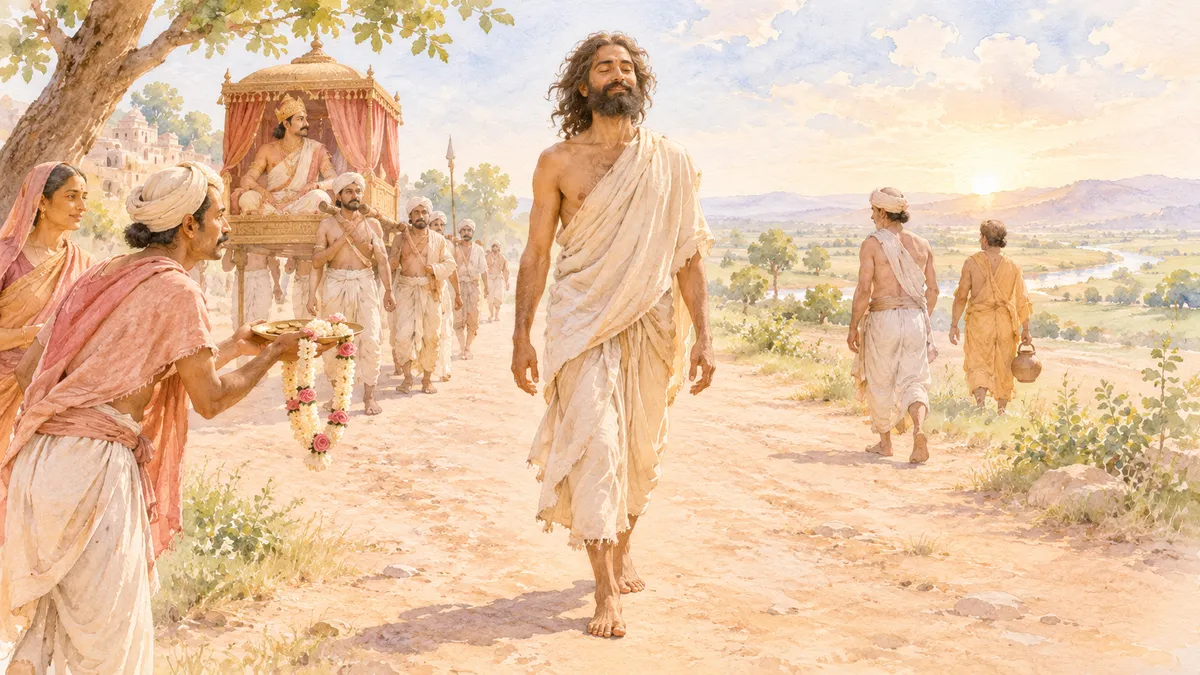
In order to spread the Dharma, of course, we must behave properly. If we become like Jada Bharata, we will not be able to spread anything, whereas we have seva, a specific sankalpa, and forms of service that we carry out in the outer world. But inwardly we must not become attached; we must not desire any of this, because that would already be an action of ahamkara.
The Nature of Manas and Buddhi
Another part of the inner instrument is manas (the mind). It can be likened to a stream of thoughts, a “ticker” that is constantly running in the form of continuous background thinking. There is also a deeper strategic and analytical center that thinks, reflects, and makes decisions—that is, a kind of operating system. This strategic center considers something and then sends the information to the forefront in the form of a ticker.
When we discover the nature of consciousness, this center also dissolves, and the ticker becomes manageable. But a person who has not practiced vichara or viveka and has not attained vairagya (detachment from the mind and ego) is a slave to this analytical center and the ticker. That is why mantra is needed, meditation is needed, mental self-liberation is needed, and sankalpas are needed. Thousands of methods exist to conquer the ego! Sooner or later, behind the mind we find the inner observer, discover the inner space, and begin to trust it more and more. This trust arises from the ability to abide in constant awareness.
When we dissolve these instruments within ourselves, what remains is buddhi—the spiritual intellect that contains an aspect of awareness. We then begin to live by means of buddhi—spiritual intellect and will—while such components of the inner instrument as chitta, manas, and ahamkara gradually lose their power and hold over us. In other words, we gradually free ourselves from the program that constitutes our inner instrument and operates within the subtle body.
Insight and Transformation
When we cease to depend on this program, we begin to sense the higher circuits of consciousness: the higher aspects of the soul and subtle divine structures begin to reveal themselves to us, and insight dawns. The feeling is something like this: “How foolish I was! I understood nothing. In reality, everything is different! The world looks different. I see myself differently. Everything is much deeper; everything is like the one and indivisible Divine Consciousness.”
Doing, actions, karma, vasanas, samskaras—all are liberated. We begin to live through space-like awareness and pure, exalted bhavas; the nondual view gradually permeates us, and the illusory nature of the world is revealed. We begin to change our attitude toward the world and reassess it: we had certain positions and desires in the world, but we reconsider them and realize that we no longer need them. There was selfishness, pride, and conditioning by the mind, but now they are no longer needed. There were certain hopes, fears, and attachments in this world, but we have reconsidered them. Therefore, we no longer place any worldly hopes in this world; if fears remain, they are only of a spiritual nature, and if attachments remain, they are only of a subtle, mental nature.
Thus we rebuild ourselves, transform our inner structure, and become sadhus. As we repeatedly reconsider our attitude toward the world, we gradually begin to understand: “This is what Shankara spoke about. This is what Sri Ramana Maharshi and Vasishtha spoke about.” It becomes not a philosophy, but a personal experience. We become happier and happier because we have discovered the subtle source of the Divine, discovered the awareness that accompanies it, and realized our independence from the mind, the ego, and the subtle and physical bodies.

Transition into the Causal Body
If all this is traced through spiritual vision, it becomes evident that our perception has shifted from the astral and mental bodies into the causal body; that is, we have made an evolutionary leap and become conscious in the causal body. We are no longer rigidly anchored in the gross body, and the false view of “Aham Dehasmi” (I am the body) has given way to the perception of “Aham Brahmasmi” (I am the Absolute). It is not yet complete, because the causal body (ananda-maya-kosha) does not yet provide the full perception of “Aham Brahmasmi”; these are only its first stirrings, but it is already a very exalted state.
And when such a transition into the causal body occurs, the yogi begins to perceive himself in dreamless sleep; he seems to be asleep and not asleep at the same time, yet he does not suffer from insomnia. Some people, especially as they approach old age, develop insomnia because over the course of their lives their constitution changes from kapha or pitta to vata, which causes agitation and restlessness that lead to insomnia. But the yogi described above has a different nature: there is no mental restlessness whatsoever; the mind is calm, he rests fully at night and gets enough sleep, yet he remains aware. He abides in the causal body and has no dreams there, or has only brief ones; he is deeply immersed in a state of Light or Space, perceives them with his subtle body, and becomes saturated with them. He does not feel that he has slept; he is fully aware. This means that the processes of antahkarana-laya-chintana are proceeding correctly. And the next stage is the transition beyond the causal body, the transition into the Atman, into that indescribable Divine realm where even the separateness inherent in the causal body and the individuality of the soul no longer exist.
When a person’s spirit transitions into the causal body through practice, a great many illusions and identifications fall away: the illusion of identification with one’s mind, ego, nation, family, lineage, clan, and humanity. A person ceases to identify with any social groups or races, or to define himself by gender, nationality, or culture. Instead, he begins to truly identify with the one Divine Consciousness. Therefore, it is said that yogis are citizens of the entire universe; they are not merely inhabitants of planet Earth, but citizens of the whole cosmos, because they have penetrated to its very center.

The transition into the causal body also liberates one from the illusion of time and space, because in the causal body time is perceived as a seamless whole comprising past, future, and present, as a single flowing substance. The transition into the causal body likewise liberates one from the illusion of spatiality. That is, the physical body may be here, but in the causal body Earth, Venus, Mars, Moscow, New Jersey, Kathmandu, Delhi, Kailash, and Lhasa are all in one place; they are close by, no farther away than your outstretched palm. This is because, in modern terms, your geolocation in the causal body is not a single point, but a state of being everywhere. For in the causal body there is no mind, no evaluative, conceptual, or interpretive activity of the mental body, while the causal body itself is omnipresent.
The Essence of Spiritual Alchemy
Thus, the yogi follows the path called antahkarana-laya-chintana—the dissolution of the ego. And the dissolution of the ego is the essence of the spiritual alchemy that we perform every day. Each day, the ego dissolves a little, literally by a millimeter. It is not destroyed, as many people think. Some even pray for the ego to be killed, believing that it must be destroyed. The ego is an instrument, a vehicle that helps us travel through life. Why destroy it? It performs its functions. But you must clearly understand that you are not the vehicle; the vehicle has no right to pass itself off as you, dictate where you should go, make decisions about your life tasks for you, or take your place.
Or one could use the example of a horse. A horse has the right to carry its master at the master's command, but it has no right to tell the master where to go. If it also starts giving orders to its master or wants to ride on him, that would be madness. Yet this is precisely what often happens in the lives of karmic people: the ego rides them. They do not use the ego as an instrument; instead, the ego uses them, and that is why they suffer.
Exploring the Nature of the Sense of Self-Importance
“Once this seed has been roasted, nothing grows from it anymore. How do you roast the seed? When you explore the nature of the sense of self-importance, you realize that it cannot be seen. This is knowledge.”
When we explore the nature of ahamkara, we discover the subtle body and chitta (memory). The memory of the subtle body can be discovered in dreams, in samadhi, and in deep meditation. This means coming face to face with your soul: you will see everything accumulated in this life; it will come to you in the form of subtle vibrations and a surge of subtle memories, at tremendous speed, as though files containing many terabytes were being downloaded. You will see everything related to this life; this is your background—your accumulated memory.
Then you will see everything related to other lives; all of it is recorded in the muladhara chakra. For example, if a person's kundalini awakens and reaches the sahasrara chakra or the ajna chakra, perceptions of past lives become accessible to them. It is as though old memories had been stored somewhere in a computer archive and were inaccessible, but then you found them and were able to view them.
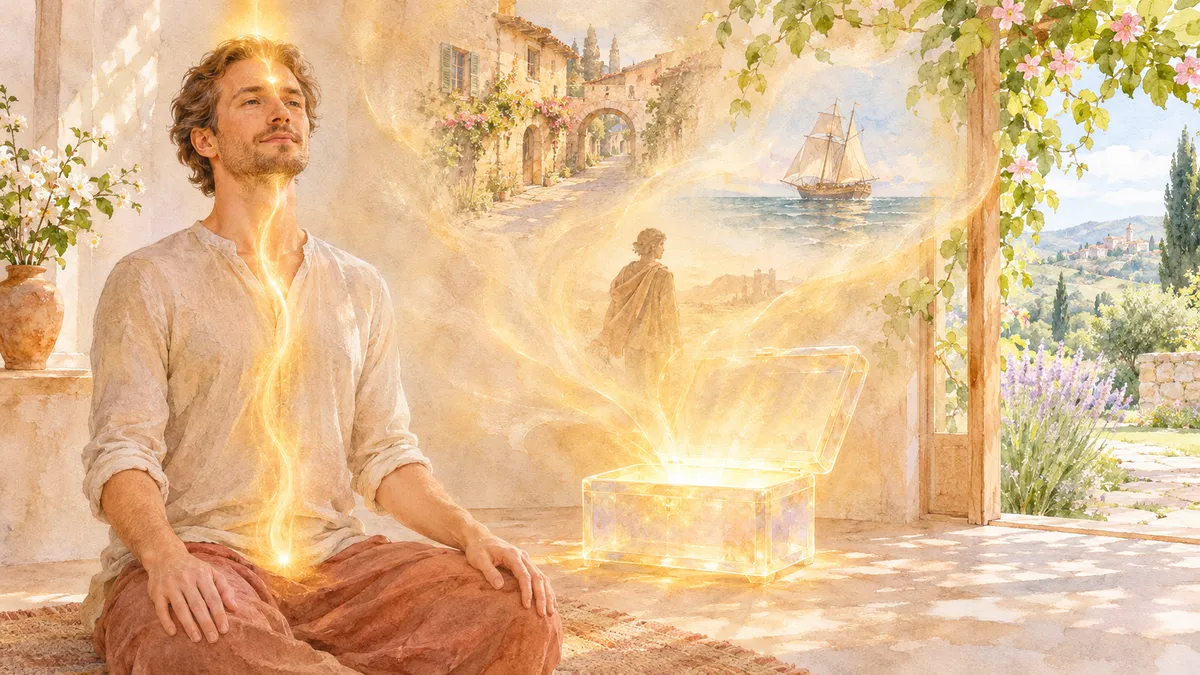
When you encounter the records of your chitta, you must not imitate or follow them; you must not react to them, otherwise they will become a new destiny and a new life for you and will alter the trajectory of your life—that is, they will affect you in some way. On the contrary, you must meet them fully prepared, regard them as an illusion, and part with them without ceremony. If you experience any sentimental feelings, this may cause you to relive old emotions and change your destiny.
Encountering Memories of Past Lives
One person practiced under my guidance, and one day he had the following vision: it was the Middle Ages, the guru was a king in some European country, and he was a subordinate prince ruling lands within that king's realm—so he was no ordinary person either. Then it seemed to him that he had too little power, so he started a rebellion. And the guru, being a powerful king, suppressed the revolt and had everyone beheaded (that was how things were usually done in those days, standard practice in the Middle Ages). This dream deeply shocked the practitioner, and he began dwelling on it despite being in retreat (one might ask, what should one be doing in retreat?). Since there were no other sources of gratification for the mind, this subject began to gain tremendous momentum in his mind, and he fell into a state of delusion. This is what samskaras and chitta can produce.

You may see many samskaras not only from one or two past lives, but from dozens and hundreds of past lives, which took place not only in this kalpa (this day of Brahma), but also in those kalpas when you were a human, an asura, an animal, or a deity. You have already lived a great many different lives, but if they make an impression on you, they will alter the trajectory of your present life and lead you astray from the path of Liberation. You may want to learn more about all of this. For example, you may discover what karmic connections exist between you and other people.
One person came to me with a question: “How can I strengthen my karmic connection with such-and-such a person?” I replied to him: “You are foolish! Why did you begin meditating? Is the purpose of your meditation really to strengthen karmic connections? You should strengthen your connection only with God! Have you not had enough of these connections in the past? And there will be more of them if you do not practice! If you want to strengthen a karmic connection with someone, then you will be reborn together in the next life. Brother and sister, husband and wife, mother and father, friend and enemy, superior and subordinate. There are so many roles, but why do you need that? Why is your thinking so immature? Like Bharata, like a deer, you must hide from all karmic connections.” This is why Tantrism includes such a mode of conduct—the conduct of the deer, which follows the conduct of the bee and the dove.
Therefore, instead of identifying with these memories and experiences, we should regard them as filth, not examine them, not be curious about them, and abandon all interest in curiosity. When Ramana Maharshi was asked, “Who was I in my past life?” he replied, “Do you even know who you are in this life? First find out who you are in this life.”
Contemplative Presence as Protection
And how can this be achieved? We must be fully prepared, that is, we must abide in the conscious contemplative presence of nonduality, emptiness, or whatever it may be called. We must have a basic foundation in contemplation, a basic inner observer (sakshi), a sufficiently strong fundamental witnessing awareness that enables us to detach ourselves; there must be viveka so that we can distinguish between these memories and awareness, and vairagya (detachment) so that we can distance ourselves from them and under no circumstances follow them. For it is precisely these memories that are the cause of future lives.
Rebirth happens quickly. First, some vision appears, and you have a feeling that it is already familiar; then the thought arises, “Wait, what is that? I have seen this before,” and then, in an instant, you are already in a new body. That is how it happens. And your desire to take a closer look is to blame. If you lose your basic contemplation, your basic awareness, you are drawn to the vision of some house or palace, or you see people engaged in sexual intercourse and think, “Who are these people? Their faces look familiar,” but they are your future parents—and in an instant, you are already in the womb!
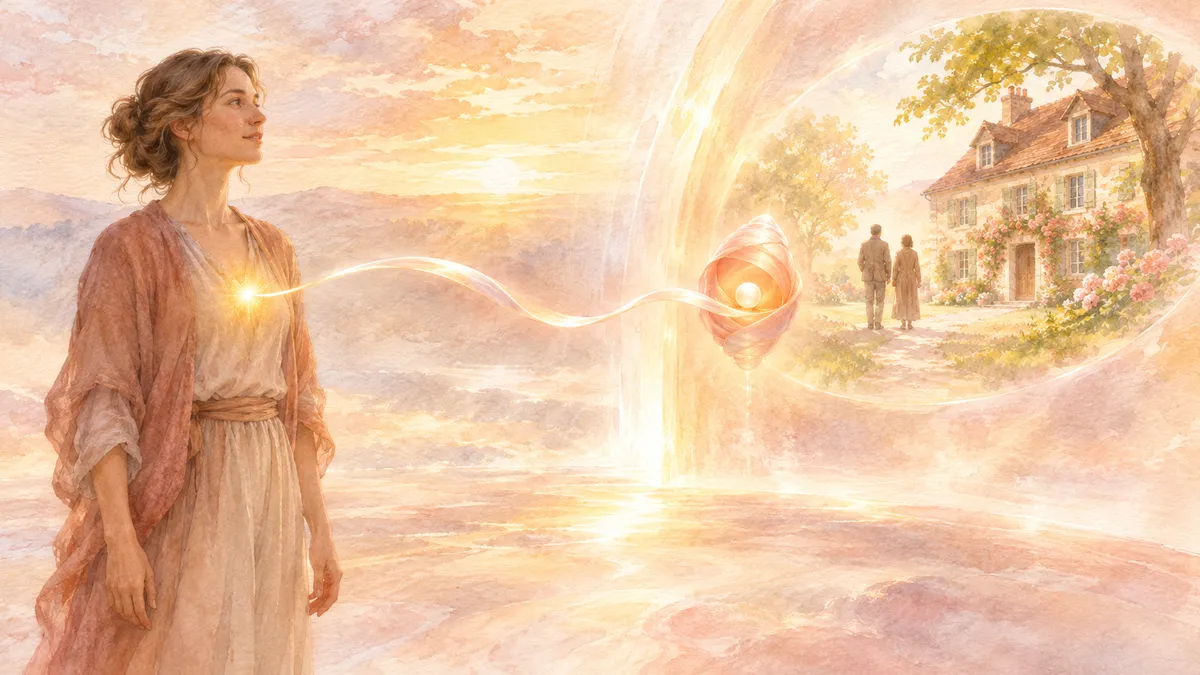
On the contrary, if you possess discriminating wisdom and awareness, you try not to examine anything; you dissolve everything—these are the processes of antahkarana-laya-chintana. Ahamkara will then tempt you in a different way—not through memories, but through the sense of ego, self-importance, pride, self-assertion, self-defense, and the desire to assert yourself. Manas will tempt you through its constant activity. And we dissolve all of this.
Dissolving the Ego in the Fire of Knowledge
In the fire of this knowledge, the sense of ego is burned away. If one becomes immersed in the concept of the ego-sense, it appears real and gives rise to the shoots of the external world. When this false concept is discarded, the sense of self-importance disappears, and knowledge of one’s own nature arises.
Thus, on the one hand, we must understand the illusory nature of the ego, its mechanism, and how subtly it operates, and learn to be free from it on the subtle level. This is vichara, viveka, and vairagya, but this is not enough. On the other hand, we must discover the source of this ego, discover Brahma Aham Bhava. There is an Absolute Source, there is the Supreme Light, there is Divine Consciousness, and discovering this Divine Source presents us with a choice: either we surrender to It or we keep our distance, that is, remain on our own. And our spiritual path depends on the decision we make.
But the ego must be surrendered to this Source; from the standpoint of spiritual life, the ego has no rights except to dissolve. The ego itself has no future in the enlightened dimension. If it has any future at all, it is only as an instrument. And when it is subdued, illumined, and surrendered to this Source, all its functions remain, but it loses all authority and power and becomes subordinate. Therefore, we must acknowledge the supremacy of this Supreme Source. This is self-surrender.
Saints are those who have unconditionally acknowledged the supremacy of the Absolute once and for all. The Bhagavata Purana uses the expression “servants of God,” and Christians use it as well. One may call them servants or devotees, speak of an illusory body, or call it the complete unity of the “I” and the Absolute. Of course, if I have realized my unity with the Absolute, whose will would I carry out other than the Absolute’s? Naturally, only the will of the Absolute, not that of the ego, because the ego is a lower structure; the ego is not me, it is merely a functional mechanism.

The Divine Play
At the very beginning of the appearance of this seeming world, the sense of ego did not exist as a reality. How, then, can we believe in the existence of the sense of ego, in the reality of “you” and “me,” in duality or in unity? Those who earnestly and wholeheartedly seek to understand the truth easily attain an understanding of their true nature after hearing words of wisdom from a teacher and from the scriptures.
Freedom from the ego, the taming of the ego, brings an understanding of one’s true nature. Freedom from the ego brings freedom from karma and the opportunity to live in the dimension of the Divine Play. As long as there is an ego, there is a doer, an action, attachment to the fruits, and a desire to be the ultimate recipient of what we do. Freedom from the ego opens up the possibility of entering the dimension of lila (the Divine Play).
Life in the dimension of play is very different from karma. Karma always involves the “I,” always duality, always action, a doer, the primacy of my interests, goal-setting, and striving for the fruits—no spontaneity, no freedom, only rigid programs, causes, and effects. It is like rigid logical schemes that produce specific results, a kind of operating system. The principle of the Divine Play, however, is an entirely different level: it is a quantum-probabilistic, stochastic, variable level of perceiving reality and life, where everything is possible and there is no rigidity, linearity, or predetermination.
For example, the law of karma says, “You cannot step beyond this. To obtain this, you must create the causes. If there are no causes, there are no effects.” It is like a bank: you can receive only as much money as you have in your account, not a cent more. These are all very rigid “credit and settlement” operations; everything is highly linear—that is what the law of karma is.

The Divine Play is the principle of quantum magic, in which your will is incorporated into the picture of the world and can change it; your will and the will of the Absolute are indistinguishable—they are together. Nothing is predetermined. The world becomes a continuous play, and it possesses probabilities. The Absolute plays, and you become a Divine Player in the Absolute’s play. We will not become liberated until we enter the dimension of play, until we learn to play instead of acting.
The Practice of Lila in Everyday Life
In play, on the one hand, everything is unreal; play is completely spontaneous and unmotivated by the ego. For example, if you prepare prasad in the kitchen while remaining in the dimension of karma, you are simply working through your karma; certain causes and effects are manifesting for you at that moment. Feeding sadhus is good karma. When you become a sadhu in your next life, you will be fed everywhere and will have no problems with food. And if you feed exalted sadhus, you will receive their merit. Yet it is still karma, even if it is good karma.
But if you prepare the same prasad in the dimension of lila (play), there is no longer any karma; even merit is relinquished. You are already in a transcendent state; preparing prasad becomes a yajna—a sacred rite, theurgy, service to the Divine. In other words, the Divine, through you, serves other deities. This is already an offering in the mandala within the dimension of pure vision; there are no causes and no effects here—it is a sacred rite, and you do not fall out of the sacred state for even a moment, regardless of whether or not you obtain a result.
The same thing happens when you eat prasad: you either eat it in a state of karma or in a state of play. In the state of play, it does not matter what the prasad is like. It is a game—you are nourished regardless. What nourishes you? Not the food, but the very process of this play. After all, the game is played not for the sake of the result, but for the “thrill”; it nourishes you with a higher dimension. Even those who have lost still enjoy themselves; they say, “We lost. So what? What a game we had!” Likewise, the result does not matter to you here; what matters is how exalted the dimension you have visited is!
And if you discover the principle of lila (Divine Play) in every action, you find that this is an entirely new dimension, where life unfolds in a highly exalted way, at great speed, where everything is empty, illusory, pure, beautiful, and free, and there are no problems, no reactions, no striving for fruits or results. You are constantly already in the result, already in the fruit. And what are these results? They are the Divine Dimension. You abide in the Divine Dimension every second when you are in the state of play.
Surrender to the Divine Player
A sadhu learns how to be a player of the Divine, how to enter the mandala and never fall out of it, how to allow the Supreme Player to play through their body. It is impossible to enter the dimension of Divine Play (lila) while in an egoistic state, because the ego cannot play; it can act only within karma, whereas the Absolute, Bhagavan, can play—this is His exclusive and absolute right. It is like how only a king may do certain things in his kingdom, and no one else. But we will be able to enter the dimension of Divine Play when we allow this Player to play through our body, when we surrender to Him completely.

What appears to be the surrounding world is a continuation of one’s own concepts or thoughts. It is based on consciousness. It is an optical illusion that subtly refracts consciousness. Therefore, it is regarded as both truly existing and unreal. Gold is the truth in the bracelet, while the bracelet itself is merely an idea or concept.
