

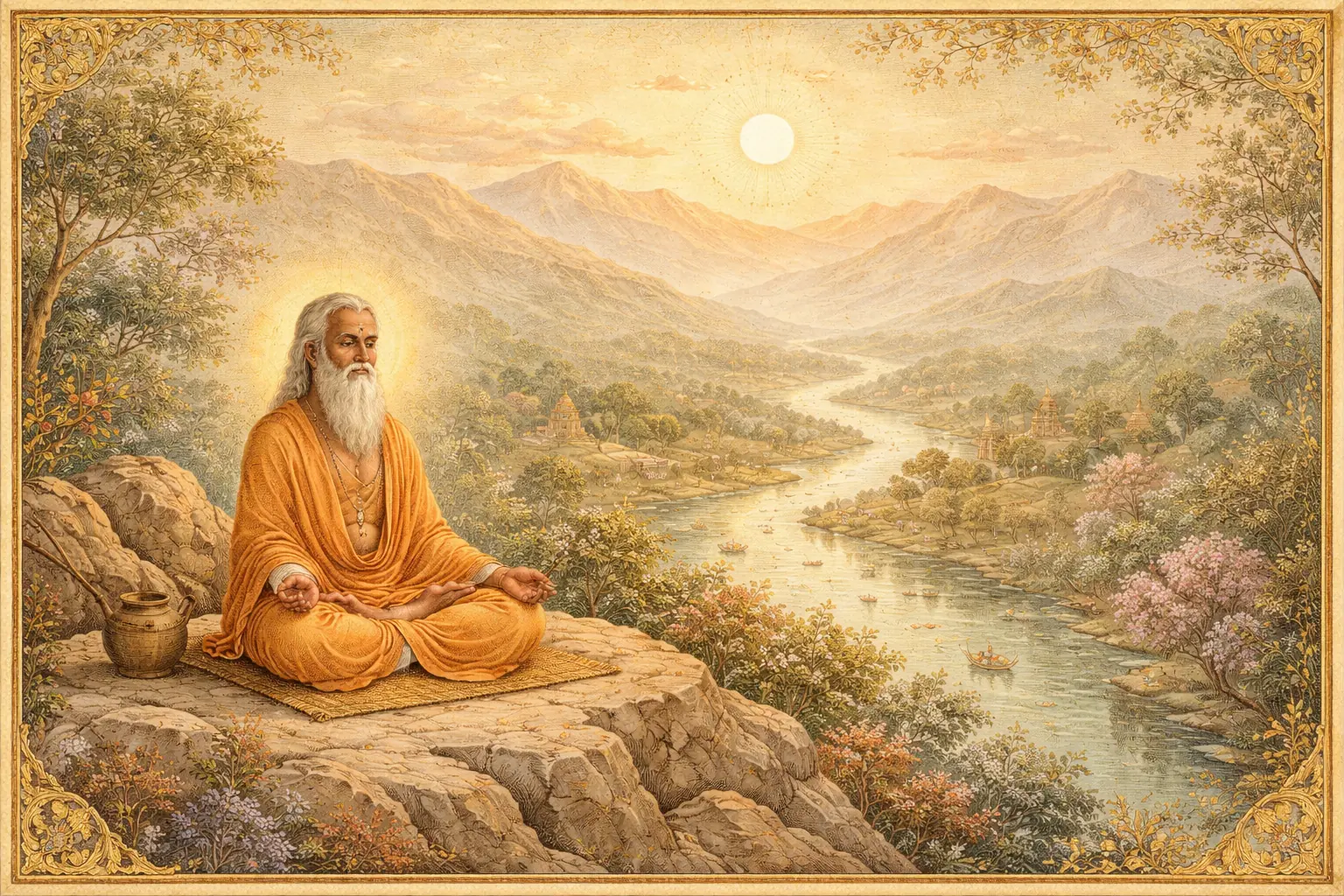
Prakamya Siddhi and the Principle of Drishti-Srishti-Vada
Continuing from the previous lecture, we will discuss such topics as mastering iccha-shakti, that is, the power of volitional intention (prakamya siddhi), the principle of drishti-srishti-vada, and the law of parasattarka logic.
Why do we focus on the principle of prakamya siddhi? It is not because this subject interests us so much that we would want to use the practice for practical purposes; there is magic for that. Someone once asked me, “What is the difference between prakamya siddhi and magic?” The same as the difference between heaven and earth.
Shamanism and ordinary magic are accessible even to an ordinary person. Even an ordinary person who does not know the nature of Mind can achieve what they desire by using magical techniques, rituals, and so forth. These are the so-called kalpita siddhis, that is, artificially generated siddhis.
Prakamya siddhi is something different; it is a manifestation of the state, that is, the play of enlightened consciousness as it transforms reality. When we use such hackneyed phrases as “the world around us is the work of our consciousness,” or “the world is like a dream,” or “the world is a manifestation of mind,” we do not actually feel any of this and think, “This is more like metaphysics. It is something accessible only to great saints.” But the principle of prakamya siddhi enables us to experience this firsthand, for real. Moreover, we use this principle as the main one for accomplishing the “great transition.”
The Three Fundamental Powers and Iccha-Shakti
As you know, there are three fundamental powers: the power of knowledge (jnana-shakti), the power of will (iccha-shakti), and the power of action (kriya-shakti). We discussed the five powers of the kriya-shakti division earlier.
The principle of prakamya siddhi is primarily connected with the power of will (iccha-shakti). In other words, to master prakamya siddhi means to master the power of will, to learn to open oneself to it and manifest it in this world. Our will is not something inherently our own. We could say that our willpower, the power of intention, is an echo of something far greater, namely the universal power of iccha-shakti.
Iccha-shakti governs the other shaktis, such as kriya-shakti. In other words, it is their very core, and therefore mastery of such powers as creation, destruction, preservation, concealment, or divine manifestation comes through mastery of iccha-shakti.
Dattatreya says in the “Tripura Rahasya”:
“Just as a sleeping person who awakens after experiencing nightmares in a dream, or a person who has attended a magician’s performance and then learned of the unreal nature of the hypnotic creations, no longer fears them and laughs at those who are still afraid, so too one who has realized the Supreme Essence not only does not grieve himself but also laughs at the grief of others. Therefore, O valiant hero, shatter this impregnable fortress of illusion and triumph over your suffering through realization of the Supreme Essence. Until then, be discerning rather than so foolish.”

A very good statement.
Dattatreya says: “Do not be so foolish; be discerning and give rise to wisdom. Understand that what you think about the world does not correspond to the vision of the siddhas and saints. Try to attain a higher perspective.” And when we enter into a higher vision, it is said that we gradually master vision itself. To master vision means to realize the principle of the natural state in its utmost depth. And this does not only mean realizing it somehow within unmanifest awareness, but realizing it in connection with energy and the external world, and understanding that the external world is inseparable from it.
“The waking universe seems so real to everyone only because of habit. If it is conceived as empty, it will dissolve and turn into emptiness.”
The Principle of Sankalpa in Action
When discussing the principle of prakamya siddhi, we speak of mastering sankalpa, of how mastery of sankalpa in the presence enables a yogi to use the power of the mind to alter the karmic space around them, achieve what they desire, and control events. Prakamya siddhi is translated as “the ability to accomplish what one has conceived.”
And what is it that we have conceived, what must we accomplish? In shamanism, for example, the following subjects are always popular: love spells, wealth and money, rejuvenation, and other trivial things. But what interests a yogi, what does a yogi conceive? A yogi conceives something entirely different—the “great transition”; that is, nothing short of the “great transition” will satisfy them.
This is precisely what distinguishes shamanism from the yoga of the siddhas and prakamya siddhi. The siddhas used their understanding of the natural state specifically to attain immortality (the “Great Transition”) through the natural state. They considered everything else unworthy of respect and warned that siddhis could become a stumbling block for those who became fascinated with them and, instead of attaining enlightenment, merely amused themselves with them. Patanjali warned about this in his Yoga Sutras. Therefore, we consider the principle of prakamya siddhi specifically in connection with the understanding of the natural state and the “Great Transition.”
We will examine how sankalpa works.
We have already discussed how sankalpa is expressed, repeated many times, and so on. How does it work? All of you who have received the transmission practice likhita japa. If you practice it, then what I am talking about is very clear to you, and after some time you see for yourselves how sankalpa works.
Sankalpa expressed by a concentrated mind changes bhava, one’s perception of the world. One could say that bhava radiates energy into external space. Sankalpa expressed correctly necessarily changes your perception of the world. When you radiate such energy (in some texts it is called “kala”), universal energies respond, resonating with the kala, and enter the yogi’s life, shifting the yogi into a new karmic vision. This is the principle of prakamya siddhi.
When sankalpa is maintained continuously, bhava (the new perception of the world) calls forth from universal space the corresponding energies of another karmic vision—that is, of the universe in which that version of events has already been realized. These universal energies transport the yogi into that space.
For example, if you continuously express the sankalpa Aham Brahmasmi, maintaining divine pride as the greatest sankalpa, and remain in the natural state, after some time this necessarily changes your bhava, and your consciousness begins to resonate at another level. When it resonates at another level, it attracts other shaktis (energies), and this begins to manifest. When it manifests, it is said that the yogi gradually enters a state of pure dimension, pure vision, the mandala. It is precisely these universal energies that transport the yogi into a new karmic vision.

In the new karmic vision, or in a new possible universe, what the yogi seeks to obtain already exists and has always existed as something ordinary and natural. Thus, the yogi does not attain what is desired, but recognizes it as already attained. This is a fundamental point in the philosophy of Pratyabhijna Yoga (the yoga of self-recognition).
The Principle of Self-Recognition and the Instantaneous Path
The saints say that enlightenment is not attained, but recognized as that which exists and has always existed. They also say: “You cannot create the sacred state through your own efforts. Effort must be made, but you must rid yourself of erroneous views about effort.” By changing your bhava, you simply move into a future in which your enlightenment is already a fact.
In other words, from the perspective of the single “taste,” the future has already happened, because time and space are discrete only for us—those who are mired in duality. For siddhas and gods, time and space are neither discrete nor dual, and the future exists on an equal footing with the past. One point in space exists on an equal footing with another point in space, even if it is infinitely distant. Therefore, one of the tantras says: “What is here is everywhere. What is not here is nowhere.”
In other words, the future—your enlightenment—has already happened. It is merely a matter of your choice. If your mind is confined and constricted, you cannot attune yourself, accept this choice, and work with it; that is, you fundamentally do not allow for it. If your consciousness has no such limitations and you allow for it, then gradually you attune yourself to the realm of karmic vision where it is actually taking place. Of course, this will not happen in an instant simply by making such a declaration.
Ramana Maharshi said: “Simply by muttering ‘Aham Brahmasmi,’ you certainly will not be able to attain awakening.” We work with this. Nevertheless, self-recognition means acknowledging this fact as already accomplished and then simply entering into it. To acknowledge this fact as already accomplished is itself to enter the natural state.
Essentially, I am explaining to you the same principle of contemplative presence. When we enter contemplative presence, we acknowledge the fact of our enlightenment and enter awakened awareness from the very beginning, and then we work with it throughout our lives. This does not mean that we realize it immediately merely by acknowledging it declaratively. That would be naive. This is called kriya-jnana, that is, practical jnana yoga. It is not yet shuddha-jnana, that is, pure jnana; nevertheless, it is still jnana when we recognize it immediately.
This is precisely the distinction of the instantaneous path of enlightenment of Anuttara Tantra—the most magnificent and transcendent teaching—compared with the lower teachings and paths, which are gradual. Therefore, it is said: “The instantaneous path of Anuttara Tantra is suitable for a yogi of the highest capacity, while yogis with the capacities of sheep will tremble with fear merely upon hearing it.”
There was an occasion when Buddha Shakyamuni taught the instantaneous teaching to the shravakas. Some of the shravakas did not understand it, some were horrified, while those shravakas who were ready were overjoyed. This shows that a yogi’s understanding may also vary depending on their level.
Choosing a Variant Universe
Thus, the principle of self-recognition means choosing a variant universe or, more simply, a karmic vision in which we are already fully realized, where the three bodies already exist in complete self-perfection. We choose it because we recognize that the future, along with the past and present, has already occurred. It is only a matter of our choice. All possible variants already exist as fully realized within the universal space of bahya-akasha. When intending to attain something, a yogi does not create anything new, but merely makes a choice, using sankalpa as a means of attuning to that choice.
Sankalpa is a kind of anchor for capturing iccha-shakti, for intention. For example, you express the sankalpa “Divine Pride” and work with it. This means that you choose a state in which you are a deity. Whether this manifests or not depends on how well you work with the sankalpa. Sankalpa is your effortless choice that changes consciousness. Sankalpa is an anchor that changes bhava and attracts iccha-shakti, that is, the power of your intention.
By expressing a sankalpa, a yogi expands consciousness. It is as if they regard themselves as already possessing what they desire. Such is the principle of instantaneous self-recognition. Having expressed a sankalpa, a yogi should not passionately desire or cling to the desire, but should recognize what they want as an already accomplished fact. In the relative dimension, it seems that the cause produced the effect, but from a higher perspective, one’s perception of the world (bhava) changed. The bhava resonated with the universal shaktis, and the universal shaktis changed the karmic vision. Such is the principle of prakamya-siddhi.

Applying Sankalpa from the Natural State
How should sankalpa be applied? Sankalpa becomes effective when it is expressed from the natural state. If sankalpa is expressed from a contracted dualistic mind, then it is not prakamya-siddhi, not akalpita, but kalpita-siddhi, that is, siddhis attained through something dualistic. But we are speaking specifically of presence that expresses intention and invokes iccha-shakti (willpower).
To realize what has been conceived, a yogi must give rise to naked awareness. Then they relax and let go of themselves, leaving behind all concerns and desires. Having let go of themselves, they eliminate effort and enter non-doing. Abiding in non-doing, they unite with the supreme Source and experience divine pride. Divine pride grants mastery over the universal forces. That is, the universal forces are ready to serve the yogi, but the yogi simply does not know how to approach them or how to control them. Divine pride is the means of controlling the universal forces.
Then, while abiding in non-doing, the yogi effortlessly attunes to the sankalpa, and this attunement changes their perception of the world (bhava). Bhava invokes the universal energies, which open up a new course of events, a new variant universe, or a new karmic vision. Such is the principle.
Dattatreya says in the “Tripura Rahasya”:
“At first, a person begins to imagine something, then reflects upon it, and then, by dwelling on it continuously or repeatedly, makes it true, unless it encounters something contradictory. As a result, the world being envisioned appears as real as one has grown accustomed to seeing it.”
Dattatreya then says:
“Now I shall tell you the truth about this objective world as it is. What you observe is by no means anything more than a vision.”
In other words, the visible world is a karmic vision; it is simply a vision. There is no single immutable world. Even within the human world, visions may differ.
“The world is nothing but an image painted on the screen of consciousness; over time, it becomes distinct from the mental picture. This is due to the power of will that generates phenomena. The universe appears purposeful, material, and perfect because the will determining its creation is perfect and independent, whereas human conceptions are more or less transient, depending on the weakness or strength of the will behind them.”

The Gross and Subtle Laws of the Universe
The physical laws of the universe are the will of Hiranyagarbha (the creator), or Brahma. In other words, they are his karmic vision as the creator of the universe. We are characters in his dream. Liberation means developing our natural state to such an extent that we are freed from his gross laws and enter the subtle laws.
There are gross laws. These gross laws are called samsara, impure vision. And there are the subtle laws of Brahma the Creator, which are called pure vision, the pure dimension, the mandala. But entering the pure dimension—that is, immersing oneself in nonduality and pure energies—requires a different level of consciousness.
In other words, living beings are subject to the laws they deserve. For example, in the universe created by Brahma, there are laws governing different lokas (levels): there are no human laws in the hell realm; in the animal realm, the law of the jungle prevails; in the realm of the gods, the laws differ from those of the human realm. The physical laws of the universe and moral and ethical principles vary according to the type of consciousness possessed by a living being.
When we develop the natural state, we cease to be subject to certain laws of the material universe and come under others. Of course, laws still exist, but they are simply different, more subtle, and we come to know them over time. For example, the law of prakamya siddhi and variant universes does not exist in the animal realm or the hell realm. For them, the world is very dense; they have no choice. But for the gods, this is something natural. Ordinary people do not have parasattarka logic; they have formal logic. But for siddhas, parasattarka logic is the only possible and accessible means of comprehending the world.
A new version of the universe of karmic vision is revealed when the bhava (worldview) that the yogi has cultivated within enters into resonance with the universal forces of the Supreme Source. The universal forces reveal a new version of the universe, a new karmic vision in which the intention has already been embodied or was realized from the very beginning.

The “Great Transition” and the Mandala
What is the “Great Transition”? It is the cherished goal of the yogi. The “Great Transition” means the yogi’s complete transition from the version in which he suffers, is subject to karma, distractions, and duality, and is a mortal being, to the already existing version of the Universe in which he is immortal, a siddha, a deity playing within the mandala. That is, it is a transition from the impure karmic vision of samsara to completely pure dimensions. It is also called the transition into the mandala of the single “taste,” into the pure land. There are various names for it.
The “Great Transition” is precisely the yogi’s goal in the context of discussing prakamya siddhi. Other siddhis arising from the natural state are not the yogi’s true goal. Attaining the transition into the pure dimension is also called achieving the rainbow body, since it is an indication of such a complete transition and of the complete single “taste,” if the yogi expresses such an intention.
What is a mandala? A mandala is a pure sacred space, the space of the Absolute’s play, in which everything appears in pure vision, and all the energies perceived by the yogi are inseparable from his presence. The “great transition” takes place when the yogi allows himself to feel that he is already in the pure dimension. The yogi does not wish to enter the pure land; he already regards it as an accomplished fact. This is the meaning of self-recognition.
There are various practices in the lower tantras. For example, there is the sadhana of Amitabha Buddha. It is practiced in Zen monasteries, where the mantra “Namo Amida Butsu” is recited continuously, invoking Amitabha Buddha. It is said that laypeople do not need to engage in any other practices. It is believed that Amitabha Buddha, when invoked diligently, will transport everyone to the pure land after death; therefore, the practice consists solely of reciting the mantra and nothing else. This is an example of the lower tantras, where you know that you will attain the result sometime in the future, once you have recited the mantra a sufficient number of times.
Anuttara Tantra: The Path of Instant Self-Recognition
From the perspective of Anuttara Tantra, you are already trying to recognize the world as a pure land. You are trying to enter the mandala not in your next life, but right now. You do this by recognizing the natural state and continually deepening that recognition.
As soon as you begin practicing such self-recognition and entering the natural state, all that remains is to observe how changes occur within you and in the external world. Gradually, signs of your entry into pure vision begin to appear:
- an increase in compassion, love, clarity, and awareness
- the blossoming of creative abilities
- deepening in samadhi
- detachment from attachments
- an increase in inner self-discipline and control
- purification of prana
- harmonization of external relationships
- harmonization of one’s inner state

By recognizing himself as being within the mandala, as a deity participating in lilas (divine plays), the yogi gradually finds himself there. Such recognition occurs because you remain continuously in contemplation and cultivate bhava; bhava displaces the old karmic vision, while your intention constantly moves you into a new karmic vision.
How does it move you? It moves you by virtue of your remaining in presence. You do not visualize it in any special way; you do not desire it passionately, for that would be a mistake; you do not cling to it, but recognize it, remaining continuously attuned to it.
Ramana Maharshi’s Teaching: “Do Not Meditate! Be!”
Ramana Maharshi said the following on this subject:
“Do not meditate! Be!”
The difference between “meditate” and “be” is the difference between the paths of the lower tantras and Anuttara Tantra. The path of sutra or the path of the lower tantras is to meditate; the path of Anuttara Tantra is to be. To be means to be instantly present in self-recognition, in the presence of perfection and pure vision.
The difficulty is that our limitations and the boundaries within our consciousness prevent us from being. In other words, if we try to be, we feel that we remain some kind of limited being. To be means to abide continuously in brahma-aham-bhava (unity with the supreme Source), allowing nothing else into consciousness, harboring no doubts whatsoever, and continuously manifesting and recognizing it.
Ramana Maharshi also said:
“Do not think that one day you will be That. You already are That.”
If you reflect on these words, a genuine revolution takes place in your consciousness. You then think: “What prevents me from being That? Perhaps my refusal to allow it? And why do I not allow it? Is it because of my limitations, the boundaries of my consciousness? And what will happen if I suddenly begin to allow it?” Then you suddenly feel your vision beginning to change literally at that very moment.
As soon as you feel such a vision beginning to change, it means that your consciousness has already begun to glide through the space of alternate universes; a shift has begun, a transition to other levels of karmic vision.

Continuous Movement in Contemplative Presence
It can be said that a jnana yogi who genuinely abides in contemplative presence and has let go of himself continuously moves within this space, constantly opening himself to ever higher dimensions. He is not confined by his conceptions but remains ever open, and his presence becomes increasingly saturated.
Each day, he moves into a deeper vision, and his natural state matures day by day. When this happens, it is said that the yogi nurtures presence as a mother nurtures her child—that is, it grows within him—or that pure vision increases.
