

The entire practice of tantric upasana is a way of establishing a connection. By invoking Dattatreya, we seek to establish a connection with Dattatreya. Of course, Dattatreya is not a human being wandering through the Sahyadri forests in the state of Tamil Nadu. He is a multidimensional divine being, the Absolute itself manifesting in many bodies. For example, the sixteen avatars of Dattatreya incarnated at different times. He is the boundless space of pure light emanating forms and bodies of deities from itself; he is the Absolute itself, uniting Brahma, Vishnu, and Shiva within himself; he is Ishvara, the Creator himself.
When we perform upasana to Dattatreya, we seek to establish a connection with the Absolute in the form of Dattatreya, with this divine being. At the moment the connection is established, we receive a return impulse, a blessing. At first, you may feel it on a subtle level: you simply practise guru yoga with Om and visualisation, as during sandhya upasana, when we chant the Datta Gayatri and Brahmananda Gayatri. You send out rays of light and visualise absorbing them. At some point, you will begin to feel that something above the crown of your head is being purified and opening up; you feel a surge of joy for no apparent reason. This is an indication that such a connection is gradually being established, that your upasana is beginning to work.
Upasana can be compared to establishing a connection, to connecting to a network—the network of the Absolute. Once such a connection has been established, atma-shakti begins to nourish you through the sahasrara chakra. The same can be said of guru yoga. Guru yoga is also a connection to the Refuge Tree through the guru, the establishment of a connection with the root guru, with the param-guru, and with the entire Refuge Tree. All these are different types of connection.
Ultimately, through these types of connection, once we have sufficiently cultivated, purified, and developed our consciousness, we will be able to connect directly to the pure tattvas: Shiva-tattva, Shakti-tattva, and Ishvara-tattva. Even without mantras or invocations, through contemplation, you may feel the crown of your head vibrating, your consciousness opening wide above your head, and suddenly you are in contact with Ishvara, with the universal, divine, unified Consciousness.
And Ishvara is svatantrya, freedom. At that moment, you experience a profound sense of freedom: I am not the body, I am beyond time, I am not bound by space. Ishvara is also sarva-jnatva, omniscience. At that moment, Ishvara's omniscience begins to flow into you. Ishvara is also vyapakatva (omnipresence), when you feel: I am present everywhere, and your limitations, your notions, maya-mala, and karma-mala fall away. Ishvara's purnatva (wholeness) is transmitted to you, and suddenly you feel: I am self-sufficient, everything is within me, I do not need wealth, girlfriends, friends, or wives. I love everyone, but I do not ask anyone for love or attention. All I want is to serve, to transmit this purnatva to others; I am free from everything. Ishvara is nityatva. This means that I am not limited by the life of this physical body; I have always been, I will always be, I always am.
This is the result of the descent of grace. Grace is the purification of karma. Once karma has been sufficiently purified, grace becomes the transmission of qualities—not in their entirety, but precisely to the extent that the vessel of our mind, prana, and body is able to contain them. At first, the transmission of blessings will simply purify our samskaras and karmas. Once they are more or less purified, it will become a transmission of qualities.
Commentary on the text “Yoga Vasistha,” Chapter 55, “Description of the State of Death in Samsara”
The awakened Lila said, “Just as a person dies, so is he born again. Tell me about this, O sovereign of the gods, so that understanding may increase once more.”
The Goddess said, “When the movement of the winds through the nadis ceases, a person reaches the state in which his mind becomes still.”
While we are alive, we are dealing with winds. It does not matter whether a person knows this or not, whether they belong to the Chinese system of acupuncture, the Indian systems of Ayurveda and yoga, Western medicine, or the Tibetan system—they all deal with the same structure of the human being. These are the pranas. The pranas move through channels, and the places where the channels intertwine are the chakras.
There are ten principal pranas:
apana moves downward
prana moves upward
samana regulates them
udana moves in the region of the head
vyana, diffused throughout the entire body, is the subtlest
Prana functions in the waking state, apana functions in the dream state, samana functions in dreamless sleep, udana functions in turiya, and vyana functions in turiyatita. When a person activates udana, they acquire the ability to separate the subtle body. Udana carries the subtle body both at the moment of death and during samadhi. Apana is associated with decomposition, gross desires, and the lower chakras, so it must be controlled.
There are also additional pranas: naga, kurma, krikara, devadatta, and dhananjaya. Each of them moves through its own channels and performs its own functions. Dhananjaya always remains in the body, even after its decomposition.
Prana Cycles Throughout the Day
We depend on the flow of the pranas. The pranas are also referred to as the pranas of earth, water, fire, air, and space. The pranas of water and earth are apana, the prana of fire is samana, the prana of air is the prana moving in the lungs, the prana of space is udana, and vyana is beyond the elements. These pranas operate during different periods of time.
From 5 to 7 a.m., the prana of space is active, so brahma muhurta practice is effective at this time because the subtle prana udana is activated
From 7 to 9 a.m., the prana of water is active
From 9 to 11 a.m., the prana of fire is active. The prana of fire intensifies attachment, acceptance, and rejection. At this time, one must be vigilant in order to dissolve them and unite with them in contemplation
From 11 a.m. to 1 p.m., the prana of fire continues to operate, and people are driven by rajas
From 1 to 3 p.m., the prana of earth begins to operate. When you feel like sleeping, it is because the prana of earth is becoming active, and not only because you have had lunch; the prana of earth is simply active at this time. The prana of earth brings lethargy, drowsiness, sluggishness, and groundedness. At this time, one should relax and perform beneficial actions of body, speech, and mind that accumulate merit
From 3 to 5 p.m., air is active. The prana of air manifests as the movement of thoughts, agitation, a certain excitement of the mind, and a desire for activity. But sensitivity to prana is also heightened. At this time, it is good to practice pranayama, prana vidya, and wind purification in order to bring prana under control
From 5 to 7 p.m., the element of space is active again, which is why we meditate on Mahashanti at this time
From 7 to 9 p.m., the prana of water is active
From 9 to 11 p.m., the prana of water is also active. This is when many people like to talk because water encourages communication and dialogue
From 11 p.m. to 1 a.m., the prana of fire begins to become active. Some people continue talking, now under the influence of the prana of fire
From 1 to 3 a.m., it is the time of the prana of earth, bringing drowsiness and lethargy
From 3 to 5 a.m., the prana of air is active again
When the prana of space is active, presence will progress well and unobstructedly during contemplation. If the prana of water is operating, contemplation will be accompanied by a transparent, pure state.
Knowing how these pranas operate, we can understand that our state changes. The pranas operate during a particular period, but each period is also divided into smaller intervals. For example, during the period of space there is still a partial influence of earth, fire, wind, water, and space. They also have their own divisions in time; that is, space is subtly colored by different elements at the beginning, middle, and end of the period.
Thus, we live precisely because prana lives within us. Life is prana. The physical body is merely a mechanism that contains prana, while our life is prana. If prana leaves the body, life also leaves the body. Prana enters the body, and the body comes to life again.
The Nature of the Jiva and the Subtle Body
“Pure consciousness neither arises nor disappears. It abides in the motionless and the moving, in the sky, in the mountain, in fire, and in the wind. Only when the wind ceases and its movement subsides is the body called dead and termed jada. In this body, which has become a corpse, in the wind abiding in the sky, consciousness abides free from vasanas in the reality of its own Self. When endowed with vasanas, it is called the jiva, the Atman. It abides here, beside this body and in the sky. That which is called ‘spirit,’ in accordance with actions and the mingling of consciousness and vasanas, abides like fragrance in the wind.”
The jiva, the soul, is the subtle body plus prana. The subtle body contains vasanas, past impressions and tendencies; it contains ahamkara, manas, buddhi, and, of course, the Atman at its very core. Even after leaving the body, the soul does not change its habits or tendencies; that is, the software remains the same. Whatever the tendencies were, they are carried over into the next life.
We are all different in this life, but our bodies do not differ. Everyone has one head, two arms, and two legs; everyone has the same proportions, but our tendencies differ greatly. Some have a tendency to be very wealthy, some have a tendency to be monks, while others tend to be sadhus, householders, scholars, people of the arts, or perhaps even bandits. There are tendencies to become mothers of many children or to have no children at all. Where do these tendencies come from? They have, of course, come from the past. In the past, they arose through the conditions and influences accumulated by the soul, through its actions, patterns of thought, practices performed, sins, and merits. In the past, the soul shaped these tendencies through its life, circumstances, deeds, and motives.
The tendencies we have now were formed by us in the past, and it is these very tendencies that continue to develop. Everything good that we have is the result of our wholesome aspirations, motives, and actions. Everything negative and harmful that we have is likewise the result of our past actions, tendencies, and thoughts.
Purification of Tendencies and the Attainment of Divya-Bhava
In this life, we try to understand and purify these tendencies in order to weaken them, so that a single tendency may arise—to abide in the Absolute, in nondual awareness, in God, in pure vision, faith, and devotion. This single universal absolute tendency is called brahma-aham-bhava or divya-bhava. Brahma-aham-bhava means: I am God, I am one with God. Divya-bhava means divine being, a divine perception of the world.
The Upanishads contain such expressions as: shivam-shantam-advaitam, satyam-shivam-sundaram, truth-goodness-beauty. All these are different facets of the one tendency that a sadhu cultivates within. This single tendency of brahma-aham-bhava, divya-bhava (also called shiva-tattva, brahma-tattva, or atma-jnana) contains within itself, in pure vision, all the energies of the world. All five shaktis and all five pure tattvas are contained within it.
This tendency is no longer karmic; it is Ishvara-tattva, the very quality of Ishvara. Even at the level of the microcosm, it contains all the qualities of Ishvara: svatantrya, sarvajnatva, vyapakatva, nityatva, and aishvarya. When we cultivate this tendency, it strengthens over time and manifests as various shaktis. You may even be surprised: I meditated on only one tendency, yet numerous divine qualities and attributes awaken by themselves. Yes, that is so. This is because this one tendency contains everything within itself. It cannot really be called a tendency; rather, it is a bhava, a state—that is, we enter the state of communion with God through the ability to contemplate, through self-surrender, and through connection with the Refuge.
The Process of Death as a Deathlike Swoon
“Having left this appearance behind, when a person abides in the vision of something else, it is like a dream and an imagining; then he assumes many forms. There he remembers what he was before, but then, after the deathlike swoon, his past incarnation seems alien to him.”
Here, Vasishtha, speaking through Lila, says that this is not death, that there is no death; rather, it is a deathlike swoon. The soul fainted in one body and awoke in another, subtle body. It begins to assume various forms. Until the subtle body has been purified, it assumes the various forms of karmic tendencies. Such a soul sees itself now in one form, now in another, as in a dream.
Sometimes in dreams we find ourselves moving about in strange ways, in strange situations; we had no intention of going there, but for some reason our mind sends us somewhere. If we practice awareness in dreams, we ask ourselves: how did I get here? Analyzing the dream—how did I get here?—is a way to awaken within the dream and restore our awareness.
Lucid Dreaming Methods
There are various methods. For example, you are advised to look at a clock or watch, if you have one on your wrist or on the wall. If the digits show, for example, 88 o’clock, then that is illogical, it cannot be, and you remember: this is a dream. You need to look for inconsistencies. As soon as we find an inconsistency or notice a contradiction, it means that this cannot be the reality of our earthly world; our world is more logical, so this must be a dream.
There are sankalpas such as this: I will look at a clock or watch, and if it shows an illogical time, then this is a dream. Or, for example, you look outside and see snow, but people are walking around in T-shirts; that is also illogical, so it is a dream. Or you look at a ball: at first it was lying still, but then it rose into the air, hovered, and flew out through the window—illogical, and therefore a contradiction. As soon as you find any contradiction in a dream, it is a signal: this is a dream; you must not act in the usual way—you need to awaken, begin reciting a mantra, and invoke the blessings of the Refuge.

Two Paths of Dream Yoga
There are two paths. The first path is to practice pure awareness without transformation, to practice Anuttara Tantra. Proceed gradually: begin with complete attentiveness, then walk in contemplation, for example, practicing atma-vichara or the four foundations of mindfulness. Gradually, you enter the natural state more and more deeply. When the depth of your immersion in the natural state increases, the power of presence itself can dissolve the dream and enable you to enter the dimension of pure light.
At this point, dream yoga ends and the yoga of light begins. The yoga of light consists in sustaining the light and recognizing the various kinds of spaces of light, sustaining the pure light for as long as possible and remaining within it yourself. Recognize the five primordial lights and sustain the pure light of awareness without losing it; it is also called the “clear light.” Sometimes “clear light” means something else, but here we mean vyoma-panchaka, that is, the pure dimension of light. When the mind becomes clouded, desires names and forms, and seeks to fall out of the pure light, you must try to ensure that it does so consciously, without losing presence or atma-vichara.
The other path is to begin working consciously with dreams: for example, moving in contemplation and traveling in dreams, and then carefully trying to change something in them, cautiously, so that the dreams do not disappear. For example, turn a cat in a dream into a dove, transform an ordinary wall into one made of malachite, make a door where there was a window, turn pots into pillars, animals into people, and so on—in other words, practice small transformations.
Then you need to apply this transformation to yourself. For example, in a dream nothing prevents you from turning into a hat, a keyhole, a butterfly, a tall person with a long nose, or some other being. You should practice making your mind flexible, expanding the limits of your imagination and creative visualization, and completely erasing false ideas about yourself. Meditate on having the siddhi to manifest any form: I can be anyone or anything. Practice in this way until the mind becomes flexible.
Cutting Attachments and Traveling to the Lokas
After this comes another stage—the cutting of attachments, hopes, and fears. Cutting attachments, hopes, and fears means consciously directing the subtle body into extreme situations in the astral world—for example, into a fire or the ocean, or jumping from a cliff into the water—in order to become fully convinced that the world is illusory and that nothing threatens us. All of this is nothing more than an illusion, and we are capable of dispelling these illusions. In this way, we eliminate fear and cut through attachments and hopes.
After that, practice changing dreams. Having stilled the mind, you simply leave one dream and summon another. For example: I was in the world of hungry spirits, and now I am going to the world of the dakinis; I was in the world of the dakinis, and now I am going to the realm of the pure lands; I was dreaming that I was in America, and now I am going to Kailash, to Nepal, and then moving here.
When you can change dreams, you are ready to move on to the next step—travel. This is the same process of changing dreams, only more advanced: through the power of intention, you can direct your soul to different lokas. For example, I want to visit the world of the god Vayu and his palace; now I want to visit the pure land of Dattatreya; now I want to visit the realm of a certain saint; now I want to visit Pitri-loka, and then Bila-svarga, the subterranean paradises. You practice visiting lokas, directing your consciousness like a rocket.
All these are advanced levels of dream yoga. Experienced sadhus can do this by directing their dreams through the power of intention and performing the practices of the goddess Svapneshvari, reciting her mantra and asking for her blessings.
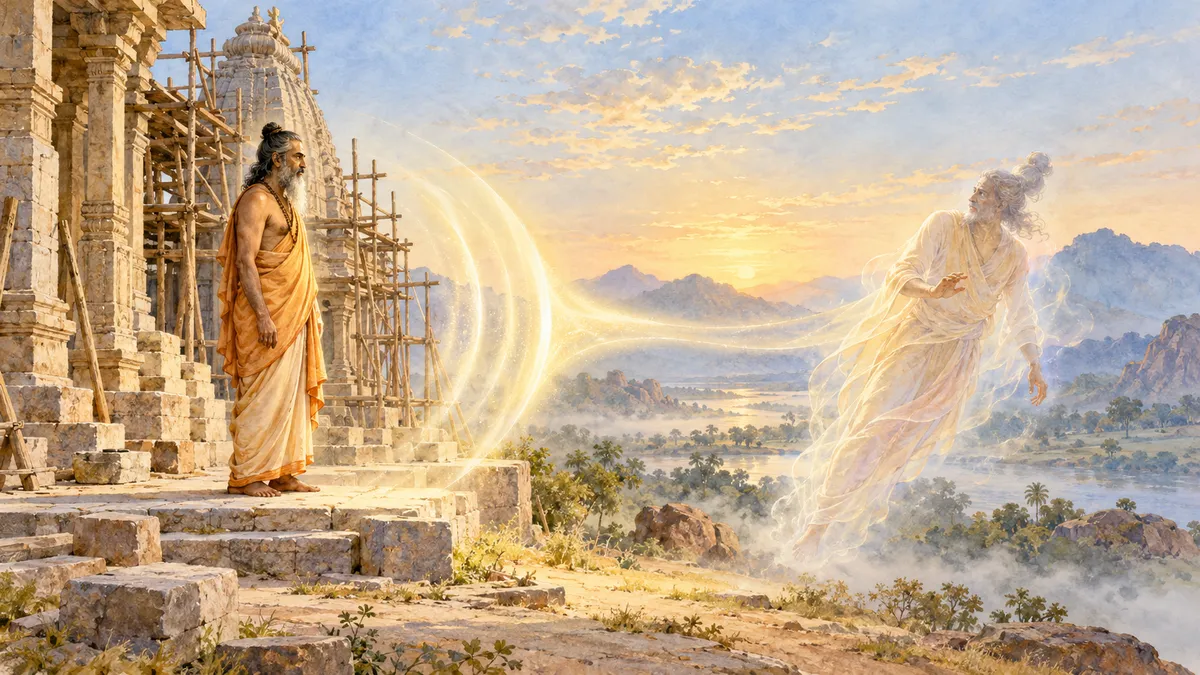
There is a story about a master who practiced dream yoga and had another master as an acquaintance. The second master was an even greater practitioner of dream yoga. They had some disagreements. One master began building a temple, while the other was opposed to it. They lived at opposite ends of the country. It is not known why they disagreed, but when one master was building the temple, the other would come in his dream body to see what was going on there.
No matter how many times he tried to spy in his dream body, the second master would meet him in his own dream body at the boundary of the temple he was building and cast him out of the dream with the mantra “phat.” This master was more powerful in mantras, while the other was more powerful in dream yoga. Therefore, the dream yoga master began to complain that the other master would not let him come near because of his mantras. Such interaction can occur in dreams.
When you gain the experience of traveling, it is equivalent to the experience of savikalpa samadhi; that is, your nighttime practice can become a complete spiritual experience in its own right.
Yoga of Light
When training in dream yoga is complete, our mind is purified, and we are ready to begin the full practice of the yoga of light. The yoga of light is not as interesting; there are no thrilling adventures in dreams. The yoga of light is deeper and more majestic. You need to explore the realm of light without name or form that we discussed.
In the yoga of light, you need to perform practices of merging with the light, sometimes using the visualization of a seed syllable in the anahata chakra as a support, and, as you fall asleep, maintain the state of space and light. If a yogi can maintain the state of light and space throughout the night, then they can, in practical terms, attain enlightenment in sleep. Through nighttime practice, they can attain enlightenment, merging with the light, sahaja samadhi.
Naturally, by that time the gestation stage must have been realized, and while awake they must know how to complete the cycle of the day. Merging with the light during nighttime practice is an esoteric method of completing the cycle of the night, which is considered the most difficult. Once you master the methods of the yoga of light, it ceases to be difficult. Every night, you work with different experiences of light, merge with them, and thus complete the cycle of the night.
Yoga of the Illusory Body
The yoga of the illusory body combines dream yoga and the yoga of light, deliberately enabling us to assume an illusory body. The illusory body purifies dreams and, through this transformation into a mandala, purifies our perceptions, while at the final stage it enables us to experience the light. At the final stage, the stage of dissolution into emptiness (laya-krama), it is no different from the yoga of light. The yoga of light is encompassed within the illusory body.
Why do we manifest again after the laya-krama stage? Karma compels us to fall out of it—that is one reason. But it is not only karma; it is also our deliberate effort. We want to create it because we need to master a certain energy, not only subtle but also coarser, manifest energy, which means that we need to unite the idea of emptiness and nondual pure light with manifestation in the form of name and form.
This will be the unity of the emptiness of light and the manifested body, the pranava-deha. The pranava-deha is not created by abiding in the light; it is created only by emerging from it into form, into name, provided that you unite shunya and rupa (emptiness and form), the light and the form of the deity. It no longer contains any karma; it contains only your will and pure luminous qualities.
Dream yoga, light yoga, and the yoga of the illusory body are special practices that purify and expand our consciousness and complete the cycle of the night. When the cycle of the night is complete, death and reincarnation are also purified and brought to completion; in fact, they no longer exist in the form in which an ordinary person experiences them. Such a yogi does not reincarnate like an ordinary person, does not die like an ordinary person, and does not undergo the processes of the intermediate state, antarabhava, because he is consciously present there.
The Processes of Death and Rebirth
“Within himself he sees another space, phenomena, and things, with another sky, earth, and moon. There are six kinds of pretas. Hear how they differ: ordinary sinners, middling sinners, and grievous sinners; there are also the ordinarily virtuous, the moderately virtuous, and the supremely virtuous. Some have one, two, or three such subdivisions. Some great sinners are said to remain unconscious for a year. They experience unconsciousness within, like a solid stone. Then, after some time, the vasanas awaken, and great infernal suffering is experienced for a long time. Having undergone birth from hundreds of wombs, passing from suffering to suffering, the rotation within the dream of samsara never comes to rest. Then, at the end of death and obscuration, they become trees, and many hundreds of sufferings are experienced in the heart. Experiencing sufferings in Naraka in accordance with their vasanas, they are reborn for a long time on earth in various wombs. Following death and obscuration, a middling sinner will for a time behold his state as being like a stone. Then, after some time, having wandered all around and experienced embodiment in the wombs of animals and others, he enters samsara. Thus does an ordinary sinner experience death. In accordance with one’s vasanas, a body is inevitably obtained.”
In accordance with one’s vasanas, a body is inevitably obtained. If a person is asked, “What kind of body do you want for yourself in the future?” he will say, “What other body? I already have this body.” But the fact is that we have had many bodies, and we will have bodies, because in accordance with the vasanas, a body is inevitably obtained.
We had bodies in the past—not just one—and we will have bodies or manifestations in the future. The only question is what kind. Bodies can be different. One may have a body in the form of a hare, or one may have a body such as a jnana-deha or pranava-deha in the form of a deity. One may have the body of an avatar; one may have the body of a deity in the world of Indra, in a heavenly loka, or a body in the form of space. There will be some kind of body. But will it be pure and consist of shuddha-tattvas?
To attain a pure body means not to be reborn. A pure body made of shuddha-tattva is sarupya-mukti. One may attain a body in a pure loka (salokya-mukti), or attain a body near the deity, in the deity’s retinue (samipya-mukti). One may attain an impure body. Those who attain pure bodies in pure lokas have attained levels of liberation, which means that they are no longer born and no longer suffer, which is very important. There is no suffering in the pure lokas. Those who have impure bodies are reborn, suffer, and are subject to karma. Ultimately, sayujya-mukti is reunion with the body of Ishvara, merging with Shiva, union with Brahman.
“The body is like a dream, like imagination; as it is conceived at the time of death, so the corresponding memory arises within it. Those who are supremely righteous, following death and obscuration, remember Svarga and the city of the vidyadharas, and thus experience themselves.”
The righteous remember their deity, recall paradisiacal states, and are drawn by the power of the soul toward such paradisiacal states and deities. Whatever a person conceives themselves to be, that is the form the subtle body assumes. If a person thinks, “I am Dattatreya,” recalling the visualization, key points, and bhava, over time they assume that very form. They follow the path of sarupya-mukti. Of course, it must be purified many times, brought to perfection, and immersed in the pure solution of the emptiness of golden light, but thanks to the practices performed, their mind already has such a tendency.
“Further, having experienced this or that karma, one obtains its corresponding fruit and is born in the human world, blessed with the company of the righteous. Those who adhere to the middling dharma, after death and obscuration, surrounded by the celestial wind, enter the shoots of medicinal herbs. Having tasted beautiful fruits, they enter a human being. Then they enter the seed and attain birth. In accordance with their vasanas, they become pretas. After losing consciousness, they gradually or immediately perceive themselves in this way. At first they think, ‘We have died,’ but as their relatives offer pinda, they think, ‘We shall be born again.’ Then, bound by the hosts of Yama with the snares of time, Yama’s servants lead them to the city of Yama.”
The Subtle World and Its Inhabitants
A soul that enters a subtle body encounters the inhabitants of the subtle world. The subtle world has a population; it is not empty, but inhabited by many beings. The subtle world has its own rulers, its own hierarchy, its own checkpoints that the soul passes through, and its own connections and relationships. It is like a person traveling to another country, for example China, where there is a distinct culture and established order.
But in the subtle world, a soul is judged according to its merits, and its destiny is shaped by how free from attachment and enlightened it is, how brightly it shines with the light of merit, and how wise it is. The subtle world is very flexible. The souls of sinners approach sinners; the souls of saints approach saints, who are invited by deities and angelic beings; gods come to those devoted to the gods; and asuric beings come to asuric beings, inviting them into their loka.
In general, this entire mechanism is governed by the servants of Yamaraja. Yama (Dharma-raja) is the supreme being who controls the subtle world. The soul is subject to the laws of the subtle world, the deities, and their servants who govern this subtle world. A strong and wise soul decides for itself how and where to go and where to reincarnate. A weak and unwise soul does not decide for itself; it is told where to go and where to reincarnate.
“On beautiful soaring vimanas, the righteous ascend to heaven again and again in accordance with their karma. For their sinful deeds, sinners enter icy wastelands and forests thorny as weapons. ‘Here is my good fortune, a beautiful path, cool gardens, cool shade, and lake water ahead,’ thinks the middling one. ‘Now I have reached this city of Yama; there is the lord of the bhutas, and there is the review of the karma I have committed,’ thus does he perceive it. In this way, everyone encounters on Earth a part of samsara, with its abodes, movements, and phenomena. Just as the void essence is realized in empty space, no place, time of action, or extension exists within it. Here I have received the lesson of enjoying the fruits of my karma; now I am going to the blessed heaven, and then to hell. What did I experience in heaven? What did I experience in hell? What did I experience in these wombs? Now I have been born again. Now I have been born as rice; now, gradually, I abide in the fruit. Thus, through plant consciousness, he believes that he has become conscious. Dormant beings, dormant senses, abide in a man in the form of seed. This seed is placed in the womb and becomes an embryo in the mother’s womb. This embryo is born into the world in accordance with past karma. The past becomes the present in the form of a playful child—or does not. Then he experiences the moonlight of intoxicating youth, turning his face toward it. Then, because of old age, the lotus face of youth fades as though from the winter cold.”
The Practice of Longevity and Health
While we live in this physical body, we must create a sankalpa—an intention to attain the siddhi of long life, health, and longevity—so that we may purify all our tendencies and receive certain signs of realization. This means that we need to create an intention and work with prana, winds, and channels.
Such attitudes in the mind are necessary in order to live a long life and have sufficient opportunity for purification and the accumulation of sattva. If you practice Dhanvantari, control the winds and channels, engage in shat-chakra yoga, maintain a positive mind, and control your desires, then your energy will contribute to the accumulation of the capacities for health and longevity. Perform upasana to the deities, asking for blessings of health and longevity. Your life force will increase. If your pure vision grows, your life force and lifespan will increase as well.
“Then come illness again, death, and once more the deadly oblivion; then again, as if in a dream, abiding, entering an embryo and a body. Again he goes to the realm of Yama and to the next world, and again into the cycle. Again and again he experiences entering various wombs. Again and again this is experienced, like some celestial form in the sky.”
The awakened Lila said: “At the beginning of creation, O Goddess, how does this cycle arise? Tell me about it once again, by your grace, for the sake of realization.”
The question always arises: where did all this come from at the very beginning? We must understand this. If past tendencies were formed by what came before, then where were the tendencies preceding them formed? Who formed those earlier tendencies? How long must one revolve in this infinity of successive births? The answer can be given only by returning to the very beginning, to the Source, to that great explosion from which samsara arose, to the moment when our soul separated from Ishvara, from Brahman, and began to consider itself independent.
The Origin of Creation
Devi said: “The condensation of the supreme reality is mountains; the condensation of the supreme reality is trees; the condensation of the supreme reality is earth; the condensation of the supreme reality is the sky. Since it is the essence of everything, all that proceeds from it is Consciousness, Ishvara, the supreme space, the pure Atman; He is present in everyone. At the beginning of creation, in Purusha’s dream, creation appears as waking reality, its beginning being Prajapati; and as he arises, so it abides within him. In him the first vibration, an image, arises, and therefore its reflection abides in every object. That which is called an empty place in the body is entered by the wind of breath; it moves within it, and the body is created. It is said that this is how it comes alive. Likewise, at the very beginning of creation, while abiding among moving beings, consciousness is motionless, just as trees are motionless. This space, being a part of the space of consciousness, brings about the arising of chetana. It becomes consciousness; it cannot become anything else. Having acquired the city of the human body, it thinks of itself as being limited by the eyes and other organs.”
The primordial chit becomes reflective consciousness, chetana.
“But the consciousness of the jiva’s eyes does not live in creation. Just as the sky is sky, the earth is earth, and water is water, so, through self-perception, it considers itself the body. Thus, through embodiment in all bodies, it abides as the movement of all that moves, the immobility of all that is motionless, and the essence of everything, manifesting in all things. From it proceeds movement endowed with self-awareness, through which it grows in everything and abides in the gods and others. Consciousness in the form of a tree abides motionlessly, as if unconscious; it is also stone, tree, and blade of grass. And although there is no difference between unconsciousness and consciousness, there is no difference between Him, creation, and all else. Their being is one. What in trees and stones is called inner self-awareness, unlike in others, is devoid of reason, buddhi; such is their condition.”
The Unity of All Souls
In reality, all souls are one living being. It seems to us that everyone is different. Souls think they are different. But this is one living being, the consciousness of Ishvara, which enters prakriti, matter. Yet in the process of prakriti’s cosmic unfolding, buddhi arises in some parts and the experience of the Atman is preserved, while in others buddhi does not arise and the experience of the Atman is not preserved. In some, buddhi arises and manifests, but there is not enough awareness to experience the Atman—only certain glimmers of the Atman.
This happens because consciousness enters tamasic, rajasic, and sattvic maya. Depending on the proportions of tamas, rajas, and sattva, in some cases the antahkarana arises, in others it barely arises; in some cases buddhi manifests strongly, in others weakly. Therefore, reflective self-awareness creates the diversity of souls’ consciousnesses, and these consciousnesses then enter bodies and assume one of the 8,400,000 forms of various species of living beings.
In reality, it is all one consciousness—in gods, humans, animals, and trees. The one consciousness creates various instruments which, through reflection, create the ego, ahamkara, establish identity, complex codes of conduct, connections, reflexes, instincts, concepts, and judgments; they have different sensations, ideas, and perceptions. This is how the diversity of souls and the diversity of bodies and karmas arise.
Depending on tamas, rajas, and sattva, various souls are drawn to their respective lokas, grouping together according to loka. The fourteen lokas, the realms of the great universe, vishva, taijasa, and prajna, are the one body of Ishvara, but at different frequencies.
People, of course, do not see it that way. People believe that we are us, Ishvara is Ishvara, and others are others. Sooner or later, we will have to realize that we were mistaken. Sooner or later, we will have to reconsider our erroneous views. All our views are false. The only correct view belongs to Ishvara and to those who have realized Ishvara within themselves.
Therefore, we must become accustomed to the view of Advaita. Adopting this view means beginning to believe and to become established in its philosophical meaning, so that it may develop into contemplation. Contemplation means that we do not merely believe, but penetrate with our consciousness into the consciousness of Ishvara, into this vision where unity exists and there is no separation. Then it gradually permeates our behavior as well.
“The inner knowledge of immobile beings and others differs only in name, depending on where they abide. It is the same infinite consciousness that the intellect recognizes as worms, insects, and birds. In it, there is no sense of difference. Just as people living at the North Pole do not compare themselves with people living at the South Pole, so moving and immobile beings abide in their own sensations, and all are dependent on their own conceptions.”
All living beings are slaves to their own conceptions (loka-drishti). The dharma of these lokas is called loka-dharma, local dharma—that is, culture, law, ethics, order, and ideas about right and wrong. Why are they slaves? Because they are identified with them. Sadhus, while living within the same culture and dharma, are not slaves because they are not identified with them.
Culture, feelings, and conceptions arise from vasanas. When there is identification with vasanas, there is no pure space of consciousness, and identification with concepts and conceptions arises. A sadhu works to free himself from enslavement to his own concepts. Then he looks deeper and sees that the issue does not lie in concepts and conceptions.
Working with Vasanas
We remove some concepts and conceptions, but some little bug remains inside, generating new ones. While we were asleep, many new concepts had already been generated. It is like a computer: while you were asleep, it downloaded something, installed updates, and reported on the work of the antivirus program. You did not order or request any of this; the computer does its own thing and lives its own life.
In the same way, our vasanas live their own lives in the subtle body. We fell asleep in a good state, slept, and awoke in a completely different state from the one in which we had fallen asleep. Why? Because our vasanas had already generated new concepts and conceptions with the help of the planets. The planets acted upon the vasanas. The planets are great deities that impart a certain state of mind and group vasanas into currents. They directed certain vasanas toward us, and those vasanas then generated new concepts and conceptions for us, which we would have to contend with that day; they colored our day, our mind, and so on.
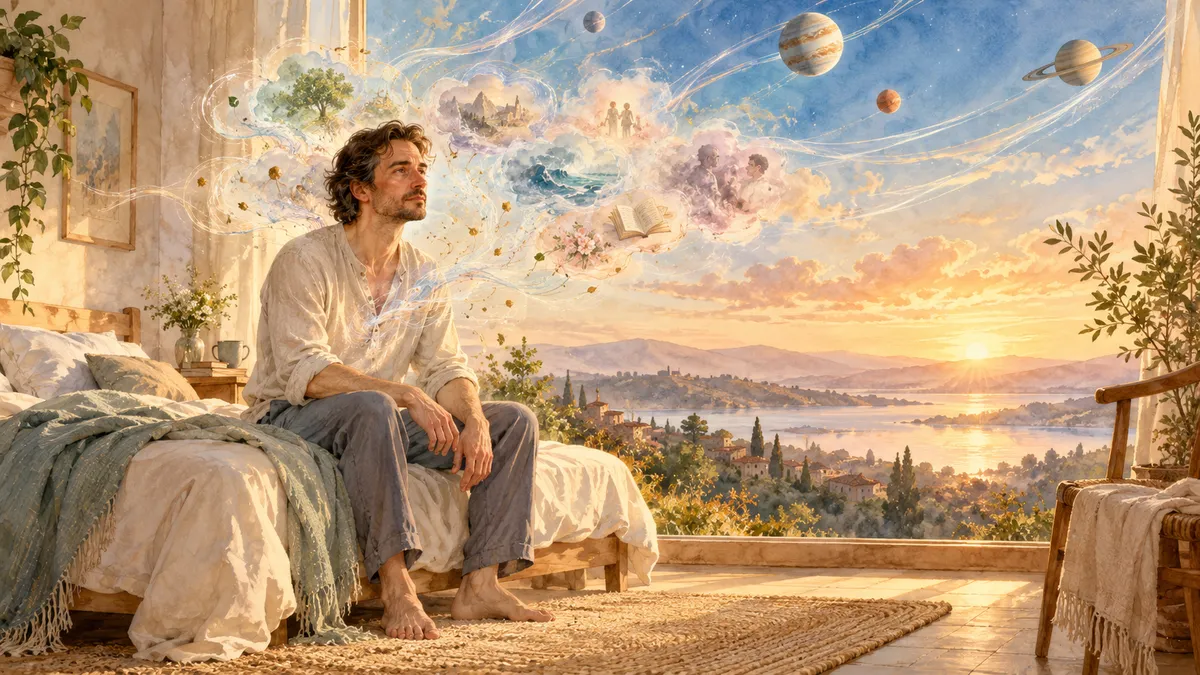
A sadhu understands that it is not merely a matter of concepts, but of vasanas, and that one must penetrate the vasanas through the power of vichara, the power of mantra, or the power of self-liberation. It does not matter how you achieved victory: through the method of sutra, tantra, or anuttara tantra. Once you have reached the vasanas, you have deprived them of control over you, deprived them of the power to persuade you and give you orders. You feel that you are truly becoming liberated, because beyond the vasanas there is purity, there is brahma-aham-bhava, pure shakti, the energies of God, the source of divine creation. Liberation comes from there.
Liberation is freedom from vasanas and from all those systems of thought and karmic vision generated by these vasanas. The acquisition of bodies and allocation among worlds are merely consequences. It is all about the vasanas.
Freedom from Fixed Ideas
“Their perception of difference is false, like the notion held by foolish frogs dwelling in a cave about what lies outside. The all-pervading chitta is perceived within the space of consciousness.”
Knowing this secret, a sadhu never clings to concepts or notions; that is, he does not insist on his concepts and notions, nor does he insist on his karmic vision. He understands that it is temporary. Once the vasanas are purified, his notions will change as well. A sadhu ceases to seek truth in karma. A sadhu understands that he must change himself, while satya, the true truth, is only one—in God. He understands that vasanas are impermanent and should not be relied upon. Therefore, he ceases to cling to anything external, increasingly cultivating devotion and self-surrender.
Fixed ideas weaken and leave him; he learns to live without fixed ideas through awareness. Fixed ideas are precisely the concepts and notions of karmic vision generated by vasanas. When he reaches their source, the vasanas, he understands that no fixed idea has any foundation behind it; it is empty.

Our life is an unbroken chain, a mosaic, an intricate pattern of fixed ideas, morality, ethics, notions of what is good and what is bad, complex connections and relationships, and orientation within society. It is an entire mosaic of certain fixed ideas. The saints say: abide in pure awareness without fixed ideas. Do not cling to any fixed idea, but at the same time do not become a nihilist.
Separating View and Conduct
If you cling only to pure awareness without taking relative reality into account, you will quickly slide into the abyss of nihilism. On the relative plane, uphold correct fixed ideas, good fixed ideas that help you accumulate merit and follow the spiritual path, while rejecting negative ones. That is the principle. This is called separating view and conduct. In other words, the instruction is this: let your view be infinite and boundless like the sky, and your conduct like carefully sifted flour.
On the relative plane, we uphold correct, good, positive ideas, while bearing in mind that even these good and correct ideas are still empty and illusory, and that only pure awareness is the foundation. Since we live in a relative world where various energies must be taken into account, we make use of and rely on them. But ultimately, just as the stick used to stir a fire is eventually thrown into that same fire, they too must dissolve.
The Danger of Nihilism
Sometimes people fall into nihilism after becoming acquainted with the Advaita view: they simply reject all ideas, including good and correct ones. For example, refuge is a good idea because holy energy stands behind it; it encompasses sacred texts, the philosophy of the teaching, and what is called Dharma. They grasp some part of the Advaita view, fall into nihilism, and discard all ideas, yet their vasanas remain, and their tendencies remain.
They have no protection, no support, no dharma, no connection with refuge, but they do have certain notions of emptiness, of Advaita, of the need to have no fixed ideas and to rely solely on pure consciousness. Yet their pure consciousness has not been realized; they may have experienced kriya-jnana, but not shuddha-jnana, and it does not enable them to cope with vasanas in any way.
Therefore, the classic nihilist is a proud person who has intellectually adopted the Advaita view, along with a slight glimpse of experience. But he remains thoroughly rooted in the kleshas and the ego, and is therefore utterly powerless against karma and completely incapable when it comes to method. By falling into nihilism, he has thereby cut himself off from the process of transformation, believing that the path of Advaita consists solely in relying on unfixed consciousness.
The Advaita path of the saints is different: it entails a process, a method, and reliance on wholesome ideas. It is not the rejection of ethics and morality, but a gradual purification toward the divine, an expansion of frameworks and boundaries. The neo-Advaitin constantly falls into nihilism. Vishishta-dvaita and Dvaita have more problems with eternalism, whereas classical Advaita and the Siddha traditions combine absolute freedom with consideration for the relative dimension in a remarkably correct, harmonious, and balanced way.
The Nature of Consciousness and Creation
“The all-pervading chitta is perceived in the space of consciousness, in creation, in the movement of the wind, and so forth; its presence is everywhere, here and now. Thought is like the space in which the winds abide. The essence of its vibration is creation and so forth, as well as movement among objects. In the highest sense, the mind abides in both the moving and the unmoving. It becomes moving together with the winds of the breath, but does not become them. In this false universe, objects are rays of consciousness. In creation and so forth, they are unreal, and thus they abide even now. The external forms of the world are a manifestation of the very nature of consciousness. They are unreal, although they appear to be real; this has been revealed to you.”
Neither real nor unreal—such is the view. Unreal means empty, devoid of inherent existence, projections of the essential nature of the “I.” Nor are they unreal—this means that behind them stands chit, the pure consciousness of the Absolute, Shiva-tattva. Behind them is the unfolding of divine energies; they are the manifestation, the play of divine energies, of the five pure tattvas, which are reflected in our consciousness, limited by the three malas.
The True Nature of the Universe
When we see the universe, we do not see the universe itself. For Ishvara, the true universe is divine: it is the five pure tattvas; it is jnana-shakti, iccha-shakti, kriya-shakti, chit-shakti, and ananda-shakti. A cat runs around or sits on a fence—it is the same thing: a combination of iccha-shakti, kriya-shakti, and jnana-shakti. These are various shaktis, and there are also the thirty-six tattvas—earth, water, fire, wind, space, the five pranas, chitta, manas, buddhi, ahamkara—all of these are various tattvas.
Why do we see things differently? Because all these divine shaktis are reflected in our consciousness, while our consciousness is subject to the three malas. There is also maya-tattva. It contains limitations, various kanchukas, and we see the divine shaktis in the form of a cat, a microphone, or a sofa.
For a time, Shiva altered the consciousness of one of his devotees so that he began to see Shiva everywhere—in women, in men, and among the people at the market—nothing but Shiva. That is, for a moment, his ishta-devata allowed him to see the pure tattvas. He removed maya-mala and anava-mala from his mind.
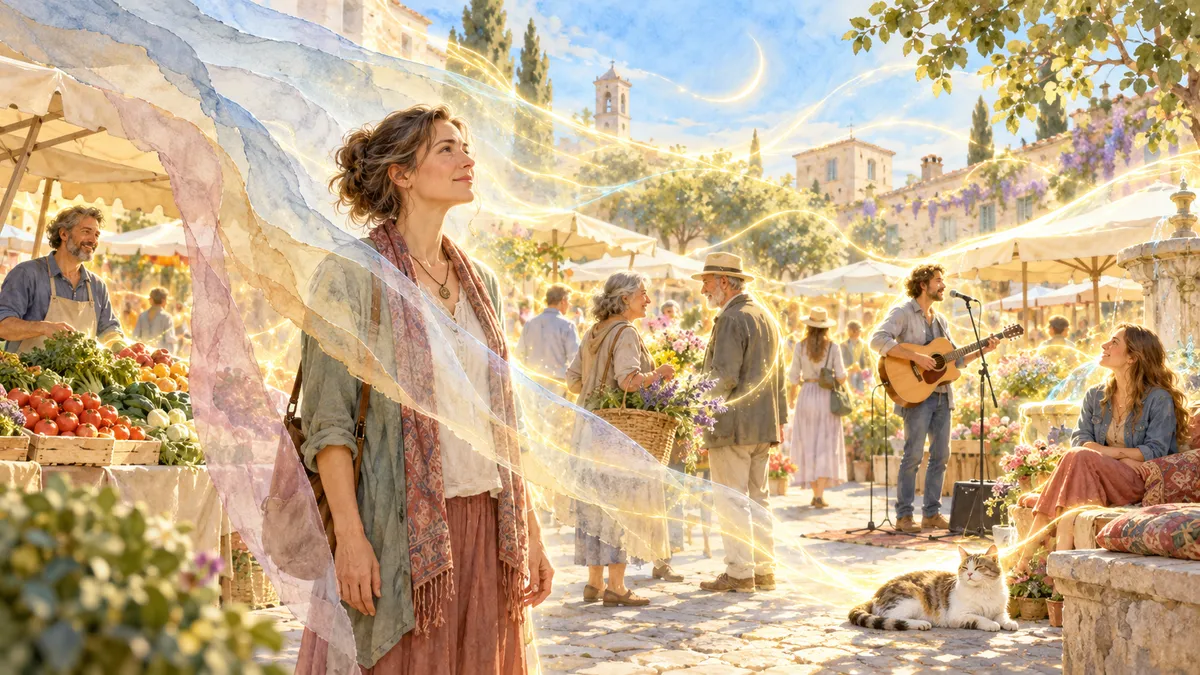
We see the world precisely as we do only because divine energies are reflected in our consciousness. As soon as we purify our consciousness, the divine energies will be reflected in it in an entirely different way. For example, we practice pure vision. This may seem like an intellectual exercise or an intention, but over time, when our dualistic notions disappear, it will no longer be an exercise; it will become the most natural experience. On the contrary, remaining unaware of the pure will seem abnormal.
The Transition of Consciousness After Death
“It is over; death has occurred. Look at King Viduratha: he is approaching the body of your husband, Padma, ready to enter his heart.”
The awakened Lila said: “By what path, O mistress of the gods, did he enter this crypt? For we shall see him and set out on the journey with him.”
The goddess said: “Clothed in inner vasanas, a person follows the path. ‘It is I who am going to another, distant world,’ he thinks. We shall travel together along this path, although each has their own desires, even when their hearts are bound to one another. Her weariness vanished in the light of awareness, and supreme vision arose in the mind of the finest daughter of the lord of the Earth when Viduratha’s unconscious mind left the body.”
