

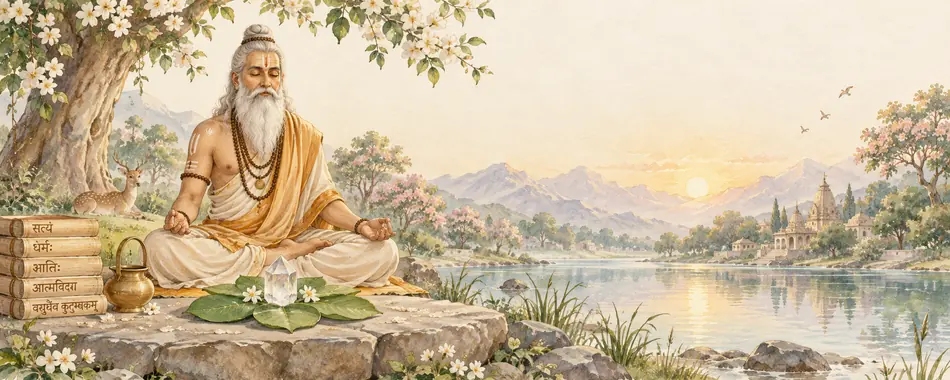
The goal of our spiritual practice is to become a jnani. As we practice, we awaken jnana within ourselves, and then become jnanis. A jnani is the same as Vasistha, Dattatreya, or Buddha. Vasistha was a jnani, Dattatreya was a jnani. Jnani means knowing one’s true nature.
The entire teaching of Prajna-yantra is Jnana Yoga. Shakti-yantra is Kundalini Yoga. Nada-yantra is Nada Yoga, Jyoti-yantra is Jyoti Yoga, and Prajna-yantra is Jnana.
Prajna-yantra is divided into two sections—general philosophy and practice. The philosophy of Prajna-yantra and Jnana Yoga are essentially the same: traditional Advaitic, Vedantic philosophy. The practice has its own features, as does every school. Many also practice jnana, but emphasize detachment, Raja Yoga in the practical sense, or simply meditation on emptiness.
The distinctive feature of our school is that we emphasize Sahaj, abiding in natural contemplation. In other words, when you encounter a school of Advaita Vedanta where Jnana Yoga is practiced, you will not always encounter this kind of practice. This is a feature specifically of the siddhas of Pratyaksha-Advaita, the Sahaj tradition. The siddhas of the Vedantic Orders of Shankara may not follow Sahaj. Or practitioners may practice traditional Mahashanti or Raja Yoga while also professing Advaita Vedanta and Jnana Yoga.
What does it mean to become a jnani? It means becoming like Vasistha in the level of consciousness, like Dattatreya—that is, undergoing such a transformation. One saint put it this way: “Who is not a fool before the Lord?” This means that when we set high standards for ourselves, we immediately see what we need to work on. Jnana is identical to Sahaj.
The Foundation, the Path, and the Fruit in Jnana Yoga

There is what is called the Jnana of the Foundation, the Jnana of the Path, and the Jnana of the Fruit. This is the same as Adi-Sahaj, Darshan-Sahaj, and Purna-Sahaj. That is, the primordial natural state, the natural state of the path, and the fully realized natural state. You must have a clear orientation regarding the Foundation, the Path, and the Fruit. Every spiritual teaching, every school has a Foundation, a Path, and a Fruit. You can easily analyze it for yourself by asking questions and examining what the Foundation of the Teaching is, what the Path consists of, and what the Fruit is.
If you ask a neo-Advaitin, he will say that the fruit is being here and now; for him, the fruit, the foundation, and the path are all the same. One might think that this is such a high-level practitioner of “one taste” who no longer distinguishes anything. But in fact, he may simply lack orientation, confusing the Foundation with the Path and the Fruit. But if you are asked what the fruit is, you can answer clearly: “The Fruit is the realization of the stage of the sixteen kalas, becoming Brahma, the creator god.”
The Jnana of the Fruit: Becoming Brahma
We engage in spiritual practice, and will continue to do so in the future, in order to become Brahma. This is our highest stage, since Brahma is considered the highest being in the Universe. Like the ten brothers of Hinduism. Some want to become siddhas, some want to become devas, while we want to become Brahma, whose mind contains both siddhis and devas. Brahma is the principle of the highest manifestation of energy itself.
At the same time, some Buddhists say: “Brahma is not eternal either; he is not self-existent, and surrendering to Ishvara and aspiring to become Ishvara is not yet complete Nirvana.” And we say: “Yes, we know all this; it is not news to us. We understand that Brahma does not exist independently; he too is born and disappears, but he is a fully enlightened being. And he is not identified with his ego as Brahma.”
Brahma is Parabrahman itself, which has simply assumed such a function, such an energy. But since it is the highest, we aspire to it and have it as the Fruit. Once we become Brahma, another Fruit of the Teaching is the creation of the Universe. If you have become Brahma, then your duty is to create a new Universe. This means that our potential of jnana-shakti—the energy of knowledge; svatantriya-shakti—the energy of freedom; iccha-shakti—the energy of will; aishvarya-shakti—the energy of divine power; and the fivefold powers of kriya-shakti—has developed to such an extent that we are capable of materializing the Universe through the power of our natural state, through the power of our sat-sankalpa, like Brahma. The creation of a mandala is the ultimate Fruit of our Teaching.
Realization of the Three Awakened Bodies

In addition to this, the intermediate Fruit is the realization of the three awakened bodies: Jnana-deha, Pranava-deha, and Siddha-deha. But when we speak of the realization of the three awakened bodies, this should not be understood literally, as if we somehow created these three bodies and now have three bodies. It is rather the realization of three awakened dimensions.
Jnana-deha is an entire dimension, a causal space; it is an entire dimension also called Prajna, and it is fully enlightened within us.
Pranava-deha is not merely an illusory body in the form of Dattatreya, endowed with thirty-two divine signs, or siddhis. It is an entire, completely pure dimension, also called taijasa, meaning that the entire astral world is enlightened. When you realize Pranava-deha, you may have not just one body, but three, seven, or ten. If you have a great deal of spiritual power, you can emanate thousands, millions, or billions of bodies. There are no limitations for you: you can manifest in the form of secondary emanations, radiate pure realms from yourself, and do anything at all. That is why the illusory body is called the dimension of the richness of manifestations: all the richness of the enlightened world proceeds from your enlightened Mind. This is the principle of Pranava-deha. We begin with one illusory body, but gradually discover that the illusory body is capable of creating anything. If the world is a manifestation of mind, then this mind is capable of assuming an infinite variety of different pure, beautiful, awakened bodies.
Siddha-deha means the ability to manifest purely in the material dimension as well. When the illusory body acquires such power that it can be seen in the physical world without losing its enlightenment, this is Siddha-deha. If some reincarnated being is born and assumes a child’s body, grows up, then this is not yet Siddha-deha. Through the method of transference of consciousness, they incarnate in a child’s body and continue their mission, like Buddhist bodhisattvas and certain avatars. But in our understanding, Siddha-deha is when the body manifests in the physical world, but is not made of flesh and blood. It appears to be made of flesh and blood, but it can assume any form. This is true Siddha-deha.
These are the three bodies of realization. In the highest sense, however, Siddha-deha is an entire enlightened material dimension. One who has reached this level can manifest not only as an enlightened body, but also as an animal, a forest, an elephant, a bridge, a river—anything at all. Anything can become one’s material body. For example, some deities have their material bodies on Earth; the goddess Ganga, for instance, has the body of a river, and there is no problem with having such a body. Some deities have a body in the form of a mountain.
The Five Main Powers of Brahma
When we have realized the three bodies, created the mandala as the universe, and realized the status of Brahma, who possesses the five main powers and the five powers of action, this is the Jnana Fruit. The five main powers possessed by Brahmas are:
the power of knowledge – jnana-shakti
the power of freedom – svatantrya-shakti
the power of will – iccha-shakti
the power of divine authority – aishvarya-shakti
the fivefold power of action – kriya-shakti, the ability to create, sustain, destroy, conceal, and manifest the divine
This is our ultimate goal, which we strive to attain through the practice of contemplation.
Discovering the Nature of Mind

First, we need to discover our mind. When we discover it, a certain openness arises within us; then we need to work with this openness until it gains strength. Until we have discovered the nature of our Mind, even to some extent, we of course have nothing to work with yet, which means that we need to search for it.
Those who have not discovered it are often misled by their mind and samsara, and sometimes they appear ridiculous, sometimes sad. Such is their karma: they have not yet discovered their Mind. But when they discover their Mind, they always appear joyful, because this is a very joyful event. To remain constantly in an open state, not to identify, to self-liberate, to play—this is no longer a samsaric life.
Because the one who has discovered their Mind has already become half a jnani, even if this has not yet gained strength. They no longer live in this world in the samsaric way; they play. This is what characterizes a jnani: the ability to play. And the ability to play means constantly remaining in a state of self-liberation. One who has not discovered their Mind cannot play; they are always acting, getting caught up, taking everything seriously. They take offense seriously, become attached seriously, reject and accept seriously. Samsara operates, and everything is taken at face value. And karmic reactions genuinely take effect. But a jnani is quite different.
As we continue working with this conscious openness, it gains strength and begins to bear fruit, that is, to manifest. Our task is to bring it to such a level that it manifests as the three bodies, the mandala, the status of Brahma possessing five primary and five secondary powers. Then this can be called the Jnana of the Fruit.
The Jnana of the Path: View, Meditation, and Conduct
And what do we need to do now? This is called the Jnana of the Path, or Kriya-Jnana. The Jnana of the Path means that we carry out the practice. Because if there is no practice, the Jnana of the Fruit will never manifest. The Jnana of the Foundation will always be there—the Sahaja Foundation, which is Brahman itself—regardless of whether we practice or not; Brahman is already perfect. It is us, and we are it. But something within us does not know this. It simply does not know. Therefore, the Jnana of the Path is necessary.
The Jnana of the Path, Kriya-Jnana, is divided into view, meditation, and conduct: jnana, dhyana, and kriya, or view, awareness, and conduct. This means that when we follow Kriya-Jnana, the Jnana of the Path, we adhere to a certain view. For example, someone adheres to the view that the world rests on three whales. Or: the most important things are God the Father, God the Son, and God the Holy Spirit.
The View of Advaita Vedanta

But we have our own view, the view of Advaita Vedanta, which is expressed through the mahavakyas. Sarvam Eva Brahman—all is Brahman. Or Aham Brahmasmi. In other words, the view presupposes reliance on philosophy as interpreted specifically by Dattatreya, Vasistha, and Shankara. The view is how we look at the world. There is no point in practicing sankalpa or contemplation until one has established oneself in the view. The view must first be understood intellectually, and then believed in. It should always remain with us, wherever we may be. We must constantly grow accustomed to it, establish ourselves in it again and again, until it fully becomes our own, and truly believe in it.
But even if we have some view—not merely as a philosophy, but as an inner conviction—that is, of course, not enough. Because the Jnana of the Fruit demands something more from us. Then we practice awareness and contemplation. We try to enter this view with the help of sankalpa, Mahashanti, Atma-vichara, and other methods. These are like keys to the view, opening the door into it. These are all methods of contemplation.
Sooner or later, your intention—that is, your awareness—and your view will meet. The view is somewhere far away and abstract, while your state is concrete. They must be united, and you unite them with the help of a method; this is called Mahamelana, the Great Encounter.
When they meet, this is called Awakening, Enlightenment, the stage of “birth.”
Enlightened Conduct
In addition, there is also conduct, action. That is, we need to bring this enlightened state into life. We must learn to act with it, and when there is movement, unite it with movement. We realized this under the wonderful static conditions of the retreat; then the movement of prana begins, there is a little more rajas, and that is it—our openness goes somewhere. This means that we have not yet mastered the art of integration, of maintaining contemplative presence in movement. Or we maintain this presence, but it is frozen within us, and we are afraid to breathe. This also means that we still lack flexibility.
But the mahasiddhas do not act that way; they are very natural, and you will not even notice, unless they want you to, that they are great jnanis. At the same time, they are constantly immersed in contemplation. Their contemplation is very deep because they have united with all actions; this is the art of conduct. It includes integration with the five elements, integration with the chakras and situations, and overcoming the division between pure and impure. In other words, one must learn to unite with all the energies that surround us, in nonduality, cutting off one’s impure vision. This is the pinnacle of the principle of nididhyasana. All of this constitutes the Jnana of the Path. We proceed along the path relying on view, meditation, and action, kriya.
The Jnana of the Foundation: the primordial natural state
What is the Jnana of the Foundation? The Jnana of the Foundation is our foundation; that is, it is the primordial natural state, Adi-sahaja, or Brahman, also called sahaja-tattva. The primordial Brahman is characterized by various qualities. The text of Brahma-vichara even contains a list of these qualities in Sanskrit.

Unity and nonduality
For example, unity and nonduality. Nonduality means that everything that appears as diversity is delusion. For example, there are many of you here, but this is a delusion. All of you are one Brahman. There are many bodies, but the being is one. And the idea that there are many of you and that you are separate is incorrect. Or, I am giving a lecture and you are listening; this is also an incorrect view from the perspective of the Jnana of the Foundation. Brahman is amusing itself in the body, playing at being a lecture, playing at being listeners, students, and a teacher. This is the view. All other relative diversity is a consequence of our ignorance.
Nevertheless, in conduct we distinguish between the absolute and the relative. That is, we accept this as a play. But not in the view, not in the Jnana of the Foundation. The Jnana of the Foundation is the uncompromising view that “Everything is Brahman”; naturally, one must approach such a view correctly. For the higher the teaching, the more illusions there are. One can make various mistakes, fall into nihilism, for example, ignore the method to the detriment of wisdom and exalt wisdom to the detriment of the method, or exalt the view to the detriment of conduct. Here, very clear and subtle instructions are needed so that samyoga, balance, is maintained always and everywhere.
The Jnana of the Foundation is, above all, unity and nonduality—the main quality is that all diversity is illusory, while unity is true. This is what Vasistha says. The qualities of the Jnana of the Foundation also include Brahman, which is beyond time, space, the gunas, qualities, and categories. This is characterized by the quality of emptiness, voidness, shunya. If some people think that shunya as a category is inherent only in Buddhist philosophy, they are of course mistaken. Shunya is also a quality of Brahman in Vedantic philosophy. This is confirmed by various texts, such as the “Atmasakshatkara,” “Devikalottara,” and others. It is simply that Vedantic philosophy more often describes Brahman in positive terms than in terms of emptiness.
The unstained nature of consciousness

The next quality of the Jnana of the Foundation is unstainedness, niranjana, that is, not being colored by anything. This is often illustrated with an example: if we look at it, the crystal is transparent, but if we place it on a surface, it seems to change color. But does it really change color or not? It is perception that changes. This is an example of the delusion of samsara. Our perception misleads us. The crystal does not change its color, but it seems to perception that it does. In reality, nothing changes. But when we place it there, we cannot deny that we see a different color. The one who denies it is lying, and one must not lie. So it does change. But what changes?
The crystal does not change; it is always unstained. If it changed, we would remove it, and it would retain the color, but it does not retain the color. Then it is our perception that changes, and we see: “This is what it is—our perception is deceptive and changeable. And the crystal is a symbol of nondual Brahman. It is not changeable. Our perception, the perception of samsara, misleads us, while the Absolute cannot be misled. We are misled because of our perception. Therefore, perception cannot be trusted. It constantly changes and falls into illusion. It constantly leads us into illusory relationships and connections. Brahman itself possesses niranjana, unstainedness.”
When we reflect on these qualities, it is very beneficial. My original consciousness is tainted by nothing. Whatever I may think, it cannot be tainted in principle.
The Perfection of the Absolute
Another quality is perfection. Perfection means that the Absolute is perfect by virtue of its very nature, without any need to create, fabricate, or attain it. This perfection is expressed through such qualities as self-existence, eternity, incomprehensibility, infinity, omnipresence, and all-pervasiveness. These qualities are inherent in the Absolute.
For example, we think: “It would be great to become immortal like the siddhas, or all-pervading, or omniscient.” But these qualities are already inherent in the Absolute. The question of “becoming” does not arise for it. If they are inherent in the Absolute, then they are inherent in us potentially; the only question is recognizing and revealing them.
The Foundations of Jnana
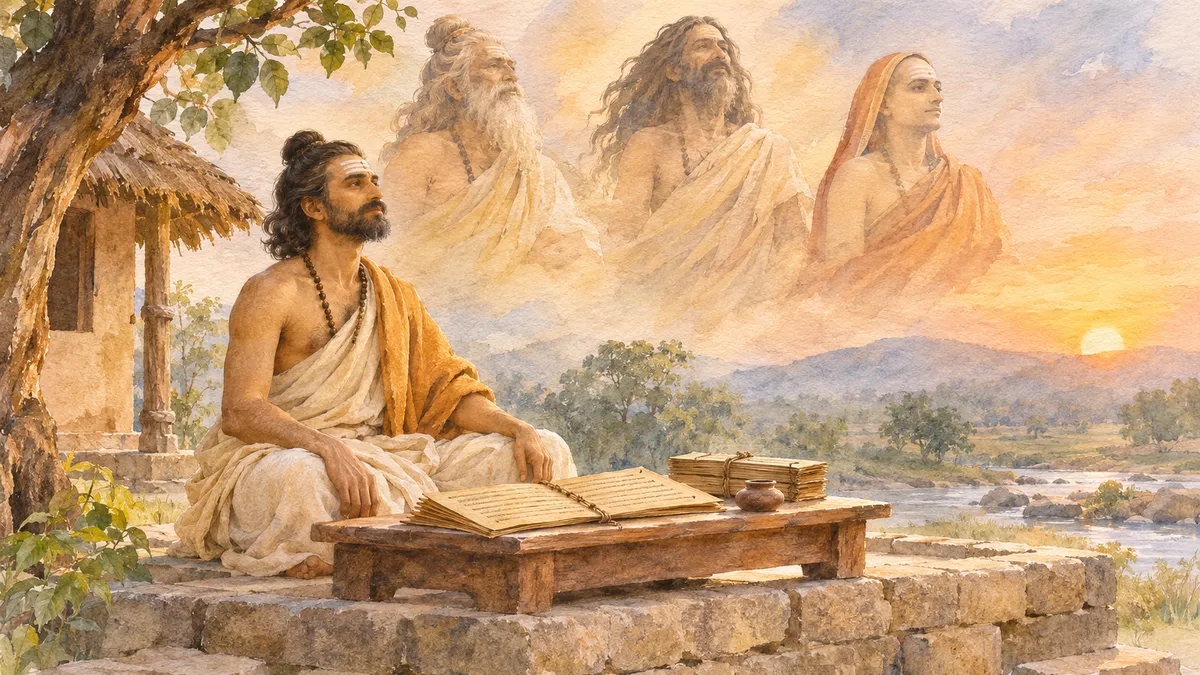
All of this is the Foundations of Jnana. To practice means to rely on the Foundations of Jnana. Because if we want to become jnanis, we need a Foundation. We cannot, having vague notions and blurred categories, think: “Now I will become a jnani.” What is jnana? You must know clearly. The Foundations of Jnana are based on the philosophy of Vasistha, Dattatreya, and Shankara, on the texts, and on an understanding of the qualities of the Absolute.
The Path of Jnana

Then, once we have understood the Foundations of Jnana, we need to apply them; this is Kriya-jnana. The Path of Jnana. We must walk the path. No one should say: “The Path and the Fruit are one and the same.” He may say this only when speaking about the view. But if he says it in relation to conduct, we will say that this is delusion. Because we must walk the path.
There is a starting point, and there is a destination. There is Moscow, and there is Delhi, and the monks need to fly to the Kumbh Mela. In the same way, there is a starting point—the point of ignorance. Ignorance exists for us, so to speak. There is the point of Enlightenment. We must travel from here to there.
Although in the view we accept the perspective that the Foundation, the Path, and the Fruit are all one, in our conduct we are obliged—we have no other choice—to accept the perspective that we must walk this path and move along it. That is why we need the Path of Jnana, Kriya-jnana.
And if a person says at the level of the view that there is no path, and also says at the level of conduct that there is no path, then you bow to him; it is the Lord speaking to you, telling you what to say. But we bow to such people from a distance. Because in reality, the Jnana of the Fruit has not been realized; it is only a declaration of the view. We distinguish between these things.
Antahkarana—the Inner Instrument

In order to understand what the Path of Jnana is, we must examine our inner instruments. Contemplation itself already presupposes a certain degree of maturity. What does this maturity consist in? It consists in understanding what we are made of.
If a person works on a computer, he knows: “This is the monitor, this is the keyboard, this is the hard drive, and so on.” He does not confuse these things. In the same way, if we practice Jnana Yoga, we must understand our inner instrument—what we are made of.
This inner instrument is called Antahkarana. Antahkarana literally means “inner instrument.” Different schools classify Antahkarana somewhat differently:
The Sankhya school recognizes manas, buddhi, and ahamkara in Antahkarana—that is, mind, intellect, and ego
Shankara’s classical Vedanta says: “There are manas, buddhi, ahamkara, and also chitta.” That is, mind, intellect, ego, and consciousness
The siddhas—for example, Gorakhnath—add a fifth element, chaitanya, consciousness. They say: “Manas, buddhi, ahamkara, chitta, chaitanya”
We follow the classification of Vedanta and the classification of the siddhas. Sometimes we speak of four, and sometimes of five. We speak of five when we want to emphasize the aspect of contemplation. We examine the principle of chaitanya, which is important to us.
Let us suppose that Shankarian Vedantists, practicing Jnana Yoga as analytical meditation and Raja Yoga, may not consider this principle important. Since the emphasis is placed on detachment. But for us, this principle of the siddhas, chaitanya, is important because the emphasis is placed on contemplation in movement and working with awareness.
This inner structure of the “I” is called the Antahkarana-panchaka, that is, the fivefold inner structure of our “I.” As jnanis, we must understand what we are made of and what we have to work with. These five inner parts—manas, buddhi, chitta, ahamkara, and chaitanya—each manifest in five ways, according to the siddhas’ classification. Each has five functions.
All these forms of the Antahkarana are located in the astral body, the subtle body. They are not located in the physical body, the etheric body, the causal body, or the Atman; they are located in the subtle body.
Manas – the conceptual mind
Manas is the conceptual mind; it can be likened to an operating system. Its functions are as follows:

Sankalpa is a desire, a firm intention, a will directed toward identifying what is meaningful. For example, each of us expresses certain intentions. This is sankalpa at work.

Vikalpa is the opposite. It is a thought that is unstable and wavering. For example, fantasies and empty thoughts. It is the wavering mind. For example, doubts, unfounded fantasies, and that which we reject.
Usually, there is a struggle in the mind between sankalpa and vikalpa. Suppose you are meditating and maintaining the feeling of “I”; this is sankalpa—to maintain the feeling of “I.” And vikalpa is the mind’s constant desire to fantasize about certain subjects. Or you are performing service or contemplating in movement—this is sankalpa. Vikalpa is fantasy.
On the one hand, there is sankalpa, and on the other, vikalpa. There is a struggle between them over which will prevail. And if the yogin is inexperienced and inattentive, vikalpa gains the upper hand. Then inner alchemy and contemplation come to a halt. But if the yogin is experienced, he has sankalpa. Sankalpa prevails. At the same time, vikalpa is not blocked; it is allowed to act and exist, but in a secondary, subordinate role. It is kept on a short leash.

Murchha—in addition, there is a state of the mind, of manas. It is unconsciousness, like fainting. It appears when the mind is confused. It is as if the operating system has frozen. Sometimes this state is used for direct initiation. If the mind is sufficiently aware, a person can open the mind wide in this state.

Manana is another quality of the mind. It is reflection and contemplation when considering something. When you evaluate, it is all the work of manas, and specifically manana, a function of manas.

Jadatta—and finally, the quality of stupor and lifelessness. When the mind is not functioning, it is like sleep mode.
These are the functions of our mind as a subtle computer. The mind can be likened to an operating system. And you can be likened to the users. A good user can work. With a bad user, the mind freezes, glitches occur, and he cannot really accomplish anything.
Buddhi – discriminating consciousness
The next inner instrument is buddhi. Buddhi is discriminating consciousness, the higher mind that regulates manas. It can be compared to a central processor that controls various programs and operating systems.
Buddhi is what generates values and meanings within us. It is our subtle consciousness, responsible for our ideology, beliefs, and worldview. When a person’s buddhi is developed, their faith and will are strong, and they are strong in their views on life, meanings, and values.
A weak, undeveloped buddhi is easy to ideologically influence; or one’s faith is mixed with doubts, one does not reflect on the meaning of life, and one’s will is weak. In other words, one follows the mind. Manas dictates everything to them. Manas is not under control. With a strong buddhi, manas is always under control.
The functions of buddhi:

Viveka – first and foremost, is discrimination, the ability to distinguish truth from falsehood, and right from wrong. If a person cannot discriminate, their buddhi is weak; if they discriminate well, their buddhi is strong.

Vairagya – another function, is non-attachment, voluntary restraint of desires and attachments. It is the ability to turn the mind away from what is wrong or useless, the ability to detach oneself. Vairagya grows when you engage in jnana. If your buddhi is weak, it is difficult for you to detach yourself from attachments and difficult to attain dispassion. Because manas and the ego are constantly telling you otherwise. A strong buddhi makes this possible. Because it possesses the quality of vairagya, dispassion. And for a yogi, it is very important to act in a state of vairagya. Then contemplation, service, and ethics come easily to them.

Santosha – another quality, unconditional contentment. Buddhi is characterized by an inner joy and contentment that do not depend on anything, since it possesses the quality of detachment. No matter what happens, you are happy everywhere. A subdued mind means a strong buddhi. With a weak buddhi, the mind is never subdued, because manas breaks free from the control of buddhi.

Shanti – another quality of buddhi: peace, equanimity, calmness, tranquility. Inner peace arises neither from external discipline nor from rigid self-control, but from a developed buddhi. In other words, you are self-sufficient, whole, and rooted in yourself.

Kshama – finally, the fifth quality of buddhi is patience. It is restraint, humility, leniency, obedience, and mercy toward others. These are all sattvic qualities characteristic of people with a developed buddhi. With an undeveloped buddhi, there is no patience or restraint; energy and consciousness are uncontrolled.
Ahamkara – the ego
Another part is called ahamkara, the ego. What can ahamkara be compared to? Ahamkara is like glue that connects all the parts. Its qualities are as follows:
Abhimana – pride, arrogance, a sense of self-importance. All of this is the ego.
Madya – another feeling inherent in the ego: possessiveness, the feeling of “mine,” the awareness of the body, senses, and mind as one’s own. When we have this understanding—“this is mine, this is me”—identification with the body, this is madya.
Mamasukha, mamadukha – there are also two other functions of the ego. Mamasukha is the feeling that happiness belongs specifically to me, while mamadukha is the sensation that sorrow is mine because there are such feelings—that is, acceptance and rejection.
Mamaidam – and the fifth feeling of the ego is the feeling “this is mine,” in the sense of possessing something external exclusively. For example, we think: “This is my music player, this is my laptop, this is my cell, these are my slippers.” All of this is the ego feeling projected outward, mamaidam.

All of these are various ego feelings that extend their tentacles and hold us. Ahamkara endows us with a sense of uniqueness, individuality, and continuity amid diverse changes. It appropriates and attributes everything to our “I.” It constantly places us at the center.
There is an expression: “He feels like the center of the universe.” This means an egoistic person. Or like Vishnu-nabhi, Vishnu’s navel. This is the ego, the action of ahamkara. It always attributes everything to itself. Sometimes such a person may mistakenly attribute everything to themselves. For example, someone says something, and they think: “They said that about me.” Although the subject may not have been them at all. Or someone is being criticized, and they think: “That is definitely about me.”
The ego identifies us with the koshas and misleads us—with the body and with the subtle body. It constantly, like glue, binds us to objects, to the koshas, to the body, and to various feelings. All of these are functions of ahamkara.
Chitta – Memory and Intellect
In addition, there is chitta. Buddhi must be developed, manas must be controlled, and the ego must be subdued and cast aside. Chitta is the next part. It is divided into the following functions:

Mati is intellect, the insight of consciousness, the ability to analyze, make judgments, and operate with concepts, judgments, and inferences. All of this is intellect.
Dhriti is another function of chitta: steadfastness, stability, and the consolidation of spiritual experience or awareness, when a certain spiritual experience becomes established and grows within us. Such steadfastness is a function of chitta.
Smriti is another function, namely memory. We all have memories, and we reproduce past experience through them. Chitta primarily manifests as the preservation and reawakening of samskaras in the subconscious activities of consciousness. In other words, chitta can be compared to RAM or hard-drive memory. There are various files within us. Chitta stores all of this, like a repository of inner tendencies.
Memory and recollections constitute our ego, our ahamkara. We are what we remember about ourselves. For example, if there were no chitta, we would fall asleep, our samskaras would enter the Clear Light and dissolve, and we would wake up thinking: “Who are we, anyway? What am I doing here? What kind of world is this?” But chitta does not allow this to happen. We remember on the level of manas and on the level of the subtle body. We even remember past lives deep within our souls—all the sins we have accumulated and all the merits we have accumulated. We remember all of this because chitta preserves all these records.
Tyaga – chitta is also characterized by the principle of detachment. It is the ability to leave or renounce something, to sacrifice for the sake of something greater. In other words, chitta, as consciousness, can renounce a certain part of itself without identifying with it.

Chitta is what exists in our memory, in our subtle body. Many people do not understand that it is memory that brings everything happening to them into existence. For example, if certain events exist in your memory, those events will occur regardless of whether you want them to or not. And they will not occur only if you make a great effort and cleanse them. Memory determines how our karma unfolds.
Three Types of Consequences of Actions
It is generally said that each of our actions produces three types of consequences, phala. Whatever you do, say, or think, you create future consequences; you produce a certain vibration in space. All of this is recorded by the subtle body.

Immediate visible consequences – there are consequences that become visible immediately. For example, you prepare soup and then eat it. You created a cause; the consequence is satisfaction. Or if you speak irritably to someone, that is the cause, and the consequence is that you end up before the monastery council. Cause, consequence—visible immediately.

Samskara-phala – but there is something else. These are called consequences in the form of impressions. Consequences in the form of impressions do not produce quick results, but they leave subtle traces within you, vasanas. You did something, but an impression appeared in your mind, and this impression becomes your memory. You cannot get rid of it at will; it influences you, and samskaras are created. It becomes the cause of your future desires and intentions.
The way we act influences what we become. If we act badly many times, a subtle memory is created, and we ourselves become bad. If we act well many times, a memory of goodness is created, and we ourselves become good. This is the principle of accumulating merit. For example, if a person has bad karma, they do not need to practice; they need to accumulate merit, that is, good memories. Good memories are good karma. Bad memories are bad karma.
The subtle body contains memory, samskaras, and after the death of the physical body, the samskaras continue to act after death, manifesting themselves. Suppose that in the subtle body of a computer gamer accustomed to playing in virtual reality, the subtle body unfolds these samskaras, and after the death of the physical body, they will play computer games. The subtle body of an artist will unfold the images they created, and in the subtle body they will encounter them after death. The subtle body of an engineer will contain the various projects they worked on. All of this is samskara-phala.

Adrishta-phala – there are also invisible consequences, invisible influences. We did something, but it does not manifest immediately; it may not have left an impression, but it has influenced you, adding one point to some quality within you, causing some quality to develop. For example, your charm may have grown, or your artistry may have increased. You do this, and it continues to grow and grow. Sooner or later, it manifests in the form of certain spiritual, religious, or human virtues, certain qualities and character traits, or deficiencies. Then they are rewarded or punished in accordance with the cosmic order, rita and niyati. This is adrishta-phala. That is, something that does not manifest immediately. All of this happens through memory, through chitta.
Chaitanya – consciousness
Finally, the fifth aspect of our inner instrument is chaitanya, consciousness, one of the most important aspects. Chaitanya is our awareness; it is the space of our mind. It also possesses various functions:
Vimarsha – reflection. This is the reflection of awareness and of various processes in our consciousness. Suppose you contemplate a sankalpa: there is a movement of thoughts, thoughts become blurred, or thinking is clear; you stop the thoughts, or impure thoughts arise. All of this is vimarsha. You are carrying out a mental process.
Chintana – another quality, awareness. This is when you can remain in contemplation against the background of presence. And when you are engaged in subtle contemplation, chintana is at work.
Shilana – chaitanya also possesses this quality. It is inner virtue, inner self-discipline, self-organization, inherently present in consciousness as inner goodness, when you intuitively know from within how to maintain the right spirit.
Dharya – chaitanya also has the function of fearlessness, the absence of hesitation. When you have become firmly established in it, your mind does not waver, because consciousness is always broader than any experience. This is dharya.
Nihsprihatva – and impartiality. Impartiality means that as soon as your awareness is liberated, you stop depending on desires. You develop a tendency to free yourself from desires. You no longer want to follow desires or be dependent on them. But if chaitanya is undeveloped and weak, this is difficult. Yet as soon as it develops, all desires fade for you, and you are free from them. At the very least, you are sufficiently free from them that they cannot greatly disturb you. This is because such is the nature of chaitanya: nihsprihatva, impartiality.

These are the twenty-five categories of the manifestation of the mind in the body. When each function of the antahkarana—manas, buddhi, ahamkara, chitta, and chaitanya—manifests fivefold. If you know these five categories of the antahkarana and the five functions of each category, you gain a general understanding of the instrument you will have to use in the process of Jnana Yoga.
It is useful to perform analytical meditations on each part of this inner instrument. For example, meditate on manas, observing its work and functions. Meditate on buddhi and on ahamkara, observing its shortcomings and strengths. On chitta and on chaitanya. In order to distinguish all this within yourself and understand what we are made of. Such analytical meditation can be a preliminary practice that will establish you in Jnana Yoga and help you become firmly grounded in the practice of contemplation. Because various aspects of the mind often surface, and we must know how to classify them and how to relate to them.
Methods for Developing Buddhi
Question: Chitta is purified through Bhajan Mandala, through visualizations and practices. And manas through concentration and the application of effort. How should one work with buddhi in order to direct it toward achievement?
First of all, loyalty to your ideals, conviction in your values, and faith—this is what develops buddhi. Next comes willpower; buddhi grows through the application and training of the will. When you do not yield to the impulses of the ego and manas, buddhi grows; when you do not follow the memory and tendencies of chitta. Self-denial, self-surrender, humility, and restraint—all of this increases buddhi.
For example, if you practice tapas, block manas, stop thoughts, do not follow the fantasies and vikalpas of manas, and do not follow chitta, the memory, then the power of buddhi is sharply activated, and you acquire great spiritual strength. It is as if you draw out from within a certain magical power inherent in you, and with its help you can do something, achieve something, or clarify something for yourself. Any tapas strengthens buddhi. If you concentrate a little and perform some kind of austerity, your buddhi increases.
Some people can strengthen buddhi through analytical meditations, reading texts, and reflecting on them. For example, for a long time I read and reflected a great deal, and this reflection continued uninterruptedly—the philosophy. Then I would fall asleep and reflect in my dreams on the subjects of various philosophies. Lines from texts would pass before my eyes in the dream. This is a form of continuous awareness through the study of the teaching. All of this activates buddhi.
Deep Self-Inquiry

When you discuss the teaching, examine some question or problem, always remember this scheme and know that a subject—a person—is embedded in the worldview, in every action and behavior. When they ask the question, “Who is this?”, there will always be the answer: “I.” And then we must break this “I” down into its components: “But what exactly is this ‘I’?”
People often practice vichara, engage in self-inquiry, and say: “Who am I? I do not find anyone there.” And so on; such answers do occur. Emptiness, thoughtlessness. But this is not enough. If you deeply investigate the nature of the “I,” you must necessarily see manas, buddhi, chitta, ahamkara, and chaitanya there; you will see all their functions, their play, interweaving, interconnectedness, and the play of nuances. And at the same time, having seen all this, you must step away from them and disidentify yourself from them. Then this can be called deep self-inquiry.
But if a person simply practices self-inquiry while having no distinction between chitta, ahamkara, and manas, and none of this is understood, then this is still only the very initial stage of vichara. That is, you have penetrated only a small layer of the subconscious.
The one who clearly distinguishes all this and is free from chitta, manas, buddhi, and ahamkara is a true jnani. I wish for all of you to become true jnanis.
