

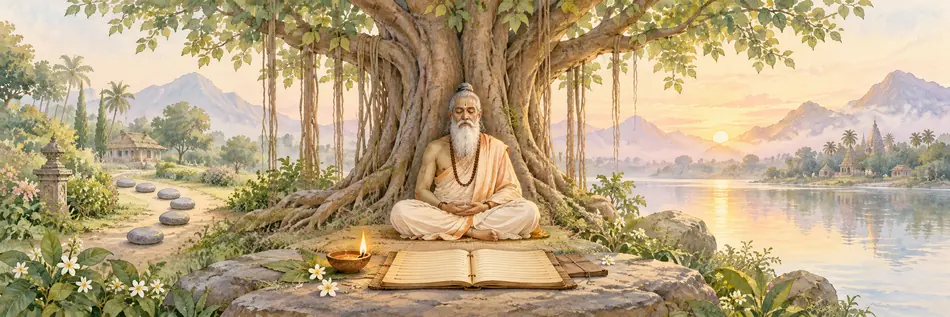
Commentary on the text “Yoga Vasistha.” Chapter 5. “On the Ending”
Because of the power of the mind’s imagination, apparent relationships become an actual force.
The entire teaching of Vasistha is aimed at enabling us to attain vichara, viveka, and vairagya.
One disciple came to the master and asked: “How can I attain liberation from the suffering of this life and gain wisdom?” The teacher gave him a mantra and meditation. Then he came back and said: “So far, I have had no experience and no success.” Then the Guru said: “You are missing the three ‘V’s.’” The disciple asked: “What are these three ‘V’s’?” The teacher said: “Vichara, viveka, and vairagya—investigation of one’s nature, discrimination between truth and untruth, and detachment—vairagya.”
We become sadhus when we attain vichara, viveka, and vairagya.
Then he meditated and practiced for some more time, came again, and said: “I have not yet attained the proper happiness, wisdom, and understanding.” Then the Guru told him: “You are still missing the four ‘S’s.’” What are these four ‘S’s’? Sadhana, seva (service), svadhyaya (study of texts), and samadhi.
When sadhana—spiritual practice—and seva—service—are present in our lives, they become our life principle and permeate our entire life. Svadhyaya—study of texts, analysis, and contemplation—and samadhi, meditation and the transcendental state—then we become sadhus.
We should consider this: if we strive for our own happiness, how can we attain these precious things?
The Nature of Imagination and Samskaras
Vasistha says that our mind dwells in imagination. Therefore, to it, this entire illusion seems real; all of maya seems like something tangible. Our imagination is very powerful. This very body is the imagination of our mind. This world, too, is the imagination of our mind.
Our mind is as limitless as the cosmos. And within it there are many different connections, imprints, and relationships. This body consists of samskaras; these samskaras brought us here to this material world, prompted us to seek a spiritual teacher, teachings, and like-minded people. They also prompted us to come here to the Kumbh Mela. They urge us to continue along the spiritual path. Our samskaras are the memory of the subtle body. If there are no samskaras, there is not even a connection with this world.
For example, when a child is born and lives for only two days, it means that he had the samskara to live in this world for only two days. The remaining samskaras will be connected with other worlds—perhaps higher or lower ones. As long as there are samskaras, there are pranas and connections with the world and with people. We strive to purify the samskaras so thoroughly that all arna-bandhanas—all karmic connections—are dissolved. And the entire world becomes, for us, a pure vision, a pure dimension.

True Dharma and False Notions
Vasistha says:
The Supreme Self is untouched by pain and pleasure. But, considering itself to be the body, it is subject to the body’s perceptions. Abandoning such an ignorant belief is liberation.
Dharma means recognizing the Supreme Self. The Supreme Self is recognized through vichara, viveka, vairagya, and samadhi. Dharma is not rituals, nor is it culture. Dharma is not some kind of hope. All these are attributes. All of this has its significance at the relative level. But dharma itself is the recognition of the Supreme Divine Self.
Once, in an Indian village where kshatriyas had always lived, a Brahmin was going to bathe. Two Muslims lay in wait for him by the well. They seized him and stuffed a cloth into his mouth. They gagged him so that he could not shout. Then, before his eyes, they drew water from the well, rinsed their mouths, and poured it back. Then they took a piece of bread that had been bitten into and threw it into the well. Next, they grabbed the Brahmin, offered him food, and said: “You are a wise man; join us.” The Brahmin became angry and refused to accept the food. Then, seeing that he did not want to eat, they let him go.
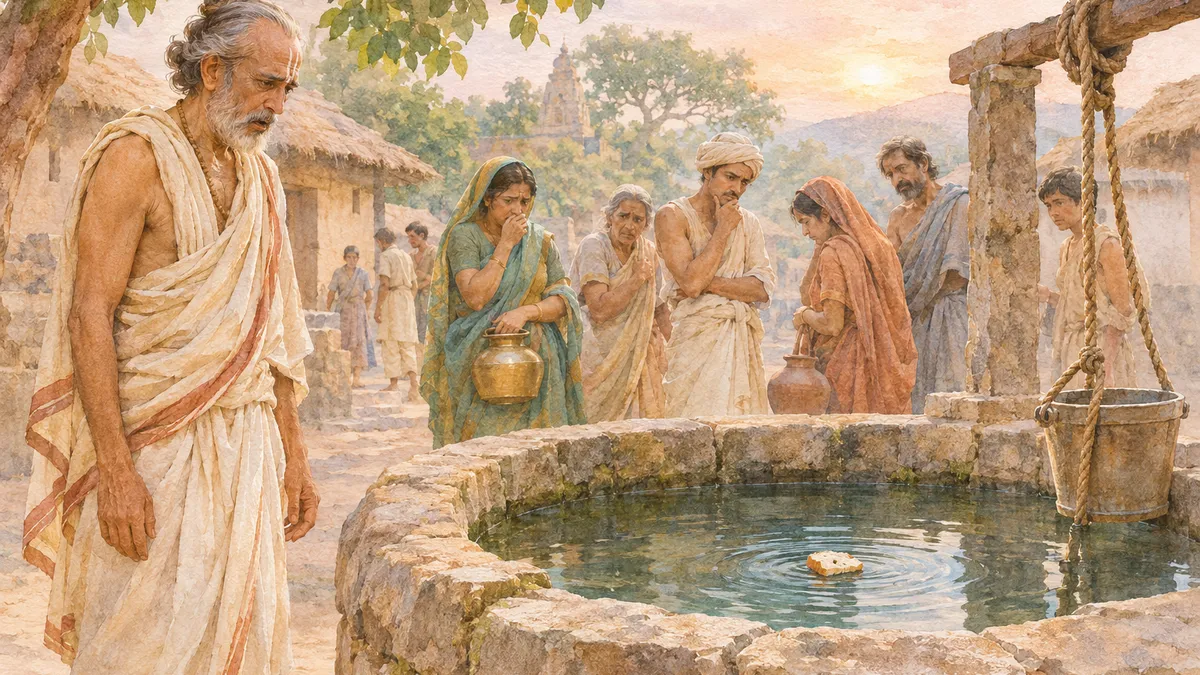
This Brahmin was simply shocked by such actions. He came and saw that the inhabitants of this village were drinking from this well, carrying water, and cooking food. He thought that he had become severely defiled, because if a Muslim (such was the understanding of dharma in medieval India) touched food or water, it became defiled. He began to fast. And people began asking him: “Why are you fasting?” He told them what had happened: the water had become defiled, and they had all become defiled; now we had lost dharma.
All the inhabitants began to grieve. But they did not grieve for long. They thought, since we have lost Sanatana Dharma, since we have all become defiled, then we will become Muslims. And the Kshatriyas of this entire village converted to Islam. To this day, this Kshatriya village remains Muslim. Weddings are held there, Vedic Brahmins are invited, and at the end a mullah comes to give his blessing—a kind of mixture.
One teacher, upon learning about this situation, began to say: “What kind of dharma do you have? What kind of Sanatana Dharma is this, which can become so defiled? Simply because someone touched it. Can anything touch the Supreme ‘Self’? The Atman is beyond reach, cannot be moistened, and cannot be cut. It is impossible to strike it with either a sword or a spear. You lost your Sanatana Dharma simply because you believed that if a Muslim touched the water, it became impure. You fell victim to prejudice. You fell victim to foolish superstitions. This is not Sanatana Dharma. This is your foolish culture, which you follow out of delusion. Sanatana Dharma is much deeper.”
Liberation from Identifications
Vasishtha says:
Those who do not succumb to identifying themselves with anything or to attachments are quickly freed from suffering.
Our consciousness dwells in identifications. Identification leads to attachment. For example, if you consider yourself a human being, your mind paints for itself a human path, human happiness, and human attachments. This mind develops a human character. Consequently, all of human karma also affects you. The question is: if we change our self-identification and stop identifying ourselves with a human being as a body, with a human being as a mind, and create a new identification—for example, Aham Brahmasmi—I am the Absolute—then gradually our mind will stop painting a human destiny, a human personality, and a human character. It will begin to tear itself out of conditioning. This is the principle of the teaching.
Gradually, we remove the old identification with the body and the mind and try to identify ourselves with the highest thing that can be—the Absolute, the Divine “Self.”
The Mind as the Creator of Reality
Our mind is like a three-dimensional printer. I often repeat this. This three-dimensional printer is capable of printing any situation, any thing. But if you envision a certain friend and want to have him, imagine this with great intensity, and if you have enough power, such a friend will appear. You can even specify his parameters, character, and the color of his eyes and hair. Where will he appear from? He will appear from the Void, from Brahman. He will materialize through the power of your intention, provided, of course, that you have a very powerful sankalpa-siddhi. He will even have his own history in the human world, a birth, and so on. He will correspond to your intention. Because your mind can do anything.
Once I was traveling from Nizhny Novgorod to Moscow in a compartment carriage. In the compartment, I thought: “I should order some better fellow travelers for myself. Let them be young, ambitious researchers connected with politics, with whom it would be interesting to talk.” And when I entered the compartment, three young researchers connected with politics were sitting there. We talked with them the entire time.

This is the mind. If you abide in a natural state, the mind can materialize any situation, any possibility for the future. It can even change the past if you are a powerful sadhu. You can shift an entire country into another possibility, into an alternative history, if you are a very powerful sadhu. Your sankalpa-siddhi can penetrate the past, change causes and effects; it is like returning to the past through time, intervening in time, changing causes and effects, and moving entire peoples or yourself into an alternative history.
There are worlds where Russia and Germany did not fight in the Great Patriotic War. There are worlds where China is the only geopolitical center. There are worlds where the Soviet Union did not collapse but successfully reformed, is moving forward and building communism, where it still exists in the twenty-first century. There are worlds with alternative histories, countless variations. And this boundless mind can print out any situations. There are worlds where we have a rainbow body in the form of Dattatreya. There are versions of reality where we are all sannyasis who have attained samadhi and enlightenment. There are worlds where you are all human beings conditioned by karma. This is an entire spectrum, an entire fan of reality, but our mind attracts precisely the version of reality that is closest and for which it has enough merit and energy.
There are worlds where we are perfect mah siddha beings and live in pure realms. And all of this is our future. It exists right now, simultaneously, right here, within arm’s reach. It is only a matter of whether it is possible or impossible to reach it. There is an alternative version of our past, because all of this is mind, and all of time—past, future, and present—is also created by the mind.
The mind is an infinite creator. The question is how pure our mind is and how well we can give it the right intention, the right sankalpa.
Pure Vision and Mind Management
Therefore, we must train ourselves to control our mind. For example, pure vision allows the mind to project only pure realities. We must tell ourselves that we do not need impure realities. If I think impurely, I attract impure realities. And an impure reality means illness, obstacles, suffering, a life full of limitations; it is unsuitable. Therefore, I do not need to go there. I must make my mind think only purely. Little by little, as we learn to control our mind, this three-dimensional printer creates exactly what we need. And we must understand what it is that we need. But it is better to ask: what do the saints say in this case?
The saints say: “Seek nothing material, seek nothing selfish, seek nothing temporary or transient. Seek divine wisdom, seek the divine will, seek God-realization.”
When we set our mind on attaining divine wisdom, liberation, moksha, we must also understand what this means. These should not be abstract concepts. What is it? When we ask, what is it—what is realization? This is called the “fruit of the teaching.”
The Foundation, Path, and Fruit of the Teaching
As you know, every teaching has a foundation, a path, and a fruit. The path is what we do to achieve a result. The foundation is what we rely on. And the fruit is the final point, the result, the destination we eventually reach.
The fruit of the teaching is the attainment of the three awakened bodies: the wisdom body, which is like space; the enlightened illusory body; and the perfect body, capable of manifesting in any reality. They are called jnana-deha, pranava-deha, and siddha-deha.
If you want to understand what the wisdom body is, simply imagine that there are no thoughts in your mind, and that it expands into infinite space, like the cosmos, while your consciousness expands as well.
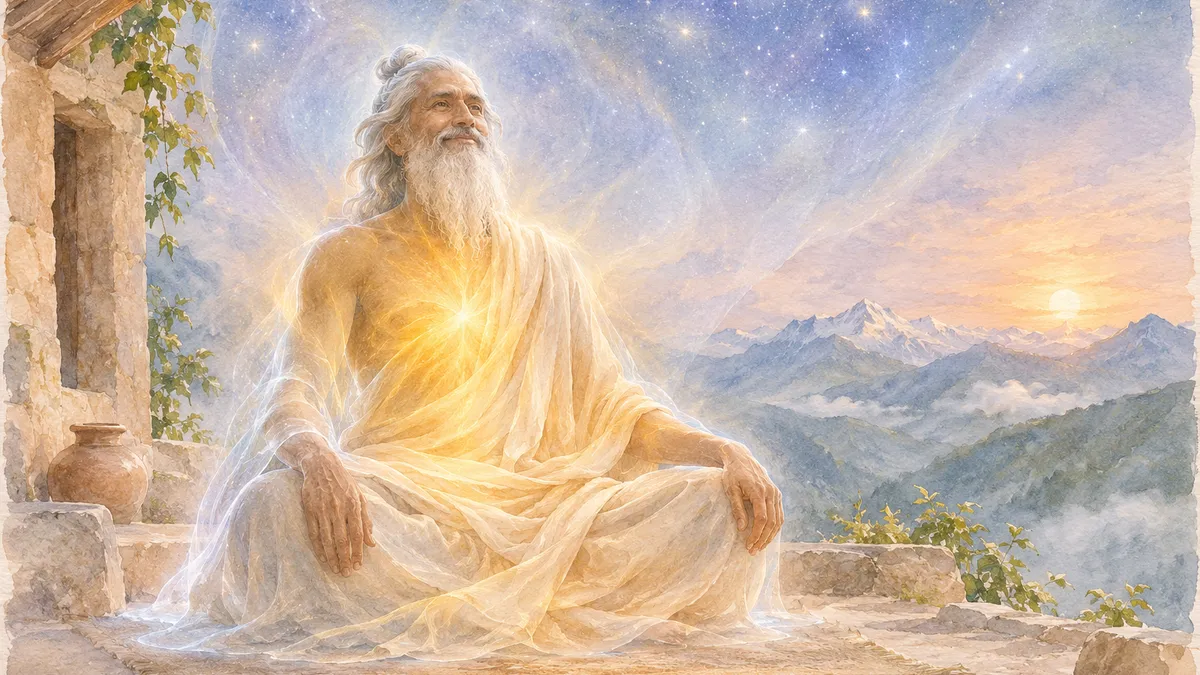
If you want to understand what the pranava-deha is—the divine body of glory—look at the jnana-devata of Bhagavan Dattatreya in this form. This body, filled with radiance, luminosity, and omnipotence, is created from pure prana in the subtle world.
What is the siddha-deha, the body of manifestation? It is the body of a siddha, which is immortal and lies beyond the influence of the five elements. Guru Brahmananda possessed such a body. Guru Brahmananda realized all three of these bodies. He could move from one body into another and live for 700 years. He still lives now, being immortal. He also has an immortal body of glory in which he can manifest before his devotees. I can state this with certainty from my own experience. He also has a body like infinite space—the jnana-deha.
Liberation from Limitations
Vasistha says:
The supreme Self is not affected by pain or pleasure. But by considering itself to be the body, it becomes subject to the body’s perceptions. Abandoning such an ignorant assertion is liberation.
Those who have not succumbed to identifying themselves with anything or to attachments quickly free themselves from suffering. Conditioning is the seed of old age, death, and delusion. But when it ceases to operate, a person transcends delusion.
A limited mind creates shackles even for ascetics, while an unlimited mind remains pure even in a householder.
A limited mind is not freedom. Liberation is freedom from limitations, attachments, and identifications.
We are moving toward absolute freedom; absolute freedom means removing all the shackles in the mind so that the mind can open up to infinity. Ultimately, we must free ourselves from doctrines, philosophies, and even methods: mantras and visualizations. We must enter the unconditioned space of consciousness, in which there is no place for either subject or object. And this boundless freedom already exists within us. It is inherent in us by right, just as the heart is inherent in us.
The other question is that we are far from it. Our mind is still far from it; it cannot reach this point or find it by groping. And despite the fact that we are already free within, our mind needs to do the work. If it does not do this work, it will not be able to attain this freedom.
Refuge and Its Levels
To do this work correctly, we need Refuge. Refuge is our spiritual connection with certain treasures. When you enter Refuge, when you take Refuge, this is a very important moment in life. It is like finding a treasure: you wander through the forest and discover a treasure. Perhaps at first it may not seem like something truly precious to us, because we have not yet established a connection. But when we establish a connection with Refuge, if you do everything correctly, this treasure begins to reveal itself to you. And after some time you understand: yes, this is a great treasure.
How do we establish the right connection with Refuge? This connection is called samaya. We honor the principle of the Guru, the Guru Parampara; we honor the Dharma as the wish-fulfilling magic jewel—cintamani. We honor the sangha as the divine mandala, as the Third Jewel. And when we honor Refuge, Refuge blesses us.
What does it mean to establish a connection with Refuge and honor it? It means invoking it on all the days when things are difficult, making offerings to it, and praising Refuge. On special days, invoking Refuge, making offerings to it, performing seva, engaging in visualization, and establishing a connection with Refuge. Listening about it, reflecting on it, and directing your mind toward it. The main thing is to understand its essence. To understand that Refuge is not holy beings somewhere in the heavens, outside us. It is not something external to us. Refuge is within us.
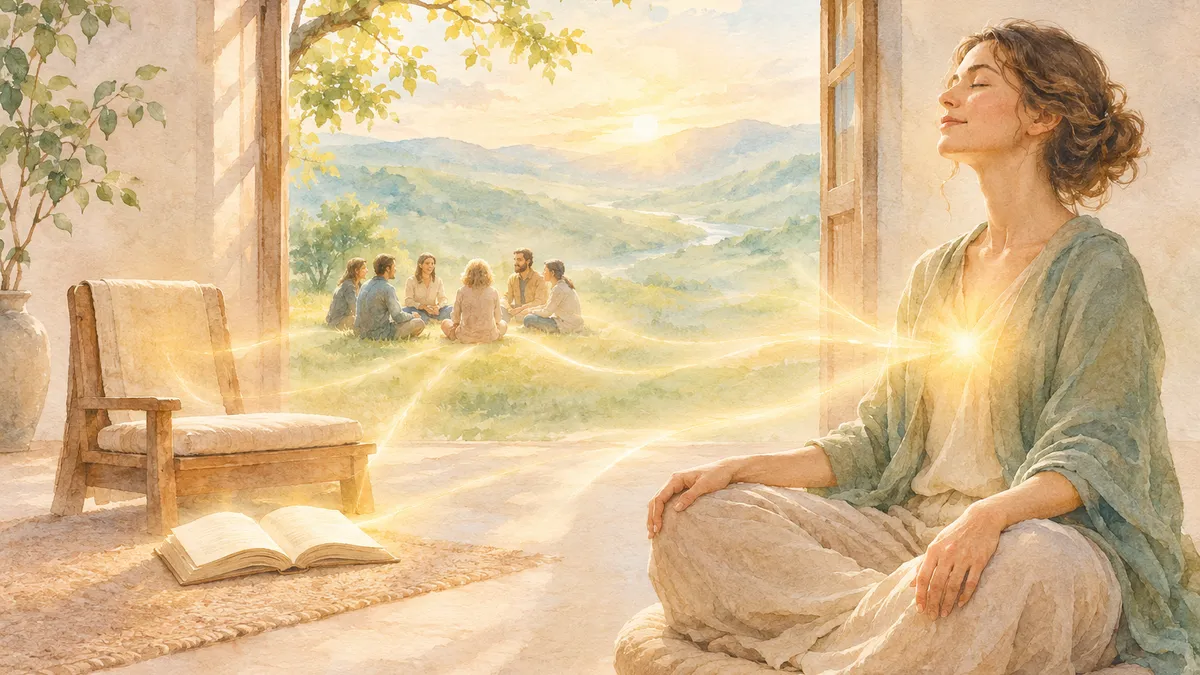
At first, of course, we take Refuge at the external level. At the external level, the Guru, Dharma, and sangha are quite material things. The Guru sits on a throne or walks around, the Dharma is presented in books and lectures, and the sangha sits here in Divya Loka. But gradually we understand that this is only the external level of Refuge.
Then we open the inner level of Refuge and understand that the essence of the Guru is the pure illusory body of Bhagavan Dattatreya—Bhagavan Dattatreya himself. Dharma is awareness beyond concepts. The path of contemplation is subtle methods. And the sangha is a divine assembly, a sacred field in which awakening takes place. Ultimately, we discover them all within ourselves. We understand that the Satguru within us is our very own self, our divine space. All of this is within us.
Dharma is our awareness, our understanding. Sangha is the entire universe, the whole boundless universe of the five elements, which is part of our consciousness. Then, from Refuge in the Guru, Dharma, and Sangha, we come to the realization of the Absolute in the form of Sat, Chit, and Ananda.
The Guru is Sat within us, the boundless space of nonduality. Dharma is Chit, our knowledge and understanding. Ananda is our boundless, unobstructed energy of bliss, when we unite with the entire universe and recognize the elements and the whole universe as inseparable from our consciousness.
Ultimately, it turns out that by taking Refuge, we take refuge in Absolute Truth itself. The Refuge of the basis is Sat Chit Ananda, it is Parabrahman. The Refuge of the path is the Guru, Dharma, and sangha. And the Refuge of the fruit, that is, the result, is our three realized bodies — jnana-deha, pranav-deha, and siddha-deha (the body of wisdom, the divine illusory body in the form of the ishta-devata, and the manifested transformed body).
But if you enter the state of no-mind, then, of course, you will have none of these concepts there. You will experience it, but you do not need to think about it.
