

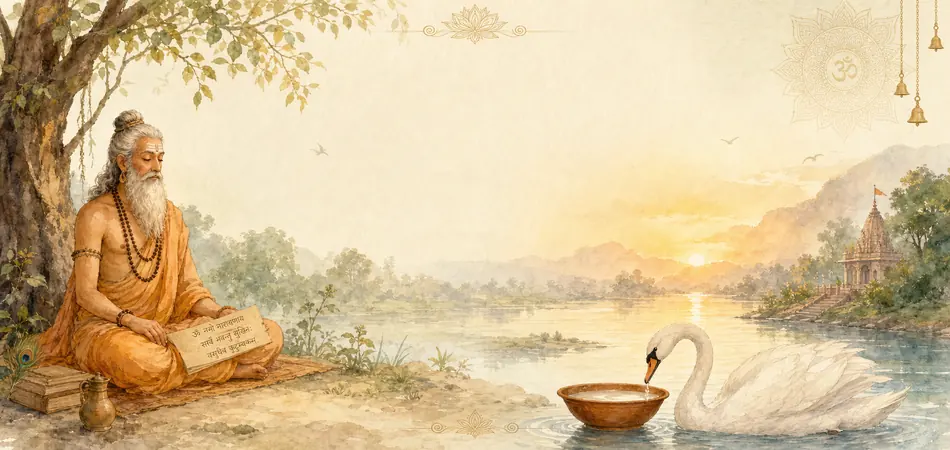
Commentary on the text “Yoga Vasistha.” On the State of the Enlightened Yogi
“Firmly established in consciousness, unshakable like a statue, he is not disturbed by the sense objects. The ‘I’ and the world, time and space, knowledge and nothingness—all this, although it may continue to exist, is not perceived by one who knows the truth. One should pay homage to the sun in human form, whose consciousness is free from rajas (restless energy or impurity), who has gone beyond even purity, or sattva, and in whom the darkness of ignorance is completely absent. This is the state of one who has transcended all divisions, whose mind has become no-mind beyond all description.”
Such a yogi is compared to the sun because he illuminates everything around him through the power of his mind.
The saint Shuka attained jnana at the age of sixteen. He was so indifferent to the world that he renounced everything completely, lived in the forest as a sannyasin-avadhuta, and walked naked. Even when he passed by girls who were bathing, the girls were not embarrassed by him. They perceived him as: “Oh, this is Shuka.” For them, he was something in between, neutral; that is, they had absolutely no attitude toward him. They did not perceive him as a person at all, and he did not perceive them either, since he was completely indifferent. But when Vyasa, Shuka’s father, came by and happened to notice the girls, they became frightened, took their clothes, and hid. He was surprised:
—It is strange: my son passed by, and you paid no attention to him, but when I passed by, you became frightened of me.
The girls said:
—Shuka is so holy that we cannot even perceive him as a human being, whereas you are still a human being to us, a man whom we regard as male, and therefore we feel embarrassed.

For such a yogi, established in nonduality, there are no human delusions based on the illusory concept “I am the body.”
“God is not far away and is not inaccessible. One’s own enlightened consciousness is God. All objects arise from it and everything returns to it. All things and objects constantly worship it through their own various methods available to them. Consciousness, worshipped in this way in different forms, birth after birth, sends a messenger for inner awakening and enlightenment. This messenger of consciousness is wisdom (viveka).”
A very important point: “This messenger of consciousness is wisdom (viveka).” Not simply wisdom, but discriminating wisdom.
The Teaching of Discriminating Wisdom
Today’s lecture will be devoted to the teaching of discriminating wisdom. This teaching is called “Viveka Chintamani,” or the teaching of the twenty-four recognitions.
We are bound by three types of karma, five sheaths, and sixteen knots of ignorance. This is what we have as our given condition. The task of spiritual practice on the path to liberation is to untie the sixteen knots of ignorance. But with what will we untie these knots? We must untie them with the help of viveka—discriminating wisdom. The teaching of the twenty-four recognitions is the theoretical essence of prajna-yantra.
Many people, engaging in self-inquiry, say something like: “I investigated the nature of Mind and found nothing there.” They think: “Since I do not exist, I can relax.”
But this is not entirely so. The result of contemplation and self-inquiry should be the emergence of twenty-four types of viveka. Of course, this classification exists only for the convenience of explanation, and viveka can take countless forms; nevertheless, the result of self-inquiry and contemplation should be discriminating wisdom. It is precisely with the help of this discriminating wisdom that we untie the sixteen knots of ignorance, separating the essence of the “I” from that which is not this “I,” just as a swan separates milk from water.
Twenty-Four Types of Discriminating Wisdom
1. Recognizing the mind as emptiness (shunyata)
The method for this is analytical meditation first, followed by the meditation of mahashanti. The experience of recognizing the mind as empty is the realization of the fifth and sixth dhyanas—an infinite space containing no objects.

2. Recognizing the mind as self-born spontaneous wisdom (sahajata)
The result of such recognition is understanding the mind as something that is born by itself, that is spontaneous, requiring no effort or attainment, as something that existed even before our birth, as something that should not be purified or attained, but rather known and recognized. This is similar to how a sculpture of a deity is originally contained within a block of marble; it already exists, and one simply needs to remove everything superfluous from the piece of marble and recognize it.

3. Recognizing the mind as space, as an all-pervading essence
The fundamental practice here is shambhavi mudra. As a result, inner and outer space merge, and we recognize our mind as having no point, center, or boundaries, having no localization. If a yogin wishes to realize this type of viveka, space becomes the object of concentration for them.

4. Recognizing the nature of the Mind as distinct from the five great elements and as the source of the five wisdoms
In its essence, our mind is neither earth, nor water, nor fire, nor air, nor space, yet at the same time it is their source. And when the fullness of recognition encompasses these elements, five wisdoms are recognized within the five elements. The main method here is shambhavi mudra combined with the five tattvas, that is, when, while contemplating, we unite presence with the earth element, the water element, and so on. It also involves integration with the five external gross mahabhutas (great elements).
The signs of realizing this wisdom are recognizing the five pure spaces within one’s body, having darshans of the five deities associated with these wisdoms, being able to unite with the external elements (mahabhutas), and controlling them to some extent.
For example, if you want to strengthen earth and water in this place, by integrating with them, you can invoke and strengthen them. And if you wish to change the element of space and the element of air, then through the power of integration, using emanation, absorption, and abiding in unity, you can change them.

5. Recognizing the essence of the “I” as distinct from the three states: jagrat, svapna, and sushupti
Through discriminating wisdom, one must recognize the wisdom of sahajata as distinct from the waking state, dream sleep, and dreamless sleep, and establish oneself in the fourth state—the turiya. The methods here are all three lines of the prajna-yantra, as well as dream yoga. The signs of realization are the penetration of awareness into the subtle body, the penetration of awareness into the infinite body of wisdom (jnana-deha), and the presence of an observer capable of separating itself from these three types of consciousness while abiding in the fourth.

6. Recognizing the mind as distinct from the five sheaths (koshas)
Through discriminating wisdom, we come to understand that the primordial observer, the witness of awareness, is separate from the body, separate from the pranamaya kosha (the energy body), separate from the astral body (manomaya kosha), separate from the mental body (vijnanamaya kosha), and even separate from the causal body (anandamaya kosha). It is as though we keep separating our subtle essence from all the sheaths. It is in fact separate from all five sheaths, and understanding this separateness is what discriminating wisdom is.
Its result is the realization of the state of Aham Brahmasmi and the elimination of essential ignorance, which is expressed by the formula aham dehasmi (“I am this body”), as well as freedom from the need to seek a new body for oneself in the next life.
It is precisely due to the absence of this discernment that a mental body is generated in living beings in the intermediate state. The being has left the body (has died), but the power of its mind is such that it instantly visualizes a new, mental body. It can feed on smells, travel by teleportation (simply through the power of the mind), pass through walls, and see spirits related by vibration. But because it has a strong identification, it seeks gross experience and incarnates again. When this type of viveka is realized, there is no longer any need to create such a body. It is either not created or is created in a controlled manner, at will.

7. Recognizing the mind as distinct from the three gunas of material nature and as the source of the three universal forces
The essential nature of the mind is separated from rajas, tamas, and sattva through the sankalpa of a single “flavor.” When all three gunas merge into one and we enter the state of the observer beyond the three gunas, such recognition takes place. In spiritual experience, this is experienced as the perception of three kinds of space and three kinds of color: white, red, and black. When these three colors are seen with spiritual vision and the yogin can separate their consciousness from them, they become free from perceiving the three gunas as part of themselves.

8. Recognizing the mind as unity, free from multiplicity
Multiplicity is a form of delusion. When wisdom arises as a result of awareness, we awaken to the perception of a single consciousness that permeates everything. We see that multiplicity is a fiction. It is like a mirror containing many diverse objects, while none of them exist in themselves; only the mirror that reflects them exists. Understanding unity as reality and multiplicity as maya, illusion, unreality, is the essence of this recognition. A sign of the realization of this viveka is a stable state of a single “flavor,” nonattachment, and detachment from one’s own evaluations and judgments.

9. Recognizing the principle of a single “flavor” (samarasya) of all phenomena
When the recognition of unity deepens and extends to the diversity of all phenomena, samarasya is realized as the complete unity of everything: time (past, present, and future), inner and outer space, pure and impure, upper and lower, right and left, hot and cold, what one likes and dislikes, worldly and sacred, divine and demonic. A single “flavor” arises as a consequence of discriminating wisdom. When discriminating wisdom is absent, there is no single “flavor” either, because consciousness becomes clouded.
For example, there is the dual category of birth and death. Why do birth and death exist for us? Because we do not discern; we do not really know what birth and life are, or what death is. They seem very different to us. We are drawn to life, and as a result, birth and death affect us.
But consider this example. A person is walking and carrying another person on their shoulders, but from a distance you cannot see that there are two people; it seems to you that one person is walking. The first moment, when it seemed to you that one person was walking, is like birth: the concept “A tall person is walking” was born in you. But as you came closer, you saw that there were two people, one carrying the other on their shoulders. That is, when these people approached you, your first deceptive perception disappeared, died. If someone asked, “Did this tall person disappear? Where did he go, then?” you would, of course, laugh. You would say, “There was no single tall person; from the beginning, there were two people: one carrying the other on his shoulders. I was simply mistaken; I saw it incorrectly.”
The same applies to birth and death: we simply do not see them correctly. Discerning wisdom means “seeing in this way.” That is, from the very beginning you see that there was not one tall person, but two: one on the other’s shoulders. It is all deception, an illusion.

10. Viveka as the principle of divine pride, divinity (divya-bhava)
As a result of discernment, we discover divine glory and divine pride as the essence of the nature of mind. When it unfolds within you, your vision is naturally purified.

11. Recognizing the mind as the principle of primordial perfection and purity
This recognition is connected with the fact that when you contemplate, you recognize the nature of mind as the essence of pure vision. Pure vision naturally arises within you. The source of this pure vision is the very nature of mind, which you recognize in everything. And since the nature of mind is pure in itself, it purifies everything with which it comes into contact. The sign of realization of this discerning wisdom is the elimination of impure vision at its root. You cannot allow impure vision toward anything whatsoever, even for a moment.

12. Recognizing the mind as luminosity illuminating all phenomena
The sign here is the experience of light in samadhi, in dreamless sleep, and in meditation. The way to achieve this is through the sankalpa “light,” Mahashanti meditation, and everything that turns the mind toward its nature, especially Jyoti Yoga and the yoga of dreamless sleep.

13. Recognizing the mind as a non-conceptual entity
Here, discernment arises that the mind is not bound by concepts and logic. The result of the practice is independence from all logical judgments, the liberation of the mind from all concepts. The sign here is that, when tested according to the teaching of the 16 kalas, you can give the correct answer to a paradoxical question. This means that you have realized this wisdom (although the correct answer is at approximately the level from “conception” to “gestation”).

14. Recognizing the mind as apprehending clarity illuminating all directions
The sign that you have realized this wisdom is your clarity, for example: the ability to understand texts, the ability to express your thoughts well, to write, to use the mind and apply it in any field.

15. Recognizing the nature of mind as unsupported, self-sustaining space (niralambha)
When you realize this kind of discernment, it is as if an understanding of the essence of all phenomena arises within you. You no longer seek support in anything except awareness itself, which is unsupported. The sign of realization of this viveka is non-attachment to anything whatsoever.

16. Recognizing the essence of mind as a view beyond the extremes of eternalism and nihilism
When a person uses the mind, they may sometimes think: “What exactly is it? Perhaps it has some color, shape, or quality?” And they try to seek it as some kind of substance and even project their desires onto it. They may think: “If I see gods, then I will definitely believe that I have recognized my mind. Or if I suddenly see some unusual patches of light. Perhaps rainbows will appear above me. Something like that must surely manifest. And these will be signs of realizing the nature of the mind.” They may have such external notions of the mind’s materiality and substantiality. Or if they have searched deeply for the mind and have ceased to perceive anything at all, they may think: “In fact, there is nothing at all, and there is no such thing as the mind, and I do not exist, and there is no will. Nothing exists.” That is, they may fall into the opposite extreme—nihilism. And since nothing exists, they experience an essential dissolution, an essential loss of the capacity to act.
But here it is said that, as a result of such wisdom, our view is free from the extremes of both eternalism and nihilism. When a person thinks that absolutely nothing exists, they can be asked: “Then what moves your arms and legs? What makes you search for this? What lives within you?” This cannot be called merely one-sided emptiness. It is emptiness in the sense that it has no qualitative characteristics: the gunas of material nature, light, taste, or smell. But in other respects, it can also be called fullness. This fullness is simply unrelated to our human perception.

17. Recognizing the mind as the principle of non-doing pervading all actions
The method here is to unite presence with movement. The sign of realization is the fact that you have learned to contemplate while moving, understood the principle of action in non-doing, made the great decision, and established yourself in it. Actions no longer bind or constrain you.

18. Recognizing the nature of the mind as independent of time and as the source of time
The method here consists of analytical meditations on intervals of time, analyzing the location of objects in time, and samyama. The sign of realization here is a clear experience of the three forms of time—past, present, and future—as arising from a single source, as well as the siddhi of manipulating the flow of time, for example, the ability to transfer one’s consciousness to realms where time moves differently.

19. Recognizing the mind as independent of space and as the source of space
The method here is shambhavi mudra. The sign of realization is the experience of the wisdom of the blue-colored element of space and the ability to alter space.

20. Recognizing the mind as that which is neither born nor dies
The method here is integration with cause and effect. A yogin who has realized this kind of wisdom understands parasatarka logic and masters sankalpa-vidya. A sign of realization is also a true understanding of Vasistha’s teaching on the instantaneous creation of the universe, a clear vision of how cause is connected with effect, the ability to create new causes and effects, an understanding of the principle of will as a passionate force (shakti) that can influence causes and effects, and the equalization of causes and effects—that is, when there is a single “taste” of causes and effects, or circular causality according to the principle that “the tail wags the dog.”
If, in a state of duality, a cause rigidly generates an effect, then when this wisdom is realized, it becomes clear that the effect can influence the cause—for example, the present can influence the past; that everything depends on passionate will; and that an effect may generate any cause or not generate one at all. Complete freedom from the law of karma arises as a result of understanding the theory of instantaneous creation and Vasishtha’s assertion that a cause is related to its effect in the same way as a crow taking flight from a palm tree is related to a coconut that happens to fall at that very moment.

21. Recognizing the nature of the mind as the essence of the five sense faculties, mind, and intellect (indriyas, manas, and buddhi).
The method here is atma-vichara and analytical meditations. When this type of viveka is realized, the mind unites with the five perceptions: sight, hearing, smell, and touch. You can integrate with any sensory experiences of the five elements. Any sensory experience you have is recognized. Behind all five jnana-indriyas, behind the mind and buddhi, the natural state is recognized.

22. Recognizing the mind as the source of the triad that generates samsara: subject, object, and perception.
As a result of this type of clarity, the yogin clearly understands the interaction of the three elements of which samsara consists: the subject, the object, and the process of perception. He sees the subject as emptiness, sees the object as emptiness, and sees the process of interacting with them as the play of two emptinesses, itself also empty at its very basis.

23. Recognizing the nature of the mind as the effective cause and means of self-liberation, bestowing the three enlightened bodies.
This aspect of wisdom is connected with truly trusting the nature of the mind. We recognize the natural state and see that it is a means of self-liberation. Until we have given rise to this type of viveka, we cannot fully make use of natural wisdom; we need various auxiliary methods. But at this stage, natural wisdom itself gives rise to the three bodies of realization, and we truly enter anupaya—that is, a state beyond method, the yoga of non-method, the yoga of non-meditation. We can realize the three awakened bodies only through non-meditation and non-method.
One yogin meditated for a long time on retreat in the mountains, and experiences began to arise in him: clairvoyance, memories of past lives, and so on. When he came to his teacher and told him about this, hoping to be praised, the teacher said:
— What a pity!
The surprised yogin asked the teacher:
— What is the matter? What is wrong?
The teacher replied:
— You sit and meditate from morning until evening, and the more you meditate, the more different experiences you have. But I would recommend that you stop meditating and remain beyond meditation. Enough—you have meditated sufficiently. Now learn to abide in the yoga of non-meditation.
This yogin, being an advanced meditator, very reluctantly agreed to such a proposal. For six months he became accustomed not to meditate, but simply to remain in the ordinary state, abiding in contemplation. But when he learned to do this, he thanked his teacher, because only at this stage did he truly understand the principle of the natural state. Before that, he had simply been a good meditator, of whom there are many, but there are only a few jnanis throughout the world who are established in natural contemplation; they are indeed very rarely encountered.
When we realize this kind of wisdom, we understand that the effective cause is the natural mind. This is the means of self-liberation. And here the key point is sahaja-spanda. Sahaja-spanda means that the natural mind is active; it is not frozen, there is no vagueness in it, there is progress in it, and the luminous clarity of sahaja is constantly moving forward, spreading and deepening. And when discriminating wisdom has grasped sahaja-spanda, it truly benefits from it. It is not enough to gaze into space in shambhavi-mudra, calm the mind a little, enter serenity, and move forward majestically and with concentration. Sahaja-spanda means that we have become established in the understanding of the natural mind, and this natural mind begins to shine like the sun: it generates its rays, and gradually sublimation takes place—the union with the pranas and with any experiences.

24. Recognizing the mind as the Absolute, whose essence is sat-chit-ananda.
This is the apotheosis, the peak, the culmination of discriminating wisdom, when we have passed through the stage of self-liberation and self-transcendence and entered pratyabhijna (self-recognition). Here we no longer need to recognize particulars; instead, we immediately recognize the mind as Brahman, as the Absolute, inherently possessing all aspects. The essence of the absolute mind is being-consciousness-bliss.
Being (sat) can be defined as jnana, as vision, the principle of meaning. Consciousness (chit) can be defined as chitta, as the source of the pranava-deha. Bliss (ananda) can be defined as lila, as chit-shakti-vilasa, the play of energy filled with ecstatic bliss, the source of the siddha-deha (the third body). Recognizing the mind as the Absolute arises as a result of the deepest discriminating wisdom, which is capable of penetrating into the fourth state—turiya.

Thus, the teaching on the twenty-four recognitions, or the twenty-four types of viveka (“Viveka Chintamani”), shows by what means we liberate ourselves from samsara.
When you are asked, “What is the mind? What is liberation?”, you can say: “It is the twenty-four types of understanding the mind.”
It is precisely through these twenty-four types of understanding that we must untie the sixteen knots of ignorance: free ourselves from the five koshas, the three gunas, the five elements, and the three types of karma. This is like having twenty-four types of magical weapons that you use in different situations.
