

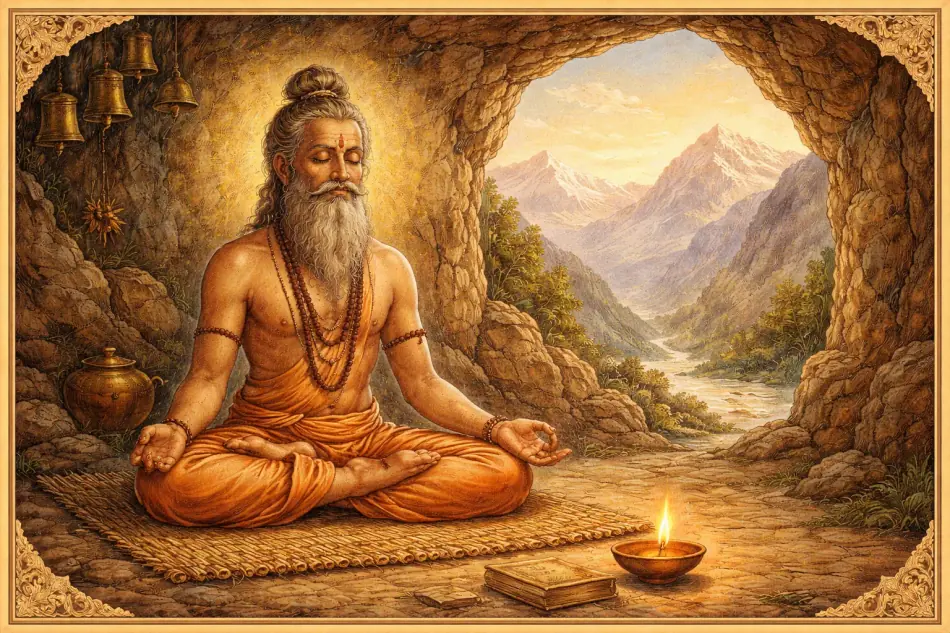
There are different levels of samadhi.
The first and lowest is savikalpa samadhi. If you can remain with the mind stilled for twenty-nine minutes and enter the first dhyana in calm-abiding meditation, you will experience the beginning of savikalpa samadhi. If you can sit motionless for five hours in calm-abiding meditation, your breathing stops and your body remains still, then you can enter the samadhi of the third dhyana; this is also savikalpa samadhi. Your subtle body or mind will move to one of the worlds of the gods, or, if your karma is impure, to the human world. In savikalpa samadhi, there are modifications of the mind. When you overcome the third and fourth dhyanas and move into the fifth or sixth dhyana during calm-abiding meditation, you can enter the world of the formless gods and feel as though consciousness is expanding to infinity, with no sense of the body. The samadhi of the formless gods is the domain of experienced meditators who have meditated for a long time.
When the highest levels of the formless gods have been passed through, nirvikalpa samadhi is attained—the samadhi in which there are no distinctions or modifications, but only pure emptiness is experienced. Attaining this level is already a great achievement characteristic of experienced meditators. However, this achievement in itself is not the ultimate goal, because even after attaining such a level of samadhi, a person may lose the attainment upon emerging from it.
Sahaja Samadhi — a single “taste”
The true single “taste” arises at the level where two kinds of samadhi—sahaja samadhi and nirvikalpa samadhi—are combined, when the state of meditation and non-meditation during the post-meditative period become equal; that is, presence and illuminating emptiness are maintained both in ordinary activity and in seated calm-abiding meditation. This state of sahaja samadhi is also called “the samadhi of the flowing river,” a term that is often used.
In other words, we can walk, talk, eat, drink, and act, yet remain deeply immersed in the natural state. Such a yogin is very flexible; he does not live but flows with the river, simply responding to events. He does not plan the future, cling to the past, pass judgments, or make assessments: “this is bad,” “this is good,” “this is right,” “this is wrong.” He constantly abides in the paradoxical, the inconceivable, the infinite, the non-mental, the beyond-thought. His point of consciousness is situated in this paradoxical, beyond-thought plane.
He does not block thoughts or feelings; he can think, make decisions, and exert his will, yet all of this is like a game, beginning on the lower planes of consciousness, while his essential point of consciousness remains in clear light. One could say that during his lifetime he abides in dreamless sleep. Even when he acts, his brain waves resemble those of a person in deep sleep. This is the principle of sahaja samadhi.
He is situated at the point where there are no disturbances or fluctuations. At the periphery of his consciousness, thoughts arise and instantly self-liberate. His experience does not take shape. Just as snowflakes fall into the ocean, thoughts, sensory impressions, and dualistic judgments do not settle in his mind but dissolve immediately. When he falls asleep after his activities, his mind instantly enters the realm of clear light. Such a person acts spontaneously, proceeding from intuitive consciousness. He is resourceful yet unattached; his mind is highly flexible, clear, and luminous. It is as though he constantly balances between two worlds without grasping onto either of them.
Such is the principle of sahaja samadhi.
