

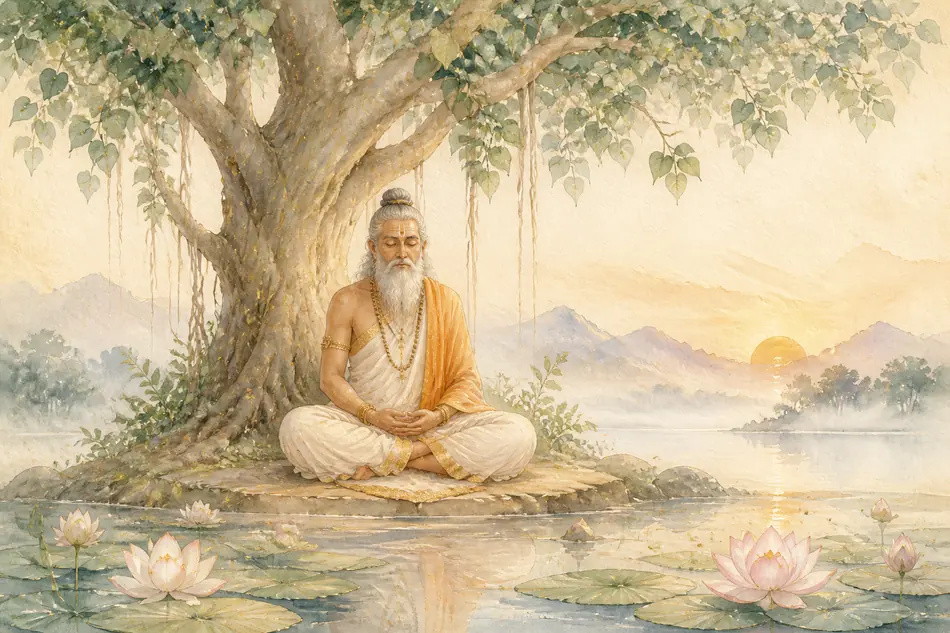
I would like to begin by paying homage to the saints of the Vedic tradition, to Avadhuta Dattatreya, and to my Guru, Swami Brahmananda Maharaj. The place where saints, teachers, and disciples gather is a place where the divine powers of enlightenment descend. It is said that spiritual transformation is possible in such a place.
Spiritual transformation occurs under certain conditions. It is possible when a rare combination of factors comes together: the qualities of the teacher, the qualities of the disciple, the place, the time, favorable circumstances, the transmission of the Dharma, and favorable karma. When all these factors come together, the process of spiritual transformation becomes possible. If these qualities are absent, spiritual transformation is impossible.
Therefore, we must always appreciate the opportunity to communicate in this way, to have certain places in Russia, to associate with teachers and disciples, and to engage in spiritual practice. For example, thirty or fifteen years ago, it would have been difficult to imagine anything like this; in 1978 or 1984, very few people could have imagined it, and no one would have understood you. Now this opportunity exists; the situation is changing, and changing for the better, and we must always cherish the opportunity to practice the Dharma, because the Teaching is very precious.
There were times when Vedic knowledge tried to descend to Earth, but it could not manifest due to certain circumstances. We are transmitters of the Vedic tradition, which means that we follow the Teaching of the ancient Vedas. This tradition is also called Sanatana Dharma. It is universal knowledge; it has no founder and no date of birth, only followers—Buddha, Christ, Allah, and others; they all belong to this great tradition.
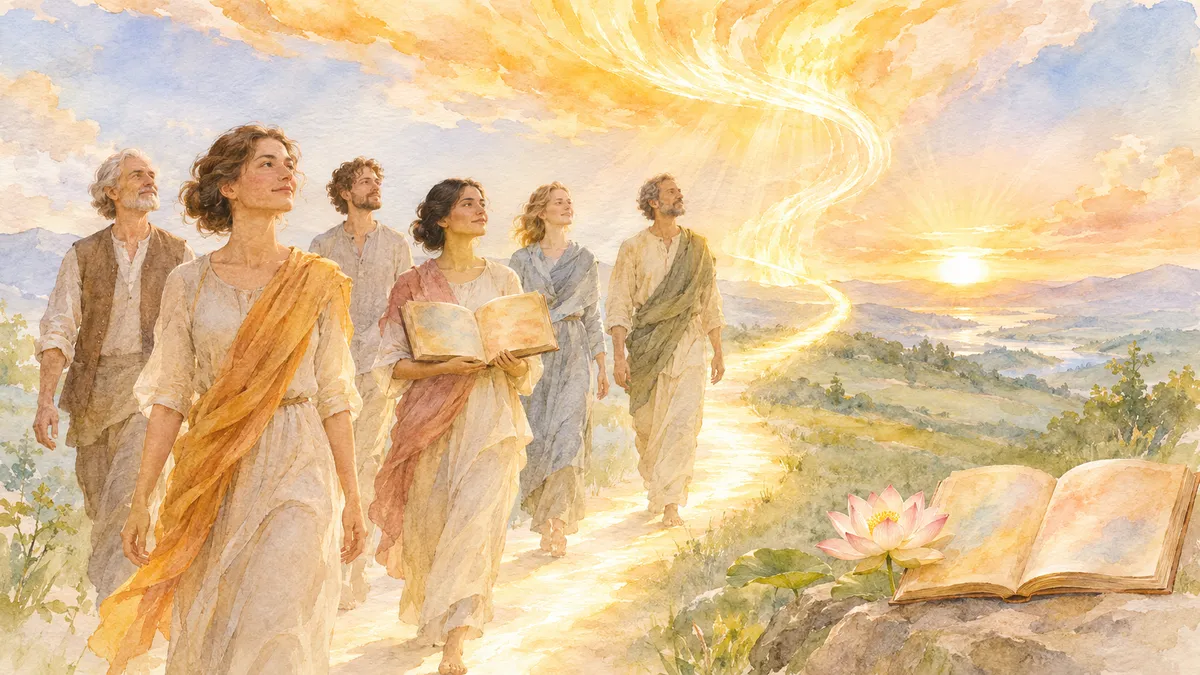
The Story of the First Descent of the Vedas
There came a time when God Vishnu decided to create the Vedas, the Vedic knowledge. Having created the Vedas, he brought them forth from himself and embodied this knowledge in the form of four youths, the Kumara boys. Then he summoned Brahma, the Creator of our Universe, and said, “I entrust you with transmitting this knowledge to Earth so that humanity may attain enlightenment and become free from ignorance.” Brahma placed these four embodied Vedas in the center of his lotus and said, “I must examine the situation on Earth and see whether humanity is ready to receive this knowledge; in the meantime, remain here.”
At that time there lived the rishi Kashyapa, one of the progenitors of our civilization and founders of humanity, who protected people and ensured that humanity developed and evolved. He had three wives—Diti, Aditi, and Danu. Aditi gave birth to divine beings, the devatas, who possessed the radiance of sattva, while Diti and Danu gave birth to asuras and rakshasas, and everything went wrong with them. Kashyapa was displeased by this and worried that Aditi bore excellent, divine children, while Diti and Danu bore non-divine children who were constantly getting into trouble and possessed negative qualities.
One day, Diti had a son named Hayagriva because his head resembled that of a horse. He possessed great mystical powers, as well as intense jealousy and envy toward humanity. He said, “As long as I live, I will not allow Vedic knowledge to reach people. I want to exalt our asuric race, and we will conquer not only Earth but the entire Universe. I will make sure of this; I will do everything in my power to prevent Vedic knowledge from reaching people. Humans are base, unworthy beings.”
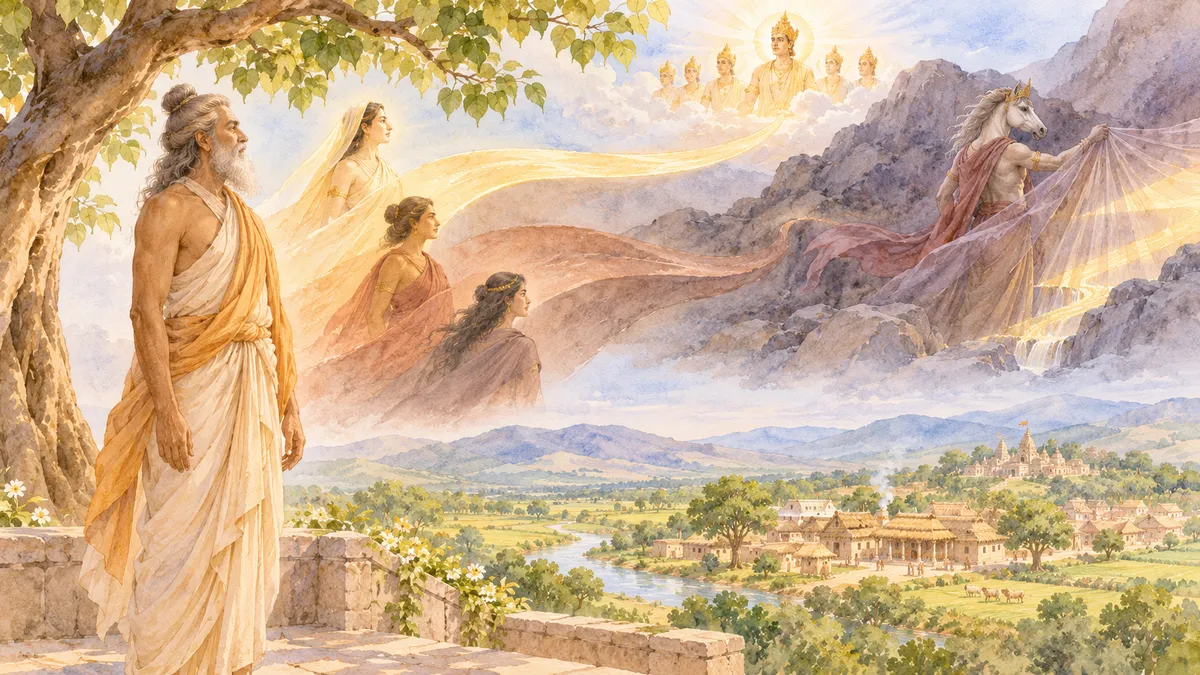
Therefore, when he learned that Brahma kept the Vedas at the center of his lotus, he used his ability to fly through the universe and first ordered his assistants to take the Vedas away from Brahma. At that time, Brahma had gone to seek Shiva’s advice. He pondered for a long time how to bring the Vedas down to earth. When he considered the state of human life, he did not find it very pleasing. There was strife, war, and corruption among people. Human beings possessed base qualities. He thought, “How can I transmit Vedic knowledge to people? Humanity’s karma must be purified.” The thought occurred to him that humanity should be destroyed and a new humanity created. He went to Mount Kailash to seek Shiva’s advice. As they discussed this, Shiva said, “Why destroy all of humanity? You can simply bring about a small flood. Humanity’s sinful karma will be washed away by this flood, most people will survive, and you will transmit the Vedas to them.”
Since Brahma greatly respected Shiva’s opinion, he said that he would do so. But something had to be done to purify humanity’s karma, because it is impossible to bring new knowledge into minds and hearts filled with vice and impure perception. Vishnu’s command had to be carried out.
The Abduction of the Vedas and the Matsya Avatar
It was then decided to bring about a small flood, so that impure karma would depart with the waters while most people remained. While Brahma was occupied, Hayagriva arranged for the four Vedas to be abducted from Brahma’s lotus. At first, he sent his assistants, but they could not even approach it, because Brahma’s lotus had been created from purity. They could not even enter, and all of them perished. These were pure energies that protected the Vedas.
Then he went himself, but he too was unable to overcome them. Through cunning and deception, performing various tricks and transforming his body into different forms, he lured away the Vedic knowledge embodied by four young men who carried this knowledge within themselves. The four Vedas—the Rig Veda, Sama Veda, Yajur Veda, and Atharva Veda—contained the knowledge in a condensed form. Hayagriva asked them to leave the lotus, saying, “Brahma has deceived you. He has no intention of transmitting knowledge to people and will not let you descend to earth. He wants to possess the knowledge alone; you will be his slaves, bound to serve him.” Since the young men were inexperienced, he tempted them to leave that realm of purity. They stepped beyond the lotus, and he mystically transported them to his asuric realm and imprisoned them in a dungeon.
When Brahma returned, he saw that the Vedas had disappeared and the knowledge had been stolen. Hayagriva declared, “Now the mystical knowledge is in my possession. People do not need it; they will never receive it. As long as I possess mystical knowledge, I will control the situation, and my might and power will continue to grow.”
At that time, Vishnu learned what had happened. He saw that Brahma was helpless and that the Vedas had been abducted and held captive. He then incarnated as Matsya—a mythical, divine fish—destroyed Hayagriva, and liberated the Vedic knowledge. But after assessing the situation on earth, he thought that the time had clearly not yet come. He said to the young men embodying the Vedas, “For now, there is no possibility for you to manifest on earth; the time is not right.” He transformed these boys into the word OM, inhaled that word OM, and dissolved it within himself. Since they were part of him, he absorbed them back into himself. Vishnu concluded that, due to certain circumstances and obstacles, it was still too early for humanity to receive this knowledge.
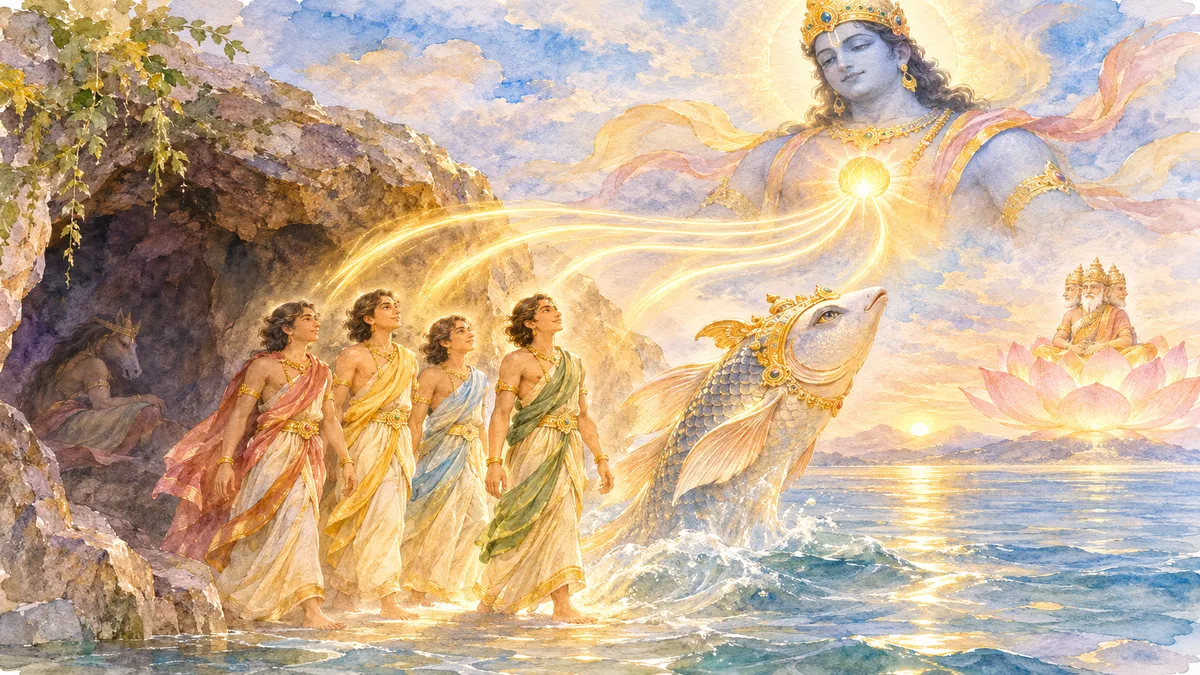
Thus, the first attempt to transmit the Vedas to the human world was unsuccessful; difficulties and obstacles arose. People did not possess sufficient qualities, and there were asuras who wanted to seize the knowledge. In fact, the threat of humanity’s total destruction arose because Brahma had become disappointed in human qualities. This is the story of Vishnu’s first avatar, in the form of the enormous fish Matsya.
The Jewel of Auspicious Timing
Likewise, when knowledge descends from divine beings, favorable conditions for this do not always exist. And when these conditions do arise, it means that favorable karma has ripened. This is that precious moment, that opening between karmas, planetary influences, and the lilas—the plays of gods and asuras—when this ray of light can descend. This moment must be cherished, it must be seized; things were not always this way, nor will they always be.
Three hundred or five hundred years ago, we would not have been able to gather. Ivan the Terrible’s oprichniki would have quickly explained what should and should not be practiced. But now there is an opportunity. This means that it is precisely our karma, the karma of the present generation, that is favorable for receiving Vedic knowledge and following the culture of Vedic knowledge.
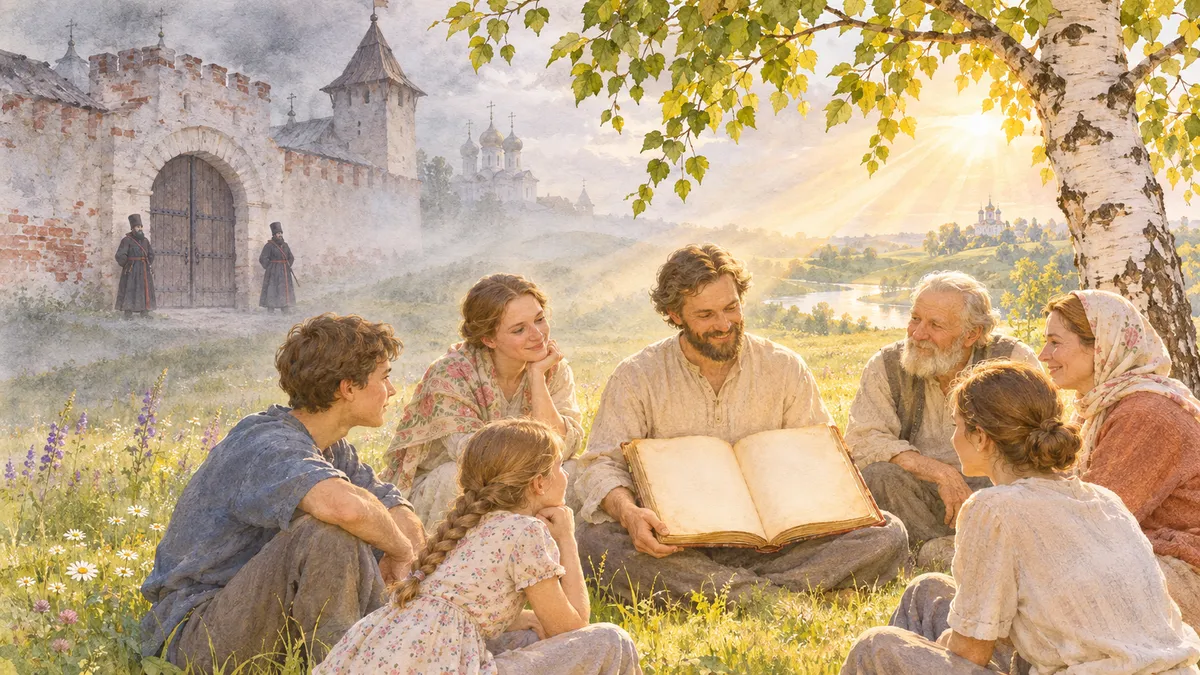
Moreover, many scholars and researchers have concluded that Vedic knowledge is intrinsic to the Russian people and has existed in these lands since ancient times. There is a great deal of research on this subject. There are scholars who are eager to fill Russian history with evidence of this. Vedic sources contain descriptions showing that the position of the sun corresponds not to Indian latitudes, but to polar latitudes. Extensive linguistic studies have also been conducted. In many villages, people sometimes speak Sanskrit; linguistic correspondences identical to the original Sanskrit are found.
Dharma as Meaning and Path
When we speak of Vedic dharma, this means, first and foremost, that our karmas allow it, and this is a precious opportunity. Why is Vedic knowledge so important to us? Our people have still not recovered from the post-communist shock—the years of perestroika, exile, and chaos from which our nation has not yet regained its footing. For seventy years, there was one great national idea: to build communism. Everyone, to the best of their ability, believed in it or tried to believe. When it collapsed, and all points of reference, meanings, values, ideals, and goals collapsed with it, our entire nation descended into the lower chakras. And it has still not risen from them.
The search for a national idea continues, but none has yet been found. Society still has no ideology; it does not know why or where it should go. For want of anything better, it offers an ideology of consumption. But this is the ideology of vaishyas and shudras, the ideology of the lower social classes, in which yogurt is advertised to us as something that gives life meaning. For a long time after perestroika, having no ideology whatsoever, our society fed on an impure spirit, criminal organizations, and corruption. And now it is very important for us to understand, both personally for each of us and collectively for us as a nation, which ideals we follow.
The years of communist ideology greatly frightened everyone. Many realized that an ideology can be totalitarian and restrictive, so many concluded that it was better to stay away from all ideals and values. But in reality, ideology is necessary; values are necessary. If a person has no ideals or values, then they have no meaning in life, no direction for development, either on an individual level or on the level of society.
Choosing a Spiritual Path and Sacred Texts
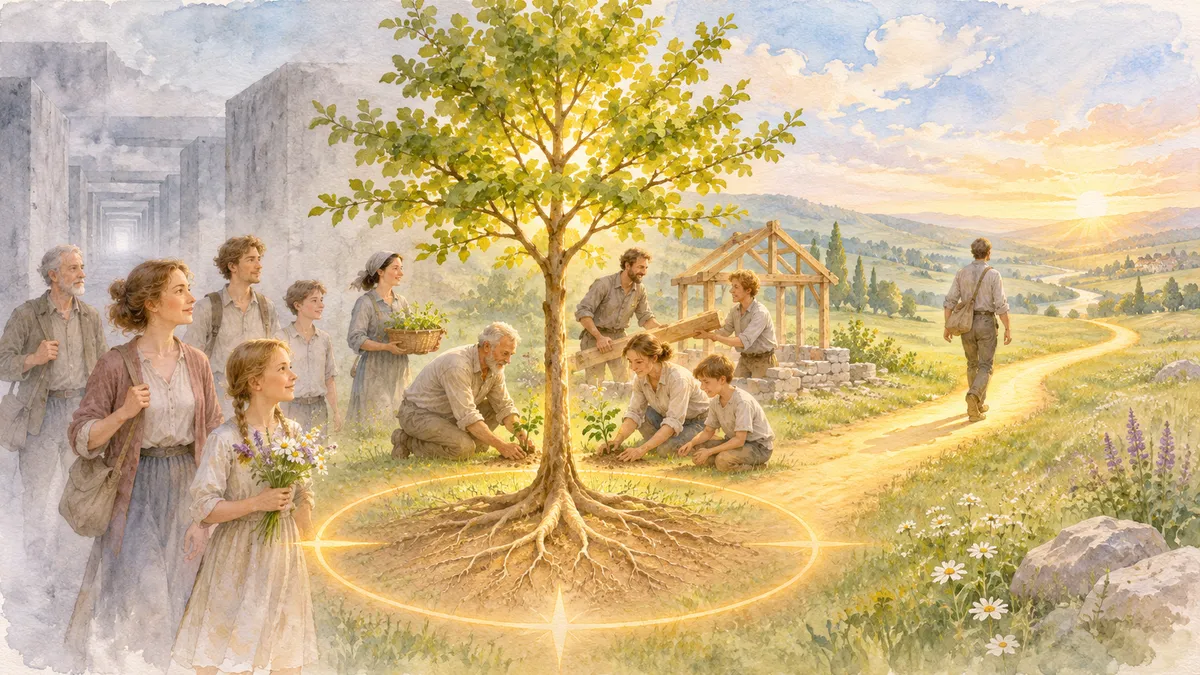
When we embark on the spiritual path, we explicitly declare that we follow certain values. Our entire future life—what we achieve, what our future will be like, and how we envision it—depends on the values we choose. The primary reason we need Vedic knowledge is personal and individual. Within each of us there is a divine essence. Regardless of what ideologies prevail or what era it is on earth, this is our personal concern, our development, and we need to resolve it for ourselves. The human being is an imperfect being who must grow into a new human being, a God-man. For a new human being, a God-man, to emerge, one must free oneself from the samsara within, from the egoistic, dualistic state. And the spiritual path helps one attain liberation and purify oneself.
The saints left behind various sacred texts, and through these sacred texts we can understand where we should go and how. In the Vedic tradition, sacred texts are usually described as non-human, that is, as having descended in the form of revelation—apaurusheya. This means that these texts were not created by people, even brilliant philosophers. They came down as divine revelations and are transmitted through the line of disciplic succession. Therefore, they are sacred and can be trusted. When we choose the spiritual path and the sacred texts descended from divine beings as our values, we direct the course of our lives very clearly in a particular direction.
There are many different points of view in the world, and when we choose spiritual values based on sacred texts as our priority, this too is a particular and very specific point of view. If we choose it, our entire future is also shaped in a particular way. Making a choice is very important. It is impossible to follow the spiritual path without making a choice. The spiritual path is always a choice. Great inner work must be done in order to follow the spiritual path.
Rishi Vasishtha's Teaching on Ignorance and Samsara
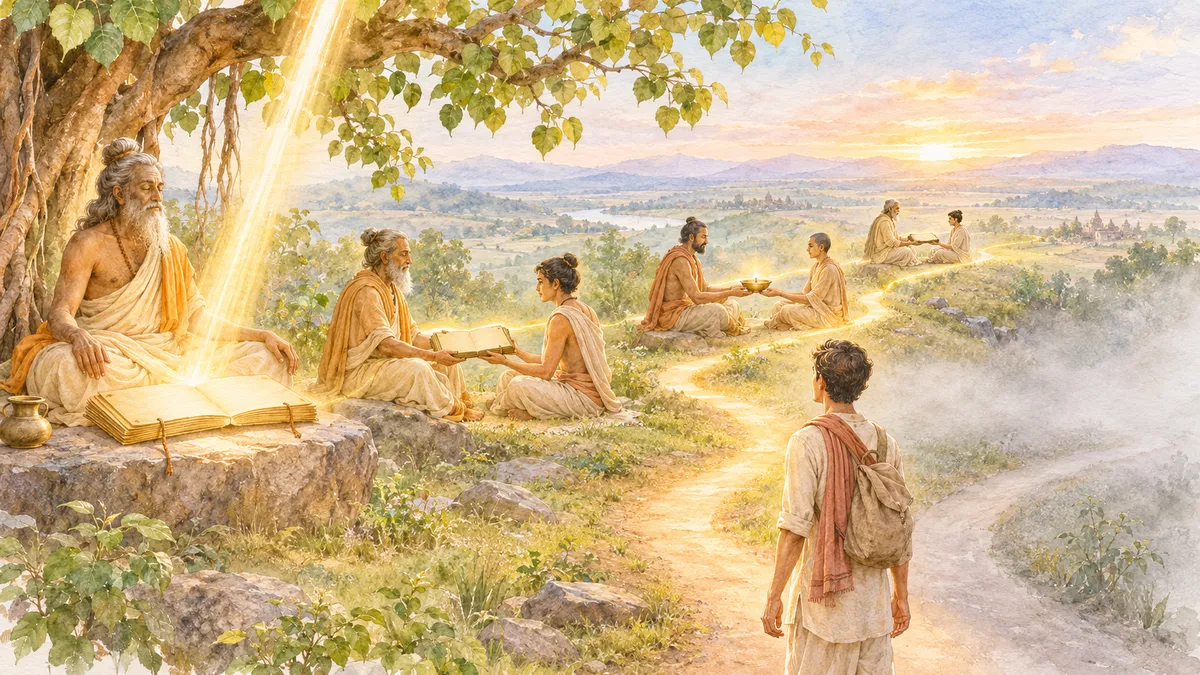
Our spiritual path is the path of enlightenment and liberation; it is the path of the saints, the rishis, Avadhuta Dattatreya, and Shankara. Rishi Vasishtha, one of the founders of the Universe, says:
“Only when there is no right understanding do false, ignorant notions arise in the heart, notions devoid of meaning. Confused by these notions arising in the absence of light—the light of knowledge—a person is constantly and ceaselessly tossed here and there, like a dry leaf in the wind.”
A person in the modern world does not fully understand who they are; they have misguided values, goals, and meanings, and when meanings, goals, and values are misguided, the path is misguided as well. Could anyone in their right mind permit advertisements for cigarettes and alcohol? Yet this happens. Why? Because 90% of people are confused, and commercial gain obscures meanings and values. Would anyone in their right mind display aggression or hatred, or wage wars? There is much ignorance and many mistakes because certain deep inner settings and meanings have not been clarified. A confused person lives their life unconsciously and leaves their body unconsciously; after leaving it, they are reborn unconsciously and receive a new body.
Over the course of a day, one hundred million sexual acts take place on Earth; one million of them result in conception, of which one hundred and fifty thousand end in abortion, while 850,000 result in births. And this happens every day. It is a vast whirlpool of souls—some souls die, while others incarnate and enter new bodies. Human life is a continuous rotation within this flow. To incarnate, find a mother's womb, be born, emerge from the womb, live a life and die, enter the subtle world in an unconscious state, find a new body again, incarnate again, be born, live a life, die once more, wander again through the subtle world in an unconscious state, receive a new body, incarnate again, be born, die, and so on without end. This is called the wheel of samsara, and this wheel turns continuously, drawing in millions, hundreds of millions, billions. Six billion human souls live on Earth, and only a few manage to break free from this wheel.
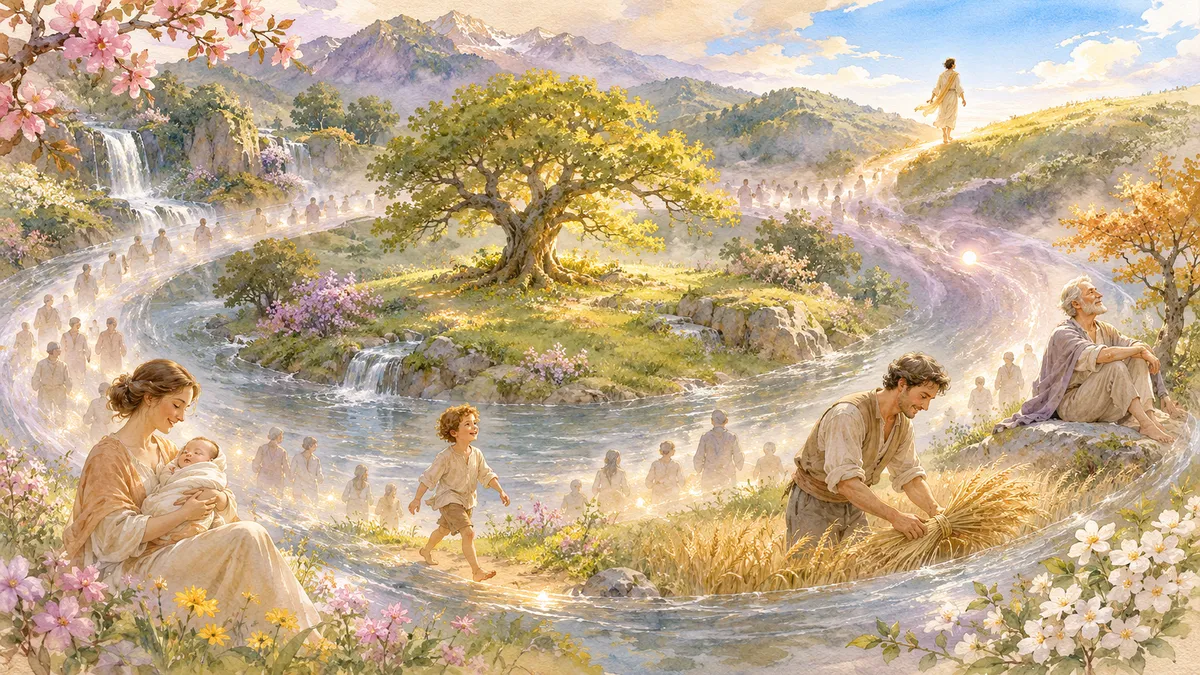
Why is it so difficult to break free from the wheel of samsara? There is avidya and vidya. How can the problem of avidya be solved, illusion dispelled, and freedom from the wheel of samsara attained? Jnana—wisdom, knowledge—is needed. One must discover wisdom.
The Nature of Consciousness and Vichara
Vasishtha says:
“In the absence of taste, jnana—that is, knowledge of reality—the senses strive to apprehend an object and, through ignorance, imagine that such contact with the object produces a sensation that means something.”
Ignorance is based on our constant concern that the senses continually need an object—an object of sight, hearing, smell, touch, or scent. But only in rare cases do the senses try to comprehend their source, their nature. Only rarely does the eye try to comprehend not its food, but the one who sees; only rarely does the faculty of smell try to comprehend the source that perceives odors.
When we turn toward the source and try to comprehend the one who comprehends, a process called vichara begins. Vichara is the foundation of Vedic knowledge. Neither rituals, nor asanas, nor worship, nor mantras—only vichara; all Vedic knowledge is built upon vichara. All other methods may fail; all other methods may be supplementary. Without vichara, no matter what you do, nothing will help you become free from samsara. Vichara is the most powerful.
Vasistha said: “Undoubtedly, infinite, eternal consciousness dwells in all of this. However, due to the absence of self-awareness, it appears not to understand itself and therefore seems limited.”
The entire world is one infinite consciousness. We are a single mass of consciousness; we are inseparable from it. When we see diversity, we feel our separateness—this is the action of maya, the illusion.
“But the truth,” says Vasistha, “is that there are many bodies, but consciousness is one.”
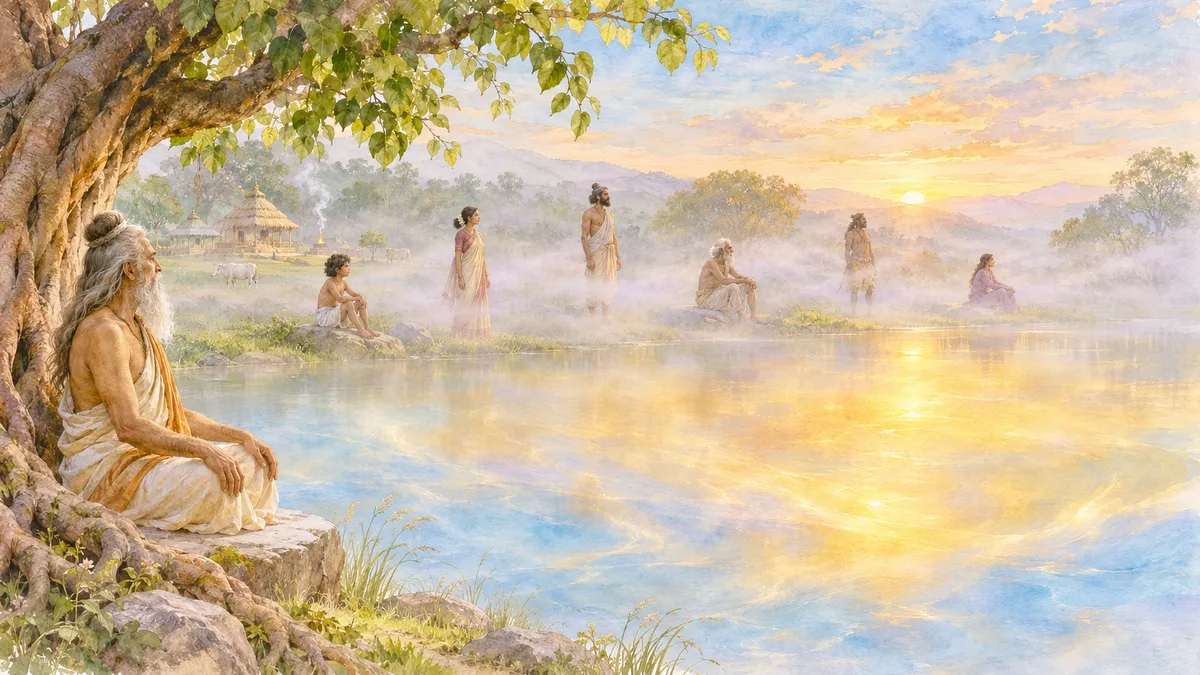
We are one being, one in many bodies. But the illusion of ignorance creates within us a sense of individuality, ego, ahamkara—the illusion of a separate personality. And then there appears to be a diversity of individuals and personalities. Each of us has our own type of character, destiny, karma, and complex relationships. All of this very strongly obscures our true nature. When we begin to practice vichara, we gradually free ourselves from the ego.
The Source of Suffering and the Path to Liberation
Vasistha said: “Not knowing oneself is the source of all problems and misfortunes. Tell me, Rama, is there any misfortune that does not arise from a failure to understand one’s own essence? The whole of creation is permeated by misunderstanding, which sustains the world. An ignorant person is visited by various sufferings again and again. The sources of suffering—the body, wealth, and family—never cease for one who does not know oneself. There is no end to ignorance for one who firmly believes that he is the body. How can true self-awareness arise in him? As long as ignorance rules, the foolish person stumbles and falls again and again, and his suffering is endless.”
Thus, ignorance rules the roost for us only until vichara begins. As soon as we begin the process of vichara, the development of self-awareness, ignorance gradually starts to recede. It is extremely important for every living being to begin vichara, but this is not possible under every condition or in every body. Vichara is traditionally considered the privilege of sages, the Brahmin class, sadhus, or meditators. Why is it a privilege? Because vichara is impossible in a restless, rajasic mind full of kleshas. It is said that before setting foot on the path of vichara, one must first purify oneself. If we are able to do this, then vichara becomes possible for us. Therefore, teachers say that service is necessary, seva is necessary, yogic principles are necessary, hatha yoga is necessary, observance of certain principles in relationships is necessary, and concentration of consciousness is necessary. We must prepare, prepare for vichara.
The Practice of Pratyahara and Reducing the World to Consciousness
When we practice vichara, we gradually detach the mind from external objects and begin to reduce the entire world to the mind, to consciousness. In Patanjali’s Jyoti Yoga, this is called pratyahara. Just as a tortoise draws its limbs under its shell, so must we turn the perceptions of sight, hearing, smell, touch, and taste inward.
For example, we see certain objects, but where are they seen? Is this hall really outside? For us, this hall is on the retina of the eye, and the retina transmits a signal through the optic nerve to the cerebral cortex. This hall is in our eyes; it does not exist in reality.
We hear sounds, but are the sounds outside? We hear them because they are present in our ears. We feel touch only because it is registered by our nerve endings. This world is not real in itself. It exists in our eyes, ears, fingertips, nose, and tongue. If our sensations change, this world will change as well.
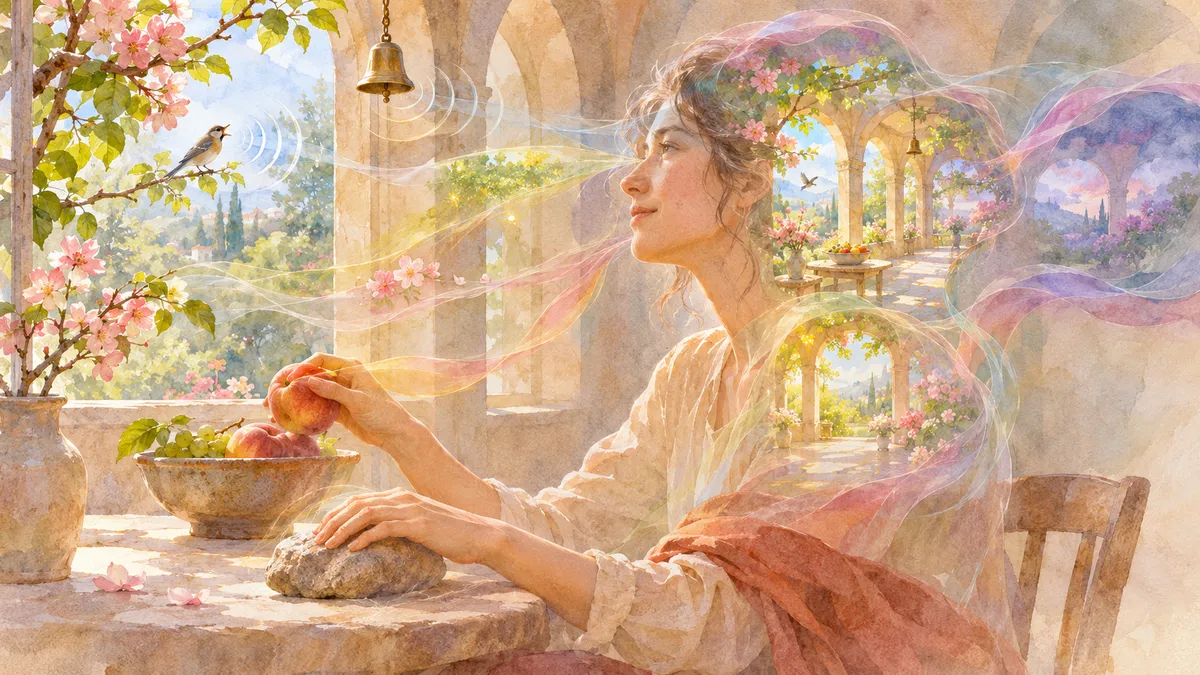
Then we need to continue our investigation: where do these nerve endings lead, and where do they terminate? They terminate in the brain. In fact, the entire world around us exists in our brain. It does not exist in reality; it is merely a complex of sensations. What, then, is the brain? It does not function on its own, does it? The brain is merely a conduit for the subtle mind, for consciousness. This means that the entire world is within our consciousness, although it appears to us as external and real.
Antahkarana and the Investigation of the Nature of the Mind
Antahkarana is when we begin to understand this process of the interconnection between subject and object, and begin to withdraw consciousness, pulling it away and freeing it from objects and from dependence on objects, as we proceed toward the source. When the entire world is reduced to the mind, we then try to understand: what is the mind?
When we investigate the mind through the practice of Atma-vichara, we come to the conclusion that the mind has no form, color, smell, or taste. It cannot be defined, and yet it exists. If we investigate this mind, we discover that there is space within it; that is, consciousness is like space. This space, this awareness, is our nature; neither the body nor images are our nature. Then we come to understand that I am not this body; I am pure awareness, like space.
The process of liberation on the path of Jnana Yoga proceeds as follows:
The entire world must be reduced to the sense organs (indriyas)
The sense organs must be reduced to the mind (manas) and dissolved in it
Manas must be reduced to awareness (buddhi) and dissolved in it
Buddhi (awareness) must be reduced to the Absolute (Atman) and dissolved in it
That is, we dissolve the world into the sense organs, the sense organs into the mind, the mind into awareness, and awareness into the Absolute. This is the process of dissolution described in Vedic science.
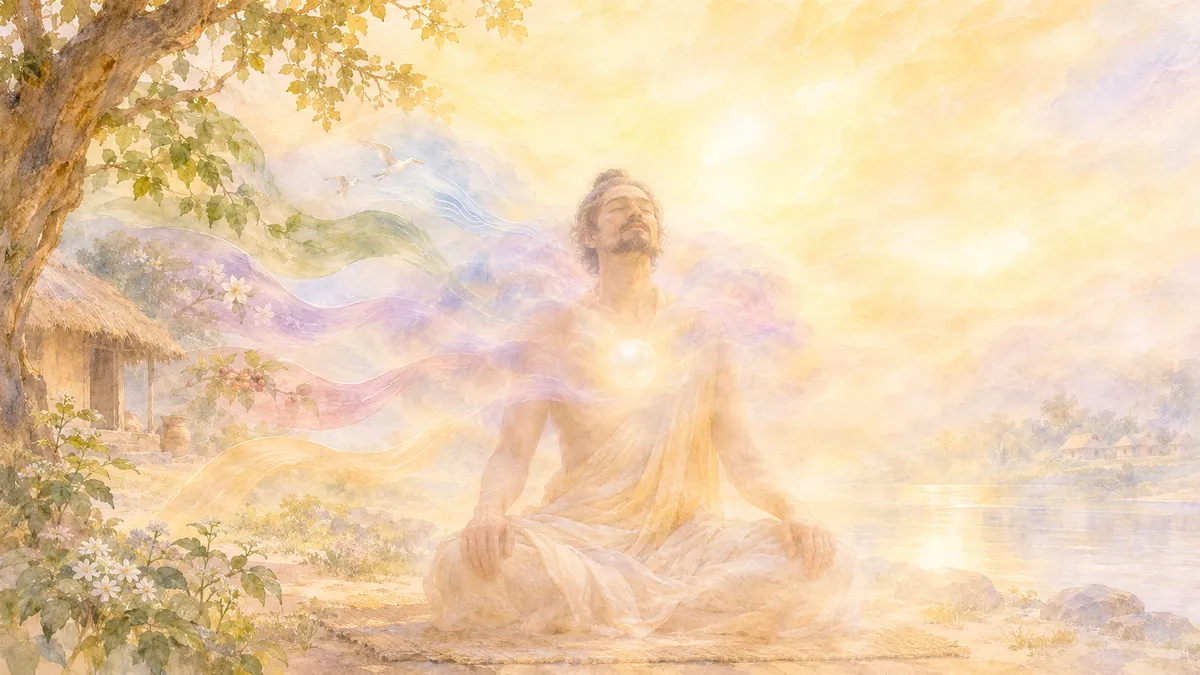
I love philosophy because philosophy prepares us to perceive subtle reality. The ability to think abstractly does not in itself mean that you are holy or enlightened, but this ability helps you draw closer to subtle consciousness, because our consciousness is very subtle. We need some kind of bridge between the sense organs, external reality, and consciousness. Vedic philosophy is unique in this respect: it gives us such a bridge and shows us the way to the other shore. Philosophy is not an end in itself. In India, great importance is attached to no-mind, because realization lies beyond the mind. This is why philosophy is important. The pinnacle of philosophy is the philosophy of Advaita Vedanta.
Advaita—the Path of Direct Knowledge
There are many philosophies, but we rely on the philosophy of Vedanta. Vedanta is of three types: the dualistic Dvaita, the partially dualistic Vishishtadvaita, and the completely non-dualistic Advaita. Vasishtha says that dualistic Vedanta is suitable for those who find it difficult to understand non-dualistic Vedanta. The partially dualistic form is suitable for those who seem to understand, but not entirely. Finally, non-dualistic philosophy is suitable for the most capable and most gifted.
Advaita Vedanta translates as the non-dual essence of Vedic knowledge. The Kali Yuga signifies the end of all knowledge. When we speak of non-duality, all knowledge reaches its culmination, its apogee; here all contradictions disappear, as do the differences between Buddhism, Christianity, and Islam. All distinctions between names and forms disappear.
In his time, Shankara spread the philosophy of Advaita. He spread it at a time when various cults and teachings were flourishing: Buddhism on the one hand, and dualistic Tantric teachings and ritual mantras on the other. Shankara gave Hinduism a new chance; he gave it the pure, unadulterated philosophy of Advaita. The revival of Vedic philosophy began with Shankara.
Vasishtha, Dattatreya, and Shankara are great luminaries of spiritual knowledge. Not only India, but Russia and all humanity are worthy of the philosophy of Advaita. Advaita Vedanta is not confined by territorial boundaries and has no nationality.
When we study Advaita Vedanta, we naturally begin with practice. The essence of Advaita lies in practice, sadhana, and jnana. We follow the path of pratyaksha—direct Advaita, that is, a philosophy in which you try to look directly at the world through the eyes of the contemplator, through the eyes of contemplative presence.
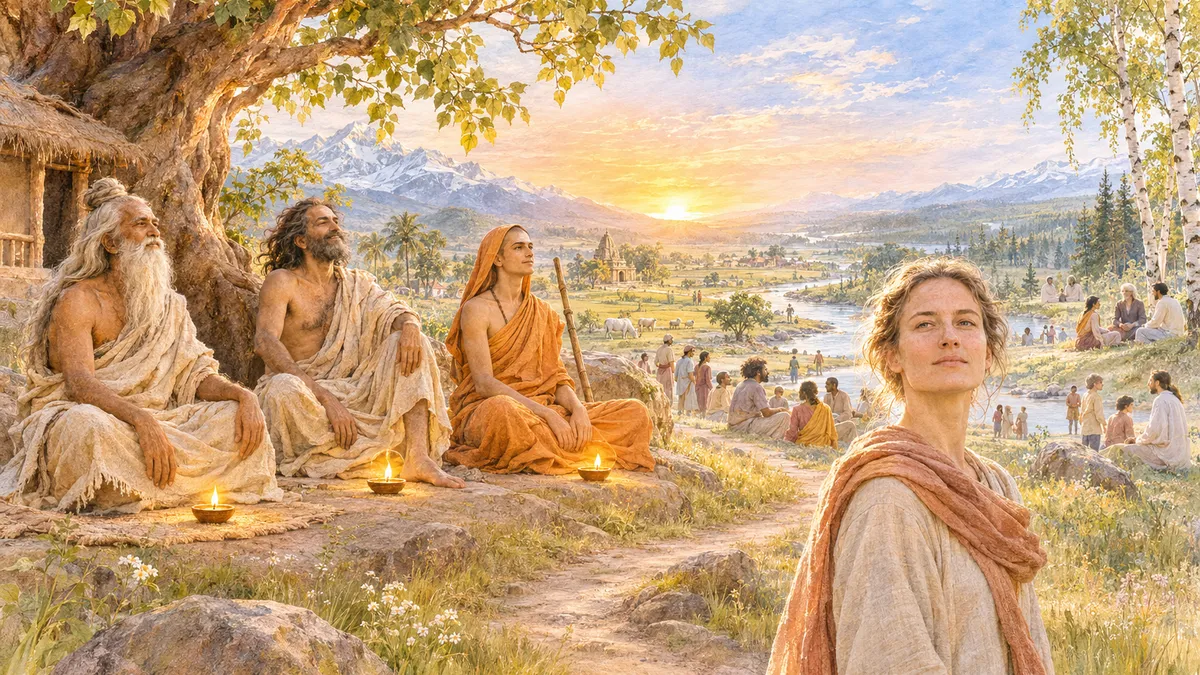
Coming into contact with the Teaching of Jnana Yoga, the Teaching of Advaita Vedanta—studying and contemplating it, especially the Tantric Teaching and the Teaching of the Mahasiddhas, which bring Advaita Vedanta into the realm of practice—is in itself a great blessing.
I wish that those who come into contact with Vedic knowledge may follow this path confidently and vigorously, without doubt and without stopping at the level they have now reached, because the spiritual path—the realization of the soul and God—is endless.
If we look at Buddhists, Christians, and Muslims—at how they follow their religion and respect it—we see a good example from which we have much to learn. Do we think that merely practicing asanas and pranayamas is enough? It is the same as simply going to church.
True religion is not a weekend religion; it is not a religion for one’s spare time. The true spiritual path, true religion, is a life imbued with dharma, holiness, self-discipline, asceticism, self-giving, self-sacrifice, and devotion. That is what true religion is.
I wish all spiritual seekers to follow this path without doubt, with faith and devotion, until complete liberation.
