

Commentary on Sri Shankaracharya’s text “Atma Bodha,” “Self-Knowledge”
“For those who strive for Liberation, who have destroyed their sins through austerities, who have become balanced and unattached, this treatise, ‘Self-Knowledge,’ has been composed.”
The treatise “Atma Bodha” is a foundational classical treatise on vision—that is, on the view or fundamental basis of the philosophy we practice. Although it cannot be called philosophy in the strictly scientific sense. Vision is, of course, neither philosophy nor metaphysics. Vision is the living experience of a siddha, conveyed in accessible words. And when it is transmitted through the lineage of disciples from guru to guru, this vision reaches you in its entirety, without interruption, right now—even a thousand years after Shankara.
In Laya Yoga, it is very important for us to understand the principle of vision. It is said: “What matters is not so much meditation as vision and becoming accustomed to that vision.” This is because meditation is not an end in itself; the purpose of meditation is to reveal vision. And once vision has been revealed, we simply need to become accustomed to it. Contemplation and the natural state are an ever-deepening immersion in the vision of nonduality.
The Only Means of Liberation
“Compared with other spiritual practices, realization of the Self is truly the only means of attaining freedom. Just as fire is necessary for cooking food, liberation cannot be attained without knowledge.”
What does it mean to enter into the vision of Advaita? It means radically changing all your views on life; it means changing profoundly within, colossally transforming, on some supremely subtle level, your vision of the world and yourself, your entire perception of reality. And only if you are ready for such colossal inner changes is Advaita for you. If you are not ready for such a transformation, then for the first twenty years you perform basic practices, accumulate merit, and intellectually establish an initial philosophical foundation. However, for one whose mind is clear, who possesses the qualities of a vira yogi, who is fearless and ready to do anything to attain enlightenment, who possesses the finest qualities (willpower, purposefulness, determination, self-surrender, the desire to move mountains for the sake of liberation, to cut off all attachments, diligence and purposefulness in practice, discriminating wisdom), Advaita offers an immense opportunity in this life to radically transform oneself and enter into this very vision within a relatively short period of time.

Advaita differs greatly from the ordinary worldly view. Moreover, it differs greatly even from the view of practitioners of the lower paths. That is, even among practitioners, Advaita stands apart as the summit, because even spiritual people find it difficult to enter into it, difficult to understand, accept, and realize it, since this transcendent view is too lofty.
The Lilas of the Absolute
For example, what is happening now from the standpoint of Advaita? The lila of the Absolute is now unfolding. The Absolute, being you, being me, being the monastery, the trees, the birds, and the stones, unfolds its lilas, its energies. It is not you who plant flowers or prepare prasad in the kitchen; rather, the Absolute uses your body in its lilas. It is not you who practice; rather, the Absolute plays within your body in accordance with your karmas and inclinations. It is not Swami Vishnu Dev who gives you lectures; rather, in accordance with the inclinations of this body called Swami Vishnu Dev, the Absolute unfolds its lilas—for example, teaching.
From the standpoint of Advaita, there are no hells, gods, relatives, monks and laypeople, sons, daughters, mothers, animals, or anything else; there is only the Absolute. In the absolute sense, there is nothing bad or good, no deeds or actions; there are only the infinite, unfathomable, mysterious, continuously unfolding lilas of the Absolute and the various levels of its manifestation—that is, avatars and embodied beings who, in accordance with their karmas and understanding, unfold and direct these lilas. There are embodied beings who have realized themselves as such and those who have not yet realized this, but in essence, all of this is the continuous manifestation and unfolding of the lilas of the Absolute.

View and Conduct
What does it mean to abide in the vision or in the presence once it has been realized? It means constantly remaining in this state of vision, in this view, without becoming mistaken or falling back into lower views. Here I am speaking about the view, not conduct. Conduct is a different domain; conduct has its own laws because it operates in the relative dimension. Here the law of energy applies, and energy must be taken into account and respected.
If one being is the Absolute and another being is the Absolute, then in the relative dimension the being with greater abilities to operate shakti as a result of clarity stands higher in the hierarchy. In the absolute sense, there is no hierarchy whatsoever; there is neither Guru nor disciple, neither gods nor hells nor animals—that is, everything is sacred. It is not that these do not exist; they do, but there are no distinctions. Everything is already transcendent from the very beginning. And the Absolute, amusing itself, manifests itself and plays in different bodies. In some bodies it plays laypeople; in others, monks; in others, teachers and saints; and in still others, siddhas and gods. Nevertheless, it is the very same Absolute. It is as though a puppeteer were performing a puppet show for you, putting on gloves and portraying different characters. Yet the puppeteer remains the same, whatever roles and characters he may assume.
And Advaita is a teaching that makes no compromises; it is oriented precisely toward such a nondual vision. However, when encountering such a lofty view as Advaita, there is a great danger of losing your way in it, of becoming confused, because when you touch it, it gives you tremendous inner freedom. But if you misuse it, you will make a mistake and may lead yourself into a new illusion. Therefore, it is said: “Distinguish between view and conduct.” In other words, while holding the absolute view, respect the relative vision in the relative dimension, in your conduct. That is, inwardly maintain the absolute view, while outwardly understanding the relative world with its energies, because it does not disappear.
Knowledge and Ignorance
“Only knowledge can overcome ignorance, like light dispelling dense darkness.
Because of ignorance, the ‘I’ appears limited. But once ignorance has been overcome, the Atman in its wholeness truly shines by itself, like the sun when the clouds disappear.”
The explanation of Advaita tears away the veil, the covering of consciousness. It is as though someone were explaining to you: “Everything you thought about yourself is unreal. Everything you believed about the world is nothing more than your illusions.” That is, in the relative dimension, any karmic vision exists, but only as a karmic vision, not in and of itself.

“Through tireless practice, knowledge purifies the soul defiled by ignorance. Having done so, knowledge itself disappears, like kataka nut powder in water.”
Six Types of Liberation
When we practice, we realize six types of liberation. To practice means to liberate oneself six times. The first to be liberated is the surface consciousness, when, on an intellectual level, we establish ourselves in the view; at least on the level of philosophical and intellectual understanding, we begin to understand something, and this understanding becomes firmly rooted in us.
Then the surface consciousness is truly liberated. Intellectual understanding is not enough. What does this mean? Even if we know Shankara’s texts (“Atma Bodha,” “Vivekachudamani,” and others) by heart, this does not mean that we have actually attained liberation. This is merely the intellectual liberation of the mind, when we have acquired a certain faith. True self-liberation of the surface consciousness occurs when you have learned to self-liberate, generated naked awareness through contemplative practice, and learned to self-liberate thoughts. In other words, you already have some experience of the contemplative state, and you cease to trust concepts as something inherently existent, placing your trust instead in the contemplative state; when concepts arise, you self-liberate them. You may work with them, but you always recognize self-liberated presence as the most important thing. When this happens, your actual surface consciousness is said to self-liberate. Concepts and your dualistic notions no longer have power over you. But this is only the very beginning, because even if you maintain naked awareness at the level of surface consciousness, you still have the subconscious, that is, svapna, the dream state. And the next liberation takes place in the subconscious.
When self-liberation penetrates the subconscious and you can contemplate in dreams, your subconscious is liberated. No subconscious images have any further influence over you. The subconscious is like a vast storehouse or an abyss. It is connected with universal energies. Sometimes, after several years of practice, a person begins to realize what vast strata of energy lie hidden within. Only then does it dawn on them what a momentous choice they have made, how difficult it is to be a monk and to practice, and that these immense energies must be worked with. These immense energies of your subconscious seem like an entire abyss, while your self-liberation seems like a small island. Or the subconscious seems like a huge wall, while your self-liberating presence seems like a tiny scraper with which you are cleaning it.

Nevertheless, the subconscious is eventually liberated as well. When a yogi can meditate steadily while dreaming, that is, at the deepest level of images, their subconscious becomes free. What does it mean for the subconscious to be liberated? It means that their presence is subtler than mental images. Subconscious images are extremely swift and subtle. One might say that they govern the consciousness of ordinary people. But a yogi’s presence is even swifter, even subtler. And it can liberate the subconscious. This is the third liberation.
However, beyond the subconscious there is a layer of superconsciousness—the causal body, perceived in dreamless sleep. Having liberated the subconscious and successfully maintained awareness in dreamless sleep, the yogi has still not attained liberation. Again and again, they strive diligently to break through into superconsciousness. Superconsciousness consists of the realms of formless space experienced in meditation.
When we train to remain in the natural state here and now, this is nothing other than an orientation toward superconsciousness, as when we speak of emptiness and so forth. Many people say that one must be here and now and let go of oneself; this teaching is very popular today. If you read holistic magazines, you may get the impression that half the world is practicing the natural state; it is already becoming fashionable. However, true superconsciousness is accessible only to saints. That is, to truly enter dreamless sleep and even to understand that superconsciousness exists, you must truly become a master of contemplation, elevate the practice to an art, contemplate even while dreaming, and completely relinquish all attachments. This is inaccessible to ordinary people.
And when the yogi liberates the superconsciousness, they make a new breakthrough and can contemplate in dreamless sleep. When they liberate the superconsciousness, nothing can any longer prevent them from realizing the Atman. All obscuring veils, all illusions covering the “I,” fall away. They contemplate the purest space of clear light. This is true liberation.
The World as a Dream
“This world is transient, overflowing with passions, aversion, and much else; it is indeed like a dream. At times it seems real, but becomes unreal after the soul awakens.”
How should Shankara’s assertion that the world is like a dream be understood? One cannot say that nothing at all exists. Energy exists—this is a fact. This energy is a manifestation of the Absolute, but our interpretation of energy causes us to perceive it as a particular world. This interpretation creates a karmic vision—a loka—and then we perceive what is called maya, illusion.
What is karmic vision? Karmic vision is a kind of superimposition of one’s own vision upon reality. For example, today in a neighboring village I saw a sign. Glancing at it, I read it as: “Greetings, Earthlings.” I thought, “That can’t be! How could you see such a poster in a village?” I looked more closely and saw that it actually said, “Greetings, fellow villagers.” There was an evening honoring veterans. But the first time, I saw and interpreted it precisely as “Earthlings”; in other words, that was my vision. If the bhava had been stronger at that moment, perhaps I would have shifted to a different version of the universe, and then it really would have said “Earthlings.” In other words, it all depends on vision.
Vision is an interpretation that makes it possible to sustain a particular layer of karmic vision, and this interpretation does not come from the Supreme Source; it is dualistic and dreamlike.
The Illusion of Silver in Mother-of-Pearl
“The world, like the illusion of silver in mother-of-pearl, is perceived as real until the nondual Brahman—the foundation of all existence—is known.”
External energy is not an illusion; energy exists—this is a fact. The illusion lies in considering this energy to be some self-sufficient, separate world. For example, when you see a person, that is energy, the illusory body of the Absolute. The Absolute is within the body, so one can also say, “This is a body.” But when you see only a person and consider him to be Sergey, a novice, or a layperson, and establish a relationship with him as with someone separate, without knowing this secret, then that is, of course, an illusion. This applies not only to people, but also to all beings, gods, and even inanimate objects. A stone is undoubtedly the Absolute embodied in the gross tattva of the earth element; in other words, it is absolute earth. But when you see merely a stone, that is nothing more than an illusion. To abide in vision means to meditate constantly in this way. And when you abide in vision and sustain it steadily, you are in contemplation.
The Supreme Lord
“Worlds are born, live, and die in their material conditioning—the foundation of the entire universe. Yet this itself is the Supreme Lord.”
It seems that external worlds exist on their own. But in reality, they are nothing other than the one vast body of the Absolute. The Absolute is not some unmanifest form; the Absolute is always connected with energy, and it can always manifest, reveal itself in the form of energy, and play. Therefore, what we see is the continuously unfolding lilas, the plays of the Absolute.
Lila is the causeless creative play of the Absolute’s energies, behind which stand deities, while the deities themselves are, in turn, rooted in the superstate. An ajnani is one who has not attained liberation; when encountering anything, he does not recognize these lilas, but sees them as something material, worldly, and ordinary. A jnani sees nothing but lila; for him, everything is nothing but lilas, plays. Lila (or vilasa), play, is not something frivolous, as it is perceived in the human world; on the contrary, it is a very profound manifestation of energies, inaccessible to consciousness.
Often, when I hear people talking about the Dharma and see that someone does not understand, I tell him, “Do not perceive everything so simplistically. Nothing is as simple as you think. The world is far more complex than you think. Do not take what you think now to be the absolute truth. Everything is far more complex.”
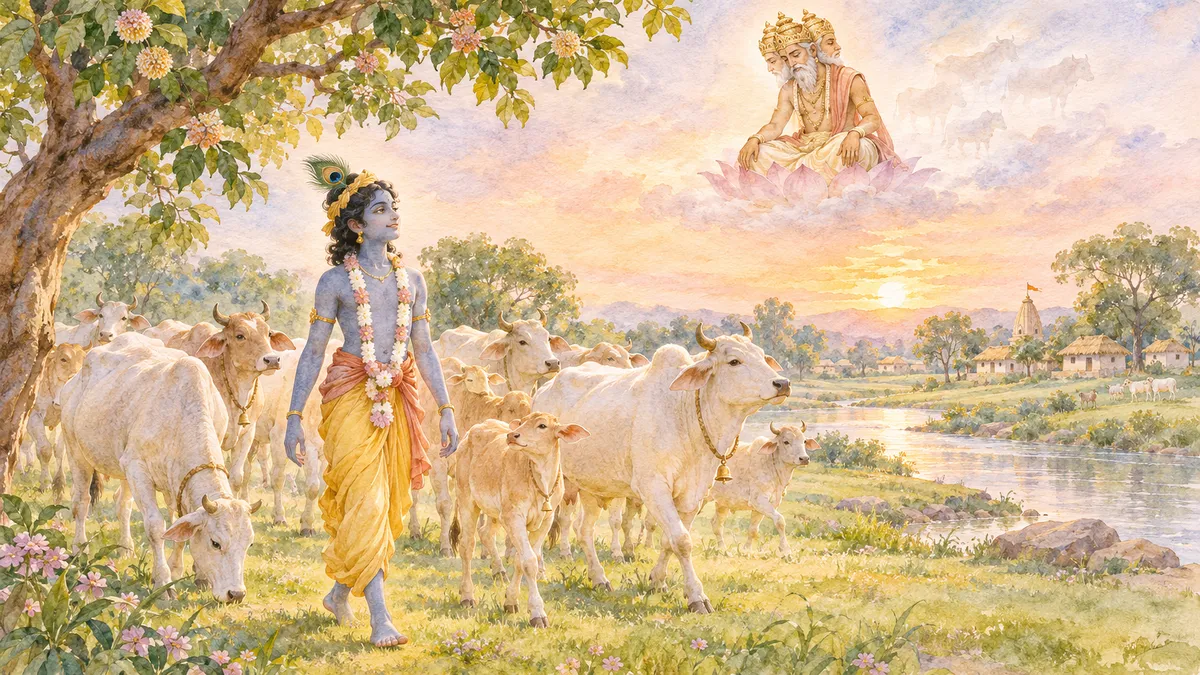
Once, Krishna was herding cows, playing with the gopis, and so on. Hearing of his glory, the gods doubted his divinity and thought, “He is some earthly boy, a mere mortal who has got an inflated idea of himself. He cannot be Bhagavan.” Then Brahma decided, “I will steal his cows, and we will see what he does. He is just a cowherd. How can an ordinary mortal human being be the Absolute?” Using his magical power (tirodhana-shakti), Brahma concealed the cows; that is, he shifted karmic perception into a reality where there were no cows, and they disappeared. When he wanted to see confusion on Krishna’s face, he saw that the cows were still there as if nothing had happened. In other words, some other cows had appeared, while Krishna seemed not even to have noticed the loss, as though Brahma had done nothing at all, and continued herding them. Then Brahma realized that his magic had proven powerless. Krishna possessed such a colossal sankalpa that he did not even notice any of it. In other words, his shakti surpassed Brahma’s shakti and was far greater, even though he was in a mortal body while Brahma was in his divine body. Thus Brahma was humbled.
Becoming accustomed to the vision means constantly remembering this view and avoiding errors in it. In other words, the view means that, somewhere on an inner level, you continuously perceive reality in this way. On the outer, relative level of conduct, this does not prevent you from establishing relative relationships and perspectives, taking hierarchy, circumstances, and the status of beings into account, and seeing differences, karmas, and much more. But here we are speaking of the view on the inner level. If you have the foundation of the view, you will never make a mistake.
The Descent of the Absolute and the Levels of Liberation
What does the view from the absolute standpoint mean? The Absolute is descending into you right now; it is manifesting within you. In accordance with past lilas, it will be manifested in this body either fully or partially for your consciousness.
The Absolute manifests at different levels in different practitioners:
In some, the Absolute has already dissolved the surface consciousness
In others, it has entered the subconscious
In still others, it has even entered the superconscious
In a fourth group, it has not only entered the superconscious but has also begun to transform prana, the energy
This is the next kind of liberation: after consciousness has been dissolved, prana is dissolved—it is completely purified and then dissolved into a pure state. In saints such as Gorakshanath, Saraha, and Ramalinga, the Absolute dissolved not only prana but also the elements of the body—the flesh (muscles, skin, blood vessels, and bodily fluids)—and they turned into light.
From the standpoint of the nondual view, the Absolute continuously descends and manifests in bodies as monks, novices, brahmacharis, mentors, teachers, lay practitioners, and laypeople who do not even practice. For example, perhaps a certain layperson specifically incarnated in order to build a hall for a bhajan mandala, and had been working toward this for fifty years.

The Dangers and Possibilities of the Advaita View
When you encounter the Advaita view, your perspectives are profoundly overturned. Nevertheless, on the relative level you must not lose yourself; on the contrary, you should draw strength from your view.
If a yogi is uneducated and weak, the view overwhelms him, and he loses himself in it. This state is called “the loss of action in awareness” or “the loss of action in vision.” He feels that he is encountering such vastness, such shocking freedom, such transcendence, that his hands and knees simply begin to tremble. He feels deeply insecure; he feels that this abyss is devouring him. Many people, on encountering this sensation, have recoiled from it in horror.
If a person has not been purified through service, self-surrender, contemplation of impermanence, and concentration, they are not ready for such a view. Nevertheless, an experienced yogi who has emptied himself sufficiently rejoices in such a view. He has no fear, hopes, or attachments. He says to himself, “Forward, into the lion’s jaws.” He gladly opens himself to such a view and, far from losing himself, draws strength from it. He draws creative shakti from it and continually manifests it in the relative realm.
The Power of One Established in the View
One who is firmly established in the view feels extremely confident. He feels very steady on his feet because his life is built on a foundation that cannot be moved. Even if the universe trembles, his foundation, built upon the view, will not shift.
Why does such a yogi feel so confident? Because he no longer acts; he plays, abiding in the view. And lilas (divine plays) are actions of an entirely different order.
For example, whenever I had to teach others or engage in various forms of service, I never felt any confusion, doubt, or anything else of the sort. It was entirely out of the question. Why? Because all these actions were based not on my own understanding but on the view, and the view manifests in the relative dimension as lila.

Likewise, if you are rooted in the view as a monk, you never experience confusion or doubt, because your foundation is immense. It is as though you were a human being carrying an entire universe within your soul and basing your life upon it. Such a yogi will not lose himself even if he encounters gods or enters the bardo. Wherever he may find himself, his view will transform any world and turn it into a pure world, into a mandala.
True Contemplative Presence
To remain in contemplative presence is nothing other than to abide continuously in such a view. If we believe that being in contemplative presence means somehow converging the visual axes of the eyes on the tip of the nose and recalling, “Who am I?”, then this certainly cannot be called the view. It may be called training.
Nor can it be called the view when we reason intellectually, “I am Brahman, he is Brahman, everything is Brahman. Brahman plays, Brahman manifests,” or when we can simply speak eloquently on this subject. It is good to have such a verbal understanding, but this is not yet the view; it is only training. In other words, this is what is known as kriya-jnana—jnana of the path, or working jnana, when we train ourselves in jnana.
True jnana, however, consists in the most subtle non-conceptual awareness, in a sky-like presence that sees in accordance with the philosophy you profess.
