

Commentary on the text of Sri Shankaracharya “Viveka-Chudamani”
Then, prostrating himself, he begins to recount his own experience:
“By the grace of your blessed gaze, the disease caused by the evil of birth has ceased, and I have instantly attained the blissful state of identity. Through the realization of the identity of Brahman and Atman, my sense of duality is destroyed, and I am free from external activity.”
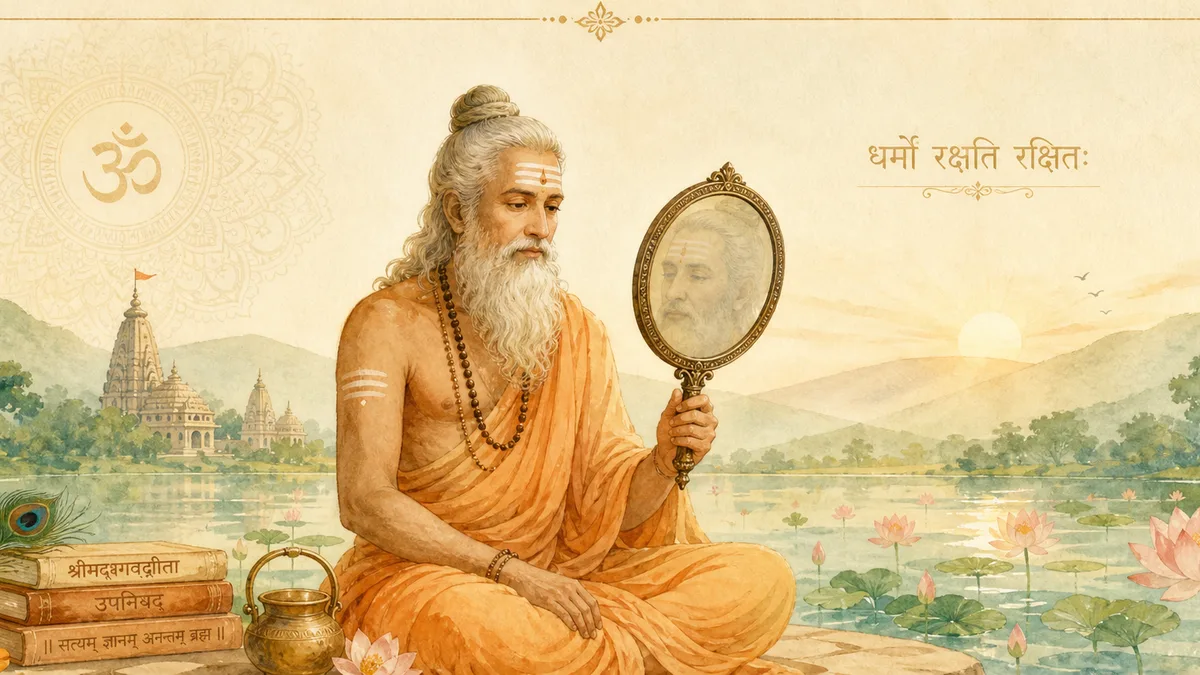
The sense of duality is destroyed by the awareness of the unity of personal consciousness and the Absolute. On a relative level, we speak of “personal consciousness” and the “Absolute,” but in reality, it only seems so to us when we are on the other side of the mirror among the reflections. When we are in the mirror, in the center, there is neither the consciousness of “I” nor the Absolute, because everything is absolute; there is no external Absolute outside of us. To realize the identity of the “I” and the Absolute, we continuously direct the mind toward the Absolute. The mind is tethered to the senses and the body; it must be turned away constantly and directed toward the Absolute.
Even if we experience difficulties, they are nothing—absolutely nothing compared to what we are achieving. Just think: what terrible austerities thousands of people around the world perform to realize the Absolute. Our austerity, called monasticism or discipleship, is, so to speak, a cruise; it can hardly even be called an austerity. Many saints go to extremes, maiming their bodies to discard the attachment of “I am this body,” sitting in the middle of five fires, standing day and night on one leg or two, holding one arm up until it withers away; yet we, as soon as an ear or lower back hurts, are almost in tears. Where is our commitment to the Absolute? One must have absolute commitment. This does not mean one should neglect the body or perform certain austerities. Our path lies in absolute commitment to the absolute Truth.
A disciple of weak faith, a young novice, asked a saint:
— How do you manage to endure such hardships?
This saint fasted and sat naked continuously in the cold and rain. He said:
— It seems like hardship to you, but I see my future lives in heavenly abodes, so it does not seem like hardship to me. Even if I had to sit like this my whole life, it would be child’s play compared to the bliss I am about to attain.
Further, this saint said:
— You simply do not know what splendor saints attain for every small austerity or difficulty. What you gain is immeasurable.
In the same way, in monasticism: for every centimeter of spiritual effort, we gain approximately a thousand kilometers of realization.
I cannot distinguish between the present and the absent. Like an iceberg in the ocean, I was gradually absorbed by the ocean of Brahman's bliss until I myself became the ocean, whose nature and extent my intellect found itself unable to comprehend. How can one conceive the vastness of this ocean of Brahman's bliss, full of divine essence, how to describe it in words? The world that was felt a moment ago has completely vanished. Where did it go, by whom was it removed, into what was it dissolved? What a miracle! In this vast ocean of Brahman's bliss, filled with divine experience, what exists to be accepted or rejected, seen, heard, and known separately from its own Self? Only I am bliss itself. I am unattached. I have neither a gross nor a subtle body. I am indestructible. I am perfect peace. I am neither the doer nor the enjoyer. I am not subject to change. Actions are not mine. I am not the seer, listener, speaker, doer, or enjoyer. I am neither that which is experienced nor that which is not experienced, but the one who illuminates both. I am the Void without and within. I am beyond all comparisons. I am the Spirit before all times.
When we direct our mind toward the Absolute, pulling it away from daily trifles and thoughts, it gradually develops a “taste” for being directed toward the absolute state.
Meditating on the Absolute, we recognize no concepts, no forms, no names; we do not imagine it inside or outside. We give it no definitions, classifications, or philosophies, as all these are chimeras born of the mind. They are useful to somehow explain Him, to provide food for the mind, but when we speak of presence, all this is irrelevant here. We do not even have a concrete idea of the Absolute; only through direct introduction and explanation of what the principle of contemplation is do we begin to sense it. We simply remain alert, conscious, open, not fixing our mind on anything. Gradually, we begin to recognize the absoluteness and perfection of this state, feeling that we do not need to move anywhere, we do not need to want anything; that when we abide this way, the mind itself is directed toward the inconceivable, the boundless, the infinite.
When we feel its breath, we gradually deepen; a “taste” for such meditation arises, as if we are delving deeper and deeper into this great idea. Then we begin to realize that the scale of our life is ephemeral. This great idea encompasses the Universe with planets and galaxies, thousands of other Universes. It includes the past with an infinite succession of kalpas, creations, and destructions; it includes the future; it includes a countless number of dimensions.
When we reflect in this way, suddenly we feel the icy breath of the abyss. We feel that we are touching such a terrifying mystery that we do not even have a chance to describe it in any way. Our ego begins to tremble, shivering with delight and awe simultaneously. It feels that just a little more, and it is finished, because it has touched that which cannot be recorded in books as philosophy (it can, of course, but it will no longer be the thing itself, only thoughts about it). It cannot discuss it or describe it; it can only perceive it live, directly. But the process of perception itself is like a rabbit looking at a boa constrictor. During this process of perception, the ego is gradually drawn into it and completely dissolves.
When we meditate in this way, suddenly we feel that all our ephemeral notions of ourselves, of the world, all attachments—are such a small shell that it is not worth clinging to, and what is revealed to us is so magnificent and boundless that we lose nothing. Then faith arises within us. We think: “Since this is such a transcendent Majesty, let it be not my will, but Its.” We decide to cut off hope and fear. Thus, we develop a great trust in this state, and we no longer resist it, but open up.
When we let go of our clinging and ego within ourselves, this great boundlessness suddenly begins to flow into us of its own accord; we no longer obstruct it. We have tasted it and realized that before it, we can do nothing, that our ego must capitulate, surrender to its mercy. Then we seem to remove the stone that blocked the path of this absoluteness, and it begins to pour over us freely. This is called the awakening shakti of the Absolute or Anugraha. On the path of instantaneous enlightenment, great importance is attached to this awakening power.

I am beginningless. In me, “I” or “you,” or “this” or “that” are not created. I am at once outside and inside all elements as the conscious ether in them, as well as their foundation. I am Brahma. I am Vishnu. I am Rudra. I am Isha. I am Sadashiva. I transcend Ishvara. I am the all-encompassing Witness, indivisible, homogeneous Brahman, infinite, eternal, Being itself, unsurpassed, ultimate perfection, existence, eternal, pure, enlightened, liberated, and supreme Bliss.
When we continue to contemplate the Absolute, remaining in this state, this shakti begins to pour into us. It pours in until the inner begins to mix with the outer. Then we realize that the separation between inner and outer space was created by our mind. Now this layer is broken, and we begin to feel outer space as our own space. The inner and outer mix.
The Mandukya Upanishad says in this regard:
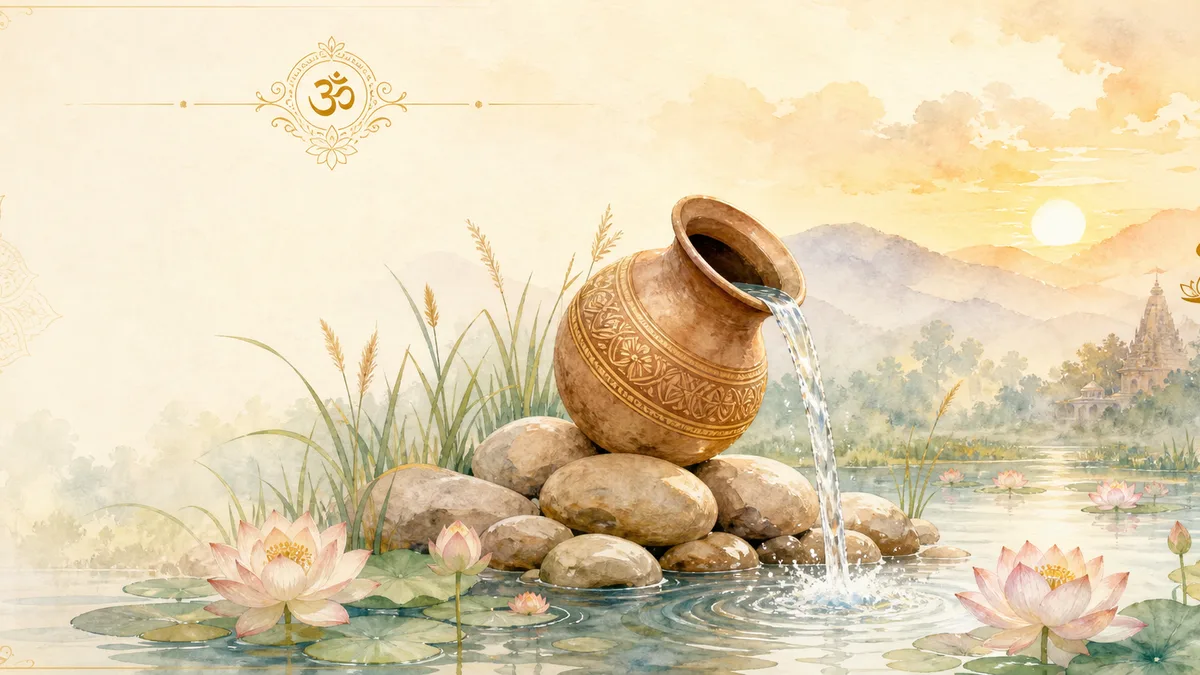
“A jar, due to the demarcation of its walls, has an inner space separated from the outer. But when the walls are broken, there is neither inner nor outer, but only one.”
If a person does not understand the teaching, they imagine the realization of absoluteness as some internal experience: a golden light or something else of that sort. However, the realization of enlightenment means that you and Eternity have united, that everything external has now become your own “Self,” that all the stars and planets are now in your chest. You walk along the Milky Way, eat the Sun and Moon for breakfast, and live in ten thousand directions of the world, because the cocoon of the individual “I” is broken.
What was previously experienced as separate things and as the experiencer-experiencing-experienced, I now find all within myself. Even though the waves of the world rise, thanks to maya, like the wind, arising and subsiding, they rise and subside in me, who am the limitless ocean of Bliss.
Then suddenly the yogi begins to understand: what he was striving for has always and from the very beginning been himself. When he realizes this, it is like a blow or a shock that arises from the awareness of the great joke of Existence that karma has played on him. Such a yogi suddenly perceives: “I have always been That; I am Him even now. I never ceased to be Him. How could I believe in this world and body? What irony of karma! How could I be so deluded, considering myself this or that.” Then he laughs like a madman and points his finger at others, asking: “Who are these unfortunate ones?” Realizing the total joke of the universe, he weeps out of compassion for all living beings.
Fools are those who, erring, attribute the body and other ideas to Me — the formless and unchanging. This resembles the division of unlimited, formless time into parts such as a year, a half-year, and a season. Just as the earth is not moistened by the water of a mirage, so destruction in no way affects Me, for I am unattached to anything, like ether, separate from everything that I illuminate like the Sun.
“Directing the mind toward the Absolute” and “abiding in the natural state” are synonyms.

He who continuously directs the mind toward the Absolute always feels the breath of eternity, therefore he is always joyful. Know that if you have confusion, doubt, despondency, or sad thoughts, then you have directed your thoughts to the wrong place, not to the Absolute. This is uncharacteristic of the Absolute. When you direct your mind toward the Absolute, you dance, sing, and frolic twenty-four hours a day. That is all there is to it: the entire practice boils down only to catching your slipping mind and directing it to this necessary point. The mind is not such a simple thing; it can subtly fool even experienced practitioners. However, a true yogi has a commitment to this state—one could say his commitment is almost passionate. He experiences this state with the full totality of awareness. When we become accustomed to it, it becomes natural, which is why it is called the “natural state.”
A true yogi is always a bit of a fanatic in the good sense of the word, that is, not in the sense of some foolish fixed ideas, but in the sense of boundless commitment to this view, where nothing interests him except this. He is like a mad scientist or a musician who is completely absorbed in his music, mathematics, or philosophy, who gives himself with passion to his favorite pursuit.
