

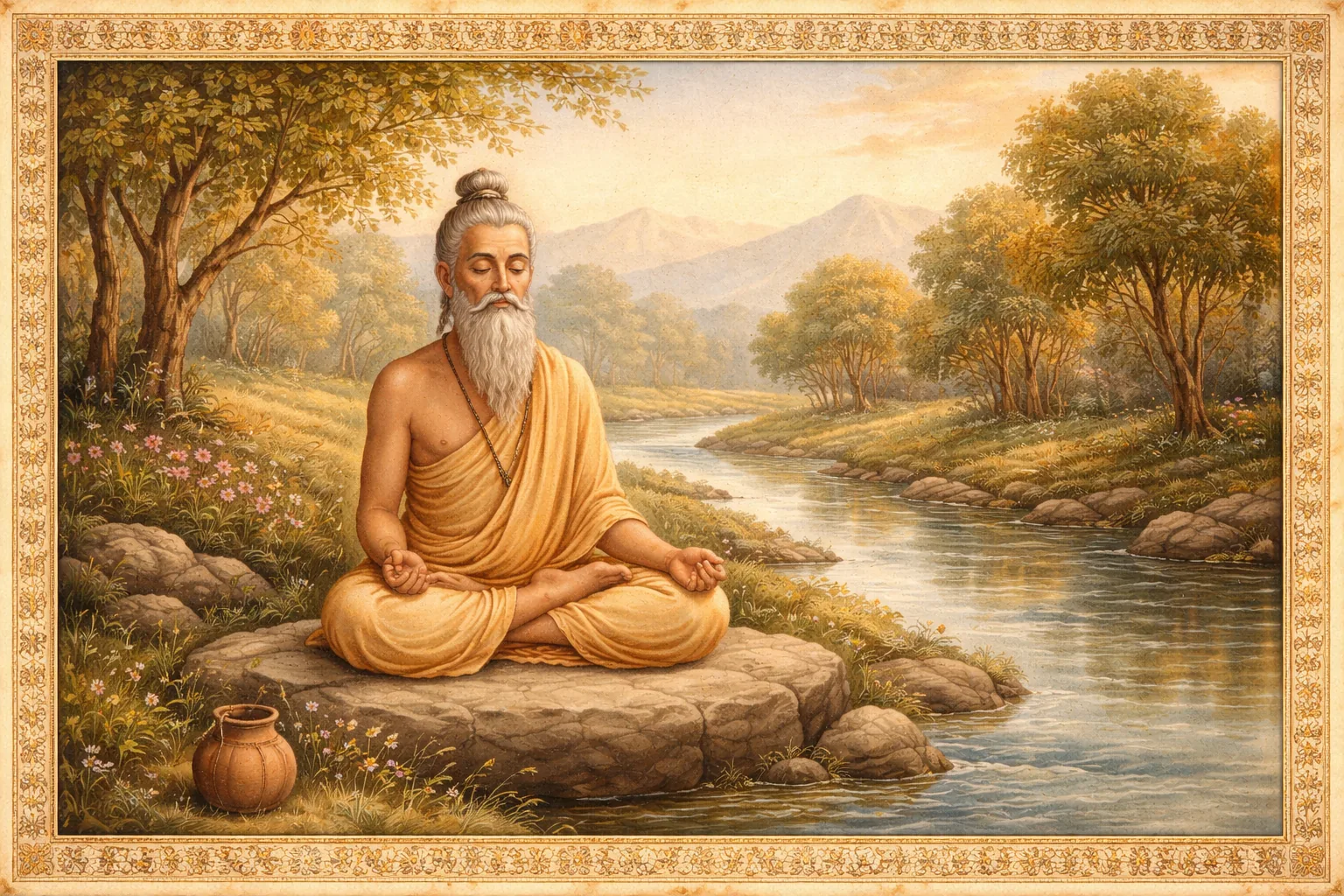
The practice of divine pride over time manifests as a deepening of pure vision, the realization of a single “taste.” At the stage of insight into pure vision, other dimensions connected with pure lands are often accessible to the yogin. He may sometimes visit these dimensions, see how they are arranged, and what the ethics of the local inhabitants are. There are countless such dimensions.
Various kinds of liberation, often mentioned in the spiritual literature of different traditions, are connected with these dimensions. Especially in traditions close to Vaishnavism, such kinds of liberation are mentioned as:
salokya – to be reborn in the same dimension as the deity to whom one is devoted
sarupya – to acquire the same illusory body as the deity with whom one practices sadhana
sayujya – to dissolve into the Absolute (a kind of liberation in yoga tantra)
samipya – to be near the deity, in his retinue, as his friend
When we speak of kinds of liberation, most often we are speaking of the realization of bodies. That is, sayujya-mukti (liberation through dissolution) is jnana-deha; sarupya is the realization of the illusory body.
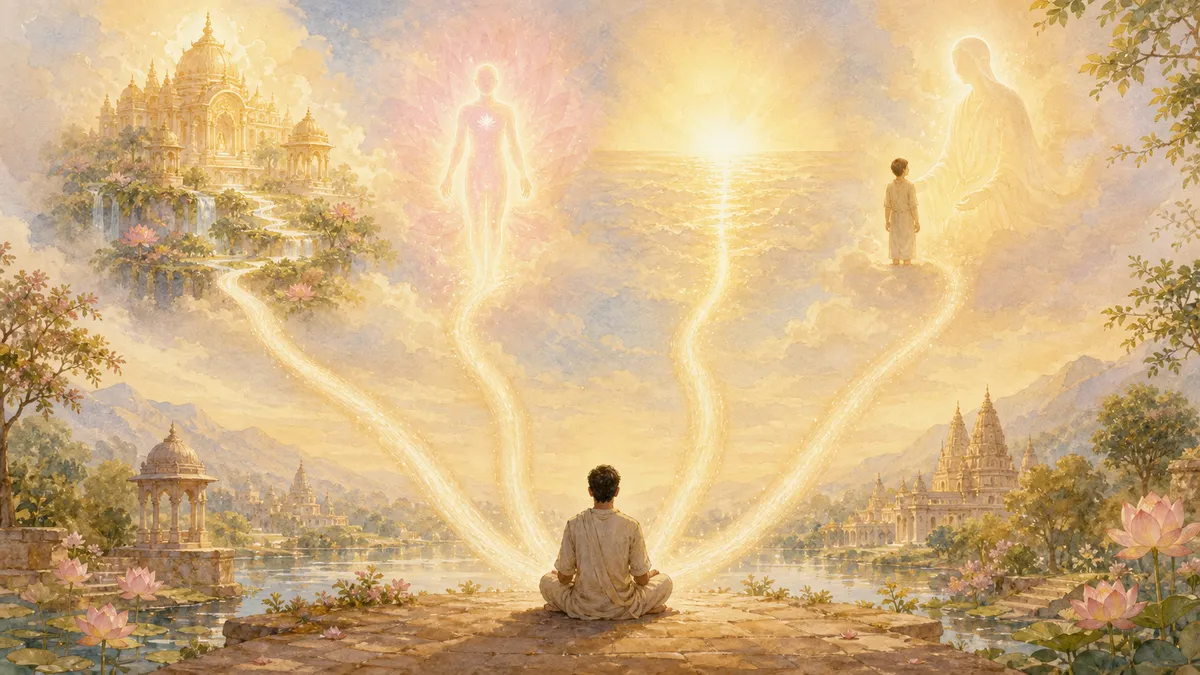
The Difference Between Dualistic and Non-Dualistic Approaches
Dualistic traditions attach importance to such kinds of liberation as salokya-mukti and sarupya-mukti, that is, to be in the same dimension as the chosen deity, or to have a form, an illusory body, the same as that of the chosen deity, or to be a deity of the retinue in the deity’s mandala. At the same time, they avoid sayujya-mukti, because sayujya-mukti means merging, the realization of nonduality, and this contradicts the principles of Vishishta-advaita.
But for us as practitioners of Advaita, on the contrary, sayujya-mukti is the most important. It is the dissolution of consciousness in the absolute, nondual state that is the foundation. Then, from this dissolution, salokya-mukti (abiding in the same dimension as the deity), sarupya-mukti, and others arise.
If in dualistic traditions people strive to enter the pure land of the deity they worship, or to be his companion, then our goal is somewhat different: we strive to become the deity ourselves and to create this pure land. This is precisely the difference. At the stage of duality, the deity is something else, something different from you, while you yourself are a peripheral deity. But at the stage of nonduality, you yourself are the deity, and you yourself create the pure land, proceeding from bhava—the inner potential.
We believe that someday practitioners of Vishishta-advaita and Dvaita will mature enough to realize sayujya-mukti, which frightens them so much and which they avoid because of their immaturity. Someday they will become so mature that sayujya-mukti will no longer be understood by them as dissolution with the loss of individuality, with the loss of creative manifestation and complete immersion only in vision; rather, this very dissolution will become a great impulse to engage their own potential and shakti, so that they can reveal their creative powers like Brahma the Creator. This is the fundamental difference between the approach of dualistic and nondual teachings.
The dream of a Vaishnava is to reach Goloka Vrindavana or Vaikuntha as a companion of Krishna, to be reborn as a gopi in one of the pure lands, of which there are countless numbers. There is no question there of realizing a mind like space; rather, it is a matter of realizing bhava and mahabhava—great devotion, through which consciousness is transferred into a pure dimension and life continues, along with relationships with the chosen deity and participation in his lilas as a friend, devotee, beloved, servant, disciple, and so on.
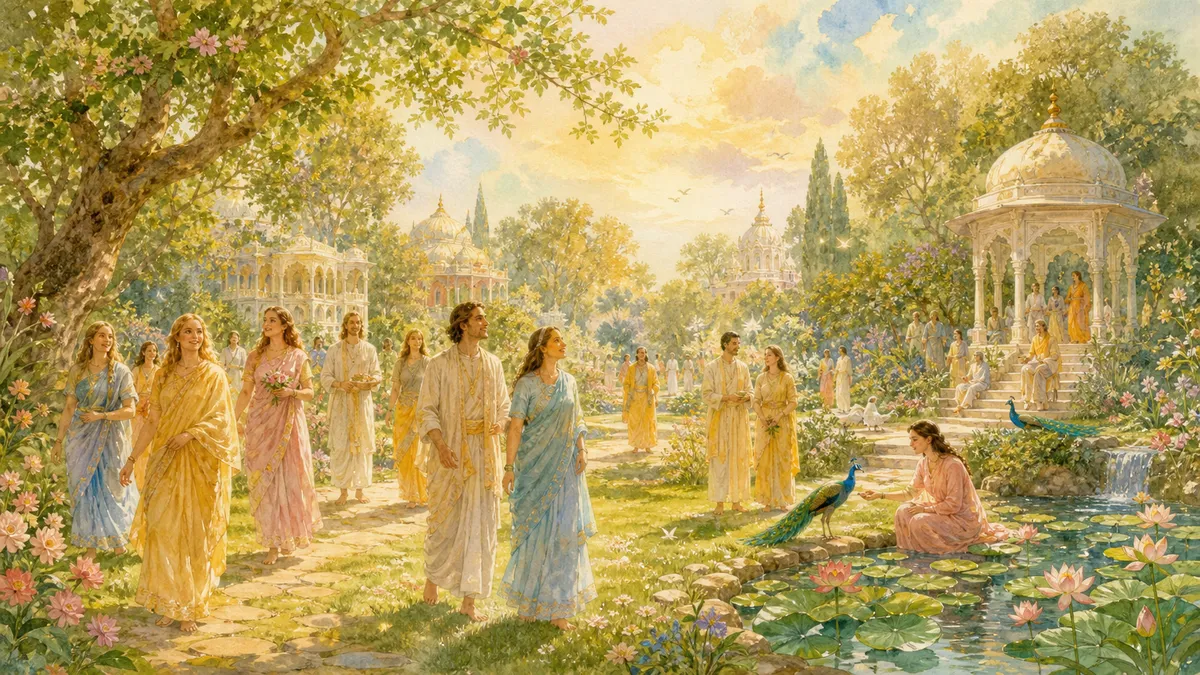
Our ideal is the realization of nondual consciousness, the activation of creative powers (shakti) and the ability to manifest them, that is, to create like the creator god Brahma himself. If a Vaishnava wants to reach Goloka Vrindavana or the spiritual dimension of Vaikuntha, then we want to realize nondual consciousness in order to create such a land ourselves through the power of our own potential. That is, these are simply incomparable levels.
One example can be given. In the seventies, many people dreamed of America. For many materialists, it appeared to be an earthly paradise. And in the late eighties and in the nineties, a mass flight there began from the countries of the former CIS, because America played the role of such a “pure land” for many residents of the USSR. Imagine that you want to get to America and you are told: “It is so wonderful to live there! You will have such great opportunities there—a highly paid job, a big house, a beautiful car!” This is one option, and it is analogous to wanting to be reborn in a pure land. That is, you are told: “You only need to get there, and everything will be okay! You will live superbly!”
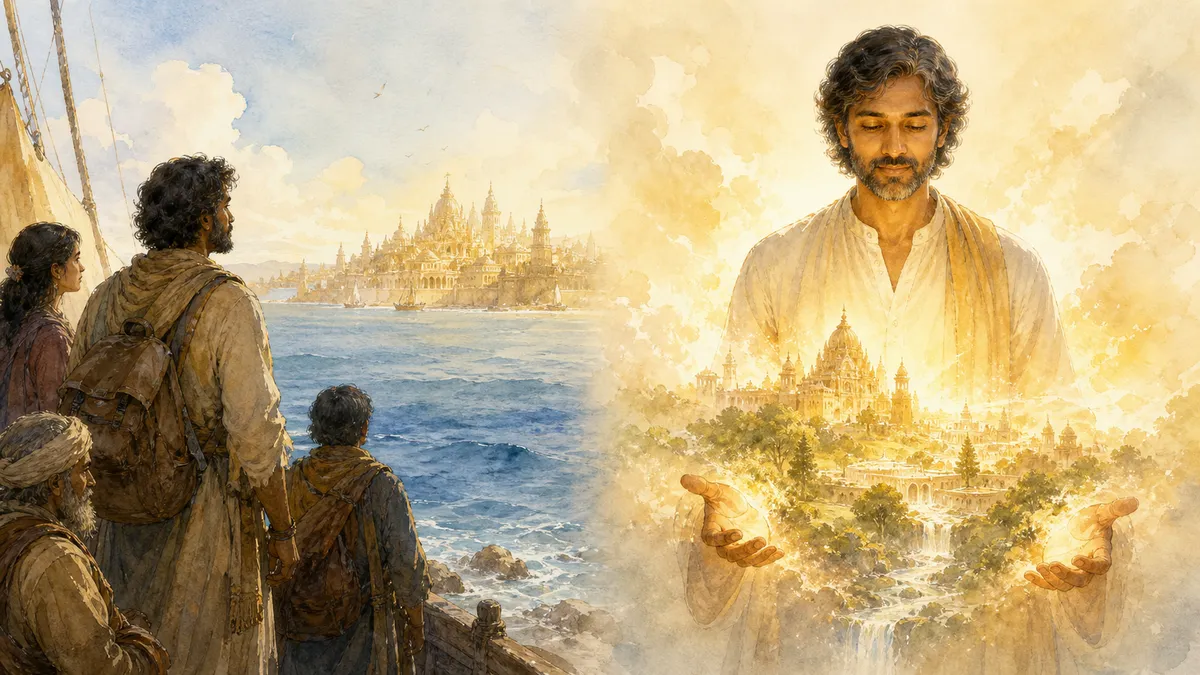
But there is also another option, when you are told: “You need to develop non-dual consciousness. You must change yourself, develop your creative potential; you must discover and create America yourself. You must act as its founding father. You must be so powerful and prepared as to possess such potential.” And these two approaches differ fundamentally.
Vaikuntha-loka and Pure Lands
So, there exists a dimension called Vaikuntha-loka. There are a great many such pure lands. Many of them are connected with Dattatreya as an incarnation of Vishnu. The closest to us are such lands as Shvetadvipa (the White Island), associated with Narayana and described in the Mahabharata, where the inhabitants are constantly immersed in a contemplative bhava (sahaja-samadhi), and various other lands. One of them is called precisely that: Vaikuntha-loka.
On each Vaikuntha-loka, Narayana abides in his four-armed form. Narayana is one of the manifestations of Vishnu. He can also be regarded as a manifestation of Dattatreya’s illusory body. Vai means “without,” and kuntha means “anxiety,” that is, it is a world where there is no suffering or anxiety. Vaikuntha-loka, like other pure lands, lies beyond the influence of the three gunas and the five material elements. Accordingly, people there are not born and do not die.
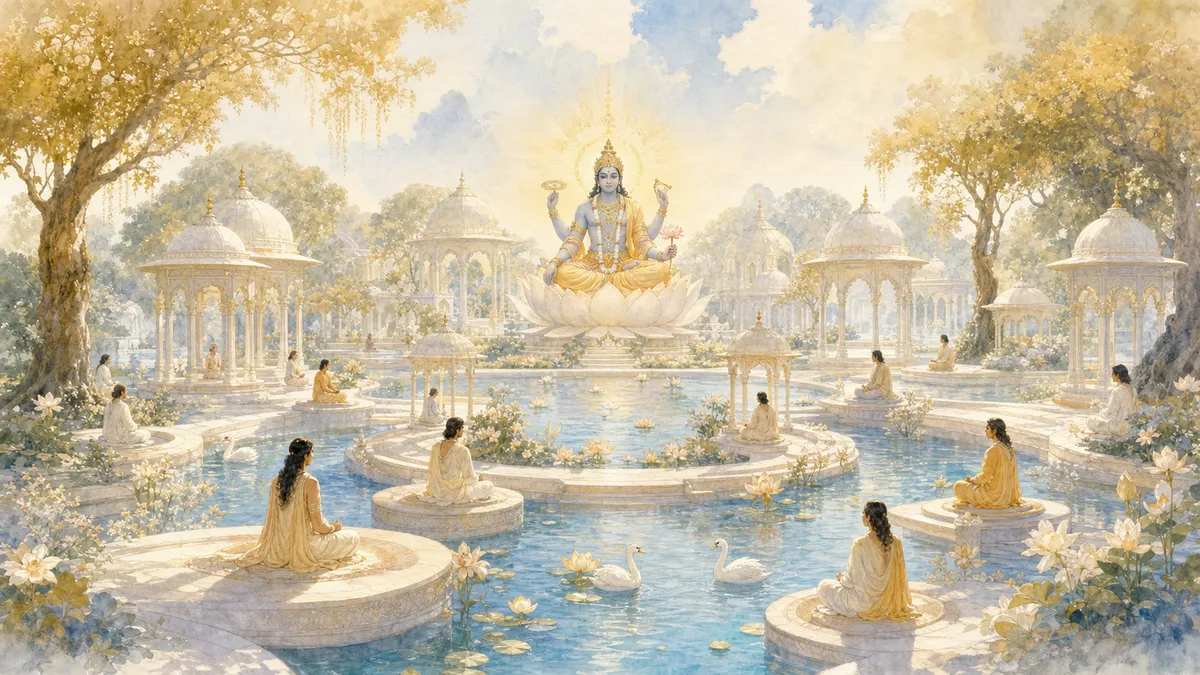
There are a large number of dimensions that can be assigned to the Vaikuntha class. Their common feature is that they are all connected with the energy of harmony and preservation, that is, the energy of the god Vishnu. Some of them were created by Dattatreya and are under his patronage; some by other manifestations of Vishnu, and they are without end.
The system of Vaikuntha lokas is a special realm of karmic vision associated with the guna of sattva. Many mistakenly interpret the word “loka” as planet, saying that it is a spiritual planet. But “loka” in Sanskrit is not a planet. That is, “planet” is, one might say, a populist translation. In fact, this term can be interpreted as a certain realm, dimension, plane, or world.
In such dimensions there is no difference between soul and body; that is, the body has a spiritual nature. Time, characteristic of the material world, flows differently there, and the laws of material time do not extend to such dimensions. Pure abodes like Vaikuntha are not subject to the influence of time; they are not destroyed during pralaya. These dimensions themselves radiate a light many times greater than the light of the sun.
An Example of Visiting Shvetadvipa
The Mahabharata describes an episode in which the rishis Ekadvata and Trita visited another pure land—Shvetadvipa—and were blinded there by the magnificent radiance of light that emanated from Narayana. Before getting there, they performed mind-boggling tapas, austerity, for a thousand years. Nevertheless, when they arrived at Shvetadvipa, they saw that no one joyfully welcomed them, showed them signs of attention, honored them, or even received them as guests, because everyone was very deeply and one-pointedly absorbed in sahaja-samadhi. These rishis were even saddened by this.
And then a voice rang out, saying to them: “It is still too early for you to be in this dimension, because you have not yet practiced enough tapas. You cannot even see Narayana, whose radiance is incredibly strong, so you still need to purify yourselves. You will be able to behold Narayana himself on this White Island and become its inhabitants, that is, attain such liberation, not in this yuga, but in the next, in the Treta-yuga, after you have performed many practices.” These rishis were advised to go back, that is, to return to the northern slope of Mount Meru, where they had previously performed tapas.
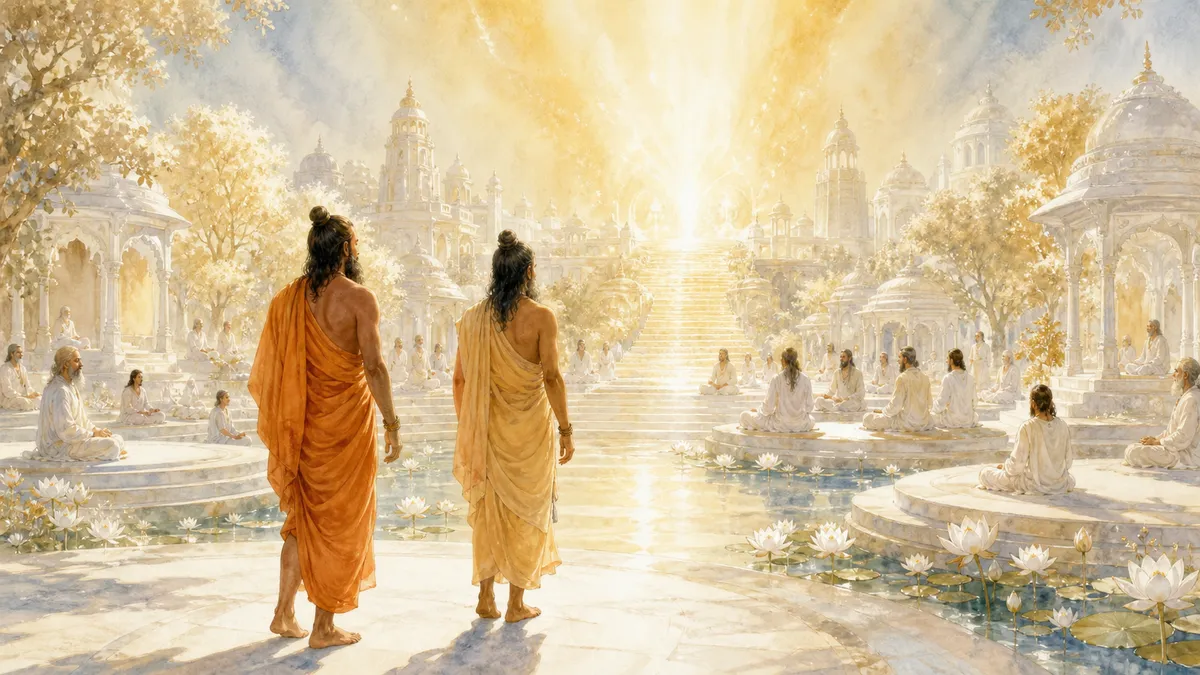
Often such pure lands unite only rishis and saints of the highest level; even ordinary saints or outstanding saints have no access there, not to mention ordinary mortals. All the inhabitants of Shvetadvipa were described as light-bearing, possessing an aura like the sun.
The Structure of Pure Lands
Various pure lands and regions are ruled by illusory forms of deities. If it is Vaikuntha, then these are always illusory forms of a deity associated with Vishnu, some avatar of his, for example Narayana, who is a manifestation of Vishnu, or Dattatreya. Such countless lokas can be compared to various rooms of one great treasury that is overflowing with an incredible amount of riches.
These pure lands are inhabited by those who constantly contemplated sattva-guna and Vishnu in one of his forms, that is, Narayana, Krishna, Vishnu, Dattatreya, and so on. Those who have realized non-duality are the creators of these pure lands, the mandaleshvaras. Those who performed dualistic worship are peripheral deities of the retinue, inhabitants of this loka. That is, they are all pure, their bodies have a spiritual nature, but even in such worlds there is a difference in spiritual level.
The three gunas do not extend their influence to lokas of the Vaikuntha level, and the energies that exist there are a manifestation of the inner energy of the Absolute. They are completely pure and manifest as play. There is no law of cause and effect there. If any laws operate there, they are closer to parasattarka logic. There is no law of karma inherent in the world of humans. In these energies there is not the slightest sign of material contamination—the impure vision inherent in the world of humans.
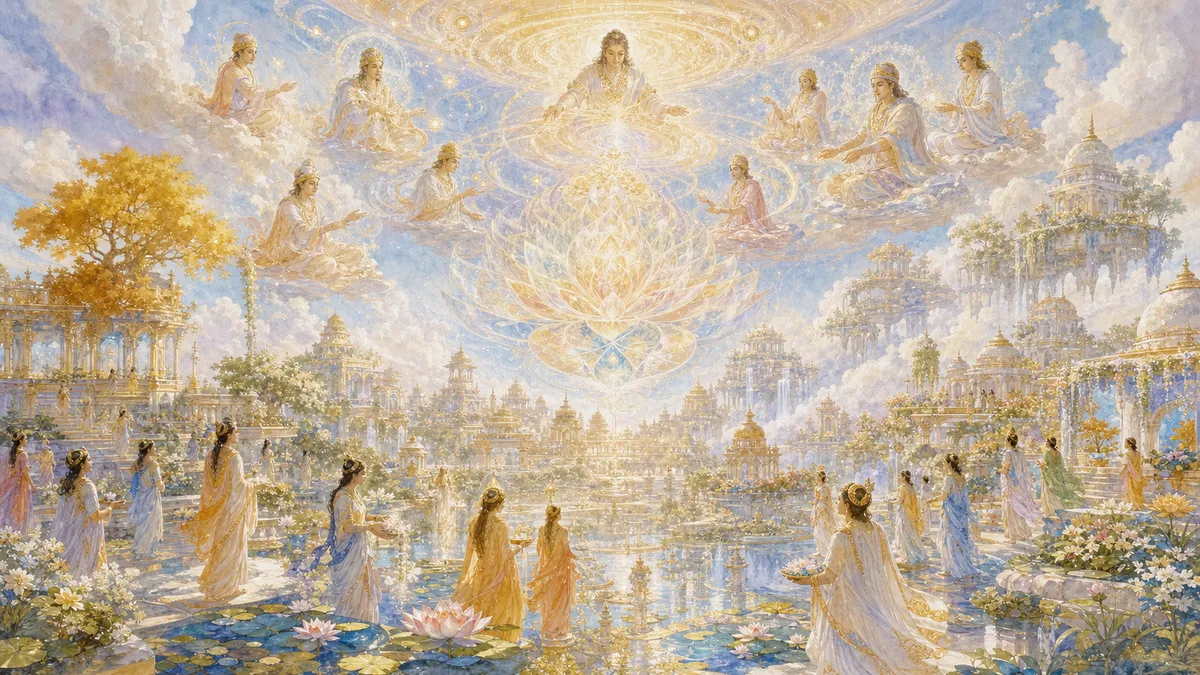
All attributes of material existence, such as suffering, egoism, ignorance, anger, envy, are completely absent. The guna of passion is absent there; nothing is created there. The guna of tamas is also absent there, that is, nothing is destroyed or ruined there.
In the spiritual world, material qualities, as we imagine them, are completely absent. There everything exists eternally, everything is filled with bliss and knowledge. How can this be described? There all objects possess the nature of consciousness, that is, every object can speak, think, move, and can see or hear with any part of its body. Even birds or flowers can read the Vedas, communicate on a telepathic level, and so on. Existence itself there is also full of bliss; it never ends, but lasts eternally.
The laws of time and space, which on Earth manifest as past, present, and future, also do not operate there. Nothing there is subject to the influence of time. For example, in the external, material world, energy always forces us to reckon with it, and we cannot by the power of consciousness abolish the laws of material nature, at least if we have not reached the level of a mahasiddha. But in such worlds, energy is directly connected with consciousness; it is governed precisely by it.
Inhabitants of Pure Lands
Living beings in lokas similar to Vaikuntha never forget their true essence, never leave the contemplative state of absorption in the Absolute. They always remember abiding, are always in presence, always immersed in bhava and mahabhava—deep one-pointed concentration on various aspects of the Absolute. Differences exist among them, but they are qualitatively the same. The difference exists in connection with which bhava each of them is absorbed in. For example, someone is absorbed in majesty, another in love, a third in the qualities of all-pervasiveness, and so on.
And these living beings are always in a state of complete self-surrender, that is, they already always feel themselves to be the Absolute, but they have bodies and energies, and their playful individuality also exists. They are all one in the absolute view, but as individualities they always play at creative manifestation.
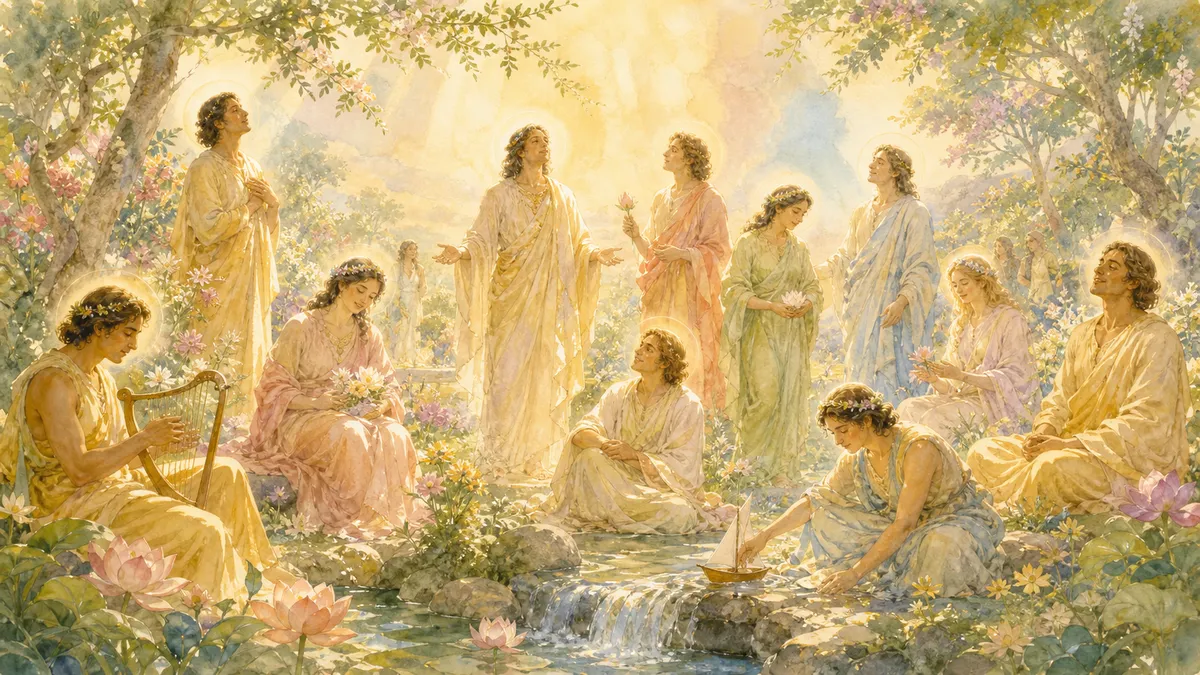
In such worlds there are various qualities, but they have nothing in common with material qualities and elements, since everything there is boundless and filled with purity. All objects there radiate luminosity, but there is no sun or moon like ours there, since ida and pingala, in the usual sense, are also absent. The sun and moon are manifestations of two drops—the white and the red—as well as of two channels—ida and pingala—in this world. They are interconnected with our body. We can perceive the sun because we have pingala. We can perceive the moon because we have the ida channel. But in these worlds, the source of light is simply the transcendental radiance of the Absolute.
Also, various goddesses who sustain this world constantly abide in such worlds. For example, goddesses of prosperity like Lakshmi. They are always surrounded by their illusory bodies in the form of friends, maidservants, and so on. This is called the deity’s retinue. They abide in their mandalas and continuously appear precisely in such surroundings, creating around themselves a transcendental atmosphere of play, joy, merriment, abundance, and prosperity. All these deities continuously worship their goddesses as manifestations of the supreme Absolute, and these goddesses, in turn, worship the supreme Absolute. If this world is ruled by Narayana, then they worship Narayana, and if by Dattatreya, then Dattatreya.
All living beings—the inhabitants of these worlds—are connected with one another by samaya, by subtle relationships; that is, there is no attachment, anger, jealousy, or rivalry among them, but there is a spiritual samaya connection.
The Appearance and Abilities of the Inhabitants
The inhabitants of these worlds can move freely through the lokas by the power of the mind. They do not need to travel by car or on foot, as in the world of humans. Their bodies radiate a sky-blue glow. They have very beautiful eyes, which are described in the texts as being like lotuses. They are often clothed in yellow garments. Their appearance is distinguished by great attractiveness. Looking at any refined iconographic images, you can imagine that all the inhabitants of these worlds have precisely such subtle and beautiful bodies of their avatars.
All of them are in the bloom of youth, that is, like 14- or 16-year-old boys and girls. If they are beings who previously worshiped four-armed forms, then they also have four-armed forms. On each of these arms there may be magnificent ornaments—pearl necklaces with decorative medallions, which also radiate a bright glow. These ornaments are a manifestation of pure vision; that is, bhava and radiance at such a level manifest in the form of energy. It is said that their heads are adorned with garlands of lotus, they have earrings in their ears, and the luster of their skin is like the radiance of corals or diamonds.
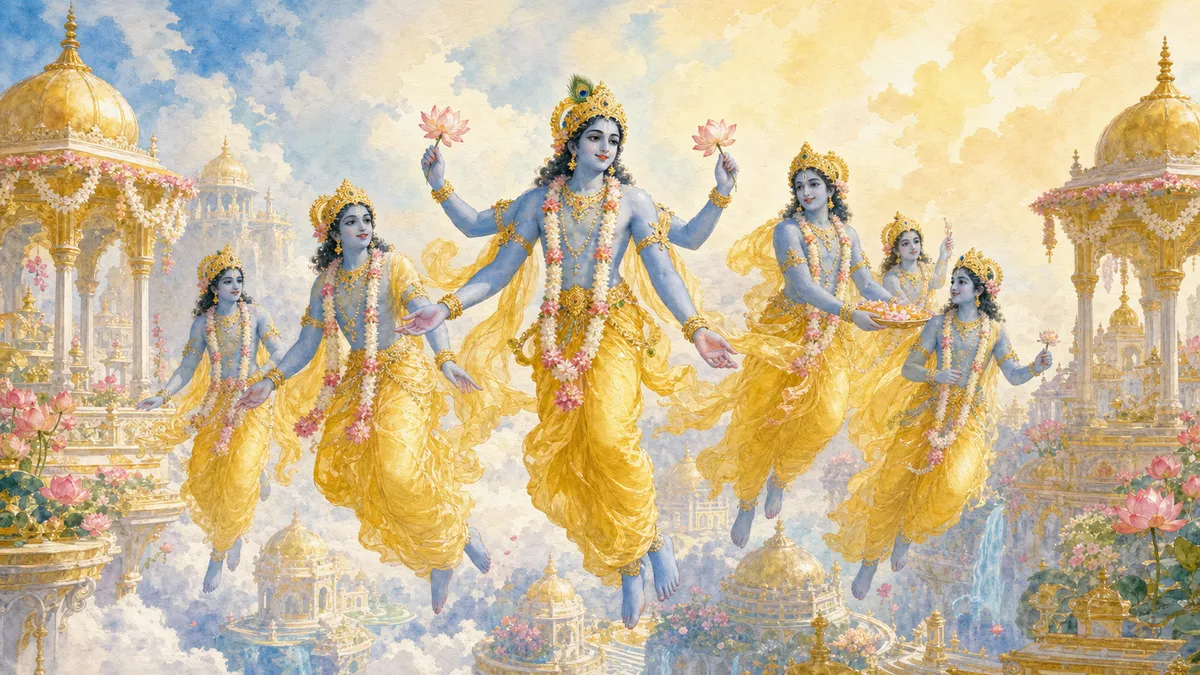
Around such dimensions in Vaikuntha-loka fly magnificent, beautifully adorned vimanas (aerial ships of the gods), from which emanates a bright radiance like flashes of lightning. These vimanas belong to the great yogins who inhabit these lokas. Various gods can also travel on them, that is, the local inhabitants, surrounded by dazzlingly beautiful spouses as their energies.
Many of the goddesses of prosperity, possessing such illusory bodies, often serve the deities of these dimensions together with their companions, who honor them as their mandaleshvaras. Their companions serve them as central deities, and they serve the lords of these dimensions by performing either chants, or magical rituals, or bhajans.
Palaces of the Mandaleshvaras
If in this country one visits the palace of the chief mandaleshvara, the deity who governs it, one can see him seated on a throne. His palace is richly adorned. Around him there are several lines of guards and servants, and he is surrounded by various energies—all of them symbolize different aspects of the personality of these deities. It seems that they are independent separate beings, but these are illusory bodies that reflect one or another side, that is, avatars, particular manifestations of one and the same deity. Such dimensions are gigantic in size, and spiritual bliss reigns in all of them. These dimensions themselves radiate light; there are no artificial sources of power there.
There are various names for such lokas. For example, Purushottama-loka, Trivikrama-loka, Hrishikesha-loka, Keshava-loka, Aniruddha-loka, Vasudeva-loka, Ayodhya-loka, Pradyumna-loka, Dvaraka-loka, Sankarshana-loka. Within the dimension of these spiritual abodes of Vaikuntha there is a large number of different districts, small regions, each of which has its own ruler—a mandaleshvara in the form of a complete avatar (purna-avatar), the chief mandaleshvara.
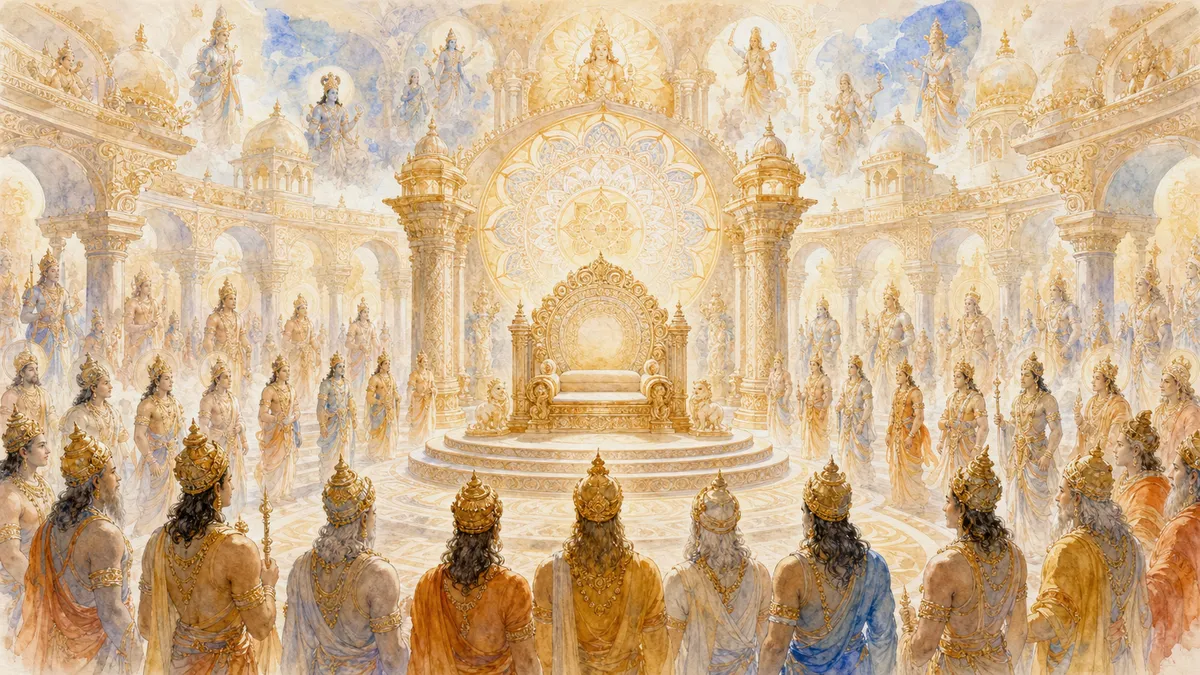
Such a ruler may have a form like that of Dattatreya, possessing several arms in which are a trident, a conch, a mace, and so on. Or he may have the form of Narayana and hold in his hands a conch, a lotus, a mace, and a disc. Depending on the particular features of the realm, these emblems are arranged differently in the hands, which means that a certain energy predominates in one realm or another.
The Structure and Inhabitants of the Divine Dimensions
In such dimensions there are four directions, corresponding to east, west, north, and south. Various deities are situated in these directions. For example, one of the abodes of Narayana is described as a divine city called Ayodhya. It is envisioned as a mandala with four entrances guarded by sentinels.
This city is inhabited by divine women and men who live eternally and always remain in the bloom of youth. There are millions of palaces there. In the center of the city is an open square with the tallest palace. Thousands of columns rise there, adorned with rubies and other precious stones, and in the center stands an extraordinarily beautiful throne.
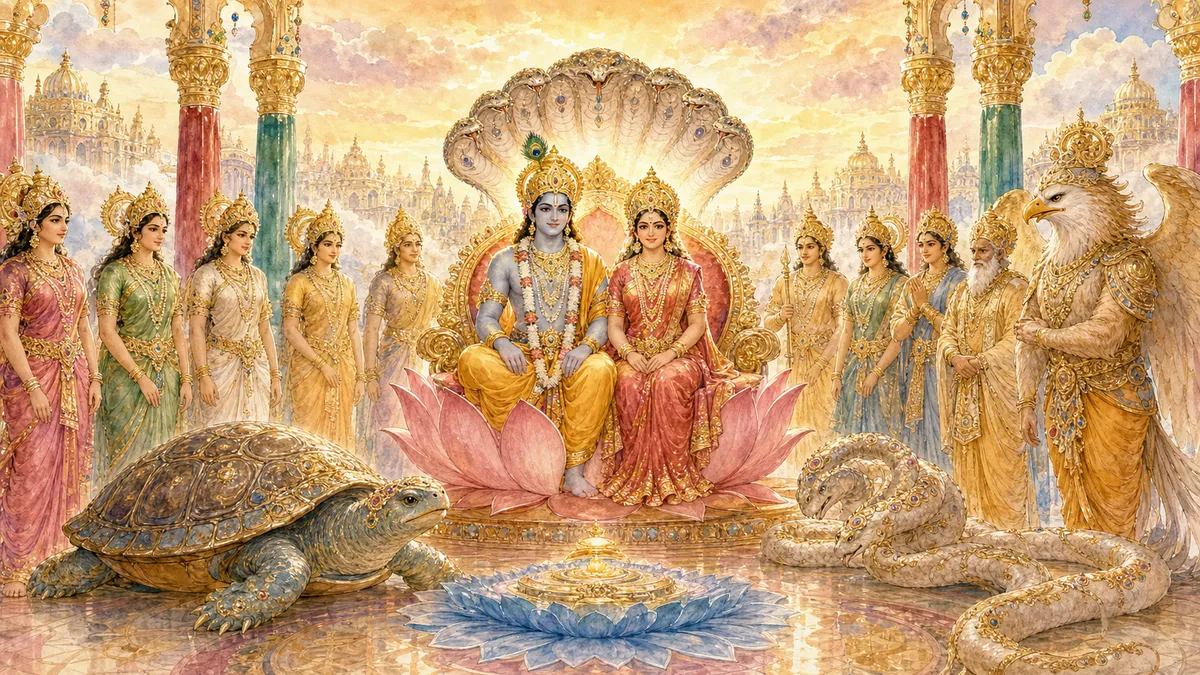
In the appropriate order, the personified Vedas are situated there: the Rigveda, Yajurveda, Samaveda, and Atharvaveda. The throne is always surrounded by embodied deities such as Dharma, Righteousness, Knowledge, Wealth, and Renunciation. The bodies of these deities radiate brilliance. The throne is also surrounded by various powers: shakti (power), chit-shakti (the power of mind), and adhara-shakti (the sustaining power).
In the center of the palace abide the rays of the sun, the moon, and fire. Also present there are the King of Serpents (Ananta), Kurma (a mighty being who supports the material worlds), and Garuda. There is a divine throne, at the center of which is an eight-petaled lotus. It emits a radiance as bright as the rising sun. Upon it sits the supreme Being together with the goddess of Prosperity. The color of his body resembles the petal of a blue lotus. It radiates a very bright brilliance, like a million suns. His hands, in which he holds a conch and a disc, also shine. On his left thigh sits the goddess Mahalakshmi, possessing a golden body and four arms. Her hands hold two lotuses, and her body also radiates brilliance.
The Nature of the Inhabitants of the Vaikuntha-lokas
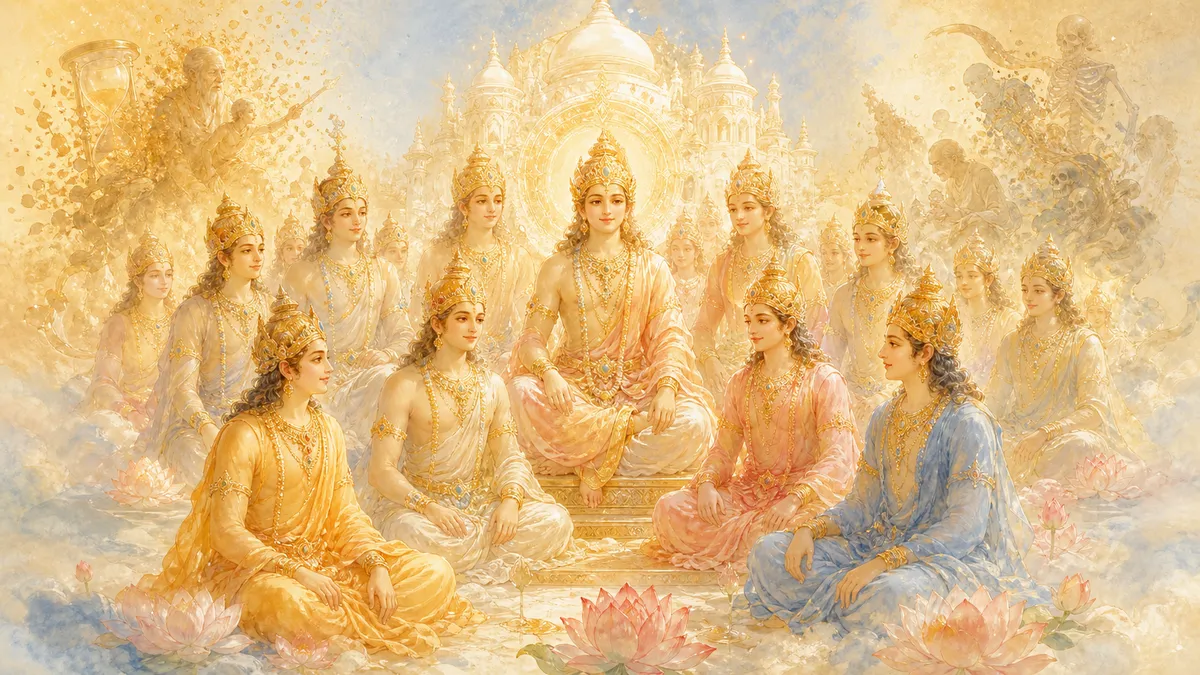
What can be said about the inhabitants of the Vaikuntha-lokas? They are all youthful, like the ruling deity, and they are all immortal. They look like young men and women of fifteen to twenty years of age. They wear yellow silk garments adorned with flower garlands and various attributes. They all have illusory bodies similar to the ruling deity, and therefore one may conclude that they have all attained one of the levels of liberation, at least sarupya-mukti and salokya-mukti.
Perhaps not all of them have realized the nondual state. Those who have attained incomplete liberation are peripheral deities, that is, deities of the retinue, and they worship one of the incarnations of Vishnu or Narayana, venerating him precisely as the absolute deity. They are in different bhavas, that is, in different relationships with him—as servants, beloveds, and devotees.
Their bodies radiate brilliance, and their eyes resemble the petals of a reddish lotus. Helmets adorn their heads. They are all adorned with necklaces, bracelets, and earrings. It is said that they are all filled with happiness and know no suffering. They live eternally, remaining youthful and enjoying life in complete knowledge and bliss. They have no fear of birth or death, they have no old age or disease, and they do not experience the influence of Kala (eternal time).
Relationships in the Spiritual Worlds
They have relatives, companions, wives, and husbands, but they do not engage in sexual relations, and no children are born to them. All of them are extraordinarily beautiful and have relationships with one another, but these cannot be called attachments. They do not enjoy intimate closeness.
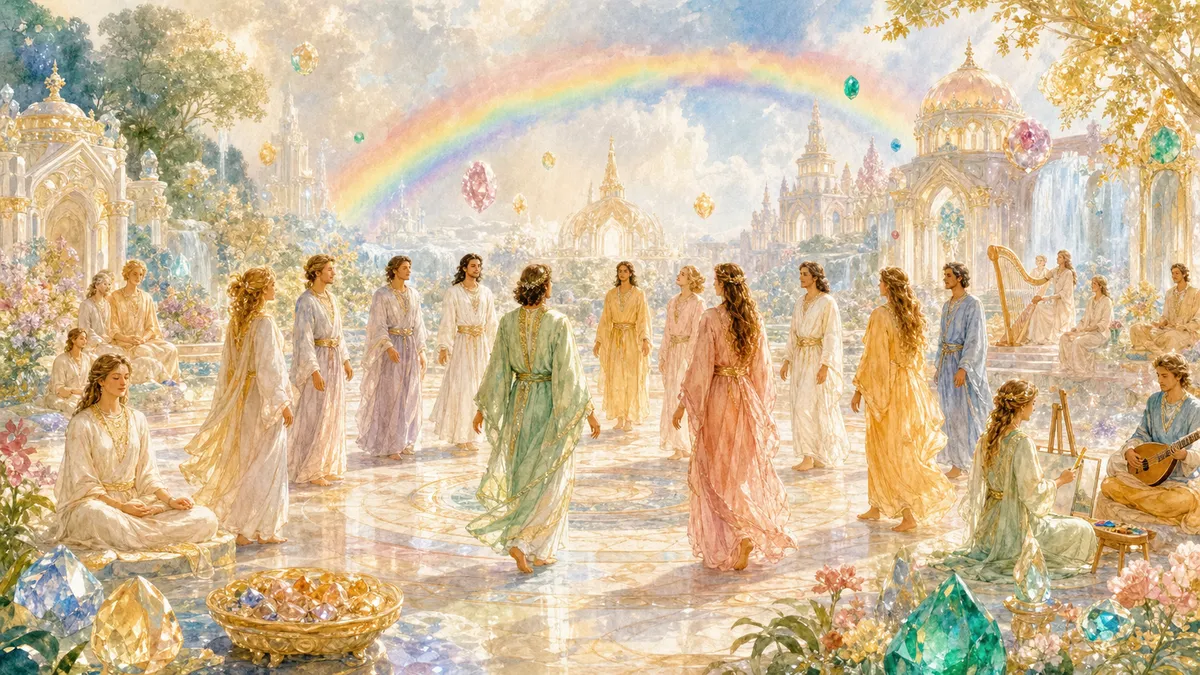
In some worlds, there are relationships between men and women, if they can be called that, but these are not sexual relationships. For example, in one of the worlds, deities (if they are worldly deities, not monks) feel a certain sympathy for one another at the level of the anahata chakra, and then an interaction takes place between them: they invite each other to something like a spiritual dance. When such a spiritual dance begins, a rainbow lights up in the sky. If their consciousnesses harmonize with one another and they enter into certain relationships with one another, then a rainbow rises in this area, symbolizing the convergence of their consciousnesses. But they have no bodily relations there, no attachments. Rather, this can be called the principle of mutual worship.
If these are higher deities, then all the energies with which they enter into relationships are their own energies; they are their illusory bodies. It is said that even surrounded by their consorts, smiling beauties, the inhabitants of Vaikuntha do not yield to the temptation of passion, remaining indifferent to their smiles and beauty. All of them are engaged in continuous abiding in samadhi and in various kinds of creativity. There is no shortage of precious stones and emeralds there, but ornaments made of subtle-material elements are obtained not through hard labor, but simply by blessing.
The Spiritual Nature of All Manifestations
The inhabitants of such lokas are very powerful; they always radiate light. Women in such dimensions are beautiful like the goddess of prosperity. All of them are manifestations of various aspects of female deities associated with prosperity.
Birds and animals also exist there, but they too have a spiritual nature. There is no difference between birds and people, since everything spiritual is filled with diversity; that is, it is the same enlightened consciousness, simply having taken such a form. Such birds and animals can also sing the Vedas, repeat mantras, and perform bhajans.
There is also what in the human world is called trees and forests, but this differs from trees or forests in the human world. Such trees possess a spiritual nature. At any time of year they are covered with flowers and fruits. They fulfill the wishes of those who approach them; that is, they are extraordinary trees. Flowers picked from such bushes and trees always remain fresh, never wither, and garlands made from such flowers preserve their fragrance.
As consciousness is purified, deepening into pure vision and bhava, the yogin can perceive the manifestation of such pure dimensions even in his own life and in his surroundings.
