Allegory of the King and the Minister: Conquering the Mind and Knowing the Self
21.06.2026
0 мин. чтения
0
Share
copy
search
add
share
Vasishtha gives Rama the following instructions:
Rama, transform your mind, as King Bali did. I will tell you a tale about Bali; by listening to it, you will attain knowledge of the eternal truth.
Vasishtha continued:
Somewhere in the universe there is a world called Patala. In it live indescribably beautiful she-devils, strange reptiles with many heads, demons with enormous bodies, elephants of monstrous size; there are places flooded with filth, where terrifying sounds are heard in the air, caves full of precious stones, places where the sage Kapila traveled and thereby sanctified them, and places where King Hatakeshvara himself was, loved by the celestial nymphs.
This world was ruled by King Bali, the son of Virochana, born of the demons. The ruler of the entire universe himself, Shri Hari, was Bali’s protector, and therefore Bali was respected even by the king of heaven, Indra. From Bali’s splendor the oceans could have dried up, and with a single glance he could move mountains. He ruled his world for a very long time.
The Spiritual Crisis of King Bali
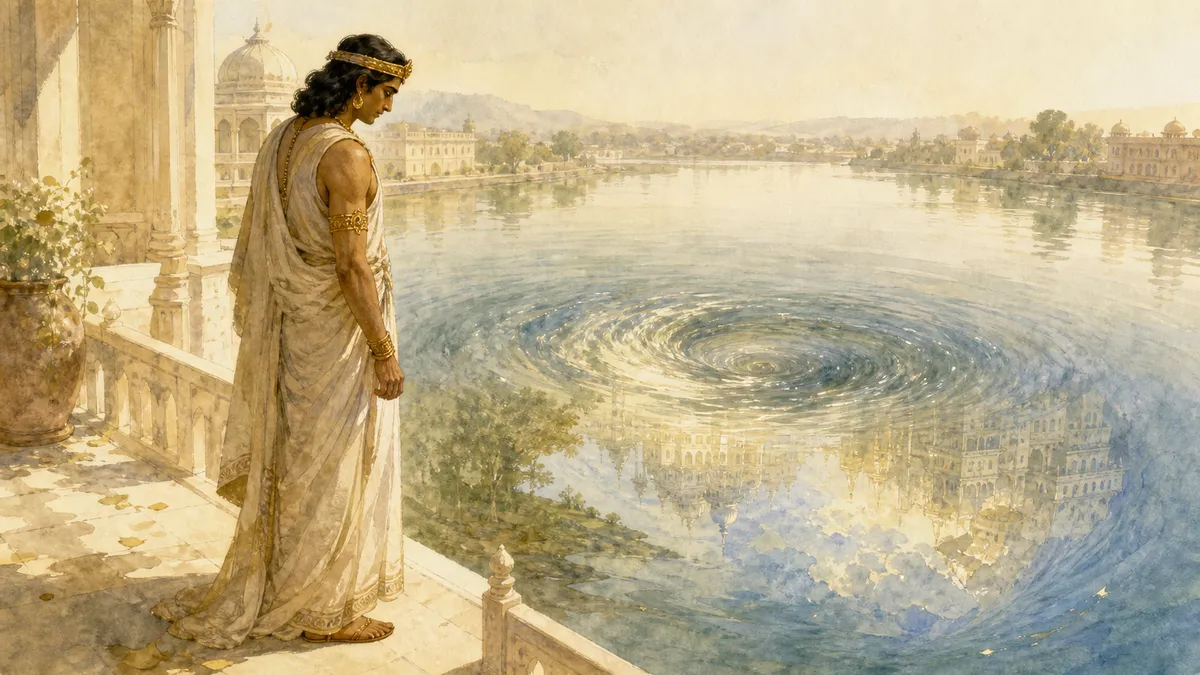
One day King Bali was overcome by melancholy, and the following thoughts came to him: “How much longer must I rule this kingdom, how much longer must I wander under the sway of the three worlds (meaning the underworld, the earthly world, and the heavenly world)? What is there for me in this rule? Everything here will someday perish and be destroyed; how can happiness be found in all this? Again and again the same loathsome pleasures, the same problems day after day—and how have the sages not yet grown tired of it? The same day and the same night, again and again; life in this world is like a whirlpool. Doing the same thing every day, how can one get out of this whirlpool? How long must we be spun around in this vortex, and what is the meaning of it all?”
In this state he remembered an old conversation:
“Ah, I remember what my father Virochana once told me. I asked him: ‘Father, what is the purpose of this visible world and of repeated existence? When will it come to an end? When will the deceptions of the mind cease? What must be attained in order to become completely satisfied, what must be seen so that nothing more need be sought? I see that this cannot be attained through the pleasures of this world or through good deeds. On the contrary, they entangle one more and more! I beg you, reveal to me the way to be forever in transcendent bliss.’”
Virochana’s Teaching on the Supreme Reality
Virochana replied:
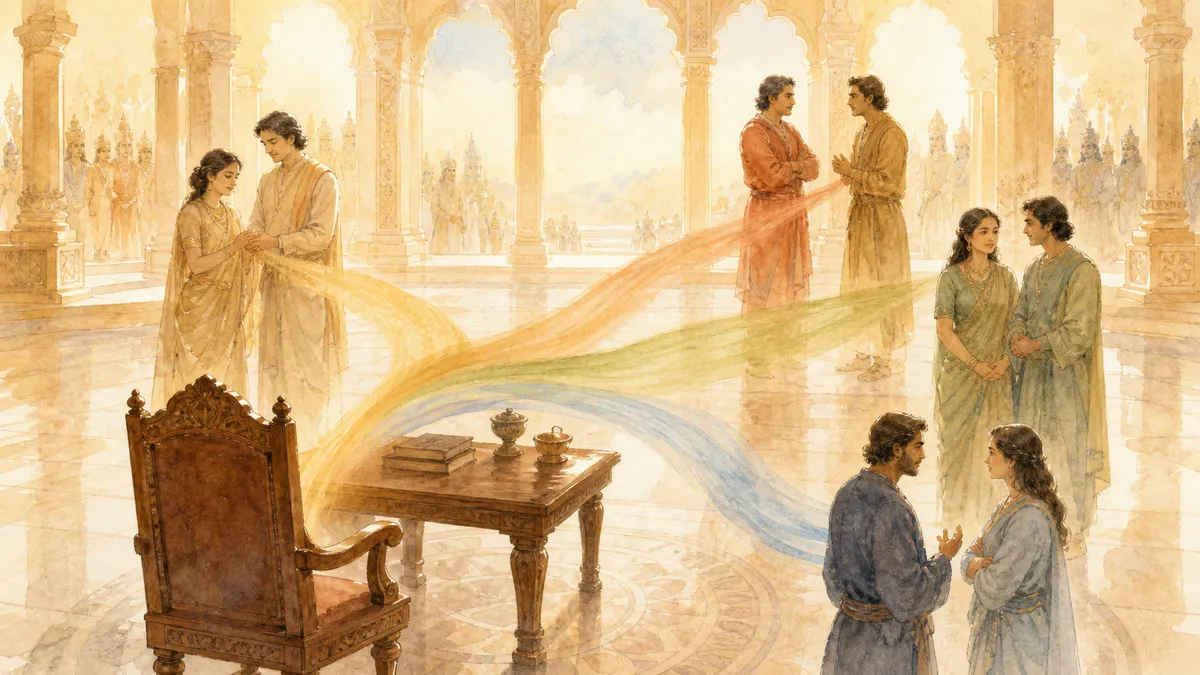
My son, there is an immense reality, immense enough to absorb all three worlds. In it there are no lakes, no oceans, no mountains, no forests, no rivers, no earth, no sky, no wind, no moon, no gods or demigods, no demons, no vegetation, no concepts of high or low, no words, no me, and not even gods such as Vishnu. There is only one thing there, and that is the supreme Light. It can do everything, it is everywhere, it is all this, and it is always silent and inactive. It is the mighty ruler. It has a minister. Prompted by the ruler, the minister works constantly—what did not exist before, he creates, and what already existed, he changes. This minister is incapable of taking pleasure in his work or in anything else, and he knows absolutely nothing; but although he is dull and insensible, he does everything for the sake of his ruler, the King of all. And the King abides in silence, in the greatest bliss.
“Father, what is this reality free from disease? Who is this minister, and who is the King? The story is remarkable and unheard of; I ask you, explain everything to me in detail.”
Virochana replied:
All the gods and all the demons together, even if their powers were multiplied a hundredfold, cannot even move this minister from his place. He is not Indra, the king of all the gods, nor the god of death, nor the god of wealth; he is not a god at all, nor a demon with whom one can do battle. Although it is said that the god Vishnu killed demons, in reality it was this minister who defeated the demons. In fact, Vishnu himself was defeated by this minister and was then born again. Love draws its strength from this minister. Anger also draws its strength from this minister. According to this minister’s will, good always opposes evil.
This minister can be defeated only by his ruler and by no one else. When such a desire arises in the ruler’s heart, the minister becomes easily vulnerable. He is the strongest in all three worlds; all three worlds are his exhalation! Only a true hero can defeat him.
When the minister appears, all three worlds become manifest, as a lotus flower opens at sunrise. When he withdraws, all three worlds also fall asleep. Only a true hero, with a mind sharp and completely freed from stupidity and deception, can defeat him. If the minister is defeated, all the worlds and everything in them are also yours. If he is not defeated, nothing has been conquered, even if you think you have attained this or that in this world.
Therefore, my son, in order to attain absolute perfection and imperishable happiness, make every effort by all known means to defeat the minister, despite all complications and difficulties.
“Father, how can this mighty minister be defeated?”
A Reasonable Approach to Subduing the Mind
Virochana replied:
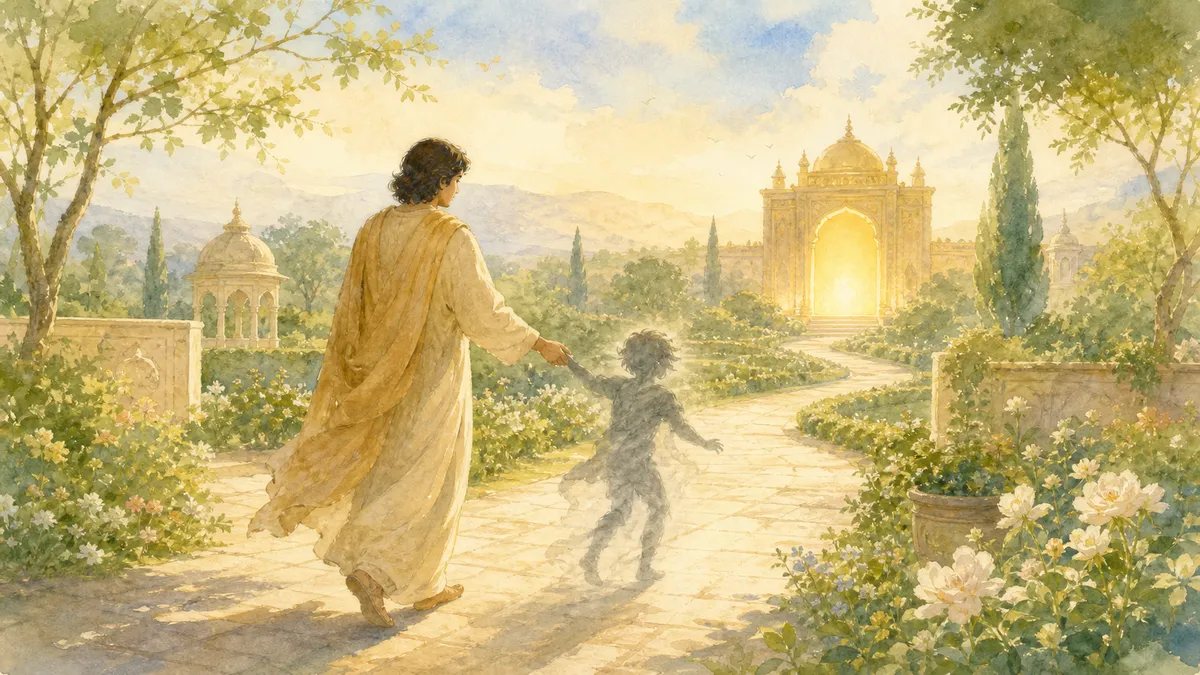
Although this minister is almost invincible, my son, I will tell you how to win victory over him. He can be defeated in an instant if he is seized with a reasonable grasp; without this grasp of reason, he will burn everything around him like a poisonous snake. Whoever approaches him reasonably, plays with him as one plays with a child and, in play, weakens him, will be able to see the king himself and become established in the supreme state. For the minister unconditionally submits to the one who has once seen the king; and when the minister is subdued, the king is seen without obstruction. Before you see the king, the minister is not truly subdued, and as long as he is not subdued, the king will not be seen! As long as the king has not been seen, the minister creates chaos and multiplies sorrow; as long as the minister is not subdued, it is impossible to see the king. Therefore, the reasonable approach must be from two sides at once: to see the king and to subdue the minister. Through intense effort and constant practice, both can be attained, and then you will enter those realms, and suffering will never have power over you. This space is inhabited by the righteous, who have attained infinite peace.
My son, I will now explain everything to you in detail! This space of which I spoke is the state of liberation from all suffering. The king is the supreme “I,” the infinite reality that surpasses all other realities and states of consciousness. The minister is the mind, which has created this entire world as a pot is made of clay. When this mind is defeated, everything is defeated. Remember that the mind is almost invincible except through a reasonable approach.
The reasonable approach is jnana yoga, and the quintessence, the core of jnana yoga, is prajna yantra, the laya yoga teaching on contemplation. A reasonable approach means that we act in two ways simultaneously: we try to subdue the minister, that is, to pacify the mind, and we try to see the king, that is, from the very beginning to penetrate into the immaculate view. Until the mind is subdued, the minister of infinite awareness cannot be seen, no matter what we fantasize or invent, no matter what practices we perform. For there is Dharma with an unsubdued mind, and there is Dharma with a subdued mind. And these two Dharmas differ as much as heaven and earth. Whatever Dharma you belong to, it is all about this alone.
Often a person does not understand this: he tries to look for this or look for that, to do this or that, thinking that perhaps he will find something there. But in fact he will find everything as soon as he subdues his mind. For the whole point is precisely to subdue this minister. But by what means can he be subdued? It is said that the minister can be subdued only when the king exerts influence on him or when you see the king. True subduing of the mind comes at the stage when we come into contact with that which surpasses this mind. When we break through the veil of conceptual awareness and enter the pure non-dual space and, having become established in it, assume a governing status in relation to the mind, we become the heart of the mind, and then the mind naturally pacifies itself and takes Refuge in this higher state.
All of this seems to be very subtle matters, but know this: your entire destiny, your entire future depends on whether you resolve these subtle matters or not. It is being decided right here in these explanations, in these words. And your whole life will consist of again and again trying to conquer this minister and see this king. Your entire future is at stake, all your next lives, all your karmas, the bodies you will accept or not accept—everything depends on this. These are very important truths. Even the gods treat these truths with great reverence.
Our intelligent approach consists in trying to conquer the intellect and immediately penetrate into the state of the king, in order to gain a certain understanding and spiritual power. If you have seen the king at least once, your illusions fall away, although many karmas, samskaras, and vasanas still remain, but you already distinguish the first from the second. Fundamental illusions are no longer able to cloud your intellect. Until you have seen the king, your mind can still be seriously mistaken. This is the difference between one who has received “birth” and one who has not, or at least one who has received a “taste” and one who has not.
“Father, please tell me about this intelligent approach by which the intellect can be conquered.”
Freedom from Desires as the Path to Liberation
Virochana replied:
The best way by which the intellect can be conquered consists in complete freedom from desires, hopes, and expectations with regard to any things at any time.
“Complete freedom from desires, hopes, and expectations with regard to any things at any time” is a phrase that could be engraved somewhere in golden letters.
We always have desires and expectations with regard to many things. Some desires are conditioned by the body, that is, by what is given, by prarabdha karma. But some are conditioned precisely by our deluded intellect. The satisfaction of these desires is nothing other than the continuation of these delusions. But the whole point is to find the one who desires and become free from such dependence.
Virochana says:
It is by this very method that this powerful elephant (the mind) can be tamed. This method is at once very easy and incredibly difficult, my son—it is very difficult for one who does not practice seriously, but easy for one who is sincere in his efforts.
Virochana speaks of abandoning clinging, attachments, hopes, samsaric expectations, and of becoming established in one’s own nature.
Imagine that you are to spend the rest of your life in a dark retreat or in a strict retreat. Or imagine that you will never again spend even a single second in retreat. For one person one thing is “torture,” while for another it is something else. But if your intellect perceives this with equanimity, knowing that both one and the other, in principle, are phenomena of the same order, if nothing in it stirs, if it cannot be touched by this and continues its contemplation, then this means freedom from desires with regard to any things at any time.
To have prospects or to have none at all, to have a wonderful future and plan it, or to have no future whatsoever, to have a beautiful past or a negative one. To cut off all hopes and desires is possible only if you rise above them and become established in something even subtler—in that which is their essence, but is not connected with them, in that which is transcendent in relation to them. If you can become established in this, then there are no problems with it, because you will see that all your hopes, plans, and notions were nothing other than delusion; therefore, it is not a great problem if they depart. When we do not understand this as delusion, it is a problem. But when we rise up and become established in a subtler vision, we see that this truly is delusion, that there was no problem in it from the very beginning.
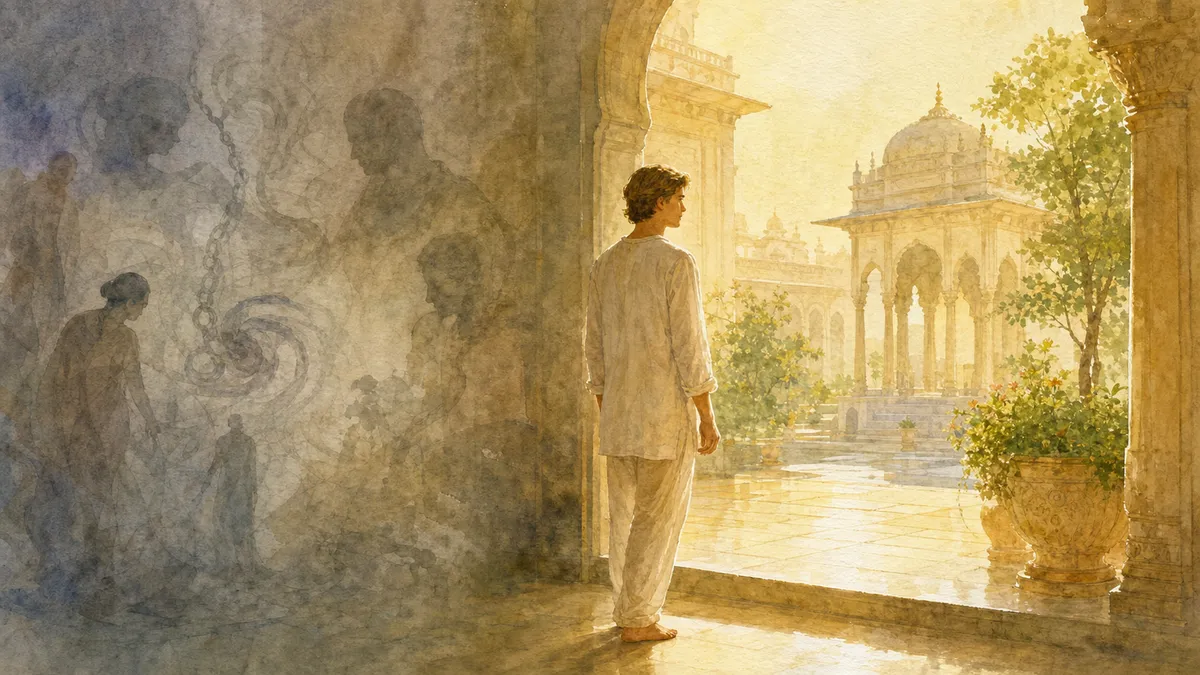
This is like a person in a dream deciding to buy a glass of water, for which he was asked to pay a little bag of gold. He bought the water because it was hot, and he felt better. But then greed arose in him, and he began to think: “I gave a little bag of such precious gold for just a glass of water!” Although the bag was small, it was still gold. And this thought gave him no peace; it simply consumed him. Then he woke up and saw that he had not bought any water, that there had been no little bag of gold; he had simply dreamed it all, and so he just laughed—the problem had been invented from the very beginning, illusory. In the same way, when we establish ourselves in this supremely subtle awareness, we see that all desires, all plans, all actions, all perceptions, all ways of viewing, all ideologies, all constructs, all kinds of worlds are like this. And then we become completely free from them. This does not mean that we do not act or cannot act. We can act, but now it is entirely different: now it is not conditioned cause-and-effect activity, but a manifestation of the play of energies. That is, there is a great difference here.
The Difference Between Action in Ignorance and Action in Wisdom
And what exactly is the difference? The difference is that we begin to live according to Vasishta’s instructions; we understand that a cause does not create an effect. An illusory vision arises, as if the effect follows the cause in the same way as a crow that lands on a palm leaf while, at the same time, a coconut falls from above. When there is the law of karma, there are causes and effects, there is rigid connectedness, linear dependence. When there is no law of karma, but there is lila, there are no causes or effects at all. Worlds are instantly created and destroyed, while to other people it seems as if causal sequences are mutually dependent and linked, as if the effect follows the cause. But in reality, in the state of play, there may also be circular causality; the effect may generate the cause, or there may be no connection between them. That is, everything appears random.
Action in such a state is a manifestation, the blossoming of energy; it is the minister acting by the order of the king. Action in ignorance is the minister acting willfully, independently, foolishly, and dangerously. To be in ignorance, not to control the mind, and not to see the king means to act recklessly, foolishly, and dangerously. Conversely, the one who sees the king and subdues the minister acts in the very best way. He acts beneficially for all living beings. All living beings who do not see the king and do not control the mind act recklessly, foolishly, and dangerously. This is so because they always have to suffer and be reborn as a result of their reckless actions. All those who discover the king and conquer the minister are true heroes. Their actions are always filled with benefit for living beings.
The Necessity of Constant Practice
Virochana says:
One cannot gather a harvest without sowing the field—one cannot conquer the mind without constant practice. Therefore, engage practically in renouncing desires. Until you turn away from the gratification of your sense organs here, you will continue to wander in this world of disappointments. Even the strongest of people will not reach his goal if he does not move toward it. No one can attain the state of infinite peace without persistent practice.
Practical renunciation of desires means that we cut off the mind’s tendency to follow fantasies, illusions, and uncontrolled energies. In fact, to cut off desires as such altogether, as long as you have a body, is impossible. At the very least, you have the desire to eat, sleep, and so on. But the point is that we are not trying to stop the functioning of energies; on the contrary, energies should move freely and not be constricted. We are trying to stop the mind’s tendency to cling to various movements of energies and to create unnecessary movement of energies—this is the art of self-liberation. Gratification of the senses in this case means seeing a sensory object, hearing it, smelling it, or touching it, and at the same time, instead of contemplating, falling under the influence of what is seen, heard, or smelled. Non-gratification of the senses in this case means continuing to contemplate against the background of smell, touch, and so on; that is, instead of falling under the energy of the object of the sense organs, joining one’s contemplation with it and self-liberating the perception arising in the body, leaving the mind pure.
This also applies to the fluctuations of the mind. If we allow thoughts to move but do not self-liberate them, they leave imprints in our mind. If we self-liberate our thoughts, our mind is purified. One who has a self-liberated mind never has problems. He moves along the path easily, naturally; his development happens by itself. One who does not self-liberate the movement of thoughts makes many mistakes and sometimes marks time.
Subduing the Minister and Seeing the King
When you have mastered the method of self-liberation, it means that you have subdued the minister. But this alone is not enough, because one must also constantly see the king. Constantly seeing the king means worshiping the higher “I” with the lower mind (manas), performing continuous self-surrender to this higher “I” until self-transcendence occurs, remaining in constant devotion and meditation on the higher “I,” opening oneself to the descending power and light of its grace, bathing in this grace, becoming imbued with this light, removing the last blockages of karma.
One who bathes in this light and becomes imbued with it has no spiritual problems, since he constantly lives under blessing. But one who tries only to pacify the minister and does not know that one must also meditate on the king remains at the level of his own will. And even if his mind is pacified, he is not yet under blessing. His own notions of himself as an ego have not yet dissolved. This is the meaning of the transition to the second stage of contemplation—self-transcendence.
One who has approached self-transcendence moves confidently toward enlightenment. One who has pacified the mind but has not approached self-transcendence goes round in circles; he cannot cope with the deep, subtle layers of karma. And usually such people say, “I understand everything, but I cannot self-liberate it.” But from the very beginning you will not be able to self-liberate it, because you are a very small personality, while the energies that act through you can be compared to the cosmos. How, then, can you self-liberate that which surpasses you? But the whole point is that you do not need to self-liberate all of this; you simply need to detach yourself from your “I” and entrust all of it to the supreme Source. As a result of such renunciation, self-liberation will occur naturally.
Ways of Seeing the King
How, then, can one see this king? At the level of the mind, it means saying: “One must constantly think of God, of the supreme Source, the Absolute.” But from the point of view of Laya Yoga this is not entirely correct, because for us thinking is rather abiding in the non-conceptual and contemplating. But if you do not succeed in this, then you can at least direct your mind and think, so that in the process of such thinking you move toward higher contemplation. Whatever you may be occupied with, your subtle essence must constantly think of the supreme Source. Just as a person who has thought a great deal about the moon sometimes feels that he himself has become a little like the moon, just as a bee dreaming of a flower sometimes discovers that it has itself become like a flower, so too a yogin who constantly directs his mind to the Supreme continuously identifies himself with the Supreme.
For one who continuously thinks of the supreme Source, directing his mind, there are no misfortunes, no sufferings, no problems, no confusion, no sorting out of relationships, no bad and no attachment to the good. For him there is only the great joy of entering into this and the constant deepening of sadhana. But for one who has not understood this, there are many doubts, delusions, and deviations in practice.
Developing Spiritual Power
In the process of such meditation of continuous thinking, not only contemplation grows, but your spiritual might, your spiritual power, also grows. It is not enough to refine and develop contemplative awareness; it is important to accumulate this spiritual might and spiritual power. That is, a practitioner is not some refined, pampered, capricious contemplator who is blown away, as if by the wind, by the slightest experiences. A practitioner who contemplates correctly is also necessarily a shaktiman—a possessor of great spiritual power (shakti). If necessary, this spiritual power will subdue spirits, pacify demons, inspire others, or manifest in real outward action. It will withstand obstacles and various negative energies, or it can create a mandala—anything at all. And the accumulation of such spiritual power is the second part of the process of contemplation.
To become a shaktiman, the possessor of immense, transcendental power (shakti), which bestows and reveals siddhis, removes obstacles, charges sankalpa with great power of realization, and embodies all your intentions—this is the next task of the practitioner who has opened their contemplation. If you possess shakti, you can meditate wonderfully, you have no obstacles, your words come true, your health is strong, your life is long and, in prospect, endless. This is the principle of possessing energy.
This energy arises through one-pointed abiding in the Source and the union of contemplative presence with its active creative aspect (with the red drop) and with various universal forces. One who is able to do this becomes a shaktiman. All siddhis are shaktimans, that is, those who possess shakti. And great gods such as Vishnu and Shiva are the greatest of shaktimans. To become a shaktiman like Brahma (the creator of the universe) or Vishnu (the preserver of the world) is the task of a yogin.
Read 15 times
Articles
Vidya AI
Search
Lectures
November 3, 2026
Mantra of the day
ОМ САДРЩАЙА НАМАХ ОМ Видящему равно – поклонение!
Auspicious Times(Rome)
Brahma Muhurta:
04:54 - 05:49
Abhijit Muhurta:
11:33 - 12:14
Sayam Sandhya:
16:43 - 17:24
Mokshada Ekadashi (6 November)
Ekadashi of liberation. Helps to achieve spiritual enlightenment.