

The sufferings (limitations of samsara) are such that whether you are a human being, a samsaric god, rich and very happy, there is no escape from the limitations of samsara in the form of karma, old age, illness and death, the limitations of physical laws. This must be realized very deeply in order to generate the intention of renunciation of samsara, an aversion to the samsaric way of thinking.
The samsaric way of thinking means an unconscious one, based on kleshas, on the mind. As long as there is no such desire for renunciation, we will remain under the power of samsara; that is, one must recognize samsara as samsara.
For example, if there are illnesses and we think that illness is nothing serious, it is normal, I am healthy after all, then an illness not recognized in time can be fatal. And samsara is an illness; if it is not recognized in time, it is fatal, meaning it must be recognized in time. When we do not recognize poison as poison, we think: “It’s all right, it can be eaten, it’s normal.”
In childhood my grandmother used to tell me: “Don’t eat a lot of salt, your eyesight will get bad,” and I would answer her something like: “Well, I ate salt and nothing happened, my eyesight is normal,” at the age of five, that is, I had some ideas of my own. And later, when I grew up, this question interested me because my grandmother had said so. I began to study and read—yes, it turns out that if you eat a lot of it, the vessels can become clogged; she was right. That is, my childhood experience was not enough to understand: if I ate salt for one year, I thought—nothing happened, my eyesight did not get worse, I know what salt is.
It is the same with samsara. We say: “It’s all right, I have lived and am living, what is so special about this samsara? Here it is, there is nothing terrible in it.” However, we must understand certain facts about samsara. For example, take statistics on births and deaths, go to a morgue or a cemetery, see how many are born and how many die, look at your elderly relatives, those over ninety—where are they all? Find your place in this chain, where we are.
It is a very, very large conveyor, and they say: “Great things are seen from a distance.” When the conveyor is moving, we do not quite understand where it is moving; we do not really assess our place, but when we step far away, it becomes clear where it is moving, where all living beings in this conveyor are going. It seems as if we are doing many things: creating families, engaging in politics, holding rallies, entertaining ourselves, but in reality all of this is rather superficial.
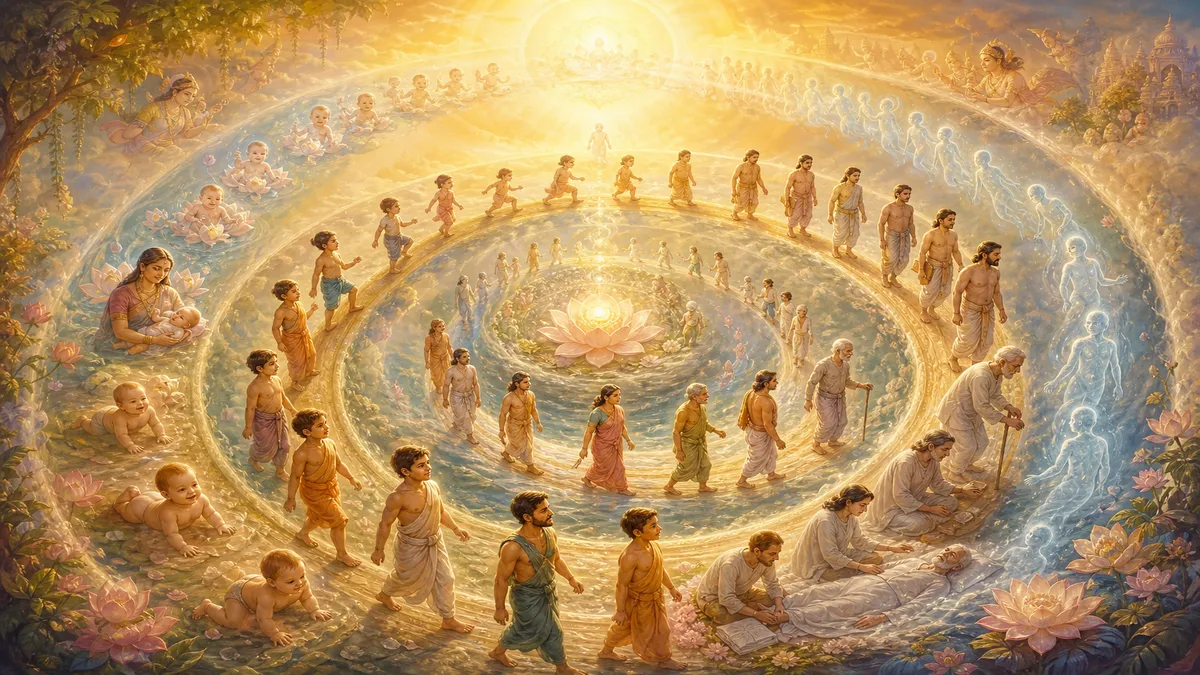
There is a certain conveyor; it moves the soul in a certain direction, and when we look a little more broadly, not from childish knowledge but from a wider perspective, we understand what samsara is. Samsara is a world where souls are constantly born and die, where they are born and incarnate again, are reborn again. This is the kind of world we have entered, and we must acknowledge it. That is, it is a world where there is old age. And what is old age? It is blocked channels, trembling hands, poor memory, poor digestion, a weak intellect, weak strength; that is, it is fading away, it is suffering. It is weak immunity, it is susceptibility to illness—this is the future, this is truly the future for this body.
When we reflect in this way, we think: “I do not really like such a world; I would like to be eternally healthy, happy, young, immortal, and not have these problems and not reincarnate at all”—this is the practice of dharma. Then we begin to think: “Could I not find such a world where this samsara would not have such an influence? And what is samsara—is it nature, or relationships with others, or is it stones, trees, the earth? What is samsara?”
The saints say: “The matter is not in nature itself, but in the mind—it is our mind, which possesses attachments; it is our ignorance.” One master said: “Those who possess ignorance, living beings, drag along a suffering existence.” Here, if we do not want to drag along a suffering existence, we need not a small desire to be liberated from samsara, but a very deep, very strong one—to renounce samsara.
This should not be a superficial aversion, when we begin to look at the world negatively and think: “How I hate this samsara, how tired I am of it,” and become even more obscured. Such an approach will not work. We must have an understanding of samsara as the ignorance of the mind, and a desire to be liberated from it and to awaken true knowledge, to awaken true wisdom, awakened consciousness. We must constantly think about awakened consciousness and build our life strategically in such a way that it all becomes directed toward awakened consciousness, and so that we are very cautious toward various forms of samsaric behavior, samsaric manifestations of body, speech, and thought—this is analytical meditation on the sufferings of samsara.
The Proper Development of Vairagya
Many saints practiced meditation on the sufferings of samsara for a very long time in order to give rise to vairagya (detachment). One must also be very careful with vairagya; there is no need to hurry to generate vairagya on the external level. For example, a person says: “That’s it, I have developed vairagya, there is nothing to do in this samsara, I am selling off my property, I will become a hermit” — in principle, the motivation and behavior are commendable; or: “I am going to become a monk” — commendable. But when this is done abruptly, it raises concern. It should not be done abruptly, because one can overestimate one’s impulse and mistake it for a long-term life strategy, while it may simply be an impulse; that is, you must test your impulse over years.
When a person does this quickly, it makes me suspicious: if he quickly changed his point of view, then he may just as quickly change in the opposite direction as well; therefore all masters test their disciples. On the spiritual path, impulses are not something that should be listened to — impulses of the mind. One should take a balanced, conservative position; that is, if one is to follow the path of renunciation, then one must proceed like a tanker or like an icebreaker — very reliably, but forever, crushing everything in one’s path, all the ice hummocks.
There is such a story: one man from an Indian family kept saying that he wanted to renounce the world, while another was a householder. The wife of this householder would say: “You see what a husband, the neighbor, is like — he says he wants to renounce the world and will soon renounce the world,” and this man would say: “In fact, he is only talking; if he really wanted to renounce the world, he would have renounced it long ago.” This wife would say: “You are just jealous, you are simply attached, you yourself cannot do it,” and she said this for a couple of years. One day he came and said:
“That’s it, I am renouncing the world, I am leaving.”
“What do you mean, where are you going? That neighbor still hasn’t left; he said he would renounce before you.”
He said:
“If you have renounced, you have already renounced; I have nothing more to talk about,” he went and left, and took sannyasa.
The desire for renunciation of the world, the desire for vairagya, must first be cultivated within as an attitude; that is, this person cultivated an attitude within himself. He had long been nurturing vairagya within himself on the inner level, and when it matured, it manifested outwardly. But at first one should not make any sudden movements; rather, one should cultivate vairagya within.

Inner vairagya means: we act in the same way in the status we have, changing nothing outwardly, cultivating a different worldview and testing this worldview in life, discovering all our weak points and working purposefully on cultivating this worldview. For example, we reconsider the long-term strategy of our life; that is, if I have understood the harmfulness of samsara, then what fame can there be, what money can there be, what honor can there be, what searches for new partners and spouses, and so on? These are completely different goals, because liberation from samsara — what is it? It is experience, it is samadhi, and this is a serious experience; one must seek it for a long time. And what is the experience of samadhi? It is sadhana. Moreover, sadhana under certain conditions, quite deep and intense; so how can I obtain this experience, how can I go through sadhana?
This is either a hermit, or a vanaprastha, or a sannyasi monk, or a hybrid of all of these; and since this implies a certain change of status, or else it is a karma-sannyasi within one’s own status, but still the very same sadhana. Sadhana according to a schedule, sadhana of the method, retreat sadhana, sadhana in everyday life with tapasya, with restrictions — this is the building of such a long-term strategy. It is a change in the value of life, the building of a strategy.
In addition, it is a certain worldview with regard to the world; for example, seeing the world as an illusion — this is inner vairagya. In addition, it is the ability to carefully cut off desires, attachments, selfish hopes and encroachments — this too is vairagya; that is, such a detached, ironic attitude toward one’s own desires and movements of the soul. When the analysis of one’s own desires and movements of the soul is considered from the point of view of renunciation of samsara, liberation, and reincarnation.
When we cultivate inner vairagya in ourselves in this way, we suddenly discover that attachments weaken, clinging to thoughts and desires leaves us, and the power of spiritual life increases and intensifies. This inner vairagya gradually begins to fill us and grow into practice, into methods, into the practice of awareness — this is the right approach. Then our behavior naturally changes following our worldview, and our awareness naturally increases.
Such vairagya should arise as a result of analytical meditation, of reflecting on the sufferings of samsara. It should not be understood that reflecting on the sufferings of samsara should plunge us into depression: “We are so upset, samsara, nothing but suffering, I am no longer interested in anything in life.” In fact, not at all. Reflections on the sufferings of samsara charge one with tremendous vigor and optimism, because they show the path of how to be free, how to be happy and joyful. They charge one with immense inspiration; this is by no means a path to such a suffering state. Christians may have something like this—sorrow, making such a sorrowful face, grieving—but on the path of Sanatana Dharma, on the path of the siddhas, reflection on the sufferings of samsara should turn toward unconditioned happiness, toward the freedom of understanding that happiness is within you.
Meditation on the Law of Karma
The next analytical meditation is the law of karma. We must understand how our mind creates various causes that lead to various effects, understand this entire chain, this entire mechanism. The mind can be likened to a kind of magical 3D printer that prints out any events, any situations, and the mind has tendencies, and on the basis of these tendencies it acts.
To reflect on the law of karma is, of course, to reflect on one’s own mind. Many believe that one should reflect on who did what and as whom they were reborn: someone was angry, committed bad deeds, and was reborn in hell—this also exists, an external reflection; or someone performed good deeds, was reborn in a heavenly dimension, accumulated merit, and the cause ripened into its effect.
But a deeper reflection on the law of karma is reflection on one’s own mind: how the mind, on the basis of past tendencies, creates various tunnels of reality, and how our consciousness is captured by them; that our mind generates various causes, and these causes will inevitably grow into effects, inevitably, and the effects will be exactly those that were generated by the causes, and no others.
For example, if you sow peas, it is impossible for roses to sprout; such a thing does not happen. Only siddhas can transform things in this way—peas will produce sprouts in the form of pea pods, and roses will not come up. When we understand how much we are subject to the influence of causes and effects, and how much the mind participates in this, we become careful with every thought, every word, every action. We ask ourselves: how can we ensure that the mind no longer generates any cause-and-effect connections?
It is said of the mind of an ordinary person that when he thinks, it is as if he is carving in stone—something is hewn for centuries, an imprint is created. It is said of the mind of awakened, holy people that when they think, it is like ripples on water—no traces remain. Reflections on causes, effects, and the law of karma should lead us to such a desire: how to have a mind in which the actions of body, speech, and mind would be like ripples on water, and not like carving in stone. How to purify one’s mind, how to discover the nature of the mind, so that external actions do not create any new cause-and-effect connections.

Sometimes in texts we read stories of holy people encountering brahmarakshasas (fallen Brahmins). They possess knowledge of philosophy and knowledge of tantric rituals, but nevertheless they have the bodies of brahmarakshasas—such fallen spirits—because they had pride and engaged in spiritual practice incorrectly. When they died, they were reborn as brahmarakshasas. They know the Vedas, can quote scriptures, know many mantras, yet such is their fate, such is their body, because during practice they felt resentment toward someone, envy or anger, or perhaps because their knowledge was disregarded. They committed some karmic error, and this error created such a body for them; they allowed a clouded state.
Conversely, there are people who have merit from past lives. It would seem that it is not due to any causes, but if one analyzes the causes of their merit, it lies in the fact that they accumulated merit by doing something very good in relation to sacred objects.
Reflection on the law of karma leads to an analysis of one’s own karma, because we, our body, our surroundings, our mind — all of this is our karma as it is, projected at this particular point in time and space. We cannot see all of karma completely, of course; if one looks into the subtle body, it can be seen, but the visible part of karma is us now: our surroundings, our appearance, our mind, our mood, our destiny.
For example, when we travel on bad roads, especially in Ukraine, this is the return of the karma of slander. I tell the monks: “Well, you shouldn’t have slandered.” When we live in a swampy area, this is the return of the karma of the impure element of water, adultery, that is, certain obscured states connected with this theme. When we live in a mountainous, rugged area, this too is the return of the karma of evil speech. When we live in a desert where nothing grows, where the habitat is poor, where there is no water, this is the return of the karma of greed. That is, what the karma of greed or evil speech is — these are all tendencies of the mind, meaning that certain obscured tendencies of the mind had been generated.
When we live in a beautiful, clean area, this is the return of pure thoughts, accumulated merit. When we are surrounded by harmonious brothers and sisters, this is the return of harmonious relationships.
Factors Influencing Karma
The influence of karma depends on several factors:
- On the action itself
- On the object of the relationship toward which the action was performed
- On the motivation behind the action
- On the subsequent satisfaction
That is, performing some action in relation to a great spiritual object, in terms of consciousness, in terms of its specific weight in the universe, and in relation to a small one — these bring different karmic consequences. For example, killing a hundred elephants and killing an ant have different karmic consequences; the karma is different. Or making offerings to a saint and making an offering to a beggar — that is, the objects are different. Bowing to a frog or bowing to a statue is also different.
And the subsequent state of mind: whether there was satisfaction afterward, reinforcement, or repentance, a desire not to repeat it — all of this also affects the consequences that will follow. Whether the action was performed with the motive of helping, or with the motive of indifference, or with the motive of showing how great I am, or, conversely, with the motive of envy — that is, the subtle motive underlying the action — this too is affected by the law of karma.
There is a result that affects the loka, the place of rebirth, the body — it gives a particular body with particular qualities — and the state of mind, which gives a mind that wants to move in a certain direction. If one caused harm, and there was no repentance, and negative motivation was further created, then a mind is created that continues to wish to cause harm in the future and derives pleasure from it, and a body is created for this with the corresponding causes and effects.
If there was a desire to make offerings to divine beings and a virtuous motivation for this was generated, along with the subsequent desire to dedicate the merits for the benefit of all living beings, then a corresponding body is created, for example, like the body of a samsaric deity, as well as the intention to continue dedicating merit to all living beings, and the result affects the loka, the place of rebirth, for example, Indra-loka or a pure land. Thus different motives and actions influence our causes and effects in the mind.
Meditation on Impermanence
Finally, impermanence is the third theme. Impermanence means that we must analyze the course of things as it is, that the external material world is subject to kalashakti. Kalashakti is the power of time, that which produces change, that which transforms us and transforms the world together with us.
When we concentrate on the principle of kalashakti, we can feel it as a karmic substance that moves the entire universe and is perceived by our subtle body. It has a particularly strong influence when negative planets are active; for example, the period of sade-sati is the time when kalashakti returns all our debts to us. It is believed that every person has three such periods of sade-sati in life. In the first period, a grandfather or grandmother passes away, perhaps more on the maternal side. In the second period, the parents may have problems with them, when this is present in a person’s horoscope. The third period of life — he himself may have problems; that is, the third period of sade-sati is already old age, when Saturn actively transmits negative karma in the horoscope — this is the action of kalashakti. Kalashakti is the power of time, which, as it were, blows away the living being, blows its subtle body out of the channels, out of the pranas of the physical body. If the soul is weak, the motivation is weak, the visualization, concentration, or pranas are weak, the life force is weak, then its lifespan is also weak.
Sometimes the soul is strong, the karmas are strong, the pranas are strong, but many sins have been accumulated; that is, the kalashakti is very tamasic, rajasic, very harsh, and it presses down on such a person. Such a person may live long, but he will suffer or be ill, or experience various problems. If the soul is strong, the life force is strong, and the karma is pure, with many merits, the life of such a soul will be long and it will be happy, because much light will come, much love, much joy, much happiness, many good experiences, and kalashakti will not affect the channels. It also happens that a soul lives a worldly, material, happy, and long life, but in ignorance, in unawareness; there is no spiritual information. It happens that a soul is not even very happy, but it is close to the dharma, and on the energetic, material level it does not experience any blissful states, a good environment, money, simply powerful health, or super-intellect. But on the other hand, it is in the dharma, and within it awareness is cultivated, subtle awareness, which allows it to relate to all this with equanimity; all this is the influence of kalashakti.
Liberation from the Power of Time
When the soul is developed, strong, and wise, kalashakti cannot have power over it; that is, over the body it will still have power, over the prana—there is no escaping that—but over consciousness it cannot have power. The ability to discover awareness, to engage in contemplation, to develop vairagya, viveka, and to abide in an aware state is freedom from kalashakti. Kalashakti acts upon my body, but I am not my body; I am consciousness. The force of the time of impermanence acts upon my pranas, but I am not the pranas; I am consciousness, like space. The force of time acts upon my subtle body, upon my environment, but I am not the subtle body, not the environment; I am a sky-like spatial presence of pure consciousness; I can observe all this, but it is not me. Thus, the beginning of liberation is the development within oneself of this consciousness, which is independent of kalashakti.
There is a well-known story from when India was being conquered; it was conquered many times, the most recent conquest being the British one, and before that the dynasty of the Great Mughals, Alexander the Great, the Muslims—who has not conquered it. When Alexander conquered it once, he ordered a sannyasin to be brought to him; he wanted to look at the Indian sages.
When the soldiers wanted to bring him, they said they had found some sadhu; they came and said: “The sannyasin does not want to come to you; he wants you to come to him yourself.” He became very angry: “I am a great king, and now some naked beggars will answer me like that,” but nevertheless he came. He said: “Do you not understand that you are in my power? If I want, I will cut off your head.” The sadhu said: “Well, you will cut it off, so what? And I will watch it. I am not my body; I can observe this. I long ago went beyond fear and beyond the bodily concept, but you, though seemingly a mighty king, have not yet gone beyond it, so it is you who should be afraid, not I.” This impressed Alexander, and like all kshatriyas—rajasic kshatriyas are easy to flatter and win their trust—he became so inspired and asked: “Well, how can I reward you, what can I do for you?” in such a patronizing way: “What can I give you?”—already entering the role of a giver. The sadhu said: “Well, what can you give me? Move aside a little, do not block the sun; that is what you can give me.”
The Tantric Path of Overcoming Kalashakti
The cultivation of observing consciousness is the beginning of freedom from kalashakti, but that is not all, because from observing consciousness powers can be born, the illusory body can be born, great prana can be born, and all this constitutes the deity, the mandala, the deity’s retinue. Not only the energy of consciousness, but energy itself, because the ideal of the siddha tradition, Shaiva Siddhanta, and in other siddha traditions of Sahajayana, is to be not only one who possesses wisdom (jnana), but also a possessor of shakti (shaktiman). The revelation within oneself of nondual awareness is freedom from kalashakti through awareness, while the development of one’s energy in the form of a deity is freedom from kalashakti at the level of energy. In tantra, the path is not only consciousness, but also energy; that is, energy is inseparable from the awareness of emptiness.
For example, when you practice visualization, the yoga of the illusory body, mantra yoga, and you are constantly certain that your mind is the mind of the deity, your body is the body of the deity, your prana is the speech of the deity, and you have a good command of mantra recitation, skillful methods of visualization, key points, and your sadhana reveals signs of realization—this too is the overcoming of impermanence, the overcoming of kalashakti.
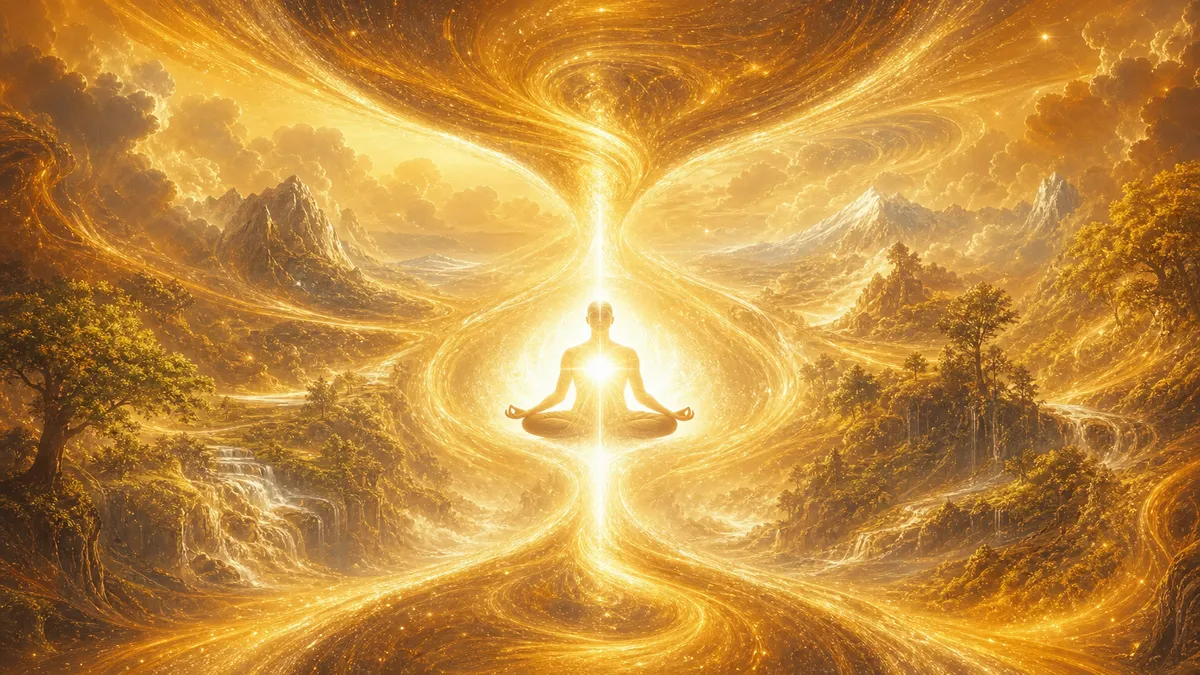
But the result of analytical meditation on impermanence should be two things: disenchantment with samsara as a realm of constant change and an understanding of the absurdity of any attachment, and the attainment of awareness that is beyond the influence of kalashakti, beyond the influence of the God of Time.
The Story of the Sage Akashaya
There is a story in the “Yoga Vasistha” about a sage named Akashaya. When the servants of Yama came for him, they could not approach him because he was surrounded by flames on all sides, by a circle of fire. They tried to get through a second time, but could not come near him; then they went to discuss this matter with their mentor, the deity of the center, of Yamaraja’s mandala. Yamaraja also arrived there, and he too could not overcome the protection of this sage. He then addressed a question, I think, to Vishnu or to Shiva, and Vishnu answered him. Yamaraja said: “What kind of disorder is this? The law of the universe is not being fulfilled. I cannot take the soul of this sage in order to direct it either to a new reincarnation or to liberation. He has been living for thousands of years, and even my servants cannot approach him, let alone take his soul. He is surrounded by tongues of flame, surrounded by the force field of his mind.”
Vishnu said: “Not only will you be unable to take his soul, you cannot even see him, because he has completely dissolved his mind in nonduality, because he has freed himself from all notions of ego, of personality. This is only a playful, illusory appearance; he has long been liberated, he is a jivanmukta, he is not in your power. So, Yamaraja, do not even expect to approach him here; sages such as Akashaya are completely free.”
The Practice of the Yoga of the Illusory Body
In the yoga of the illusory body, when we perform various sadhanas, we carry out the visualization of protective circles, the five elements, the vajra tent—that is, we establish the mandala—then generate the deity’s palace and visualize ourselves in the form of the deity. We generate the key points and gradually saturate this with the understanding of emptiness and spiritual power, that is, by meditating on the key points. If we take the practice not from the position of anuttara tantra, but from the position of tantric visualization, then as such visualization progresses, we become more and more accustomed to the thought that our mind and the mind of the chosen deity are inseparable; if the mind of Dattatreya is infinite, then our mind is also infinite. Our body is like the body of the chosen deity; if this body is pure, empty, like a rainbow, and is recreated from pure light, then our body is the same.
Gradually, in the course of sadhana, receiving blessings and receiving transmissions—all this becomes clarified, more and more clearly. At first we accustom ourselves to doing a brief visualization, reciting the mantra and visualizing the key points, transforming into something very simple. We train ourselves to recognize visualization as inseparable from emptiness, to maintain the pride of the deity, to maintain a presence like the sky as the mind of the deity, and to maintain the mantra. As the sadhana progresses, visualization and maintaining the key points become natural and merge with our life, and then we move on to the yoga of conduct. What does this mean? It means that during the taking of prasad we practice the yoga of eating; during ablution—the yoga of ablution; during the needs of the body, we practice the yoga of the needs of the body. In all these aspects of life, we perform the corresponding transformation, offering, and visualization of ourselves in the form of the illusory body. Then no aspect of life remains undivinized; not a single second of life remains undivinized. The ability to divinize all aspects of one’s life naturally through visualization, mantra, and maintaining presence is the essence of the tantric path, of transformation, when the world is transformed into a mandala, we ourselves into the deity, and our mind into the mind of the deity.
Transferring Consciousness into Sattvic Maya
By combining the two paths—the path of contemplation of anuttara tantra and the path of the illusory body—we become free from kalashakti; that is, kalashakti, just like Yamaraja’s messengers, could not reach the sage Akashaya. In the same way, the energy of impermanence is unable to harm us. Why? Because we transfer the main focus of our consciousness out of the samsaric realm. And what is the samsaric realm of the universe? It is tamasi-maya and rajasi-maya (tamasic prakriti and rajasic prakriti), that is, the worlds of gross forms. We transfer our consciousness into sattvic maya, into the realm of Ishvara, that part of the universe where luminous, pure prakriti operates. There we create for ourselves a body, psychological continuity, and the environment of the mandala, and continue to live in it.
Experienced sadhus, while still alive, possess such illusory bodies, palaces in sattvic maya, mandalas, and during their lifetime can live both here in this world and in sattvic maya, in their divine palaces. This means that on the physical plane we see such a sadhu, we see his body; he may be sitting entirely in a room or teaching, transmitting the Dharma, but he has a body in the realm of Mahar-loka or in the realm of Svarga-loka or in the realm of Jana-loka; he has a mandala. He has a divine palace, he has illusory bodies in the form of deities of the retinue, and he lives a full life in this second body.
Finally, besides this second body, he has a wisdom body like the pure space of light, in which he abides in dreamless sleep; thus, three bodies are realized in his life. Although only one of his bodies is visible to us — this is the realization of trideha (the realization of the three awakened bodies). The realization of the three awakened bodies is a skillful method of tantra for becoming free from impermanence.
Twenty-four Analytical Meditations
Following this, there are twenty more analytical meditations — these are the first four of twenty-four topics. They include contemplation on the uniqueness of human birth, the greatness of the path of liberation, the importance of Refuge, all the way up to attaining the highest experiences, self-surrender, and self-recognition. These twenty-four topics, if you do not have them, the monks can give them to you. I recommend practicing them whenever you have free time or when you are doing meditation, during the first five minutes, in order to create the right motivation for meditation. Even though meditation itself is the path beyond the mind, it does not contradict analytical meditations. Analytical meditations change the direction of our mind, moving it toward liberation.
The Illusoriness and Emptiness of the Universe. “Yoga Vasistha,” Chapter 4, “On Existence.”
Vasistha continued:
— O Rama, though this universe seems to exist, in truth nothing exists. It is only the appearance, or reflection, of infinite consciousness, which is the only reality.
Contemplation on the illusoriness and emptiness of the Universe is an analytical meditation that can lead to one of the levels of insight, to fleeting samadhi or to a kind of temporary enlightenment. We should devote sufficient attention to such contemplation. In what sense is the Universe illusory or empty? There are several aspects to contemplate. Understanding the emptiness and illusoriness of the universe is extremely important for a spiritual yogin, because without it our karma will not lose its power over us. Our karma, our desires, attachment, and thoughts have power over us precisely because we do not recognize their illusory nature, their empty nature.
For example, if you see another person, and that person may say something offensive to you, then you believe in his offensive words and become offended. At the root of your reaction lies the belief that the person really exists, and therefore his words really exist. But if you recognized his empty nature, his illusory nature, then you would say, well, it is just as if a reflection in a mirror said something to you; you would simply laugh at it, that is, self-liberation would naturally occur and there would be no reactions.
If you believed that this is your own manifestation, you would say: “Oh, hello, what interesting thing are you saying there?” — you would look at it as at yourself. This is such a simple reaction, and many of them accumulate in a day; they all arise as a result of not recognizing these things. This means that, as long as we do not have the spiritual experience of awakening that gives the natural experience of this, we must train our mind in analytical meditations in order to recognize in this way and stop reacting conditionally.
For example, if we desire something in the material world, this too is a lack of understanding of certain things. For convenience, one may desire, but when it is no longer a matter of convenience, but a matter of prestige, wealth, fame, of what comes from the ego — this means that we also do not recognize the empty, illusory nature of what is arising. Only foolish people chase after illusions; true people gather wealth elsewhere. If you ask a sadhu what wealth is, what power is, he will say: “Pure prana channels, good visualization, mantras, the experience of the clear light of dreams, pure sattvic qualities, control of pranas, the illusory body, a realized divine palace in Svarga-loka.”
This is true wealth; but what do kings boast of, businessmen, billionaires? Material riches. Why? Because they do not recognize the illusoriness and transience of all this. The direction of our life depends on recognizing illusoriness and transience. And how does the illusoriness of the universe manifest?
- That it is transient — this is one
- That it is a manifestation of our mind — this is two
- That at the basis of all phenomena lies emptiness, non-duality, emptiness — this is three
Methods for training the mind in recognizing illusoriness
If we meditate on these three key points, it will help us a little. There is a method in which we practice viewing all phenomena by dissolving them into a state of rainbow color. For example, we take a glass, visualize it, and imagine how it breaks down into particles of rainbow color into emptiness; then we restore it again, but now we remember that this glass was created from particles of rainbow color, that is, it consists of light. We do this with all the objects in the room. This is an exercise for preliminary training of the mind, in which we practice viewing the world as an illusion. From the practice of prajna-yantra there is a sankalpa: all dharmas are an illusion, a dream, in which we practice seeing the world as a dream.
There is one practitioner who said: “I practice, and when I practice the Dream sankalpa, I begin to fall asleep, I want to sleep.” But in fact the practice should lead to the mind becoming ever brighter and clearer. This is not autosuggestion, where we attune ourselves to a sleep-like state; on the contrary, by viewing the universe as a dream we generate such an alert, ready, curious, bright and clear consciousness, very bright, very clear. After all, if this is a dream, then it is extraordinarily fascinating at the very least, it is extraordinarily curious, and we relate to it no longer as ordinary reality, but with a heightened state of awareness. Maintaining such bright, clear consciousness with an understanding of unreality is the correct approach in the Dream sankalpa.
There are other problems: when a person practices the Dream sankalpa, he begins to feel that he is getting lost in the experience of illusoriness and losing touch with reality. Here one must be very vigilant, and the adequacy of the dream must be preserved no less than in the physical world, because even if you realize that this is a dream, but a truck is coming, you cannot say: this is a truck, this is a dream.
Recognizing the illusoriness of the universe as a spiritual practice
Recognizing the emptiness, the illusoriness of the Universe, is both analytical meditation and a practice, a preliminary practice of the yoga of the illusory body and the yoga of contemplation. Recognizing the world as a dream, we must not lose our adequacy, our correct connections and relationships; on the contrary, all this should be purified. If we did not recognize the universe as a dream, then we would have the right to be angry, to manifest egoism, but since we recognize it, we can very easily love others, forgive, be flexible, and detach from negative emotions. On the contrary, our level of adequate perception of the universe only increases; we stop worrying about anything whatsoever, and this gives us the ability to be very flexible, very adequate, and clear.
Recognizing the illusoriness of the universe, nevertheless one must understand: this dreamlike universe operates according to certain laws, and we are part of these laws, and until we are liberated, we still bear responsibility for these laws. It is like in a dream: even when you act in a lucid dream and remember that all this is a dream, nevertheless you understand that the dream is arranged in such a way that you are not completely free in it, that there are certain energies there that can influence you.
One fairly advanced monk once complained to me, saying: “Guru, I can be conscious in a dream, fully remember myself while dreams are going on, but sometimes I find myself in such realms where I am conscious, but I cannot do anything; the dream happens against my will, I only remain aware, and what is happening I cannot control, I cannot change. Once I found myself in the world of pretas, in the world of hungry spirits; they forcibly seated me at a table and began treating me to buns against my will, simply shoving them at me.” Some merit was returning in this way; that is, usually everything is taken away from hungry spirits, but the monk had accumulated sufficient merit. He said: “I cannot do anything, I do not control it, I am aware of everything, I understand that it is an illusion, but the energy is stronger than I am.”
The limitations of awareness and the status of Ishvara
In the same way, when in the material world we are sufficiently aware and awakened, and view the world as the illusion of a dream, nevertheless our awareness does not allow us to control this reality, because we are not yet shaktimans, because the one who can control this reality is the one who possesses the status of Ishvara, the one who created this universe.
Once, Neem Karoli Baba had a devoted female disciple, and he sometimes liked to joke with his disciples. There was a European mataji who had a long nose, and he would constantly grab her by the nose and twist it like this. She said, “Baba, if you can change this nose, then you’d better change it or don’t touch it.” Laughing, he said, “Only the one who created it can change it” — that is, only Ishvara.
To become Ishvara means to become a shaktiman in this dreamlike universe; that is, only Ishvara has complete control over the universe, meaning the creator of the universe. We are his parts; we do not yet possess complete control, despite the fact that our consciousness is identical to Ishvara. But as jivas, we are considerably inferior in power to Ishvara, because Ishvara possesses aishvarya (divine omnipotence), sarva-jnana (omniscience), vyapakatva (all-pervasiveness), svatantrya (freedom of will), nityatva (eternity), and purnatva (divine wholeness).
As jivas, we share a part of Ishvara’s dream; we are in his dream, but we do not possess these powers of Ishvara. We are moving toward becoming Ishvara.
Proper Conduct When Practicing the Sankalpa Dream
This must be taken into account when we practice the Sankalpa Dream, so that we do not behave irresponsibly, because if you practice the Sankalpa Dream for a long time, especially in seclusion, you may develop a very cheerful mood: “Ha-ha, it’s all a dream, how wonderful, now I am almost free, I am a Buddha, probably, I see the whole world as an illusion, as a dream.” But these temporary insights should not be taken for some kind of realization, because in such cases samsara can quickly put us in our place.
Instead, while maintaining a state of awareness, one must take into account the principles and laws of this world; therefore, there is a section of the teaching called conduct, where we must understand how a sadhu should behave at a given level, in a given status. Of course, everyone would like to behave absolutely freely, everyone would like to unite view and conduct at once, everyone would like to behave like Avadhuta Dattatreya — spontaneously, naturally, and beyond all conceivable and inconceivable limitations.
But it will not work. That is, in our soul we may have a free view, an absolutely free one; in our soul we must consider ourselves completely free, meaning the view should have no limitations whatsoever. But in relative life, we constantly have to take into account the laws of samsara, the laws of karma; therefore, there are nine types of tantric conduct.
We do not begin with the conduct of the dog-pig or with the conduct of the lion. We begin with the conduct of the bee, then with the conduct of the dove, then with the conduct of the deer, then with the conduct of the mute one, the madman, the lion, and only then do we move on to the dog-pig. There are different people who like to practice tantrism who, without having gone through the path of the mute one or the deer, immediately say: “I am already beyond; I am already practicing the dog-pig” — none of this is simple. There are fourteen samaya vows that tell us how to cultivate inner relationships in conduct.
There is a division between the view and the conduct of the two truths, and therefore we never mix view and conduct; that is, to mix view and conduct means to put oneself in a foolish position, that is, to fail to take relative reality into account. And what do we do? We smoothly bring the view into conduct, very smoothly; therefore, there is a saying: “Even if your mind is boundless like the sky, let your conduct be careful and deliberate.” “Even if your mind is like that of a Buddha, behave like an ordinary person” — there are many such instructions.
Nevertheless, it is right to strive to smoothly unite the view with conduct, but it must be smooth; and what does smooth mean? It means in equilibrium (in samyoga) — this means that nowhere is the balance of the proportion of energy disturbed; we do not leave equilibrium. Cultivating in oneself a sense of equilibrium (samyoga) is a great art for a sadhu.
The Teaching on the Mind as the Creator of the World
In this consciousness, creation manifests as in a dream. Therefore, only that in which it manifests is real — it is the infinite nothingness. You see the world because the eyes (or other sense organs) perceive the world; likewise, if you think or believe or know that the world exists, this happens only because your mind thinks so. The mind created this body in order to dwell in it itself. All the powers inherent in the mind, by which this world is created, are in infinite consciousness; therefore the wise proclaim that the mind is omnipotent. All these deities, demons, and people were brought to life by the mind; when the mind no longer holds such notions, they cease to exist, just as a lamp goes out without oil.
So, there are two main difficulties — eternalism and nihilism. Eternalism means seeing the world as real, separate from oneself, and perpetuating it, believing that it is self-existent. Nihilism means denying the law of karma, denying the world as energy and its influence on oneself, and failing to take it into account. When we are free from eternalism and nihilism, we go down the middle, the middle way, which is called the path of the siddhas.
Another aspect of the illusory nature of the world is that it is created by the mind; the following rule applies: we become what we think about ourselves; what you think, that you become; wherever and whatever consciousness conceives, that is what manifests. By reflecting on this for a long time, we gradually come to the teaching called sankalpa-vidya. Sankalpa-vidya means the ability to change reality through the power of intention.
For us, sankalpa-vidya consists in changing our own reality into a purer one, divinizing it, attaining the body and enlightened mind of a deity. We do not strive too zealously to obtain material benefits, some kind of success, or magical powers through the power of intention, although this is also possible.
Worship of the deities of Sanatana Dharma is always possible in two variants: in the theurgic variant, when worship is offered for the sake of the deity’s grace, its enlightened wisdom, for the sake of the deity itself; and the thaumaturgic variant, when worship and invocation, veneration, are undertaken for the sake of achieving goals, worldly goals or others — this is thaumaturgy. Thaumaturgy is magic; it is: “God, make it as I want,” while theurgy is: “God, send me grace so that I may become wiser.”
Analysis of Attachments to Objects
A wise person knows that all objects in the world are unreal and does not regard them as something worth striving for. One who chases after objects created by the mind undoubtedly comes to suffering. This seeming world has come into being because of desire, and it ceases to exist only with the cessation of desires.
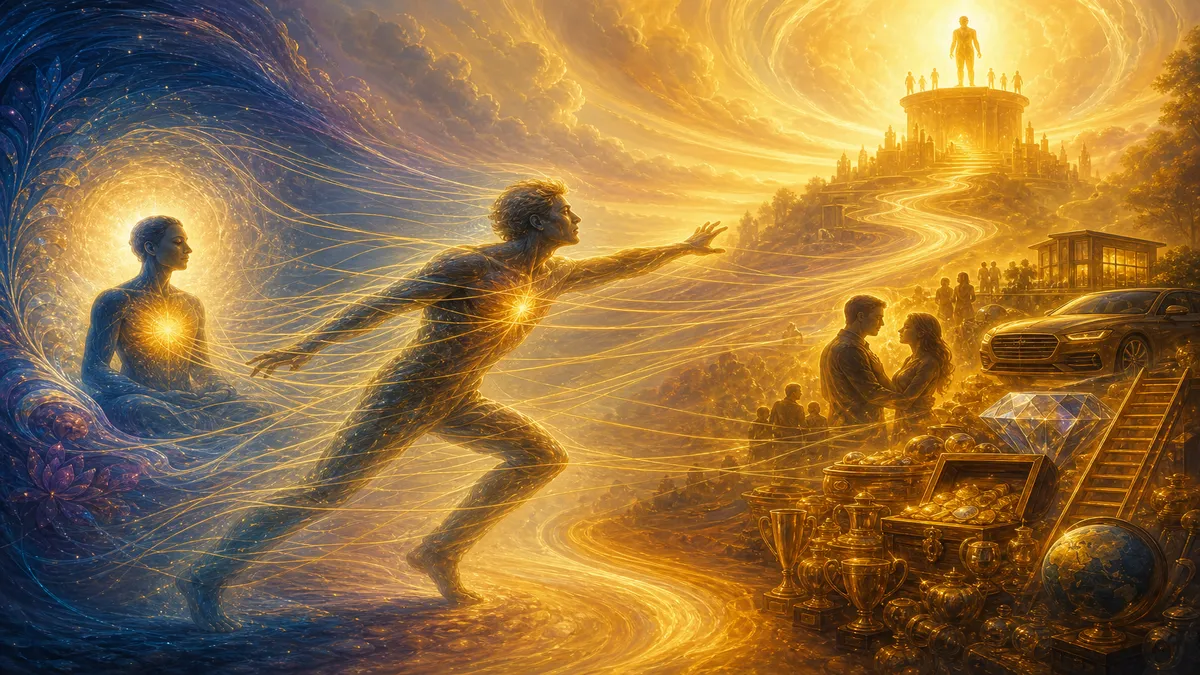
Here one must analyze which objects my mind is chasing after at the moment, whether it is chasing at all, and the grossest level is the pursuit of external objects. For example, we desire to acquire something in the material world, or to gain the favor of some person, or to achieve something in the material world, and this greatly occupies us.
If we have enough vairagya (non-attachment), wisdom, then we do not chase after objects of the material world; then comes the turn of the objects of the inner world. It happens that a person is not attached to material things at all, to anything, but he may be attached to his social media account. All his property, all his wealth consists not of material assets, but virtual ones — his blog, his creative work, where he records himself playing the violin and carefully stores heaps of discs, considering this his inner capital. All of these are subtle inner attachments to inner objects, to various abilities, tendencies, worldly tendencies of the mind; all of this is a pursuit of various objects. These too are objects, albeit subtly material ones, such as certain acquaintances in the subtle world.
I have met different people; one said: “I am friends with a spirit, I have my own poltergeist, I cannot live without him,” and he showed who would come to visit him, how the door would open, noise would be made, and so on.
We must analyze which objects our mind strives toward, to which external or internal objects we have attachment, what its cause is, when it arose, perhaps very distant causes. Such objects may also be your memories; that is, very many people draw energy from the past, live by past memories, feed on this energy, or on hopes. Many people live by hopes; they may be completely unrealizable, but they can feed on these hopes. There is even such a phrase: “Hope nourishes young men” — there are even people who are not young men, but who live by chimeras, mirages, imagine something and warm themselves with that something.
We must carefully discover where we have attachment to external or internal objects, where it will lead if we develop it, and what its cause is. When we analyze it, we will discover that its cause is ignorance, a lack of understanding of the empty essence of these objects, a lack of understanding of the empty essence of the “I”; and empty does not mean non-being—empty means divine, absolute and unreal at the same time—and a lack of understanding of the connections and relationships with these objects; and the consequences to which it leads can be diverse.
The Path to Liberation from Attachments
The analysis of such attachments should lead to the arising of vairagya, when we want to say: “I will no longer give power over my mind, over my soul, to any objects; I will give my soul into the power of God alone.” To give one’s soul into the power of God means to abide in the living perception of divine reality, in sky-like awareness, in pure luminous clarity, in the experience of all-encompassing emptiness, inseparably with energy.
This is a state of awareness without any concepts, without fixations, without visualization, memories, fears, hopes, concepts, or attributing inherent existence to anything at all. It is the broadest, most open, freest, and subtlest state, the state from which the experience of unity with God is possible. This is what is called jnana-drishti, the view of Advaita, the vision, the worldview of the siddhas.
Jnana-drishti, when we become accustomed to it and maintain it constantly, smoothly grows into contemplation, into our natural state (sahaja), and sahaja, when it penetrates all everyday aspects and actions, becomes our behavior. Thus the three dimensions unite, and then our view is transformed into jnana-deha, that is, from the view our body of wisdom is born; from the unity of the view of our mind, prana-deha is born (the body in the form of a deity). From the unity of the view, contemplation, and our physical body, siddha-deha is born (the ability to manifest unobstructedly in any material dimension of samsara or other worlds).
