

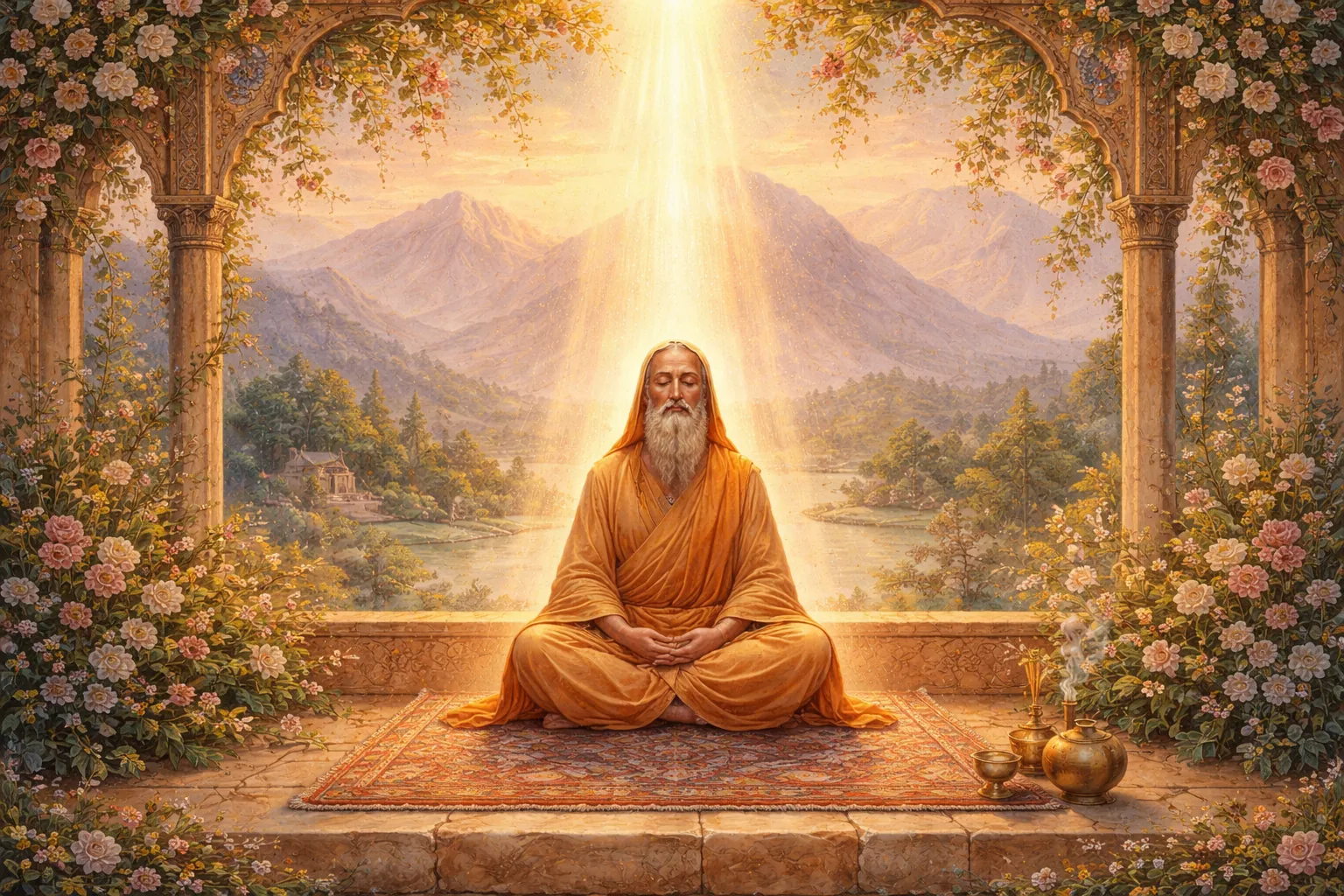
The Descending Power of Anugraha
The principle of Anugraha, shaktipatha, is a sign of the descending enlightening power common to all Advaita. In some traditions it is emphasized, while others merely note it, and that is all. In Kashmir Shaivism it is given its own emphasis; in Laya Yoga it is also regarded as an important principle of the sadhana of the effortless state.
At first, we make no effort toward enlightenment, remaining in ignorance. Then, of course, we begin to make efforts, believing that if we do not make them, if we do not meditate diligently and practice awareness, no one will attain enlightenment for us. We know that our happiness is in our own hands. And the saints say that the Teacher shows the road, but we must walk the path ourselves. No one can walk it for us, so we begin to advance along it diligently. We know that very much in this life depends on our will and sankalpa, on whether we can manifest it or not. When we become a vira yogin, we are the embodiment of such will, of yogic sankalpa. That is, we can perform severe techniques and carry out any assignments. Sixteen-hour sadhana is like a joke to us, since we possess the true qualities of a vira yogin. This is a certain stage in spiritual life, and one who cannot reach this level is still somewhere far away.
Thanks to the power of will and sankalpa, we realize samadhi, or dhyana, or naked awareness. And then we are told things that may seem strange: now it is necessary to abandon efforts and abide in non-doing, because now effort will be an obstacle. Moreover, the saints and the teaching tell us that it no longer depends on us, that a higher power takes our spiritual life into its hands, and that we must simply open ourselves to it and surrender to it. And then the next stage begins — the stage of effortless non-doing, which is not suitable for beginners. It is suitable only for those who have succeeded in meditation and developed stable abiding in contemplation with effort. Next, one should abandon effort, and then — the contemplator himself.
When we abandon effort, this is still understandable. In the state beyond effort, contemplation can continue if you are an experienced practitioner. For example, an experienced swimmer can relax and float downstream on his back, catching the rising currents of water; a bird can glide, relying on subtler currents of air. Sahaja samadhi is the same, since the yogin relies on subtle currents of consciousness. However, there still remains the ego, the “I,” which must also be abandoned. And what happens then? Then sadhana turns one hundred and eighty degrees. Then it is no longer the yogin who practices; the Absolute Mind descends. Non-duality presupposes that we must realize the state in which there is no jiva striving toward the Atman, but everything is only Brahman. Shaktipatha, the principle of descent, describes this process, which is why this is a very transcendental topic; and when you listen to this teaching, a revolution takes place in your consciousness.

The Five Actions of the Absolute
“The philosophers of Kashmir approach this question in a distinctive way. The Absolute is conceived by them as a boundless ocean of blissful consciousness. They describe its volition as a wave of bliss through which it reveals its nature or divine essence. This manifestation of the divine nature is represented by five actions: creation, preservation, destruction, obscuration, and revelation.”
Among these five powers, the one most interesting to us is the power of self-revelation — Anugraha. There are also other powers, the power of concealment (tirodhana) or destruction (samhara), but we do not pay special attention to them. For us, Anugraha is important, that is, the power of self-revelation of absolute consciousness. When we speak of the self-revelation of absolute self-awareness, we always mean the revelation of the absolute mind, not an Absolute located somewhere beyond the “I.” And even when you hear very exalted concepts, you should understand that these concepts are merely an indication of what takes place beyond words, of the process of enlightenment of the subtle layers of the mind, of the descent of the Clear Light into the grosser layers of the mind. In the absolute sense, there is nothing to descend and nowhere to manifest, because everything is non-dual. Nevertheless, we operate with concepts in order to point to this process, because this process is global. There is the concept of “sattarka logic.” This is not logic in the ordinary sense, which relies on the laws of formal logic, but a higher logic arising from intuitive mystical experience. The term “sattarka” was introduced by the saint Abhinavagupta. For example, a scholar is guided by ordinary logical knowledge of texts and by the laws of formal logic. A saint, however, is guided by logic of another order — sattarka logic, which flows from mystical experience. In this logic, two times two may equal five.
“All that exists is in him in the form of pure blissful consciousness. Here a comparison with dairy products potentially present in milk is appropriate. Following his will, he manifests as the material world.”
Everything that exists is already present in potential within absolute consciousness. When something is created and manifested, in fact it is not created in the full sense of the word. One could say that it is brought to the foreground. The past, present, and future exist simultaneously. In the form of seeds, they all exist together; however, for a certain period of time a particular chain of events becomes activated, and it is brought to the foreground at that moment. In the absolute state, however, there is no time.

The Creative Act of the Absolute and the Arising of Ignorance
“At the moment of creation, his independent playful will continuously materializes, instantly manifesting in its material aspect. During this creative act, the Absolute undergoes no transformation, but simply manifests like a crystal, taking on various hues reflected in it. Thus, it appears as a limited subject and object in a countless variety of forms. At that time, acting in this way, it conceals its divine nature. It is precisely this divine action, obscuration, that stands at the origins of the separate human personality.”
There is a single universal Source — Mind, like space. But in the relative dimension it manifests as the subject (the human being) and the external relative world. Then ignorance manifests.
“This ignorance grows and unfolds, leading to the infinite psychological diversity of this world. According to Kashmir Shaivism, the arising of ignorance and its subsequent transformation into the diversity of the world is the first stage of the divine play.”
The first manifestation, if viewed from the standpoint of nonduality, the entire phenomenal world is the play of the Absolute. We think that we live and practice, but the Absolute has a different view. For it there is no us, just as there are no other living beings, but only It itself, since only the Absolute exists. This Absolute is not some super-mind somewhere at the center of the galaxy. It is our own higher “Self,” located at the center of our heart. Liberation is nothing other than a radical change in our self-identification. When our views begin to coincide with the views of the Absolute. Bondage is when our views and the views of the Absolute differ greatly. We are a human being, that is, a mortal being, while the Absolute is nondual, nonconceptual, spacious. In essence, all our spiritual practice consists in trying to bring our own views into alignment with the views of the Absolute. Until this alignment occurs, there will be no liberation either. The mind of all saints is the same. There is a saying: “If you dip your finger at the beginning of the ocean, close to the shore or farther out, it will always have the same saltiness.” The mind of saints is always the same, because the saints, having realized the most essential part of the mind, have come to one and the same experience: that there is no ego, but only the Absolute.

Of course, this does not mean that saints have no individuality or speak in the same way. In the relative dimension, their minds are different. This depends on karma, nation, style, era, and language. But this is only manas, the mind, the ego, ahamkara. And when it is said that the minds of saints are the same, what is meant is their essential part, that is, the nature of Mind. Saints realize the state of unity, and therefore they always understand one another absolutely; that is, they understand that, first, there is nothing to understand; second, that they do not exist, but only the Absolute does; third, that all this is a dream, everything is empty, nothing exists in itself.
Nevertheless, the relative cannot be denied, because it manifests all the same, since the nature of energy is to manifest. But it is empty, and since it is empty, this means that it is simply a creative, unconditioned manifestation, that it is simply play. The whole world is a play (lila), and they are simply actors in it. Saints understand that this is a play, and therefore they simply play along with one another or with other people; that is, they are players who move through life. People live, while saints play, knowing this secret. Therefore, enlightenment is nothing other than the discovery of such views and entry into this play.
The Second Stage of the Divine Play — Enlightenment
“At the second stage, he sends people enlightenment and reveals the true divine nature. Through such enlightenment, these souls realize their unity with the Absolute. They perceive their ‘I’ as one with everything and understand that all the richest diversity of the universe is, in fact, their own creation, created by their own will. For such enlightened souls, the entire universe becomes a show, a game, a drama, or a reflection.”
The whole world is a manifestation of the collective minds of people united by shared karmas. The subject of free will, grace, and personal effort is the most complex one. European scholastics puzzled over it for more than a millennium, never arriving at a final conclusion. On the one hand, there is our effort, but if everything is nondual, then in the end it is seen that we do not exist. So what role, then, does our effort play? This means there is something transcendental, something above our will, which is called grace, descent, the will of the Absolute. And then the question arises: where does our effort end, and where is the will of the Absolute? The will of the Absolute is from above; our effort is from below. Our application of effort is the result of the manifestation of our will, but one can say that it too is the will of the Absolute, for it is within his power to make us apply effort or to cloud our consciousness so that we do not apply such effort. Some schools believe that everything depends only on us. For example, orthodox Theravada Buddhism holds such a position, saying that everything is attained only through our personal efforts. At a certain stage this is so, but when the “I” disappears and nonduality is realized, we look from the other side. If we no longer exist, if there is no “I,” then whose efforts will they be? What “our” efforts can one speak of if everything is nondual, if from the very beginning we did not exist?

When we examine everything and study the higher efforts, we discover that the illusion of the ego, the “I,” is at first accepted conditionally, that is, as a conditional truth. At the higher stages (levels), everything is seen nondually, that is, as a manifestation of the one Absolute. This is a very majestic picture. The Absolute plays with itself. His grace descends from above as Anugraha, as a flow of his energy. The will applied by the jiva (the individual), which seems to be something separate, is in fact also part of his play, only under another aspect. This too is Anugraha, but one that assumes the role of being hidden, envelops itself in other shaktis (the energy of concealment), takes on avidya, creates the ego, ahamkara, manas, chitta, and buddhi as working instruments, and creates the illusion of personal effort and striving upward. Thus, one energy comes from above, manifesting itself as intuition, shaktipatha, Anugraha, while the second comes from below, manifesting itself as sankalpa and purusha-kara. They move toward each other, intuitively seeking one another, like two lightning discharges directed from above and from below. When they find each other and unite, a quantum flash occurs: enlightenment, the restoration of nonduality. The Absolute recognizes itself within itself, and thus a gigantic lila is revealed.
The Nature of Divine Grace
“This kind of illumination cannot descend upon people through their personal effort alone. Human effort and goals are inherently limited, since they can be directed only toward something already known. Since a person is not capable of fully knowing the nature of the Absolute, this knowledge can never be the goal of anyone’s efforts. Both ignorance and revelation are inspired by the Absolute. This inspiration of divine knowledge is known as his grace, Anugraha, or the descent of his power, shaktipatha. Only those who have received true shaktipatha show interest in true knowledge.”
When we step onto the spiritual path, there is something greater behind our decision than our individualized will. It is precisely the descent of the absolute Light that impels us to make certain decisions, to choose, to believe, and so on. It would be surprising if absolute Consciousness did not stand behind this, for it stands behind everything. Ultimately, we come to the conclusion that behind all our feelings, desires, will, thoughts, and even the slightest fluctuations stands absolute consciousness, since nothing else exists besides it. Therefore it is said that, at first, absolute consciousness stands behind our spiritual search.
“It is his grace that awakens devotion in people, through which, by concentrating on love for him, people attain the highest perfection. Shaktipatha does not depend on any other cause except the gracious and completely free will of the Absolute.”
The concept of grace is something causeless, something independent of the limitations of the individual; it is that which is given almost freely. One could say that our effort is necessary rather for purification, in order to attract this flow of descending grace. Of course, one might think that since everything is grace, everyone will attain enlightenment (shaktipatha descends, Anugraha unfolds), then one can lean against the wall and stretch out one’s legs, completely relaxing. However, on our part we also make an effort, exert personal will, because this is an opportunity, through our freedom of will, to manifest this descending power from below.

There is a story about a man who was riding in a cart loaded with sacks of grain, driving a donkey. The cart fell apart, and the grain spilled out. This man began to pray to God that his cart would be repaired. He prayed for a long time, but nothing happened. Then he became angry and said to himself in frustration: “I prayed so much, but there is no result! What kind of God are You?” Then an angel appeared before him and said: “But it was precisely God who gave you intelligence, hands, and creative powers so that you could do all this. Why do you reject His gift and not make use of it? He gave all this to you long ago, and now you must manifest it all.”
The power of self-revelation from below takes into account our will and our qualities. It created them specifically in order to unfold by operating through them. This is our freedom of will. This is the meaning of individual effort and personal will.
The Independence of Divine Grace
“Abhinavagupta expresses this in the following words: ‘Therefore divine grace does not depend on any external cause.’ The authority of the unlimited power of the Absolute’s grace was recognized by philosophers, since the state of perfect liberation cannot be attained otherwise. Thus, such shastras as the Puranas say that the power of the Absolute is independent. Its dependence would mean a deficiency of the divine essence in Him. The Upanishads also agree with the principle of independent shaktipatha. The Katha Upanishad says: ‘The essence of the “I” cannot be realized either in discussions, or by means of the intellect, or through diligent study of treatises. The “I” can be realized only by the one whom it chooses for this purpose, and only to him does it reveal its true essence.’ The Kaushitaki Upanishad says: ‘It is He who directs toward the performance of good deeds those beings whom He wishes to lead beyond worldly existence, and toward the performance of unwholesome actions those whom He wishes to cast down.’ However, devotion (bhakti) is highly valued by such great philosophers as Utpaladeva. In the Shivastotravali he describes the relationship between devotion and shaktipatha in these words: ‘O Lord! You are pleased by our devotion to You, and it depends on Your will. And only You know how this interdependence is accomplished.’ This can be explained as follows: the arising of the feeling of devotion to the Absolute depends solely on His grace. As this feeling of devotion grows, it impels the Absolute to send a more powerful shaktipatha, which in turn strengthens the feeling of devotion, and so on.”
This is an increasing process. The Absolute chooses us, and therefore we, as it were, enter the path. The more strongly we enter the path, the more our commitment to the path and to the Absolute arises. The more commitment to the path and to the Absolute arises, the greater the grace He sends. And possessing the immense descending power, shaktipatha, we are capable of making incredible efforts. In the end, they meet. It is like closing an electrical circuit, as a result of which the ego burns up.
“Being in such mutual dependence, grace and devotion become perfect. Utpaladeva describes this precisely in another part of his work: ‘A small portion of the Absolute’s grace toward me is enough for devotion to awaken within me. But when will both grace and devotion increase in their mutual fusion and reach the desired perfection?’ According to Utpaladeva, perfect devotion is both the highest knowledge, and yoga, and true liberation. He says: ‘Devotion to You is the highest aspect of true knowledge and the highest level of yoga.’”
Devotion as Self-Transcendence
For us, devotion means the stage of self-transcendence. For bhakti, it is more connected with form and with bhava dedicated to form. For us, it is connected with non-conceptual formless contemplation and self-transcendence, when the ego aims itself at the Absolute, which is like space. The ego becomes, in the form of the conscious surface mind (manas) and buddhi, an arrow that, through one-pointed maintenance of contemplation, flies into luminous space without deviating anywhere.
“Liberation is called perfect devotion to You. Therefore, having risen to its initial stage, we strive toward liberation.” The gradual development of such devotion, reaching its culmination in a state of complete perfection, depends on the grace constantly sent by the Absolute.”
It can be seen immediately whether a person is strongly illumined by this grace of shaktipat or not. One who is illumined by it always abides in it. His soul is bright, his heart sings, because his upper chakras are open. He does not take this world, his ego, or pride too seriously. He constantly lives under God, and therefore does not identify too strongly with trifles and the like. He always sees a huge pillar of light above his head (perhaps not literally, but certainly in a spiritual sense), and it always warms him, orienting him toward further practice.

The Play of the Absolute and the Descending Power
“Since the entire spectacle of liberation and bondage takes place by the will of the Absolute, and there is nothing in the whole universe that differs from it, and it is everything, there can be no question of partiality in how exactly it sends shaktipat to itself. Only one who is different from it can consider it partial. Philosophers see the sole cause of the state of bondage and liberation in the free will of the Absolute, which playfully unfolds this spectacle according to its own boundless volition.”
The power of enlightenment is sent to everyone (to every dog, every human being, and so on), but whether one is open to it and perceives it, or does not feel it, depends on karma, on karmic conditions. Therefore, our practice connected with effort is aimed at accumulating a sufficient amount of merit and purifying kleshas and obscurations so that we can become open to this descending power.

“Someone may also ask why the Absolute should become absorbed in this play of bondage and liberation, a play filled with pain and suffering. Philosophers consider this question from two sides. First, they point out that the Absolute is in a state of complete independence and freedom, where the question ‘why?’ is simply inappropriate. Second, the continuous involvement of the Absolute in the five divine actions of creation, preservation, obscuration, dissolution, and remembrance of itself is its very nature. The Absolute, deprived of this independence and the play of these aspects, would cease to be the Absolute. If the Absolute rested only within the limits of one of its aspects, transcendental consciousness, it would cease to be the Absolute and consciousness, and would become like an inanimate object.”
That is, if the Absolute were only unmanifest and did not penetrate, as the manifest, into all that exists, into all energies, then it would not be the complete Absolute. This would be a logical paradox, because the Absolute cannot be incomplete, since the Absolute is always purna, always whole.
Predestination and Free Will
“If the interest in liberation and the effort on the path to realization depend only on the gracious will of the Absolute, why should people worry about how they live? Why should we not eat, drink, and be merry, leaving the whole matter of liberation to the Absolute? Abhinavagupta answers this in his explanations: ‘A person is not free to do or not do anything. People are inevitably doomed to do what is predetermined. We are compelled to act in a certain way, according to our nature, given by the Absolute.’”
In a relative sense, we are a product of the law of karma. That is, we do what we created in past lives. If we accumulated merit and practiced, then we created such karma. Now we are embodying it.
“If this is so, what is the point of engaging in useless activities such as collecting sacred works, reading them, discussing their meaning, explaining them, and reflecting on them? One should cast off this heavy burden and plunge into silence. The will of the Absolute itself will carry ashore the person who is destined to be carried ashore. The answer to this statement is as follows: ‘That same gracious will of the Absolute leads us to such reflections. Therefore, we should not strive for the enjoyment of food and sweet sleep without contemplation of the Self, or without discussion with worthy people marked by the higher grace of the Absolute and possessing wisdom.’”

Despite the fact that the Absolute leads everyone to enlightenment, He manifests through our will and our subtle qualities. It is the Absolute who speaks to us in the words of the Guru, the Absolute who instructs us in contemplation and meditation, who impels us to purify ourselves, to be attentive, to train in practice, and to renounce desires. That is, at a certain stage of development, when the ego is sufficiently mature, the Absolute delegates His functions, grants authority and free will to the soul.
Types of Shaktipat
“When divine grace descends upon a practitioner, he must continue moving along the path of self-realization and subsequent liberation. He is destined to attain that greatest summit of realization when the grace of the Absolute and the devotion of the practitioner reach complete perfection. As soon as there comes a clear understanding that all interactions, states of bondage and liberation are merely the play of the Absolute, life can be perceived as an astonishing drama. If the Absolute were to manifest His grace and wrath according to some limited plan for each person, the universe would be filled with an endless industrial complex producing sets of people of various kinds, similar in character and nature, like factory-made products. But since the universe is the divine play of the Absolute, each actor has his own individuality, free from any repetition. God creates an astonishing diversity of characters in this divine drama through infinite variations of two kinds of His activity: obscuration (nigraha) and revelation (anugraha). As we have already said, He carries out revelation through Shaktipat, which is bestowed in many ways. Thus this wondrous, unending drama is sustained. Abhinavagupta divides Shaktipat into three main types: tivra — intense or swift; madhya — moderate; manda — slow. Each of these types is further divided into subtypes.”

These types divide not the descending force itself, but people. That is, there are those who perceive it quickly, those who do so moderately, and those who do so slowly. For example, there were saints who received transmission from a teacher, immediately became enlightened, and realized the rainbow body. There were cases when, at the end of a lecture, students, after listening to it, passed through walls. But this is a very rare combination of qualities. I have read in sources about such cases, which, as described, occurred about a thousand years ago. This is the principle whereby Shaktipat touches instantly: mind transmission — click — all dualistic states and karmas disperse, and space shines.
