

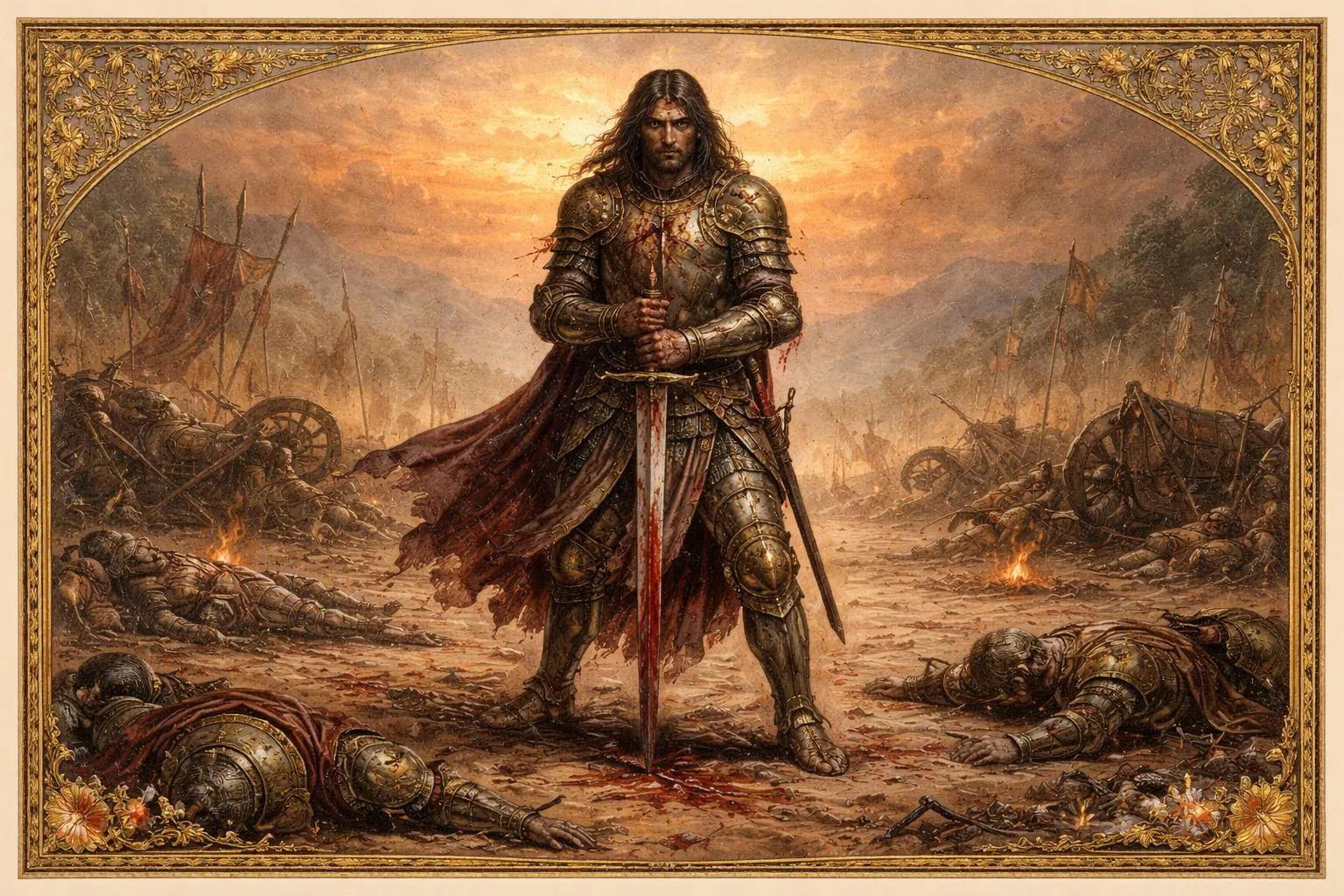
Commentary on the text “Shiva Purana. Shatarudra Samhita.” Chapter 36. “The Incarnation of Shiva as Ashwatthama
Nandishvara said: “O omniscient Sanatkumara, listen to the narrative of the incarnation of Lord Shiva, the Great Soul, as Ashwatthama. O sage, although he was an incarnation of the great celestial sage Brihaspati, the self-assured and judicious Drona was born of Bharadvaja, but not from a mother’s womb. He was outstanding among archers, a hero, a sage, a Brahmin, versed in all sciences, endowed with great fame and brilliance, and the most excellent of all who wielded weapons. Learned men knew Drona as the most excellent in the art of archery, a knower of the Vedas and an expert in various other activities. He was also known as the one who made his lineage prosper. O Brahmin! By virtue of his strength, he was the preceptor of the Kauravas. He was the most famous of the six maharathas among the Kauravas.”
Ashwatthama’s father was Drona, Dronacharya, an outstanding warrior and archer. In the Mahabharata, he took the side of the Kauravas.
The greatest Brahmin Drona performed severe penance to Shiva in order to obtain a son and help the Kauravas. O excellent sage! Then the delighted Lord Shiva, gracious to His devotees, appeared before Drona. Seeing Him, the Brahmin Drona, whose heart was supremely delighted, bowed to Him, folding his palms in reverence and praising Him. Satisfied and pleased with his words of praise as well as with his penance, Lord Shiva, benevolently disposed toward His devotees, said to Drona: “Name the boon you wish to receive.” Hearing Shiva’s words, Drona bowed low and said: “Please grant me a son born of You, who will be invincible to all and who will be very powerful.” Hearing Drona’s words, Lord Shiva said: “So be it.” O dear sage! The Lord, who bestows happiness, then disappeared.”
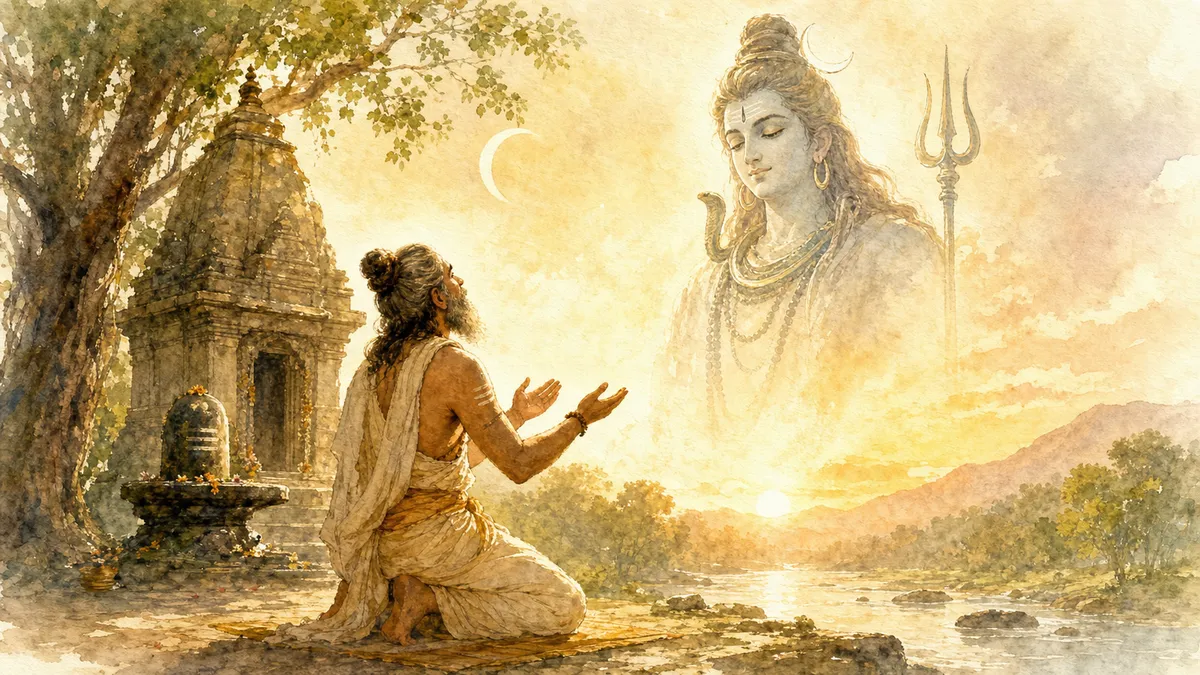
Thus, Ashwatthama was born as a result of Dronacharya’s tapas. When Dronacharya was performing tapas, Shiva appeared, and he asked Him for a blessing for the birth of such a son as a maharatha, an invincible warrior, like the very incarnation of Shiva.
The Birth and Exploits of Ashwatthama
Drona returned to his abode very pleased and free from delusion. He joyfully told his wife all the details. Taking the opportunity, Lord Shiva, the destroyer of all beings and very powerful, was born as Drona’s son from a particle of Himself. O sage! He became well known on earth as Ashwatthama. He was a hero, he had lotus-like eyes, and he could diminish the strength of his enemy. Having received his father’s permission and instruction, this famous hero helped the Kauravas in the Mahabharata war. Relying on the help of this mighty hero, Bhishma and the other Kauravas became invincible even to the gods. Fearing him, the Pandavas, though they were great heroes and very skillful, were unable to defeat the Kauravas. Following Krishna’s example, Arjuna performed severe penance to Shiva and obtained divine weapons through Shiva’s grace. Then he defeated the Kauravas. O sage! Although the great hero Ashwatthama was born from a part of Lord Shiva, nevertheless, because of his devotion to the Kauravas, he manifested his full power. He destroyed the sons of the Pandavas, although Krishna and other great heroes had taught them to fight. He possessed a power that was impossible for an enemy to withstand. Seeing that Arjuna, distressed by the death of his son, rushed toward him together with Krishna, Ashwatthama fled from the battlefield. He released the divine missile Brahmashiras at Arjuna. Then a fierce splendor enveloping all directions manifested itself. Sensing danger to his own life, Arjuna was overwhelmed. Having lost all his brilliance and become greatly frightened, he spoke to Krishna, being utterly exhausted. Arjuna said: “O Krishna! O Krishna! What is this? From where has it arisen? I do not know. This unbearable fiery splendor is advancing from all sides!” Nandishvara said: “Hearing Arjuna’s words, Krishna, the most excellent of Shiva’s devotees, meditated on Shiva and Parvati, and then addressed Arjuna.” Krishna said: “Know that this is the most powerful missile, bestowed upon Ashwatthama by Brahma. There is no other missile to counter it. Immediately think of Shiva, your Lord, the protector of devotees, who gave you the weapon capable of any action.”
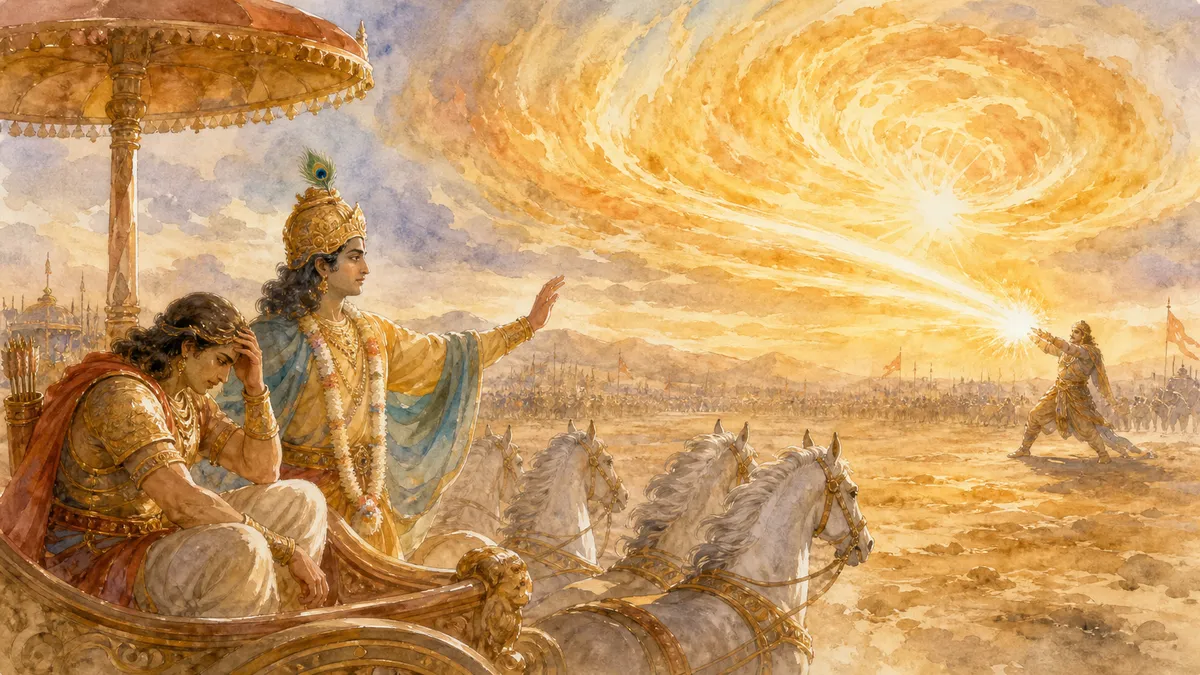
The translation here into Russian is “missile,” but this is not an entirely adequate translation, because the Brahmashiras, the Brahma-astra, is not a missile; it is a magical weapon controlled by mantras. It is not a missile like the Trident, Tomahawk, or SS-20, as today. At that time the weapons were different, the strategy was different, and even the physics of the world was different. It was a magical weapon that was at the disposal of great heroes by the blessing of their patron deities. An astra. And there are various, the most powerful types of weapons: the Brahma-astra—the weapon of Brahma, the Pashupata-astra—the weapon of Shiva, the Vishnu-astra. That is, this is a weapon capable of shaking the world. In terms of power, perhaps comparable to nuclear weapons.
“Counteract the fiery splendor of Brahma’s missile with your missile of Shiva.” Having said this, Krishna Himself meditated on Shiva for this purpose. O sage! Hearing Krishna’s words, Arjuna remembered Shiva, touched water, bowed to Shiva, and released the projectile bestowed upon him by Shiva. O great sage! Although the Brahmashiras projectile never becomes ineffective and cannot be counteracted, its power subsides before the splendor of Shiva’s projectile. Do not consider this too astonishing, for Shiva is full of wondrous things. Unborn, He creates, protects, and destroys the entire Universe by His own power.”
That is, it is considered impossible to counteract a weapon of the Brahmastra class, except that it can be counteracted by a weapon of the same class, the Pashupata-astra, if it is directed against it.
“O sage, knowing that this had happened under the influence of Shiva, Ashvatthaman, born of Shiva and acting according to Shiva’s will, did not regret it at all. Then the son of Drona, wishing the world to be freed from the lineage of the Pandavas, desired to kill the child in Uttara’s womb. The mighty Ashvatthaman hurled an extraordinarily radiant projectile of Brahma, which no other projectile could stop, directing it into Uttara’s womb. Then Uttara, Arjuna’s daughter-in-law, burning within because of this missile and agitated in mind, praised Krishna, the Lord of Lakshmi. Then, meditating mentally on Shiva, bowing to Him and praising Him, Krishna understood that this was the projectile of Drona’s son. With the help of His weapon, the brilliant Sudarshana, granted to Him by Shiva for His protection, He saved her by the will of Shiva. Then Ashvatthaman understood that Krishna had assumed his form by the will of Shiva, since he was the foremost among the devotees of Shiva, and abandoned the thought of destroying Uttara’s infant. Then the leading devotee of Shiva, the delighted Krishna, made all the Pandavas fall at Ashvatthaman’s feet in order to appease him. Then Ashvatthaman, the son of Drona, greatly pleased in mind, blessed the Pandavas and Krishna with various graces. O excellent sage! Thus incarnating on earth in the form of Drona’s son, Lord Shiva engaged in various kinds of lilas. The incarnation of Shiva, Ashvatthaman, of great power and glorious deed, even now lives on the banks of the river Ganga, bestowing happiness upon the three worlds. The incarnation of Lord Shiva in the form of Ashvatthaman has been explained to you. He is the cause of all siddhis and fulfills all the desires of devotees. Whoever listens to this with devotion or narrates it with a pure mind attains all siddhis here and reaches the abode of Shiva hereafter.”
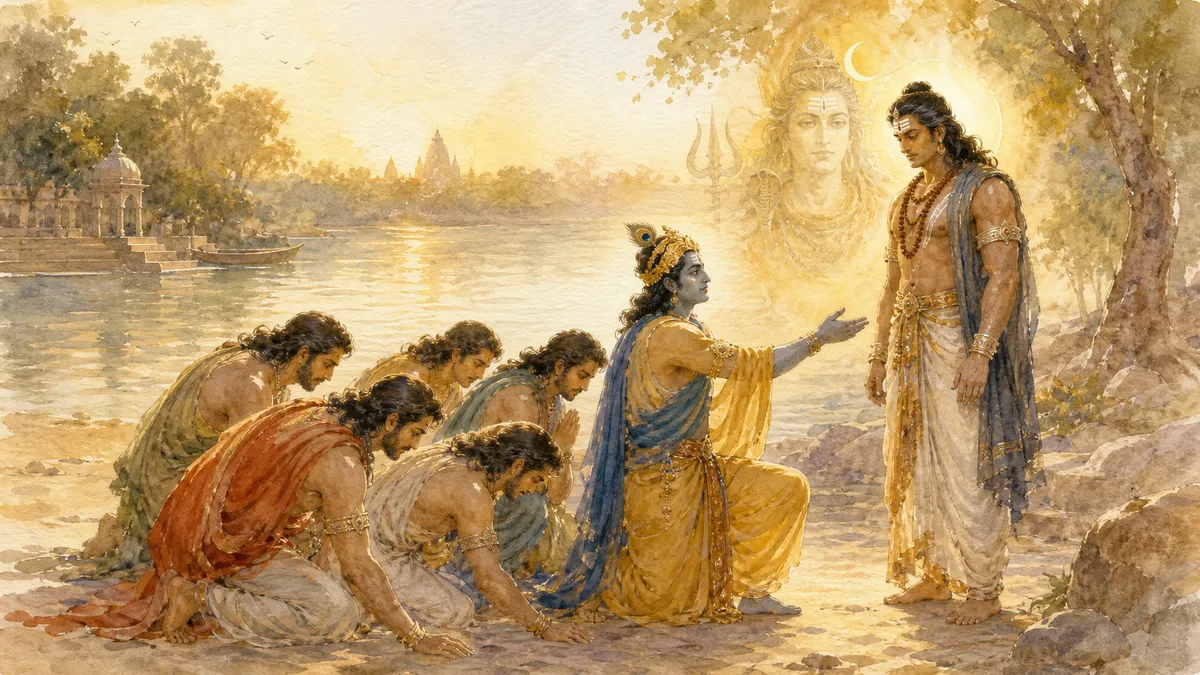
Such is the thirty-sixth chapter in the sacred Shiva Mahapurana, in the third, Shatarudra Samhita, called “The Incarnation of Shiva as Ashvatthaman.”
Ashvatthama in the Mahabharata Epic
So, Ashvatthama or Ashvatthaman is a participant in the epic “Mahabharata,” the son of Drona and Kripi, the grandson of Bharadvaja. He is considered one of the seven immortals, one of the seven chiranjivis. Ashvatthama was Drona’s beloved son, but he fought on the side of the Kauravas.
There is a story of how Krishna conveyed false news of Ashvatthama’s death. Drona asked, “How is my son?” And Krishna said, “He has fallen.” But at the same time, there was also an elephant in the army named Ashvatthama, and it had indeed fallen. And Krishna was being crafty, saying, “Yes, Ashvatthama has fallen,” but quietly adding, “the elephant.” However, Dronacharya did not hear that it was the elephant, and his hands fell. He said, “There is no point in my fighting, no point in living.” And at that very moment he was killed on the battlefield. This was such a ruse by Krishna in order to save Arjuna. The false news of Ashvatthama’s death, which led Drona to his death at the hand of Dhrishtadyumna.
Ashvatthama was one of the outstanding generals and military commanders who sided with the Kauravas at Kurukshetra. And in the Bhagavad Gita, Duryodhana mentions Ashvatthama’s name together with such great warriors as Bhishma, Karna, Kripa, Vikarna, and Bhurishrava.
The Dark Side of Ashvatthama’s Story
But Ashvatthama’s story is more complex. In many texts he is known not only as a great warrior, but also as the unworthy son of the brahmana Drona, as an aggressor who villainously killed the five children of the Pandavas and was punished for it. What was the story there? When Duryodhana had already lost the battle at the end of the Battle of Kurukshetra and lay with a broken spine, already dying, Ashvatthama swore to avenge him. At night he made his way into the Pandavas’ camp and killed Draupadi’s five children by cutting off their heads. Then he brought these heads and threw them at Duryodhana’s feet, saying, “Here, you are avenged.” But Duryodhana, even as he was dying, felt jugupsa—strong revulsion at such a “feat”—and condemned it.
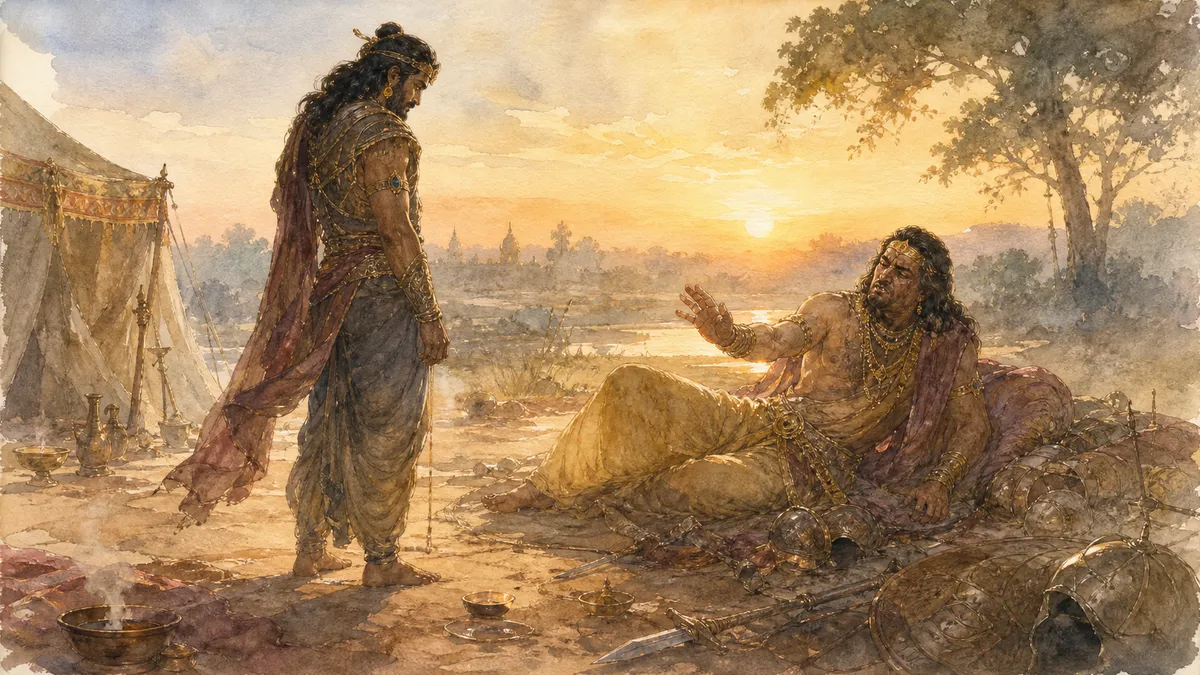
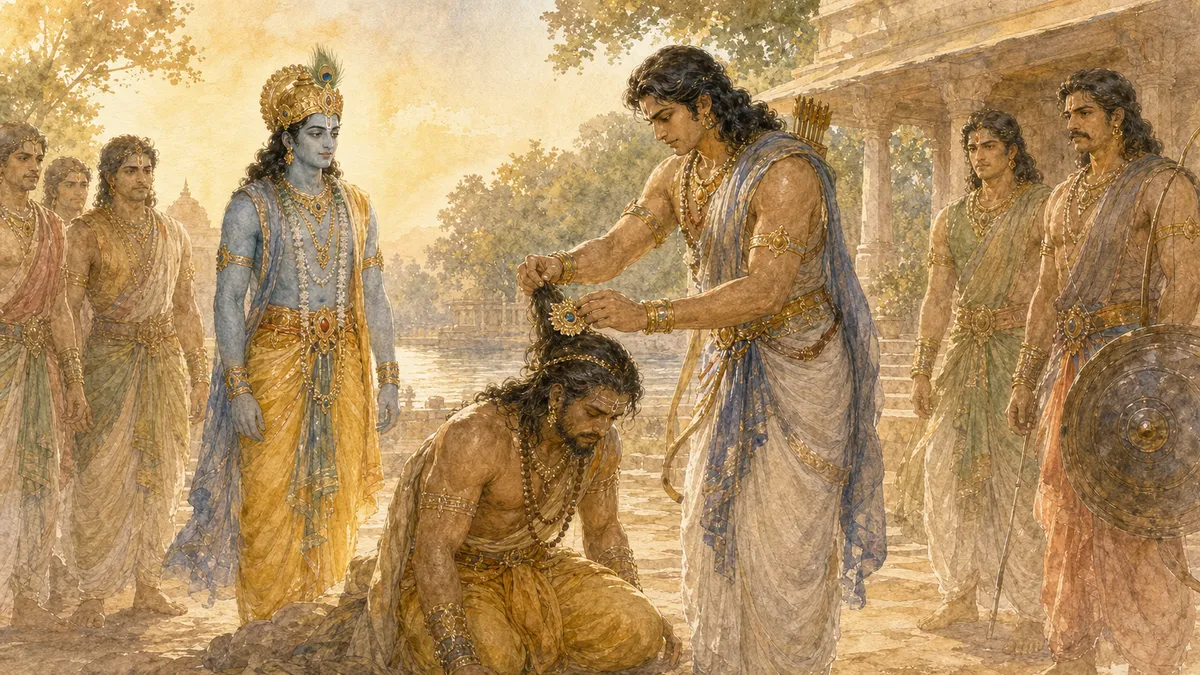
And how did it end? He was caught, and he was cursed by Krishna. They wanted to kill him, but Draupadi saved him. She said, “I would not want another mother to suffer. Although he killed my five children, he is still the son of a brahmana; he must be treated differently—let him live.” And thanks to Draupadi, he was pardoned. But Krishna cursed him. He said, “You will not die; you will suffer from leprosy, your body will rot while you are alive for several thousand years, and you will be driven away from everywhere.” And his hair was shaved off, his shikha was cut off, and the jewel that was in his forehead and contained all his mystical power was torn out. He was not merely a human being; he was endowed with enormous power, and this jewel contained all his magical power.
And many later condemned Ashvatthama. It went down in history that, being the son of a brahmana, he did not, as it were, possess worthy qualities. And he was not a brahmana, but a brahma-bandhu, which means “one who has a kinship connection with a brahmana.” And this was because, after beheading the five sleeping sons of Draupadi, he brought their heads as a trophy to Duryodhana, believing that he would be pleased.
The Battle of the Divine Astras
Upon learning of the murder of the children, grief-stricken Draupadi began to weep, and Arjuna promised to bring her Ashvatthama’s head. Mounting his chariot, donning his armor, and taking up his weapons, Arjuna set off in pursuit of Ashvatthama. And when Ashvatthama saw that Arjuna was catching up with him, he began, in fear, to recite hymns, activating the Brahmastra, although he himself did not possess the ability to stop it—he could only launch it. But he had this thought: “If this is the end, then let everything here burn.” And the Brahmastra released by Ashvatthama, the son of Drona, was aimed at the five Pandavas and at the last of the Pandava line, the infant in the womb of Uttara, the wife of Abhimanyu.
And seeing that the Brahmastra was approaching, all five Pandavas took up their weapons, while Uttara, the woman in whose womb the child was, began to pray to Krishna. And Krishna sent his blessing to Uttara, enveloping her fetus with his energy. Thus his life, as the last descendant of the Kurus, was preserved. And this infant, whose life was preserved in the womb, was the future emperor of the world, who was known as Parikshit, Maharaja Parikshit, the saintly king.
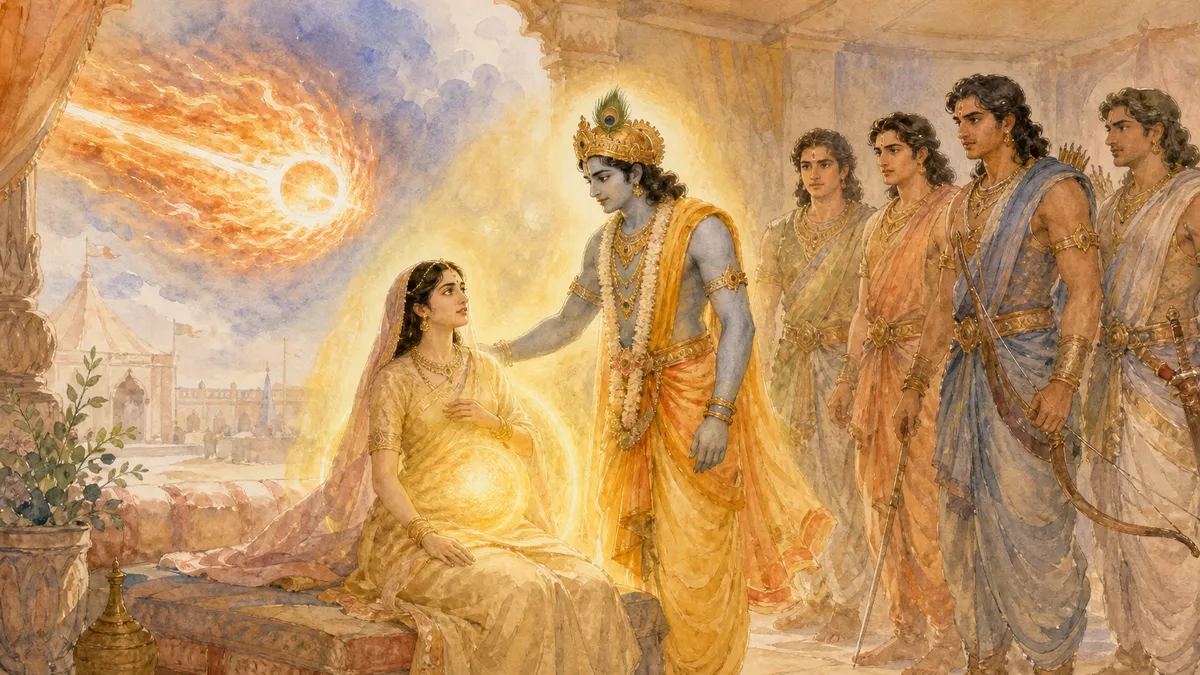
And Arjuna, seeing this unbearable blinding light and feeling that his life might now come to an end, turned to Krishna, asking what this radiance was and where it came from. Krishna, possessing his deep vision, said that it was the Brahmastra, and that the son of Drona had activated it by reciting hymns. Certain Vedic hymns had activated it. And Krishna said that only another Brahmastra could counteract a Brahmastra. On Krishna’s advice, Arjuna released his own Brahmastra and thus stopped the action of the Brahmastra that had been released by Ashvatthama.
Draupadi’s Mercy and Ashvatthama’s Punishment
After this, Arjuna managed to catch up with Ashwatthama in his chariot; he bound him with ropes and brought him to the camp. According to Vedic law, everyone was prepared to kill him. However, according to other Vedic laws, he was the son of a brahmana, and he had to be spared. And Arjuna did not know whom to listen to, since the laws were contradictory. In addition, he had already promised Draupadi to bring her the head of the killer of her sons. But when Draupadi saw Ashwatthama, who was bound and silent, she sincerely and kindly offered him the respect that should be offered to a brahmana. And it was painful for her herself to see Ashwatthama bound with ropes. She asked Arjuna to free him from the ropes and not to kill him.
Arjuna still remained confused, not knowing what he should do. Then Krishna said: “One must not kill a brahma-bandhu, but if he is an enemy, it is necessary to do so. All these laws are in the scriptures, and you should act according to them.” After these words of Krishna, Arjuna decided to act as follows: with his sharp sword he cut off the hair and the jewel from Ashwatthama’s head, and he was exiled. And he was so offended, humiliated, at once both killed and not killed. According to the dharma-shastras of that time, it is considered that cutting the hair from the head, depriving one of wealth, and banishing one from one’s own home is the punishment prescribed for a relative of a brahmana. The death penalty is not included among them. And this is how that story ended.
A Meeting with Ashwatthama in Our Time
And there is a story that Pilot Babaji described. It is quite an interesting story, from when he went to the Narmada, in the state of Madhya Pradesh, where people speak their own language, not Hindi. Ancient tribes live there, not even entirely resembling Indians. And together with Hari Baba they were doing parikrama along the Narmada River in the state of Madhya Pradesh. The Bhil tribe lived there, and the Bhil tribe lived by hunting in the jungle and robbing everyone who wandered in there, “freeing them from attachment to the material world.” And everyone who, out of ignorance, might enter there—tourists, simply the curious, Hindus, merchants—they robbed them all. But they did not touch beggars, tribes like gypsies, that is, they did not touch the poor.
And when they entered there, they also had bags with them. The Bhil tribe surrounded them; there was excitement, and they began talking among themselves in their own language. They surrounded them and took their bags to check them. And they saw that they had only neem leaves and some other food there, and no possessions at all. They were sadhus and observed the vow of non-possession. And then the Bhils somehow looked at them with respect and went to their chief. They began to show signs of attention, brought them into a hut, lit a dhuni there, gave them tea and some kind of flatbreads—in short, they honored them as sadhus.
And at that time a strange man arrived. He looked somewhat different from all these people of the Bhil tribe. And they saw that the Bhil tribe had its own culture, its own civilization, its own discipline, despite the fact that they were robbers. But they believed that they were within their rights, because people entered their territory. It is like crossing a border without a visa, so customs confiscates everything. Since they did not have such a civilization, they simply robbed them and drove them away. That is, all the same, they had their own civilization.
And so a man arrived, and this man was in yellow clothing, in a turban, tall, with some special facial features, long arms, and some protruding mustache, completely unlike them. This was a short-statured tribe, while he seemed to be from an entirely different race. And he behaved very majestically and was there, as it were, as a chief. And they said that they worship him twice a year, that he is a very respected person, but no one really knows who he is.
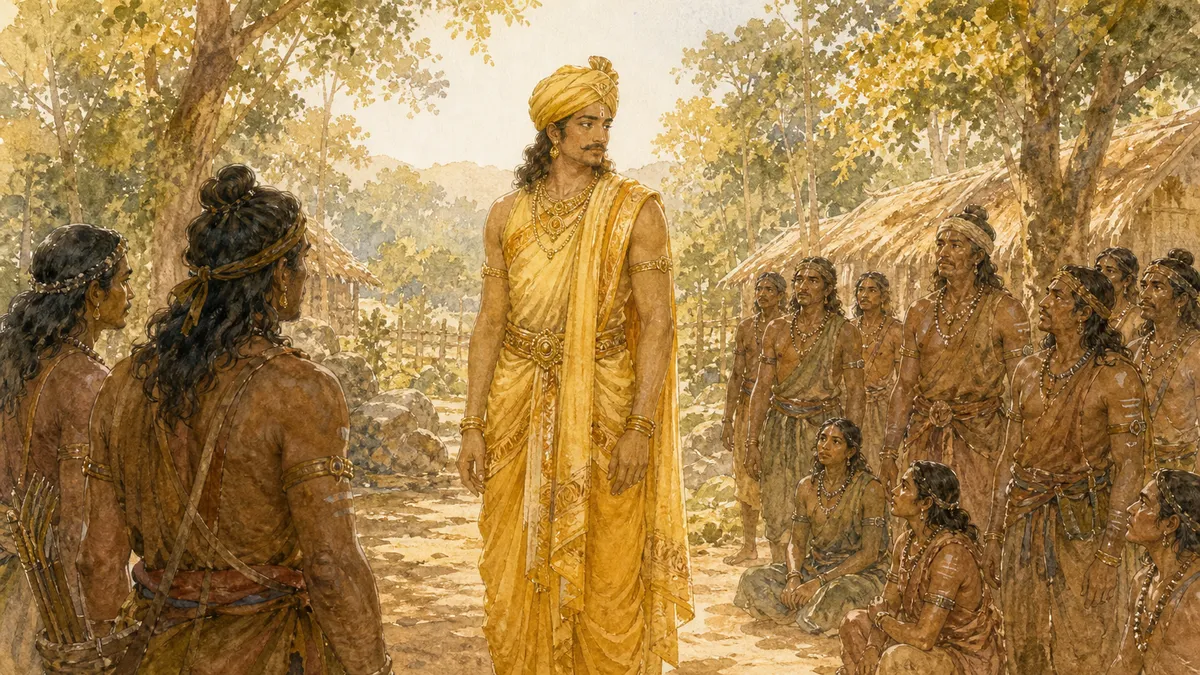
Pilot Baba asked Hari Baba: “Who is he?” Hari Baba said: “It is better not to ask, we should go.” But a strong desire arose in Pilot Babaji to find out who he was. He grabbed him by the feet, bowed to him, and said: “Maharaj, whoever you may be, we want to know who you are; what is your mercy? I see signs on you that you are a man of another race and not of this age at all.” These Bhils became very agitated; they were surprised by such disrespectful behavior, that Pilot Babaji stopped him, blocked his way, and began asking questions. Usually they worshipped him and did not ask any questions at all.
And then he called them to come with him and said: “I am Ashwatthaman, I am a participant in the Battle of Kurukshetra, I am the son of Dronacharya. Once I was a great hero.”
And he moved a lock of hair aside, and he had a scar across his entire head, and light was coming from within that scar. But the stone was no longer there. He said: “Once I had a stone, I was a great warrior, and the knowledge of all military strategies was mine, but now all knowledge has left me, and the mystical power has also left me together with this stone. Now I already live in the past.” He lost his jewel in his forehead, and his powers left him, but in return he received from Krishna either the gift or the curse of immortality.
Krishna cursed him, and that was his curse. Krishna said: “Your body will rot alive from leprosy for several thousand years, but you will not die. Thus you will suffer, because you cannot be killed for your deed. According to the Vedas, you are, as it were, the son of a brahmana. And out of respect for Dronacharya we cannot kill you.”
Ashwatthama’s Life in Repentance
And they began to talk with him, and he said: “All my deeds are in the past, and now I simply live here, and I perform upasana to Shiva, while they worship me, seeing Shiva in me. I have entered the path of Rudra-upasana and am performing my repentance. I am performing repentance for deeds of long bygone days, which are already five thousand years old. Seeing my contemporaries from the time of the Mahabharata in the bodies of animals, snakes, and birds, I reflect on the law of karma, on impermanence and the preciousness of human birth. I teach no one, I preach to no one, I live very hidden away. This tribe is very closed, and no one disturbs me here, no one touches me. Only sometimes do I go to the Himalayas to meet other immortals — Kripacharya, the son of Vyasa, and Vidura, the son of Dhritarashtra. Thus I live, a very secluded way of life, wholly focused on upasana, observing mauna and immersed in aradhana, that is, worship. Aradhana is precisely worship.”
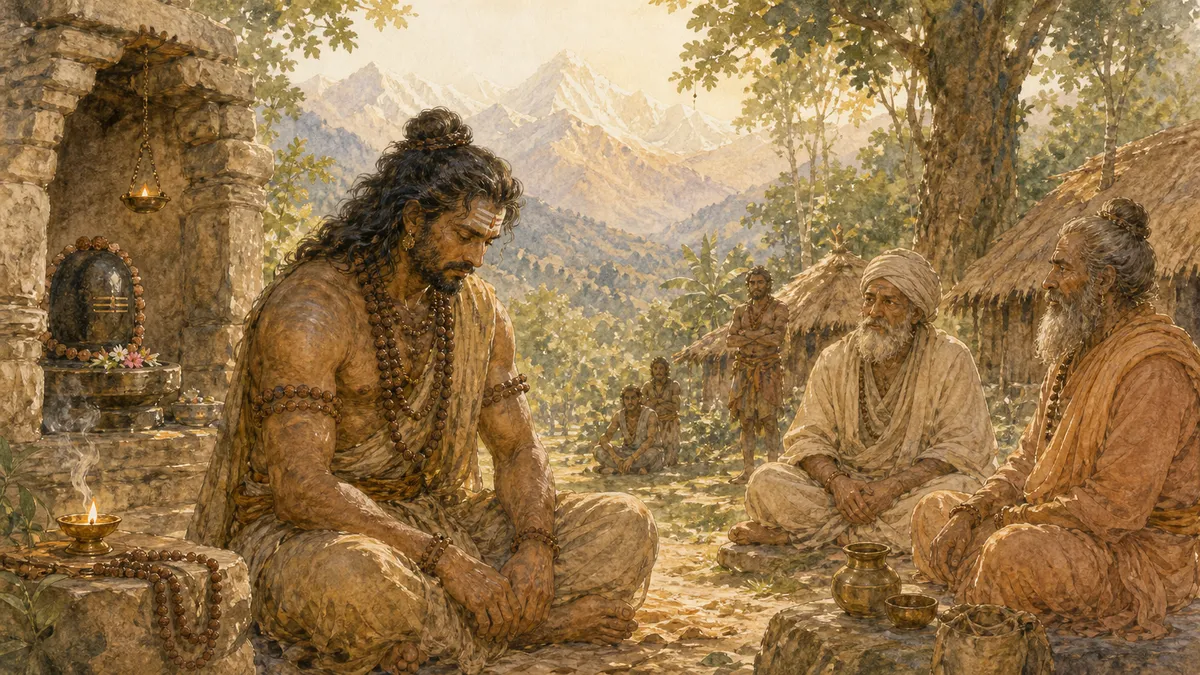
And Babaji and Hari Baba lived with Ashwatthama there, among these Bhils, for about six months. And then he said farewell and disappeared.
The Mitigation of the Curse Through Repentance
Krishna’s curse was that he would live in a decrepit body. But they saw that he was not in a decrepit body at all; he was in an immortal young body, the body of a young man, but with unusual facial features not found in that locality. And it is believed that this was because he realized his guilt and took up Shiva-upasana. But the entrance to the heavenly worlds is still closed to him, possibly until the end of Kali Yuga.
When he received Krishna’s curse for killing the children of the Pandava lineage, because brahmanas could not be killed, and when everything was over, he withdrew and began to perform repentance. And his remorse, anutapa, led to Krishna’s curse being softened. And thanks to this he no longer had to be leprous or suffer in a decrepit body; he was not driven away, everyone did not despise him. He was in a young, normal, good body, and he had a good fate — the Bhils worshipped him.
Predictions of Ashwatthama’s Future
In the Puranas there is a prediction that he will be one of the Saptarishis in Manu’s council in the next age. The Kurma Purana and the Vishnu Purana speak of this. They also say that in the next age, in the next Kali Yuga, he will also become Vyasadeva, that is, the next Vyasa, the literary avatar who divides, classifies, and systematizes the Vedas. And he will be the only one who will be a witness of Kali Yuga, who will live until the end of Kali Yuga and remain the sole witness. Therefore he will describe everything, all the deeds of Kali Yuga, just as Vyasa described the deeds of this Kali Yuga — the Mahabharata and the Ramayana. And when will the next Kali Yuga be? Some have even calculated it — something around 4 million 300 thousand years. A complex calculation.
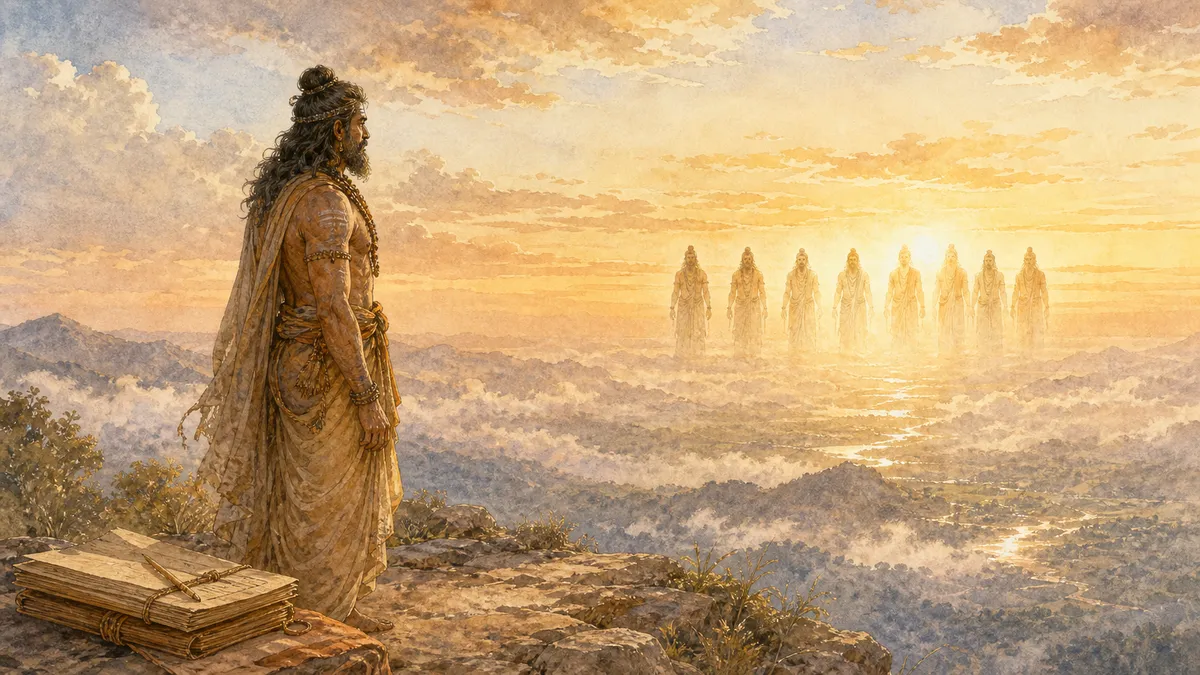
It is also said that in his time he was friends with Arjuna, even before they fought. And Arjuna took a vow never to eat in the dark. And since sometimes he would come and want to eat, but it was dark, what was to be done? Then Ashwatthama would reveal his stone, which emitted light, illuminated everything, and Arjuna could eat.
Thus, Ashwatthama is an avatar of Shiva, who in the next age will become Vyasa and who will also become one of the Saptarishis in the next manvantara, in Manu’s council. And now he still lives on earth.
