

Commentary on the text “Mahabharata,” Book 3
The “Mahabharata,” Book Three, “The Forest,” Chapter 38. A conversation between the rishi Vaishampayana and Janamejaya. Janamejaya wants to know the story of how Arjuna (his great-grandfather) performed ascetic practice, and asks Vaishampayana this question.
Vaishampayana is a descendant of Vishampa, a disciple of Vyasa. The narration of the Mahabharata is conducted in his name. So, Vaishampayana says:
I will tell you the story of Arjuna and his hand-to-hand combat with Shiva.
The Beginning of Arjuna’s Ascetic Practice
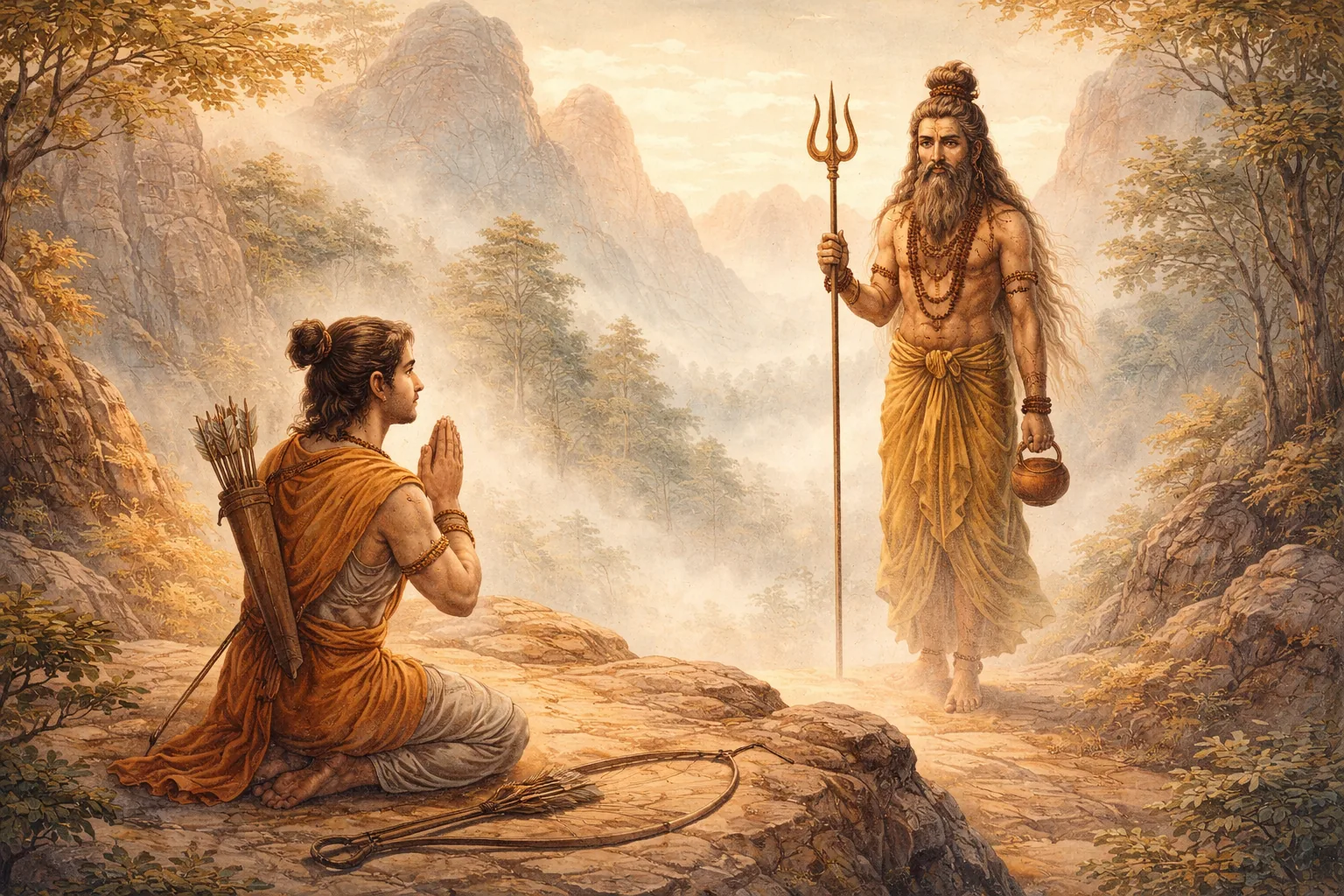
One day Yudhishthira ordered Arjuna to perform a practice on the advice of the rishi Vasishtha in order to obtain magical weapons before the battle with the Kauravas. And then he decided to meet with Indra (Shakra) and with Shiva (Shankara), took his bow and sword, and went north to the Himalayas. Then he entered the dense Kantakito forest. It was an abode of wanderers, rishis, and gandharvas, full of animals and rich in flowers. And as soon as he entered the forest, the sound of conches and drums rang out in the sky, flowers were showered down—that is, there were auspicious signs.
Having crossed the mountain, he settled on the Himavan ridge; it was a very auspicious place, peacocks and cuckoos lived there, and the pleasant singing of birds could be heard. Arjuna, having entered the forest, was delighted by the nature of this place; he liked it very much. With a joyful heart he went deep into the forest, took off his royal garments, dressed in a skin and coarse cloth, took a staff, and prepared a place for practice.
At first he ate torn-off or fallen leaves, and then one fruit once every three days. In the second month he ate one fruit once every six days, and in the third month he took food only on the full moon. In the fourth month he subsisted only on air. And all this time he stood in vrikshasana (the tree pose) on the toes of one foot, with his arms raised upward. That is, he performed the traditional practice of tapas, engaged in reciting the mantra and contemplation.
The Rishis’ Appeal to Shiva
The rishis noticed this. They came to Shiva to tell him that Arjuna had given himself over to harsh practice, asceticism, and mortification of the flesh, evidently wishing to receive something as a blessing. Bowing to Shiva, they praised Arjuna with these words:
The magnificent son of Pritha stands on the Himavan ridge. From his terrible ardor, from his standing, the quarters of the world have become veiled in haze. But we do not know his aims. The fire of his austerity scorches even our world, and some imbalance or disruption may occur. He must be stopped.
And then Shiva said:
Do not worry and return by your own paths. His purpose is known to me. He desires neither the heavens nor dominion, and what he wants, I will give him.
Then the rishis went to their abode.
Shiva’s Appearance in the Form of a Highlander
After this, Shiva assumed the illusory body of a highlander, a hunter-man. He took a bow and arrows and, like a flame (a pillar of golden fire), descended into the world of humans together with his consort, the goddess Maya. His retinue also followed him—the spirits who were devoted to him. In the clothing of a highlander, he was at first surrounded by thousands of women who were manifestations of his energies. When he arrived, manifested himself, the sounds in the forest immediately disappeared; the birds fell silent.
Coming closer to Arjuna, he saw that a certain rakshasa, the son of Kashyapa and Danu, had assumed the terrible form of a boar and had decided to attack Arjuna. Arjuna, seeing this boar (the illusory body that this rakshasa had assumed), took his bow and said:
I will send you to the abode of Yama before you destroy me.
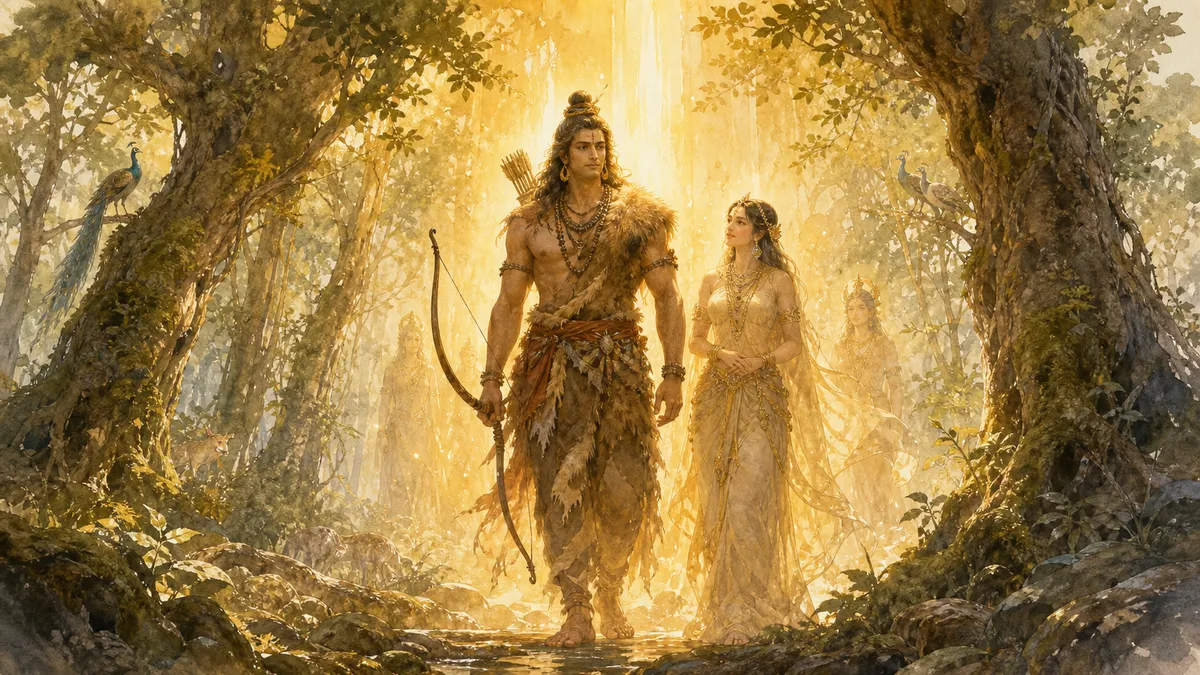
Then Shiva, in the form of a highlander, approached him and said:
This is my boar! I am a hunter, and I was pursuing it, so you had better not touch it.
But Arjuna did not even take these words into account and shot at the boar an arrow rumbling like thunder. He released two arrows, and both of them struck the body of Muka—this magical boar. It fell, stretched out, while the two arrows, with a crash and lightning, lodged in the rocks. Struck by the arrows, the rakshasa died.
The Dispute Between Arjuna and the Highlander
Then Arjuna saw a radiant man in the form of a highlander together with a woman. This highlander asked him:
Who are you? And why did you shoot at this boar? After all, it is my prey. You have insulted me, and now you will not leave this forest alive. Since you have acted contrary to the law of the hunt, I will punish you for it.
Then the highlander said with a smirk:
This land has always been ours. I see that you have taken a liking to your difficult ascetic life. We also live here, performing various practices. But you are still very young. How will you travel through this lonely desert land?
With these words, Shiva wounded Arjuna, calling him a boy. Then Arjuna took up his enormous bow and said:
For me there is no problem living in this forest if I was able to shoot such a boar.
But the mountaineer objected:
This boar was killed by arrows from my bow. It was my target; I killed it. And it is not proper for you, intoxicated by your strength, to shift your wrongdoing onto another. Feeble-minded boaster, I will punish you for your bragging!
Arjuna accepted the challenge, and then the mountaineer said:
Well then, watch: I will shoot at you, and you shoot your arrows at me. And then we shall see which of us shoots better, which of us is greater, since you are so proud.
The Battle Between Arjuna and Shiva
Arjuna became very angry because some mountaineer had dared to instruct a great kshatriya warrior, perfectly trained in the art of war, and even threaten him. Seized with fury, he began to shoot arrows at him, while the mountaineer, with a cheerful heart, received these iron arrows and said:
Come on, come on... Give me more. That is somehow very weak.
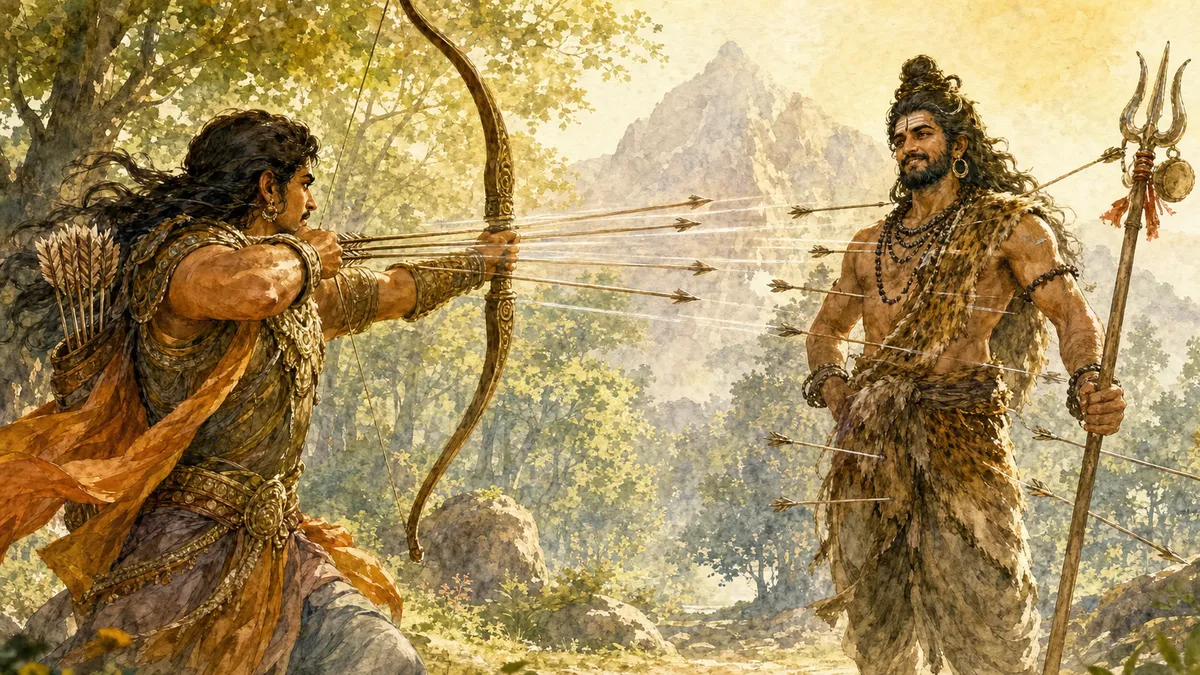
Arjuna shot bamboo arrows at him, iron arrows, and swords. He poured an entire rain of arrows upon him. The mountaineer also shot arrows, but there were far more arrows from Arjuna’s side. Shiva received them all with a contented heart, while he himself stood unharmed.
Then Arjuna began to think: “Strange... How can this frail Himalayan dweller, this mountaineer, receive such arrows from my bow without harm? Perhaps this is one of the gods who has appeared, some asura, sura, yaksha, or rudra? I have heard that even gods from among the thirty-three chief gods come to this mountain. Only a great god possessing great magical powers could withstand such a cloud of arrows. If even a lesser god stood against me, I would have sent him to the abode of Yama long ago.”
And again he began to shoot arrows by the hundreds with even greater force. But the mountaineer stood like an unshakable rock and received all these arrows. Suddenly the blessed quivers, with which the god Agni had once endowed Arjuna, disappeared. Arjuna could not understand at all who this man was, absorbing his arrows in this way. He thought: “I will strike him with the point of a spear, as I can strike an elephant, and I will still send him to the abode of Yama.” He loosened the bowstring and began to strike Shiva with the bow’s shaft, but the mountaineer simply took and tore this bow from his hands.
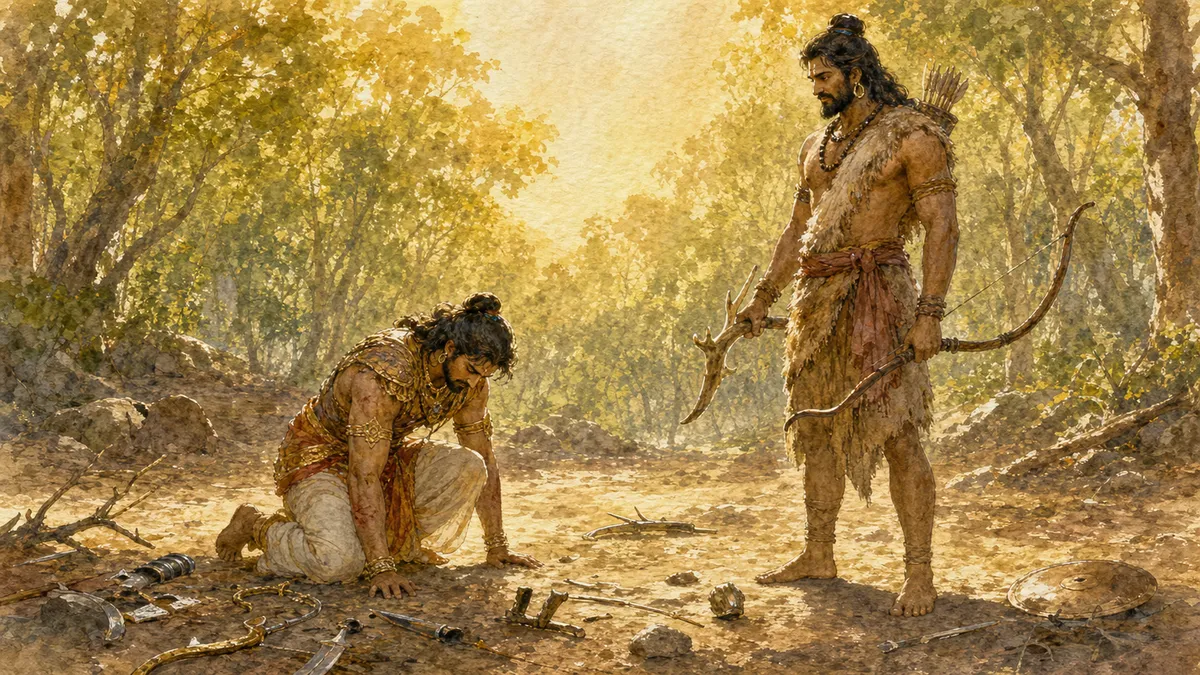
Then Arjuna seized a broadsword (a small sword) and struck the mountaineer’s head with great force, but the broadsword shattered to pieces as soon as it reached the mountaineer’s head. Then Arjuna began tearing off branches, looking for sticks that were nearby, large boulders, and stones, but the mountaineer also deflected even the trees and huge stones with his body. Then Arjuna attacked him with his fists, beginning hand-to-hand combat. It is said that his blows were like thunderclaps. But the mountaineer, with even more powerful punches, began to press Arjuna back. During this fistfight there was a very loud crash. This duel lasted a very long time. Arjuna pressed against the mountaineer with his chest, while the mountaineer struck him. In the end, Shiva exhausted him and twisted his arms. Arjuna’s consciousness became clouded, and Shiva pinned him down so that Arjuna became breathless and collapsed to the ground, losing consciousness. When he came to, he found that he was drenched in blood and completely exhausted.
Recognizing Shiva and Receiving the Blessing
Then Arjuna, seeing that nothing could be done, began to worship Shiva. He made a small platform of clay and offered a small garland of flowers as an offering to Shiva. But suddenly this garland appeared on the mountaineer’s head. Realizing this, he became filled with great joy and fell at Shiva’s feet. And Shiva said to him:
I am pleased with you! There is no warrior equal to you in steadfastness. In greatness and courage you have become like even me, and therefore I wish to show you favor and grant you various blessings. You can defeat any enemies, and even the celestials, in battle. And as a blessing I will give you an invincible weapon that you can carry.
Then Arjuna saw Shiva together with the goddess, his consort. They manifested their illusory bodies in their true form. Arjuna bowed to Shiva, then fell at his feet and said:
For you are the one who wears the skull. You are the lord of all the gods, the blue-throated god. Now I recognize you: you are Mahadeva, the god of all gods. I acknowledge you as the prime cause; you are the three-eyed Lord, you brought forth this world, you are the one who is invincible in all three worlds: in the world of the gods, in the world of humans, and in the world of the asuras. You are Shiva in the form of Vishnu, and Vishnu is your form. I know that it was you who once destroyed Daksha’s sacrifice, and therefore I address a prayer to you as the three-eyed one, as the bearer of the spear, as the bow-armed protector, as the sun, as the supreme purifier. I ask you, the highest transcendent Purusha, to forgive me. I came to the mountain to see you specifically. And for this I performed my practice. Please forgive me for fighting with you, not recognizing who you were. Let my punishment not be excessive, since I dared to do such a thing only out of ignorance. I rely completely on your protection.
Then Shiva raised his hand and said:
I forgive you.
Then he embraced Arjuna, calmed him, and said:
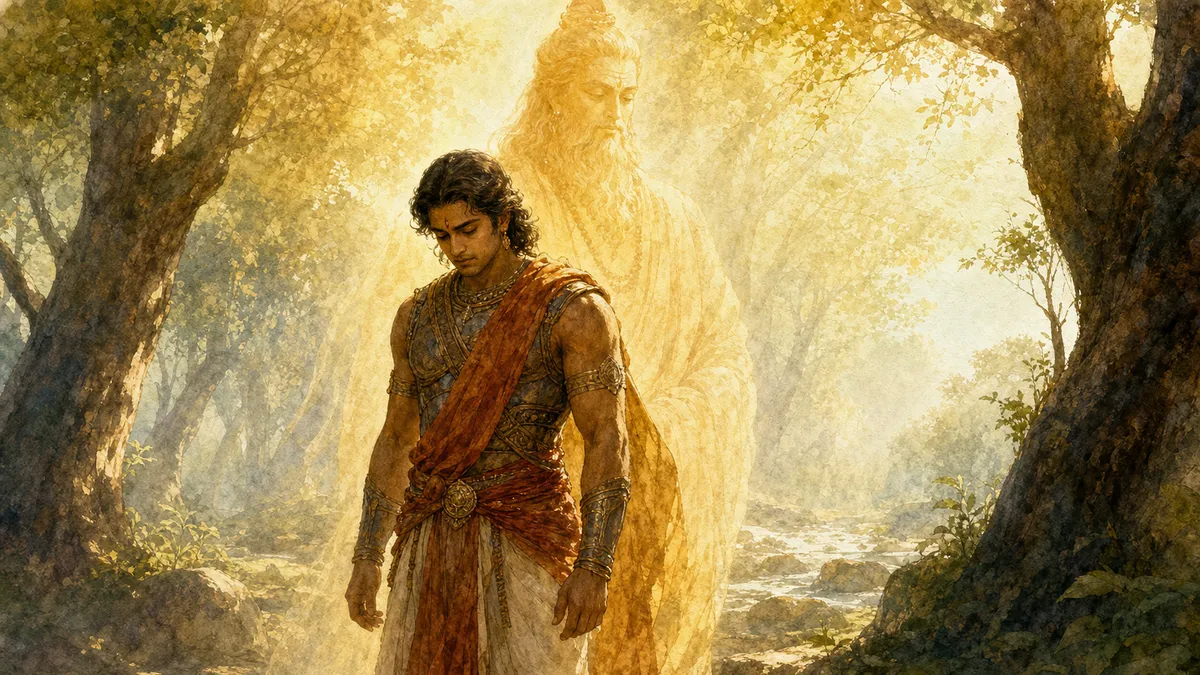
In fact, in past lives you were the rishi Nara, the companion of Narayana—another rishi. You yourself are an incarnation of an ancient rishi.
Usually we perceive Arjuna as Krishna’s inexperienced disciple and a good warrior. But in fact this is only his outer shell; Arjuna himself is an emanation, the illusory body of a great enlightened demigod, a semi-siddha, a deity, a great rishi in the past who had already attained realization. It was simply that the lila was such that Arjuna, with the mind in this illusory body, did not fully remember his level and his realization.
The Granting of the Divine Weapon
And Shiva said:
Once, in the region of Badarikashrama, you performed great and terrible tapas for millions of years. There is in you the same immense power as in Vishnu. You are two supreme spirits thanks to whom the entire world of samsara is sustained. When Indra was crowned king, the danavas (enemies, demigods of a rival race) took possession of magical weapons. But it was you together with Krishna who overthrew them, and then your weapon was absorbed by me, but now it belongs to you again. I grant you the blessing of invulnerability. You may also ask me for any blessing, for there is no equal to you among the kshatriyas; even in heaven there is no one who would be superior to you.
Arjuna said:
I wish to receive the wondrous and terrible weapon belonging to Pashupati, that is, to you, Shiva, and the dreadful power proper to your very incarnation as Rudra, which is called “the head of Brahma” (brahma-shiras). This is the weapon with which you bring this world to an end, destroying it at the end of the Kali Yuga. I am destined for the greatest battle with the Kauravas, and I think that only with such a powerful weapon will I be able to defeat all the danavas, rakshasas, impure spirits (pishachas), and nagas. It has been foretold to me that in the future I will fight with this weapon.
And Shiva said:
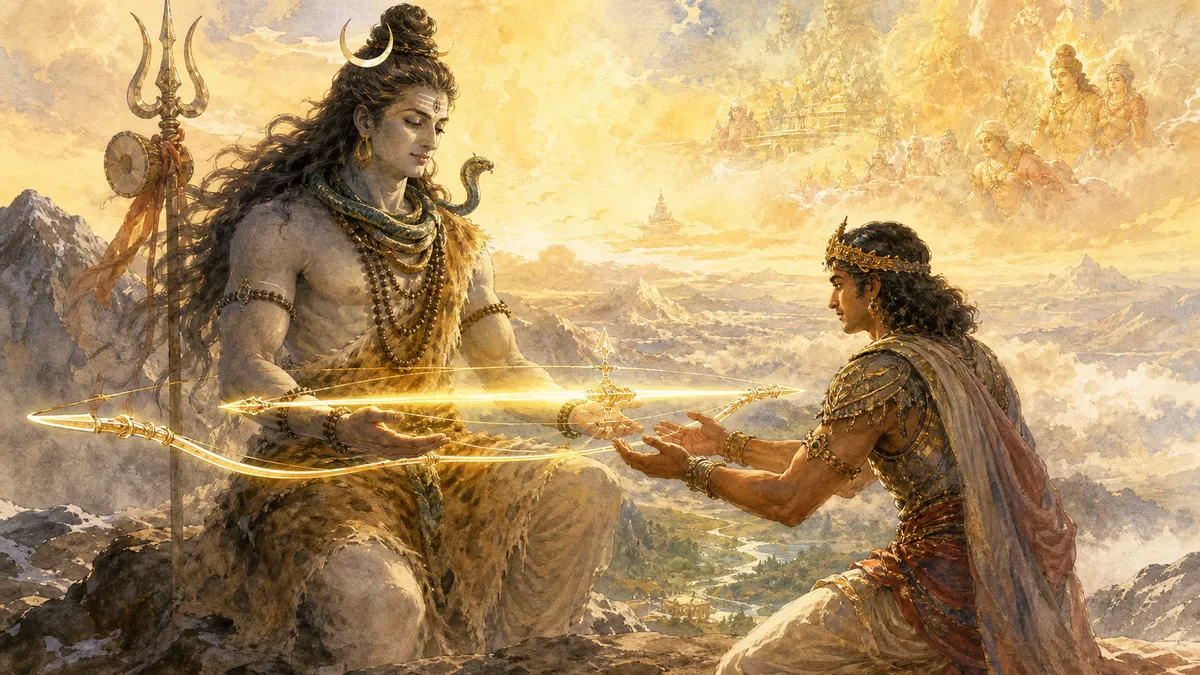
I grant you my beloved weapon. Only you are capable of carrying it, setting it in motion, and stopping it.
That is, this was not the simple Gandiva bow that people speak of. It was some very complex magical weapon that had to be learned and mastered. This weapon could be controlled by thought, by word, and by gaze.
Shiva said:
Even Kubera (the lord of the yakshas), Yama, Varuna, Vayu, and other gods cannot control this weapon, much less humans. But to you I will give such a blessing that you will be able to control it. However, you must not use it against a person of little strength. If it strikes an insignificant object, it will bring great calamities upon the Earth, because in the three worlds everything may be subjected to destruction.
Arjuna performed purification and, approaching Shiva, said:
Please teach me how to wield it.
And Shiva initiated him into the secrets of this weapon. Arjuna accepted this weapon, that is, the task of his tapas was fulfilled. At that moment, the earth shook, together with mountains, trees, forests, and seas. The sounds of a thousand conches, tambourines, and drums rang out. Whirlwinds came crashing down. And then this terrible weapon flashed so brightly that even the gods and danavas (representatives of the demonic race) saw it. Shiva touched Arjuna, after which everything impure in Arjuna’s body at that time disappeared, that is, his body and pranas were completely purified. Shiva said to Arjuna:
Now you are so pure that you may go to heaven.
Thus Shiva, in the form of the lord of the mountains, Girisha, gave Arjuna the Gandiva bow, which could strike impure spirits and various obstructing beings. After this, Shiva, together with Uma, disappeared; leaving Arjuna, they departed into their own realm.
The Appearance of Other Gods and Their Blessings
Then Arjuna exclaimed in great delight:
How wondrous! I have seen Mahadeva himself! I am greatly blessed and enriched, for I was able to behold Shiva. I even touched him with my hand! I have realized my goal and attained the supreme Atman. The prophecies will surely be fulfilled — I will overcome my enemies.
While he was reflecting and rejoicing in this way, all quarters of the sky were lit up with colors. At that time Varuna appeared — the lord of waters and water spirits. He was accompanied by nagas, various deities of streams and rivers, daityas, and various spirits. Then Jambu, adorned with gold, appeared on a chariot; that is, the radiant Kubera arrived accompanied by yakshas (demigod-semi-spirits). Illuminating space with his form, he too came to look upon Arjuna, blessed by Shiva. The holy and majestic Yama also appeared, he who brings about and controls the end of the entire world, and with him came the spirits of the ancestors, who watch over the life of generations. He hovered on his chariot, illuminating the three worlds, and with him were guhyakas, gandharvas, and nagas. At that time Indra also arrived with his wife Indrani and a retinue of gods.
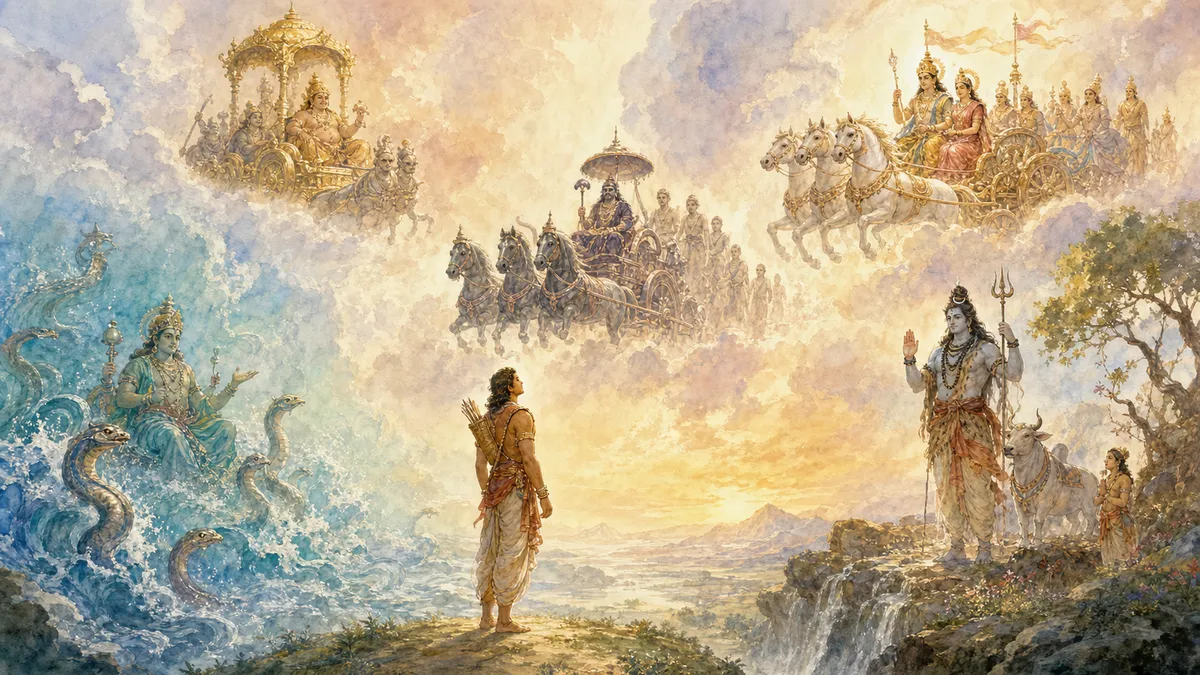
All of them gazed from the summit of the mountain at the shining Arjuna, who had received such a blessing from Shiva. Moreover, they held an umbrella over his head. Arjuna himself at that time shone like the lord of the stars, like the rising Sun. He was praised by the gandharvas and rishis who had gathered on the mountaintop. And then Yama, the knower of dharma, who stood in the south, said:
Arjuna, we are the guardians of the world, and we bestow upon you magical sight, for you are worthy of enlightenment. Once you were a mighty rishi endowed with great siddhis, named Nara. Your spirit was boundless, you were fully awakened, but by the command of Brahma you descended among mortals. Though your memory has become clouded, you are that very rishi. It is you who will slay the great righteous Bhishma in battle. You will be protected by the son of Bharadvaja, who has taken on a human form. You will strike down many danavas, and you will also strike down the valiant Karna. You will take possession of the lands of the incarnate gods, danavas, and rakshasas when they fall in battle. All of them will receive the path they have deserved. Such are the plans of the gods, and you will be their executor.
Since Yama is the embodiment of dharma (the law of justice and karma), he predicted all this to Arjuna and explained his mission. Then Yama said:
Your glory in this world will be imperishable. You have seen that Shiva was pleased with you in battle. In truth, he was simply testing your abilities by coming to you in the form of a mountain dweller. Together with Vishnu, you must lighten the karma of the Earth, therefore accept from me this weapon, which is the embodiment of retribution and the purification of human karma. You must fulfill your greatest destiny on Earth.
Arjuna accepted it with mantras and according to certain rituals. Then the lord of waters, Varuna, who dwells in the west, rose and said:
You are now the ruler of the kshatriyas; you hold supremacy over them. And I have prepared special nooses of Varuna, from which one cannot escape and from which one cannot hide. Once I myself bound thousands of daityas, alien spirits, with them. Accept these nooses from me. Even death itself will not be able to flee from these nooses if you capture it. If you go into battle with these nooses, then, without doubt, all your opponents will vanish from the Earth.
Then on Kailasa, Kubera, the keeper of treasures, also rose and said:
I too am very pleased that you have shown yourself so in battle with Shiva. Once you too were a god and constantly took part together with us in various games. And after Varuna and Yama have given you celestial weapons, I too bestow upon you a magical weapon—excellent armor, possessing which you will defeat the armies of Duryodhana. Accept my beloved weapon, which gives the ability to be invisible; it gives brilliance, strength, and lulls the vigilance of enemies. When Shiva destroyed the three cities of the asuras, it was with the help of this weapon that he burned the asuras. Only you are capable of holding it, since it possesses immense weight, like Mount Meru.
“Possesses immense weight” means that it possesses colossal energy.
And Arjuna accepted the weapon from Kubera as well.
Then Kubera said:
You must accomplish the great deed that the gods have conceived. You must now ascend to heaven. A divine chariot with a charioteer will descend to earth for you and take you to heaven, where you will receive your wondrous armor.
When Arjuna saw the guardians of the world, who had gathered on the mountain peak, he was filled with as much amazement as when he had seen Shiva, for he had never seen anything like it before. He honored everyone according to the ritual and made offerings to them of fruit and water. After that, the gods returned to their abodes. And Arjuna, having received their weapons, thought that at last the fruits of his tapas had manifested.
The Stage of Offerings on the Path of Divine Pride
As you know from the teaching of the path of divine pride, there exists a so-called stage of offerings. And here this stage of offerings is shown very vividly, when the yogin sees various signs, receives blessings, and divine beings appear before him. That is, the power of his mind had become so purified that the purity of its radiance began to manifest as a pure dimension.
The offerings in Arjuna’s karma manifested in accordance with his samskaras, that is, with the samskaras of a kshatriya. If Arjuna had not been a kshatriya but a pandit, most likely he would have received a magical scroll with sacred texts or something similar.
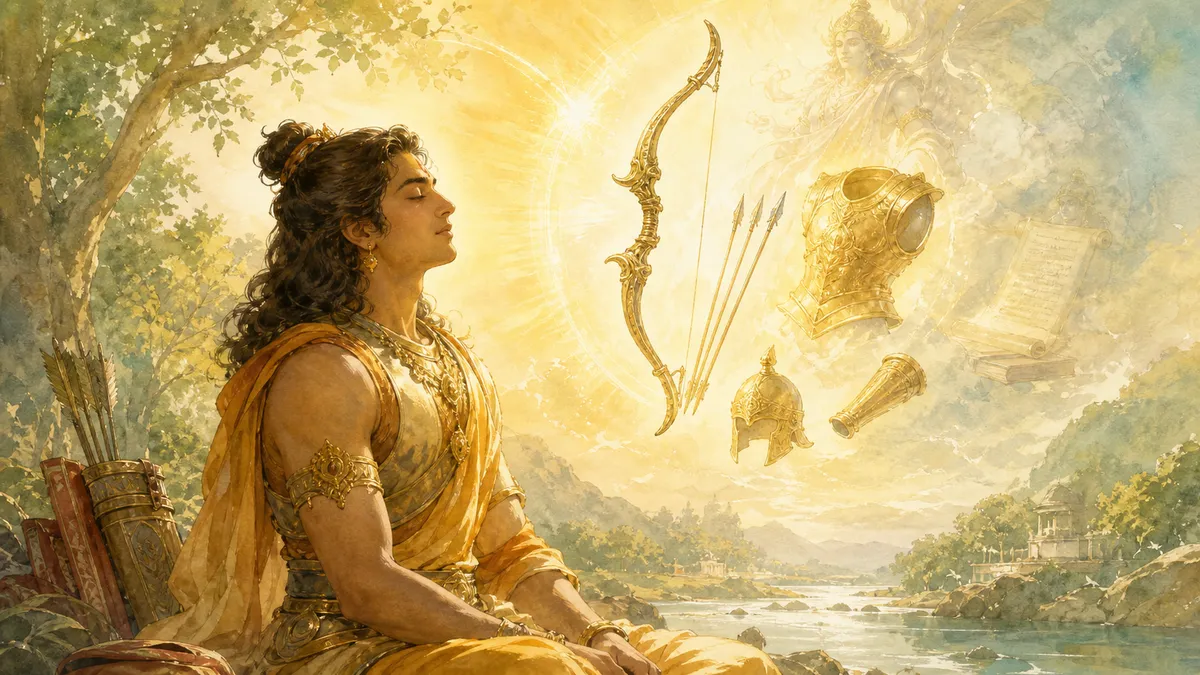
In the same way, when your consciousness is purified and you enter the stage of offerings, you too will be able to receive offerings in the form of various universal forces that become favorable to you and bestow their blessings.
