

Commentary on the “Shiva Purana.” Shatarudra Samhita
November 22, 2025
Chapter 38. “Description of Arjuna’s Austerities”
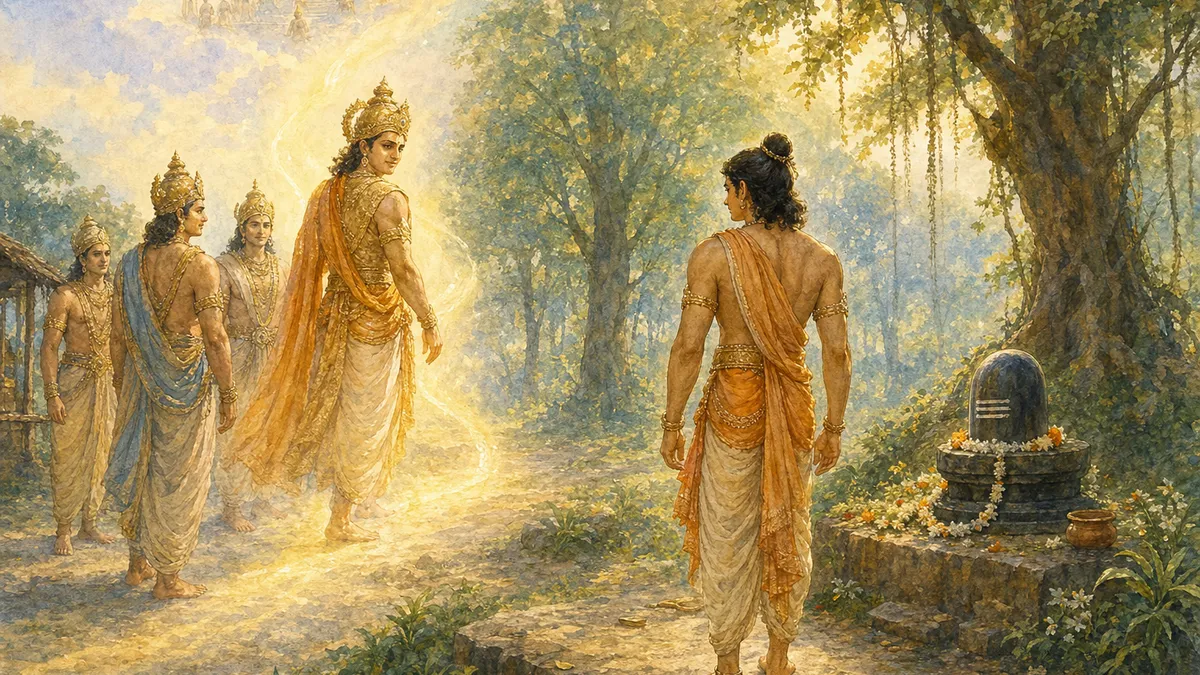
Nandishvara said: “Then Arjuna appeared, exceedingly bright and radiant, having attained incomparable splendor through Shiva’s mantra. Upon seeing Arjuna, the Pandavas were convinced: ‘Undoubtedly, we shall succeed, for Arjuna has attained immense splendor. This task can be accomplished by you and by no one else. This follows from Vyasa’s words: “Make your life fruitful.”’ Having said all this, they reluctantly bade farewell to Arjuna, distressed by the impending separation.”
Thus, on Vyasa’s advice, Arjuna went to the mountains, to the Himalayas, to perform tapas in order to receive the blessing of Indra and then Shiva, and to protect his family, his clan, from Duryodhana’s attacks. He sought to receive from Shiva the same blessing that Krishna had received. Krishna said that he had worshiped Shiva and, through worshiping Shiva, had attained all his spiritual powers and accomplishments. Arjuna hoped that Shiva would grant him the power to protect his people and his clan.
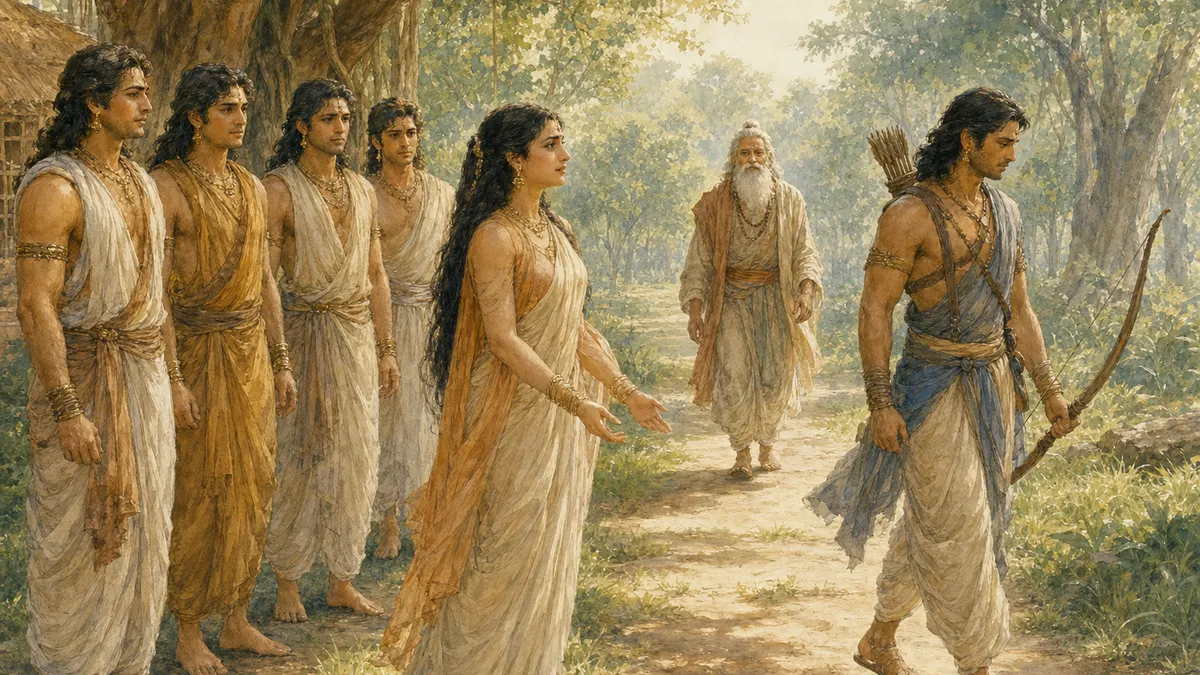
“Overcome with grief, the chaste Draupadi, holding back her tears, bade farewell to Arjuna. Draupadi said: ‘O king, you must act diligently according to Vyasa’s instructions. May your journey be auspicious; may Shiva be gracious to you.’ Nandishvara said: ‘Having lovingly bade farewell to Arjuna, all five remained there, deeply distressed. O excellent sage! As they stayed there, they spoke with one another. Listen! Even in misfortune, if loved ones are nearby, sorrow is lessened. In separation, suffering is doubled. Even the bravest cannot preserve their courage. O great sage! While the Pandavas were grieving, the great sage Vyasa, an ocean of mercy, arrived there. The Pandavas honored him with their presence and bowed respectfully, offering him a seat. In their distress, they reverently joined their palms and spoke.’ The Pandavas said: ‘O holy Lord! O excellent sage! We are burning with grief, but upon seeing You, we find comfort and joy. O Lord! O Brahman! O sage! Please remain here for some time and dispel our sorrow! By Your very glance, our suffering is dispersed!’
Nandishvara said: ‘Thus, at their request, the excellent sage remained there for their happiness, dispelling their grief by recounting various legends.’”
The Sage’s Energetic Influence
By a single glance from a sage, suffering is dispersed. This is not a figure of speech; it is both an energetic fact and a fact of consciousness. People suffer when their minds are constricted and do not abide in the nature of the Atman, and when prana moves through the lateral karmic channels. Karmic pranas are in motion. But in a sage such as Vyasa, the mind is firmly immersed in the nature of mind, in the Atman, while prana moves through the central channel. And when people are in his presence, his bhava is naturally transmitted to them. His vision is also transmitted, while their winds gradually and slowly begin to realign as well, increasingly abiding in the central channel and less in the lateral karmic channels. Samsaric concerns trouble them less, and the natural, innate ananda inherent in awareness awakens. Thus, these are not merely respectful words, but an energetic fact.
“O kind sage!” While speaking with Vyasa, Yudhishthira humbly bowed to him and spoke. Yudhishthira said: “O excellent sage, listen: I seek relief from our grief. O wise one, I ask this humble question. O Lord, please explain graciously. Has anyone ever experienced such grief before? Truly, it is only we and no one else.”
The Pandavas were deeply fixated on their grief. They had lost their kingdom, been banished to the forest, effectively overthrown, and deprived of power. They lived like commoners, subsisting on simple fruits. And although Krishna’s blessing supported them from afar, they nevertheless fulfilled the vow they had made and lived in utterly wild, non-royal conditions. They grieved that their clan had been destroyed and their power lost. But they thought their grief was the greatest of all. They asked: “Is there any other clan as unfortunate and accursed as ours? Have there ever been kings who suffered more than we do?” Vyasa consoled them and said: “Yes, there have.”
Vyasa said: “Once, King Nala, the noble-souled king of Nishadha, endured suffering greater than yours. Great calamity and grief befell King Harishchandra. They cannot truly be described, for they would deeply distress everyone. O Pandavas, even Rama had to endure such suffering that, on hearing of it, men and women would be deeply moved. Therefore, it is very difficult to explain this misfortune. The body is a mountain of suffering. Bearing this in mind, you must avoid all misfortunes.”
The Nature of Suffering and the Path to Overcoming It
And the suffering of these kings, these people, these heroes was based on duality, on dualistic notions, dualistic relationships, sensual attachments, on the duality of their status, their identity, and the possession of wealth. In essence, if they had practiced contemplation—for example, sankalpa, atma-vichara, Shambhavi Mudra, or divine pride—they would not have suffered. Because when you practice sankalpa, Shambhavi Mudra, or abiding in the nature of the mind, it can be practiced successfully in a royal palace, in a forest, surrounded by people or away from them, with or without social interaction.
What can seriously hinder you? If the body is healthy and there is a little food, then all these sufferings cease to be suffering, because nothing prevents you from abiding in the nature of the mind and in the state of contemplation. At that moment, you are engaged in the inner processes of awareness, and nothing can prevent you from continuing to engage in them except your own distraction. But when the mind is turned outward and we greatly overestimate the external material world, identify with it, and become attached to it, then, of course, suffering may arise if something goes wrong in the material world.
And so, the process of shifting perception from the external material world to the processes of contemplation is a process in which you notice that your suffering begins to disappear. You recall: “When was the last time I suffered? I honestly don’t remember. Probably thirty years ago.” And you notice that when you are aware, when you contemplate, and when you have few desires, there is no room for suffering. The suffering of the body still remains; we do not deny that. Yes, the body experiences pain or may have a runny nose. But we are talking about the suffering of the mind, sensual and emotional suffering. As soon as you stop focusing on the external material world and identifying with it, focusing on society and identifying with it, focusing on relationships and identifying with them, focusing on things, money, power, fame, objects, and entertainment and identifying with them, space and time are freed up for practice, awareness, and contemplation.
There can be no suffering in contemplation. At most, you may suffer because you became distracted. But this kind of suffering is easily eliminated. If you became distracted, simply return, and that is all. And you notice that when you contemplate, and when you are not contemplating you study texts, you have no suffering at all, nor can you, because the very object of suffering is absent. What suffering is there in the practice of Shambhavi Mudra? Perhaps your back or legs become numb; that is the most that can happen, but it is not serious suffering. Thoughts overwhelm you. But this is the kind of suffering you can easily handle. What suffering is there in contemplative practices? In the contemplative practices of divine pride? At most, you simply fail at them. But this is not suffering; it is more like slight dissatisfaction. Yet a sadhu easily overcomes slight dissatisfaction. He easily and decisively overcomes it in the first months of practice. How? Instead of dwelling on dissatisfaction, on the thought that “it isn’t working,” he simply says: “I am moving forward.” And he simply continues. It is not working right now, but I continue. And then it works. That is all—there is no suffering.
And if a sadhu lives in a space of awareness and practices continuously—I am not speaking only of Shambhavopaya, only of contemplation. You can also take simpler methods: mantra, japa. Just as with contemplative sankalpas, you can live in mantras, in visualizations. And if some subtle visualization does not work, then nama-smarana, remembrance of the name, remembrance of the deity’s form at the level of simple recollection, cannot fail. You recite the mantra, and you remember the deity and the mantra. A mantra cannot fail. Once you have recited it, the very fact that the prayer beads are turning between your fingers means that you have succeeded. You turned the beads for three minutes while reciting the mantra—you can congratulate yourself; you succeeded. And you remembered Dattatreya or remembered Shiva. There is nothing difficult about it.
And the moment you come to understand that spiritual practice is simple, and that if you devote attention and perseverance to it, it is bound to succeed, you feel contentment, and there is never any suffering because your mind is drawn to the practice, to the method. To be fascinated by the method, to be absorbed in the method, to immerse yourself in the sweetness of the method, to immerse yourself in the joy, bliss, rapture, ecstasy, and delight of the method, to immerse yourself in the subtle clarity of the method, to progress in understanding the method, to grow into subtle revelations and insights as you apply the method—this is the life of a sadhu. Everything else—cooking, service, cleaning, ongoing ritual practice—is naturally done playfully, by default. It cannot be done laboriously. Neither relationships, nor practice, nor service can be burdensome. Because when you are absorbed in the method, progress in its clarity and wisdom, and rejoice in it, all of this is easily done on a technical level, by default, of its own accord. At that moment, all suffering and all doubts and confusion leave you. You have only one thing to do: practice well and continue to progress deeper, deeper, deeper every day.
Therefore, a sadhu has no suffering, even if he has not yet attained liberation. Even an unliberated sadhu should have no suffering. He may still be bound by karma, but he cannot suffer because he is absorbed in the method, and there is no suffering in the method. There may be dullness in the method, yes, there may be distraction, or there may be a peak of rapture, bliss, or insight. But these are not suffering; rather, they are different forms of clarity and absorption in the method. This is the first sign that you have become a good sadhu: you are never bored, you always have something to do in your practice, and you have no need for any desires, relationships, external entertainment or possessions, money, power, property, fame, a good name, or authority. You regard all of these as sand, as pebbles. You are interested only in... You know that your happiness lies there. If not in shakta-paya, then in shambhava-paya. And if neither shakta-paya nor shambhava-paya, because these are also subtle methods, then in external anava-paya: arati, sutra, puja, homa, bhajan mandala, prostrations, external yoga practice. One way or another, you must attain absorption in one of the levels of the method. And when such absorption occurs, it means that you have the adhikara to practice this method. And you are happy. That is, a sadhu is happy when he is engaged in his method. He also performs seva, but he performs seva inseparably from the method. Method and seva must go together. Without the method, seva will merely accumulate merit, but with the method, seva will become a path to enlightenment.
This is the secret of never suffering and always being happy.
“This body is permeated and sustained only by suffering; there is no doubt about it. From the very beginning, birth itself in the mother’s womb is a cause of suffering. Even in infancy and childhood there are great misfortunes. In youth, a person experiences suffering even while enjoying pleasures. As the days come and go, as the burdens of worldly affairs arise in abundance, and life draws closer to its end with each passing day, a person remains unaware of it. In the end, there is death, after which even greater suffering arises; there are various kinds of hellish torment, and all of this is experienced by ignorant people. Therefore, this world is not true. You must always follow the truth. A person should do those things that please Shiva.” Nandishvara said: “Thus, the brothers spent their time in various conversations and discussions. Arjuna crossed impassable mountains to perform his regular rituals. Along the way, he encountered a yaksha and killed many bandits. He was pleased and soon reached the magnificent mountain.”
A great kshatriya. Along the way, he killed quite a few people. That is normal for a kshatriya. By modern standards, he was like an exceptionally well-trained special forces soldier. No bandit could survive an encounter with him.
Arjuna’s Tapas and Indra’s Attention
“Not far from the Ganges, he saw a beautiful place with groves of ashoka trees. It was magnificent, like heaven. There he stopped, bathed, and bowed to his venerable preceptor. He took the garments and attributes in accordance with the instructions. He restrained his senses and mind and stood motionless. He made an even and beautiful idol of Shiva out of clay. Before it, he stood in meditation on the magnificent mountain. He bathed three times a day. He performed various forms of worship. Again and again, he worshipped Shiva in the form of upashti. Indra’s messengers saw a magnificent pillar of light emerge from the crown of his head. They were frightened by this and thought to themselves, ‘When did he arrive? Indra must be informed.’ Having said this, they went to Indra. Indra’s messengers said, ‘O Lord of the Gods, we do not know who it is that is performing penance in the forest. Could it be a god, a sage, the sun, or fire? We were blinded by His splendour and have come to You to tell You the details. Please do what must be done.’
Nandishvara said, ‘Thus, having received the news from the messengers, Indra, the enemy of the mountains, understood everything that Arjuna intended to do.’”
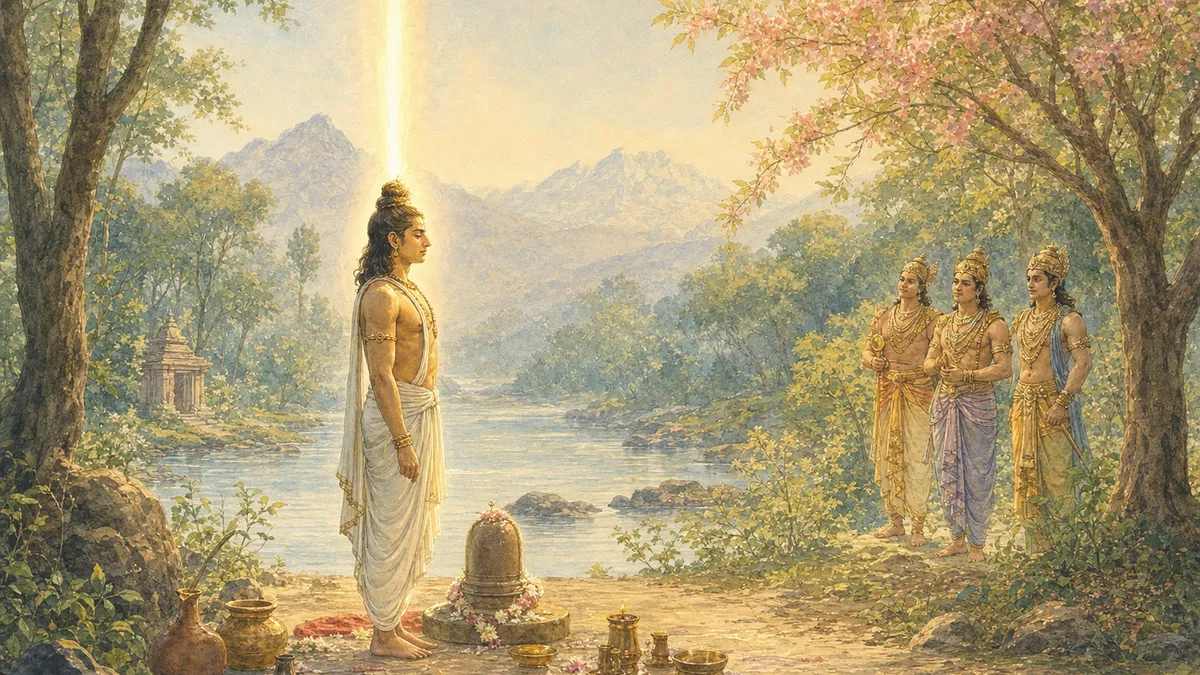
Indra is the deity who rules the entire universe; throughout the universe are his eyes and ears, his messengers, emissaries, observers, and representatives, who watch the behaviour of living beings: gods, humans, rishis, yogis, and animals. And when someone disrupts the homeostasis, the equilibrium, of this world, Indra receives a report. That is, when the magical fabric of reality somewhere begins to fluctuate because of excessive tapas, power, magic, and yoga become noticeable. This reaches them, and Indra is informed that there is a disturbance of physical laws and constants, a deformation of the magical fabric of reality in one location of the universe or another. They then begin to determine who it is—a deity, rishi, siddha, yogi, or human being—what purpose they are practising for, and what they want. If their goals are unwholesome or selfish, certain actions will be taken to hinder them. Indra’s task is to maintain balance in the universe as he understands it and to prevent distortions of energy and imbalance.
Indra is sometimes portrayed as a rather short-sighted, selfish deity who is deeply concerned about his throne. Of course, Indra is not like that. Indra is enlightened. He is a deity possessing great powers. He simply has his own understanding of the universe, his own understanding of its processes, and, so to speak, holds his particular office. It is the office, I would say, of the sthānapati of the universe, perhaps the administrator of the entire universe. And he performs his service to Shiva, acting in accordance with his understanding.
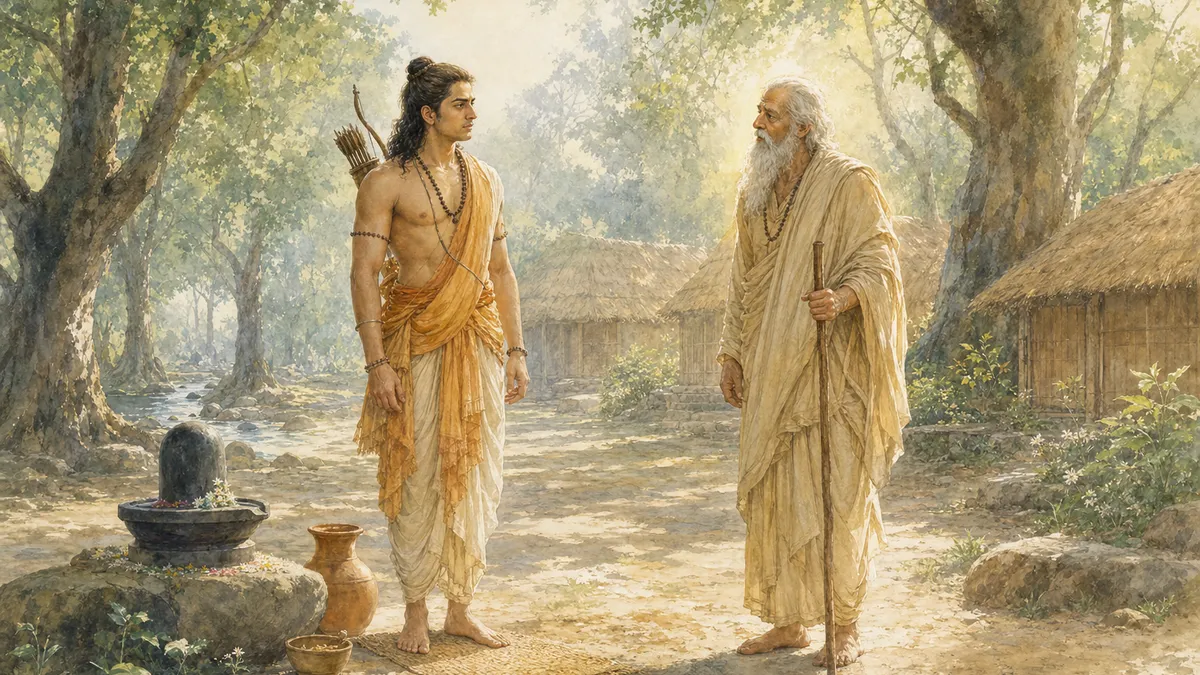
“He dismissed them and decided to go there to examine him. O foremost brahmin! Indra, the Lord of Shachi, assumed the form of an elderly brahmin brahmachari and went there to test him. On seeing him, Arjuna bowed to him, addressed him with words of praise, stood before him, and said...”
Indra can communicate with any living being, and his network, called Indra-jala, is spread everywhere—it is like rays of Indra’s consciousness permeating the entire universe. He can move freely along these rays and project his form, appearing at any point in creation. He easily found Arjuna and projected his illusory body, assuming the form of a brahmin brahmachari. Many gods like to assume the form of a brahmin brahmachari in order to test someone. Shiva tested Parvati in the form of a brahmin brahmachari. Vishnu, in the form of Vamana, tested another king. And now Indra assumed such a form to test Arjuna. Therefore, when you see a brahmin brahmachari before you, be attentive.
Arjuna’s Trial
“Where have you come from now? Please tell me.”
The Lord of the Gods, to whom this question was addressed, answered thus out of love, wishing to test Arjuna’s courage.
The brahmin said, “O dear one, why are you performing penance in the prime of your youth? Is it for the sake of salvation or victory? In every respect, this ascetic practice of yours is useless.”
Nandishvara said, “Thus questioned by him, he told him everything.” On hearing this, the brahmin spoke again: “It is not proper for you to perform this penance in order to attain happiness or salvation through Kshatriya rites, O excellent scion of the Kauravas. Indra is the bestower of happiness, not salvation, O great one; therefore, you should perform a greater penance.”
Indra’s Revelation
“Nandishvara said: Upon hearing this appeal, Indra was delighted. He revealed to him his wondrously beautiful form with all its attributes. Seeing Indra’s form, Arjuna felt ashamed. After comforting him, Indra spoke to him again.
Indra said: ‘O dear one! O Arjuna of great wisdom! Choose what is best for you! Whatever you may desire in your mind, there is nothing that cannot be granted to you.’
Upon hearing Indra’s words, Arjuna replied: ‘O Father! Bless me with victory! I am beset by enemies on all sides.’
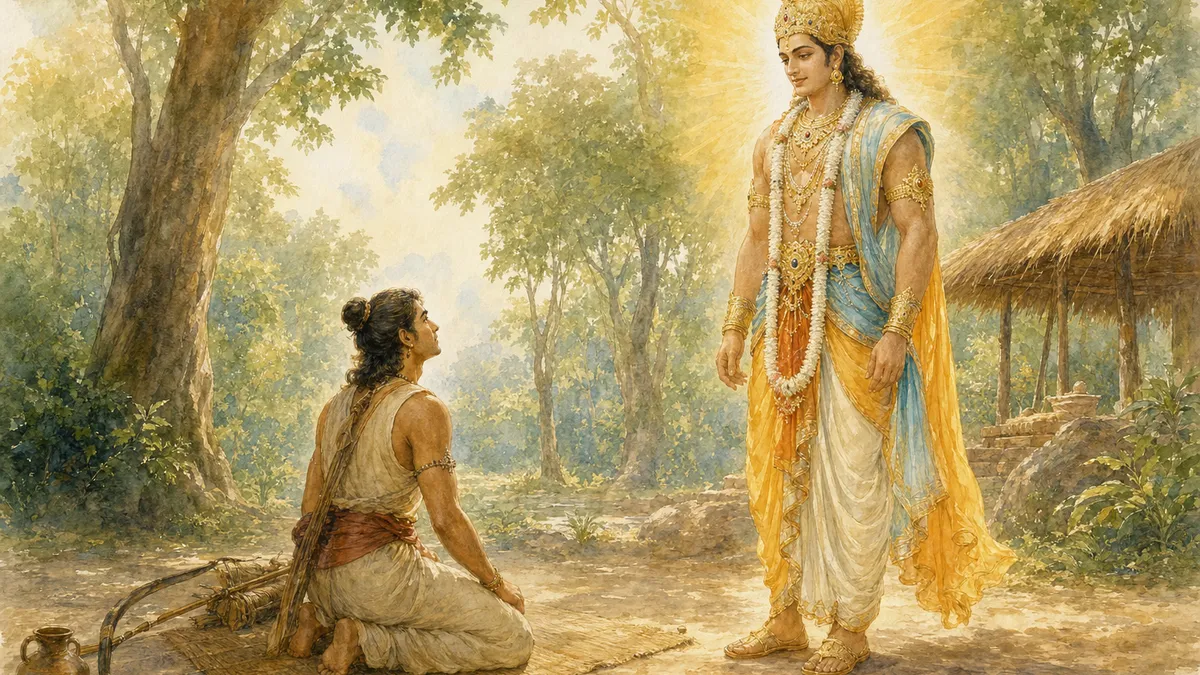
When Indra revealed his divine form, Arjuna became subdued. He realized that it was Indra himself and began to pray to him, explaining the true purpose of his austerity: it was not for liberation or the fulfillment of desires, but solely to protect his lineage. In other words, it was not a selfish goal. And Indra said: “Well, I am hardly able to help you with this; only Shiva can help you here.” And he was very pleased that Arjuna was not motivated by self-interest and that he would worship Shiva.
The Might of the Enemies and the Necessity of Worshiping Shiva
“Indra said: ‘Your enemies, Duryodhana and the others, are very powerful. Drona, Bhishma, Karna, and the others are certainly invincible. Ashvatthaman, the son of Drona and an incarnation of Rudra, is utterly invincible.’
And why could Indra not simply help? Because his enemies themselves had received many blessings from various other gods. Of course, many people assume and perceive the Kauravas and Pandavas as ordinary human beings, but this is not so. Many of them were avatars, while some were sons of gods, such as Karna. Krishna, who was on the side of the Pandavas, was an avatar. Many were blessed with divine powers, and some were mahasiddhas. When they fought, they used various astras, various kinds of weapons—that is, they could strike with fire or lightning. And each of them possessed several astras. Arjuna likewise received astras as a result of his blessing. Thus, these clans were not ordinary royal clans; they consisted of sons of gods, avatars, and mahasiddhas. Yet they were not fully enlightened, because they still had certain karmas and egos. Therefore, Indra said that defeating them would not be so easy. If they had been ordinary people, that would have been an entirely different matter.
“But they can be opposed through me. Heed what is beneficial for you. O hero! No one is capable of performing this japa. Shiva is the greatest of all. Therefore, do not delay—perform the japa of Shiva. Shiva is the Lord of the worlds, of moving and unmoving beings. He is the Lord of Heaven. He can do anything whatsoever. He is the Bestower of worldly pleasures and salvation. I, Brahma, Vishnu, and the other bestowers of boons, as well as those who yearn for victory—we are all devotees of Shiva. Therefore, worship Shiva with devotion, following the rules prescribed for the worship of his wondrous lingam, and contemplate him. O Bharata, worship Shiva through your devotional feelings and forms of service. Your attainments will be unwavering. There is no doubt about this.’
Indra’s Blessing and Instructions
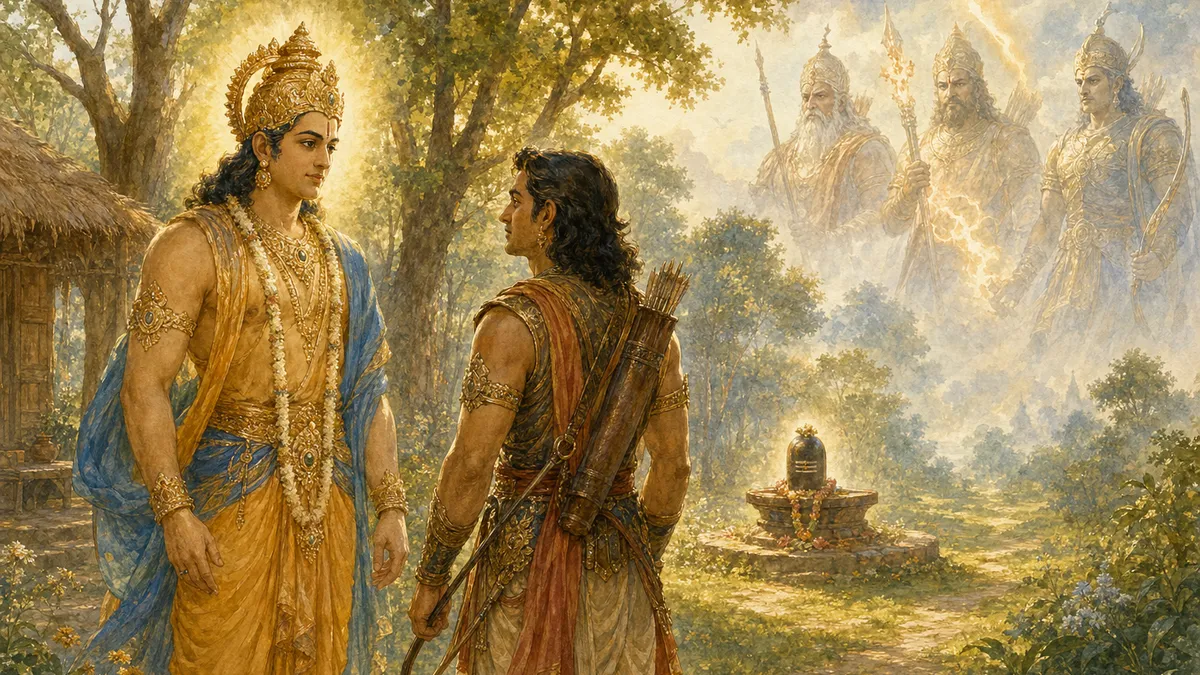
“Nandishvara said: Having said this, he summoned his messengers and said: ‘All of you must remain cautious and vigilant, always protecting him.’ Thus, having instructed his messengers concerning the protection to be given to Arjuna, Indra again spoke to Arjuna with a heart full of love.
Indra said: ‘O gentle one, O most fearsome to your enemies, you must not make mistakes in governing your kingdom. This mantra will enhance your glory. A seeker must always maintain courage. Shiva is the protector; he will grant you wealth and the fruits of your desires. This is undoubtedly so.’
Nandishvara said: ‘Having shown his grace to Arjuna, the Lord of the Gods remembered the lotus-like feet of Shiva and departed for his abode. The heroic Arjuna, having bowed to the Lord of the Gods, performed austerities with a restrained mind, keeping Shiva as his goal.’
Thus ends the thirty-eighth chapter, entitled “Description of Arjuna’s Austerity,” in the third Shatarudra Samhita of the sacred Shiva Maha Purana.
