

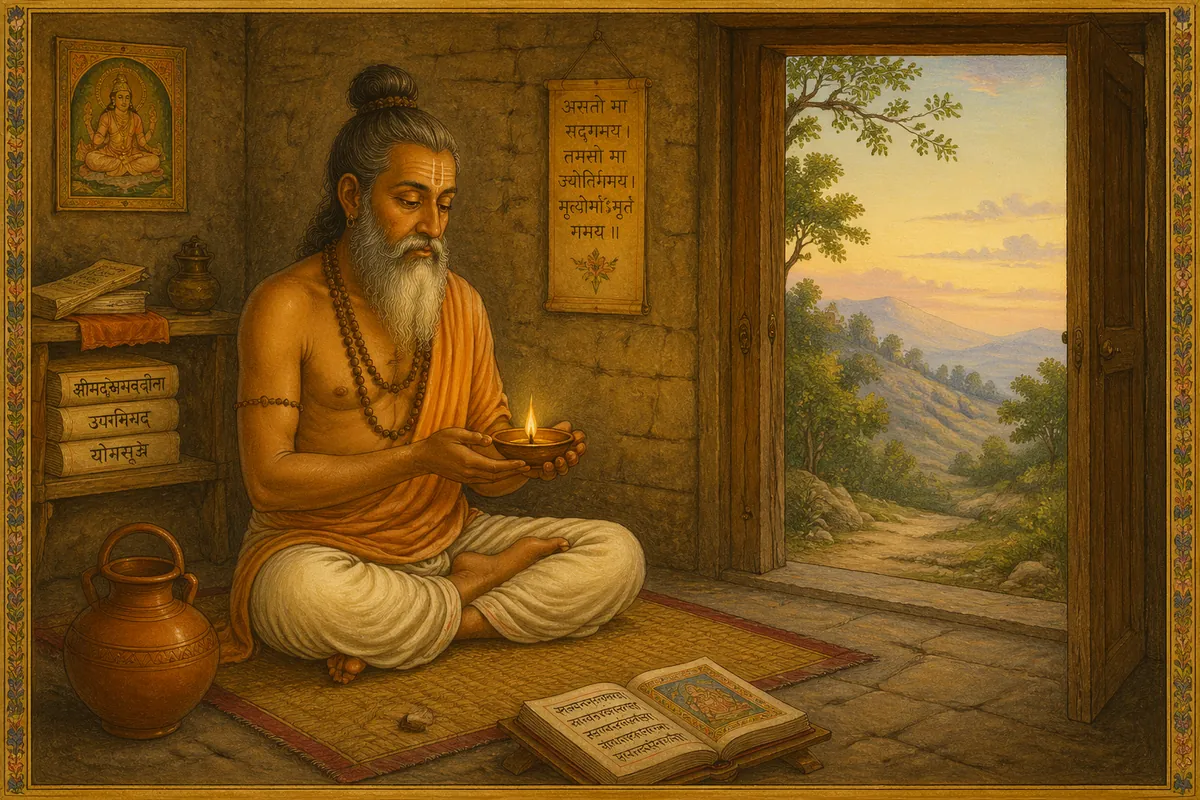
Commentary on Sri Ramana Maharshi’s text “The Path of Sri Ramana”
Sri Ramana Maharshi’s text “The Path of Sri Ramana” is devoted to the theory and practice of self-inquiry. Atma-vichara is a practice common in the Vedanta tradition to all schools. This is a very important topic, and it is also a component of the prajna-yantra. When we have mastered atma-vichara, we have created a powerful, solid foundation for our further practice of contemplation. Conversely, attempts to contemplate without atma-vichara will always give rise to doubts — whether we are contemplating, or doing something else.
“Thus the mind, concentrated on the true ‘I,’ is no longer the mind. It is the aware aspect of the true ‘I,’ atma-chit-rupa. In the same way, as long as it is turned toward objects of the second and third person, toward the world, it is not the conscious aspect of the true ‘I.’
What is the conscious aspect of the true “I”? It is buddhi. When, by means of atma-vichara, the chit-jada-granthi is pierced, when the ego is pierced, the principle of awareness remains — the conscious aspect of the true “I.”
First we must understand the theory of atma-vichara intellectually. Our intellect must not be dulled, but sharp, clear, and curious, seeking knowledge. Curious not in terms of worldly things, but in terms of comprehending the Dharma. After this, we must undertake practice; we must know how to unite practice with life.
Atma-vichara is not only when we walk in chankramanam or sit. Atma-vichara means always uniting practice with life. It consists in concentrating on inner subjectivity, withdrawing the mind from objects of the third person and the second person.
The Three Persons of Perception
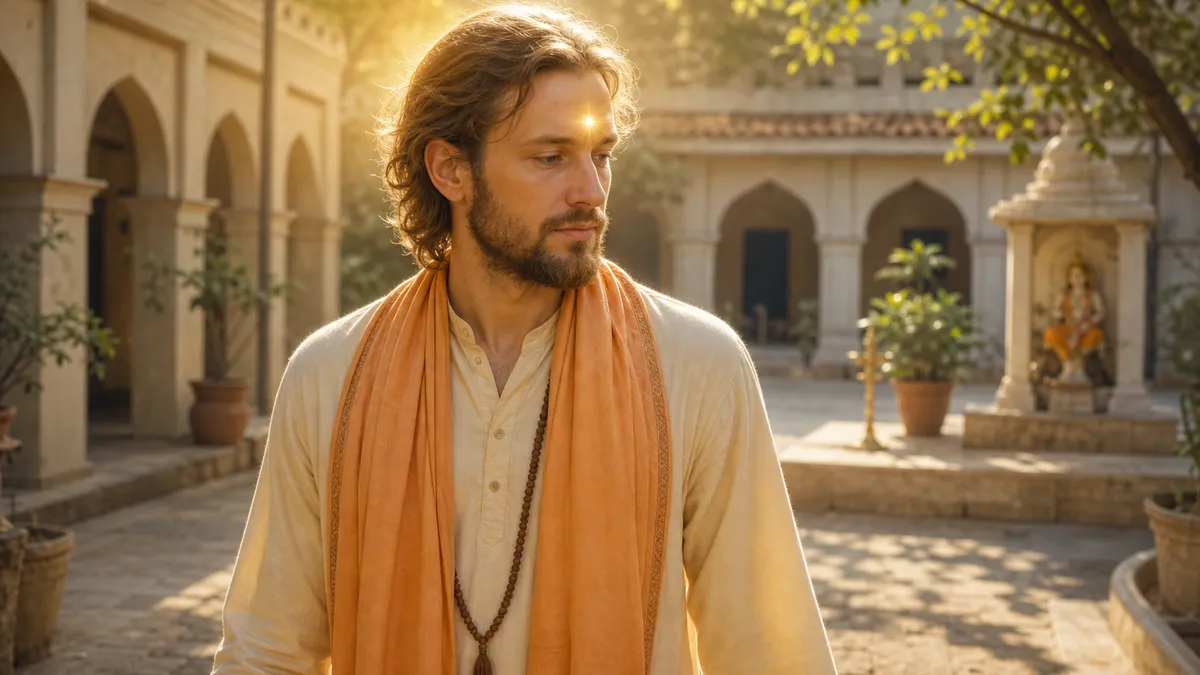
What are objects of the first person? An object of the first person is myself. An object of the second person is you; it is relationship: I am I, and there is already you, and between us, with you, there are always some misunderstandings. Objects of the third person are they. I do not know them; I have certain assessments and judgments about them. This is even farther away; these are external objects. For example, aliens are they, animals are they, some foreign people in some foreign countries are also they. Therefore, for us the world is divided into three persons.
Atma-vichara, when it is said that one must concentrate on the principle of the first person, does not mean that we cut off the third person and the second person and close in on ourselves like a crayfish in its shell — that is incorrect. It means that, by means of vichara, we discover the inner subjectivity of the awareness “I am,” the pure awareness “I am.”
With the help of viveka, we discover this awareness “I am” in the second person and in the third person. That is, in beings of the second person we discover the first person. In beings of the third person we also discover the first person. Thus, atma-vichara does not mean that we have completely shriveled up and shut ourselves off from everything altogether. On the contrary, it means that we have discovered the first person and then brought the entire universe into the state of the first person.
This means that now, for us, “I am,” my own subjectivity, is also the people around us, and UFOs, and animals, and in general all distant people of foreign cultures, beliefs, and mentalities, beings of various types of samsara — bhutas, pretas, pishachas, gandharvas, vidyadharas, great beings, mahamantreshvaras. All these are in fact objects of the first person for me, if I abide in the contemplation of Advaita. Everything becomes a continuous first person; the entire universe must become the first person.
When it becomes the first person, there are no problems at all. For example, mutual understanding immediately arises, because this is I am — how can I not understand myself? It is easy to integrate, easy to see the higher “I” in another. That is, with beings of the second person everything is easy. You also understand beings of the third person, because within them you see the same primary consciousness. Primary consciousness comes to the foreground, and apart from it nothing is primary.
Primary Consciousness as the Absolute
We must not appropriate this primary consciousness; we must not consider it to be our own subjective consciousness. This primary consciousness is Paramashiva himself, it is Parabrahman, the Absolute. Therefore we must understand it well. It must not be attributed to the five koshas, perceived personally, or appropriated.
It is like the Internet. At first it seems that your computer — the computer is standing on the table, of course, it is yours, and you have the right to say: “It is mine.” Inside it there are various operating systems; you bought them too, they are yours. Then you think: “So the Internet is mine too.” But when you go online, it is inside your computer, yet you suddenly understand that the Internet is not yours. At the moment when you use it, it is as if it were yours, but in general it is not yours. That it is a certain global system, and you can only perceive a part of it; that it is something that does not belong to you and belongs to everyone.
In the same way, awareness is the global meta-mind of the Absolute, which belongs to everyone, is washed through everyone, within every soul. It does not belong only to you. If you think that it is something only yours, of course, you are mistaken. This means that you perceive atma-vichara without pancha-kosha-viveka. You perceive it in identification with ahamkara, with the mental sheath, with something personal. This must be taken into account in the practice of atma-vichara.
Such difficulties arise for one reason — there is simply no atma-vichara. Why? Because when there is atma-vichara, there are no difficulties, no spiritual ones — well, there may be material ones, but material ones are not the biggest problem. If there is atma-vichara, they are easily resolved. But there are no spiritual, psychological, other difficulties, no dharmic ones. That is, if you have difficulties, write to yourself: “There are no difficulties, there is poor atma-vichara,” because good atma-vichara deprives the very difficulties of the basis of existence. It opens the correct dimension of dharma to you; it is a universal transformer of difficulties into spiritual victories. It is continuous and leads you directly to the comprehension of God, to sambandha — connection with God.
Atma-vichara as Non-doing
“This is the mind as the reflected form of consciousness, chit-abhasa-rupa. Therefore, attention to the true Self, I-attention, is neither doing (kriya) nor action (karma). That is, only the true Self can realize the true Self. The ego cannot do this.”
At the beginning it seems to us as if atma-vichara is something to do. We were not in atma-vichara, and we begin to do it, and we get the feeling as though we are doing it. We sit down in an important posture, close our eyes and begin some process, set it in motion — this is doing. But in reality true atma-vichara arises from non-doing. When we move into non-doing, it means that our atma-vichara has deepened.
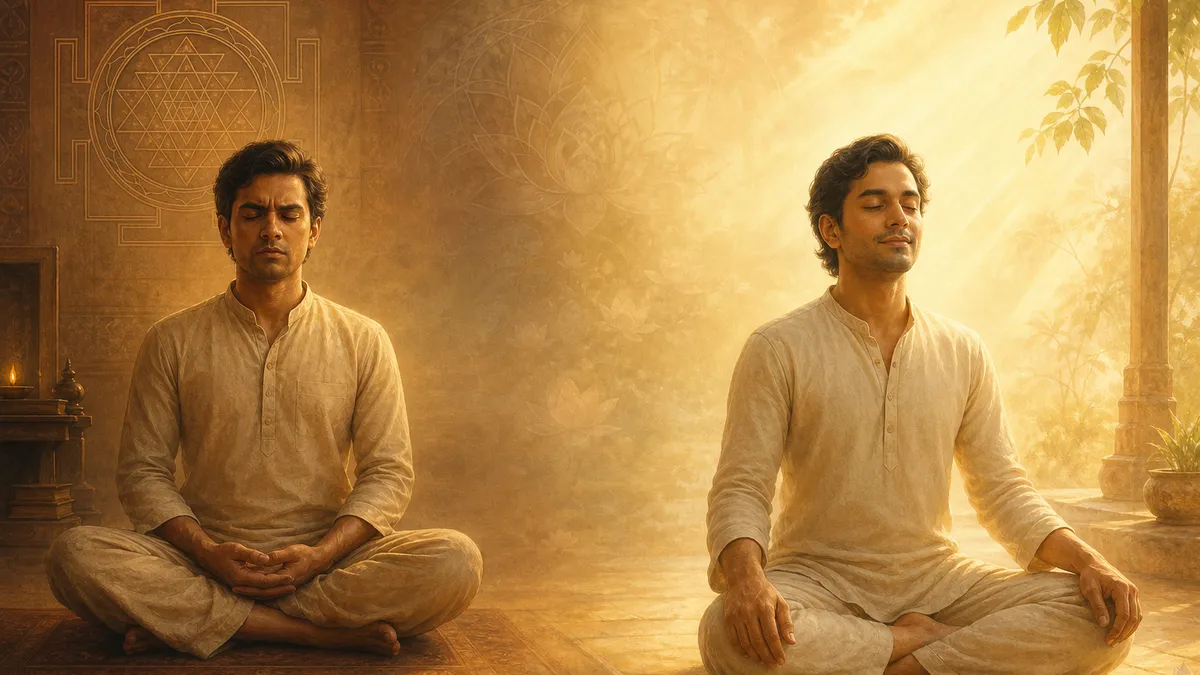
If you are in atma-vichara, then your mind no longer runs anywhere else. It can run only when you have no atma-vichara. No atma-vichara means: I want something outside, I want to get something, I want to learn something, I want something from the second person, from the third person. But when there is atma-vichara, I want only atma-vichara itself; I want nothing else.
You can analyze your mind and your desires: what do I want at this moment? Do I want something else, or do I want only atma-vichara alone? If I want only atma-vichara alone, then I can relax, because to attain atma-vichara nothing is needed — it is with you, if you are simply attentive to it. Here it is, right here, right now; you do not even need to study books if you have received transmission from the Guru.
Therefore, atma-vichara is the highest way to carry out Guru yoga, ishta-devata yoga, to enter the dimension of the Sadguru within oneself. But when I still want something else, it means that I am dissatisfied, not very happy in my atma-vichara, because I do not have it, and therefore I seek many things that I want.
If there is atma-vichara, I rely only on atma-vichara. But if it is not there, I also rely on various things, because at some level of depth atma-vichara becomes the principle of the Sadguru, it manifests as the ishta-devata, and it even manifests as God Himself. This is a question of trust in this practice.
Atma-vichara is entry into the natural state. To contemplate the natural state without having mastered atma-vichara is the same as trying to ride a horse without a saddle, without stirrups and without a bridle — it is impossible. As soon as you climb onto that horse, you will fall off. But when you have a good foundation in the practice of atma-vichara, contemplation comes by itself, the intuitive wisdom of awareness manifests by itself.
The Mature Mind and Vairagya
“The mind that has attained a passionate desire to turn attention to the true ‘I,’ the inquiry into the true ‘I,’ is considered fully mature (pakva-manas). Since it is now completely disinclined to concentrate on second- and third-person objects, it can be said that it has reached the summit of non-attachment (vairagya).”
So, vichara, atma-vichara, means that we generate vichara-spanda — that is, our consciousness generates a special investigative activity, a kind of directedness. One could say, curiosity. Vichara-spanda has a twofold direction. One is directed outward — this is bahir-vichara, directed toward an external object. The second is directed toward the feeling “I am.”
External bahir-vichara is necessary for life. For example, if you are making soup, you need to understand how much grain to add, how much water. But inner atma-vichara is intended for awakening. When we abide in inner atma-vichara, viveka develops. Viveka means that, by illuminating the sheaths (koshas) through inner inquiry, we can distinguish them from the Atman, and we must discard them one after another.
Atma-vichara as the Art of Archery
Therefore, atma-vichara can be compared to archery. Vichara-spanda is the arrow, our consciousness is the bow, and the target is turiya, Brahman, and we must hit this target. We must constantly hit this target. If our goal is Brahman, we must not miss; we must become a good archer. This is an instruction from the Upanishads. It says there: “Take the greatest weapon of the Upanishads — that is, knowledge; take the bow sharpened by meditation, concentrate, and hit, as a target, O dear one, eternity” — that is, Brahman, turiya.
The transmission of the Guru, direct introduction, or explanation of the method of atma-vichara is nothing other than an explanation of skillfulness in atma-vichara. The Guru gives instruction as an archery master does: “Now, aim higher, aim more to the left. That is not the target at all. Shoot! Miss. Shoot! Miss. Shoot! Oh, excellent, a good shot, keep going like that.”
In the end, when you acquire mastery, at first you hit once out of a hundred, but gradually you hit more often. Then you hit one out of three, then you hit one out of two, and then you hit one out of one. When you hit one out of one, it means you can contemplate atma-vichara continuously under ordinary conditions. But this is not yet true mastery.
There was once a great archer, and he was renowned throughout the Celestial Empire — that is, China. But another man found him and said:
“Are you a master?”
He said:
“Yes.”
“Come, I will show you something.”
They climbed a mountain, and he said:
“Now stand with your eyes closed, with your back turned — and there is a sheer mountain, a peak — go to the very edge, and now shoot.”
But he could not even move; his legs gave way, because he could not shoot under such conditions.
True mastery means that you can hit ten out of ten under any conditions, even difficult ones, like Arjuna. When Arjuna shot, he aimed at the eye of a fish that was suspended somewhere under the roof, standing with his back turned, looking into a vessel of water — that is, aiming at the reflection. Arjuna, raised by Drona, was an archer of such a level, of such mastery.
In the same way, you must acquire mastery in spiritual archery, in atma-vichara, like Arjuna. This means you must hit the target while walking, eating, working, during battle, during enjoyment, in difficult conditions, during mental activity, during physical activity, during philosophical debates, during worldly conversations, during inner suffering, when your horoscope is not very favorable, during mystical experiences — always.
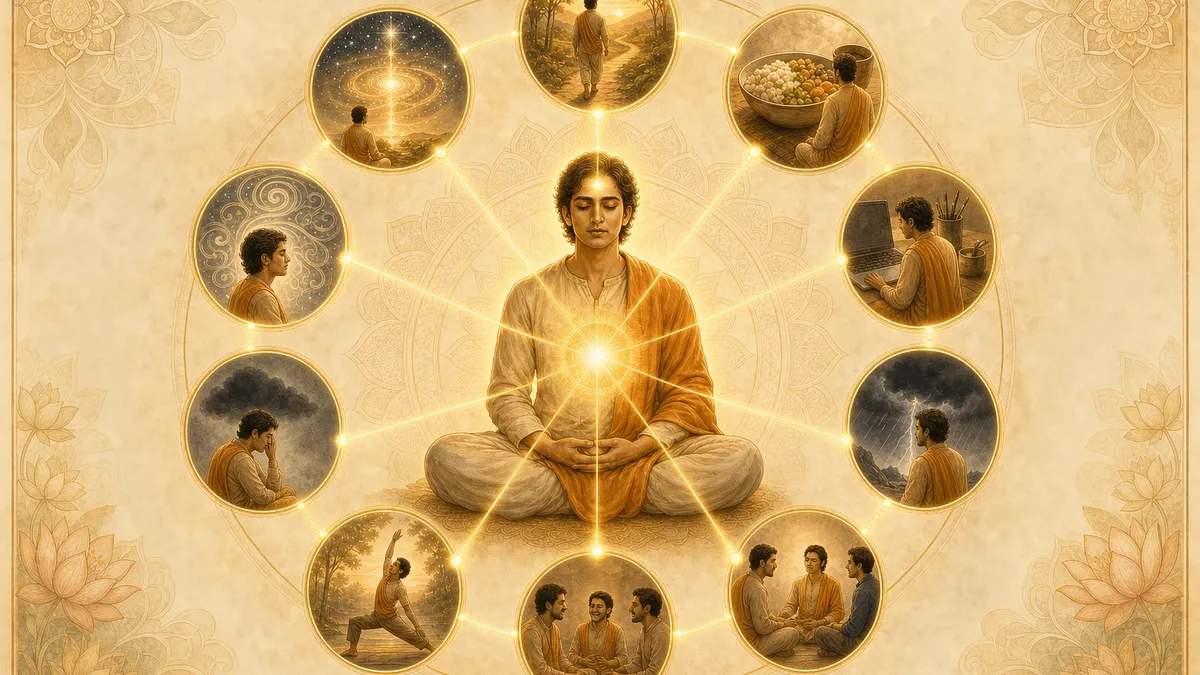
Then this will be mastery. You must not abandon it; you must also hit successfully, just as a successful archer can, with closed eyes and from any position, hit the desired target. Finally, such mastery must penetrate dream sleep and dreamless sleep. This is the meaning of training, of working with sankalpa.
When you have cultivated your practice with atma-vichara, other sankalpas come easily. In fact, you no longer need to train in them; you simply practice them, and they work. Therefore, the main training concerns the sankalpa of atma-vichara, while the other sankalpas you apply naturally once you have already trained.
Overcoming Doubts Through Atma-vichara
Therefore, one who has mastered atma-vichara has no doubts. What do doubts indicate? That a person lacks understanding, that some question needs to be asked. For example, he doubts, and an experienced practitioner will say:
“And who is doubting?”
“I am.”
“And who am I?”
The conceptual mind is stopped; a breakthrough of superconsciousness occurs. But an inexperienced practitioner does not think to perform this simple operation. An experienced practitioner does not even ask such questions; he simply abides directly in the dimension of the nondual “I” without all these manipulations of “who is doubting,” “and who am I” — this is for beginners. Then comes the breakthrough — he is already in the dimension of breakthrough without mental operations. But in the beginning you need this; that is, at the very least you must remember it.
Just as it happens in a dream: strange things happen to us, it does not even occur to us to reflect on ourselves and the situation even a little critically; we get caught up in it and do foolish things. As soon as we were to remember that it is a dream and ask what is happening: “Is this a dream, and where am I?” — all of it would disappear, everything would change. Exactly the same thing, only a little more clearly, happens in the material world, in this life.
As soon as we begin to do this work, suddenly karma, the karmic knots into which our consciousness has fallen, are released, and we breathe freely. They say: “Self-liberation” — that is, we ourselves have liberated ourselves; we have liberated ourselves through our mastery in contemplation.
Many think: “Dattatreya will liberate me” or “Shiva will liberate me.” Well, here he has come to you and is explaining. Or how do you think he will liberate you? Or do you think he will do atma-vichara for you? Yes, he sends grace, but he does not do it directly. He does it either through the Guru, or through the murti on the altar, or through upaya (method), or as the inner Sadguru, or as the inner light within. But you must also do something yourself.
The spiritual path, the path of liberation, presupposes a certain attentiveness on our part, inner activity, and awareness. This activity, attentiveness, and awareness are vichara-spanda. It presupposes a certain correct position that we have learned to take always and everywhere — this is contemplation. Contemplation is the correct position of the mind.
The Importance of the Correct State of Consciousness
If a person is not in an aware state, whatever he may say — let us say he is indignant, he is seeking truth, he is seeking something else — you can say: “All of this is useless; you are simply in the wrong consciousness.” First return to the correct consciousness. All your speculations, all your ideas, all your assessments — none of this matters; simply return first to the correct consciousness. As soon as you return to the correct consciousness, all of this will go away, because in the correct consciousness there is only happiness, calm, peace, ananda, and play.
This is the best answer. There is no need to clarify anything. Ninety percent of the things we try to clarify in relationships, and even with ourselves, with our own mind, are simply a matter of being in the wrong state of consciousness. Return to the correct state of consciousness — everything will resolve itself. Therefore, atma-vichara is the art of returning to the correct state of consciousness.
For example, when a person is intoxicated, it is useless to make agreements with him, to talk, to conclude business deals — all of this is useless; no one will do it. It is useless to take oaths or promises from him — he is inadequate, he is simply not sober. It is useless to discuss any issues with him — all of this is impossible. He cannot be believed, he cannot be trusted. Therefore, when a person is not abiding in awareness, one must be just as careful with him.
The Correct Understanding of Atma-vichara
It is like saying: “First sober up, and then we will talk” — that is what people say in the world. “You just need to go and get some sleep” — people say in the world; and in the case of a sadhu: “You simply need to practice atma-vichara, you simply need to enter the correct state of mind.” Of course, we do not say this when communicating with those who are not aware, but it is implied.
In the same way, inwardly we must be able to speak to our mind like this. When our mind becomes strongly attached, suffers, worries, projects something, creates value judgments, we must say to the mind: “You simply need to enter the correct state of atma-vichara a little, and then we will see.” As soon as we enter the correct state, many things disappear, many dissolve, and others become play, and very few unresolved questions remain.
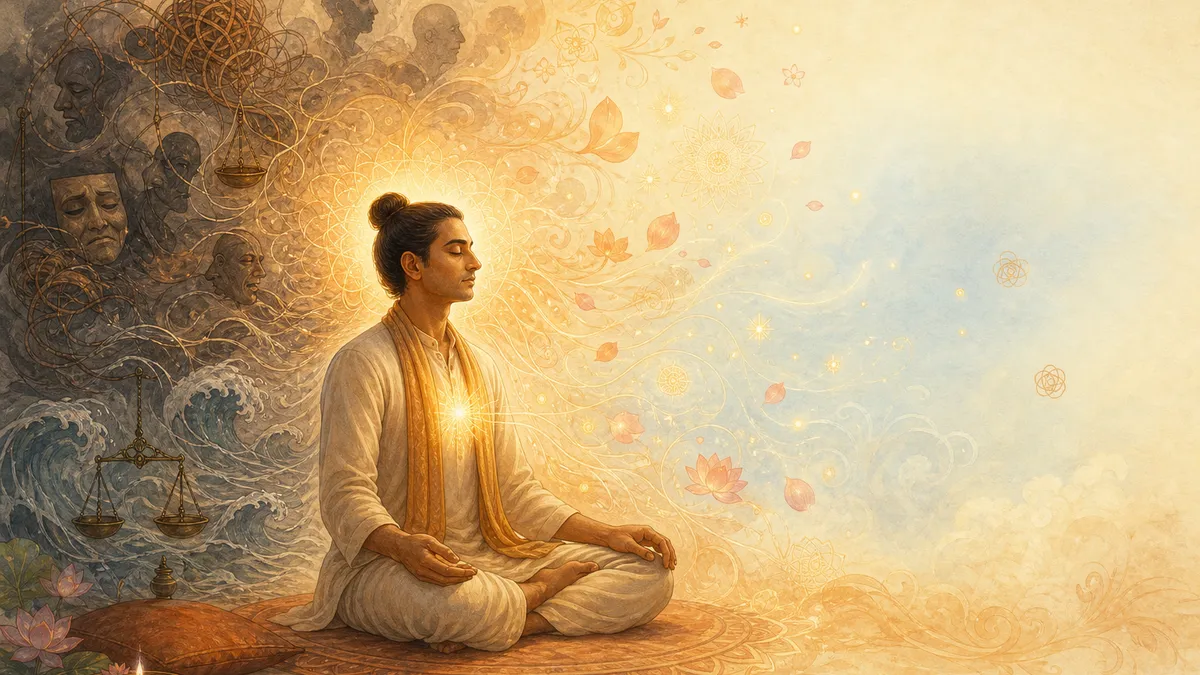
“Are not all our desires and attachments directed only toward objects of the second and third person? This mind now understands very well that the source of genuine and absolute happiness can only be the consciousness shining as ‘I’. Now this mind seeks the true ‘Self’ because it has a natural desire for happiness. This strong desire, the turning of attention toward the true ‘Self’, is in truth the highest form of devotion (bhakti).”
Mistakes in the Practice of Atma-vichara
In Odessa, I gave a lecture on this topic. Searching for the true “I” does not mean shrinking the mind, concentrating on oneself, and thinking something like: “Step aside, you are disturbing me, I am focused on the true ‘I’,” — that is, it is not a reason to become increasingly self-absorbed, not a reason to become more and more egoistic. If you become more and more egoistic, you are in fact making a mistake.
One can often see how practitioners of atma-vichara in particular become very concentrated egoists—not outwardly, but inwardly—because they seal themselves up in the feeling of “I,” but they do not separate this “I” from the five sheaths; instead, they project it onto the five sheaths, and a very strong bondage arises to the mental body, to the astral body, to ahamkara.
The feeling of “I” means becoming detached from these sheaths, from oneself, separating them from one’s “I,” and then expanding one’s feeling of “I” to all aspects of life, uniting it with all aspects of life, seeing one’s feeling of “I” everywhere. And what happens then? Then a person says: “I do not feel joy from upasana (worship); I feel that all of this is useless. Why?” Of course it will be useless, because the mind has gone inward; I abide as if in a shell, and outwardly I do not believe that it is capable of evoking anything in me at all.
Then I sit before the deities, before the murti, but all of this is formal, while the mind is only inside. I do not allow the mind to touch the bhava of the deity, to enter into the mood, and there is no contact whatsoever; then upasana has no blessing. But atma-vichara means that I see the first person also in the murti of the deity, that I expand my “I” to the level of the deity, and through this intuitive level true contact is possible; or I feel that outwardly nothing gives me satisfaction, I feel that everything is useless.
This means that the sense organs are frozen, but true atma-vichara means that we expand the feeling of “I” to the external and bring awareness into action. Then action becomes a game, a way to contemplate, a way to unite; therefore, the key point here is union, integration. We must learn to unite during atma-vichara, not freeze the sense organs. To include the external world in inner awareness, to see the external world as the first person, because the external world and the inner world are all one consciousness. When we rise to the level where the external and the inner unite — this is turiya; but if they have not yet united, then at most it is jagrat, svapna, sushupti; it is annamaya, pranamaya, manomaya, vijnanamaya-kosha — all of these are koshas (sheaths); this is still not it, not it.
Three Aspects of True Atma-Vichara
“The practice of the inquiry ‘Who am I?’ which Bhagavan Sri Ramana gave to the world can be called true only when the mind, fully matured through such devotion and detachment from the worldly (bhakti-vairagya), turns its attention to the true ‘I’.”
So, there are three aspects — devotion, bhakti; there must be devotion, that is, your atma-vichara is your way of worship (upasana), it is your way of striving toward God. You are not striving toward yourself; that is, it seems as though you are striving toward yourself, toward your true “I,” toward some special “I” of your own. Of course, understandably, you closed your eyes, you focused on the “I,” and it seems as if you are striving toward yourself—where else could it be? But in fact the goal of atma-vichara is not you yourself at all; the goal of atma-vichara is God, and He can be known through turiya. Therefore, vichara is a form of upasana, of devotion, and we say that we worship.
For us, this is a way of worshiping Dattatreya in the form of digambara (clothed in the directions of space), in the form of space, because when you investigate the feeling of “I,” you discover space, the subtlest element. You separate yourself from earth, from water, from fire, from wind, and space remains. When you begin to feel space, this is a sign that you are making progress in atma-vichara — this is devotion.
The second aspect is vairagya (detachment). Along with bhakti, with aspiration, there must be the ability to detach. We must possess the wisdom and strength to ignore the lower sheaths, ignore the mind, ignore sensations, ignore thoughts, to separate ourselves from what we are not. For example, it is difficult to separate oneself from the mind; for some it is difficult to separate oneself from emotions; it is very difficult to separate oneself from the body. But vairagya means that we have generated such awareness that exists separately as an alternative reality, and we have become established in this alternative reality of consciousness. We understand that we use the five sheaths, but they are an instrument. When, at the same time, there is directedness toward the feeling of “I,” these are the conditions under which atma-vichara is possible.
The Dissolution of the Ego in the Process of Self-Inquiry
“So, will the realization of the true ‘I’ reach a mature mind that has met Sri Ramana on its path and wishes to keep its attention on the true ‘I,’ to abide in I-attention? No, no, it is doomed to failure; referring to suicide, it ascends the scaffold by turning attention to the true ‘I’ and will be sacrificed. Why? As long as it was directed toward objects of the second and third person, that is, it was called the mind, but as soon as it turns attention to the true ‘I,’ it loses its name, mind and form, thoughts.”
So, our ego lives in identification with the second and third person. As soon as we begin to shift perception toward the investigation of subjectivity and toward the first person, this ego discovers that it is losing its form; it discovers the element of space. Detachment occurs from those forms of egoism and from those ways of carrying out our egoism that were inherent in us.
At this time, if the practitioner is not fully trained, such melancholy, a universal sorrow, overtakes him; he begins, for no apparent reason, to feel a little sad. He feels that he is parting with some part of his past, and that it can no longer be brought back, there is no way back, and what lies ahead is unclear; he feels sorry for this past. This is a sure sign that you have come upon the element of space, this universal sorrow.
But you should not be upset; if you practice well, universal ananda awaits you; you need only have faith, self-surrender, and continue spiritual practice. The spiritual practice of awakening is truly the path of the fearless. Ordinary people are asleep; this is understandable, because they are within their identifications, and even asking questions about the meaning of life is frightening. A believer of any religion must be fearless, because asking questions about the nature of God, the meaning of life, and engaging in self-inquiry always means overcoming limitations. Overcoming limitations always makes one reflect on how not simple this life is, how not simple this world is; it is easy to sleep, easy to think about small things, easy to be immersed in thoughts.
It is difficult to inquire; to challenge one’s limitations, one must be fearless. But here you can be fearless, because behind you stands the transmission line of the saints, behind you stands the ishta-devata, behind you stands the Paramguru, Dattatreya; you have a powerful support group. All of them have long since walked this path; millions of sadhus have walked this path, they have left behind experience, sacred scriptures; you are not alone on this path, therefore every time you can draw inspiration; you have the Guru, samaya brothers, therefore you can draw inspiration in order to overcome this confusion and fearlessly go further.
Therefore, whenever you doubt how your atma-vichara is going, the disciple clarifies it with the Guru, he clarifies it in the sacred texts, or he simply talks with an experienced monk who, as they say, has also eaten more than one dog in atma-vichara, even though he is a vegetarian.
The True Nature of Self-Inquiry
“It can no longer be said that attention to the true ‘I,’ I-attention, or the questioning of the true ‘I’ itself, is carried out by the mind. That which turns attention to the true ‘I’ is not the mind; likewise, the natural spontaneous I-attention of the conscious aspect of the true ‘I’ (atma-chit-rupa) is not the mind, it is not an activity. If someone declares that he practiced self-inquiry, went deeply within himself, and finally realized the true ‘I,’ know that this is an absolute lie, not for knowledge, but for the death of the ego that is willing to be anything. Only Arunachala (the true ‘I’) knows the true ‘I.’”
Sri Arunachala Venba
So, there is much talk that the ego must be killed, that it must be cast aside, that it must somehow fall away. Indeed, the ego cannot comprehend Atman, the ego cannot comprehend Brahman. It is like the salt doll in Ramakrishna’s example: the salt doll decided to measure the depth of the ocean; it entered the ocean, but as soon as it entered, it began to dissolve in it. By the time it had gone a few more steps, nothing remained of it. The ego, as a form of identification (ahamkara), as that mental apparatus, must dissolve, and this is good. This is called manonasha — the dissolution of the mechanism of identification with the mind. Likewise, our vasanas, kleshas, the imprints of past lives with which we identified ourselves in addition to our personality, must also dissolve, and this is good; this is called vasanakshaya.
This does not mean that our cognitive abilities, our operational instrument (ahamkara), must disappear. They remain, but they exist in another form, like a rope that has been burned and can no longer bind anyone. We can use it in the same way; our personality remains, but it remains, as it were, no longer real; it is playful. We can use it, or not use it, as an instrument.
For example, if you have pliers—they are a good tool, it does not occur to you to say, “I am the pliers,” and you do not suffer when the pliers need to be struck with a hammer; they are simply your tool. When necessary, you can put them aside and go where you need to go, and when necessary, you can pick them up and tighten a screw, or do something else.
Thus your ego plays the role of such a tool; you do not suffer, you are not identified with it—this is what it means to discard the ego. We do not break the pliers; we simply set them aside and learn to pick them up when needed and work with them as necessary; it no longer occurs to us to identify ourselves with the tool. As for an unawakened person who has not gone through the processes of vasana-kshaya and mano-nasha, he believes that he is the pliers—that is the kind of idea there is. These two processes lead to enlightenment, to boddhi. This means that we perceive the Atman directly through the buddhi. Buddhi is intuitive consciousness connected with the perception of the causal body (ananda-maya-kosha). Therefore, one who has attained awakened consciousness abides in ananda, because he knows that he is not the ego, he is not the tool.
Pure and Mixed Consciousness
“The feeling ‘I am’ is familiar to everyone without exception; in this ‘am’ lies consciousness or knowledge. This is not knowledge of something external; it is knowledge of oneself—this is chit. This consciousness is us. ‘We are truly consciousness,’ says Sri Bhagavan in the poem ‘Upadesha Undiyar.’ This is our being, our true existence, or sat. This is what is called that which is—uladu. Thus, in the phrase ‘I am,’ ‘I’ is being—sat, and ‘am’ is consciousness—chit. When the true ‘I,’ our nature of being-consciousness, sat-chit-svarupa, shines not as the pure consciousness ‘I am,’ but as a mixture of pure consciousness and the adjunct, the upadhi, combined with it—‘I am a person,’ ‘I am Rama,’ ‘I am so-and-so’—this mixed consciousness is the ego.”
So, we have two possibilities: to be in pure consciousness and in mixed consciousness. Mixed consciousness means that pure consciousness does not come to the forefront, but remains on the periphery, is weakly perceived, or is not perceived at all. There is the consciousness of the ego. Such completely impure consciousness, in which the ego dominates and the feeling of “I” is not perceived, is the state of a karmic person, that is, an unawakened person. Then comes a sequence of mixed consciousness, when ego is mixed into the awareness “I am”; sometimes the ego prevails, sometimes the awareness “I am” prevails.
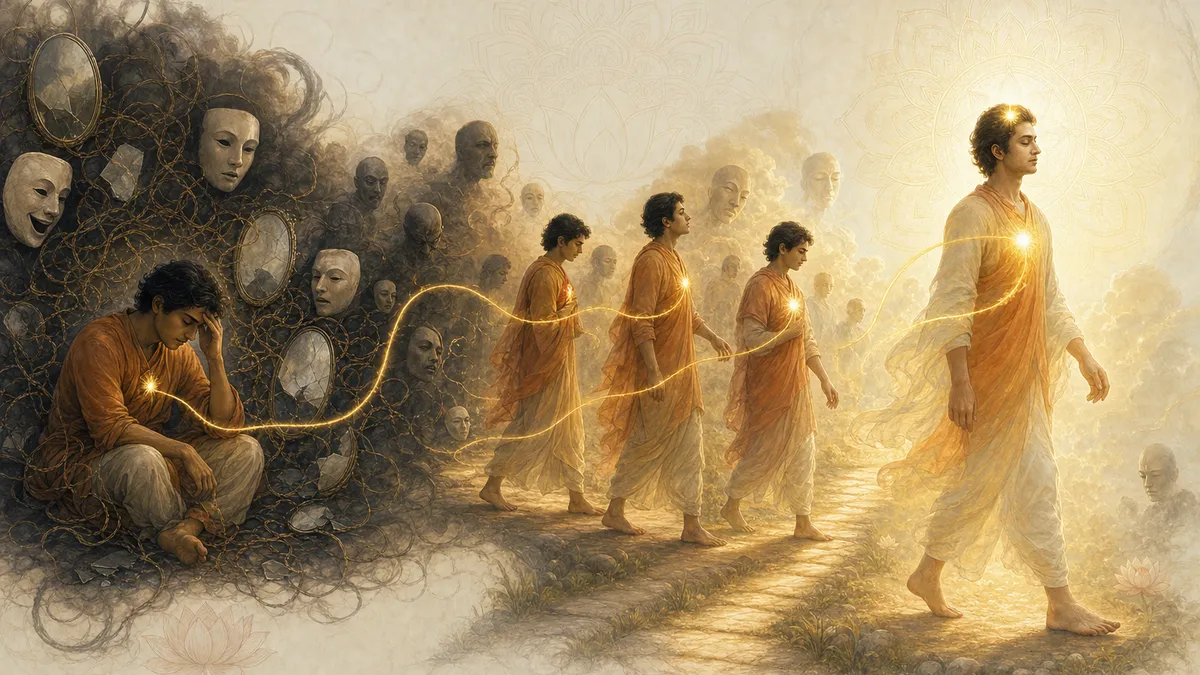
Finally, when vairagya has arisen as a result of viveka and vichara, the moment of pure consciousness comes. This “I am” awareness dominates, while the ego has a subordinate character, and what happens then? Through the “I am” awareness comes the blessing of the pure tattvas—Shiva-tattva, Shakti-tattva, Sadashiva, Ishvara, Sadvidya; various tattvas manifest their blessing. The higher elements of the universe begin to resonate, that is, chit-shakti, ananda-shakti, iccha-shakti, jnana-shakti, and kriya-shakti awaken in a person; he truly becomes a conductor of divine knowledge.
He does not act, but the shaktis play through him; then he also becomes a divine player, he exits karma and enters the dimension of lila. This occurs not through mantras and visualizations, as in tantric transformation, but through direct realization of the higher “I.” When he feels himself to be an instrument of divine energies, an instrument of divine wisdom, divine will, divine deeds, and divine consciousness.
For example, there was a Zen master, I believe Bankei, who, when he wanted to eat, would say: “Being thirsts in me.” Why did he not simply say, “I want to eat”—the monks, his disciples, would have brought him food anyway. He said, “being thirsts,” because he could not use “I” in relation to the body, since his “I” had dissolved; the process of mano-nasha had taken place. This means that the being of the pure “I am,” having mixed with the body, was carrying out its natural play.
The Nature of Thought and Pure Consciousness
“This mixed consciousness can arise only by receiving a name and form. When we feel: ‘I am a person, I am Rama, I am sitting, I am lying down,’ is it not obvious that we mistakenly take our body to be ‘I,’ and its name and its position in space to be ‘I am this,’ ‘I am so-and-so.’ The sensations of ‘this’ and ‘so-and-so’ arise mixed with the pure consciousness ‘I am’ (sat-chit). This is what is called thought; this is the first thought. The feeling ‘I am a person,’ ‘I am so-and-so’ is merely a thought, but the consciousness ‘I am’ is not a thought; it is the very nature of our being. The mixed consciousness ‘I am this,’ ‘I am that’ is a thought arising from our being. Only after the arising of this thought of mixed consciousness, the first-person subject, do all other thoughts arise, which represent knowledge of second- and third-person objects.”
Thus, pure consciousness knows only the first person. For pure, awakened consciousness, only the first person exists. For mixed consciousness, the second and third persons also exist. Someone may say: “How, then, can jnanis and saints exist when for them there is only the first person? After all, we see different masters, we know stories of siddhas, that they communicated with others, they said ‘you’ to others, they were in various relationships, beginning with the avatars of Vishnu, Shiva, Krishna. Shiva married Parvati; Krishna fought on the battlefield of Kurukshetra and was Arjuna’s friend; Dattatreya taught disciples while conversing with Parashurama; Vasishtha taught Rama. After all, all of them seemed to acknowledge the existence of second- and third-person objects. Some of them had varga friends, wives, families, disciples, and so on. They all manifested activity—how can this be reconciled?”
The Nature of Enlightened Consciousness
The answer here is simple: for them, in their subjective vision, there was only the first person. For them there was no second or third person. Of course, they pretended that the second and third persons existed for them, but this was a form of their lila (play). In reality, for them there was only the first person; that is, Krishna, speaking with Arjuna, was speaking with himself, and on the battlefield of Kurukshetra he was also fighting with himself. Shiva married himself, since, abiding in unified consciousness, they abided in ultimate subjectivity. For them there was no second person, no third person as self-existent being—they realized the truth that “all is Brahman.” As a play, of course, in relative behavior they used various models of conduct, models of communication, and accepted stereotypes. For what purpose? In order to be able to help other living beings.
“Only if there is a first-person subject do second- and third-person objects exist” (“Ulladu Narpadu”). This mixed consciousness, the first-person subject, is called the arising of us or the arising of the ego. This is the primary mental process (adi-vritti); thus thinking is a mental process (vritti). Being, however, is not a mental process (“Atma-vichara-patika”).
The Practice of Nondual Contemplation
The practice of contemplation in Laya Yoga in nondual consciousness means that we find the moment where the previous thought has gone and the new first, primary thought has not yet arisen, and we try very subtly to catch this moment. To enter into it very subtly in a state of awareness, and once having entered, to remain in it, without any doubts or distractions. When we first receive transmission from the Guru, we must very subtly enter this moment, when the primordial adi-vritti has not yet appeared.
Many may think that this is thoughtlessness—not quite. It is the state when vritti has not appeared, but then, when it first appears, and we do not follow this vritti but remain in presence—this is it. After that we need to continue remaining in this state, since it is closest to our nature and there are no actions in it—it is called sahaja, and since it is beyond thoughts, it is called amanaska.
“Pure being-consciousness, ‘I am,’ is not a thought. This consciousness is our very nature (svarupa). ‘I am a person’ is impure consciousness—it is only a thought. Thus, every seeker must first of all understand the difference between our being and our arising, that is, between existence and thought. Bhagavan Sri Ramana recommended practicing self-inquiry either in the form ‘Who am I?’ or in the form ‘Whence am I?’”
The Method of Atma-vichara
When you go on pilgrimage in India or travel in Nepal, the most common question you are asked is: “Where from?”—a kind of atma-vichara. But in atma-vichara we use the method “Who am I?”; that is, we need to turn to the feeling of “I” and identify it with something. If we cannot identify it, we must make sure that this is so, we must acknowledge it—there is nothing terrible about it; this is how it should be.
The disciple says: “I cannot find it, I cannot identify it.”
The guru says: “Look more carefully.”
He searches again, and on the third day says: “I still cannot find it; it is something elusive.”
The guru says: “Yes, that is correct, that is how it is; congratulations, well done.”
Then he asks: “And are you not, every second, every instant, right in it now?”
If the disciple practices vigilantly, he says: “Yes, I am; that is so, it is present every second.”
Then he asks: “And are you not present in this elusive consciousness?”
The disciple reflects and says: “Yes, I am present.”
“Everything is correct; this means you are on the right path. Abide every instant, every second, in this presence, in this elusive consciousness. Continue to investigate without interruption. Generate investigative activity, penetrate ever deeper into it, establish yourself in it, and when extraneous thoughts come, cut them off. Do not freeze the sense organs; learn to unite this state with all experiences.”
Stages of Spiritual Practice
This is manana — clarification, the cutting off of various uncertainties and doubts. Many times, in millions of situations in which the disciple will find himself, he must clarify this same state, single it out, strike it like a spark. When he has clarified it and not a single doubt remains that he will no longer lose it, he receives the right to nididhyasana yoga. He breaks through into the number of souls who will attain liberation, who will attain enlightenment. He completes the process of manana and moves on to nididhyasana.
At the stage of nididhyasana, in a certain sense, nothing among spiritual things that do not relate directly to nididhyasana is important. This does not mean that you discard them, but it means that they now have a secondary nature, because nididhyasana itself is like a queen, and everything else — mantras, rituals, invocations, actions, visualizations — is the retinue of this queen, because the most important thing is direct abiding in nididhyasana itself.
When you abide in God, whatever you may be doing, rituals will neither help nor harm you. Mantras will change nothing radically for one who abides in God, because the purpose of rituals and mantras is for you to immerse yourself in God, and when you have immersed yourself in Him, they lose their significance for you precisely from the standpoint of knowing the absolute truth. But they retain their significance for you in relative truth; therefore many saints, even at the stage of nididhyasana, recite mantras and perform rituals, but with different aims: the aims of shakti, attracting shakti, helping others, healing, removing obstacles, realizing sankalpa, attracting grace.
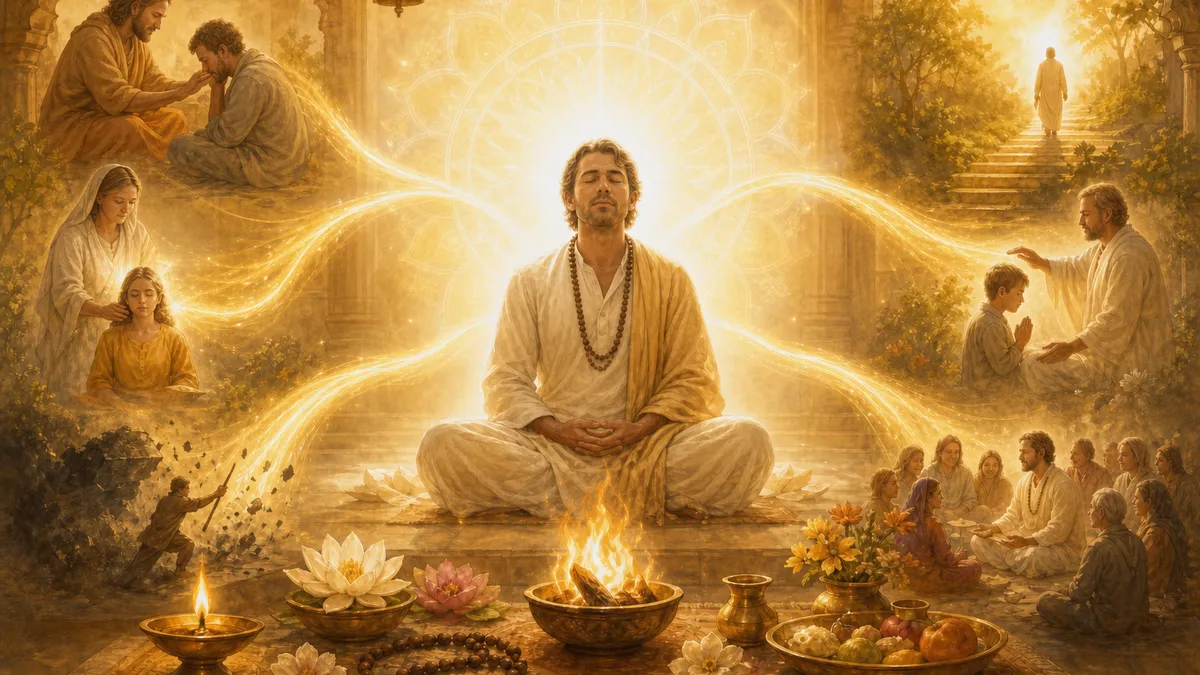
But for their own nididhyasana this will neither harm nor help, because they already abide in the dimension of ritual or in the dimension of mantra. We perform rituals from the very beginning in such a way as if we already abide in the dimension of rituals; that is, alongside the ritual we abide in nondual contemplation. In the same way we recite the mantra and make an effort. Even if we do not abide in such a dimension, we try to do so; we learn.
Mistakes in the Practice of Self-Inquiry
“There are very different opinions regarding these questions, and many people cannot understand what should be practiced from this and how. Even among those who believe that these two questions are about one and the same thing, there are many people who understand them superficially and do not even try to understand why they are about one and the same thing. Some practitioners who ask themselves the first question simply repeat aloud or inwardly like parrots: ‘Who am I? Who am I?’ — as if it were mantra japa.
This is absolutely wrong. Turning the inquiry ‘who am I’ into japa is no better than reciting the mahavakyas or meditating ‘I am Brahman,’ thereby losing the very purpose of the inquiry. Sri Bhagavan himself repeatedly said: ‘Who am I’ is not for japa repetition. Others, thinking that they are practicing the inquiry of the second formula, ‘whence am I,’ try to concentrate on the right side of the chest, where, according to their ideas, some spiritual heart is located, and expect to hear in response something like: ‘I am from here.’ This is no better than the ancient method of meditating on any of the six yogic centers in the body (shat-chakras).”
In other words, atma-vichara is not shat-chakra yoga. It may be experienced in any of the chakras, but it is not connected with the sheaths (koshas); it is connected with transcending the sheaths.
“Is concentration on any part of the body not concentration on a second-person object? Before undertaking the technique of self-inquiry, it is very important to rid oneself of all misconceptions. Let us therefore clarify how to eliminate them. In Sanskrit there are two words for conveying the idea of ‘I’ — Atman and aham. The term atma-vichara indicates that attention seeks to find out ‘what this I is.’ It can also be called I-attention — attention on the true ‘I’ or abiding in the true ‘I.’ Here, I-consciousness is the sense of the first-person subject, but as has already been said above, it should be understood that consciousness mixed with the combined adjunct ‘I am this’ or ‘I am that’ is the ego (ahamkara) or the individual soul (jiva). Whereas pure consciousness, free from admixtures and adjuncts, the only existent, shining as ‘I-I’ or ‘I am that,’ ‘I am,’ is the true ‘I-Atman,’ the Absolute, Brahman, or God, Ishvara.”
The Search for Unmixed Consciousness
When will the feeling “I am” become an experience of the Absolute? Of course, not every feeling of “I,” “I am” is something one can rely on. It is like when you are looking for gold, but not every little stone will be real gold. For example, if you are looking for gold, you have a whole basket of sand, but when you sift it, one gram remains. In the same way, when you experience different forms of “I am,” you must sift out everything related to the body, the mind, thoughts, the subtle body, the mental body, and even the causal body. When you sift them out, the unmixed dimension of turiya remains.
The unmixed dimension of turiya can be experienced in any of the states: in waking, in dreaming, in dreamless sleep — then it is called jagrat-turiya, svapna-turiya, sushupti-turiya. When it is experienced in waking, it is called fleeting samadhi. When it is experienced in a dream, it is a form of samadhi experienced when turiya is experienced by the subtle body. When it is experienced in the causal body, it is a form of nirvikalpa samadhi experienced by the causal body. Finally, when it is experienced as turiya-turiya, pure consciousness experiences itself — this is the unmixed form of nirvikalpa samadhi. When it effortlessly embraces all aspects of your life, whether waking or dreaming, it is called sahaja samadhi.
The key point: you can say that your sense of “I” is Atman, Brahman, one with Atman, only when you experience turiya through this “I,” that is, your “I” must reveal turiya to you.
If you inquire into your “I,” and your “I” shows you a mental image of “I,” this is not turiya; or it shows a concept of “I,” this is not turiya; or it shows you merely sensations, for example, you feel a vibration somewhere — this is the pranic body, this is not turiya; or it shows you some form of awareness, but in this awareness there are still admixtures of duality — this too is not turiya. The analysis of these admixtures is a very important task in the process of testing a disciple. When a master tests a disciple, he is precisely looking to see whether there is turiya or whether there are admixtures there — until the disciple cuts off all these admixtures.
The True and False “I”
“Is this not equivalent to saying that the consciousness of the first-person subject, ‘I,’ can be either the ego or the true ‘I’? Since all people usually take the sensations of the body, ‘I am the body,’ to be ‘I.’ Some shastras still call the ego the ‘I-Atman’ and designate it as the individual ‘I’ (jivatma). For this reason alone, the shastras even call directing attention to the ego, to ‘what is this’ or ‘who is this,’ self-inquiry (atma-vichara). But is it not obvious that the true ‘I,’ being-consciousness, does not need inquiry and cannot be subjected to questioning? It was precisely in order to correct this error that Bhagavan Ramana called the practice ‘Who am I?’ instead of using the ancient term self-inquiry — atma-vichara. The ego, the sense of ‘I,’ which is usually taken to be the consciousness of the first-person subject, is in fact not the true consciousness of the first-person subject. Only the true ‘I’ is the first-person subject.”
It is very important: the real first-person subject is Atman; it is not our personality. Therefore, to practice atma-vichara means to find not one’s own personal subjectivity, but ultimate subjectivity. Your personal subjectivity is the subtle body containing karmas and vasanas. Your ultimate subjectivity is Brahman. In this subjectivity there is no dichotomy, no duality, no division into subject and object, no division into inner and outer.
Therefore, atma-vichara smoothly grows into sahaja-sthiti (the natural state) of awareness, a single “taste,” samarasa, into divine pride, into divine grandeur, into divya-mana — not your own. After the discovery of this ultimate subjectivity, atma-vichara becomes a continuous background of pure awareness, in which you begin to live like a fish in water.
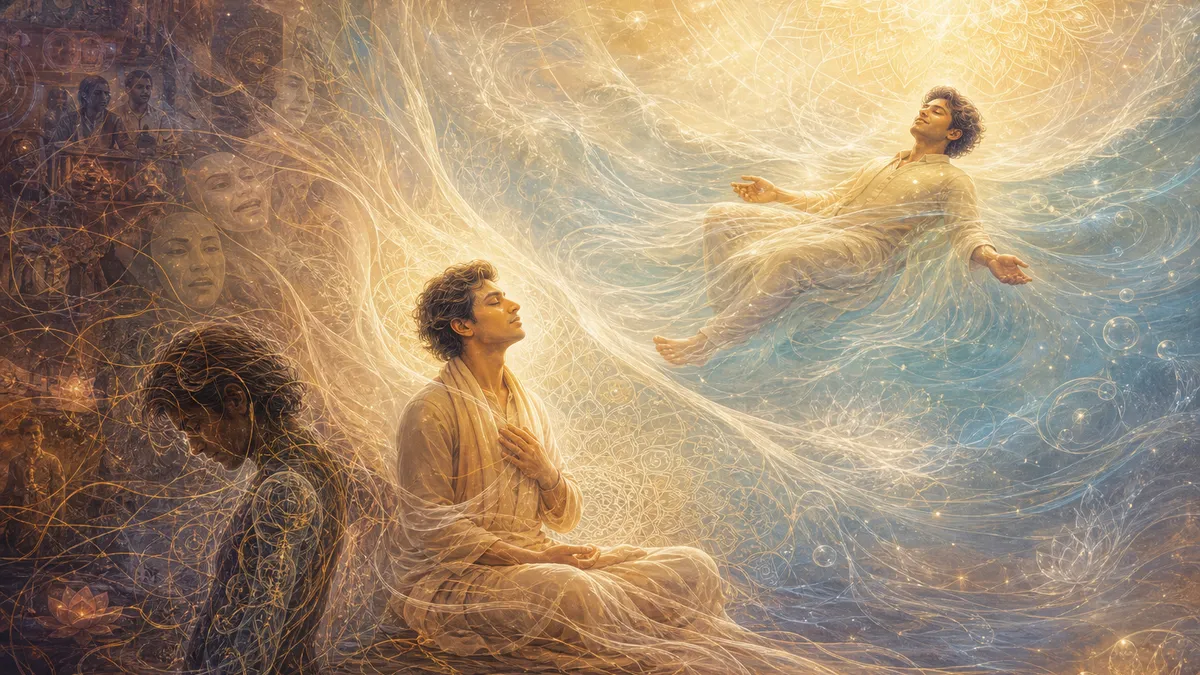
A fish feels water as its environment — in the same way, you begin to feel pure awareness as the environment in which you continuously live. If earlier you felt that this environment was limited, that it existed only within you, now you feel that it is inside, outside, in other people, and it is everywhere, and everything abides in this environment. Therefore consciousness is often compared to an ocean — it is truly an ocean of pure consciousness.
For us, this is Lord Dattatreya in the aspect of digambara, that is, clothed in nothing. Unclothed does not mean not wearing trousers or a shirt; it means that he has no coverings, is unlimited by anything, that is, upon the pure consciousness of Dattatreya there is no covering of earth, no covering of water, fire, wind, or even space — this is only a hint at this pure consciousness.
Abiding in this pure consciousness is for us a form of upasana of the ishta-devata, upasana of Dattatreya and upasana of Shiva. It is emptiness at the beginning, as it seems, but then we discover its active part in the form of shakti, and it is capable of manifesting, radiating boundless energies. Therefore beginners seek emptiness, seek ultimate subjectivity; those who have found it and attained enlightenment exercise themselves in the ability to emanate various kinds of shakti, they train to be shaktimans, uttama-purushas.
The Disappearance of the Ego and the Discovery of the True “I”
“The sense of ego, which is merely its shadow, is the false consciousness of the first-person subject. When a person investigates this ego, finding out what it is or who it is, it disappears, because in reality it does not exist, and the investigator, to whom nothing else remains, becomes rooted in the true ‘I’ as the true ‘I.’ Since the false consciousness of the first-person subject from the true ‘I’ must have a place and time for its arising, the question ‘from where am I’ means only ‘from where does the ego arise.’ Only the ego can have a place of arising; the true ‘I’ cannot have any specific place or time of arising, since it neither arises nor disappears.”
The higher “I” has no place of arising, no time of arising, but there is a time only when we recognize this process. Boundless consciousness has always existed, it has no localization, but in our life there may be a time when we unite with it — then people say of a person: “He has attained enlightenment.” But in fact it is not that he attained enlightenment — his ignorance disappeared, his notion of “as he is” disappeared, while enlightenment always was and had been waiting for him. But it could not wait for him until his mind could disappear. When his mind disappeared, only enlightenment remained, only boundless consciousness remained.
Therefore, when they say, “He attained enlightenment,” it is more correct to say: “he disappeared, and enlightenment was revealed,” because nothing else was obstructing it. He existed for a long time and concealed enlightenment with himself — enlightenment had always been there alongside him. Through practice he disappeared, because he — this third person — was ignorance, was an illusion. Enlightenment remained as it had always been; nothing happened to it — the enlightened dimension of boundless consciousness had always existed. Since he disappeared, it revealed its nature in all its fullness, not immediately, but gradually.
When enlightened awareness reveals its nature in all fullness, this is the descent of grace, the manifestation of various pure tattvas: svatantrya (freedom), purnatva (fullness and wholeness), ananda (joy), the ability to abide in divine deeds, to be a conduit of the divine will (iccha and kriya-shakti), wisdom, natural clarity (jnana-shakti).
All these kinds of shakti proceed from awakened consciousness at the moment when the illusion of “I” disappears. But it is not that he attained enlightenment — he cannot attain enlightenment, because while he exists, there is no enlightenment; when enlightenment exists, he is not there. Thus the phrase “he attained enlightenment” is no more than a figure of speech; it carries no meaning behind it, it is meaningless. But as a tribute to the stereotypes and patterns of the mind, to vocabulary and syntax, masters say: “He attained enlightenment,” though always with this reservation. No one has ever attained enlightenment, no one can ever attain enlightenment.
Enlightenment always exists, but on the path the ego disappears, and only enlightenment remains in this body; and since nothing obstructs it anymore, it manifests — then others say: “He has attained enlightenment.” What, then, manifests; what is enlightenment? Enlightenment is the manifestation of Paramashiva, the manifestation of God; that is, it is not some personal enlightenment of our own — it is a divine dimension that has always existed. It is simply realized in this body, at this time, in these circumstances in the relative, in this consciousness.
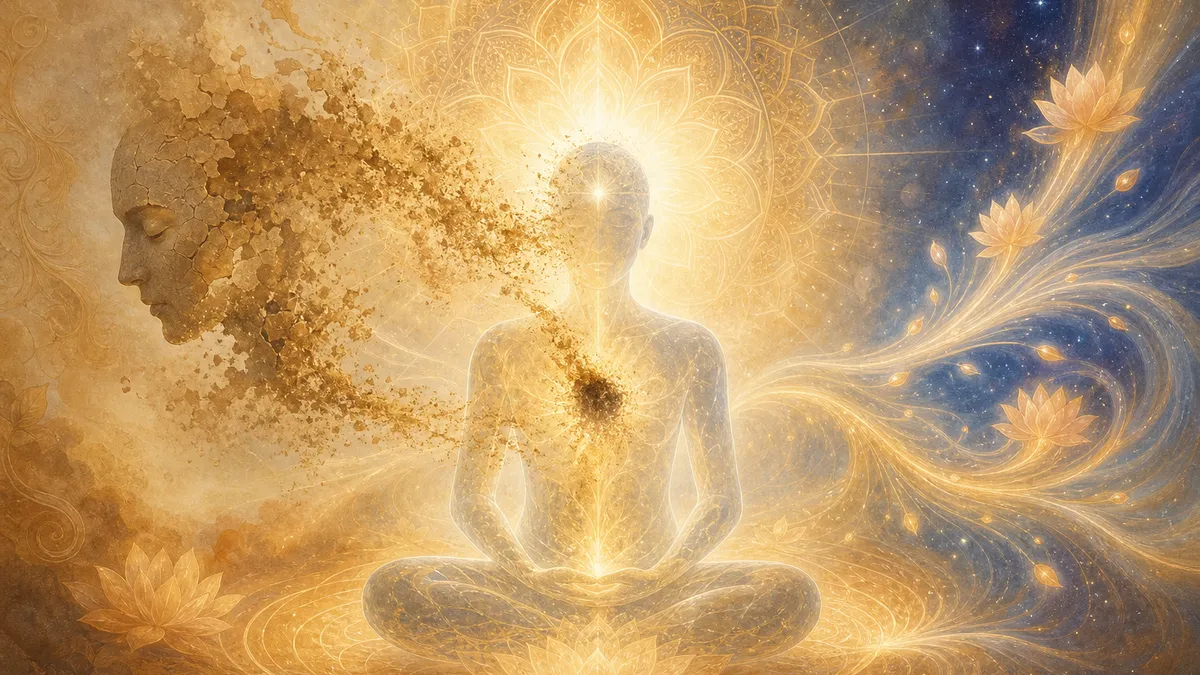
“We are the only one now, later, and always. We are the only one in space, here, there, and everywhere.”
