The Vigilant Mind: The Difference Between Sleep, Samadhi, and Self-Realization
03.09.2026
0 мин. чтения
0
Share
copy
search
add
share
Commentary on the text “Tripura Rahasya,” Chapter 16, “On Consciousness, Restraining the Mind, and Sleep,” a continuation of the conversation between King Janaka and Ashtavakra.
“Does a log, before which there is only one single object while all others have been removed, reflect that object merely because all the others have been removed? Reflection can occur only on a reflective surface.”
Here Janaka says that eliminating the perception of external objects is not enough; there must be prajna—cognitive activity. The log here personifies the absence of cognitive activity. Prajna is our discerning consciousness; one could say that it is the ability of manas to perceive the light of buddhi and merge with it, as well as the ability of buddhi to perceive the light of the Atman. When these three faculties merge into one, they become the cognitive activity of consciousness that leads to realization.
As long as manas remains coarse, it cannot perceive the light of buddhi; its cognitive activity is very primitive, and it operates in a mode of acceptance and rejection, judging things as “bad—good,” “yes—no,” and “like—dislike.”
When we practice contemplation, we activate buddhi, which is associated with will, tapas, self-surrender, contemplation, and space; then manas gradually begins to sense a higher intuitive consciousness above itself and starts to nourish itself with its light. Buddhi is the source of everything creative in a person; with the help of buddhi, a person makes decisions and builds a system of values. If a person has no definite meaning in life and their values are not clearly defined, it is said that their buddhi is undeveloped.
For example, if you ask someone, “What is the meaning of your life?” and they ponder for a long time before answering, it means that their buddhi is undeveloped. Conversely, if a person has a philosophical cast of mind and deeply discerns truth from false values, it is clearly evident that their buddhi functions well.
But buddhi itself (the intuitive intellect) is merely a reflection of the true Self. When buddhi is purified through contemplation, it begins to sense the immense depth that lies behind intuitive consciousness. This is the process of purifying the mind. It is extraordinarily subtle, and it is very important to go through it without making mistakes, because even seemingly minor things can determine your future. By correctly understanding and realizing something, you can traverse the spiritual path in a short time; but by misunderstanding something, you can waste twenty or even thirty years.
The Story of Rishi Satya and His Wife
Rishi Satya had a wife named Pushkaradharini. He lived in the forest and was known for subsisting on roots and ears of grain. His wife served him, but she did so simply because it was her duty. She knew that Satya was a powerful sage and thought that if she served him poorly, he might curse her. In other words, this was not self-surrender, but merely a sense of duty (according to the rules of varnashrama dharma, a rishi or brahmin at the vanaprastha stage would retire into seclusion together with his wife, who served him, while he paid no attention to her at all and meditated).
Another rishi, another saint, noticed this and decided to change the situation, that is, to help Satya and his wife. He entered the body of a doe and, coming to Satya in that form, said:
—Sacrifice me now in the sacrificial fire, and you will gain great merit.
Being a righteous man, Satya said:
—I do not kill my neighbors, and you, doe, are my neighbor.
The doe insisted:
—Then I will approach the sacrificial fire myself and throw myself into it; I so want to reach heaven.
In fact, this saint had decided to test the strength of Satya’s ahimsa and break his tapas so as to take away his merit.
The rishi said:
—I am committed to ahimsa; I will not violate ahimsa.
Then the doe magically entered Rishi Satya’s mind and showed him the celestial abodes of the gods, their amusements, and the pleasures of the gandharvas, apsaras, and vidyadharas, and said:
“Do you see what fate awaits you if you offer me to the sacrificial fire? Offer my flesh to the sacrificial fire, and you will acquire all this merit.”
At that moment, Satya lost his awareness. Greed arose in him, along with the desire to gain this merit from the ritual so that he could attain the wealth and delights of the worlds of the rishis, mahatmas, and gandharvas that had been shown to him. He said:
“Very well, I will offer you to the sacrificial fire.”
As soon as Satya raised the cleaver, the doe disappeared and the rishi appeared, saying:
“You see, all your merit has been destroyed by a single state of clouded consciousness.”
When Satya saw that he had lost all the tapas he had accumulated as a result of his mistake, he was deeply distressed, but in the end it proved beneficial to him, because the holy rishi used this situation to instruct him and his wife on how to properly organize their lives. His wife then also began to practice tapas, mortification of the flesh, and asceticism, and consciously turned to the Dharma, while Satya made new progress in his practice.
On the Vigilant and Aware Mind
“A reflection can occur only on a reflective surface, not on every surface. Likewise, Self-realization can occur only when the mind is vigilant and aware, not when it is dulled or stupefied.”
These words ought to be inscribed on a golden plaque and hung in a prominent place. A vigilant, aware mind creates clarity, and clarity transforms the entire world into pure vision. When the mind is vigilant, the world becomes a mandala—a pure, manageable reality. When the mind is dulled and clouded by distractions, kleshas, and karmas, everything is seen differently; therefore, a monk’s life is a ceaseless struggle to maintain a vigilant and pure mind and to avoid dullness.
If a monk does not overcome laziness, drowsiness, tamas, unwholesome thoughts, and the tendency toward criticism and slander through viveka (discriminating wisdom), he will not attain liberation. Every available means must be applied for this purpose: knowledge of philosophy, methods of self-liberation, control of the pranas, cutting off egoism, vigilance, and the method of maintaining presence known as the “iron chain,” in which the yogi trains to remain aware regardless of any obstacles whatsoever, as though a wild beast were placed on an iron chain so that it could not run away.
After a monk wins the battle against dullness, unawareness, and the kleshas, and the fire of inner awareness begins to shine within him, he becomes worthy of receiving the grace of the Supreme Source, the descent of Anugraha. Before this, the descent of Anugraha cannot occur, and even if it does, it will be fragmentary and partial, because the descending enlightening power has an extremely subtle, luminous nature and is connected primarily with buddhi (one might say that the descending power is the stream of the Atman flowing from buddhi). But if a person’s buddhi has not been activated, the descending power cannot take root in their consciousness.
“Newborn infants have no Self-realization because of the absence of vigilance, or awareness. Furthermore, examine the analogy of a mirror coated with pitch. The pitch may prevent images from being seen, but this does not affect the quality of the mirror, for the coating of pitch itself must still be reflected on the inner side of the mirror (between the pitch and the mirror). Likewise, although the mind is withdrawn from dreams and wakefulness, it still remains under the sway of dark sleep and is not free from qualities. This becomes evident when one recalls the dark ignorance of sleep upon awakening.”
There are times when we successfully withdraw the mind from external objects. For example, during meditation, having stopped our thoughts, we sit before a dark screen. But sitting with a certain degree of awareness within this dark screen must develop into something more. Yet how can simply sitting in mahashanti be transformed into the bright light of samadhi? There must be vigilance here, like that employed when placing a wild beast on a chain; only through such vigilance does cognitive activity develop that is capable of perceiving the light of buddhi and penetrating into the Atman. If, however, the yogi allows vagueness or agitation to arise, vigilance does not develop. Meditation performed correctly is always tapas. And when we practice mahashanti, we must follow this strategy: fifteen minutes of genuine meditation are better than two hours of vagueness.
The Difference Between Sleep and Samadhi
“Now I will explain to you the difference between sleep and samadhi. Listen carefully. There are two states of mind: illumination and examination. The first state is the mind’s connection with external objects when it notices them, while the second is the contemplation of the object that has been seen. Illumination is unconditioned and undefined by the limitations of objects; contemplation is conditioned and defined by the limitations pertaining to the objects that have been noticed, and this is the stage preceding their clear definition. At the preliminary stage of simple illumination, no distinctions are observed. The thing itself has not yet been defined, and so illumination is considered unconditioned.”
What is the mind’s function of “illumination”? It is like the way you perceive reality in deep contemplation while practicing, for example, Shambhavi Mudra: there are no evaluations, no judgments, the thing has not yet been defined, and conceptual labels have not yet enveloped it. You perceive reality vividly, brightly, clearly, vigilantly, and directly. A play, a dance, a certain unity arises between you and reality. You do not attach any evaluations or definitions to things, because the conceptual mind has no power; you experience the very essence of the thing. This is illumination.
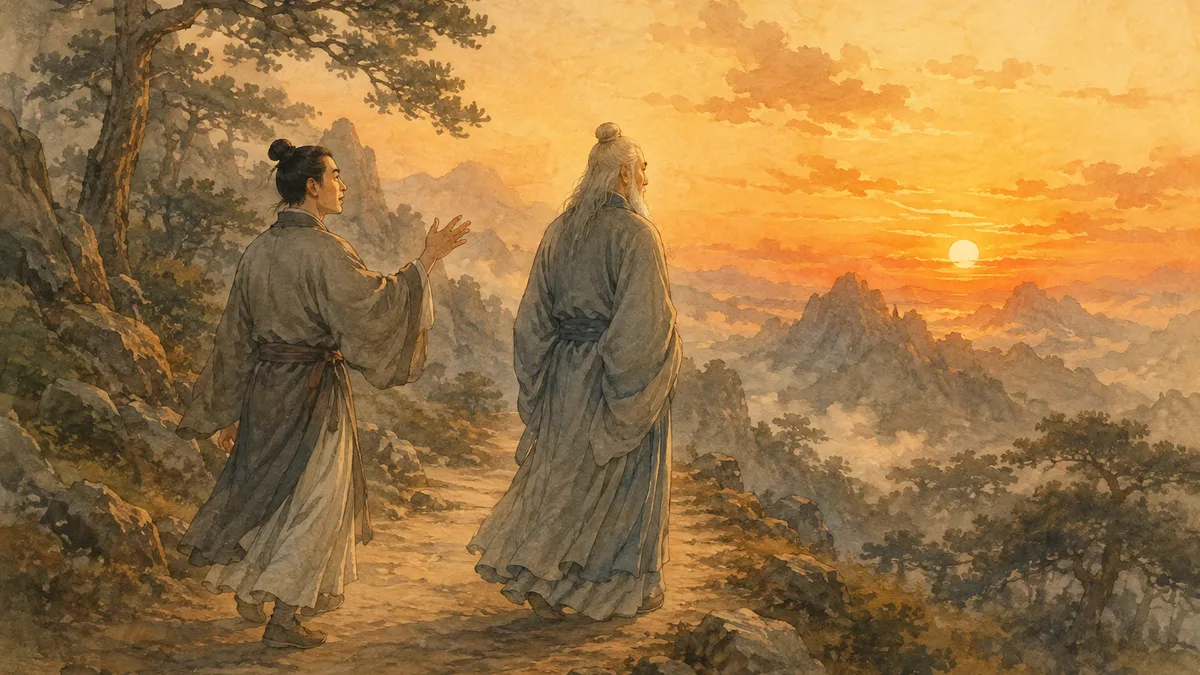
Once, when Lao Tzu was walking with his disciple in the evening, the disciple exclaimed as he looked at the beautiful sunset:
“What a sunset!”
Lao Tzu replied:
“You talk too much. Next time, I will walk alone.”
Lao Tzu was in a state of integration, in the state of illumination, while the disciple was at another stage—the stage of examination.
The stage of examination is when, instead of seeing things directly, we perceive them through manas (the superficial mind), attach labels to things, and create limitations. We then deal no longer with reality or energy, but only with their mental imprints—this is examination. In other words, we come into contact not with the thing itself, but with a picture that is merely its reflection; this picture (image) is in our consciousness, and we examine it.
Remaining immersed in evaluations and judgments means having no contact with the true world. One could say that this is the very film of avidya (ignorance) that obscures our genuine perception of reality. The fact is that, because of such evaluations arising from examination, we misinterpret reality.
For example, when we see a person in deep contemplation, that person is not merely a person; there are also enlightened deities in their channels, wrathful deities, an astral body, a causal body, and the boundless space of the Atman. Their actions are multidimensional: they are ordinary actions, ignorance, lilas, and the enlightened play of the Absolute. All of this exists together, and we can perceive it directly through the insight of our contemplation.
But if we make judgments, then to us this is simply a person, a particular novice or monk; their actions are predictable and fit neatly within the framework of our perception. In reality, however, we know nothing about this person; we merely create a label for them. We then come into contact not with the person as they truly are, but with a label created in our own consciousness. This label is our own product; it is not the person at all. And because our judgments contain a great deal of duality or impure vision, we can project much of this onto the label accordingly. As a result, what the person truly is—their divine essence—is ignored; we see neither their potential nor their abilities, and we cannot even establish contact with them, but instead communicate with a label we ourselves have invented. This is what happens with most people, which is why there is so much disharmony in the world.
“A thing becomes defined later, and then it is said to be such-and-such. This is the perception of a thing after deliberation. Deliberation, in turn, is of two kinds: one is an actual experience, called ‘fresh,’ and the other is reflection on that first experience, which is called memory. The mind always functions in these two ways.”
An actual experience is when you deliberate at the moment of perception, which is why it is called “fresh.” For example, I see a dog and at that very moment consider its behavior. A subsequent experience is when I no longer see the dog but simply remember it.
“Dreamless deep sleep is characterized solely by the illumination of sleep, and the experience continues uninterrupted for a certain period of time, whereas the waking state is characterized by deliberation that is constantly interrupted by thoughts; therefore, it cannot be said to be ignorance (oblivion).”
Thus, illumination is generally inherent in dreamless sleep, but true illumination is inherent only in those who are capable of remaining aware in dreamless sleep. For others, the following occurs: illumination is carried out by the Atman and buddhi, but during sleep manas is unable to connect with it, and therefore there is no awareness.
“Deep sleep is a state of oblivion, and although it consists solely of illumination, it is nevertheless considered ignorance, for the same reason that light, though luminous, is considered inanimate. This conclusion is also accepted by the wise. Deep sleep, the first to arise from transcendence, is also called the unmanifest, the detached, or the great void.”
What does it mean to see God, to meditate on God, to abide in God, to be in the state of sahaja-sthiti? It means to be in illumination while awake—that is, to be in the same state while awake as in dreamless sleep. In other words, a saint, while awake, is as if in deep sleep. For example, an electroencephalogram was performed on one spiritual teacher, and it showed a state of dreamless sleep even though he was awake.
And even if some acts or operations of thought take place on the periphery, and certain apparent judgments are made, they are all detached, playful, self-liberated, and never obscure the state of radiance. That is, this deliberation may resemble the mental activity of an ordinary person, but it is self-liberated and in no way affects the process of radiance.
Mental activity, in turn, makes a strong impression on ordinary people, and deliberation completely changes their consciousness. For example, if a person who has not attained self-liberation reads a book or absorbs certain information, it may change their opinion about something. But if the information is absorbed by someone who has mastered the secret of self-liberation, it will have no effect on them because they exist on a fundamentally different plane. In other words, if you are accustomed to seeing everything nondually, in pure vision, and someone tells you, “This person is such-and-such,” your opinion of them will still not change, because you know that whatever may be said about that person, whatever they may think of themselves, they can be none other than Brahman playing in a body.
“The state of unmanifestation, or emptiness, is the basic state of consciousness, whose characteristic is the absence of anything knowable as such.”
The state of emptiness is the basic state for contemplation. I emphasize: basic, but not final. Many people think that it is the final state, but such views are a grave misconception. Why? Because our cognitive activity can never develop if we make the state of emptiness the final state; that is, our genuine contemplation will be unable to unite with the energies. On the contrary, if we make the state of emptiness the basis for contemplative presence and unite it with the energies, developing flexibility, then this will be the samarasya we seek. And sometimes teachers deliberately pulled a disciple out of the basic state of emptiness if the disciple mistakenly began to regard it as the final state.
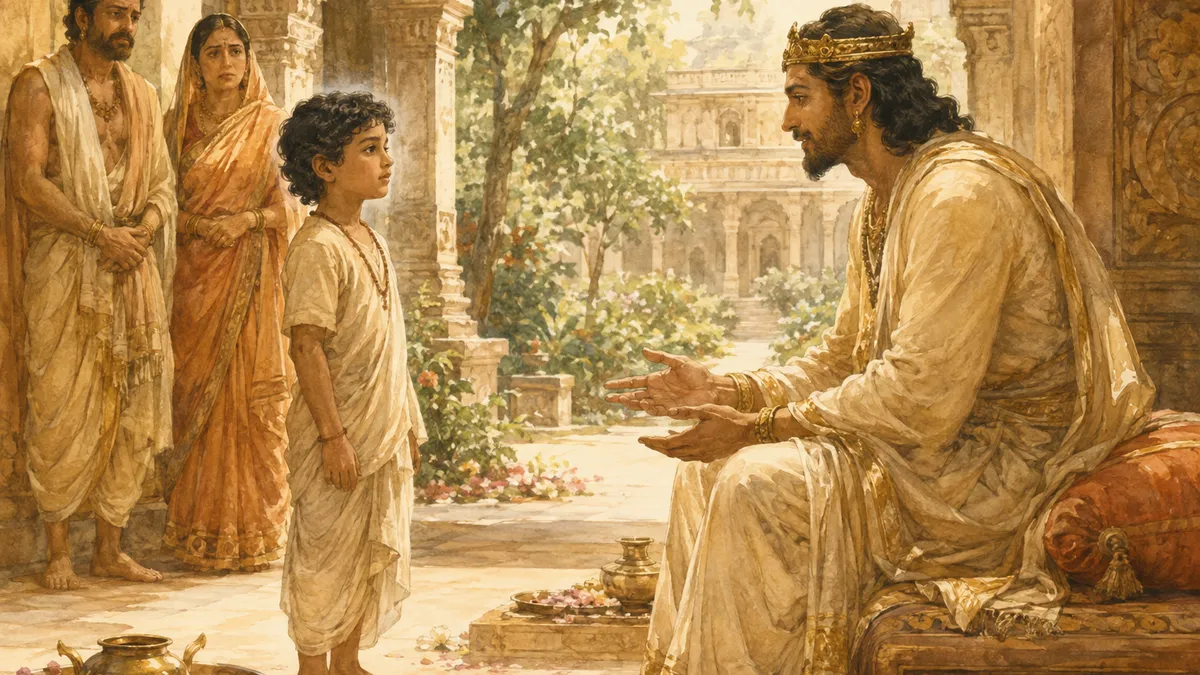
The following example may be given. The “Hastamalaka Stotra” describes the state of a saint who entered the body of a boy. From childhood, this boy did not speak to his parents. He began to speak after a brahmin was invited to see him and asked:
“Why do you behave this way? You do not speak, you are unlike other children, and you behave strangely.”
And the boy replied:
“I am the essence of all living beings, so what children are you talking about? What is strange and what is not strange?”
Suddenly, the brahmin realized that before him was a holy soul, a sadhu. Indeed, it was the soul of a saint who had entered the body of the drowned boy.
A similar story appears in the tale of Dattatreya. A saint was reborn to a certain couple, and he was a boy who had not lost awareness of his past. It proved impossible to raise him at all: he refused to eat the food his parents gave him, urinated wherever he pleased, observed no rules whatsoever, and when anyone said anything to him, he would simply turn away and leave. His parents thought that the boy was either possessed by evil spirits or insane. No mantras, purifying Vedic rituals performed by brahmins, or shamanic or magical incantations helped.
Then they turned to King Vishnudatta, who was awakened. Vishnudatta immediately understood that before him, in the boy’s body, was a holy sadhu who had already attained realization, and said:
“I understand that you are working with us, that you are a very great soul, but who are you? Why do you behave this way?”
The boy replied:
“Working with you? And who am I? What is the soul? Do you yourself understand what you are asking? I am limited by neither time nor space. You cannot understand my behavior.”
Vishnudatta rejoiced even more that such a great soul dwelt in the body of this boy. Yet he too possessed realization, and he said:
“You truly are a very great soul, but tell me, why do you behave this way? Do you really still have attachments and fear? For the sake of others’ welfare, are you afraid to accept limitations and conduct yourself in a way that may benefit someone? After all, if others imitate the way you are behaving now, they may go insane or fall into the lower worlds. So why can you not accept certain restraints on your behavior for the benefit of others? Do you really think that if you conduct yourself as is proper in Vedic society, your mind will become clouded? Why do you have this fear, this final attachment?”
Vishnudatta spoke to the boy with great insight, and the parents saw that this conversation completely changed everything. Later, the boy brought tremendous benefit to living beings, serving as an example of spiritual life. He concealed his irrational, insane, completely self-liberated side and, for the benefit of living beings, manifested another aspect of his personality. In other words, Vishnudatta freed him from his primitive attachment to emptiness and showed him that empty consciousness has many facets and can be creative, manifesting in accordance with circumstances and benefiting others, and that emptiness can have a hidden meaning and an active side.
Nonduality and Rules
A female disciple once asked me:
“But rules and all such things are duality.”
I told her:
“Perhaps there is simply something you do not understand? I, for example, see no duality. Are rules not also the play of the Absolute? Why are you so afraid of rules if you abide in nonduality? Is there anyone who can be subjected to them? What are you afraid of? Are your questions not duality? Is the question itself not absurd if we adopt the viewpoint of nonduality? Perhaps you need to change your views on nonduality and look at all this more deeply? Perhaps nonduality can manifest in many different ways, benefiting a multitude of living beings, and flexibility lies in manifesting this nonduality according to the circumstances?”
The Dharma is far more complex than we think, and the minds of saints are far deeper than we think, but they may reveal themselves not at once, but gradually, as our understanding grows. Sometimes the gods may play with people, concealing themselves.
The Intermediate-State Technique
“Deep sleep is that which makes this absence known (or illuminates it). Even in the waking state—at the initial moment of apprehending another object—the mind abides in this state (that is, it is free from mental constructs).”
This passage describes a very important technique explained in the Vijnana Bhairava Tantra and several other sources. It states that it is possible to recognize this state of illumination and enter deep sleep while remaining awake. This occurs at the moment of initially apprehending the next object. In other words, when we detach the mind from one object and move on to another, there is an intermediate state of uncertainty. It arises at the moment when perception has already detached itself from the previous object but has not yet shifted to the new one. If you can recognize this state of uncertainty and merge with it, you can enter such an experience of illumination, experience freedom from mental judgments, and, by developing this state, enter deep presence.
For example, when the bhajan mandala has already ended but you have not yet left, there is uncertainty; if you enter this intermediate state of uncertainty and become fully aware of it, you may have a powerful “taste” of presence. Or when you go to bed but have not yet fallen asleep, there is a transitional state. Or when you have sat down but have not yet begun to partake of prasad. When the mind has detached itself from one state but has not yet entered another, it resembles a caterpillar moving from one leaf to another, but at a certain moment it is not entirely on either one.
Samadhi
Vigilance
Atman
Buddhi
Prajna
Avidya
Tripura Rahasya
Manas
Author Гуру
Read 13 times
Articles
Vidya AI
Search
Lectures
November 4, 2026
Mantra of the day
ОМ СИДДХАЙА НАМАХ ОМ Совершенному – поклонение!
Auspicious Times(Rome)
Brahma Muhurta:
04:55 - 05:50
Abhijit Muhurta:
11:33 - 12:14
Sayam Sandhya:
16:41 - 17:23
Mokshada Ekadashi (6 November)
Ekadashi of liberation. Helps to achieve spiritual enlightenment.