

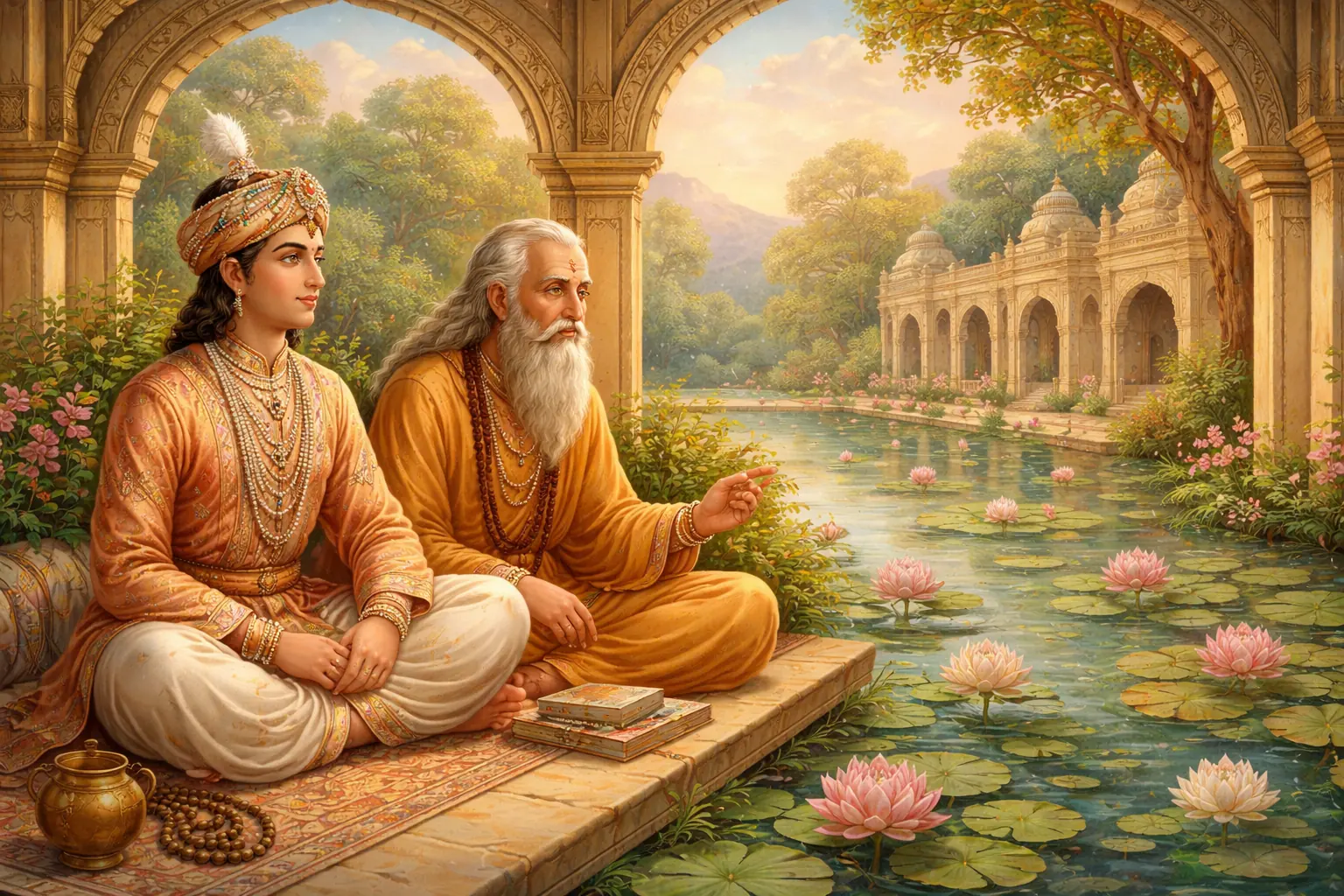
Vasishtha tells Rama the story of Vipasita—a king with four bodies. He says that one of the Vipasitas began traveling through the expanse of the universe in order to explore outer space and the celestial spheres. Vasishtha says:
“Brahman is infinite, therefore the misunderstanding of Brahman is also infinite. Misunderstanding exists until Brahman is understood; when it is attained, misunderstanding no longer exists.”
The Principle of Infinite Misunderstanding
Let us suppose that a cow can continue to be born in the animal realm due to its karma, and that it can be reborn for billions of kalpas, trillions of kalpas, unless some powerful impulse arises that would shift it in one direction or another. And even some extremely large number, for example quintillions of quintillions of kalpas, is not a large number for the universe, for nature. In other words, quintillions of quintillions of kalpas are as insignificant to infinity as a snap of the fingers. If such an impulse arises in this cow that it raises its consciousness and attains a human body in its next life, it may do so in this lifetime. If it does not arise, it may remain a cow for quintillions of quintillions of kalpas. This is the manifestation of the principle of infinite misunderstanding.
When we reflect on this, we arrive at the conclusion that precious human birth is of great value, as is engaging in spiritual practice—that in this life we have the opportunity to consciously complete this cycle or greatly shorten it without falling out of it.
In other words, you began engaging in spiritual practice, while some friend of yours did not. You may move to pure lands and become a creator god, while he may remain human and revolve within all of this for billions of ages. A very great gap may arise between you—this is the principle of infinite ignorance.
The Nature of Great Ignorance
Vasishtha says: “Misunderstanding exists until Brahman is understood.” We can speak of various forms of avidya (misunderstanding), the principal kleshas (avidya, asmita, raga, dvesha, abhinivesha). But the entire diversity of misunderstandings, kleshas, and forms of maya and illusory conditioning can be reduced to one great misunderstanding, which is also called maha avidya—great ignorance, or fundamental ignorance. This great misunderstanding is connected with a misunderstanding of the principle of Brahman, while all other misunderstandings—misunderstandings in the sphere of relationships and misunderstandings in the sphere of the intellectual clarity of the teaching—are secondary manifestations of this one great misunderstanding.
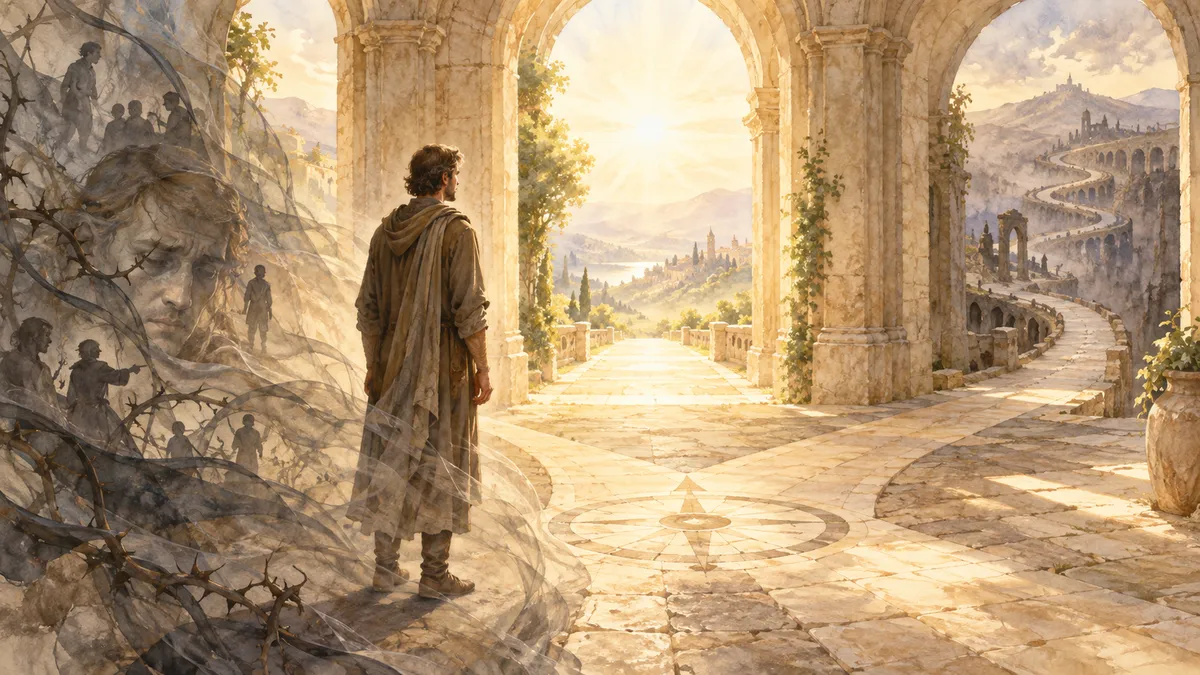
What is the misunderstanding? It is that we consider ourselves real individuals, that there is no element of self-liberation, no play; we have taken this with deadly seriousness; there is no understanding that the other is also Brahman; there is no understanding and self-liberation of the situation itself. In other words, the situation does not descend to a lower level, but takes on a qualitatively different character. From a dualistic situation of subject-object relations, it becomes a vivarta, lila, or vilasa—that is, a play of the creative energy of the Absolute, where all contradictions have been smoothed out and disappeared, where everything manifests as a whole. In other words, there is no understanding of the subject—not of oneself as an individual, but as the Absolute. There is no understanding of the other; that is, one sees them as a separate object rather than as Brahman, the Absolute. There is no understanding of the situation as a playful manifestation, vilasa, lila, and in pure vision, as the darshana of the deity that manifests this lila.
And why are these three understandings absent? Because there is no one great understanding—the understanding of the unity and wholeness of everything. The absence of this understanding leads to three misunderstandings: the subject, the object, and their interaction. And these three types of misunderstanding give rise to myriads of other misunderstandings.
But if misunderstanding is eliminated at its very root, then everything is immediately and instantaneously recognized and self-liberated. In other words, misunderstanding exists until Brahman is understood.
Subtle Forms of Misunderstanding
There may also be a misunderstanding regarding one’s own feelings. For example, such a person thinks: “Yes, I must be aware; I must abide in the philosophy of Advaita, in the View.” Yet their own energies, such as anger, jealousy, and envy, still manifest. And they fall into a sense of obscuration, beginning to think: “I am a worthless practitioner,” or they develop a sense of powerlessness in the face of these energies—this too is a form of misunderstanding, only a subtler one. They try to control them. But true understanding means that you recognize your fundamental consciousness as Brahman, and then all energies are recognized as well.
What else could these energies be but the play of Brahman? Nothing else. However, as soon as ahamkara arises, these energies are immediately attributed to oneself, along with identification with them and a sense of guilt. And if there is a sense of guilt, a scenario of punishment follows. For example, if a sense of guilt arises amid scenes of hell in a dream or in the bardo, a scenario of punishment is inevitable, because there is identification. If confusion arises during rebirth, when Yama weighs sins and merits, the scenario of karmic retribution—the law of karma—unfolds.
But if recognition exists from the very beginning, all of this is instantly self-liberated at the root. Then none of the manifestations are yours anymore; all of it is Absolute. And if it is absolute, then it is also perfect, because an imperfect Absolute is something that cannot exist. And if it can exist, then it is not reality but an inconceivable play.
The True Nature of Omniscience
Thus, Vasistha says:
“Misunderstanding exists until Brahman is understood; when it is attained, misunderstanding does not exist.”
When we directly see reality, all misunderstanding disappears. And some scholars put forward theories that realization means becoming an expert in all sciences and all arts: physics, mathematics, chemistry, biology, religion, history, and so on. In other words, this is superficial omniscience. One could put it that way, because if you realize the primordial state, your clarity increases, and you may indeed possess supergenius abilities. But that is not the point at all. It does not mean that, having realized Brahman, you instantly begin to know what some group of people in Argentina is doing, what the bacteria on Venus are doing at that moment, what the weather is like on Jupiter—in other words, that you come to know all of this simultaneously. Perhaps you will not know these things, but an intuitive awareness of omniscience may be present with astonishing clarity. And if you develop the abilities of omniscience, perhaps you will arrive at this as well. But fundamental understanding of Brahman means that you intuitively see through to the foundation that removes all contradictions and identifications, one that solves all problems at once.

Vasistha says:
“However far Vipashit may have gone, he still wandered in this misunderstanding.”
In other words, Vipashit flew through all the starry worlds, but he flew while remaining within his limitations.
“Of the others, one attained enlightenment, another became a deer, and the third still wanders in misunderstanding. The two who strayed into distant worlds are not visible in our consciousness. But the one who became a deer is within our space. The world in which this Vipashit lives as a deer is our own world, located in a remote corner of the infinite expanse of consciousness.”
“Vipashit himself lived in this world at the very beginning, and then departed from here. How, then, does he now live as a deer in this same world?”
Vasistha replied:
“Just as one who possesses limbs knows them, so do I know everything that can exist in Brahman, because Brahman is my Self. The past does not know the future, and vice versa, but consciousness undivided by time knows both. In this consciousness, everything is ‘here,’ although in ordinary perception something may be far away. Therefore, I see both the world in which Vipashit wandered and how he became a deer in this world. In fact, I know where this deer is at this very moment, O Rama. It is the deer that King Trigarta gave you.”
When Vasistha said this, Rama, the other sages, and everyone present were astonished. Rama sent several boys to fetch the deer. Upon seeing him, the entire assembly was amazed and exclaimed: “Truly, illusion is endless and boundless!”
Liberation Through Fire
“O wise one, by whom and in what manner will this deer be liberated from such an unfortunate existence?”
Vasistha replied:
“The way out of misunderstanding is the very same path that led into this misunderstanding. Any other path is wrong and will bring neither happiness, success, nor any results at all. King Vipasita worshipped fire, and upon entering the fire, this deer will regain its former state, just as gold begins to shine as before after passing through fire. Watch, I shall now make this deer enter the fire.”
Having said this, the sage Vasistha took a sip of water from his vessel and created a fire in the center of the hall without any wood. It burned brightly, without sparks or smoke. The people in the hall moved away from the fire. The deer, however, was delighted and began to dance around the bonfire. Vasistha was in deep meditation and blessed the deer to be freed from its past sinful tendencies. He prayed to the fire god: “Remembering its past existence, O fire, please give this deer its former form as King Vipasita.”

As soon as the sage uttered these words, the deer joyfully leaped into the fire. It remained there for several minutes while everyone watched, and then its form gradually transformed into that of a human being. He was radiant and beautiful. As soon as he emerged from the fire, the fire disappeared. The sages exclaimed with one voice: “He was radiant (bhasa) like the sun! Surely he will become known as Bhasa.” From then on, he was called Bhasa.
At that moment, Bhasa remembered everything that had happened to him in his previous incarnations. He stood up, approached the sage Vasistha, and bowed to him. The sage blessed him, saying: “May the misunderstanding that has oppressed you for so long leave you.” Then Bhasa bowed to Rama and greeted him.
After this, King Dasharatha greeted Bhasa:
“Welcome, O king. Sit down. You have traveled for a long time through distant places in this samsara. Rest here.”
Bhasa sat down together with the sages of the assembly. King Dasharatha continued:
“Alas, like a bound elephant, this King Vipasita had to pass through innumerable sufferings. What terrible calamities pursue an inaccurate vision of reality and a distorted understanding of truth. It is astonishing how powerful illusion is: although it is unreal and nonexistent, it can create all kinds of apparent worlds in infinite consciousness and a variety of experiences.”
Vishvamitra said:
“Indeed, O king. Many people wander in this samsara because they have not attained true knowledge or enlightenment. Here is a king who has been wandering in samsara for the last one million seven hundred thousand years. These ignorant people take an interest in the nature of the objects of the world—and samsara carries them along, and they cannot break free from it.
This creation exists in infinite space as a mere concept in the mind of the creator Brahma.”
The Nature of Multiple Worlds
The multiplicity of worlds seems real to those who remain in duality. In fact, it is the same kind of multiplicity of worlds as if you had different books on your shelf, each containing its own world, and you lost yourself and became immersed in that world while reading the book, forgetting this real world. But all these worlds fit on a single shelf and do not possess self-existence. Or it is as if you had discs with different computer games or video films, and, immersing yourself in one of them, you believed that you lived in one world, while, immersing yourself in another, you believed that you lived in a different world. But this reality is not comparable to the real world. All these worlds exist simply in the space of consciousness, while on the physical level they occupy the dimensions of a shelf. That is, they have never actually existed. They have no real coordinates, parameters, or physical laws; they are nothing more than a game of imagination created by the writer or by whoever created these game worlds. In the same way, the worlds in which people, gods, asuras, and rebirths in them exist, together with the laws of cause and effect, are similar to such worlds as books on a shelf or discs. They exist in the imaginations of their creators and of the living beings who are located within these imaginations and subject to their laws.

When we awaken to true reality, we free ourselves from these forms of imagination. And to do this, we must free ourselves from our own imagination, that is, from being seized by illusory energy through the activity of our mind. The best way to do this is to develop the ability to self-liberate all our dualistic perceptions. In one way or another, evaluative and interpretive activity always arises in us when perceiving any phenomena, and we become drawn into them.
Self-Liberation from Concepts
For example, you have a dream in which some being approaches you and asks: “Why are you not performing such-and-such a practice?” In other words, it reproaches you, and you begin to justify yourself guiltily. But if it is a dream from the very beginning, what are all these conversations for? You do not talk to your reflection in the mirror, nor would it occur to you to take some scrolling message at a train station seriously and answer it, because you understand that it is unreal in nature. But when this happens in a dream, your consciousness is clouded, so you enter into dialogue and experience real feelings. This may deeply affect you. But if you have no evaluations or interpretations, if you are immersed in direct seeing, where there are no meanings imagined by samsara and no subject-object relationships artificially created by the mind, then identification does not arise either.
A seeker once asked a sage:
– Swami, how can I attain God?
The Swami said:
– Oh, how much you have in your head! You think about yourself as someone who exists, you have the concept of attainment, and you have read a great deal and know about God. But all of this only hinders you. If you free yourself from the very concept of God, from attainment, from the concept of yourself, and enter into direct nonconceptual seeing, you will attain God much more quickly.

Why? Because He cannot be attained through the imagination of your mind, which is entirely illusory. He can be attained only by relinquishing all the functions of consciousness and penetrating into the place where all the functions of consciousness disappear. At the same time, I am not referring to the relative dimension. In the relative dimension, let the functions of consciousness operate as they are meant to. But the essence lies in the point at which to hold consciousness during the essential practice of contemplation.
