

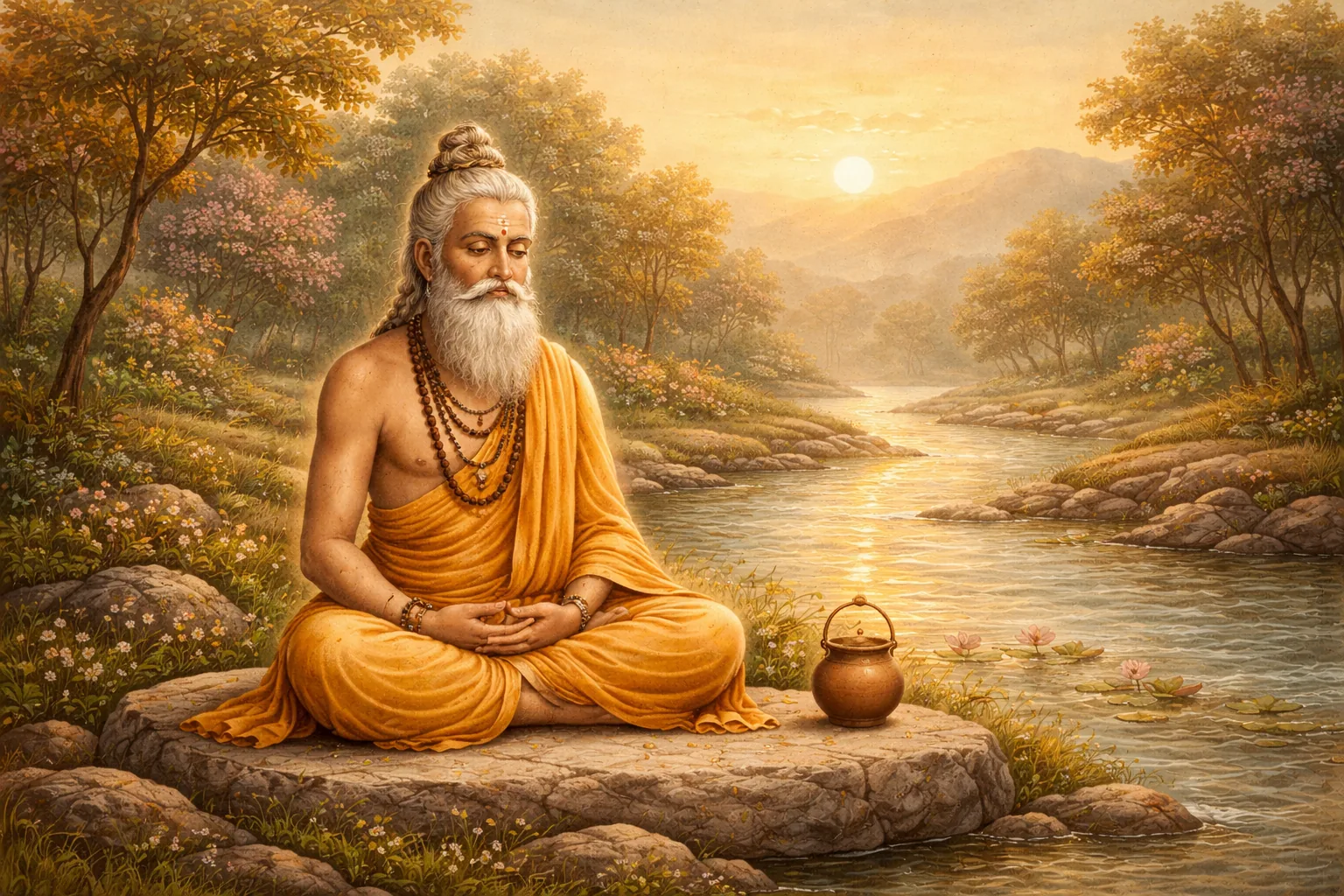
Commentary on the text “Ashtavakra Gita.” Ashtavakra’s instructions to King Janaka.
Ashtavakra said:
Undoubtedly, the self-aware one, playing in worldly life, is in no way similar to the dull donkeys of this world.
Truly, one concentrated in mystical yoga feels no agitation, having become established in this state, although all the gods, beginning with Indra, yearn and grieve.
Ashtavakra says that one who has realized non-duality is not in a state of ordinary life, but in a state of play. The state of play is very different from the state of ordinary, conditioned vision. The state of conditioned vision is like the vision of a dull donkey. Thus says Ashtavakra. The state of a deity, the state of awareness of unity with the Source, is like soaring in space, like the dance of a deity. And these two states are incommensurable.
Many people asked Ramana Maharshi: “The jnani does this and that.” And Ramana Maharshi said: “That is how you see it. The jnani does nothing.” They ask again: “The jnani speaks, gives instructions, takes care of us.” He said: “The radio also speaks and sings. But if you look inside the radio, you will see no one there.”
In the same way, the state of a jnani who has realized unity with the Source is, inwardly, complete emptiness. It is essence-less, non-substantial. However, other people, seeing his actions, may be misled, thinking that his consciousness functions in an analogous way.
The State of Play of the Enlightened One
The jnani is continuously in a state of play. For him there are no such concepts with which the ordinary human mind is entangled: good-evil, pure-impure, right-wrong, good-bad, truth-falsehood, past-future. For him such things are laughable. He does not share human stupidity on any point. It may be said that he agrees with nothing, with not a single word of an ordinary person, but he does not show this. It is not that he is in some kind of aggression, ready to argue or fight. On the contrary, he may very well radiate love or compassion. But he does not agree in essence, in the most fundamental, the most important matter, because he knows that there is no bad in the world, only what a person dislikes; there is no good, only what he likes; there is no this or that, but there are different kinds of perception.
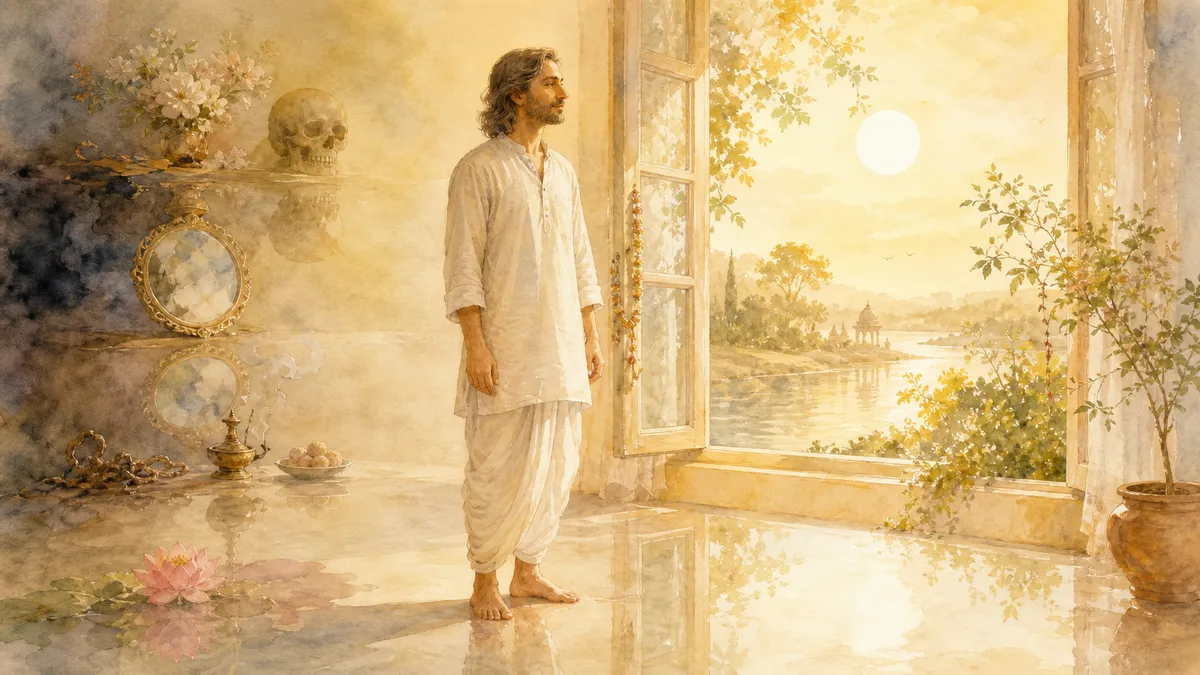
And when the jnani is in a state of unity with the Source, then all that remains for him to do when manifesting is to play. To play means to establish completely different relationships with reality, with the world, with oneself, with one’s thoughts, with one’s perception, with other beings. These are very subtle, very graceful, very deep relationships based on the vision of non-duality. They are based neither on the law of karma nor on human notions. In the state of play, it is unthinkable to share any human notions, because the state of play is the vision of divine beings, fully awakened sons of the gods, children of heaven.
Once, a person from Neem Karoli Baba’s close circle left the body. Other people grieved deeply over this. They came and asked Neem Karoli Baba: “You must be so upset about this!” And Neem Karoli Baba laughed and said to them: “Do you think I share your dreams?”
This means that life and death exist for those who dream. The other exists for one who sees himself as a subject. But in the Absolute all this is unreal. In the Absolute, everything that happens is the play of the Absolute. That is why Ashtavakra spoke so sharply about the dull donkeys of this world. This was done not to arouse dislike, but to draw a clear distinction. Although a saint who has unity with the Source plays in this world, he is never obscured by it. It is unthinkable that his consciousness, even for a moment, should lose the vision of the Source and enter into obscuration.
He says that he feels no agitation, being concentrated in such a mystical state, although even the gods of samsara yearn and grieve. Agitation is a sign of ignorance, a sign of the sleep of reason, of delusion. The saint, however, abides in great joy and reverent ecstasy thanks to unity with the Supreme Source, because the dreams of reason can no longer mislead him. And although he pretends to share human concepts, in reality he does not share them, because he is devoted to other concepts—the concepts of the Absolute.
Someone might think: “Does this mean that one must deny human concepts, give them a good fight so that they know their place? Perhaps one must show them what the true spirit is?” Such practices have also existed. For example, the training program of the well-known Kapalika school included similar behavior. They pretended to be cripples, deaf-mutes, madmen; they bandaged their hands, pretending to be ill with leprosy. They went into cities and villages and behaved like madmen: babbling incoherently, snorting, frightening people. People became angry with them in every possible way and cursed them. Through such practice, the sadhus of this school tested whether they were attached to human opinion about themselves, to prestige in society, and how far they had detached themselves from their personality. They believed that if people were angry with them and cursed them, then in this way they purified their karma; that is, for them this was actually very favorable.
But in reality, to deny the human side or declare war on it is also an extreme, only of another kind. Since in the primordial natural state there is neither acceptance nor rejection, a saint abiding in the natural state does not deny the human part; he does not fight with it. If a yogin has opened a connection with the Supreme Source and after that begins to deny the human part to which he previously clung, then this is another duality, another extreme. The primordial state, however, is beyond extremes, when the yogin neither denies it nor accepts it. He simply relates to this human part with boundless humor, not considering himself inwardly connected with it, yet participating in it by the will of fate. That is, he relates to it exactly as one should relate to it in the practice of play.
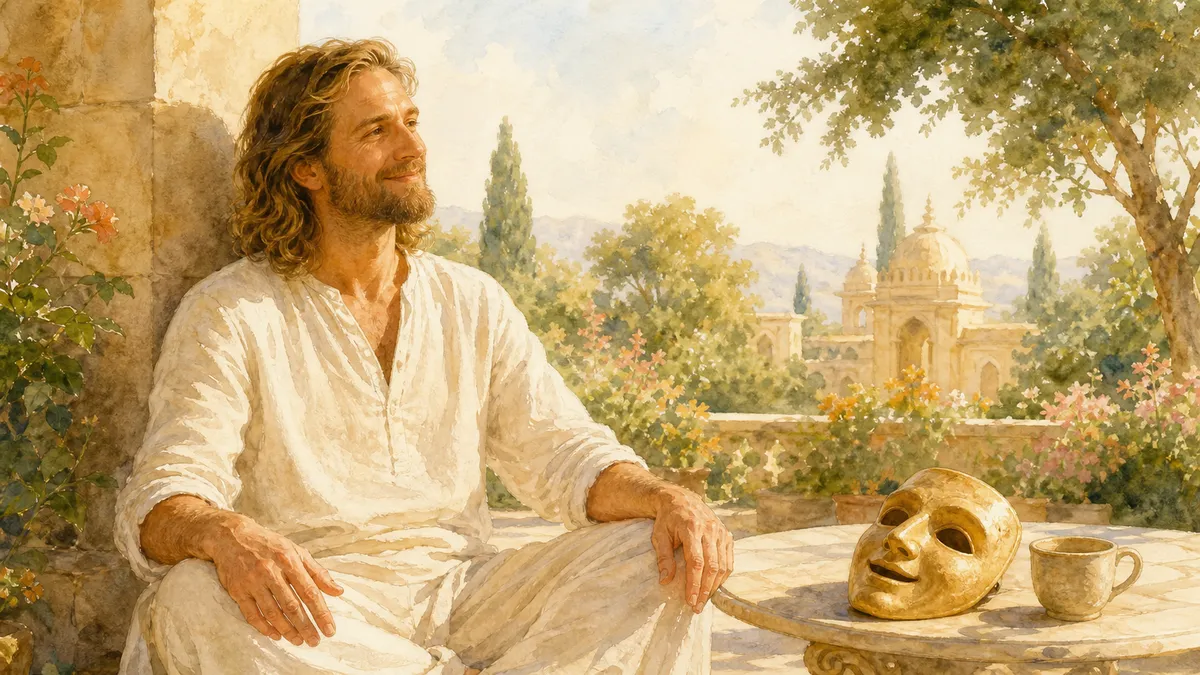
One who cannot relate to his human part with boundless humor is most likely not acquainted with his primordial Consciousness. He is often extremely serious when it comes to his human part. Therefore, he is still an ordinary being subject to karma, and not one who is playing. He can still be caught by somehow stepping on one of the sides of his false ego. But a playing saint, who from the very beginning relates to his human parts with boundless humor, is always light and harmonious. He is attached neither to himself nor to others, but this does not prevent him from radiating love, joy, and compassion, or from being in harmony with others. On the contrary, being empty, he becomes boundlessly flexible in any situation. Since there is nothing to be attached to, nothing prevents him from being flexible.
Why are we often inflexible in communication with others, in our relationship with ourselves? Because there is some fixation somewhere; we are attached to something within ourselves. And if we are attached to something, then we already lack freedom of action in a given situation. The absence of attachment gives the yogin astonishing lightness, emptiness of heart, and flexibility, when he knows that nothing—neither outside nor inside—is worthy of causing confusion in his mind. Then he simply relaxes and lives spontaneously.
When a yogin has attained such consciousness, it is said that he is no longer on the human level, but on the level of a deity.
Freedom from Karmic Conditions
He, the knower, is not touched by conditions manifesting in accordance with good deeds or bad ones, just as the sky is not touched by smoke, however high it may rise.
What can prevent a great soul, who has known this entire world as his own life, from being satisfied?
When a yogin has realized unity with the Great Source, when he has known the whole world as himself, then what cataclysms, what events can prevent the soul from being in a state of contentment? This is impossible in principle. Therefore, he is never touched by the conditions that manifest in accordance with karmas.
Karmas are impermanent. For example, at the time when a person began the spiritual path, according to his natal chart the element of space was active in him. The period associated with the element of space lasts eight years. This is a cycle during which a person experiences an extraordinary uplift and lightness, spiritual enthusiasm. Everything works out for him; his mind operates at great speed. He feels that if he continues in this way, he will certainly become a great saint. But after eight years have passed, the period of the water element begins; that is, instead of the vishuddha chakra, his consciousness descends into the svadhisthana chakra. And suddenly he feels that the spiritual uplift he had for eight years has disappeared somewhere. New conditions arise, new states of self-perception, new karmas manifest. If his mind has not gained spiritual strength during this time, he begins to fall into confusion. New planetary configurations have gathered over his head, and he may feel that his world no longer looks the same.
There are various conditions that either favor a person or do not. And everyone is subject to such conditions. Therefore, the master says to the novice disciple: “Learn patience, acquire will, do not try to grasp the stars from the sky. Learn the basics. It is unknown what is in your consciousness, how you will respond to it. Learn to be constantly even in everything. Learn to be always the same.”
When you have attained an absolutely even consciousness, it means that you have already realized something. There is a saying: “If your mind is unchanging, then you are in sahaja-sthiti.” This means that your consciousness will remain the same, your mind will not change depending on whether you undergo a long retreat or do not, whether “Divya Loka” is the most prosperous sangha in the world or consists of only three dozen monks, whether you occupy the humblest position or the highest, and so on. In that case, it can be said that you already have a certain attainment.
True Knowledge and Renunciation
Of all four categories of beings, from Brahma down to a blade of grass, only a person of knowledge is capable of eliminating desire and aversion. A rare person knows himself as the indivisible Lord of the world; no fear comes to one who lives by truth.
Ashtavakra said:
You are bound by nothing. What should a pure person like You renounce? Having withdrawn from the problems of the body, You can become calm. Everything arises from You, like a bubble from the sea. Knowing yourself as the One, you can be at peace.
Then Ashtavakra says:
Although everything is before your eyes, all of it is unreal. It exists in you. Everything external is like a snake in a rope, so you can abide in serenity.
Remain equal in pain and pleasure, equal in hope and disappointment, equal in life and death. Then, without any flaws, you can abide in samadhi.
It seems that such equanimity is something quite ordinary, but in fact it is not so.
Soma-rasa—the principle of the single “taste”—implies the yogin’s ability to remain in an even consciousness when it encompasses vast bands of perception. It is easy to remain in an even consciousness when consciousness perceives something insignificant: the same delicious prasad, friendly monks, strict principles of conduct, favorable principles for practice, a strong and healthy body. Under such conditions, maintaining an even consciousness is easy. However, true equanimity means that your mind is capable of encompassing very broad bands of perception and, at the same time, not changing in either direction.
Will your mind be able to remain even if you find yourself in the greatest luxury, the greatest glory, enjoyment, refined entertainments—that is, in a situation you could not even have imagined? These may be very deep states connected with clarity and knowledge, when superpowers and extraordinary abilities are revealed to you. When you find yourself in a state of power, or when you feel that behind the monk’s kurta there is a deity hidden within you, creating universes, will you not become intoxicated by all this? Or, conversely, when you find yourself in harsh conditions where your creative potential is blocked, where your external freedom is limited, where elementary comforts for your body are absent, will all this not upset you?
That is, we have only slightly expanded the spectrum of awareness, although it can be made much broader. If the spectrum of awareness is shifted downward, very harsh energies will be there. If it is raised upward, very subtle and sublime energies will be there. And the yogin, experiencing this entire boundless spectrum, must preserve his equanimous consciousness without acceptance or rejection. Such equanimous consciousness is called soma-rasa-vidya (knowledge of the single “taste”).
A true sage accepts everything with equanimity: even upon reaching the heavens, he will not be enchanted by them; even when in very harsh conditions, he will not fall into despondency.
For example, in hell the conditions are terrible. Living beings there continuously torment one another. Their bodies emit a foul stench. Many of them live in filth. Horrific tortures are inflicted upon them. Their life proceeds roughly like this: terrible tortures alternate with unconsciousness, and when memory returns, these tortures resume. Therefore, they very much want to live in unconsciousness, since unconsciousness is the only period of time when they do not suffer. But when unconsciousness disappears, hell begins again. They have neither will, nor thoughts, nor feelings. They are completely helpless; their consciousness is narrowed down to a single thought: “How can I get rid of this wild pain?”
The consciousness of a being of hell is very different from that of a human being. It is very narrow. Its perception is roughly this: “How can I get rid of this wild pain? How can I weaken it at least a little?” And all of life passes between the experience of wild pain, pain that is slightly less intense, and unconsciousness. Such is the consciousness of beings of hell.
The disciples of one teacher asked him: “In which heavens do you intend to be reborn?” He answered them as follows: “I pray to be reborn in hell. Otherwise, who will save the living beings there?” This means that a saint, by the power of his consciousness, can preserve clarity and equanimity even when he finds himself in very harsh energies. Even with such experiences, he can play. He can become a wrathful deity there and transform hell into a pure vision, into a wrathful mandala. He can make the servants of hell the guardians of this mandala and the deities of the periphery. He himself will reign in the wrathful mandala as the central deity and will play among fierce energies.
The world of the gods is something entirely different. It is exquisite, refined pleasure. It is a continuous stream of bliss, ecstasy, and clarity, play and creativity. It is a world where your abilities increase hundreds and even thousands of times. It is a world where all your desires are fulfilled with great speed. You have not even had time to think about it, and it is already given to you; you have not yet had time to dream of it, and you already possess it. It is a world in which you think: “What else should I imagine, desire, and receive?”
However, a saint abides beyond such worlds in a state similar to space.
The State of All-Acceptance
I am infinite like space; the world is like a vessel. Know this, and there is no need to renounce, accept, or cease anything whatsoever.
Ashtavakra says that the matter is not renunciation, but understanding. That is, renunciation is necessary for learning and understanding. But in Laya Yoga we speak of all-acceptance as the highest stage of spiritual practice. Renunciation is necessary in order to leave behind everything worldly and bring the kleshas under control, to bridle them and become a true yogi. However, true renunciation is not the denial of the external world and one’s own energies, but detachment.
Detachment is the elimination of dependence; it is freedom from any manifestations while perception remains full. Therefore, we say that a yogi who has attained detachment is beyond acceptance and rejection. He is not bound by any manifestations, yet he does not reject them either. An equanimous attitude toward everything becomes established in him, because he has no judgments or evaluations.
The state of all-acceptance is a state of total unity with all that exists. A yogi who lives in sahaja samadhi feels how the sap flowing in grasses and trees flows also in his blood. He feels how the countless myriads of beings living in the universe move within his body, because he is one with all Being. When he sees the stars, they are not external to him, but are in the space of his own “I.” One could say that he breathes in every pair of lungs and beats in every heart. He only appears to be living in one body. In reality, he is the possessor of countless bodies.
I am like the ocean; the diversity of things is like waves. Know this, and there is no need to renounce, accept, or cease anything whatsoever.
For an ordinary person, the “I” is like a drop. The “I” of a yogi abiding in sahaja samadhi is like a wave, or even an entire ocean. The state of a drop is always a state of confusion, narrowness, clinging, and false judgments. The state of the ocean is a state of complete non-duality, a state of unity.

The Path to the State of All-Acceptance
Such unity is attained when the yogin has cultivated detachment, will, serenity within himself, when he has let go of himself and entered non-doing, when he continuously remembers himself. Until he has developed these qualities within himself, he cannot enter the state of all-acceptance.
But when he has cultivated patience, self-surrender, boundless will, and detachment within himself, has managed to let go of himself and relax, then all-acceptance, the single “taste,” and non-doing come of their own accord, naturally. This is the logical completion of the yogin’s practice.
Many may not understand this. Many may associate yoga only with a method, with a specific technique, but this is not so. Methodology is only methodology. But all-acceptance, letting go of oneself, non-doing, the single “taste” arise as a result of going beyond the limits of the personality. This is very different from methodology. It is a matter of awareness and self-surrender.
