

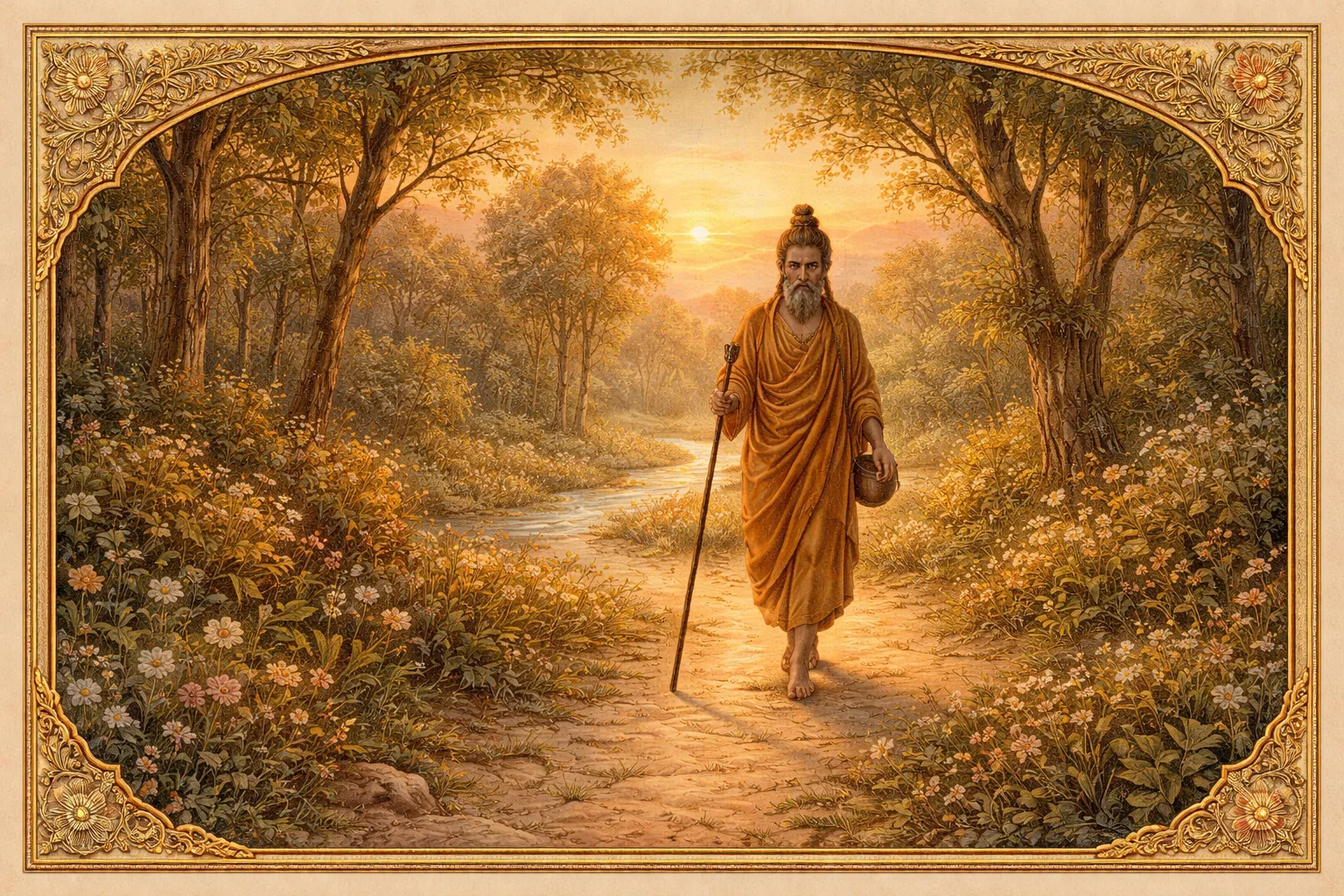
Commentary on the text “Sri Guru Charitra”
The text “Sri Guru Charitra” contains stories about the incarnations of the avadhuta Dattatreya.
The Birth of Narasimha Saraswati
The eleventh story, “The Birth of Narasimha Saraswati,” tells how Ambika, having received the blessing of the guru Shripada, became pregnant, since she had good thoughts and was married to a practitioner, a devotee of Shiva. When she gave birth to the child, everyone was amazed. Astrologers predicted that the child would be a world teacher, would possess the eight siddhis and nine kinds of knowledge. They also said that she had given birth to an incarnation of God and that he would not be bound by worldly life. All the townspeople came to visit the infant and present him with gifts. On the twelfth day he was given the name Shaligram.
One day the mother told her husband that she did not have enough breast milk for the child and asked him to bring a cow. The child laughed, and then touched her breast with his right hand, and immediately milk began to flow so much that her clothes became wet. However, it so happened that seven years passed, and the child had not spoken even once. The parents began to worry that the sacred Brahmin thread ceremony could not be performed, since he would not be able to recite the Gayatri mantra. But the child reassured his parents with gestures. They said: “We thought that you were our hope and would take care of us in old age, but you are mute.” But then the child brought home a piece of iron, gazed intently at it, and turned it into gold. The parents were amazed; they gave him another piece of iron, and he again turned it into gold. Then they were very happy and asked him to speak, since he possessed such abilities. He made it clear that he would speak only after the initiation of the sacred thread.
The parents hired astrologers and Brahmins and began preparing for the sacred thread ceremony. The townspeople laughed, thinking: “Why does this mute boy need a ceremony and such great expenses?” But when he was initiated into the Gayatri mantra, the boy immediately pronounced the Gayatri mantra aloud. When, after the Gayatri mantra, his mother said to him according to tradition: “Study the Vedas, observe the traditions, live in accordance with dharma, and live on the food you receive as alms,” the boy unexpectedly began to recite the Rigveda by heart. When the words were spoken to him a second time, he recited the Yajurveda. When he was given the ritual offering a third time, he recited the Samaveda. Everyone was struck dumb with amazement, seeing the mute boy chanting the Vedas, and said: “This is an incarnation of God.”
After the ceremony the boy said: “Since you told me to live on alms (there were such words as ‘bhiksha-vritti’), I am going to follow your advice completely and become a sannyasi. Give me permission to leave.” The mother was very upset that she would have no one. But he said to his mother: “You will have four more children.” Narasimha began to insist on becoming a sannyasin at the age of seven, that is, a renunciate monk.
Many people doubt whether they should become monks at thirty, at forty; even at fifty they still doubt. But when you hear stories about seven-year-old boys taking sannyasa, consider that perhaps you are forty years late. Why do you doubt?
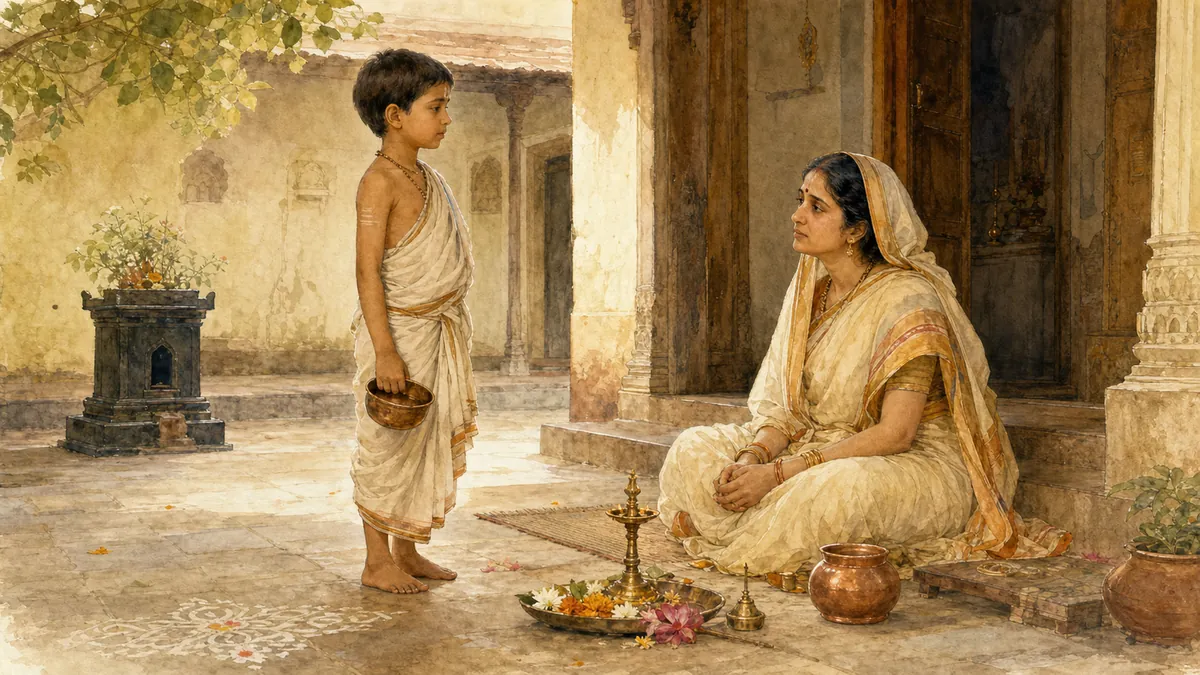
Narahari said: “The body is mortal, wealth is not permanent. Human beings should be guided by a righteous life in youth and have the strength to work.”
Because the earlier a person enters the path of dharma, a pure and elevated way of life, yogic practice, purification, and service to the forces of enlightenment, the greater his chances of attaining liberation and fully purifying himself. The earlier meditation, study, the path of practice, the cutting off of attachments and karmic ties inappropriate for enlightenment begin, the more favorable and pure the yogin’s next life will be. Why do some take sannyasa at such an early age? Because their past life was completely pure, there were no karmas, nothing to work out. In the same way, those who are monks, even if they do not manage to attain liberation, in the next life at the very youngest age will find a spiritual teacher, perceive the spiritual teaching, and adopt the monastic way of life or the way of life of a practitioner, since there will be no impure karmas that they would have to work out.
One who has conquered death will understand that the body is perishable, life is short and as impermanent as water. Wife, children, wealth—nothing is eternal or permanent. Worldly life is like a dream. Lost time never returns. When it rains, water does not remain in plants and trees for long. In the same way, human beings must one day die—this is certain. Life is like foam on water. Jasmine flowers bloom quickly, but they also fade quickly. The body exists in the same way.”
“Amba Bhavani was transformed by this teaching of Brahma Upadesha. She bowed to Narahari and said, “Stay with us until another son is born to us. Otherwise we will not live long.” So he stayed with his parents for another year. Even learned people came to him to learn the Vedas. He became famous throughout the area. After some time Amba Bhavani became pregnant and gave birth to twins.
Narahari is a childhood name. Often in India, in addition to the name given at birth, children are given some temporary childhood name: Munna, Papu, Narahari, that is, something funny. A child is called by such a childhood name until the thread ceremony.
Then Narahari said to his mother: “Your wish has been fulfilled. Two more boys and a girl will be born to you, and they will live long. Now allow me to leave.”
With heavy hearts, the parents said to Narahari: “You are our family deity (kula-devata). We are guilty of having spoken harshly to you, but it is because we love you.” Narahari reassured them and said: “Do not worry, I will come to you when you remember me. Serve Ishvara and you will be liberated. I will visit you in twenty-one years. Now I must set out on pilgrimage and meet the siddhas.” He showed them his true form and departed with his parents’ permission. All the residents of that place came to see him off.
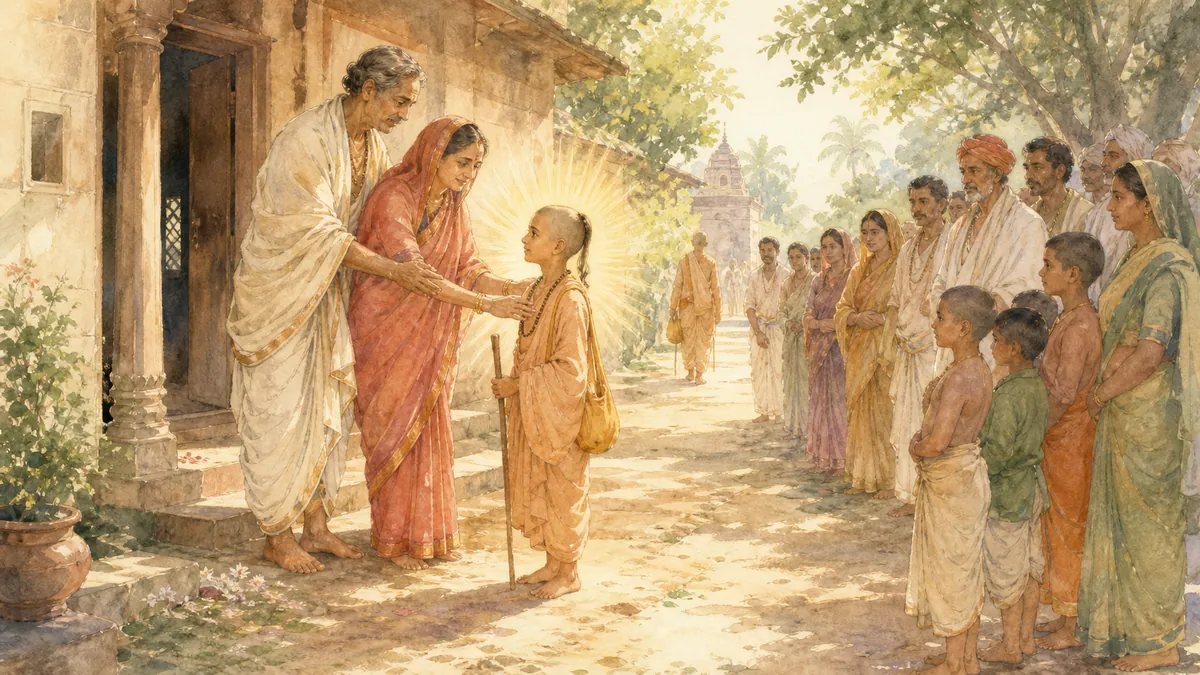
I read in one of the stories about Narasimha Saraswati that his mother was very adamant about not letting him go into sannyasa. When she had already exhausted all her arguments, and he still insisted that he would become a sannyasi, she said: “You have no right to steal my property.” He asked: “And what do you mean by your property?” She said: “Your body came out of my body, I fed it, therefore it is my private property. If you leave, you will steal it and violate the law of dharma.” Then he demonstrated siddhis, showing that he was free from the body, and his astonished mother could no longer say that it was her property. When he asked, “What exactly is your property?”, she replied: “For example, your skin.” Then he turned his body inside out and said: “You may take the skin.” His mother was shocked by this and said: “All right, I don’t need anything.” She let him go.
Initiation into Sannyasa
He came to Kashi Kshetra and began performing religious rites. Kashi was full of scholars, sannyasins, yogins, yatis, ascetics (tapasvis), and they were amazed to see Narahari, a young brahmachari who had excelled in the yoga of meditation. They said: “This boy is performing difficult austerities. He does not spare his body. How has he attained such freedom and detachment?” They all came to him and praised him. Among them was an old sannyasin named Krishna Saraswati. One day he said to the other ascetics: “This brahmachari is no ordinary boy. He is well known everywhere. He is Narayana himself. We shall initiate him into sannyasa, and he will become a Guru. He is ready to be the Teacher of the world.” All the ascetics agreed. Then they came to Narahari and said: “O young ascetic, in this yuga people criticize sannyasins. In order to preserve and support the institution of sannyasa, and for the good existence and prosperity of people, you should allow us to initiate you.”
Narahari treated the request with respect and allowed the old Krishna Saraswati to initiate him into sannyasa.
In another version it is said that the elders, yogins, and ascetics were struck dumb when they saw what abilities this boy possessed. They said: “We see that you are beyond our understanding and that you need neither formal initiations nor any sannyasa or other ashramas. For you are beyond them. But in order to support monasticism, please accept this ceremony, and accept the status of a monk, a sannyasi, so as to strengthen the spirit of practitioners. This will be your very best service to the dharma.” And he, of course, agreed.
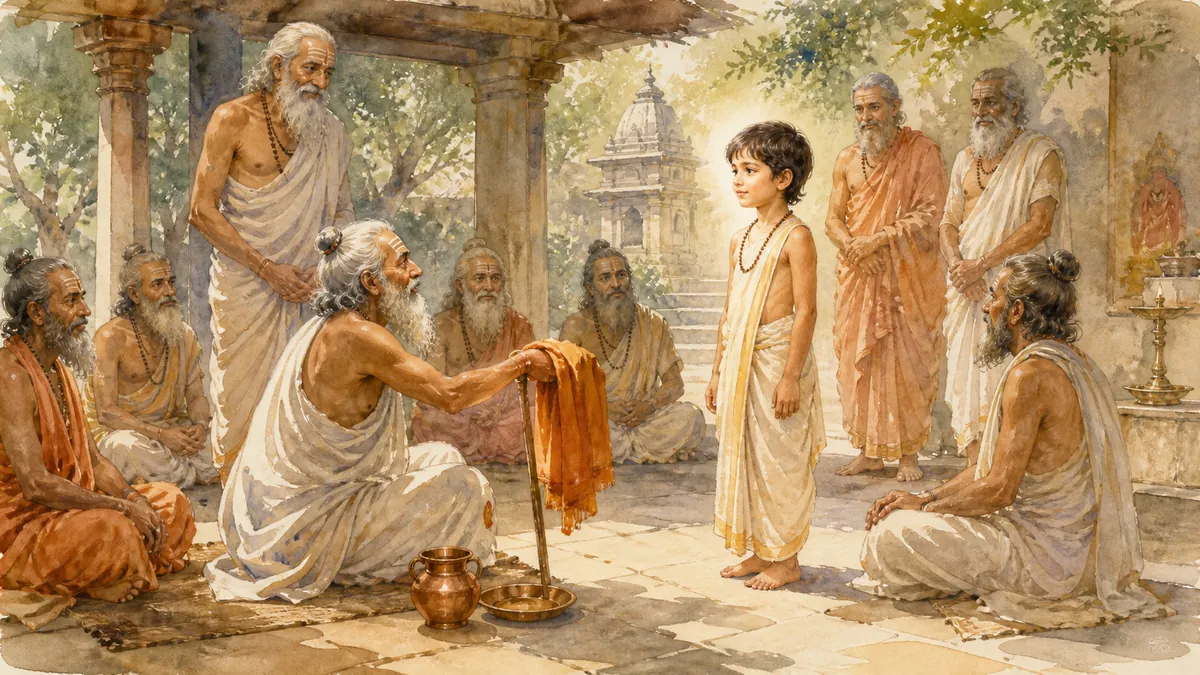
Then they gave him the name Narasimha Sarasvati. When God takes an incarnation in human form, he must behave like an ordinary human being. Long ago, God took incarnation as Rama and Krishna, and at that time Vasishtha and Sandipani were their gurus. In the same way, Krishna Sarasvati was Narahari’s guru. After he became a sannyasin, Narasimha Sarasvati began to preach and explain the meaning of the Vedas. He became the most famous in Kashi. Many people became his disciples. After some time, he and his disciples set out on a holy pilgrimage. They traveled throughout the world, then went to Ganga Sagar, and from there to Prayag. He initiated a Brahmin named Madhav into sannyasa, naming him Madhav Sarasvati, and initiated him into the teaching of Brahman.
The “Shri Guru Charitra” is like Kamadhenu and fulfills all desires. One who listens to it will gain knowledge and attain all the purusharthas (siddhis of perfection).
What does listening to stories mean? Listening to stories is like darshan, initiation. You simply attune yourself to this karmic vision, and Guru Yoga takes place spontaneously.
Meeting with the Parents and the Teaching on Karma
Grace to the suffering.
Shri Guru remained in Prayag for some time. Many people became his disciples. Among them were seven significant disciples, namely Bala Sarasvati, Krishna Sarasvati, Upendra Sarasvati, Madhav Sarasvati, Sadanand Sarasvati, Jnana Jyoti Sarasvati, and Siddhayogi. After he visited many places of pilgrimage, he arrived at his birthplace, Karanya Nagar, and met with his parents and relatives. Shri Guru assumed many forms and was in many houses simultaneously for bhiksha (alms). Thus, people came to know that he was a yogi and Vishnu in human form. His parents worshiped him, and he appeared to them as Shripad Vallabha. Amba Bhavani told her husband about her previous birth. They prayed to him to save them from worldly life (samsara). The Guru said to them: “The family in which someone accepts sannyasa attains Liberation within forty-two generations.” He told his parents to go to Kashi and live there in their old age. He blessed them, and they attained liberation.
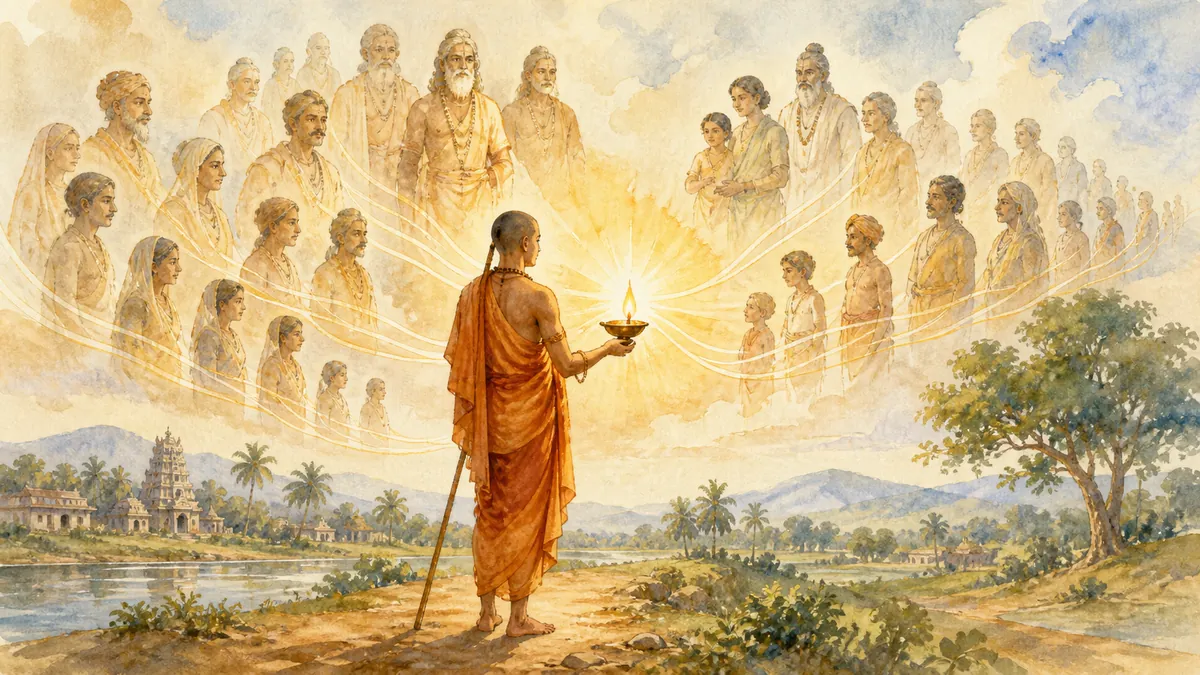
If a person simply accepts sannyasa or monasticism, it is said that his family attains liberation within forty-two births. But if a person accepts sannyasa or monasticism and himself attains liberation in this life, it is said that seven future generations and seven previous generations are also purified. Some, however, say that they too can attain Liberation within seven lives. Why does this happen? Because there is ancestral karma, subtle astral connections that extend among relatives over several generations. And the one who attains liberation or accepts sannyasa becomes a powerful source that purifies ancestral karma. He is the strongest light or torch that shines for souls who have a karmic connection with him.
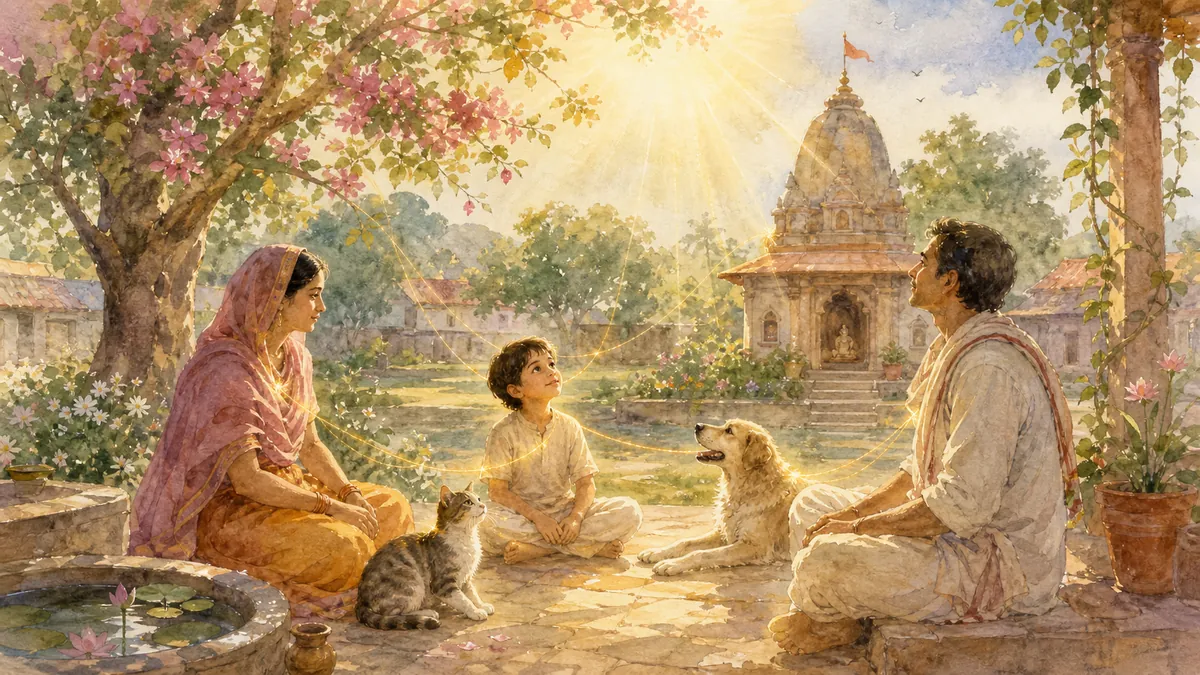
Then his sister Ratnabai came to him, bowed, and said: “O Swami, protect me; I will perform austerity.” Shri Guru said to her: “The husband is god for the wife. You will receive the reward according to your faith. If you understand that your husband is Shiva Himself, you will be able to cross the ocean of life.”
Narasimha Sarasvati gave her a simple sadhana. He said to her: “Meditate on your husband as the Absolute.” Knowing that she lived in these circumstances and that such were the traditions of that time, he recommended to her the most accessible, the most ordinary sadhana. If even in an ordinary person you can recognize the Absolute, then your consciousness will also recognize itself as the Absolute, as the supreme Source. Because to recognize the supreme Source in an ordinary person means to attain liberation.
From the point of view of Advaita Vedanta, there is not a single ordinary person, not a single ordinary cat, dog, or anything at all; there are only the energies of the supreme Source. And to recognize the energy of the supreme Source in a cat, in a dog, in a person, a woman, a man, to see the deity—this means giving rise to the most powerful state of pure vision (samarasa), entering the single “taste” of perception of all phenomena, and attaining complete realization. Therefore, Narasimha Sarasvati’s instructions for this woman were entirely correct.
When she asked about her future, Shri Guru said: “In your previous birth you struck a cow; because of this sin you will suffer from leprosy. You also sowed discord between husband and wife, therefore your husband will become a sannyasin and leave you.” Ratnabai was in grief and fell at his feet. He consoled her, saying: “O girl, you will be happy with your husband for some time. After he takes sannyasa, you will fall ill with leprosy, but your sins will be washed away when you see me again.”
Why is there retribution for an impure deed? For example, why, having struck a cow, did she have to fall ill with leprosy, or why did her husband have to leave her because she had caused discord in a past incarnation? Because, when performing any action, the mind generates bhava, a worldview, that is, an atmosphere. If this action is negative, then a negative bhava is generated, a deviation is created, an excess potential. That is, an impure state of mind is created, which resonates with and attracts universal shaktis, forces. If it is a destructive state of mind (destructive bhava), it resonates with and attracts destructive forces (samhara-shakti). If it is a veiling, obscuring, tamasic tendency of the mind, it attracts the corresponding forces (tirodhana-shakti). These corresponding forces have already established a connection with the being. Perhaps they do not manifest immediately, but it is said that karma manifests when the conditions ripen, and until these conditions have ripened, karmic forces wait for their time, remaining in a hidden, latent state. When the conditions are suitable for realization, sanchita karma passes into prarabdha karma and becomes destiny, that is, what a person experiences in his life.
Upon hearing such prophecies from Narasimha Saraswati, the woman became very upset and burst into tears. Nevertheless, if we contemplate, self-liberate, and have strength of spirit, then whatever sinful states there may have been in a past life, all of this self-liberates, because any excess potential and any destructive energies can be self-liberated if you are in a deep state of presence.
In the texts, in particular in the “Laya Amrita Upadesha Chintamani,” in the “Song of Tilopa on Mahamudra,” which is close to our tradition, there are always such lines: “Long kalpas of samsara cannot obscure the shining sun. Even a past life full of sins can be self-liberated if you have discovered this great sun of the natural state.”
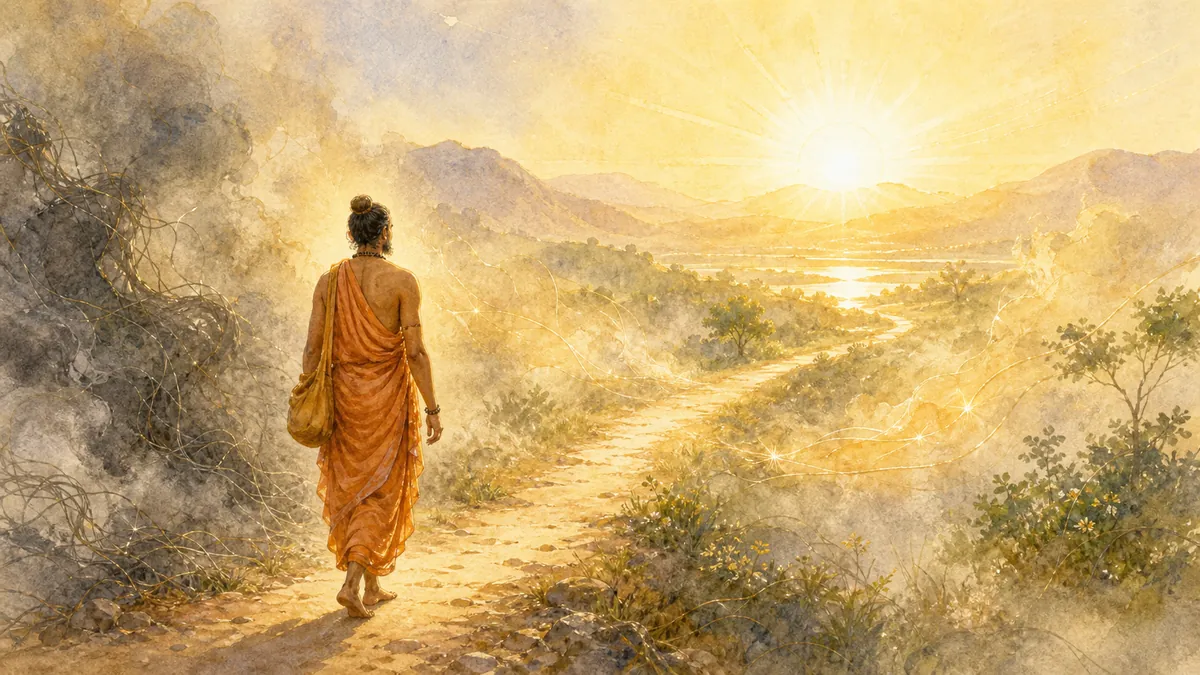
Often a yogin experiences various difficulties or problems at the beginning of spiritual life. This is nothing other than the return of excess potentials, of negative energies attracted in this life. But if he has faith, determination, courage, strength of spirit, and most importantly, knowledge of how to self-liberate them, over time they all self-liberate, and therefore his karma is purified.
Compassion for the Suffering
Shri Guru came to Tryambakeshwar, and then to Manjarika, where the muni Madhavaranya saw him in meditation and came to him. Shri Guru blessed him and said: “You worship Lord Narasimha every day, therefore God will appear before you as Narasimha.”
From there he arrived in Brahmeshwar and went with his disciples to bathe in the Godavari. At that time, a Brahmin suffering from unbearable stomach pains was writhing in agony on the riverbank. His pain was so great that he decided to end his life. His illness was that the pains began as soon as he ate food. Therefore he ate only fruit. But on the day of Mahanavami he ate a great deal of food. As a result, the pain became stronger than ever before. He was broken with grief and said: “I am going to die. I am sinful. Food nourishes all human beings, but for me it is poison. It will be better if I die.” With these words he tied a stone to his stomach and went to drown himself. In his mind he prayed to God, saying: “I was born as a burden on this earth. I have never made offerings of food, not even of water. Now misfortune has befallen me because of the sins in my previous birth. I do not know whether I reproached my guru for something or offended my parents.”
Shri Guru saw a man trying to drown himself and ordered his disciples to bring him to him. They pulled the man out of the water and brought him to the Guru. The Guru is Kalpataru, the wish-fulfilling tree for the needy, a savior for the helpless, and compassionate toward the suffering. He said to the Brahmin: “There is no greater sin than suicide. Why do you want to part with life?” The Brahmin said: “O Yathisvara, I was born with no worth at all. If I eat, I get severe stomach pains. It becomes unbearable. How can I live?” The Guru replied: “Do not be afraid. I will give you good medicine for your illness. From this moment you are healed. Today you will be able to eat whatever you want.” The Brahmin bowed reverently to the Guru.
A little later, the village official came to the riverbank. He saw Shri Guru and prostrated himself before him with devotion. The Guru asked him: “Who are you? Where do you live?” The man replied: “My name is Sayamdeva, and I live in Kadagandji. I am a Brahmin and am in the service of a Muslim king. For a year I have worked as the tax-collection official in this village. Your darshan has purified me.” The Guru said: “Sayamdeva, listen to me, I have told this Brahmin about a remedy for his severe stomach pains. Today you will prepare for him many different sweet and spicy dishes. This food will be the resolution of his illness.” Sayamdeva said: “Swami, I know about this Brahmin. As soon as he eats, his stomach pains begin. He has not eaten for some time. He began having severe pains yesterday after he ate. If I feed him, the sin of killing a Brahmin will be upon me.” Shri Guru said: “Do not worry, I will give him medicine. Take him home and prepare many sweet dishes for him.”
Healing by the Guru’s grace
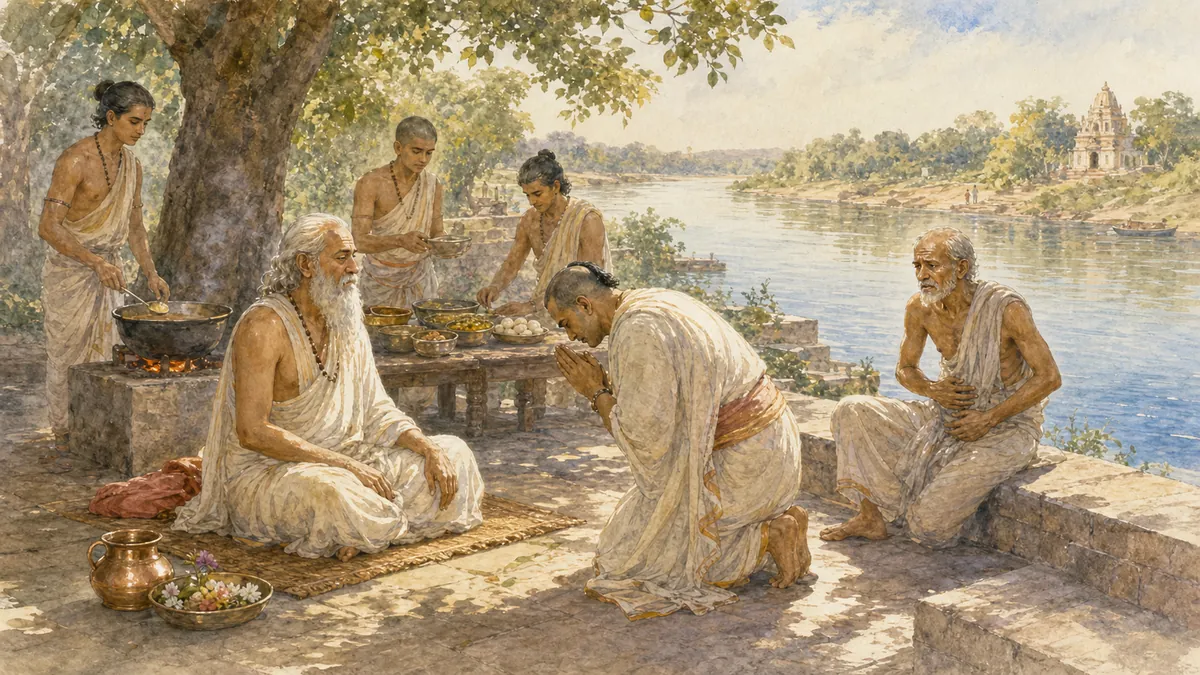
Sayamdeva said: “Gurudeva, let it be as you wish. But please come yourself to our home for bhiksha together with your disciples.” Gurudeva agreed and came to his home with the disciples. Sayamdeva worshiped him, performed the ablution (abhisheka) and puja with music and songs. He served food consisting of many dishes. Shri Guru ate together with everyone. And that Brahmin ate as much as he could. His illness disappeared.
When everyone can obtain liberation from the worldly illness through the Guru’s grace, how could a stomach ailment withstand it in this case? By the Guru’s grace, food became medicine for the Brahmin, for whom it had previously been poison. All those present were amazed at the sight of this.
Those who listened attentively to this story will be blessed. Their suffering will disappear, and they will certainly become happy.
