Brahman as the Only Reality: A Commentary on the Yoga Vasistha
01.08.2026
0 мин. чтения
0
Share
copy
search
add
share
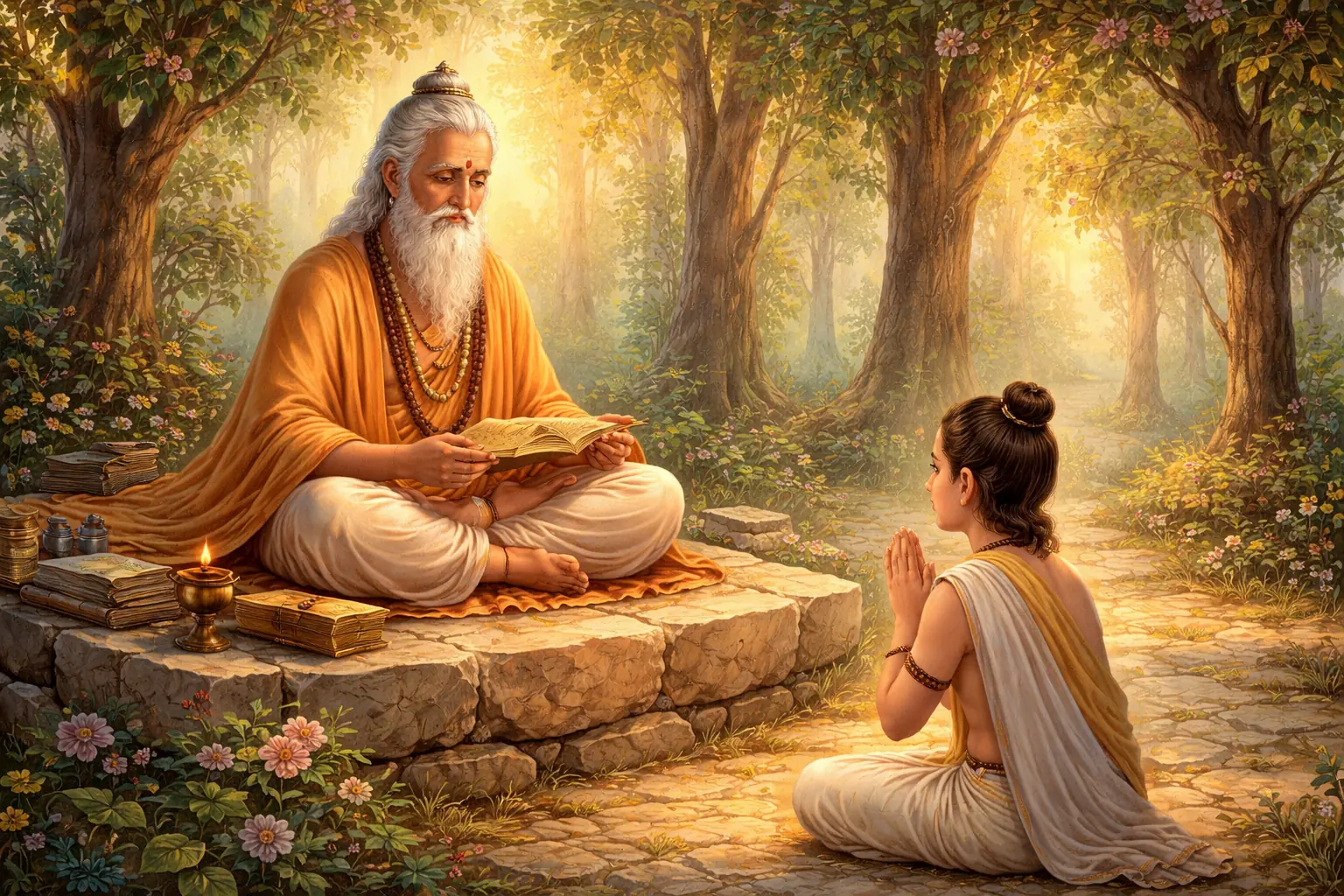
“Again and again I repeat the same thing to you, O Rama, so that you may awaken spiritually—for understanding does not arise without such repetition.”
This is also called shravana.
In the community of Buddha Shakyamuni, there were saints who were called “those who attained through extensive listening.” They did not meditate or perform any special practices; they simply listened to a great many teachings and meditated on them. There is an entire branch of Hinayana Buddhism called “Shravakayana”—the vehicle of listeners. Indeed, if you have an inclination and receptivity to spiritual knowledge conveyed through sound, vibration, and voice, then simply by attuning yourself to the meaning, to this vibration, and meditating on it, you can eliminate dualistic thinking and enter deep contemplation, because speech, as a special form of prana, carries both meaning and energy. It is not merely dualistic conceptual knowledge.
The Nature of Self-Realization and the Example of the Deities
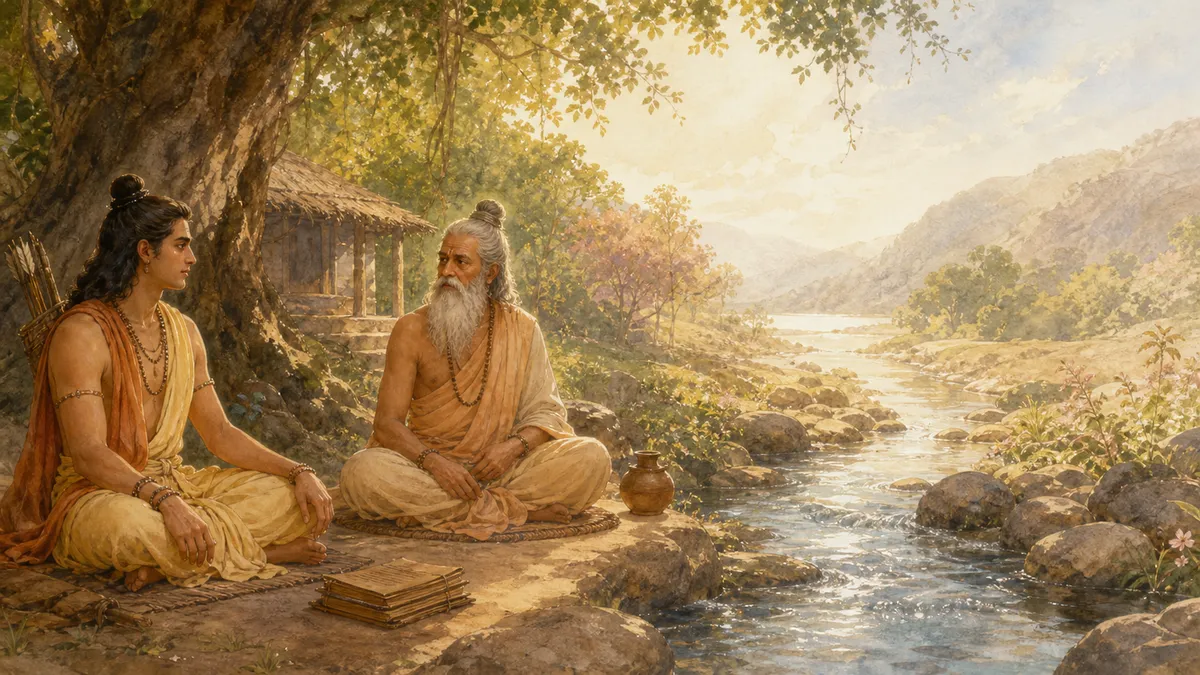
Vasishtha says:
“This lack of understanding has become so dense and impenetrable because it has been repeated, expressed, and experienced through thousands of incarnations, in this body and beyond this body. But self-realization is beyond the reach of the senses. It arises when the senses and the mind become still. O Rama, live in this world firmly established in the knowledge of your true nature, just as King Janaka lived, knowing that which is worth knowing. In his case, the truth was attained forever, regardless of whether he was working or resting, asleep or awake.”
Vasishtha then gives the following example:
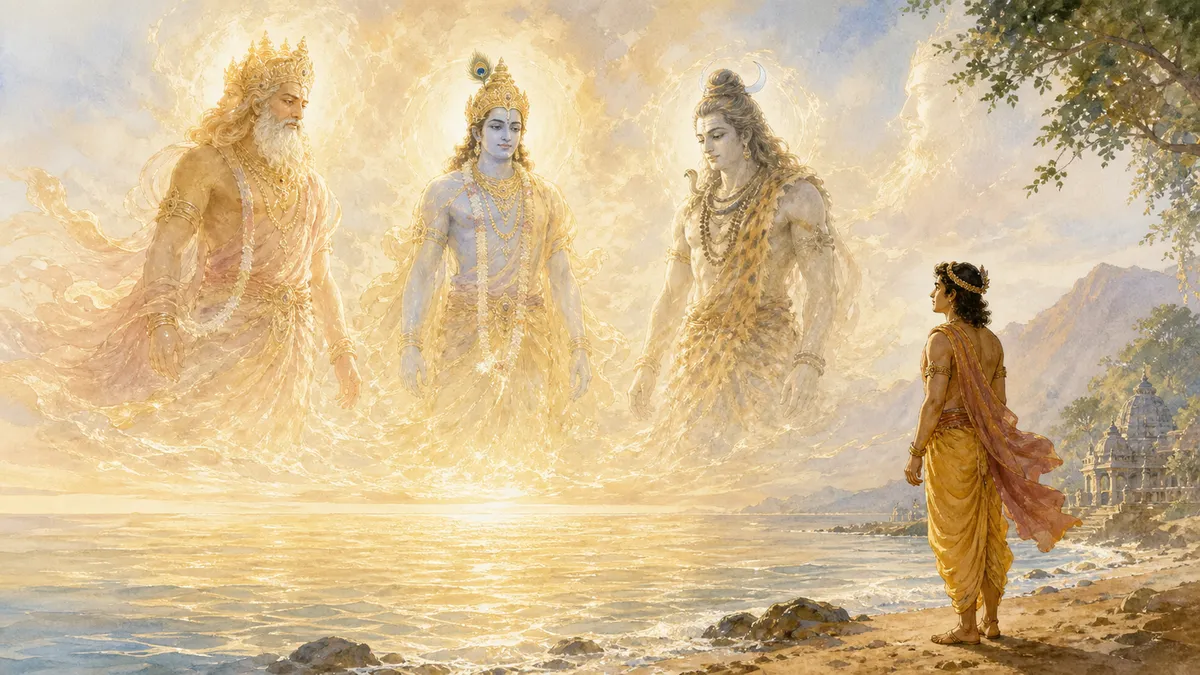
“Vishnu incarnates in this world fully aware of his true nature and never forgets it. Shiva also knows and remembers, as does Brahma. You too, O Rama, must recognize and understand as they do.”
The gods, especially the supreme gods, are always awakened. They are always enlightened by their very nature. And when they arise, it is like a magical illusion on the surface of the ocean of the Absolute’s consciousness. Fulfilling the role of creator of the universe, preserver of balance in the universe, or destroyer, these supreme deity-forces do not distinguish themselves from Brahman. They themselves are the Absolute, its unique creative play. They possess both individual self-awareness in the form of a deity and the complete realization of nonduality. In the same way, both gods and siddhas have individual awareness as a playful ahamkara, a playful sense of “I,” which is also called the purified form of the false “I” (shuddha-sattva-svarupa), but their primary consciousness is nonduality. A clear connection is always established between their primary consciousness and their relative “I.” Their relative “I” is always in complete submission, in complete obedience to the higher “Self,” because enlightenment, the realization of nonduality, is the ultimate obedience of the lower “I” to the higher.
In the case of deluded beings, however, individualized consciousness predominates, while the higher consciousness is as if clouded, as if covered by a dark veil of ignorance, and such obedience is absent. The lower “I” is the individualized free will of a living being. And in beings of the lower worlds, it is a distorted will that has individualized itself and taken the wrong path. Therefore, lower-class beings do not possess obedience of the lower “I” to the higher “Self.” It wanders perversely through the labyrinths of illusion, suffering blows and experiencing pain.
And here Rama asks:
“I beseech you, tell me: what is the nature of the self-realization possessed by these sages?”
Vasishtha replied:
“Rama, you already know this. But you ask about it again so that it may become even clearer.”
Vasishtha then gives instructions to Rama.
The chapter “Discourse on Brahman” (6.1) may be called the central chapter of the “Yoga Vasishtha,” its quintessence. It is the loftiest poetry of Advaita Vedanta as expounded by Rishi Vasishtha. Therefore, anyone who wishes to learn the essence of all spiritual knowledge in a single chapter may simply reread this chapter again and again. It can even be memorized, if one so desires.
Everything Is Brahman
Vasishtha says:
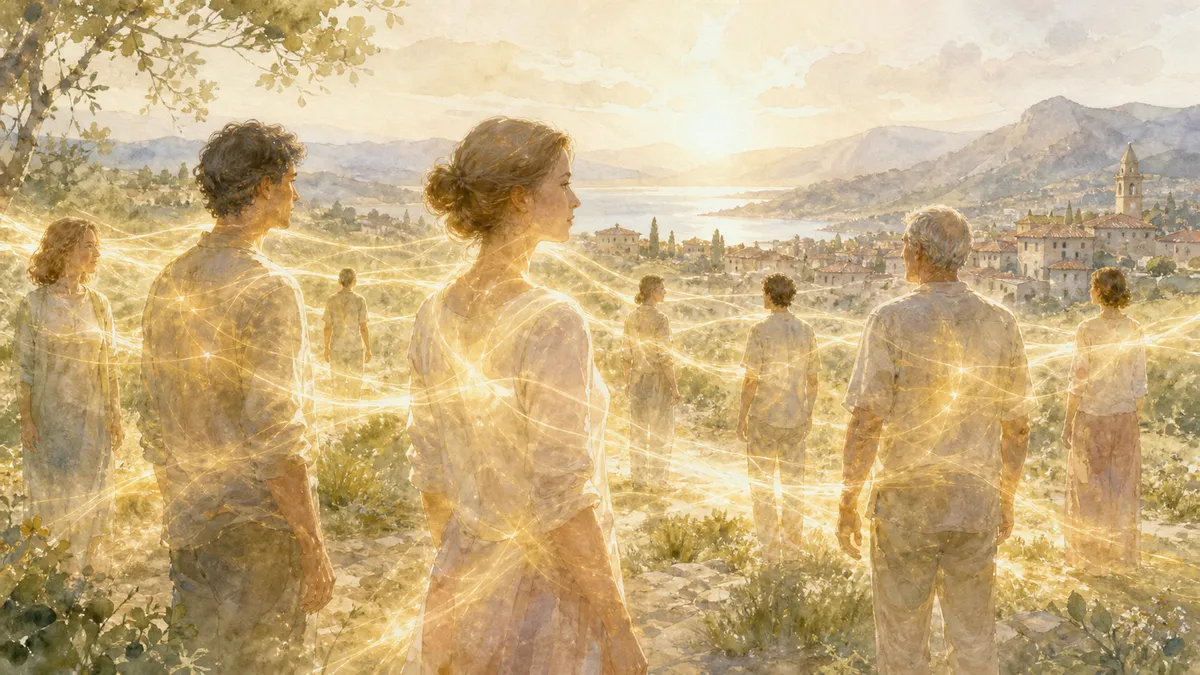
“Everything that exists here and appears to be the world is only pure Brahman, or absolute consciousness, and nothing more. Consciousness is Brahman, the world is Brahman, all the elements within it are also Brahman, I am Brahman, my enemy is Brahman, my friends and relatives are Brahman, and Brahman is the past, present, and future. All of this has its origin in Brahman. Just as the ocean appears fragmented because of the waves, so Brahman appears manifold because of the infinite number of different substances. Brahman reaches Brahman, Brahman experiences and enjoys Brahman, Brahman manifests in Brahman through the power of Brahman itself. Brahman is the form of my enemy, whom I, Brahman, hate—in that case, who does what to whom?”
The ignorance of living beings, which makes them believe in multiplicity, is like a skilled actor who quickly changes costumes and puts on masks. This is what worldly actors do during a performance. The actor performs, delivers a monologue, then goes backstage, removes one mask, quickly puts on another, and comes out again. The transformation happens instantaneously, so it seems as though they are different people. The idea of multiplicity is like such an actor putting on different masks and appearing before you as a friend, a worldly person, a husband, a wife, a mother, a relative, a senior monk, a guru, a deity, an animal, and so forth—all these are masks behind which stands one and the same consciousness. But an inexperienced spectator, unaware of what is happening backstage, thinks: “There are so many different actors. They are all different people. They all put on different shows.”
This is precisely how the idea of multiplicity misleads us. But once the idea of unity is realized, we see only masks concealing something behind them. And this something is so unfathomable, absolute, and transcendent that there is not even any hope of knowing it through reason. It can be known only by that unfathomable part within ourselves which is also transcendent. When we know that external aspect through the part of ourselves that is transcendent, everything begins to merge, and we see that the diversity of living beings consists of masks behind which only the one consciousness is hidden; that we ourselves are this one consciousness; and that our body, speech, mind, and ego are also a mask concealing this one consciousness of Brahman. But because we identify so strongly with this mask, we take ourselves to be the mask.
The Relativity of Judgments and Perceptions
Vasishtha continues:
“States of mind such as attraction and aversion, liking and disliking, are the result of imagination.”
One saint said: “There is nothing bad—there is only what you do not like. Likewise, there is nothing good—there is only what you like.”
People usually divide the world rigidly into good and bad, but this is merely their value-based view of the world, since they judge it entirely from their own perspective. They naively consider bad whatever they dislike and find uncomfortable, and good whatever brings clarity. These are merely relative conditions and circumstances that instill a particular system of values in us. However, as our practice progresses, our ideas change if we deepen our awareness.
All human hopes, aspirations, and dreams can be illustrated by the following example. In childhood, a person had various problems related to relationships with friends, as well as childhood fears, complexes, and so forth. But when they grow up and come of age, they smile when others remind them that they once had such problems. When they recall them, they think: “It was all childish nonsense.” Yet when you were a child, you did not feel that it was nonsense; it was real to you. At that very moment, all of it was truly real for you.
In the same way, all of a person’s experiences and concerns in the relative world seem real to them, just as a child’s problems seemed real to that young person in childhood. But upon awakening and realizing nonduality, they truly seem like a game of no significance.
The Triumph of Brahman in Everything
“When Brahman alone moves in everything, it is only Brahman that manifests as Brahman in everything. Where, then, is joy, and where is sorrow? Brahman is satisfied by Brahman; Brahman abides in Brahman. There is neither ‘me’ nor ‘another’!”
Once, long ago, I had an experience in which I truly felt that Brahman triumphs everywhere and at all times. Something did not work out for me; something went against my will, not the way I wanted. And I thought, “Well, I could become angry or upset. But what would be the point? After all, Brahman triumphs regardless.” That is, some part of Brahman simply outplayed me in this body. But the part that outplayed me is more intelligent than I am, higher, wiser, and deeper. And what part is that? It is not a worldly part, but a holy one. Some great gods intervened and manifested their glory, grandeur, and power. I thought, “Well, Brahman always triumphs. Why be upset? One should simply sing of it and praise it.”
Thus, when things happen that we do not like—failures and so on—there is no point in viewing them as failures. This is the triumph of Brahman. Dharma unfolds in all its fullness and grandeur, in all its glory, regardless of whether you experience problems and obstacles or whether your plans fail to come to fruition. This, too, is the triumph of dharma, only in some other guise that we do not always recognize. For what else but Brahman could be behind it?
Unity in Diversity
Vasishtha continued:
“All the objects of this world are Brahman. ‘I’ am Brahman. In that case, both desires and dislikes, aspirations and aversions are merely concepts. The body is Brahman, death is also Brahman, and when they meet, is there any reason for distress? Likewise, the body is Brahman and pleasure is Brahman, and when they meet and the body experiences pleasure, is there any reason for jubilation? When the waves on the surface of the ocean are agitated, they do not cease to be water! Likewise, when Brahman appears to be restless, its essence remains unchanged, and there is neither ‘me’ nor ‘you.’ When a wave dies in the water, nothing dies! When death-Brahman comes to the body-Brahman, nothing is lost.”
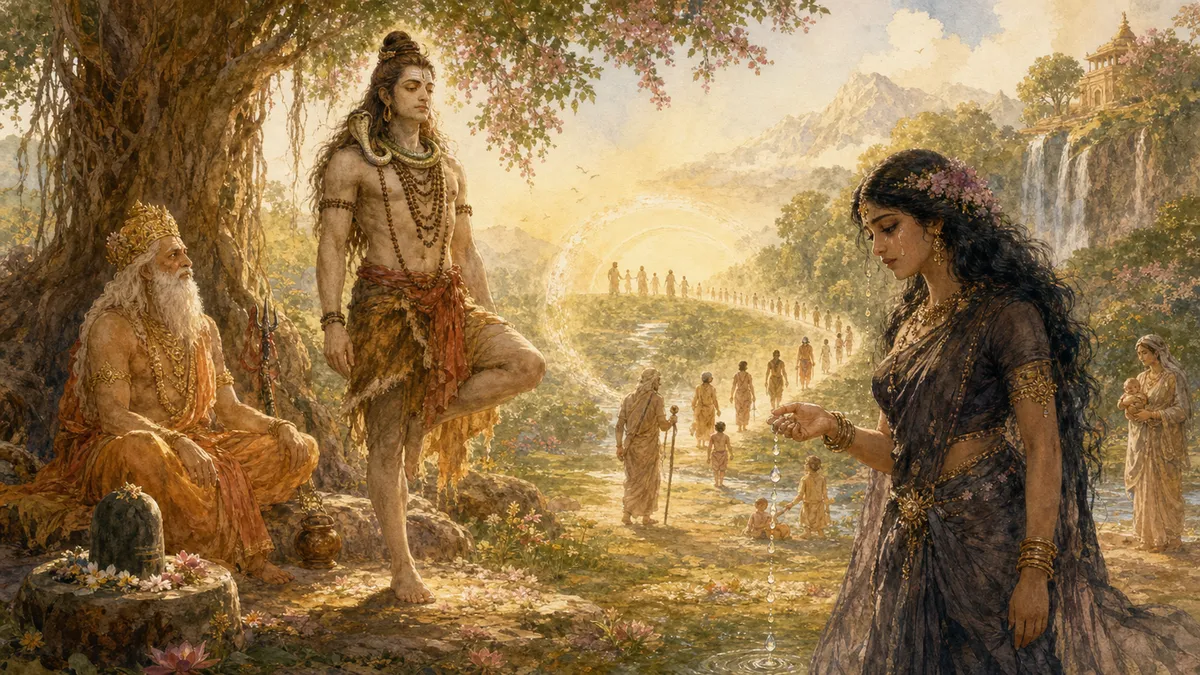
There is a legend in the Mahabharata. Once, the goddess Earth came to Brahma and said, “People are multiplying, and it is already becoming difficult for me to bear them. Could you do something?” Then Brahma began destroying people, reducing the size of their population. People were born, and then they died, departed forever, and dissolved into the Absolute without being reborn. But they had no realization either.
Shiva, who even then was an outstanding yogi, felt sorry for the people. He began performing tapas, standing on one leg for a very long time and meditating. Brahma came to him and asked:
“What do you want? What are your demands?”
Shiva said:
“Let people not die altogether; instead, let them at least be reborn, preserving their subtle individuality. Let them evolve.”
Brahma said:
“Very well, but I cannot allow them to live on Earth forever.”
Then he pondered and created Mrityu, a goddess in the form of a beautiful black-skinned maiden. He instructed her to kill living beings at the time of rebirth and take away their bodies, while allowing them to be reborn. The goddess Mrityu greatly disliked this service. She said:
“How can I take a mother away from her son, children from their father, a wife from her husband? I will not perform this service. This is a curse, not a service!”
But Brahma said:
“There is no curse in this. This is a form of service. Perform it.”
She refused and practiced austerities so that Brahma would release her from this service. She stood on one leg for ten thousand years, imploring Brahma to relieve her of such service. Brahma, too, stood his ground. In the end, Brahma grew angry and, after scolding her, ordered her to perform this service. He set the following conditions:
“You may take those who have fallen away from dharma, who are subject to old age, disease, and death, and who have many defilements. In other words, not everyone indiscriminately. And your tears shall become diseases and obstacles.”
Reluctantly, she agreed; therefore, when death comes to a person, the will of Brahman comes to them. Likewise, when immortality comes to them, another will of Brahman comes to them, since Brahman has an infinite multitude of wills. Depending on our spiritual level, we encounter one will of the Absolute or another, because the will of the Absolute is not linear or unambiguous, but probabilistic. It corresponds to our consciousness.
Wisdom and Ignorance
“When death-Brahman comes to the body-Brahman, nothing is lost. Water may be calm or turbulent—and likewise, Brahman may be calm or restless. Such is its nature. Foolishness and misunderstanding divide the one into ‘this conscious being’ and ‘this unconscious matter’—the wise do not hold such erroneous views. For the fool, the world is full of suffering; for the wise, the same world is full of bliss, just as for the blind the entire world is shrouded in darkness, while for one who can see, the world is full of light. The one Brahman permeates everything; therefore, there is neither death nor anyone who lives.”
Death exists for the one who lives. To realize Brahman means to cease living in this way.
When Ramana Maharshi was asked where he intended to be reborn, he replied, “Where would I go? I am here.” He did not even say, “I will be here” or “I will be with you”; he spoke in the present tense: “I am here.” People did not understand him. But he meant that there is nowhere to go or disappear when you yourself, as such, are a complete illusion.
The one reality is always unchanging, always in the same place.
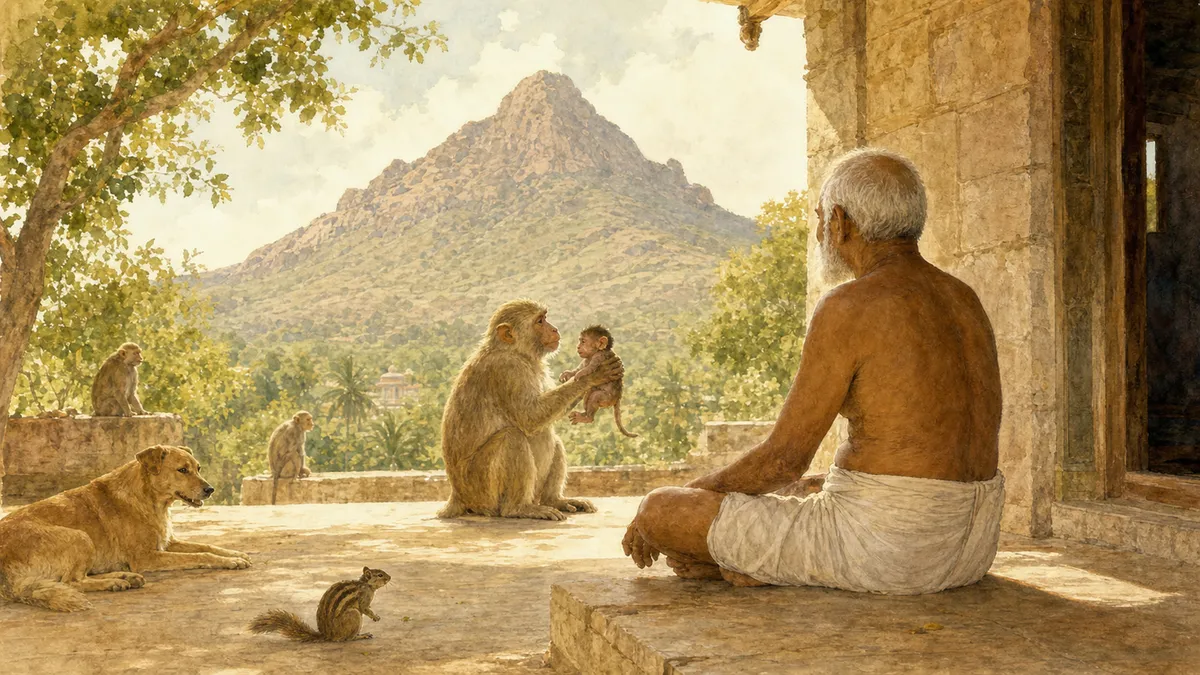
Ramana Maharshi’s equanimity went so far that he often made no distinction between monkeys and humans. In his youth, he sometimes lived among monkeys and learned their language. Sometimes, when the monkey leaders quarreled with one another, he acted as a negotiator and reconciled them. Each monkey tribe has its own habitat, boundaries, and leaders. If someone crosses the boundary, a fight begins. Before the fight, envoys are sent, and then the leaders come out to settle matters. Ramana learned all of this and often pulled the leaders apart. They accepted him as an authority. It even happened that monkeys who had given birth to a baby would come and show him their infant through the window so that he might, as it were, bless them.
On another occasion, when Ramana was already walking with a crutch, a dog began chasing a squirrel before his eyes. To save the squirrel, he took his crutch and threw it at the dog, thereby driving it away. But because he had thrown the crutch, he fell and broke his collarbone. Yet he was not troubled by it. For him, there was no distinction.
The Play of Cosmic Consciousness
“The one Brahman permeates everything; therefore, there is neither death nor anyone who lives. Waves play upon the surface of the ocean, and they are neither born nor do they die! The same is true of the elements of this creation.
‘This is that’ and ‘this is not that’—such erroneous concepts arise in the infinite Brahman. These concepts have neither cause nor motivation, just as a crystal reflects multicolored objects without any motivation whatsoever.
The Supreme Self remains itself even when the energies of the world cause endless disturbances on the surface of the ocean of consciousness. In this world, there is nothing independent of Brahman that can be called a ‘body’ or anything else. That which is seen as the body, and that which is seen as concepts, objects of perception, the perishable and the imperishable, thoughts, feelings, and their meanings—all of this is Brahman within Brahman—infinite consciousness. Duality is visible only to the eyes of those who do not understand. The mind, intellect, sense of ego, primordial cosmic elements, senses, and all the diverse phenomena are nothing but Brahman; pleasure and pain are merely meaningless words and illusions. Just as a sound in the mountains produces numerous echoes, so the one cosmic consciousness experiences multiplicity within itself, with such concepts as ‘this is me’ and ‘this is my mind,’ and so on. The one cosmic consciousness sees multiplicity within itself, just as a dreamer dreams of various objects within themselves.”
When you practice dream yoga, you can enter the near layers of the subconscious. And at first, you really do enter the near layers of the subconscious rather than some elevated realms. These layers are worlds created by you yourself. And you can see what exists within you as your impressions—for example, a market (fair), a monastic community, a meditation hall, or people you know. If a person is inexperienced and does not fully understand how the subconscious works, they may think they have entered some unknown world. But in reality, their own consciousness has created all of it.
They may see a teacher, friend, or monk there and regard them as something separate. They will even behave intelligently, but all of it will be that person's own mind, since the subconscious has an astonishing ability to generate objects. And because consciousness is intelligent, the objects it generates will also be intelligent. All the characters will be intelligent and will give certain answers. And if a person is not very aware within the subconscious, they will be talking to themselves—that is, to the objects of their own consciousness—while regarding them as something real. Sometimes they may even become frightened by certain aspects of their subconscious, but all of it will be the same as they are. It will not be different from them.
Something similar also happens in relative reality. It is simply manifested here more vividly and more directly.
The Mire of Misunderstanding
Vasishtha continued:
“When gold is not recognized, it is trampled into the mud. Likewise, when Brahman is not recognized, the mire of misunderstanding arises.”
What does “the mire of misunderstanding arises” mean? When we are distracted, our assessments, thoughts, and judgments begin to dominate, obscuring our vision of the situation. All of this is the mire of misunderstanding. Suppose lila, the play, is not recognized behind a situation, and a person's absolute nature is not recognized behind that person—this is the mire of misunderstanding.
Question: Tell me, when a person's nature is not recognized, when there is mire, kleshas... Is all of this not a play? It turns out that this is also a play.
This is a play, too, and so is your question.
Question: So there is absolutely nothing outside the play? All thoughts, all feelings, everything bad and everything good—is it all a play?
It is just not your play yet. And so it is of little benefit to you.
Question: Whose is it, then?
Brahman's.
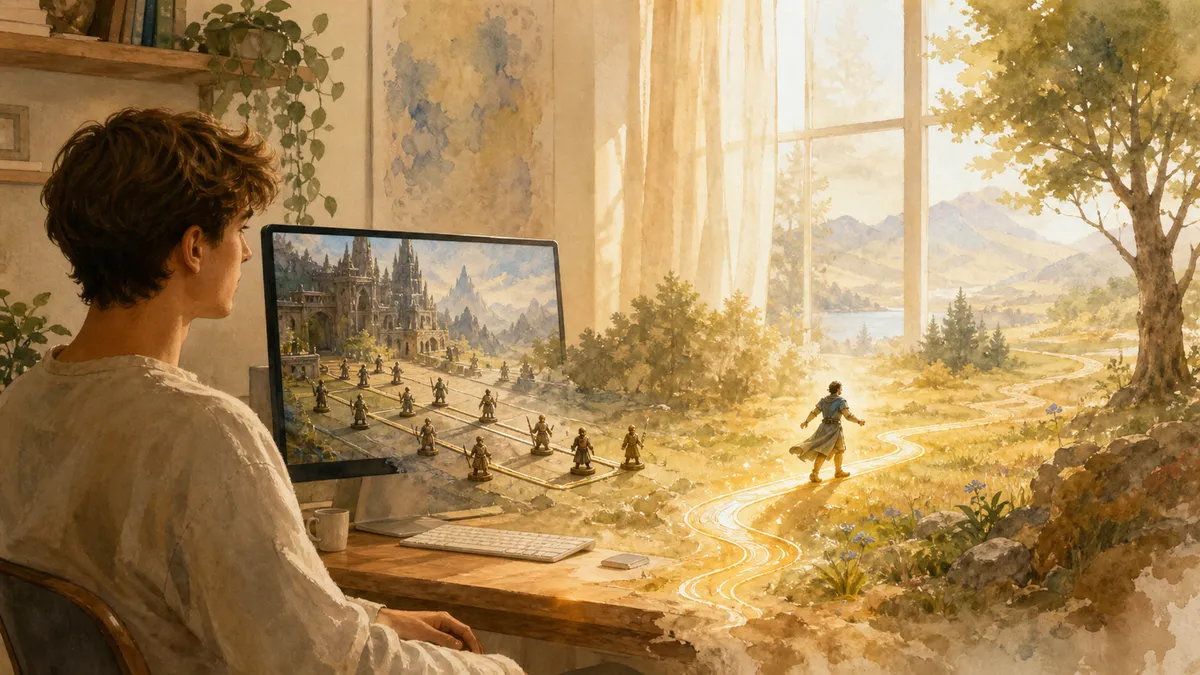
Imagine a person at a computer playing various games and manipulating game pieces. It is a game, but this does not make things any easier for the pieces inside the game, because the game is not being played by their rules. This is karma, krida. And for this game to become lila for you, to cease being karma and krida, you must give rise to self-awareness. But if you recognize everything as a play, self-awareness arises at that very moment.
The Purpose of Rebirth and the Development of Awareness
Question: Shiva performed tapas so that beings would be reborn. But what was wrong with the way things were? One lived for a little while and then dissolved into nirvana. They do not exist anyway; it is all an illusion. It seems there was nothing particularly good about what he did. I understand, of course, that Shiva embodies tamo-guna, and this is probably some kind of lila of his.
The task is to develop awareness. Because if one lives for a while and immediately enters nirvana, it is like the consciousness of a stone. Nothing moves within it. Stones and minerals abide in tamo-guna, in a very inert state of dreamless sleep; they are almost completely unaware of themselves. The higher consciousness is only weakly manifested in them.
From the standpoint of the Absolute gaining experience, this does not suit it. In other words, that is why it created human beings and gave them the opportunity to be reborn, gain experience, and move independently toward enlightenment: because it wishes to expand, delegate its functions and powers, manifest in different bodies, create new mandalas, and thereby gain even more experience. And if it had not allowed people to be reborn, there would have been no experience.
Question: Well, he enjoys this experience, so to speak... But once he finds out that all of it is an illusion, what difference does it make how many times you have been reborn? You still end up like a stone.
That is not the point. Imagine that you have a dog. In principle, you could give it plenty of food every day and provide it with the most comfortable conditions. You could give it three kilograms of sausage every day, and it would eat it with great pleasure. But if you are a good owner, you will give it only as much as it needs and will not allow it to overeat. Moreover, you will not let it live an excessively comfortable life; instead, you will help it develop, train it, and teach it various skills. Why? Because your idea of the dog’s happiness and the dog’s own idea of happiness differ somewhat. You will teach it things and regulate its interactions with other dogs. You will take care of it. Why will you do this? Because, through the dog, you also want to fulfill yourself in some way. You want to impart some of your human wisdom and compassion to your dog as well. You do not want it to experience problems or be stupid; you want to help it develop. Something similar happens between the Absolute and the human being. The Absolute delegates some of its functions to the human being. The Absolute itself wants to develop and realize itself within the human being. It wants to see its own growth, creativity, will, and independence manifested in the human being. And this is possible only if the human being passes through all these chains of evolution and, at a certain stage, gives rise to their own will, self-awareness, the ability to assume responsibility, make decisions and formulate hypotheses, and seek a way out on their own. This is the meaning and beauty of the development of human evolution.
Brahman cannot do this for us. We ourselves must do all of it. Because if Brahman does it for us, it will substitute its own will for ours, which means that we will not develop and Brahman will not realize itself in our body. And if it does not realize itself in our body, this means that its wisdom will not extend to a certain level of chaos, of unconscious matter; in other words, evolution will not proceed any further.
Scenarios in the Absolute’s Game
Question: Tell me, is it predetermined by some kind of scenario whether a person will be able to develop self-awareness or not? In one lecture, you said that there are people who, for the time being, are fundamentally unable to do this, while there are others who can. So there must be some kind of scenario; that is, does Brahman itself choose whom to enlighten and whom not to enlighten?
There is a scenario, but it is not unambiguous. The scenario changes flexibly as the game progresses, depending on how you interact. It is interactive.
In fact, just the other day I finished revising a play called “Advaita.” It explores similar questions. These are very complex questions because it is extremely difficult for the logical mind to understand the Absolute’s motivation. This is possible only during moments of very profound insight and experiences of nondual samadhi. But we can still explain all of this to ourselves somehow at the level of the mind.
“One who knows Brahman declares that they themselves are God and Brahman, while a fool fails to recognize this truth, and this failure to recognize it is called foolishness. One who knows Brahman also knows that the fool’s foolishness is Brahman too. When gold is recognized as gold, it instantly ‘becomes’ gold; when Brahman is recognized as Brahman, it instantly ‘becomes’ Brahman.”
Even when a fool fails to recognize the truth that they are Brahman, this failure to recognize it, though called foolishness, is Brahman too. The fool’s foolishness, the deluded person’s delusion, the obscured person’s obscuration, the sufferer’s suffering, the unenlightened person’s lack of enlightenment—all of this is Brahman too. These are also forms of its play.
We have the opportunity to choose among numerous scenarios in the Absolute’s games, since these games unfold continuously. And our wisdom lies in choosing those scenarios that are conducive to the awakening of our consciousness.
Although human life may appear to be a chain of cause and effect, a sequence of events, in reality it is a constant choice of scenarios. People whose consciousness is clouded have very few scenarios available to them—one, or two at most. But those whose consciousness is awakened have a much greater range of such scenarios to choose from.
What does it mean to gain the ability to choose the scenarios that unfold in this world? It means being aware of yourself at the highest level, without identifying, and from this awareness manifesting sankalpa, intention.
A human being is bound by the bonds of karma, whereas a deity possesses probabilistic consciousness, and for a deity everything is possible because its consciousness is deeper.
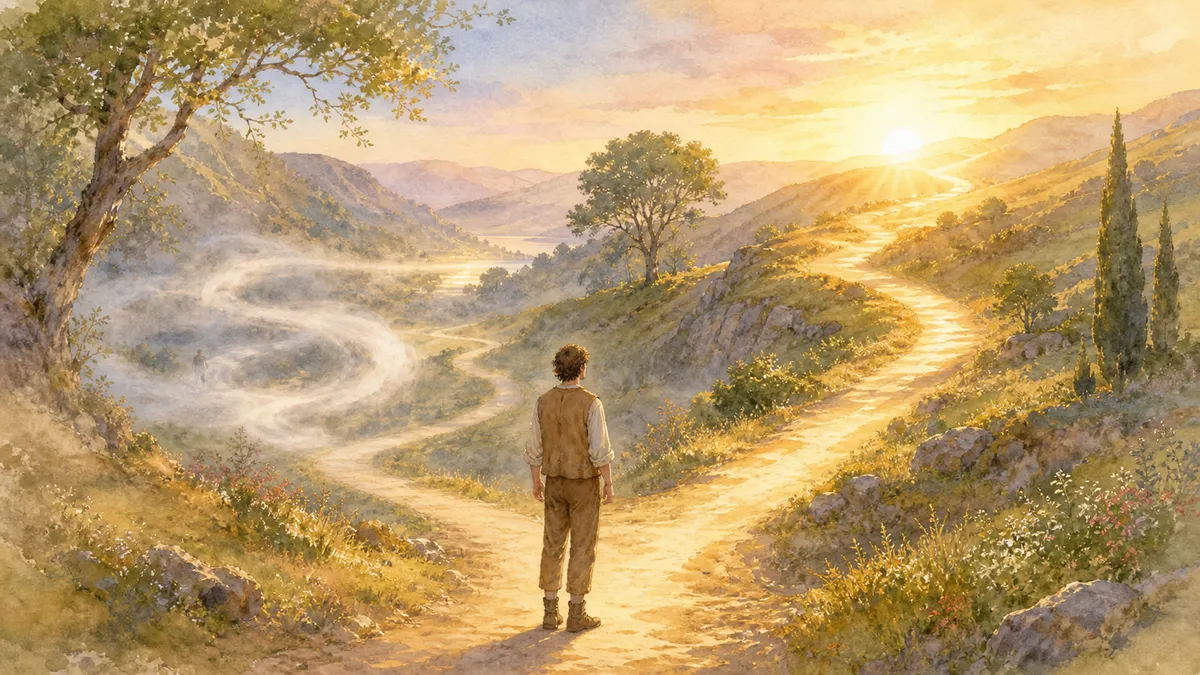
All of you still have a past, and you will also have a future. Some of you will become swami monks, some will attain awakening, some will realize the state of a deity and manifest their mandala, and some may attain a certain accomplishment—all these are different scenarios of our lives. But for these scenarios to be realized, you must have the right consciousness, one capable of allowing them to happen. The scenario of your life is drawn precisely from the state you are in now. One small mistake, and a different version of events begins to unfold; everything goes differently, and the future follows a different course. We constantly find ourselves as if at a crossroads, where there is a choice between one thing and another. This scenario is being written continuously, so one can say that something is predetermined, but it is not rigidly predetermined; it is probabilistically predetermined. It depends on our consciousness. And the stronger our consciousness, the broader the range of possibilities. The narrower our consciousness, the stronger the predetermination.
Predetermination and Awareness
Question: Tell me, does probability lie in the unfolding of events or only in the activity of consciousness?
In the activity of consciousness. The unfolding of events is already a consequence.
Question: Maharshi was once asked the same question. He was asked whether the future was predetermined or not. He said that absolutely everything in events is predetermined, even the fact that you have just stood up and asked this question. He said that the only possible choice a person has is either to be aware or not to be aware. He said that the script of one’s life is completely written at the moment of birth. That is, you have only just been born, yet all events are already known, so there is only one thing you can choose—whether to be aware or not.
That is so. But when you choose to be aware, everything changes. Ramana Maharshi was speaking to those who are unaware. As soon as you choose to be aware and begin working with awareness, the scenario of your life begins to unfold differently. And here everything depends on the level of your awareness.
Here is a worldly example. There is a society, and laws operate within it. All citizens are obliged to obey the laws, and all citizens do so. But above ordinary citizens there are very high-ranking citizens who write these laws themselves. They are elected. And when they dislike a particular law, they gather and say, “All right, let’s change it; something is not right. We are not in the mood to obey it.” Why can they do this? Because their level of worldly awareness surpasses that of the other citizens. Because their level of volitional authority is an order of magnitude higher. Because they themselves create these laws.
It is the same with the gods. You are subject to chains of cause and effect as long as your consciousness remains narrow. As soon as your consciousness expands, you cease to depend on them.
I will release any monk from the Vinaya if he demonstrates Buddha consciousness. But you understand that it is not so simple. For example, you develop your consciousness, become accomplished, and then your karma also changes. Then you do not need to attend classes for novices. You simply enter another realm of laws, another mandala. It also has its own laws, but they are subtler and deeper, intended for a different status. The same is true of our life. This life has power over you as long as you have human thinking. When you develop divine thinking, everything is different. Our task is to develop this divine thinking and move from the lower human laws to the monastic laws, from the monastic laws to the laws of the siddhas, from the laws of the siddhas to the laws of the rishis and gods, and from the laws of the rishis and gods to the law of the creator god himself.
Self-realization
Advaita
Nonduality
Karma
Ramana Maharshi
Lila
Vasishtha
Brahman
Illusion
Yoga Vasistha
Author Гуру
Read 14 times
Articles
Vidya AI
Search
Lectures
November 3, 2026
Mantra of the day
ОМ САДРЩАЙА НАМАХ ОМ Видящему равно – поклонение!
Auspicious Times(Rome)
Brahma Muhurta:
04:54 - 05:49
Abhijit Muhurta:
11:33 - 12:14
Sayam Sandhya:
16:43 - 17:24
Mokshada Ekadashi (6 November)
Ekadashi of liberation. Helps to achieve spiritual enlightenment.