

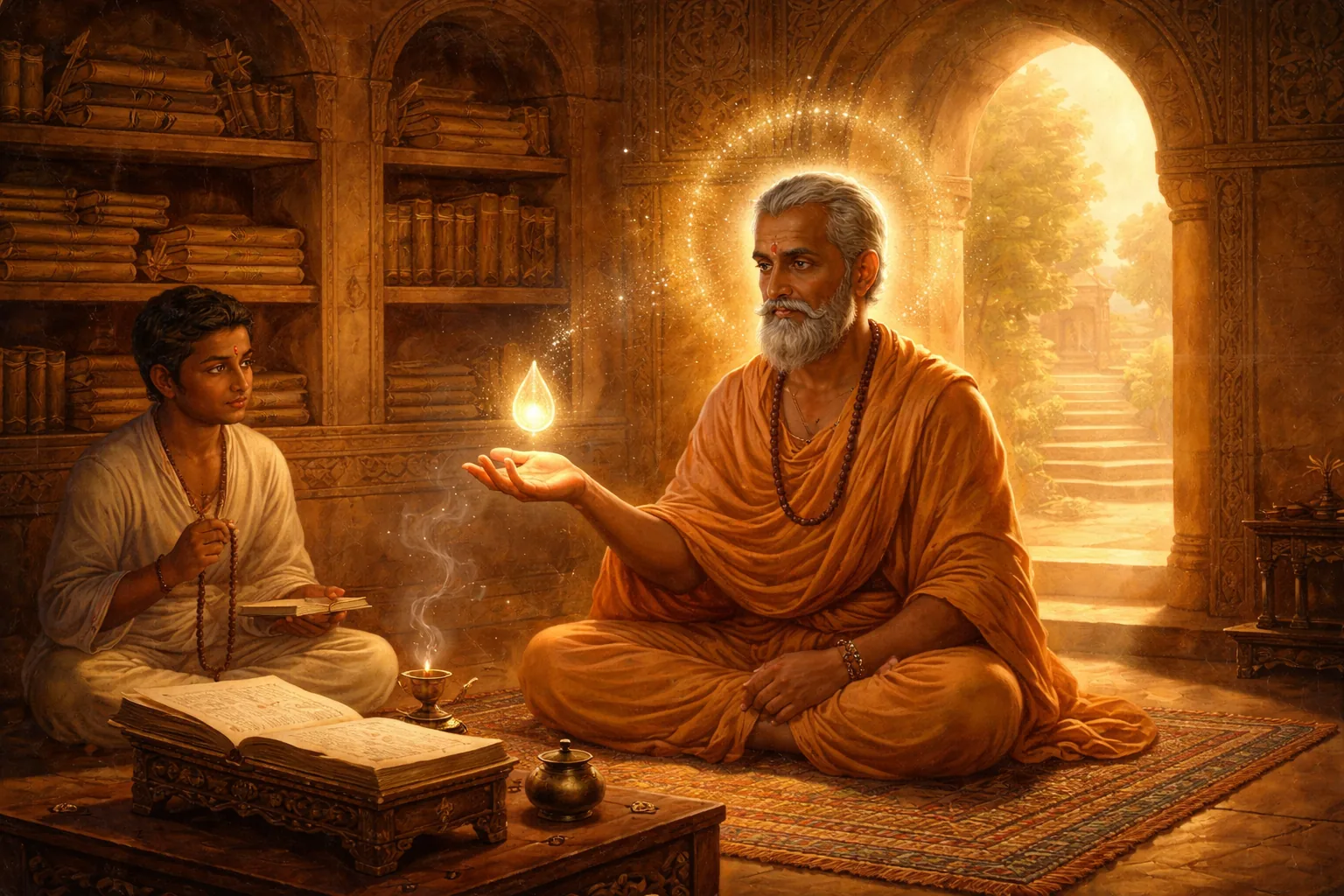
Commentary on the text “Tripura Rahasya,” Chapter 16, “The Mystery Beyond the Trinity.”
The Ground, Path, and Fruit in Spiritual Teaching
Any teaching can be divided into three main sections: ground, path, and fruit. The ground is what we believe in, what we orient ourselves toward. For example, in Advaita the ground is non-duality. In other words, for us the Absolute is a state of non-duality. That is, in Laya Yoga, God is a state, not an image, not a subject, not an object. It is a state of consciousness; it is an experience.
We have already said earlier that the ground is non-dual awareness, like space. The element of space in Laya Yoga is very important for us as an analogy of the absolute “I.” The element of space does not contain coarse categories, so through it it is easiest to arrive at an analogy of our absolute “I.” The elements of water, earth, fire, and wind are all coarser categories. In other words, the element of space contains a minimum of maya; therefore, when we integrate with the element of space in contemplation, we begin to perceive the nature of Mind as such.
We understand that our consciousness is like boundless space. This space has always existed, but we were inattentive to it, and therefore did not notice it. One could say that space, for us, is an image of God. If for someone the image of God has a certain form and attributes, or is contained in certain conceptual scriptures, then for us the Absolute is space. Therefore, the simplest way to attune oneself to the Absolute is to enter into integration with boundless space.
This space is incomprehensible because it lies beyond thoughts. It is originally pure, since no manifestations can touch it. It is perfect in the sense that it cannot be created by effort or attained through practice; practice is required only in order to eliminate ignorance. This space is all-pervading, since everything is based upon it. This is usually how the ground is described.
The path is the next category of spiritual practice. The path is how we realize the ground, how we practice. Finally, the fruit is the final stage.
When speaking of the path, it is said that the path consists of worldview, awareness, and behavior. Worldview is that consciousness of non-duality which we have absorbed and by which we orient ourselves. Awareness is our practice of meditation; it is directly how we meditate. Behavior, or action, is how we bring our knowledge into everyday life. In Sanskrit, this is called jnana (view), dhyana (awareness), and kriya (behavior). We may have a non-dual view but dualistic behavior; inwardly we may be guided by non-duality, while in the relative dimension taking into account the realities of the relative world.
The instructions on fleeting samadhi pertain to awareness.
Awareness is how we try to realize non-duality. Even if we have knowledge of philosophical texts on Advaita, if we have received many instructions and can easily operate with such conceptual notions as Atman, Brahman, self-liberation, but have still not realized non-duality, then all these things remain merely words for us. Awareness gives us living experience, allowing us to experience what Advaita speaks of.
In this chapter of the “Tripura Rahasya,” King Janaka explains to the Brahmin Ashtavakra the teaching on fleeting samadhi.
The Nature of Fleeting Samadhi
“Fleeting samadhi is experienced by everyone. And this happens even in those moments when they are absorbed in their concerns. But it passes unnoticed by them, because they are unfamiliar with it. Every moment free from thought and reflection in the waking state is the state of samadhi.”

In fact, a person can be likened to the tip of an iceberg, and his deep awareness to the ocean in which this iceberg floats. Sometimes, when the ocean is stormy, the waves roll in, and the tip of this iceberg submerges into the ocean, disappearing completely. The iceberg itself and its tip are an insignificant part: this is our personality, our ordinary consciousness, the body, and the visible world. And the most important part, like a boundless ocean, lies just a little deeper.
Despite this, we almost never recognize this deep part. Nevertheless, in life there are moments when our conceptual mind is paralyzed, and for a fraction of a second a very deep state of clarity, similar to space, is laid bare. Every person experiences certain moments of shock, stress, love, wonder, confusion, when his mind is stopped. And at this moment, when his mind is stopped, a very deep state briefly opens up. This state is called “fleeting samadhi.” At this time there are no thoughts, and a yogin, if he has received the proper instructions, can use these experiences to enter an even deeper state.
However, ordinary people do not notice fleeting samadhi, and therefore it does not bring them any benefit. It can bring benefit only to a practitioner who has the appropriate instructions.
Then Ashtavakra became interested and asked King Janaka:
“O King, please tell me in the greatest detail about what you call transient samadhi in the waking state, so that I may develop it and attain prolonged samadhi.”

Examples of fleeting samadhi
When asked about this, Janaka replied:
“Listen, O Brahmin! The following cases are examples of such a state.
When a person does not notice the inward and outward movement for a short period of time and is not oppressed by the ignorance of sleep.
The infinitesimally small moment when he is beside himself with joy.
When he is embraced by his beloved with the purest feelings.
When something he had very strongly desired is obtained, though he had previously, in despair, given it up.
When a solitary traveler, having no doubts about the complete safety of the path he is following, suddenly finds himself facing the greatest danger.
When a person hears of the sudden death of his only son, whose health had been excellent, and when the son was in the prime of life and at the height of his glory.
There are also periods of samadhi that occur in the interval between the states of waking, dreaming sleep, and deep sleep.
During the perception of a distant object, when the mind, on the one hand, encompasses the body and at the same time, on the other hand, projects itself into space until it encompasses that object as well, just as a worm stretches itself while crawling from one leaf to another, striving as it does so to grasp the next support.
Carefully observe the state of the mind during such an interval of time.”

Thus, Janaka lists here the intervals during which the deep space of our “Self” opens up for a time. In fact, there are not so few of these intervals. There are many of them, and even ordinary people partially enter them. But ordinary people cannot use them, since they are inattentive to them, and therefore they are useless for them. An experienced practitioner, on the contrary, tries to cultivate attentiveness to them; he tries to make use of them in order to deepen his natural awareness and come closer to sahaja samadhi.
This type of samadhi is called fleeting because it arises for a short time spontaneously, suddenly, and then ceases just as quickly. In the “Vijnana Bhairava Tantra,” one hundred and twelve ways of entering it are described.
Practical examples of intervals
When you are falling asleep, but there has not yet been a withdrawal inward. That is, you have not lost control over awareness, but you have already ceased to perceive the external world. In this state you are on the boundary between the inner and the outer. If you are sufficiently vigilant at this moment, your mind can open wide.
The first moment after awakening. When you wake up, you sometimes have the feeling that you are looking at the world as if you had just been born. You do not know your name, you do not remember how you got here (this sometimes happens). You try to recall it, and for a while you experience confusion, when the mind still refuses to function because you have not yet fully awakened, but you can already see everything quite clearly. If you are aware at this moment, you can enter a very deep, wide-open state.
The moment when you experience immense joy. If you vigilantly examine the source of this joy, suddenly your conceptual mind will stop, and you will experience a very deep state of presence.
The moment when a desire that is very important to you is fulfilled. At the moment of its fulfillment, a brief confusion arises, because emptiness comes; the mind is paralyzed, it has nowhere else to move. Previously, the mind was moving toward the desire, but after it has been fulfilled, the mind remains for some time in such a state of cessation.
A moment of stress or shock during danger while traveling, upon receiving some news, and so on. That is, anything that strongly affects the mind paralyzes it. For a while, the mind falls into confusion and stops. If this is an ordinary person, he simply experiences certain emotions, since he does not work with this experience. If this is a practitioner, he sees it as an auspicious moment to deepen his contemplation.
For example, in Divya Loka, one monk was walking at night through a ravine in order to go from one hall to another. And in this ravine, such strange sounds can always be heard even during the day; for example, one can hear someone laughing. Many monks think that someone lives there, because unusual things often happen there, sounds are heard, or there arises a feeling of someone else’s presence. And when this monk was passing through there at night, suddenly there was a loud noise in the bushes. He became frightened, his muladhara chakra vibrated strongly, and so fear arose. But since he was a practitioner, at that moment he was in contemplation, in presence. During the fright, his mind entered very deeply into a state of nonduality, similar to space, as if it had become the entire cosmic space of fear. He experienced such a deep state that he completely forgot about his fear. That is, fear turned into bliss, and bliss into nonduality, and in the end he completely lost his individual “I,” while his mind dissolved as if he were present in a billion places in the universe. He completely forgot both about fear and about everything else, because he was very inspired by this state that he was able to experience. Usually, this is precisely how the experience of fleeting samadhi occurs when a practitioner works with it. And since this monk was an experienced practitioner, he was able to work with his fear.
When you contemplate something that is very far away from you, and your mind extends to some large object, then at that time your consciousness expands. If you carefully observe this expansion, the gap between surface consciousness and the subconscious also opens slightly for a while.
In other words, the purpose of all these intervals is somehow to compress surface consciousness so that the subconscious and the superconscious, our true “Self,” come to the fore. And when the conceptual mind is compressed and the subconscious has come to the fore, then one simply needs to abide in presence and awareness, connect with this, and remain in this interval longer.
This is in fact a complex topic, requiring certain skills in contemplation.
Conditions for Abiding in the Intervals
King Janaka says:
“Everything happening around will become still if the mind becomes homogeneous. Abiding in these intervals of time becomes possible when a certain harmony reigns in the mind, which under ordinary conditions is constantly disturbed.”

It is said that if someone can track these fleeting samadhis, then he has no need for any other samadhi. The yogin who can observe these subtle intervals and enter such states of contemplation gradually deepens his awareness to the genuine state of sahaja samadhi.
Why Ordinary People Do Not Attain Liberation
Ashtavakra regarded this with distrust and asks Janaka:
“Why, then, have all people not yet attained liberation, if fleeting samadhis occur so often in their lives? If this fleeting samadhi is such a beacon that brings enlightenment, which can even penetrate dreamless sleep, then why does the higher Essence of people not realize itself and become liberated?”
Janaka answers him: “The cycle of birth and death, which has existed since time immemorial, is conditioned by ignorance, which manifests as pleasure and pain, yet still remains only a dream and something unreal. Only knowledge can put an end to this ignorance.”
Knowledge is wisdom born of self-realization. The understanding “I am That” (the Supreme Source, boundless Consciousness), when we know “I am boundless consciousness,” is true knowledge. Everything else, however it may appear, is a form of ignorance.
Janaka says:
“Despite the fact that even ordinary people experience this for some time, occasional fleeting samadhis in the absence of proper knowledge cannot liberate a living being. Just as a person unaware of the qualities of an emerald cannot recognize it in a treasure chest by appearance alone, just as another person cannot recognize an emerald if he has not seen it before, even if he possesses theoretical knowledge on the matter, so theory must be supplemented by practice for a person to become an expert. Ignorance cannot be eliminated by mere theory or by the occasional fleeting samadhi of an ignorant person.”
Janaka explains that ordinary people who do not possess sufficient attentiveness or awareness cannot benefit from fleeting samadhi because of inattention. An inattentive person who does not abide in contemplation cannot comprehend samadhi, even if it recurs in his life again and again. It is like a person who knows nothing about the treasures buried beneath his floor collecting alms every day. Thus such samadhi can bring great benefit only to experienced practitioners who constantly exercise awareness and attentiveness.

Three Classes of Spiritual Seekers
King Janaka says:
“Spiritual seekers can be divided into three groups: the best (divya), the middle class (vira), and the lowest (pashu). Representatives of the highest class attain realization at the very moment they receive direct transmission. They become established in the truth and contemplate it simultaneously with their instruction. No effort is required on their part for the realization of the truth.”
Janaka then says that once, when he was intoxicated and lying in his pleasure garden, the full moon was shining. Suddenly he heard the sweet, nectar-like songs of invisible beings. These invisible beings gave him the teaching about the unity of the higher Essence, of which he had never heard and known nothing before. That is, they told him about the Supreme Source, the unborn Mind. As soon as the king heard about this, he immediately reflected upon this Supreme Source, meditated on it, and realized nonduality in less than an hour. Then, for an hour and a half, he remained in samadhi—in a state of supreme bliss. Afterward he returned to ordinary experience and began to think about this experience: “How wonderful this is! How full of bliss I was at that time! If only I could return to it again. Even the happiness of the king of the gods cannot compare with it.” And then he felt a strong aversion to all actions, to his royal position, and to all of samsara in general. He thought: “Enough of such passionate craving for samsara. Since there is such a great experience, I would like to remain in it forever. Aversion to these actions had not arisen in me before because I foolishly walked the roads of this world. Enough of these foolish actions.”
As soon as he made this decision and tried to turn his mind inward, another idea dawned on him. He thought: “What confusion I am in! What is it that I want to do, if I always abide in perfect bliss? What else could I acquire? What do I lack? When and from where could I obtain anything? How can I, the infinite consciousness of bliss, know and experience effort?”
Then, analyzing his experience, reflecting and immersing himself even more deeply in samadhi, the king suddenly began to understand that what he had wanted to achieve through effort, and that toward which aversion or attachment had arisen in him, was illusory. He discovered that this state not only permeates all aspects of our life, but is also never lost. When he became established in this understanding, an unshakable sahaja samadhi arose in him, which he never lost again. Thanks to this, he could rule the kingdom, be a magnificent king, and at the same time be a liberated soul, a jivanmukta.

Such is the highest class of practitioners, who attain liberation in a short time, practically instantaneously. However, it is believed that these are souls who performed great practices in past lives.
Janaka says that his experience is an experience similar to that of the best seekers. Janaka says:
“I always abide in my own supreme Essence as the perfect source of bliss and as pure, uninterrupted consciousness.”
That is, he always remains unstained and abides in a state of perfection. But seekers of the lowest class acquire the wisdom of enlightenment as a result of many births. They need to accumulate merit, gradually change themselves, until they are able to approach nonduality, and this takes many lives. Over the course of many lives, the soul must experience pain, suffering, disappointment from ignorance, fear of death, rebirth, and the futility of seeking pleasures, in order somehow to feel out this glimpse.
Three Classes of Spiritual Seekers
As for the middle class, seekers of this category attain enlightenment within one lifetime. This happens gradually, according to the following scheme:
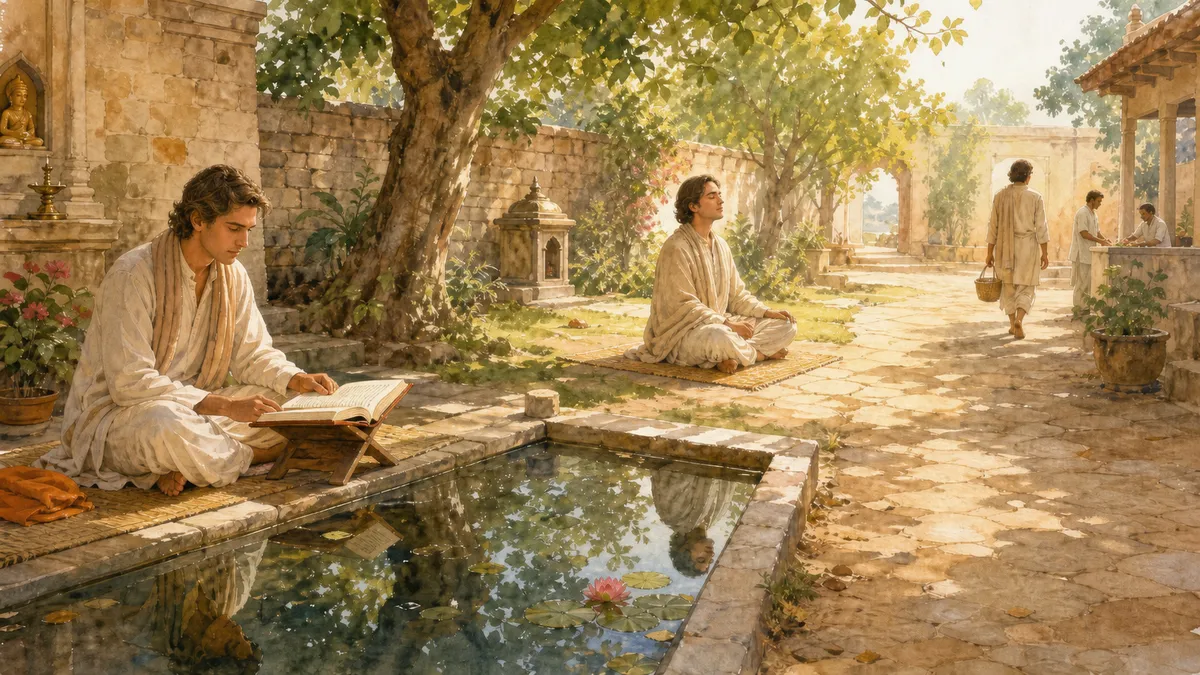
- First they study the truth (shravana). This is what we are engaged in now.
- Next comes the stage of gaining conviction in this truth (manana). For example, when you have received a certain understanding, a glimpse, and have experienced it yourself. That is, you have acquired some experience, become convinced: “Yes, this is so” — and you maintain the principle of awareness through atma-vichara.
- The third stage is meditation in samadhi with qualities and qualityless samadhi (nididhyasana), when you have received some experience and constantly sustain it, wherever you may be.
- The fourth stage is the state of sahaja samadhi, when you remain untouched even during external activity. This last state is extremely rare.
Janaka’s Instructions
Next, Janaka gives Ashtavakra the following instructions:
“As long as a person lives an ordinary life and does not look upon everything happening around him as a projection of the supreme Essence, as long as he does not live without deviating from the supreme Essence under any circumstances, until then it cannot be said of him that he is free from the obstacle of ignorance. The Absolute Mind is the background upon which all phenomena are displayed. It seems unconscious because it is not different from the phenomena displayed by it. When they are removed, it becomes discernible.”
Such is the brief exposition of King Janaka’s method of self-realization.
Next Janaka said:
“Brahmin, reflect more often on what I have told you, and you will surely attain enlightenment. With the wisdom that your enlightenment will bring forth, you will yourself abide as the supreme Essence, inherently present in you, and you will always be free.”
Having conveyed these prescriptions to Ashtavakra, Janaka told him to depart. Ashtavakra returned to his dwelling place and applied the knowledge he had received in practice. Very soon he too became a jivanmukta, that is, liberated while living. Ashtavakra was also a spiritual seeker of the highest category, that is, one who possesses extraordinary abilities. As for ordinary spiritual seekers, they have the opportunity to attain liberation within one lifetime if they sincerely follow the spiritual path.
Such are the instructions of the text “Tripura Rahasya.”
Seven Special Points in Laya Yoga
Usually we say that in laya yoga there are seven special moments with which one can unite in order to experience fleeting samadhi:
A moment of shock — when consciousness is frightened and falls into shock. If the yogin is vigilant at that moment, then, by uniting with this energy, he can abide in contemplation. Instead of falling into panic, his energy can be seized and introduced into the central channel. Thanks to this, consciousness will receive a powerful impulse.

A moment of strong desires — when we are seized by strong desires or emotions that are difficult to control. For example, the first moment before eating, if there is a strong desire for food.

The first impulse of emotions — the first impulse of anger, of lust. That which arises in you and that which you stop and notice.

The period between sleep and wakefulness — the moments upon waking in the morning.

Moments of shame — when the mind is paralyzed by a situation that diverges from ordinary notions of honor and dishonor, of the pure and the impure.

Moments of unusual behavior — when the habitual description of the world, the behavioral pattern of relationships with the world or with others collapses thanks to new, unusual elements. When you feel that the situation you are facing is getting out of control, and your mind is in confusion. This is a good moment for abiding in presence, for nurturing contemplation.

A moment of a paradoxical concept — when the conceptual mind is paralyzed, and conceptual notions and logic collapse. This is a moment that, in the laya yoga tradition, is connected with meditation on sayings.

Meditation on Paradoxical Tasks
When the teacher gives the student certain sayings and says: “Think about this.” What is this frog that swallows an elephant? What is the sound of one hand clapping? Reflecting on such paradoxical tasks, the student tries to answer them. At first he tries to give a mental answer. But such an answer is not correct. Finally, the student understands that the only correct answer he can give is by entering a deep state of clarity and integrating himself with this paradoxical question, allowing clarity to respond to this question.
To everyone sitting here, I give this assignment: in parallel with the preliminary practices, reflect on what the sound of one hand clapping is. When you have a suitable answer, you may convey it to me. But do not try to answer with the mind, since any answers from the state of the mind will not be correct.
Method of Working with Paradoxical Questions
Such questions should be answered in the following way. For some time you sit, relaxed and abiding in thoughtlessness. Then you recall the task and mentally ask yourself: “What is the sound of one hand clapping?” In this, the words are not so important for you as the feeling of this question is. If you attune yourself to the question, it will be something that contradicts your logic.
Once you have caught such a feeling, you need to try to abide in thoughtlessness and go even deeper into it in order to switch off the conceptual mind. Then you should maintain this state from the question, abide in thoughtlessness, and enter into it ever more deeply. When you feel that you have entered thoughtlessness as deeply as possible, you should try to respond to the question from this state of thoughtlessness. And then, perhaps, you will receive the correct answer.
You should not think that it will come to you immediately, in three days. More than one monk has spent years meditating on this question. However, answering this question is equivalent to attaining enlightenment. Some students, while meditating on it, have thoroughly clarified the mirror of their mind.
Until you have come close to understanding this question, you will be gliding along the periphery. When you approach this understanding, then even if you have not yet received the answer, you realize non-conceptual knowledge. And then all your illusions begin to dissipate. In this way, you draw closer to fleeting samadhi. As for one who can answer this question, he can freely enter fleeting samadhi at any second, at his own will. And this means that he has a basic contemplation on which he can rely for the rest of his life.
