

When a disciple touches the feet of the Guru, this is called padanamaskar. What is the meaning? It is believed that immense shakti is contained in the feet. Through the feet, by touching them, one can receive the Guru’s blessing.
Chakras: from the feet to the head, there are considered to be 9 chakras in which divine powers are contained in all of you.
Vira chakras are the chakras from the throat to the coccyx. These are human chakras.
Pashu chakras are the chakras from the muladhara to the soles of the feet. These are animal chakras: impulses, instincts, desires — all these are pashu chakras, up to the thighs.
Divya chakras are the chakras that contain wisdom, superconsciousness. Dvadashanta is 12 finger-widths above the crown of the head.
It is believed that it is precisely in the pashu chakras that immense power is contained in every person. Tremendous power can be extracted from these chakras, because it is the source of creation. It is at the very bottom, in the region of Patala, that the thousand-headed serpent Ananta Shesha is believed to recline, holding the entire Universe upon his hoods. These are images that point to the immense Kundalini-shakti upon which all the primordial elements rest.
The Path to Superconsciousness
Our task is to open the divya chakras within ourselves. When you penetrate there, superconsciousness is always with you, sahaja samadhi is with you. Samadhi becomes accessible, wisdom becomes accessible, you always have a connection with God.
But when you live through the vira chakras, the human chakras, you think within the narrow track of human perception. The pashu chakras are sheer passions and desires, a tremendous dependence on desires, attachment. There are also nagas, pishachas, spirits, but many siddhis can live in Patala, Mahatala, Rasatala and have their mandalas there, manifesting there as deities. These are the siddhis who seek energy and worship God in the aspect of Shakti, the Divine Mother.
Our task is to break through into the realm of the divya chakras, to overcome our attachment to the vira chakras, to human perception. To activate this realm within ourselves, to reveal the spirit of superconsciousness within ourselves. Pure vision, one taste, divine pride, shambhavi mudra, siddhis of the subtle body — all of this is hidden here, the dimension of holy beings. The energy we draw upon for this breakthrough is located in the lower chakras, and we need to awaken it skillfully, sublimate it, use it as fuel for the rocket, for the flight.
The Unity of the Red and White Drops
If you deny your lower part, your red drop, and say: “This is impure, sinful energy, contemptible energy; I will live only by sattvic energies,” then you deny your own power. The question is not to deny “impure” energy, but to purify it and subordinate it to the divine will.
The white drop is sattvic energy, and the red drop is rajasic and tamasic energies, but they must be in unity.
A yogin is one who unites the red and white drops in the central channel.
The point is to be able to come into contact with the energy of your red drop very carefully, in a state of equilibrium, like a tightrope walker. Because this energy can raise you to spiritual heights and cast you down into the mud. As a tightrope walker walks along the rope, people applaud him, but he does not look, does not think about the spectators; he is very concentrated — only then will he reach the goal. Or a person walking through a coal mine in a white suit must walk very carefully, otherwise one careless movement — and he is soiled. The energy of the pashu chakras, and partly of the vira chakras as well, is energy that can very easily soil our white suit. The white suit is sattva, our elevated consciousness, a pure state, the pure illusory body.
Directing Energy into the Central Channel

In what case will the energy not damage our suit? In the case when we are able to capture the energy of our red bindu and introduce it into the central channel, not allowing it to go outward through the chakras. When the energy in the chakras rotates clockwise, it enters the central channel and does not become our karma. Entering the central channel, it becomes the energy of enlightenment.
But when we lose vigilance and awareness, this energy does not obey us. Shakti is such a force: she does not ask you, she does everything in her own way, and if you are not vigilant, she does not even ask you — she begins to dance, as Shakti tramples upon Shiva.
If one does not manage to remain in a state of awareness, to integrate with this energy, to introduce it into the central channel, then the chakras begin to move not clockwise, but counterclockwise, and the energy begins to flow outward. When it begins to flow outward and the lower chakras are activated, dense energies begin to operate in our body; that is, our body becomes denser, our vibrations become tamasic, rigid, and our mind falls under the influence of these energies.
Attracting Various Beings Through Energy
Then this energy connects us with certain regions of the subtle world, rigid regions. There are very many such regions: the regions of people, pishachas, rakshasas, pretas, nagas, asuras. The vibrations of this energy begin to attract beings from these worlds to us; they come to visit us, simply out of curiosity. If you are playing a beautiful melody, someone hears it and wants to see what is going on there. In exactly the same way, the vibration of these energies summons such beings, and they come to visit. But when asuras, rakshasas, and pishachas come to visit, various unpleasant things happen in your destiny.
All this happens because of a violation of samyoga, because people use their energy incorrectly. But if you use your energy correctly, then your energy does not go outward; you can seize it, hook it with presence, and bring it into the central channel. Then the energy in the chakras rotates only clockwise, and only divine bhava is radiated into the subtle space. You attract blessings, and saints, enlightened masters, divine beings want to come to visit you; they respond to your subtle energy.
When you live in such a state, your mind is pure and inspired, your emotions are elevated, there is love and compassion, harmony, purity, joy — you attract sattvic beings. Sattvic beings will always visit and inspire you.
Asuric beings will want to subdue you and rule over you, and if they do not like you, they may even want to destroy you. There can be no friendship with asuric beings.
Beings with the preta factor will always want something from you, ask for something; they will think that you are to blame for their misfortunes — they always think that someone is to blame for their misfortunes. Even among people there are those with this factor. They can never trust themselves, accept responsibility; they always think that there is someone who is to blame for their karma, for their suffering, for their problems. And they look for someone onto whom they can project their dissatisfaction: there, he is to blame! And they unload their problems onto him.
This is the preta factor, hungry spirits. Avoid them, and explain this kind of functioning of consciousness to others. Sometimes even on an international scale there are countries that believe other countries are to blame for the fact that they live poorly, and they look for an enemy: “Aha, the Americans are to blame. No, it is the Jews who are to blame; all our troubles are because of them, exactly,” and this mobilizes and unites the nation.
Who is preventing you from being successful like the Americans, or like the Jews? Sometimes some people say that America destroyed the Soviet Union, or the CIA — that it was a special project. But even if that is so, then why did you not destroy the CIA, or America; who prevented you? Some conspiracy of Jewish bankers — create a conspiracy of Kyiv bankers so that they cannot outplay you, because it is a game, right? Why, then, did you allow yourselves to be outplayed? In reality, no one is to blame; we ourselves are to blame, both on an international scale and on a personal scale, but the consciousness of a preta, a hungry spirit, always looks for problems in others.
A sadhu is one who always very firmly cuts off such consciousness within himself: never to look for problems in others. The source of everything is you yourself, your karma. If you want to criticize someone, criticize yourself. This especially concerns anything connected with the Three Jewels, with sacred energies, with divine forces, with samaya brothers and sisters.
Therefore the sages say: if you want to criticize someone, criticize yourself. Say: “This is me — a sinner; all of this is because I acted this way in past lives, but now I will correct myself.” Because when you criticize yourself, you always have a path of correction, but when you criticize another, the other person will not be the one to correct himself; he will still live the way he wants.
Working with Various Types of Chakras
Different areas in our body connect us with different kinds of reality, projecting different energies. Our task is:
To purify our vira-chakras — the entire area from the tailbone to the throat. These are all vira-chakras, human chakras; they contain attachments to the earthly, to the human, to the ego — this is the basis of egoism.
To detach from the action of the pashu-chakras — from the tailbone to the feet. These are all animal chakras, various instincts.
But siddhis can activate even the pashu-chakras, extract enormous energy from them, and it can benefit them, but ordinary people cannot do this. For siddhas, the entire body is a huge pillar of energy, and all their energies are pure and move through the central channel. But if an ordinary person begins to activate these chakras, then his energies will not go into the central channel, but through the side channels, and then pishacha-avesha begins in him — possession by various impure spirits, impure states.
Activation of the Higher Chakras and Their Treasures
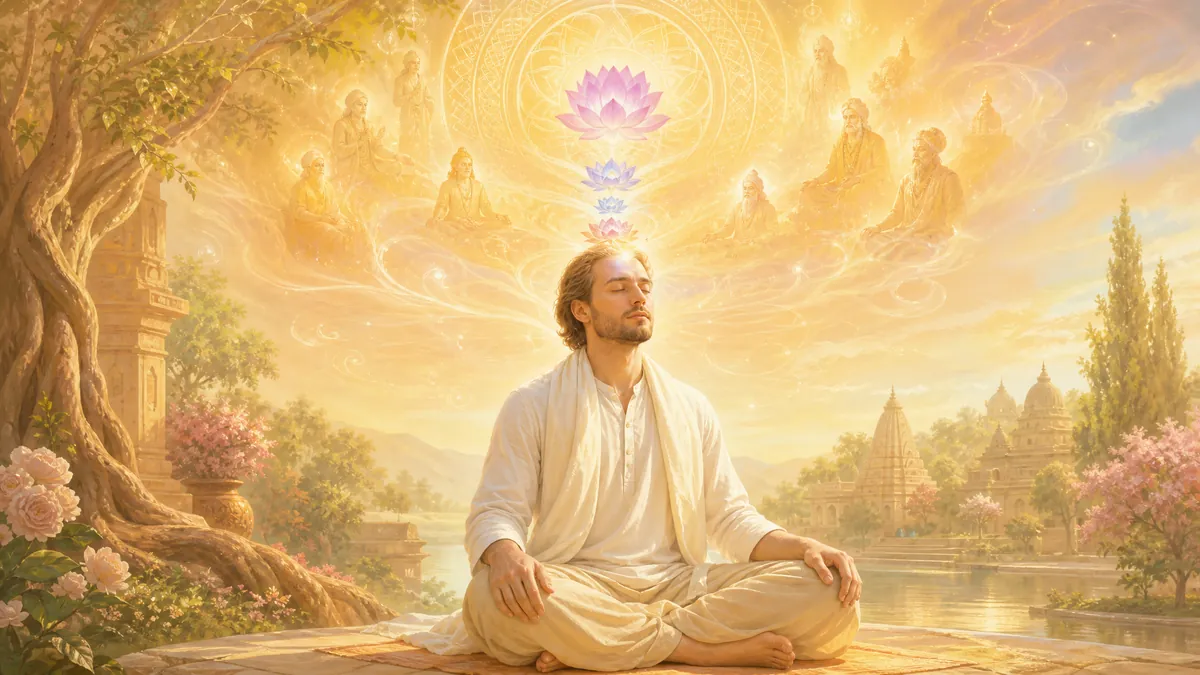
When we have purified the vira-chakras and detached ourselves from the action of the pashu-chakras, our energy naturally moves upward, and the ajna, vishuddha, sahasrara, lalana, bindu, guru-chakra above the head, and nirvana-chakra are activated. All these chakras contain, as if in a condensed form, vast layers of knowledge, wisdom, information, subtle divine bhavas, and experiences, and we can make use of them.
Each of you has a treasure, and this treasure is contained here, but one simply has to reach it. In this treasure there are:
- Open channels of communication with other worlds
- Wireless connection with saints, siddhas, and rishis
- Experience of heavenly dimensions
- Experience of divine bhavas
- Super-intensive consciousness
- High speed of thought
- All-pervading wisdom
- Super-intuition
- Super-knowledge
- Super-will
Many hidden abilities are contained here, but in order to reveal all this, we need the energy to carry our consciousness there, so that the energy does not stop either below or somewhere in the chakras.
Obstacles on the Path of the Energy’s Ascent
Often, when we strive to rise into this area, we discover that our energy gets stuck somewhere; there is an outflow, a leakage, or a loss. It is as if you wanted to raise water to the 21st floor, but somewhere on the 3rd floor there is a breach, on the 4th floor a pipe has burst, on the 5th floor the pipes are narrow and uncleaned, and so on on every floor, and nothing reaches the 21st floor; everything ends at the 18th floor at most. On the 18th floor it drips a little, but on the 19th there is already nothing, and on the 21st floor they are asleep altogether; no one lives there.
Our divya-chakras are like such upper floors where the water does not reach, while below, on the contrary, the water gushes out and floods everything: the first floor is flooded, the second as well; everything is dripping there, the taps will not shut off. This happens, for example, when leakages of sexual energy are allowed, when anger is allowed, or greed through the manipura-chakra.
The chakras are like such taps, and we must regulate and cleanse this whole system through which our energy moves, and block all leakages so that the water rises to the very highest floors; and there, on the upper floors, treasures await us. But if we begin to block the energy on the lower floors, while on the middle floors the pipes are narrow, they will begin to burst. There are many nuances — all this is the art of Kundalini Yoga, prana-vidya, and shat-chakra yoga.
Connection with the Underground Worlds
Padanamaskar, when a disciple touches the Guru’s feet, is precisely a touch to the pure power located in the pashu-chakras. The pashu-chakras connect with Patala, Rasatala, Mahatala, and other lokas, which are also called Bilba-svarga — paradises, underground paradises.
Our body is a microcosm, and the microcosm is connected with the macrocosm, and the macrocosm has underground heavenly dimensions, Bilba-svarga. These are dimensions where nagas live; there are dimensions where Shiva and Shakti dwell, and everyone is nourished by their energy. The great architect Vishvakarman lives there, as does Mayadanava — a great siddha, magician, and sorcerer, the first sorcerer in all humanity; all occult knowledge, knowledge of magic and tantras, comes from him.
All magical scrolls — he possesses all the magical arts of the world, and all magicians and sorcerers obey him. The great siddha in the field of magic is Mayadanava. He is not human; he belongs to the race of danavas — a more ancient race that appeared together with the deities.
Ancient Races and the Cosmic Hierarchy
The first races were the races of asuras and demigods, who were born from the marriage of Kashyapa and his wife. Kashyapa had two wives — Kashyapa is one of the forefathers of humanity, the founder of humanity, a Prajapati. From one wife were born the gods, the sons of Light, and from the other — the asuras, the sons of Darkness. The mother of the gods was called Aditi, and the mother of the asuras was Diti, or Dan. The asuras, the danavas, were born from the mother of darkness — Diti. Two ancient races. People came after them, much later.
These worlds can manifest as very beautiful, even more beautiful than the heavens of Indra. But at the same time, in these worlds there are such hellish regions — these are very dense energies. If you experience vengeful jealousy, anger, fear, then they are connected with these worlds. The chakras in the thighs, the chakras in the knees, in the calves, in the ankles, in the feet — if they are active and this is accompanied by emotions, a person is connected with these worlds; but at the same time, this is a source of enormous power for a siddha.
The Story of Bali Maharaja
Bali Maharaja also lives in one of these worlds. Bali Maharaja was once an asura; he possessed great powers and worshiped Shiva. He became so strong that he began to conquer Indra-loka, the worlds of the gods, all three worlds, so that the gods, first and foremost Indra, became alarmed. Indra went to complain to Vishnu that King Bali did not know his limits at all, that he was laying claim to the worlds of the gods, even to my throne, and that he had to be subdued, for he is an asura: we cannot allow an asura to rule over the Universe.
Then Vishnu came in the form of a brahmana to Bali Maharaja when he was giving out gifts. This brahmana came and said, “You are giving gifts to everyone; you must give something to me as well.” Bali Maharaja asked, “And what should I give you?” He said, “Give me as much land as I can measure with my three steps.”
The guru of the asuras, Shukracharya, who was nearby, said, “Do not give it; this is not a brahmana, in fact, this is not an ordinary person; some divine power stands behind him.” With his divine vision he saw that this was an incarnation of Vishnu. He said, “He will take all your land from you; do not listen to him.” But Maharaja did not listen to Shukracharya; he said, “You need three steps of land? No problem — I have an enormous amount of land, go ahead and step!”
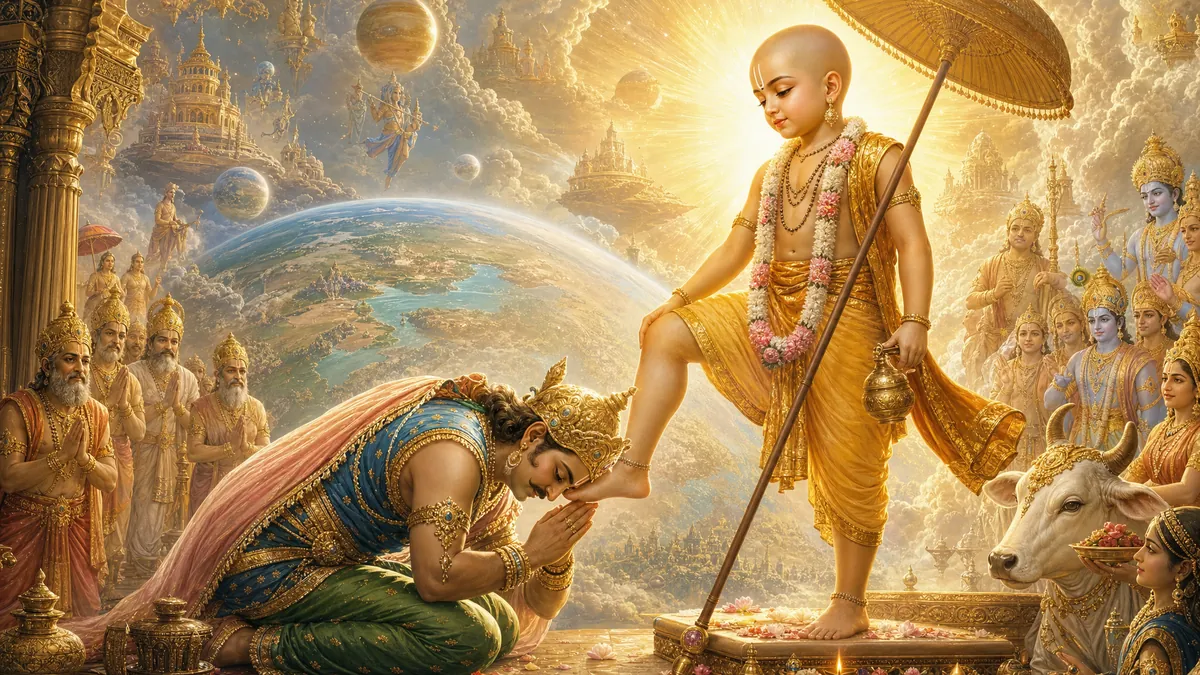
Vamana then took one step and covered the entire Earth; he took a second step and covered the entire Universe, but for the third he said, “There is nowhere to place my foot.” Bali saw that this was Vishnu; he had already suspected that it was Vishnu, and he wanted to make an offering to Vishnu. He then bowed his head and said, “Place it on my head.” Then Vamana placed his big toe on his head and lowered him downward, pressing him through several dimensions, so that from the earthly plane he went to Patala-loka, Mahatala-loka.
As a consolation prize, Vishnu left him a kingdom in the netherworld and said that according to his command: “Although you are an asura, you will reign until the end of the kalpa, and in the next kalpa you will become Indra, the ruler of this entire world, the new Indra.” When Bali Maharaja accepted this, he accepted it with humility, and he began to rule below, in this subterranean kingdom in Patala-loka.
Indra was his rival, and they fought, while Indra defeated him with the help of Vishnu, who had incarnated; then Indra went in his subtle body to Patala-loka. He came and began to mock Bali Maharaja. He said, “Well then, you laid claim to the entire Universe, claimed you would conquer the gods; where is your power now? Now you are no one and you can do nothing.” He mocked him like this for some time, saying, “You were a great ruler; now you see: our power has come.”
But Bali Maharaja said, “Do not worry, Indra; I look upon everything with equanimity, in one taste; for me all this is lila, a play, because in truth none of us does anything; it is time that does all of this. Your time will come — and time will devour you too. I accept all this with humility, with humble destiny.” Even in such a position, Bali Maharaja demonstrated the lofty spirit of a sadhu, a practitioner. This story is described in the “Moksha Dharma.”
The Inner Battle of Divine and Asuric Forces
Within us, in our microcosm, sattvic and asuric energies also battle. Sattvic energies come from this region. These are our purity, nobility, compassion, love, harmony, faith, and devotion to the Refuge. Asuric energies are our egoism, pride, envy, ignorance, and attachments.
Tamasic energies do not fight; they simply lead one into dullness; they cannot fight, they are not active in the way rajas is. Tamasic energies simply bring on a state of stupor, drowsiness, a desire to be in such prostration. Asuric and sattvic energies constantly battle in our mind.
A sadhu is one who knows how to constantly take the side of sattvic energies within himself. In the soul of a sadhu, sattvic energies must prevail, and in the course of a day thirty duels between asuric and sattvic energies may take place there. If a sadhu engages in this and begins to help the sattvic energies, then he begins to play the role of the god Vishnu, because awareness is Vishnu, Vishnu is the sustaining energy, sthiti-shakti. But if a sadhu does not engage, if he even forgets about it, then the sattvic energies (inner deities) and the asuric energies (inner demons) fight, and it is unknown which side will win.
When Vishnu intervened in the battle and cast the demon Bali down, it means that transcendental, nondual consciousness intervened; it took the side of the gods, and it tipped the scales in favor of the gods. In the same way, within ourselves, we must take the side of Vishnu; we must intervene in the inner battle of the asuras and the gods. If we intervene and help the inner sattvic energies, the inner asuras will be defeated and cast down. What does “cast down” mean? Into the depths of the unmanifest. Into the depths of the unconscious; there they will be limited, they will not be given much opportunity to act. But if we are not conscious, if we do not intervene, then our inner deities may lose this duel.
Imagine: twenty or thirty duels a day. And one must see by what score and which forces are winning. Suppose you are communicating with someone, and pride arises in you, whereas, ideally, love should arise. Pride is the inner asuras, and love is the inner deities. This means that at this moment there is a struggle within you, a battle, and the inner asuras are overpowering your inner gods. And what does that mean? If they overpower them, they can take possession of your entire inner universe, and they can even throw Indra off the throne. Indra is your spiritual intelligence, which controls your inner universe. That is, they can become your mind; your mind can change, become asuric.
It is very important which side we take, whether we understand that asuric and divine forces are constantly fighting within us. Do we intervene, as the god Vishnu intervenes, or do we simply observe, thinking: “This has nothing to do with me.” No, the responsibility lies precisely with you. And, conversely, sometimes we begin to support the inner asuras: well, they are good guys, why shouldn’t they beat the gods? But then, if you support the asuras and they beat the gods, you will have to live on the energy of the asuras and act in the same way. Such scenes are very often found in the Vedic tradition:
An elephant went to a watering place, and a huge crocodile seized him. The elephant was a devotee of Vishnu, and in his heart he prayed to the god Vishnu. Then Vishnu descended on Garuda and destroyed the crocodile.
The crocodile is the dark, instinctive forces of the subconscious; these are the pashu chakras, the world of the asuras, all the nagas, the serpents—all of this belongs to these realms. The elephant is a sign of the vira chakras, the middle chakras. And Vishnu on Garuda represents the divya chakras, the higher divine beings, the energy of sattva, the inner deities.
That is, the energy that awakened in the pashu chakras seized the consciousness of the middle vira chakras and began to drag it downward. In other words, some energy of anger, dullness, rajas, greed, fear began to pull, just as a crocodile drags an elephant into the river. But because the elephant had devotion to Vishnu, a connection with the divine, sattvic energies, he prayed to them in his heart; Vishnu heard him, descended on Garuda, and killed this crocodile with his Sudarshana chakra, his discus. That is, Vishnu intervened, and he restored the balance.
In the same way, within ourselves, as awareness, we must constantly intervene in such a balance and restore it, taking the side of the inner deities. Our consciousness, our deep awareness, our contemplative presence, our faith and devotion—this is the principle of the god Vishnu. And we must win all these battles, because only by winning battles do we maintain balance and equilibrium in our inner universe.
If we lose these battles, the balance of our inner universe is disrupted. The ratio, the proportions of rajas, tamas, and sattva change, and then the influence of the inner lower worlds upon us increases. The spiritual path, on the contrary, is to change the ratio of rajas, tamas, and sattva in favor of sattva, of luminosity. And spiritual life means constantly winning such battles when they take place, standing on the side of the gods, on the side of the sattvic, luminous divine forces.
Therefore, when you want to criticize someone, get angry at someone, or display pride, immediately take out a slipper and hit yourself on the head, saying: “Oh, I am a foolish person, I am making things worse for myself!” And immediately stop your mind, switch to the meditation on the four immeasurables, and instead of criticizing, begin to praise someone.
The Soul as an Inner City
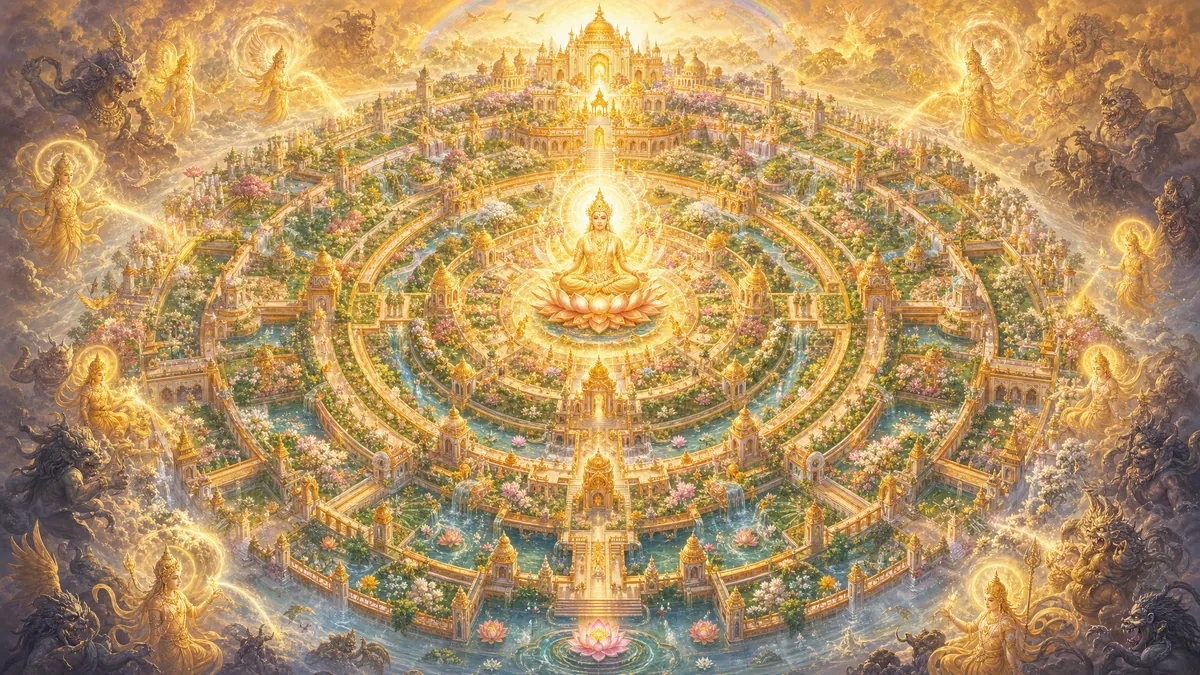
The soul of every sadhu is a battlefield where, in the inner microcosm, the greatest battle between asuric and divine forces unfolds. If one enters the soul, then one can see a great deal within it. The soul (jiva) is like a vast city, or state, and there is a king, ministers, officials there — these are subtle contours of consciousness, inner deities. There are palaces, buildings, mountains, trees; at the same time there are thieves and robbers there, and at the same time there are arrogant officials brazenly plundering your inner treasury. Various monsters may even dwell there: dinosaurs, crocodiles, some untamed forces of the subconscious, untamed demons; but there are also angels, deities, and a bright holy host there.
That is, our soul is a vast microcosm, a vast city. And gradually, in the process of sadhana, we become enthroned in this inner city as the central deity, as an anointed king, and this city gradually becomes our mandala. And we must purify this city, subdue all the inner mafia, all the inner monsters, the demons of the subconscious, all evil forces, all demons and robbers, drive them out, conquer them, bind them with oaths to serve the king. As they say nowadays, to clear the territory of harmful forces. We must place the inner deities in the most important posts, make this city beautiful, blooming, prosperous, a magnificent paradise garden. That is, everything in our soul must be transformed.
When such a transformation takes place, our soul becomes a mandala, a divine dimension, and our “I” is the central deity in the midst of this universe, the king of such a mandala.
The Yoga of the Illusory Body and the Mandala of the Pure Land
The yoga of the illusory body, the yoga of the pure land, tantric methods — these are precisely such methods, when we transform and purify our soul with the help of mantra and visualization. That is, we ourselves transform into a deity, while different parts of our consciousness become retinues surrounding this deity. And they become the mandala of the pure land.
According to the Teaching of Nidra-yantra, on the subtle level, in the subtle body, we must fully transform into a deity in the form of Dattatreya, into a retinue made up of different parts of our consciousness, and into a pure land that fully expresses our various aspects. Similar methods exist in Buddhist tantra as well. There, it is visualized how the bones turn into the columns of a palace. The intestines turn into ornaments, the inner bodies turn into this or that. In the same way we practice too, only our system of practice is somewhat different.
We transform into the central deity, and this central deity is created as a result of visualization, the invocation of divine forces into the body, and the recitation of mantra. The world around us, our consciousness, turns into our surroundings, into the pure land. And different aspects of our consciousness — that is, for example, the five karma-indriyas: the arms, legs, and so on; the five jnana-indriyas: the eyes, ears, nose, mouth — turn into different tattva-mandirs, into places situated in the area of the brahma-chakras. Other aspects of our consciousness turn into various other aspects of the pure land. And our inner deities, as they are transformed, become the guardian deities of this mandala.
That is, on the subtle level we turn into a mandala — into a pure land, while we ourselves sit as the central deity on Mount Meru. This is the meaning of Nidra-yantra. That is, we begin with the practice of the illusory body, which we practiced at the retreat, and then move on to the surroundings. The surroundings are already energies emanated from the illusory body.
The Three Bodies in Laya Yoga
When we realize this, it is said that we have realized pranava-deha — one of the attainments in the Teaching of Laya Yoga, one of the three bodies. Pranava-deha is not only the body in the form of a deity, but also the entire environment, the entire mandala. That is, the mandala of the pure land means that external reality is inseparable from our consciousness; external reality is our consciousness itself.
Jnana-deha is the consciousness of nonduality, of emptiness. Pranava-deha is the illusory body and the mandala, that is, our soul as a mandala. And this mandala is no longer composed of gross elements; it consists of shuddha-tattvas — that is, the purest, sattvic, purified energies. And Siddha-deha is our ability to manifest in the gross world, in any of the gross dimensions. For example, even to go to the worlds of Patala-loka, transform there as a deity, and create an illusory body from the five tattvas. And all these three dimensions are present within us.
The seminar was devoted to the awakening of the three bodies — we have, in fact, planted the seeds of these three bodies just a little. Now your task is to water these seeds. The Jnana-deha is watered through contemplation and meditation: the experience of the nondual space of consciousness-emptiness, “Aham Brahmasmi,” through visualization, mantra, and the invocation of Dattatreya. Through working with inner energy and managing inner energy, the second body is watered and grows; and through service as well — especially service, the art of external interaction, integration, the proper manifestation of different energies in everyday life — the third body, the Siddha-deha, is watered.
That is, if you want to realize the Siddha-deha, from the very beginning set this attitude: my present physical body is already illusory. Whose illusory body? The illusory body of Dattatreya; it has already been created here as an emanation for the benefit of all beings. Treat this body as if it were created by the power of thought, and not artificially. Gradually these three bodies grow within us.
Three Factors of the Influence of Kala-shakti
Kala-shakti acts upon us — the force of time, the pressure of time. This Kala-shakti manifests as karma and as three factors.
The first factor is adhibhautika. Adhibhautika is an external factor: for example, a strong wind, an earthquake, an external element, the actions of authorities, wars — all these are external, uncontrollable factors: intense heat, cold.
There is another factor — adhidaivika. Adhidaivika refers to astral currents, the influence of grahas, planets — everything that comes from the subconscious and is difficult to control. Adhibhautika is the weather, external natural elements; adhidaivika is the subtle world, the influence of spirits, of certain uncontrollable divine forces — all of this is adhidaivika.
And the third type of influence is adhyatmika. Adhyatmika is the influence of the subtle energies of our mind; it is connected with our “I,” with our karma. And the influence of adhyatmika comes from the subtle primary plane of the tattvas, where the five elements arise in their very seed form and shape our destiny. And the pressure of time manifests as these three factors: adhibhautika, adhidaivika, and adhyatmika.
Overcoming the Three Factors of Time through the Enlightened Bodies
When we generate the three enlightened bodies, we cut off these phenomena. Everyone says that time must be conquered, that one must gain power over time so that it does not affect us. But how exactly?
For example, when we open the space of wisdom (jnana-deha, the factor of nonduality), the factor of adhyatmika ceases to affect us, because we become established in akhanda-kala — indivisible time.
When we create the illusory body and manifest in the form of our deity and in the form of the mandala, the factor of adhidaivika — the subtle astral currents — ceases to affect us, because in the subtle world we have created such a pure, impregnable island, an island of pure vision, an island of our own spiritual power. And adhidaivika (time), through its astral currents, can no longer erase or destroy us.
And finally, when we create the siddha-deha — the ability to manage external reality and the elements, to be invulnerable in the material world, to have a strong physical manifestation in this world — we subdue the element of adhibhautika.
Thus, the three enlightened, illusory bodies subdue the three manifestations of the energies that influence us. But unfortunately, people live in such a way that they are aware of adhibhautika, but they are not aware of adhidaivika and adhyatmika — these are very difficult-to-control, subtle influences.
The Seven Paths of the Soul’s Evolution
So, we have spoken about the three types of chakras, about the inner gods and asuras, about the need to help the inner gods and not feed the asuras, not give them resources; about how the inner cosmos is connected with the outer one; about the three bodies, about the principle of the illusory body; about how the three factors are overcome by the three illusory bodies. Reflect more and more on this, reflect on it, and clarity and spiritual experience will come. And the spiritual path is the arising of great clarity, great wisdom; and when you have wisdom, there is no longer any need to convince you — you understand everything yourselves. But when there is no clarity, no wisdom, then there is nothing to oppose material energy, samsara. It is very easy for maya to enchant and seduce a person, to impose its games. And the saints say this: “be vigilant with regard to maya, be very careful with it, do not let it beguile you.”
And the best way not to let maya beguile you is to devote your life to carrying out the divine will, to serving the divine will. Because in life there is always a choice:
choice “a”: you serve the will of your “I,” your ego; choice “b”: you serve the will of certain people who have no divine purpose (for example, some political party); choice “c”: you serve the divine will.
It is very important to understand why it is important to serve the divine will, and what the divine will is, how to serve it, how to understand the divine will, how to make your own will synchronize with the divine will. Serving the divine will frees one from karma; it protects against these three factors: adhibhautika, adhidaivika, and adhyatmika. Serving one’s ego, or serving some other wills, creates new karmas.
And all great beings, all great saints, gods, angelic beings — they are all conduits of the divine will; they even compete to see who will serve the divine will better, who will be its best conduit. And the wiser, the holier the soul, the better a conduit, a channel of the divine will it is. And this hierarchy, the position of beings in the cosmic hierarchy, is determined by who is the best conduit of the divine will. That is, the better a conduit of the divine will he becomes, the more creation itself raises him on the evolutionary ladder. They all understand this principle, but in human, in the lower worlds, this principle is not understood, because when a soul is immature, it is occupied with forming its ego, and carrying out the will of the ego, indulging its whims, is for it still the main way of life.
Anava-marga — the path of the ego
And this stage of the soul’s development, when the soul serves the will of its ego, is called anava-marga.
The planet Saturn takes part in the formation of the human ego; it is Saturn that limits our boundaries and shows our possibilities. And many young souls incarnate on Earth not in order to carry out the divine will, but to at least form their own ego, because it has not yet been formed in them. There is a person who has not gained experience: experience of relationships, experience of money, experience of power, experience of responsibility, experience of relationships with society, experience of accepting oneself, and so on — this is still an immature soul; it still needs to go through these experiences and complete the formation of its ego. And when you tell it that it is better to serve the divine will, it cannot understand this at all; it has not yet learned to serve itself, it has not yet established itself, its programs and karmas of self-assertion have not yet been completed; it needs to assert itself before its parents, before the opposite sex, before itself within, before society; it has not yet gone through the egoistic program of self-assertion — a young soul, it still cannot fully serve the divine will; it still has karmas of self-assertion, of proving something, that here I am, I exist, I am like this...
But even such a soul can gain great benefit if it becomes involved in service; then the programs of self-assertion will unfold in a playful form, where it will learn not to cling to this self-assertion, and it will already develop its ego in the right flow until its full maturation, as seva. But many souls go through the program of ego development through various problems, through suffering; for example, great kings, military commanders, Napoleon, Hitler — this is also the stage of anava-marga, but with a dreadful set of karma and subsequent karma-phalas (the return of results). That is, you have asserted yourself — yes, you have proved that your ego is great, but for this you will have to spend time in hell, where you will be taught that improper self-assertion leads to bad results.
Yoga-marga — the path of union
But when the soul has already passed through the stage of anava-marga, and its ego has developed and asserted itself, it begins to feel the nearness of the divine; it begins to understand the limitations of the ego; it begins to understand the fact that all the wisdom of the ego is not in the ego itself, but comes from the divine plane, that the ego in itself is simply a vessel, a conduit of divine light. And all the foolishness of the ego’s self-assertion is clear before it. Then it begins to wonder how to go beyond the limits of the ego, how to serve the Supreme Source, how to become established not in the ego, but in the Supreme Source.
Then yoga-marga begins — the period of yoga. Anava-marga has been passed through; yoga-marga begins. And the process of service, spiritual practice, the search for methods of contemplation, meditation, samadhi — all this is the great process of yoga-marga. Millions of sadhus follow this path.
Jnana-marga — the path of wisdom
Finally, when it becomes established in the Divine Source and does not separate itself from it, the next stage begins — jnana-marga. For the state of a jnani, one who is in sahaja-samadhi, the questions no longer arise: “Who am I?”, “What should I do?”, “What is the meaning of life?” These questions no longer exist. He abides in the Divine Source; he is already one with the Divine Source. But his evolution continues, because the energy matures and develops further. And jnana-marga then gradually passes into siddha-marga — the attainment of perfection.
Siddha-marga — the path of perfection
If in jnana-marga the wisdom of unity with the Source is realized, then at the level of siddha-marga the power and purity of the elements, of the energy that binds the soul, are realized. At the level of siddha-marga, the Divine Light penetrates the tattvas, the elements, and changes all the laws of samsara. Finally, when siddha-marga gains strength, the path of siddhi, the next transition takes place — divya-marga.
Divya-marga — the path of deities
Divya-marga is the path of deities, of divine beings; it is when your wisdom and power have matured so much that you take on some responsibility in the Universe, take on some great function, some great service: for example, you create a Universe, or accept responsibility for some region of the cosmos, for some function, like the great gods. Divya-marga is the final stage on the evolutionary ladder.
The lower paths: maya-marga and karma-marga
We have not yet spoken about the paths before anava-marga. Before anava-marga there are also lower paths. And, if we go downward, then maya-marga is susceptibility to various karmas and illusions, and karma-marga is the path of being seized by action, the path of dull action. And in the process of evolution the soul changes paths and leaves some paths for others; its destiny and surroundings change.
For example, karma-marga is when you work in order to survive, act completely unconsciously, and all your subtle circuits of consciousness do not function; you work like a social automaton. You do something, and you are driven by lower instincts — all this is karma-marga, and the law of cause and effect acts upon you flawlessly.
And maya-marga is when you begin to listen to your soul and follow inner urges, inner impulses, follow certain desires; perhaps a person of creativity, or a person who wants to satisfy certain desires. For example: there are people who fall in love and do various insane things for the sake of love — this is also maya-marga. They are ready to fly to the other side of the world, to write in the air from an airplane: “I love you,” to draw a heart — maya-marga. Or a person has a passion for collecting beetles or stamps. That is, a person follows certain illusions, and he dedicates his life to these illusions.
Anava-marga is a more integral path. Anava-marga is when a person begins to understand that the most important thing in the world is himself. And he begins to work on himself, to engage with himself, to attend personal growth trainings, but all of this is still selfish; all of this is self-assertion. He wants magical powers, is interested in sorcery, superabilities, but he needs all of this in order to feel strong, great, wise, and beautiful. That is, he invests in himself, in himself, in himself... But it does not occur to him that everything he receives, he receives from the Divine Source — anava-marga. Many people in this world are at the stage of anava-marga.
For example, in America there are very many such people — very creative, free-thinking; they are constantly doing sports. For example, if you walk somewhere in New York, in a park, Americans are always running there; they have a player, sportswear, they are running, or riding a bicycle, or a skateboard — that is, all of America is running. Some people are fat, and some are running. That is, the fat ones are those who do not run. Those who run are on the path of anava-marga, and those who are fat, very fat (there are such people), are obviously on the path of maya-marga, being subject to some of their own illusions. That is, different paths — different destinies.
The transition from egoism to service
But when a person has become disillusioned with anava-marga, has asserted himself, outlined the boundaries of his ego, and understood the limitations of an egoistic position, he begins to understand: ah, there is some source, there is That which nourishes me, from which I originate, there is some great Meta-mind of which I am a part, and I do not need to serve myself; I am a temporary phenomenon, I am simply a bubble on the water, but there is some ocean from which I arise like a bubble, and I need to understand what this ocean is — this is when yoga-marga begins, when we want to find the ocean of consciousness, to understand our relationship with it, to realize our identity with it.
But if a person gets stuck on anava-marga, revels in himself, becomes such a yogic narcissist, then the path of jnana-marga is closed to him. It is as if he is being told: if you revel in yourself, you can go on reveling for another ten lifetimes; it is still too early for you to enter the plane of God. And in order to rise to a higher plane, to the divine plane, to move from anava-marga to yoga-marga, jnana-marga, one must include the principle of service, the carrying out of the divine will, in the meaning of one’s life. That is, we cannot pass by and ignore this principle.
The Naturalness of Service as a Law of the Universe
Why? Because this is the nature, the purpose of every living being; it is a normal phenomenon. That is, for example, a cell is part of a finger, the finger is part of the hand, the hand is part of the body. The cell serves the finger, performs some of its own small functions, and the finger serves the hand. The cell has no personal, special path. If the cell says, “I have my own special path,” it is an insane cell, a sick one. It is a sick cell. Such cells must be healed. If the finger says, “I have my own special path, a future separate from the body,” something is wrong with the finger, because it is designed as part of something greater. Or if the hand wants to say, “I have entered into contradiction with the body altogether, and with the head as well; I will go my own separate way,” something is wrong with this hand, because it is designed as part of a single whole, together with everything else. That is, the cell, the hand, the finger have no separate future, no separate great future outside the entire body.
Thus, just as for us, living beings, there is no great future separate from God. That is, if we think that we can have great happiness separate from God, we are like a sick cell; not everything is right with us, we are in dissonance with the laws of the universe. Because the purpose of the finger is to help the hand, the purpose of the hand is to serve the whole body, because all of this is one; it is one part. In the same way, in the Universe we are all one, we are one part, and we must understand this common unity. We are not separate, we cannot separate ourselves from God, because we came from Him, we are His part, and service is our normal purpose.
When we sever our connections with the Universe, with creation, with the inner deities, with the Absolute, then we feel that we are alone, that God has abandoned us, that inspiration has abandoned us, that people have turned away from us, and we feel ourselves enclosed in a shell — this is not a normal state. But yoga, sadhana, on the contrary, is openness and reunion, reunion with creation, reunion with God, the reunion of all broken connections. And so, when we perform a yajna, we harmonize and restore broken connections, make offerings, sing bhajans, meditate — all of this is the harmonization and restoration of these broken connections until we enter a state of complete unity.
And this spirit of service is what restores these broken connections. Contemplativeness, abiding in meditative consciousness, is what restores broken connections with the Absolute.
The Material World as a Place of Re-education
And why are they broken? Because here, in the material world, everyone’s connections are broken. Apart from avatars, specially incarnated Masters who have come here with a mission, no one has normal connections with the Absolute. It is like a hospital, and it seems that in a hospital there are sick people, but there are also doctors, and the doctors are in the hospital not because they are sick too, but because they have a certain mission, a specific mission — to heal the sick. But in the entire hospital, all the people are there only because something is wrong with them. Or if there is a prison: living beings end up in prison for certain violations, but there are also attendants there — they can come of their own will and leave; they are there at work.
And the material world is such a realm where the proportions of tamas, rajas, and sattva are shifted toward these lower, negative, material energies. Therefore, the living beings who enter the realm of samsara, the realm of impure dimensions, are here as if in exile, for re-education; they behaved badly, or they wanted some kind of extreme experience, or (which happens extremely rarely) they came here with a specific mission — to help other souls be re-educated. This means that they were born neither from parental karma nor from their own karma — they voluntarily accepted this as service, as austerity: “yes, I take this upon myself, I no longer need it, I have already gone through this experience, but I take on this mission as service, to help others.” Such people have no desires in this world; they have only one — the desire to fulfill their mission.
It is like when a doctor from the Doctors Without Borders mission comes to an African country. They treat African children there, feed them, and so on, but they themselves are not planning to live in an African country and would never have gone there if they had not been sent on a mission of service. This material world is the same — such a not very high dimension for immature souls who are undergoing lessons here in re-education, in detachment from egoism. But service, the mission of service, can justify our being here. Then we are not subject to karma; that is, we are here with a completely specific, understandable purpose.
If you are in a hospital, you are either a doctor or a patient; if you are in a prison, you are either a guard, the director, or a prisoner. If you are in the material world, you have either fallen into a trap, or you are here with a specific mission: to help others get out of it. If you are in an underground mine that has collapsed, you are either a suffering worker, or you are from the rescue service. And to be a servant means to accept such a rescue-service status.
For those who are servants, the laws of samsara no longer apply in the same way. Of course, they too may have various problems, but they are under a completely different jurisdiction; karma does not affect them. That is precisely why we say that service is also a way of liberation. It is very important to change one’s mentality from that of a karmic person, an achiever, to that of a servant. When we change our mentality to that of a servant, our personal achievements also come, and they come much faster.
Even when a person comes to a monastery with the mentality of an achiever, he comes with dissatisfaction; he says: “Give me retreats, give me this, give me that...” And he seems to want to be freed from dissatisfaction, but his dissatisfaction only increases. He had hoped so much, expected so much, that he would be given something. But when a person comes as a servant, he says: “How can I be useful, how can I be useful to others?” And he enters retreat even with the motivation that “I am entering retreat in order to open my enlightened consciousness, to deepen my energy so that my qualities may help others practice even better.”
In the same way, in worldly life, in samsara, when we act as servants, we are not vulnerable to the energies of samsara. Servants think of others; achievers think of themselves, but precisely because they think of themselves, they never achieve. Servants achieve because they think of God and of others as His manifestation. They can detach themselves from egoism, expand their consciousness, and they themselves achieve easily, playfully.
There was a king, his name was Khatvanga Maharaja; he always fought on behalf of the gods, and one day the gods appeared to him and said: “You have defeated so many asuras in battle; we would like to bless you. What blessing do you want?” — “I did this not in order to receive any results from you; I did it out of my sense of duty. But if you wish to bless me, then give me such a blessing that I may know the moment when the time comes for me to depart, so that I may be warned in advance.”
And when he was fighting in another battle with the asuras, a certain deity came to him and said: “Khatvanga Maharaja, the time has come.” He then threw aside all his weapons, sat in the lotus posture, and transferred his consciousness to the world of the gods. He had no attachment to this body; he was simply a servant, he did not try to assert himself or achieve victory.
The Consciousness of a Servant

When we are servants, we are not attached to our ego, our goals, our plans, or even to our body. We know that we can serve the divine, carry out divine purposes anywhere: in Russia, in America, in England, in Africa, even on the Moon if necessary, because we are like the illusory body of Bhagavan Dattatreya. Dattatreya emanated some body from himself with a specific mission, sent it forth, withdrew it, and emanated another. And so we acquire such a broad consciousness, one that does not depend on material factors or on the body.
This physical sheath is not us. The energetic sheath is not us either. The astral sheath is not us. When we disidentify from them, we can use these sheaths, subordinating them to the divine “Self.” This is the principle of service.
