

Commentary on the text “Be Who You Are”
Teachings of Sri Ramana Maharshi. Chapter “Jnani”.
Seeker: What is the difference between a baddha and a mukta—an ordinary person and a liberated one?
Maharshi: The baddha lives in the head, not being aware of himself in the Heart, while the jnana-siddha (jnani) lives in the Heart.
When it is said that one is aware through the head and the other through the heart, physical parts of the body are not meant. The Heart in which jnanis live is the space of the Absolute, transcendental reality, while the head by which the dreaming person, the baddha, lives is thoughts, concepts, and the idea of “I” based on them, the ego (ahamkara). The difference between a jnani, an awakened one, and a sleeping person lies in the fact that he lives in transcendental reality.
“When the latter moves about and interacts with people and things, he knows that what he sees is not separate from the one highest Reality, Brahman, whom he realizes in the Heart as his own ‘Self,’ Reality.”
When a jnani, immersed in transcendental reality, moves, speaks, and goes about, he is always awakened to the vision of the One. His mind is always directed toward one essence—the Supreme Source, the absolute Mind.
The Inner Jnani and the Inner Baddha
Within us there is such an inner jnani and an inner baddha. The inner jnani is our mind in its true suchness; the inner baddha is the ego, the mind that is deluded.
At first we must distinguish within ourselves the inner jnani and the inner baddha, that is, the person as jnani and the ordinary person. We must separate within ourselves the boundless part from the human part. We must clearly understand that the boundless part has nothing in common with the human part. The boundless part is so exalted, absolute, and incomprehensible that the human part, in comparison with it, is very insignificant; it can even be reduced to zero. Therefore, if we are speaking about the boundless part of us, we must not superimpose anything from the human part onto it.
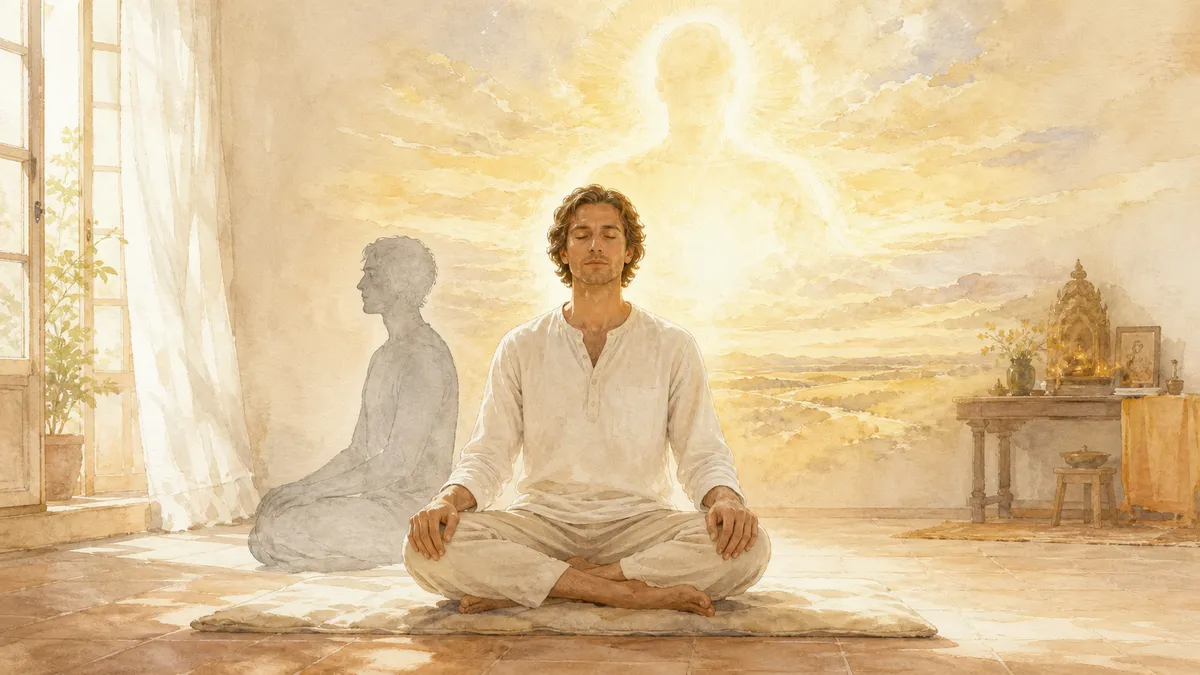
Many mahasiddhas, having discovered their boundless part, refused to speak about it; some even hid from people. I also refuse. As soon as I begin to think, my mind refuses to do anything. Then I switch to the human part, recall the language of people, and continue again. But when you are in the boundless part, it is impossible to describe.
The Development of Discriminating Knowledge
When we separate the human part from the boundless one, discriminating knowledge—viveka-vidya—arises in us. We begin to understand what the false ego is and what the nature of the Mind, the true “Self,” is. The false ego is mortal, illusory, and does not really exist, although it seems real. Our boundless part is eternal, immortal, and incomprehensible, although at first, before we have discovered the principle of awareness, it seems as if it does not exist at all.
The first action that a yogin performs is the separation within himself of these two parts: the human and the boundless. Observance of the commandments, renunciation, various rules and principles, the relationships of monks, seniors and juniors—all this is intended to acquire the necessary discipline and to separate these two parts within oneself. We must move them completely, like two poles, in opposite directions.
When we have moved them in opposite directions and can understand, without confusing them, what in us is human and what is boundless, the next stage comes, when we must recognize the greatness, absoluteness, and universality of our boundless part. Gradually we shift the focus of our consciousness and all our life attitudes from the human part to the boundless one.
The Process of Transformation of Consciousness
How is this done? By learning to ignore the human part and to strengthen and support the boundless part. When you are told something that offends you, if you are a wise practitioner and wish yourself well in the spiritual sense, you must ignore your human part, which can take offense, and support the boundless part. When you live your whole life ignoring your human part, your absolute part gains strength, and the human part gradually begins to yield to it, acknowledging its power.
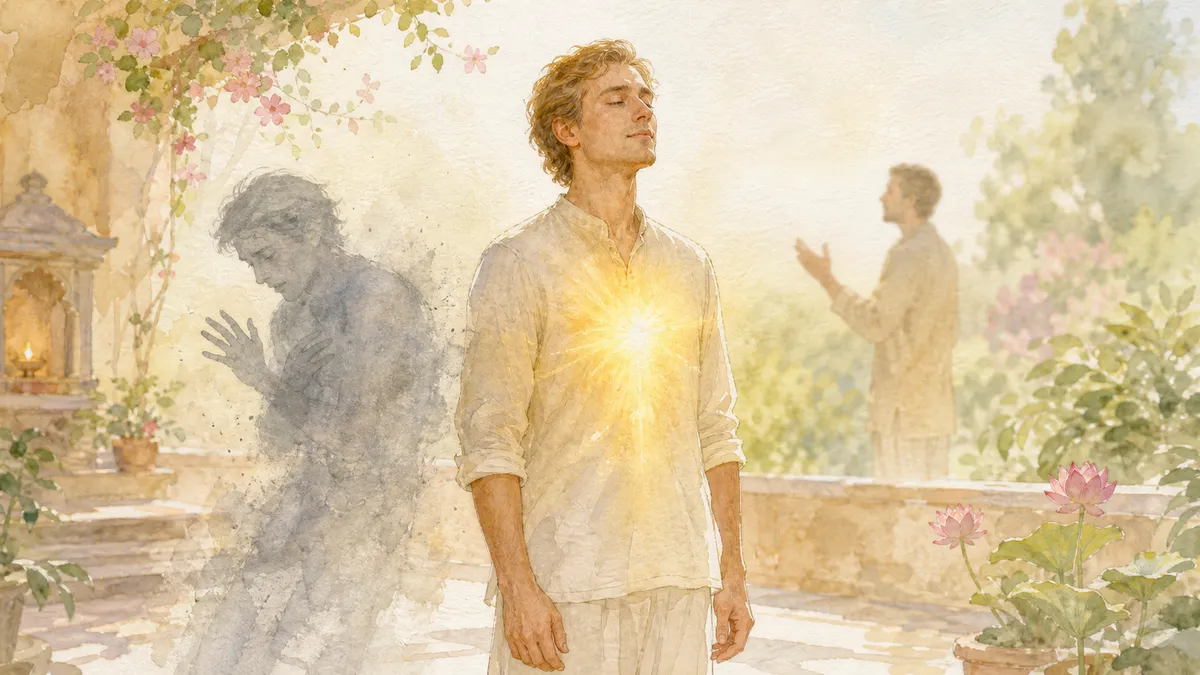
At first the ego, your human part, rebels and does not believe the boundless part. The boundless part seems to it like some kind of dream, theories, lofty words, philosophy, poetry. But this is because the human part is very blind. It is not only blind, but also dull. It is limited; it simply represents an ordinary state, similar to the state of a highly developed dog. In principle, it cannot understand that there is a boundless part.
But when we ignore it all our lives and develop our boundless part, the boundless part gradually gains strength. And then the human part understands: “Yes, the boundless part exists” – and begins to believe in it. When we continue the practice, our absolute part becomes stronger, gains power, and already begins to shine, to blaze, and then the human part begins to yield its positions to it and gradually surrender. It begins to understand: “Before, I had no idea what power the boundless has. I did not understand at all that I am completely subordinate to the boundless, that I am only its insignificant part.” And then the human part begins to capitulate, to surrender completely to the boundless part. It finally recognizes the authority of this boundless one and says: “Everything is Your will. As You say, so it will be.”
The Stage of a Saint and Self-Surrender
When a yogin completely surrenders himself to the will of the boundless part, this is already the stage of a saint. We call it prapatti – self-surrender, self-transcendence. When such surrender occurs, the greatness of the boundless part begins to sparkle in full force. Then, for the yogin, there is no longer life or death, joys or sufferings; everywhere there is only the Absolute: around, within, and without. There are no more illusions and no limitations.

Who is a saint? It is one who is constantly directed toward his boundless part and constantly listens to it. A wandering person, bound by samsara, is one who ignores the boundless part, who turns away from it and directs all his attention to the human part: attaches great importance to it, invents something about it, cherishes and nurtures it.
Final Merging
Ultimately these two parts merge completely, and then even the human part is discovered to be inseparable from the boundless part, as that which has always belonged to the boundless part. To its amazement, the human part discovers that it never existed at all, that it was simply the play of the boundless, its joke, that it simply thought about itself incorrectly, that there has always been only the boundless, manifesting itself in different forms, including as the human. This is like an illumination or a bright flash. When this understanding is fully realized, it is called self-recognition, or pratyabhijna.
For example, from the point of view of non-duality, it is not you who are listening to the lecture, nor I who am giving it; rather, in different bodies, there is the play of this boundless part, which conventionally calls itself the guru and the disciples. Having assumed different positions in this play, it tries to explain to itself in different bodies what the true state of affairs is.
Seeker: And an ordinary person?
Maharishi: As I said, he sees things outside himself, that is, he is separated from the world, from his own deep truth, from the truth that supports him and everything visible to him. The person who has comprehended the highest truth of his own being realizes that it is the one supreme Reality, standing behind him, behind the world. In fact, he realizes the One as Reality, the Self – in all individual “selves,” in all things – eternal and unchanging within everything impermanent and changeable.
The Story of Kumbhakarna
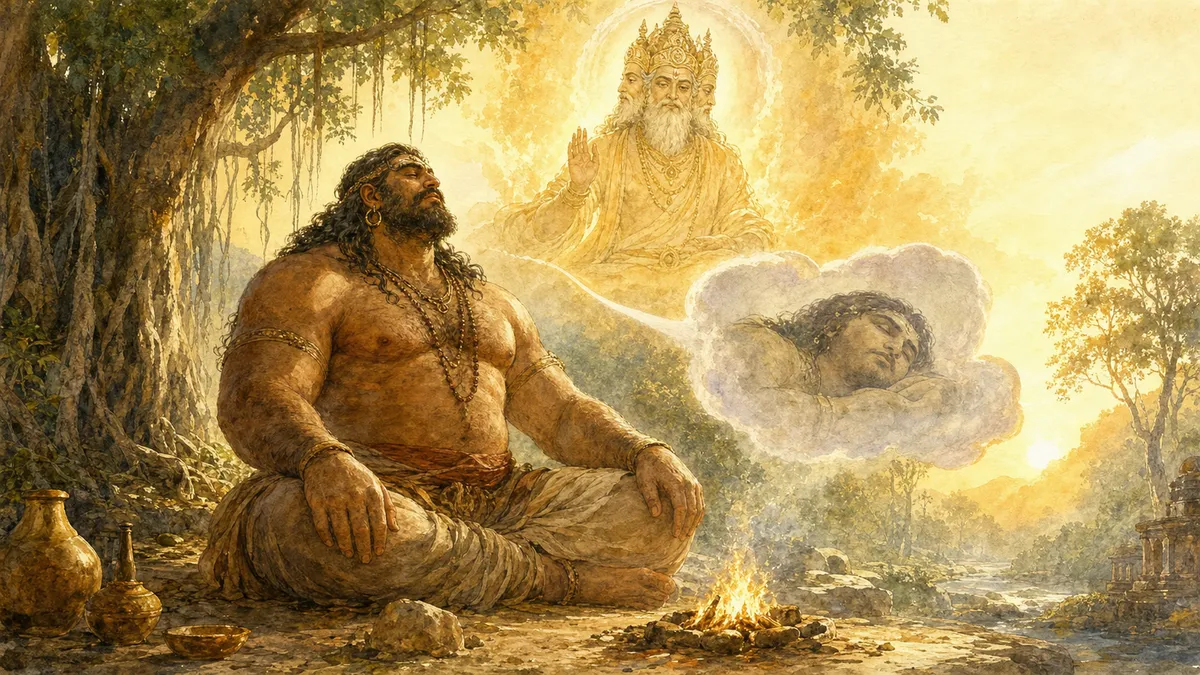
There is such a story in the “Ramayana.” Ravana’s brother Kumbhakarna was an asura with an enormous body, and he decided to perform tapas. While he was performing tapas, the god Brahma appeared to him.
Kumbhakarna said:
– I want to attain eternal life, immortality.
But Brahma saw that he had an evil soul, that his tapas was asuric, arising from the strong will of the false ego and not from true understanding. And he did not want to grant him the blessing of immortality, eternal life, but since his tapas was strong, Brahma could not refuse him a blessing. He said:
– Very well, I will give you a blessing. But you must ask me for it officially.
And the nuance here was that Brahma asked the goddess Saraswati to temporarily enter Kumbhakarna’s speech and alter it in such a way that, when making his request, he would be unable to pronounce the word “immortality.” Therefore, when Kumbhakarna began formally asking Brahma to grant him the blessing of eternal life, instead of “eternal life” he uttered a similar expression in Sanskrit, which sounded like “eternal sleep.” Then Brahma said to him:
“I bless you,” and disappeared.
Since then, Kumbhakarna spent most of his life in dreams, periodically waking only to take prasada. Even when Ravana wanted to summon him to the war against Rama’s monkeys, he had to be awakened for a very long time, with arrows being shot at him. He had an enormous body; he was described as a giant. Only after he felt hunger did he wake up, come to his senses, and begin fighting on Ravana’s side.
Who is Brahma, who appeared in response to Kumbhakarna’s tapas? And why is it said that Brahma could not resist Kumbhakarna’s tapas?
Brahma is a subtle part of Kumbhakarna himself; it is his boundless “I,” manifested in the illusory body of wealth, in a divine body. It is the sacred part of this demon that he was able to attain by practicing tapas. This part was wiser than Kumbhakarna’s main human part. And this part saw that his intentions had not yet been purified, so it granted the blessing with such cunning.
It is said that the gods do not like to grant the blessing of immortality to asuras. When they attain their darshan through tapas, the gods, of course, cannot refuse, but they set such conditions that can later be broken, and then their blessing will lose its power. For example, Hiranyakashipu and Ravana, having received blessings from the gods, violated these conditions and therefore lost their power. Why are these conditions needed? Because their boundless part, when it reveals itself, sees that egoistic tapas without self-surrender will not lead to enlightenment, and even if the blessing of immortality is received, the living soul will remain in ignorance; that is, it will gain no benefit from it.
When does the true blessing of our boundless part come? When our egoistic part understands the greatness of the boundless part and completely surrenders to it. When our egoistic part stops performing its own lilas, because it understands that they will be fruitless, and asks the boundless part: “What are Your lilas?” The egoistic part can ask and come to know what the lilas of the boundless part are only if it is very refined and constantly listens sensitively to the voice of this boundless part.
The Nature of Pure Consciousness
Seeker: What is the connection between pure Consciousness, realized by the jnani, and the “I am”-ness that is recognized as the fundamental fact of life experience?
The translation of the question is not very convenient. Here the person is asking: “What is the relationship between the sense of ‘I,’ aham-vritti, and the Absolute, the nature of Mind?”
Maharshi: The undifferentiated Consciousness of pure Being is the Heart, or hridayam, which you truly are. From the Heart arises the sense “I am” as the primary datum of one’s experience, which in itself is entirely pure (shuddha-sattva) in nature. It is in this form of primordial purity (shuddha-sattva svarupa), untainted by rajas and tamas (activity and inertia), that this “I” appears to live in the jnani.
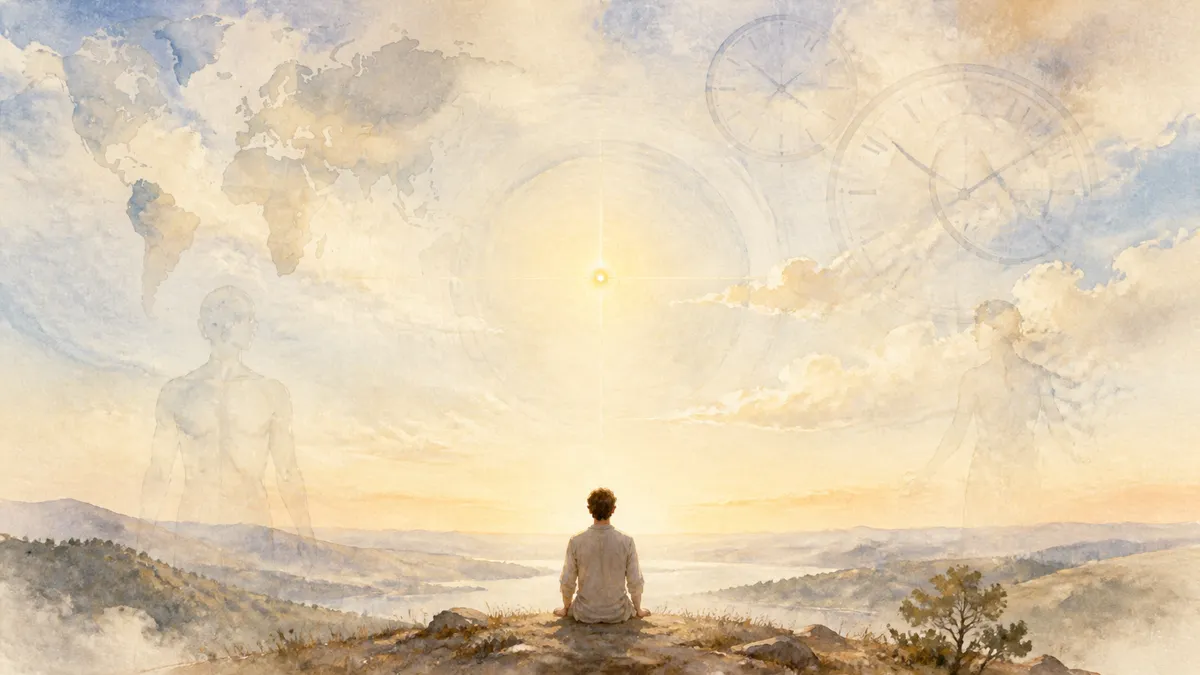
Ramana says that the sense of “I” is located at the very center of infinite space. For us, the sense of “I” is connected with the body, with coordinates, geography, position in time; however, this is an illusion. In reality, the sense of “I” is located at the very center of infinite space; it arises from it. And one who has practiced atma-vichara correctly understands what is meant.
Seeker: In the jnani, the ego exists in a pure (sattvic) form and, therefore, it appears as something real. Am I right?
Maharishi: The existence of the ego in any form, whether in the jnani or in the ajnani, is in itself an appearance. But for the ajnani, deceived by thoughts about the reality of the waking state and the world, the ego also seems real.
For both an ordinary person and a saint, the ego is an illusion. The question is that an ordinary person recognizes the illusion of the ego as reality; he takes it for what it is not, considers it something real. It is like having drawn money that is not actually money, yet you seriously think it represents an enormous fortune. The situation with the ego is the same.
The Action of the Ego in a Jnani
Seeker: How, then, does the aham-vritti (the “I”-thought, the sense of individuality) act in a jnani?
Maharishi: It does not act in him at all. The true nature of the jnani is the Heart itself, because he is one and identical with that homogeneous, pure Consciousness referred to in the Upanishads as prajnana (complete consciousness).
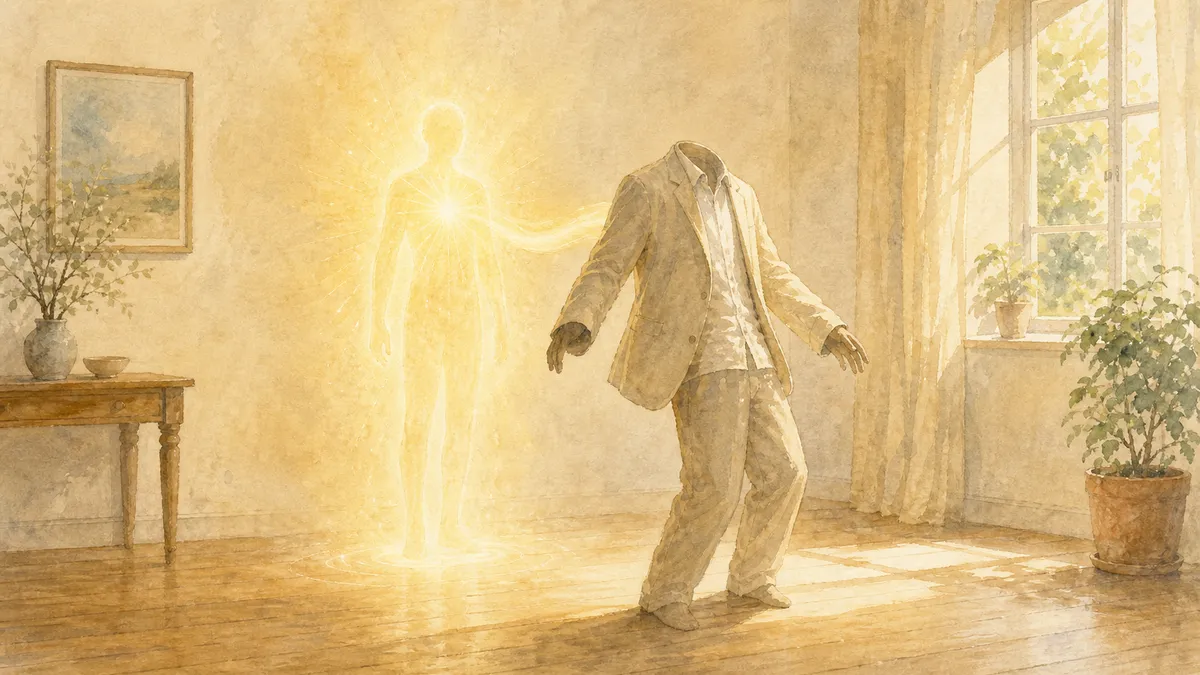
Ramana says that the ego in a jnani does not act on its own at all. It acts constantly only on the basis of commands from prajnana, the primordial reality of consciousness. In itself, it will not take even the slightest step to perform any independent actions, because its emptiness has been fully recognized. A jnani never lives in the ego, although he uses it.
It is like a suit that will not take a single step by itself. It will do so only if its owner, who is in the body, gives the command. The suit will move together with the body, together with the owner. A conditioned being, on the contrary, is a suit that walks without listening to the master. Therefore he always suffers, he is always deluded, any of his actions are doomed to suffering, because he is in contradiction with the objective law of the universe. He does not listen to the deep center of being; he himself tries to become the center, without having the right to do so.
When the ego tries to become the center, it always fails. Suppose you are establishing a relationship with someone and want to become the center, but the other person also wants to become the same kind of center. And when both the first and the second want to become Bhagavan, it turns out that there cannot be two Bhagavans. Disharmony arises. But if the ego subordinates itself anew, then no matter how it acts, harmony always manifests.
Prajnana as Brahman
Prajnana is truly Brahman, the Absolute, and there is no Brahman other than prajnana.
The first years of practice are needed by the yogi in order to completely separate his infinite part from the human one and never confuse them. Then the yogi becomes established in the vision of his infinite part, in abiding in and contemplating this infinite part. Day after day, morning and evening, wherever he may be, he contemplates only the infinite part. And when the yogi can hold his consciousness on the infinite part, it is said that he has mastered the realization of the sutra.
In order to hold consciousness on the infinite part, one must protect one’s mind from the five thieves; one must nurture one’s attentiveness as carefully as a mother nurtures her child. One must guard and protect this infinite part as the apple of one’s eye and as the heart in one’s chest, because a person has nothing more precious than it. If you have a certain “taste” of it and nurture it, it will grow into something greater, into the Absolute. The process of such nurturing is true spiritual alchemy.

I read about how a father and son who practiced alchemy got up at four in the morning for twenty years to collect dew from the grass, which they needed for their alchemical experiments. They did not miss a single day.
And a true yogi must become like such an alchemist, who does not miss a single day. Every day, from morning to evening, he ceaselessly gathers the dew of his contemplation until it fully separates, crystallizes, and is nurtured. Even a small omission means that he has moved backward, surrendered his positions. But when his infinite part, his true awareness, has crystallized and been nurtured, he celebrates victory, or almost victory. He is ready to become immortal.
