

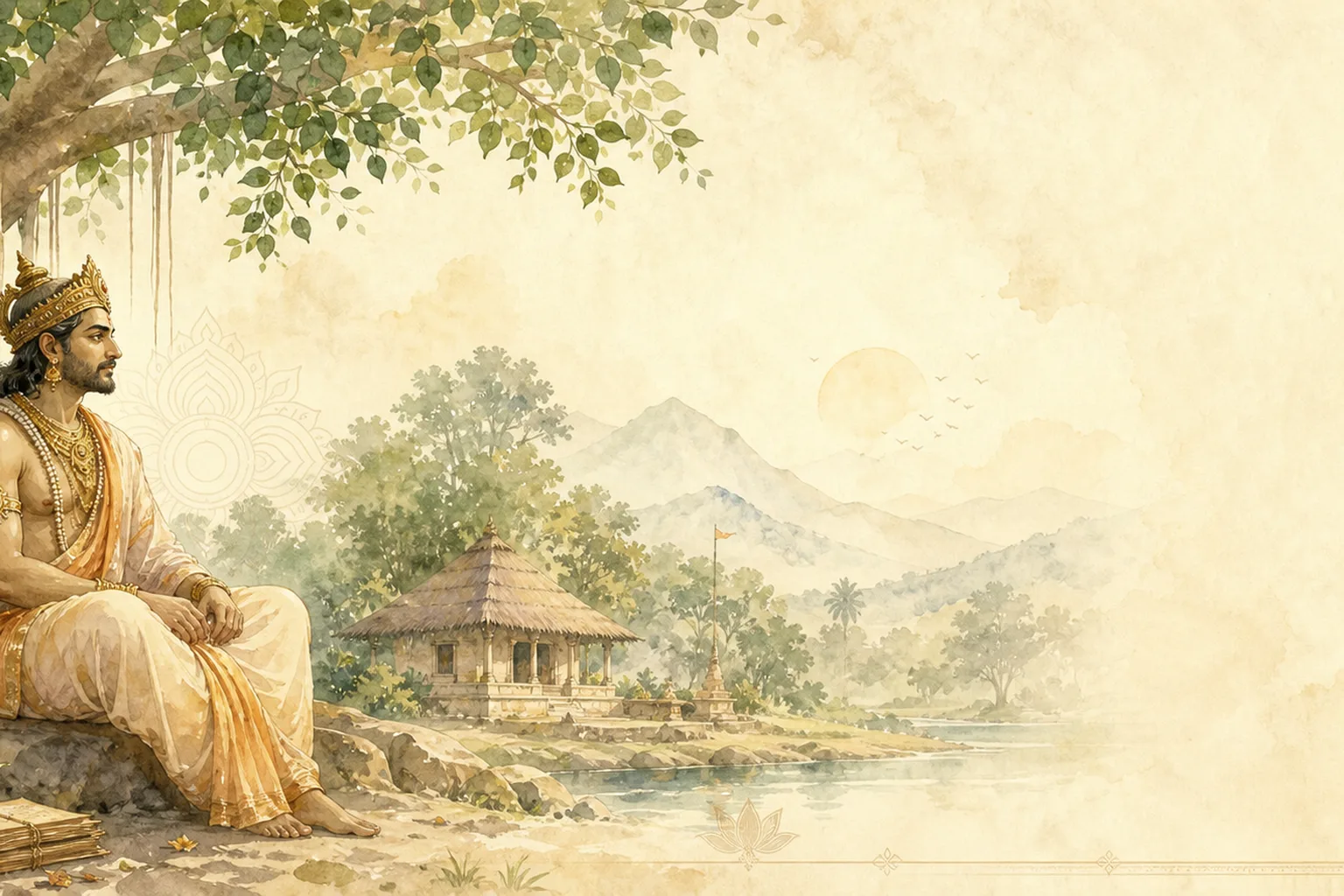
“The King of Kashi wanted to send a message offering Alarka a chance to surrender, but Alarka could not be found. Being a just man, the King of Kashi did not wish to attack the fort and destroy it in the king’s absence. He was now astonished to see Alarka suddenly standing before him.
Bowing to his elder brother Subahu, he smiled at the King of Kashi and said, “King of Kashi, take my kingdom and rule it, or hand it over to my brother. You may do as you please.” The King of Kashi could not believe it and said, “Do you not know the rules of conduct befitting the Kshatriya class? I agree that your defeat was certain, but how can you, out of fear for your life...” Without letting him finish, Alarka laughed: “O King, until yesterday I would have agreed with you. Today my mind has been completely transformed by the grace of Sadguru Dattatreya. While you were attacking the fort here, I sought solace from Lord Dattatreya, who kindled the light of knowledge in my heart. In that light, the entire universe of animate and inanimate objects appears as sat-chit-ananda and the Supreme Brahman, the One without a second. So who is my friend now, and who is my enemy?
Henceforth, I have renounced all duties and, bringing my senses under control, shall undertake the journey into the empire of the Supreme Brahman. This will be the greatest victory of my life. My brother and you have created a favorable opportunity for this. Therefore, you are my benefactors, not my enemies. O valiant king, if you still wish to fight, go and find another enemy; you may take my kingdom.”
As the King of Kashi listened to Alarka’s words, he wondered whether Alarka was of sound mind. Meanwhile, Subahu, who was sitting to one side, rose, approached his younger brother and, embracing him, said, “My brother, you have chosen the path of dharma. I am very happy for you.” Then he turned to the King of Kashi, bowed to him and said, “My friend, you have accomplished my task for me. With your help, the purpose for which I sought refuge with you has been fulfilled. Now I shall leave you.” The King of Kashi now felt that Subahu, too, had lost his mind. “What is the reason for such illogical behavior on the part of these two brothers? The younger brother voluntarily admits defeat, while the elder is about to leave, abandoning everything to him after congratulating his younger brother.” The King of Kashi was bewildered.
Taking Subahu by the hand, he said, “My friend, what does all this mean? You said that your younger brother was unwilling to give you the kingdom and that you had to take it from him by force. Having achieved this, you now say that your task is complete and decide to leave?”
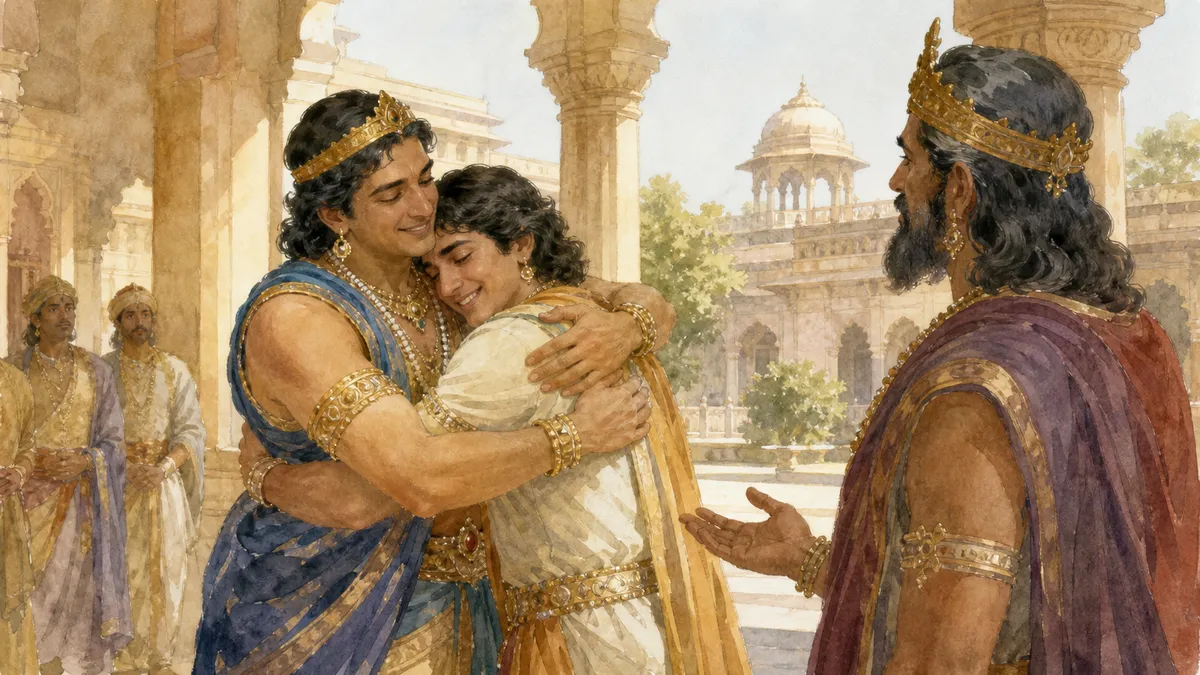
“Sir, am I not a wandering ascetic? I shall tell you why I came and how my task was completed. You know that our mother Madalasa is Yogamata herself. When we, her four sons, were born, she nursed the first three of us with her breast milk, mingled with the nectar of wisdom. Therefore, when we reached youth, the three of us renounced worldly affairs and the path of kingship and attained divine bliss. When the youngest was born, my mother, bound by her husband’s instructions, taught and instructed Alarka in worldly affairs and the governance of the state. Therefore, it was impossible for him to choose the spiritual quest, and he assumed responsibility for worldly affairs.
During my voluntary wanderings, I happened to come here and, learning of Alarka’s condition, became troubled. Though born from the womb of such a great soul as Yogamata Madalasa, who was the embodiment of wisdom, and nourished by her, he was immersed in sensual pleasures in the company of women. Seeing this, my heart sank into despair. It is like traveling together: if some misfortune befalls one of us, the others cannot remain completely indifferent as they watch. If someone so close to me is destroying himself, is it possible to remain detached and allow him to do so without intervening?
Therefore, I wanted to bring him back to the righteous path. In order to become spiritually prepared, he first had to become dispassionate. To become dispassionate, he had to be subjected to endless suffering. To experience suffering, he had to be deprived of power, physical strength, and wealth. With this intention, I sought your help. Now my plan has achieved its purpose. My brother has fallen at the sacred feet of Lord Dattatreya. My task is complete. The honor for such a fortunate turn of fate belongs to you alone. Rule this kingdom. Allow me to leave.”
Upon hearing these words from Subahu, the King of Kashi felt his head reel. His intellect had been purified through the performance of many dharmic actions in the past. This turn of events awakened virtuous inclinations within him. Addressing Subahu, the King of Kashi said, “My dear friend, are you not giving the best to your younger brother and something worthless to your friend? Is this the rule of friendship? Having shown your younger brother the right path, why are you pushing your friend toward a ruinous one? I, too, am suffering in the quagmire of samsara. Whatever my shortcomings may be, I am now benefiting from associating with you. Satsang will not be in vain. Please grant me the alms of spiritual knowledge.”
Subahu’s heart was filled with compassion.
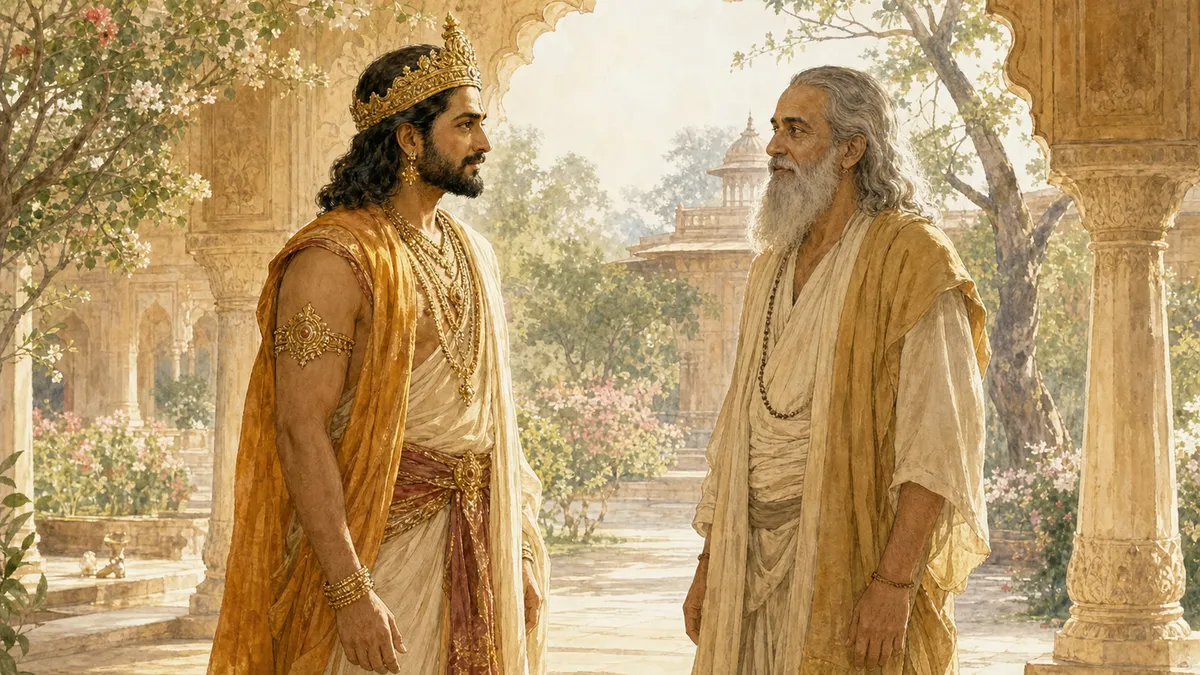
“Sir, you have a pure soul, and you have helped me just as my younger brother did. The merit of these actions will elevate you. You have already attained three goals in life: dharma, artha, and kama—that is, righteousness, wealth, and the fulfillment of desires. Moreover, you have fervently worshiped Vishveshvara. You are also blessed with the good fortune of being the ruler of Kashi. Only the fourth goal of life, called moksha, remains to be attained. I will tell you about it briefly.”
It turned out that all of this had been a skillful stratagem intended to free his younger brother from attachments.
The Four Goals of Life and the Path to Moksha
The living soul (jiva) enters the path of liberation after the three preceding goals—dharma, artha, and kama—have been fulfilled, exhausted, and transcended, and when the vasanas associated with these three goals have been exhausted.
Dharma means fulfilling one’s duty, such as one’s social duty: to family, society, nation, and children (whether in this life or the next)
Kama means sensual pleasures, the gratification of the senses, and the inner satisfaction derived from it
Artha means possessing material energy, prosperity, owning property, and managing it
When the vasanas associated with these three goals are exhausted, the living soul naturally develops an aversion to the samsaric vision and samsaric consciousness, and these things are left behind naturally, just as kindergarten is left behind when it is time to go to school, or school is left behind when it is time to go to university. The term “renunciation” cannot even be applied to this. You do not renounce your childhood toys or worn-out clothes, do you? You simply leave them behind.
Only when moksha comes to the forefront for you and the vasanas associated with the three preceding goals of life have been exhausted do you become sadhus, monks, and disciples. If you become sadhus or monks while your vasanas of dharma, artha, and kama have not been exhausted, then it is difficult for you. A conflict of goals arises: you strive for moksha, yet the tendencies of kama, artha, and social duty remain. And if a conflict of goals arises, you cannot devote yourself fully to any one of them. Therefore, it is believed that proper, true renunciation occurs when the vasanas associated with the preceding goals have been exhausted.

“Exhausted” means that there is no attachment to them and that you do not seek to obtain them, at least beyond what is appropriate. This does not mean that you do not engage with these energies at all; you may engage with them as necessary—for example, by working with material energy while living in a monastery. You still have to do this, but it is performed as service, without any personal vasanas: if it is necessary, you do it; if it is not, you do not, and neither preferences nor attachment arise in your soul.
You perform your duties by following monastic dharma, but this is service rather than conditioning by national, family, or other preferences. If necessary, you leave everything behind and go into retreat without any difficulty, because your main goal is moksha. You should periodically reflect on these three goals and constantly direct the vector of your purpose toward the fourth goal—moksha.
Maturity of the Soul and the Right Strategy for Spiritual Life
If the soul is immature and childlike and has had little experience in samsara, then the three preceding goals are important to it. It thinks: “Oh, my duty, my country, my people, my family, my clan, my lineage. I must serve them,” or “Wealth, authority, power—I have not attained these yet,” or “I have not yet experienced all the possible sensual pleasures in samsara.” These are all delusions. This is how an immature soul reasons.
A mature soul understands: “Danger! This is poison!” It knows that one must not immerse oneself too deeply in such things. A little is permissible, of course, since it is impossible to live in this world without coming into contact with anything; after all, we are not gods who walk six inches above the ground. One way or another, we are forced to come into contact with certain things, but as monks we know that this must be done carefully, consciously, in accordance with samaya, Vinaya, and discipline—and no more than that.
A mature soul never immerses itself in sensual pleasures, the pursuit of wealth, or social dharma. On the one hand, it seeks to avoid contact, while on the other, it seeks to integrate and unite. It moves toward its goal—moksha. When your soul is mature and your priorities regarding meaning, values, and goals are properly set, sadhana and monastic life present no difficulty for you; they are natural to you.
You must always remember that there are millions of people who dream of being in your place. They make desperate efforts, vowing to become monks in 2017, when their son grows up and they no longer have to pay child support. They dream of becoming novices in 2020, when all their karmas have been exhausted, their agitated minds have calmed down, and their parents and children have let them go. I communicate with lay disciples, and this is truly the case. Yet you are already here, which indicates that you have enough merit to have reached this stage.
When your samsaric meanings and goals have already been exhausted, you are left with the principle of moksha. However, the principle of moksha does not mean that we must abandon and forget everything and only sit in samadhi, because there is an inherent logic to the development of prana and the mind and to the purification of samskaras, and even if you wanted to do so, you would not succeed. This must be done little by little, exhausting your karma, purifying the pranas, ridding yourself of selfishness, pacifying the mind, and training it to abide in a state of presence and service to the supreme truth, Anugraha. You must slowly but methodically build up more and more momentum. This will be the right path, one on which you will not make a mistake. In other words, you must change yourself gradually, yet progressively and methodically, day after day, month after month, steadily.
The sign that your practice is correct is stability: you constantly move forward, progress, and grow. Incorrect practice is when a person initially rushes toward liberation, performs austerities, meditates at night, desires transcendent practices and long, dark retreats—that is, moves toward their goal like an aircraft taking off vertically—but then karma emerges, and their sense of purpose, enthusiasm, faith, and dharmic values are lost. They become first a nihilist, then a person of little faith; they are pulled one way and then another, and wonder what they should do in the monastery. This is wrong; this is what is called “failing in spiritual life.” The aircraft took off, but someone from samsara shot it down, so it is forced to fall again. Such cases occur when the wrong tactics or strategy for spiritual life are chosen.

A true strategy for spiritual life must be long-term, not merely for three to five years. It would therefore be a mistake to think: “I will come to the monastery, practice, and quickly attain realization.” A true strategy for spiritual life must be long-term, serious, enduring, and lifelong. And rest assured that your spiritual life will not end with this lifetime; it will continue beyond it, because the mind is a universe and will need to be further developed and purified.
You are only at the very beginning of the spiritual path: if there is a vast staircase leading upward, you are at the first step; you have stepped onto it, and now you simply need to keep going. Nothing ends even with enlightenment; enlightenment is also a particular step. Everything changes from the moment of enlightenment, that is certain, but this does not mean that everything comes to an end; immense potential lies ahead. Spiritual life is endless, and you simply need to proceed methodically, step by step, pacifying the ego and the mind—this is the right way.
Self-Inquiry and the Search for the True “Self”
“The actions of dharma always depend on the one who performs them. Therefore, who performs them is more important, while the performance itself is secondary. One must renounce unimportant and impermanent matters and turn only toward what is important and eternal. ‘I’ and ‘mine’ must be discarded, and the Atman underlying them must be found. If you focus all your attention on the Atman, you will attain the highest degree of true knowledge. Who is the true ‘I’? Is this ‘I’ outside, or is this ‘I’ within? Reflect on this yourself. The unmanifest is the cause, while the manifest is the effect, the result. Then who is the one who calls himself ‘I’? Such reflection and self-observation must continue without interruption until you discover the answer, and then everything will become known.”
If you practice correctly and diligently, sooner or later you will attain nididhyasana. A person who has attained nididhyasana has no questions, only a movement inward. They may have technical questions, but all essential questions have been resolved. Those who have not yet attained nididhyasana experience much confusion and constantly stray from the right path; therefore, it is important for them to engage again and again in manana—reflection and clarification of the point toward which consciousness should be directed, the principle of self-inquiry.
From Manana to Nididhyasana
To move from manana to nididhyasana means to accomplish the great task of life. Life is divided into two halves: before nididhyasana and after it. Even if you have embarked on the spiritual path, there is still confusion, vacillation of the mind, mental questions, questions arising from the ego, and unclarified meanings, goals, and values. Much remains unclear. And all this is the stage of manana, when everything must be clarified through reflection, and doubts and uncertainties must be cut away.
But once you have passed through this fragile period, in which most mistakes are made, and moved to the level of nididhyasana, everything changes: another half of life opens up, one associated with the continuous maintenance of awareness. It does not matter what you use to sustain it; what matters is that you have somehow reached the point where you do sustain it. Atma-vichara, concentration on the breath, mindfulness of bodily actions, immersion in bare awareness, and working with a simple or complex sankalpa are all different methods of maintaining nididhyasana.
At the stage of manana, you are constantly beset by uncertainties, standing thoughtfully among many paths: perhaps you should turn this way, perhaps that way, or perhaps go back. At the stage of nididhyasana, however, you know for certain: “I have chosen the right path, and now I simply need to keep walking along it.”
The task of manana is clarification, but this does not concern accumulating information or studying various religions and points of view, because all of this must be clarified even before shravana. Clarification at the stage of manana is essential and internal; it takes place at the level of subtle awareness: how to place awareness at the right point—that is what manana is.
The tasks of nididhyasana are different: awareness has already been placed at the right point, and now it simply needs to be monitored so that it does not stray from the proper path. Here the goal is to put the mind on an iron chain, to attain absorption in presence, to immerse the mind in natural awareness as a finger becomes stuck in glue—that is, to glue it to awareness—and to learn not only to remain continuously aware but also to be flexible, that is, to learn to unite awareness with actions, movement, eating, and conversation.

To cultivate this awareness so that, while remaining aware, one can think and perform even complex tasks. To make this awareness so deep and powerful that it helps cut through the deepest attachments and identifications, hope, fear, memory, past experience, and ego—in other words, to bring this awareness down to the very archetypes of the subconscious that still lie deeply embedded. All these are stages called “birth,” “education,” and “nurturing.”
Thus, the tasks of a person of Dharma who has attained nididhyasana are entirely different. They have already become firmly established on the path and are no longer enticed by other teachings or anything external. They do not seek external dharmas, understanding that everything depends on their awareness. When they discover this path, at first they dance with joy because they have completed a major task in life: they have brought the disparate parts of their mind together into an integrated whole. It is as though you have received a magical object that grants wishes; perhaps you do not yet know how to use it properly, but you have already received it—this is what nididhyasana is. Before nididhyasana, you have not yet received this object; you are still choosing it or trying to assemble it from different pieces.
One who abides in nididhyasana possesses inner wholeness and natural wisdom. Calmness, serenity, self-control, compassion, love, devotion, pure vision, divine pride, and open-mindedness increase within them of their own accord. They may not even engage in intensive practices, but simply maintain awareness, and all these qualities grow day by day. A day passes—and your attributes improve. If we consider our subtle body, we all possess certain qualities and attributes: clarity, willpower, strength of intention, awareness, attentiveness, and the power of the intellect (manas-shakti). By maintaining nididhyasana, all our qualities blossom; they grow naturally day by day.
One who abides in nididhyasana is a happy person, because life has turned in their favor. They are already at the stage of non-doing and experience joy in every moment; they dwell under God’s protection, under God’s blessing. But one who is at the stage of manana still only dreams of this and strives toward it.
Nididhyasana is not yet realization, enlightenment, or the eighth stage of awakening. But it is steady progress toward the summit.
Signs of Attaining Nididhyasana
What are the signs that you have attained nididhyasana?
You have no fundamental doubts
Your mind is stable
You abide in serenity and contentment
You are troubled by neither gross desires nor conceptual thinking
Your egoism has been subdued and is under complete control
Thanks to your attentiveness, your spiritual power and qualities increase day by day
You are happy solely through awareness and contemplation, rather than because of any external conditions
Neither bad dreams or omens, nor external insults, nor any joyful or harmful events can shake you
You are gradually becoming established in pure vision, although you are not yet fully established in it
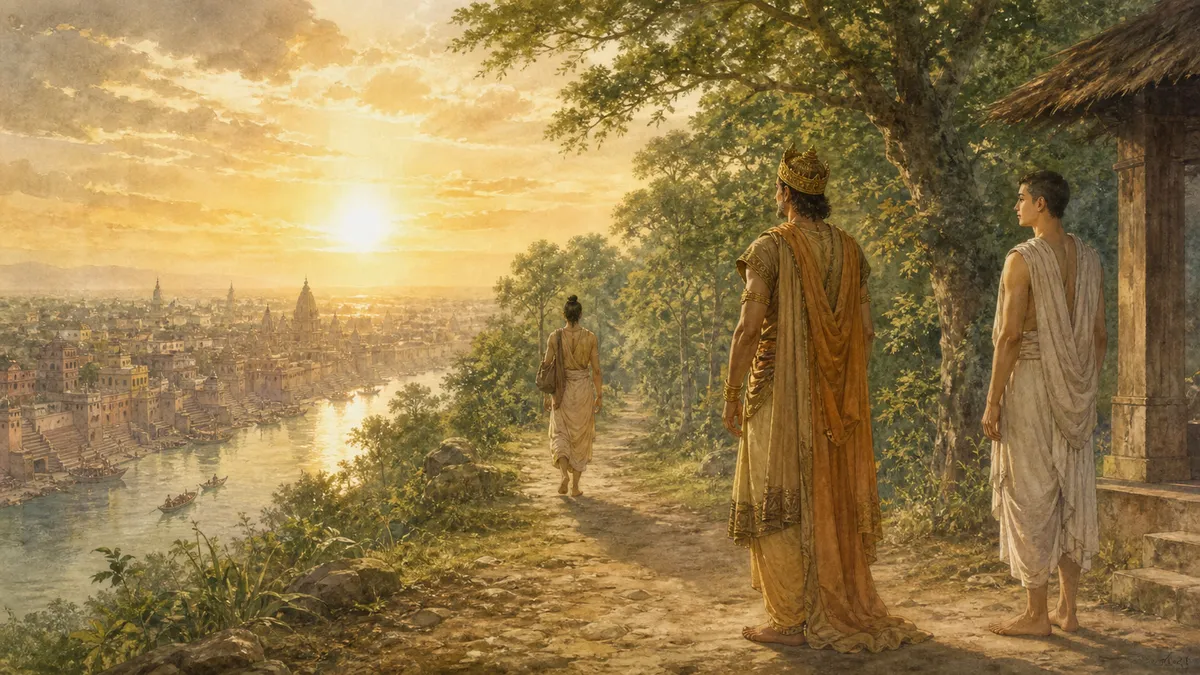
“O King, because of ignorance, people mistake the ‘not-Self’ for the true ‘Self.’ When you realize the ‘Self’ as all-pervading, then you too will become the ‘Self.’ Since you asked me, I have explained this tradition of Self-knowledge to you. If you follow this practice, you will certainly attain realization. Now allow me to leave.”
The King of Kashi set out for his sacred kingdom of Kashi, contemplating the advice he had been given again and again until it became his firm conviction. Alarka thanked his brother from the bottom of his heart and prepared to become a monk. Subahu was happy that Alarka had had the opportunity to receive the grace of Lord Dattatreya, and once again departed for the forest.
