


Commentary on the text “The Great Assembly of the Siddha Yogini Machig Labdrön”
Teaching on the four demons and the fundamental principle of cutting through them. A text from an excerpt of the great assembly of the siddha yogini Machig Labdrön.
The root of the demons is our own mind.
When we perceive something as an external object and experience desire and attachment, we are possessed by demons and fall into delusion, mistaking a creation of our own mind for an object.
There are four types of demons:
the demon that obscures the truth, rooted in external objects;
the formless demon, rooted in internal mental constructs;
the demon of complacency, rooted in the manifestations of our own qualities;
the demon of self-importance, rooted in dualistic perceptions.
They can all be reduced to the demon of self-importance.
Here we have read a general description of the four types of demons that must be cut through, and of the fact that the root of them all is the ego.
When embarking on the path, we must realize that liberating our mind means freeing ourselves from inner and outer demons. We should not have rosy notions about the spiritual path, as though we would encounter only pink elephants along the way. On the contrary, if you have little merit, be certain that you will have to fight demons; you will have to fight them in earnest and at great cost. You will have to become very skillful and resourceful in order to overcome them, because they are not as simple as they may seem.
This is precisely what the spiritual path of monasticism entails. A monk is a spiritual warrior who fights and triumphs. When a person first takes Refuge, becoming a monk or a novice, I think, “We shall see whether you even make it to the twelve-year finish line.” It is not all that simple. And that youthful enthusiasm for the Dharma that warms the yogin at first must give way to a very profound approach to practice, because if such an approach does not arise, these demons make the spiritual path impossible, and every experienced practitioner knows this.

The Demon That Obscures the Truth
The demon that obscures the truth is multifaceted, but its principle is as follows: when an object appears before our sense organs and we evaluate it, rejecting or accepting it, we are under the power of the demon that obscures the truth. Clinging to the materiality of objects, we become entangled in samsara.
What is this demon that obscures the truth? It is the demon of our incorrect evaluations. Until we have realized the awakened Mind, all our evaluations are incorrect. It is precisely because of these evaluations that a false perception of reality arises.
For example, if you look at a person and think that this is a person, that in itself is already an incorrect evaluation. In reality, it is not a person at all, but Brahman, the Absolute, assuming human form. But if this does not occur to you, then you perceive him only as a person. Consequently, an incorrect view arises from this initial premise; incorrect actions proceed from an incorrect view, and then all other relationships are already samsara and delusion. In other words, at the very first moment you evaluated something incorrectly, and from then on everything else automatically went wrong.
Or you evaluate yourself as a person, as a limited being. At the very first moment you evaluated yourself incorrectly, and everything else is already wrong. It is good if you are a practitioner of contemplation and understand all this; therefore, you are very cautious about your evaluations, knowing that they are temporary and conditional, born of your ignorance, and remain in effect until your mind is purified. But if you do not know this, you blindly believe your evaluations, and as a consequence everything is wrong, deluded—these are all demons.
A Christian saint once said, “When two afflicted people interact, it is two demons interacting.” Why did he say this? Because an incorrect evaluation from the very beginning leads to completely erroneous interpretations, and then everything else is erroneous as well.
From birth, people are imposed with various judgments such as “this is good, and that is bad.” Or they make similar judgments about religions, science, and life. People are led to believe that a man should be this way and a woman that way, that Islam is one kind of religion and Christianity another. All of this consists of various illusory judgments based on limited perceptions. And people, as a rule, sincerely believe that their judgments are true. But Machig Labdrön says here directly that this is the demon that obscures the truth.

And how does a practitioner differ from an ordinary person? A practitioner does not trust their superficial judgments. Of course, they have them, because it is impossible to do without them completely; however, they relate to them cautiously, as if through self-liberation. They know that reality is multidimensional and diverse, and that these judgments are relative because they work only in a certain sense—in other words, they are not absolute judgments. They know that a person may be not only a human being but also a deity, and may even be the Absolute. They understand that through a person, a demon, a deity, or God may speak; that a person may be an expression of their own consciousness, or that signs from deities may manifest through them. They know that a situation may simultaneously be an everyday situation, a lila, a darshan, and a means of cutting off the ego—in other words, they see a situation ambiguously, from five perspectives or even seven. They understand that judgments, too, can be ambiguous: for example, a person can be regarded as a mara, as a deity granting darshan, as an ignorant person, or as a god amusing himself in this body. In other words, everything depends on your view.
In other words, the only way to defeat the demon that obscures the truth is not to create illusory judgments and not to become attached to them. If a person is blind to this and their own judgments of reality obscure true nondual vision, then they are clouded by the demon that obscures the truth.
For example, if someone tells you something and you think, “No, you’re wrong! I’m right!”, then this is the work of the demon that obscures the truth. After all, from the very beginning, the situation could be viewed differently: “Perhaps God is sending me signs, giving me certain signals, while I stubbornly try to cling to my own position and turn away? Perhaps these are clear indications that I need to change something in myself?” But the whole point is that you cannot even understand this. The traffic light is working, a red or yellow light is signaling to you, and you do not even understand that it is a sign meant for you. You are so gripped by your limited human thinking that you cannot even take this into account.
There is a story. During a severe flood, a Christian priest prayed fervently. When a boat came for him to rescue him, he said, “Save those who do not rely on God; God will save me.” The people shrugged and rowed away. Then a raft floated past, and he was offered the chance to move onto it to save himself. The priest continued praying to God for salvation and arrogantly said, “Save those who do not rely on God; God will save me.” When the water had already risen to the level of the rooftops, a helicopter flew in for him! But again he said, “I place my hope in God. I trust Him completely, so do not worry about me.” Finally, the water flooded even the rooftops, and he drowned. Appearing before God, he indignantly said to Him, “I put so much hope in you! Why didn’t you save me?!” God said, “You know, I have never seen such a fool as you! I was the one who sent you the boat, the raft, and the helicopter!”
This is an example of our mistaken interpretation.
And yet form is empty in its very essence. Therefore, do not become attached to form, but contemplate it, recognizing emptiness in it!
By having no attachment to form, you become free from the demon of believing in something permanent.
All contemplation consists in not becoming attached to that which has form, appearance, and a name, but in shifting the focus of your consciousness toward the formless, finding this formlessness and seeing the formless playing in manifested forms. But if we do not see this formlessness, form begins to seize our mind, and then we have taken the demon that obscures the truth’s bait. Whatever we may think about it, we are already hanging on that hook. The only way to overcome this demon is to remain vigilant at all times, every second, as if a sword were hanging over your head, as if you were walking along a razor’s edge.

An experienced practitioner is distinguished by the fact that his vigilance is continuous and constant. He never allows the demon that obscures the truth to cloud his mind. Whether he is reproached, scolded, insulted, or has tea splashed in his face, or whether some completely absurd things happen, he thinks: “No, no, you will not deceive me.” In other words, he continues to strive to discern the emptiness playing in all these different forms.
Without making emptiness an object of the mind, you will undoubtedly free yourself from the demon of belief in complete nonexistence.
The demon of belief in complete nonexistence signifies the manifestation of nihilism. If the demon of attachment to form is eternalism, when we blindly believe in forms, then nihilism, on the contrary, is when we completely deny form, believe that nothing exists, and want to go where there is nothing. All of these are different kinds of demons. They are certain extreme views that prevent us from forming a correct vision.
The demon that obscures the truth (eternalism) is when, for example, we blindly believe that the purpose of tomatoes is to be canned. But they grow without even knowing that there are people who want to consume them; they grow simply because that is their nature. Just as raspberries do not grow in order to be picked, and mushrooms do not grow in order to be fried; they simply exist. But when we impose our ideas upon reality, the demon that obscures the truth gives us an illusory perception.
When we free ourselves from the demon of eternalism, which makes us believe in the inherent existence of things, and from the demon of nihilism, which makes us believe in their nonexistence and strive only toward this nonexistence, we attain the true view. Attaining the true view is extremely important for the contemplator, because to contemplate means nothing other than to abide in the true view. If we have not attained the true view, free from these two extremes, then even if we work with sankalpa and meditate in mahasanti, we can very easily fall into all kinds of illusions.
It is impossible to stop the manifestation of form. But instead of clinging to its concreteness, recognize in it the light of your vision. The same applies to sounds, smells, tastes, tactile objects, and the mind, which self-liberate in the same way.
In other words, it says here that it is impossible to stop the manifestation of external objects (this applies to what is felt, smelled, seen, and heard). Therefore, instead of clinging to them, recognize in them the light of your consciousness, your nondual vision. Instead of grasping at what is seen, recognize the seer and the light of primordial consciousness that is present in the seen. Instead of grasping at the sounds of speech, pleasant and unpleasant words, recognize the hearer and the light of primordial consciousness that is present in what is heard. Instead of grasping at taste, recognize the taster and the light of primordial consciousness that is present in what is tasted.
When we act in this way, the demon that obscures the truth loses its power over us.
The Formless Demon
The formless demon.
In the “Great Gathering” it is said:
How does the formless demon arise?
Everything that appears to our mind as good or bad, we distinguish on the basis of our concepts—this is the formless demon. Apart from our own self-arisen Mind, there is nothing good that could be regarded as a deity, and nothing bad that could be regarded as an evil spirit.
In the absolute sense, there is no good in Brahman; there is only what we like. Likewise, there is no bad; there is only what we dislike. Good and bad are conditional categories that depend on our evaluations. We ourselves generate these evaluations, based on our accumulated experience, karma, upbringing, and other factors.

For example, in Eastern countries with a Muslim religion, it is considered that a woman should behave in a certain way, cover her face, and so on. This type of woman is considered virtuous. In Western countries, however, it is considered that a woman should be emancipated, have equal rights with men, be active, and earn her own living. In the eyes of Muslim people in the East, a Western woman is vicious, promiscuous, and completely inconsistent with the ideal of a woman. In the eyes of Western people, an Eastern woman is oppressed, socially inert, and not deserving of respect. But in reality, these are merely judgments generated by the cultural characteristics of one country or another.
The incorporeal demon is connected with our judgments, with the concept of what is bad and good, and with our accumulated experience.
The movements of the mind, generating hope and fear, plunge us into complete dependence on our own demon. From the natural clarity, the boundless dimension of the absolute nature of phenomena, all kinds of images and ideas arise, just as waves arise on the surface of the sea.
Those who have directly realized this have no need to correct anything—leave everything as it is.
How can we overcome the incorporeal demon connected with our division into bad and good?
Everything self-liberates in the original dimension, bringing neither benefit nor harm. One should not feel envy toward what arises from the dimension of the absolute nature, nor should one reject or accept it. Accept and reject nothing—for this is the self-born Mind.
The incorporeal demon is a very subtle demon that is not easy to recognize; it is connected with our subtle ideas that produce instantaneous judgments. If we contemplate correctly, we do not need to accept or reject anything, because we see everything as manifestations of the self-born Mind.
It is believed that there are a great many demons:
- demons that inflict diseases;
- demons that create obstacles;
- demons that cause quarrels and hostility between people;
- demons that push monks to break their vows;
- demons that push laypeople to engage in degrading actions;
- demons that urge people to take pride in their qualities;
- demons that push people to remain in despondency, confusion, and fear;
- demons that bewitch people with illusions, providing false information and confusing them.
All of these are different states that arise from the original nature. If we do not recognize these demons through pure vision, if we do not understand that even this is the play (lila) of the Absolute, then we become subject to their influence. If, however, we manage to recognize this, the demons are pacified and appear before us in pure vision as deities.

In the course of practice, you have already had to—and will have to many more times—encounter various manifestations of such demons. The path you choose to follow in life and the course you will pursue depend on how you interpret them and how you relate to them. It has even happened that people with great merit made a mistake by failing to understand the demons and lost the path. Therefore, every monk, if he is an experienced practitioner, remains highly vigilant, knowing that these demons never sleep.
These demons can be regarded as certain guardians on the path, intended to teach a person some lesson. If he passes these trials, the demons appear before him in a peaceful form. If not, they do not let him proceed farther and block his path. To pass their trials, one must be ready to constantly change oneself and challenge one’s old ideas. Those who are not ready to do this inevitably fail.
For example, the bardo texts describe beings of the Yama class who come for a person at the moment of death. If the person has great merit, they help him leave his body very gently. But if the person has committed many sins, they pull his soul out with hooks. “Pulling him out with hooks” is an interpretation by the subconscious, indicating wrathful energy. If the person is holy, dakinis or gods catch him and carry him away in their chariots. If the person is wicked and has violated his samayas, demons come for him, dragging him along and beating him with whips. Then he appears before the elder spirits, who review the life he has lived and ask questions. If a person has violated his samaya, has defilement, a sense of guilt, or a sense of sinfulness, then at the moment when he views scenes from his life, his consciousness changes. No one punishes him; he punishes himself. That is, seeing once again the events he has lived through, he falls either into anger, fear, self-abasement, or a sense of guilt. And when such a change in consciousness occurs, the elder spirits think: “He still needs to work on this situation, because he has not yet understood its essence. He needs to go to such-and-such a world.” But if the person does not fall into anger, envy, or guilt in response to the questions asked and what is shown to him, but maintains pure vision and presence, the spirits step aside and let him pass, giving him way, transforming into deities, and arrange themselves favorably for him.
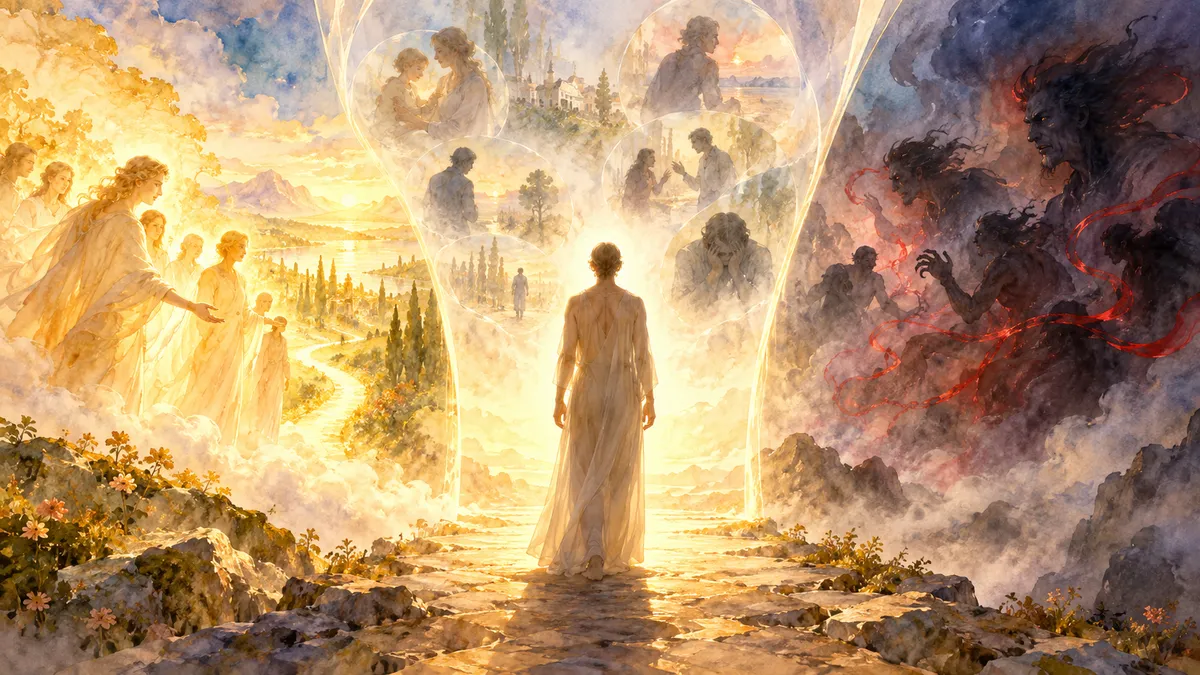
People lose their minds when they are shown scenes from their own consciousness; that is, they are unable to self-liberate them, and therefore receive a new body in their next birth. Practitioners, however, see all these manifestations as their own “I”; not even a shadow of doubt arises in them about this, and therefore they can self-liberate all these parts of their consciousness. Remaining in unwavering presence, they do not listen to a single word of the demons or the spirits, but simply recognize their true nature flawlessly, and then everything becomes one with the mandala of contemplation; everything manifests auspiciously. Therefore, practitioners who have realized the one “taste” go to the pure lands, to nirvana, to the heavens of Brahma.
