

Commentary on the text by Swami Sivananda
“Brahma-jnana is an occult mystery, a subject for initiation by a genuine guru. Stop for a minute and think seriously about your life. You are proud that you are wise. But are you really knowledgeable in everything? Absolutely not. You are hopelessly ignorant. How many maternal wombs have you been in? You have been deceived more than once by lustful sight and a restless tongue. You have been hopelessly led astray by color, smell, and touch. Wake up, arise, and do not stop until you attain eternal heavenly happiness, ultimate happiness, or the state of turyatita, or nirvikalpa samadhi, or videha kaivalya. Develop the six virtues (shat-sampat). Acquire the four qualities.”
Swami Sivananda speaks of the qualities that a practitioner must possess. When we begin practicing exalted teachings, such as anuttara tantra, it is often said that these teachings are very great and sublime. Some even say that these teachings are not for ordinary people, but for masters, those who are almost enlightened, and for saints; that is, they are something very lofty, the highest level of mastery. Or it is said that they are for people with the highest abilities.
But when we approach the teaching, it is important for us not to remain in fantasies or illusions, but to assess our abilities adequately by critically analyzing our karma. If our neighbor is a spiritual genius with incredible abilities, that will not help us, because we ourselves must work with our own karma. What is good for our neighbor may not suit us. It is very important to determine our own abilities, without comparing ourselves to some general level, because it is with our own abilities that we begin the practice, walk the path, and complete the path. And, as is well known, everyone has their own abilities.
For example, Milarepa once came to a certain saint who taught the anuttara tantra of the Nyingma school. Before this, Milarepa had studied magic and in one week mastered the ability to summon rain and hail by means of magic, and in twenty days he mastered the entire science of magic. When he came to the teacher, the teacher said: “My teaching is very exalted: if you begin practicing it during the day, you become a Buddha that very day; if you begin practicing it at night, you become a Buddha that very night. It is so great that a person with the best abilities need only hear about it, and he immediately becomes awakened.”
Milarepa was very happy and thought: “Surely fortune itself has brought me to this teacher, whose teaching is understood easily and quickly.” He became a little proud and thought: “If in twenty days I learned magic and killed thirty-eight of my enemies, if in just one week I learned to summon rain and hail, then I will certainly learn such an easy and wonderful teaching in a day.” He did not even sit down to meditate, but lay down to sleep.

The next day the teacher said: “It seems I have overpraised my practice and my method. You are not suited for my teaching. I had signs and visions that my teaching would not help you. In another part of Tibet there is a holy teacher, Marpa. He is a great practitioner of tantric methods, so you had better go to him.”
This example shows that even such greatest luminaries as Milarepa must remain vigilant with regard to their karmic inclinations, treat the teaching with respect, and cultivate qualities.
Often practitioners, hearing that they are practicing lofty teachings, neglect certain basic qualities. But a foundation, a platform, must be created for lofty teachings. And it is very important not to overestimate one’s abilities, not to imagine oneself a spiritual genius, but, on the contrary, to develop humility and modesty and diligently engage in certain practices.
Of course, our inner “I” is, by definition, a spiritual genius. Our spiritual spark is the highest and most capable, and we absolutely must develop the spiritual genius within ourselves. But developing the spiritual genius within oneself does not mean falling into pride or conceit. This is precisely the difference between divine pride and worldly pride, which is a klesha.
If you are truly a spiritual genius, it will reveal itself anyway; it will not be a secret to anyone, and you will not even need to declare it. And if you are not one, that too will be visible to everyone. In fact, nothing can be hidden. If you become a source of virtuous qualities, if your virtues and merits radiate from you every second, it will be impossible to hide; everyone will know about it: the gods, ancestral spirits, the people around you, masters, and so on. If your merit from past lives is such that you are a great Buddha, a king of the Dharma, and a great mahasiddha teacher, you will not be able to hide it. But if you do not possess the potential and you have limitations, that too will not be possible to hide. And there is no need even to worry about it or make any effort, because everything will be noticed anyway. It is noticed from the very first days of being in the sangha, from the very first conversations.
The Four Qualities According to Shankara
Sivananda speaks of acquiring six virtues and four qualities. These are the four classic qualities spoken of by Shankara:
viveka (discriminating wisdom)
vairagya (dispassion, tolerance, indifference to sense objects)
mumuksha, or mumukshutva (an ardent striving for liberation)
shat-sampat (that is, the sixfold virtue)

Viveka – Discriminating Wisdom
Viveka is the ability to discriminate, that is, to separate what is right from what is wrong. Sometimes even in the most ordinary situations viveka is required, and if there is no viveka, we make certain mistakes.
For example, you do not like prasada. If you have viveka, you can think: “This is an excellent training in eliminating acceptance and rejection.” And then, instead of getting angry or being dissatisfied, you turn the moment of this dissatisfaction into an excellent method of spiritual practice, gain benefit, accumulate merit, and advance on the spiritual path. But if you miss this moment, dissatisfaction arises within you, and aparadhas automatically begin toward the cooks, toward life, toward the world in general. And after such prasada you feel as if you have been poisoned. In fact, that is so. That is, monks may make some completely foolish mistakes out of ignorance.
For example, when I was engaged in practice, I consciously ate prasada that was not tasty—made from pearl barley and the cheapest mustard oil. The mere thought of that mustard oil made me nauseous. And I ate such prasada in retreat for several months. I believed that even if there is an opportunity to eat tasty food, one should try what it is like to eat tasteless food in order to detach oneself from one’s preferences.
In the monastery there is an attitude that prasada should always be good, that is, the environment should be beautiful, but this is merely an offering to the Dharma, not a gratification of the ego. In other words, we try to make the Dharma pleasant and beautiful because, if it is very ascetic, the consciousness of those who come here is unlikely to be elevated by that. Personally, I have always felt inspired by asceticism, poverty, and other similar things. But when I had to head the monastery, I thought that with such attitudes the Dharma could not be spread widely, so I had to give up my preferences and, on the contrary, cultivate other sankalpas that, generally speaking, have not been characteristic of me in recent years. And if I had not cultivated them, life would have been more difficult for the monks, and the Dharma would have spread with greater difficulty.
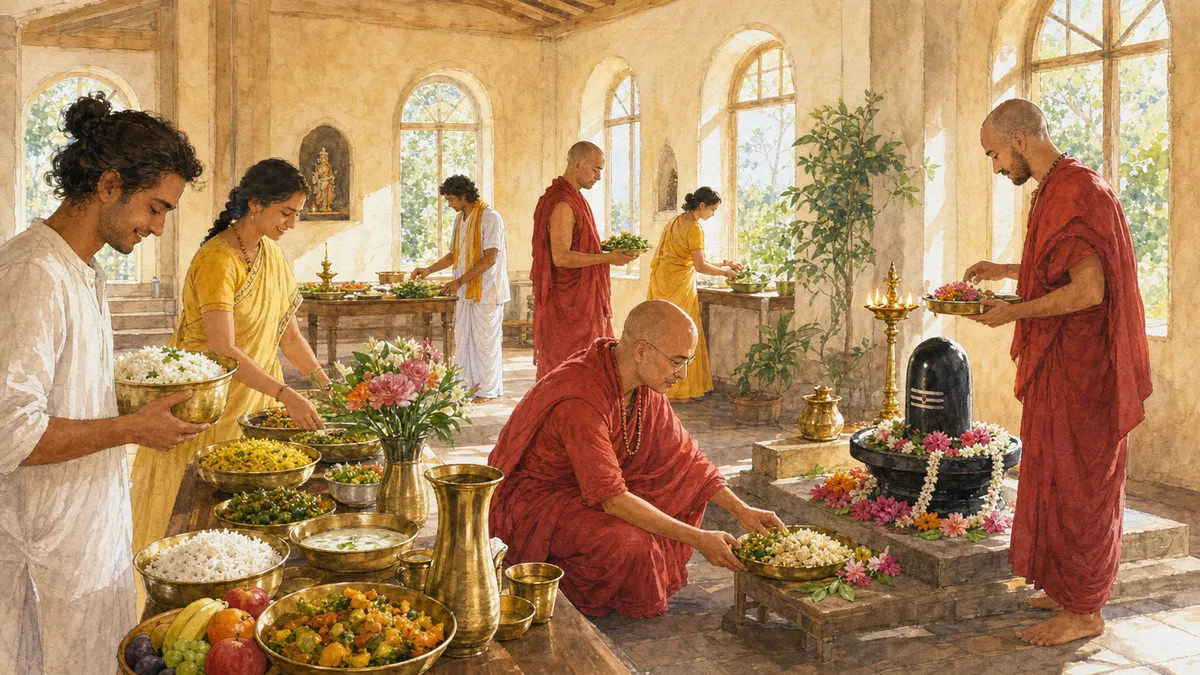
But when we make such beautiful offerings to the Dharma, this does not mean our attachment; inwardly we must be detached, thinking: “This is not mine; all of this belongs to the Great Lord, to God. Since it belongs to the Great Lord, it must be beautiful, but I should not draw any egoistic pleasures from it.”
Viveka also means the capacity for discrimination in many matters. For example, understanding the monastic rules: how to observe them, what to emphasize. If you communicate with a monk and evaluate him by human qualities but forget that he is a person of vow, a person of service—that is, you see some of his ordinary qualities but do not notice the exalted ones—this is precisely a lack of viveka. If you see in a senior monk not his position but his human qualities, and therefore find it difficult to build a relationship with him, this too indicates a lack of viveka.
Viveka allows one to see the Dharma precisely as it advances one toward spiritual life. When I give various transmissions, subtle practices with sankalpas, work with the winds, I see that some grasp them “on the fly”: it is enough merely to say that they exist, and such practitioners take them up and practice them on their own, as if they had been doing them all their lives. But others, even after numerous consultations, cannot understand what the matter is after all, what these sankalpas are. This is also a manifestation of viveka.
For example, while I was walking here to the bhajan mandala, without wasting time, I practiced one of the sankalpas while walking—the “Descending Force” sankalpa. And this happens every day. If, however, we walk, get distracted, and simply stare around in a state of complete unconsciousness, then this too is a lack of viveka, a lack of discernment.
Viveka manifests in everything: in our detachment from desires, in our behavior. In other words, we clearly understand what is true and what is not true, and constantly watch over ourselves. In the absolute sense, the most important viveka is the ability to distinguish naked awareness, presence, from distractions.

Vairagya – dispassion
Vairagya is dispassion, tolerance, indifference to sensory objects. Dispassion means that we must once and for all put an end to the samsaric vision, the samsaric pull toward material objects.
One monk, having come to a teacher, asked:
– What is your teaching? What are your highest instructions?
The teacher said to him:
– Renunciation.
The monk expected to hear some complex practices of “reverse triple transference in the bardo,” some complex methods of “catching fish in the net of awareness in a dark retreat.” But he was told one word—“renunciation.”
At the same time, we understand renunciation in a special way—precisely as great devotion to the natural state, which self-liberates hope, clinging, and fears, as a vision of the illusory nature of the world. There is a difference between renunciation and denial. In denial there is still some negativity, a certain value-based attitude, but renunciation is something deeper, when we completely move over to the side of seeing the Dharma through the eyes of contemplation, when we completely move over to the side of God.
Mumuksha – an intense aspiration for liberation
Mumuksha, mumukshutva, is an intense aspiration for liberation. An intense aspiration for liberation does not mean some dualistic dreams: “Oh, when will I attain liberation? I did not attain it today, and I did not attain it yesterday...” and suffering over it. Of course, at the initial stage it can also be like this. For example, one student, after spending two weeks in the mountains, returned. I asked him:
– Well, how did the practice go there?
He said:
– I did not attain samadhi.
But in fact, for practitioners of Laya Yoga, an intense aspiration for liberation is not connected with projections into the future, with selfish striving, beating oneself on the chest, and other such things. One can say that it is much more subtle, deep, smooth, yet continuous; it is more correct. That is, for us, an intense aspiration for liberation is nothing other than immersion in presence right here and now and total devotion to it, when the question of anything else does not even arise.
You do not think about future liberation; you are so devoted to liberation in the present that you do not have even a second to be distracted. Every second you remain vigilant—this is your intense aspiration. You do not plan for future retreats or some future attainments. You know that what is here and now is absolute, and you strive intensely toward it, not forgetting it for a single second; therefore, you do not have time to project any future hopes. This is mumuksha from the point of view of Anuttara Tantra.

Shat-sampat – the six virtues
Finally, Shankara speaks of shat-sampad, that is, of the sixfold qualities. These are the six virtues:
shama – calmness of the mind
dama – control over the senses
uparati – cessation of worldly activity
titiksha – strength of spirit
shraddha – faith in God, the guru, and the sacred texts
samadhana – concentration of consciousness
Shama – Calmness of the Mind
Shama (calmness of the mind) arises from your awareness, from the understanding of self-liberation. One who knows how to self-liberate possesses calmness of the mind. One who does not know how to self-liberate attains calmness at best during a mahashanti retreat.
Calmness of the mind arises at the moment when we steadily distinguish naked awareness, when we can freely self-liberate all emerging concepts. In the tantras there is the expression “the dangerous gorge of dualistic thoughts,” meaning that when thoughts surge in and take possession of the flow of our consciousness, it is likened to falling into a dangerous gorge. That is, we think something, “wind ourselves up,” and create an entire world out of it, instead of laughing, letting go, immersing ourselves in presence, and seeing the emptiness of these thoughts.
There was one Christian saint who, at the end of his monastic path, became a holy fool. When some eminent hierarchs came to him for advice, he would ask them:
– Why have you come to me, a fool? I am not a scholar and completed only two years of school.
They would say:
– We have come to you for heart teaching, not intellectual teaching.
He would say:
– Well, all right.
Then, addressing the metropolitan, he would ask half-foolishly:
– What’s your name then?
– Joseph.
– Ah, so Joey, then.
Another says:
– And I am so-and-so, the Reverend Basil.
– Well, that’s clear – Basil-boy.
In this way he would check whether it was worth speaking with them about spiritual life, or whether their spiritual pride would not allow him to communicate with them. And only when he saw that the visitors were filled with humility would he speak with them on the subject of spiritual life.

Dama – Control over the Senses
The next quality is dama (control over the senses). Control over the senses means that you constantly control yourself. This control is not only external through the rules of the vinaya; in anuttara tantra it is, above all, internal, through the continuous maintenance of mindfulness. You do not allow anger, attachment, envy, or irritability to burst out, and even if something does burst out, you instantly pull yourself back.
If a disciple is aware and attentive, there is no need to persuade him of something for a long time, no need to somehow wag a finger at him and remind him: “Be attentive, observe the vinaya.” It is enough to give him only a subtle hint, just to raise an eyebrow, and he immediately understands everything. For example, if a disciple has an attachment to something, one need only say to him: “And what about this with you?” He immediately understands everything and says: “I have actually already even forgotten about it.” That is, there is no need to read him long lectures about the harmfulness of attachment. This is perfect control of the senses. Such a person is capable of instantly eliminating his mistakes.
Uparati – Cessation of Worldly Activity
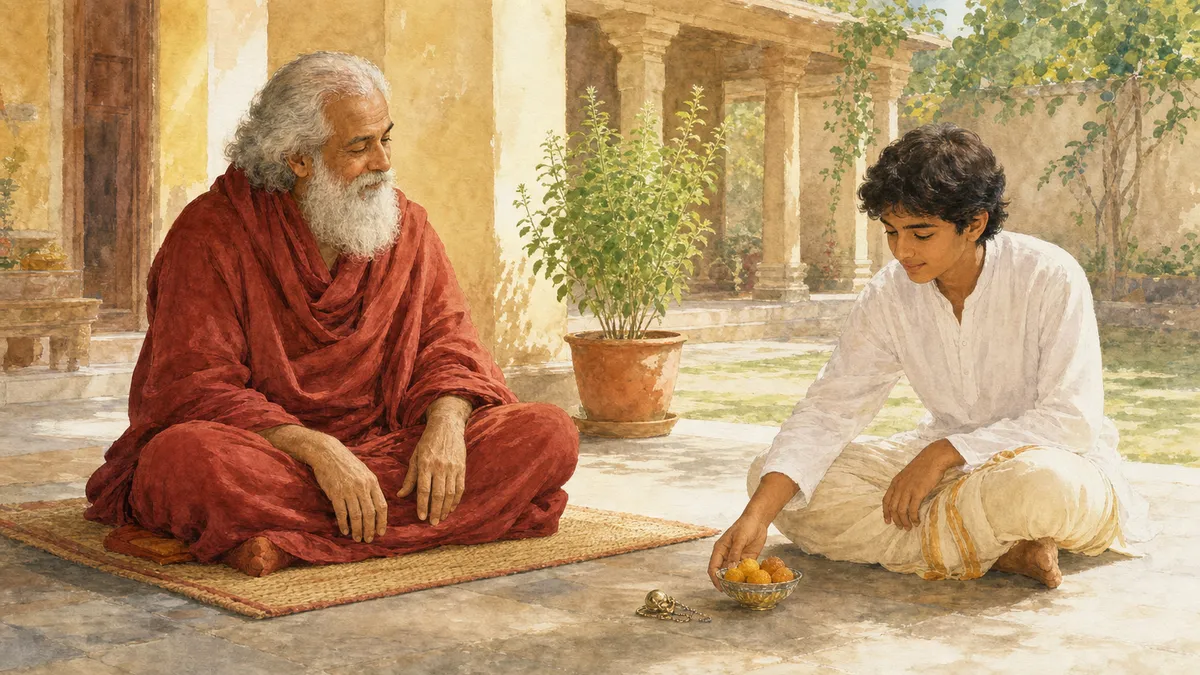
The next quality among the six virtues is uparati (cessation of worldly activity). On the relative level, we cease worldly activity in the sense that we stop interacting with impure samsaric energies and serving them in some way. We do not completely cease activity; however, we change our attitude toward it.
First, we begin to serve the universal energies of enlightenment, that is, we stop working for companies or for anything else, and begin to work for Anugraha Shakti, that is, for the enlightening force. This is a completely different informational flow. Second, instead of generating clingings, hopes, plans, and identifying ourselves with the sense of being the doer (karta and kartritva), we become established in the state of non-doing, cutting off attachment to the sense of being the doer and to the fruits of our actions. That is, we become established in the principle of service and self-surrender. When we act in this way, this is the cessation of worldly activity.
If we have not ceased worldly activity, then during actions we often become confused because we do not have bhava. In worldly life there is the word “drive.” Drive is something positively excited, something that stirs the blood and warms the heart. But if translated into a more elevated language, it is bhava, an exalted state. If you become attached to activity, you never have bhava. The sense of doership obscures bhava, the mind shrivels, and you do not experience satisfaction from activity. The goal-setting mind switches on, projections arise, clinging appears, and therefore there is no emptiness within you. To cease worldly activity from the standpoint of anuttara tantra means to combine action and non-action at the same time, the achievement of goals and the absence of attachment to the fruits.

Titiksha – Strength of Spirit
The next quality is titiksha (strength of spirit).
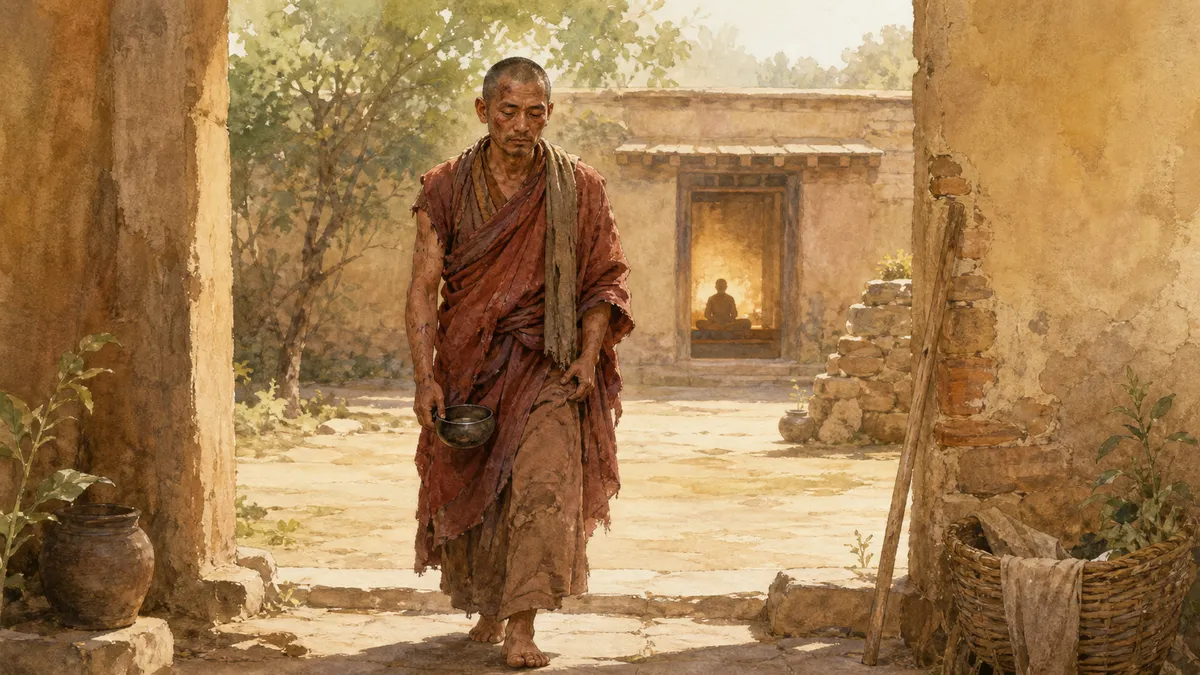
Once Tilopa said to Naropa:
“There is a wedding nearby. Go there and collect some prasad for me.”
When Naropa brought back a dish consisting of eighty-four ingredients, Tilopa liked it very much, and he sent Naropa there once more, calling him “my son.” Naropa thought: “For twelve years he has not even looked at me once, and now ‘my son.’ Surely after this he will grant me initiation.” And Tilopa asked him to bring this dish a fourth time, and a fifth. On the fifth time, Naropa was given nothing, so he simply stole the entire pot with that food. The theft was discovered, and Naropa was beaten half to death. When he dragged himself back, Tilopa, grinning sarcastically, asked:
“What happened to you? Have you changed your mind about studying with me?”
Naropa said:
“No, even if I had been beaten even more severely, it would have been just, because I deserved to fall into hell. These beatings are nothing compared to the goodness of the Dharma that I receive from the teacher.”
This is an example of such tremendous strength of spirit. And yet Naropa was not a beginner; he was not a beardless youth. Before becoming Tilopa’s disciple, he himself had been a pandit at Nalanda University and the guardian of the northwestern gate; for ten years he gave lectures and debated with representatives of other teachings. That is, he was already a rather mature practitioner.
Shraddha – Faith in God, the Guru, and the Sacred Texts
The next quality is shraddha (faith in God, the guru, and the sacred texts).
One siddha, while crossing the Indian Ocean by ship, thought of his guru. For literally a moment, a proud thought crept into him: “Of course, the guru surpasses me in realizations and siddhis, but in wealth and the number of disciples I surpass him.” As soon as he thought this, the ship began to sink. Then the guru appeared, helped him save himself, and said: “This is not right; such thoughts will lead you into a bad state. Purify your samaya.”

Samadhana – Concentration of Consciousness
The next quality is samadhana (concentration of consciousness). Literally, samadhana can also be interpreted as stability in the natural state, stability in sahaja samadhi. It arises when we have a powerful foundation in contemplation.
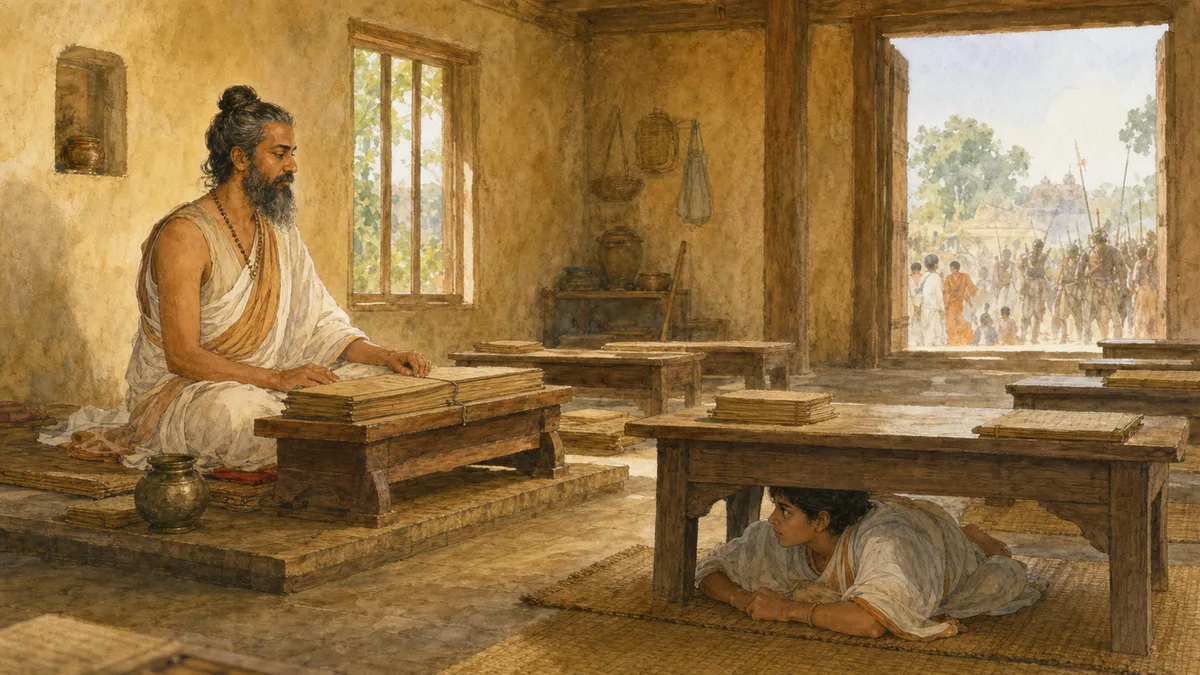
One teacher in a Vedic school taught Sanskrit grammar. The king of a neighboring state attacked the village where they lived. When the soldiers appeared, all the students ran away, but this teacher, as if nothing had happened, continued explaining grammar. Only one student remained, hiding under a desk, and listened to his instructions.
Samadhana means that presence does not waver. If samadhana is true, it is the same as faith.
