

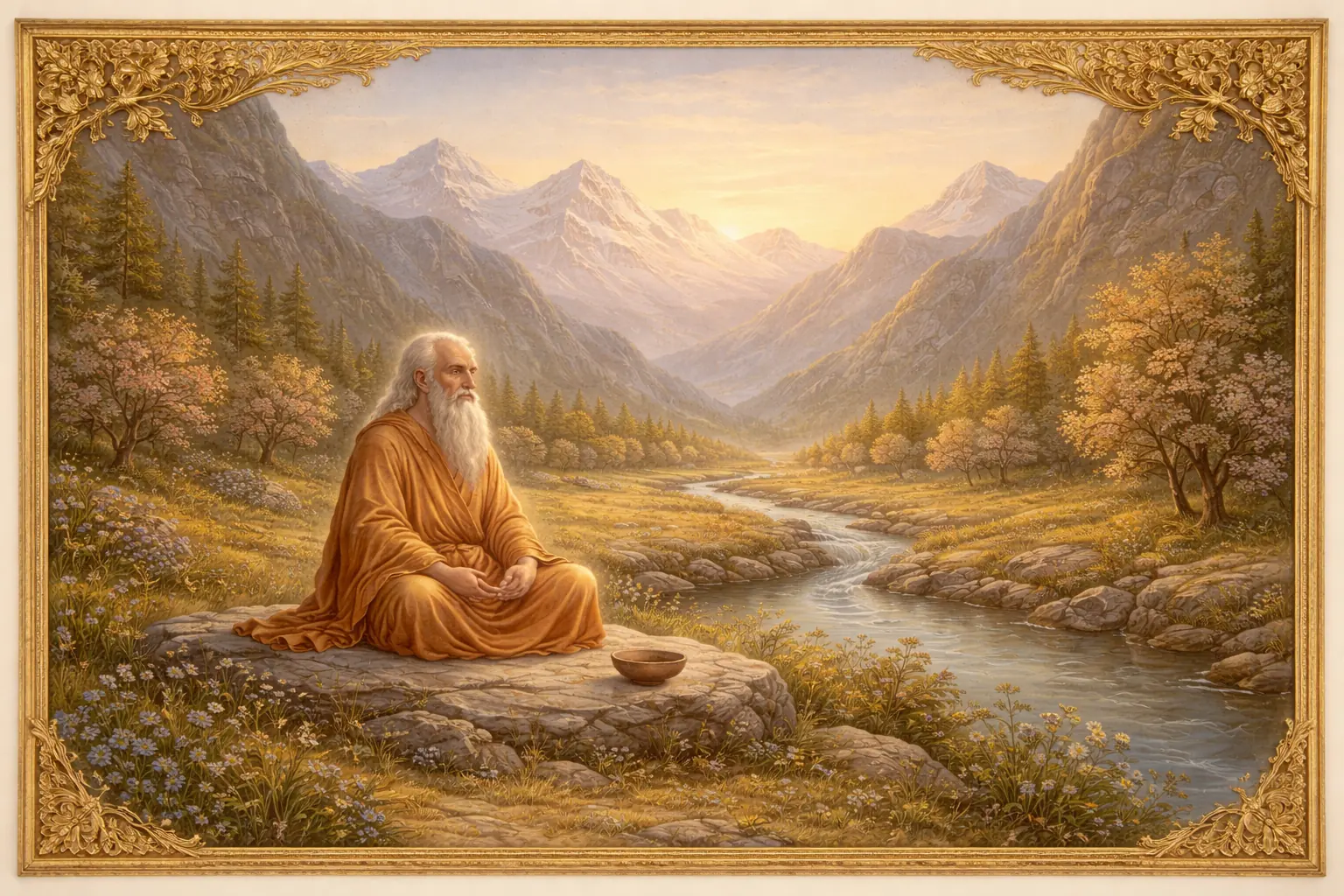
Commentary on the text “The Guru Padmasambhava’s Instructions.” The Testament “The Precious Point”
The Guru said:
People do not think about death. Human life is like a heap of chaff or a feather on a mountain pass. The demon, the lord of death, swoops down suddenly, like an avalanche or a hurricane. The afflictions are like straw ready to burst into flame.
The life of a human being rapidly diminishes, like shadows at sunset.
All living beings of the three worlds wrap themselves in the black snake of anger born from themselves. They pierce themselves on the horns of the red bull of passion born from themselves.
They obscure themselves with the impenetrable darkness of ignorance born from themselves.
They chain themselves to the rock of conceit born from themselves.
They are torn apart by the jackals of envy born from themselves. People do not understand that they can avoid the five perilous gorges of the afflictions.
Yet this life flies by in a brief instant, while samsara is endless.
What will you do in your next life? Moreover, the duration of this life is unknown. A person does not know when death will come. Like a criminal walking to execution, with every step they draw closer to death. All living beings are impermanent and must die. Have you not heard of people who have already died? Have you not seen one of your relatives die? Do you not notice old age approaching?
And still, instead of practicing the Dharma, you forget past misfortunes. Instead of being frightened by future hardships, you close your eyes to the suffering of the lower realms.
Pursued by fleeting circumstances, bound by the fetters of dualistic concepts, exhausted by the river of desires, entangled in the nets of samsaric existence, caught in the grip of karma, you continue clinging to amusements and remain careless even when the news of the Dharma reaches you.
Does death not come to people like you? I feel sorry for all living beings who think this way.
The foundation of Dharma practice is the four mindfulnesses. The four mindfulnesses are what make the spirit impeccable and vigilant. Often, when giving lectures on these subjects, I notice that many people do not particularly like them. I have noticed that people most enjoy listening to lectures on such topics as play, crazy wisdom, secret tantric practices, divine pride, and self-liberation. This expands their consciousness. While the lecture is going on, they feel almost like Brahman already. But when you lecture on the sufferings of samsara, karma, hells, the four mindfulnesses, and impermanence, their minds contract and shrink. They do not like listening to any of this.

However, whether you like it or not, this is how things are. Death exists, hells exist, samsara exists, regardless of how you feel about them. And until you come to terms with all this, until you give rise to a spirit of total impeccability, you cannot hope not only for liberation but even for a higher rebirth.
This is precisely the spirit that must burn within you. And only with disciples who possess such a spirit will I speak about play, divine pride, lila, crazy wisdom, tantric practices, and everything else. Because if such a spirit is absent, all of this will simply be a kind of showmanship.
Therefore, we must always compare our view with the view of the saints. And the saints insist on such a spirit of boundless faith, determination, and devotion to the Dharma. Otherwise, the sublime Dharma of gods and other inhabitants of the heavens will completely plunge us into illusion and delusion, confuse us, scatter the sharp point of our spirit, and make us weak-willed and indulgent toward our weaknesses. This must not be allowed under any circumstances.
Only boundless devotion to one’s path and mastery of the Dharma elevated to the level of an art can save us.
Nothing will help you at the threshold of death, so practice the Dharma. It is your best friend. Your Guru and the Three Jewels are the best company. Therefore, take refuge in them with all your heart. The practice of the Dharma is what is best for the state of your mind. Remember what you have heard, because the most reliable thing is the Dharma.
Whatever teaching you practice, cast off drowsiness, apathy, and laziness. Clad yourself in the armor of diligence. If you have understood the teaching, then, whatever it may be, do not separate it from its meaning.
The Armor of Diligence and Constancy in Practice
To clad yourself in the armor of diligence means to follow the sadhana day after day throughout your entire life—not for one or two days, or a month or a year—to perform the prescribed practices and accumulate merit. In other words, to practice the same thing even when you feel like sleeping or eating, when the weather makes you melancholy, when you are torn apart by desires, when you are cheerful, when you long for your relatives, when, on the contrary, you want to turn away from everyone, and so on. Dharma means moving forward with an even state of consciousness, without interruption, day after day, ignoring all of this. Only then do you have a chance to free yourself from the cycle of birth and death.

Then Guru Padma said:
Act in this way if you wish to practice the true Dharma. Keep the oral instruction of your Guru in your memory.
Dharma is very profound. Only the initial instructions are simple. The farther you go, the more inconceivable Dharma becomes. Each line unfolds into an entire universe, and a gigantic super-intellect, great clarity, is needed to comprehend it. Therefore, we make every effort to understand every word of Dharma thoroughly and make it our own.
The highest nondual teachings can very easily lead one astray. For example, having received initiation into divine pride, one may imagine all sorts of things about oneself without possessing even the most basic qualities. We once had a novice who had gained certain experiences and said something like: “You do not even know what the Guru and I have done for the Earth.” But holding such views is not a path to liberation; it is a path to a mental institution.
A practitioner cannot afford to be careless, to study superficially, to make no effort, to fail to examine every detail, or to make mistakes. Perhaps no one will even notice when he makes such a mistake, but existence does not forgive mistakes. The Guru and the guardian of Dharma may forgive them, but existence is merciless. That is the whole point. Therefore, a master has no right to make blunders.
From the very beginning, if one does not absorb the master’s approach, this will not be understood.
It is not enough simply to listen to the instructions of saints or the Guru; you must make them your heart, your breath, the meticulous record of your memory, and your living, moment-to-moment guidance.
Observing the Mind and Accumulating Sattva
Do not judge your experience, because this only fosters attachment or discontent.
Observe your mind day and night. If your stream of consciousness contains anything unwholesome, renounce it with all your heart and pursue only what is beneficial.
Your task as monks is to accumulate sattva (the radiance, the luminosity of consciousness). Sattva accumulates each time your thoughts are directed toward something elevated, pure, luminous, benevolent, toward love, compassion, divine pride, purity, exaltation, and impartiality. Sattva accumulates through contemplation. When you contemplate sacred images, perform prostrations, or recite mantras—all of this is the activity of sattva.

The great task of a practitioner is to accumulate as much of this sattva, this radiance, as possible. Our bodies truly emit a radiance that is called “kala” in Sanskrit. There are places from which it radiates. Depending on the phases of the moon, this radiance becomes weaker or stronger. The yogi’s task is to constantly accumulate such radiance. If you abide in the proper consciousness of samaya and purify yourself, this radiance grows day by day. Then one can even see a person’s face becoming brighter.
However, if a person is not in the right state of consciousness, if its very foundation has been undermined and there are obscurations, practice may not only fail to give them radiance; on the contrary, they may even lose this radiance. This is a very important point to understand. We must accumulate enough of this radiance over several years for it to qualitatively develop into something great—a flash. When sattva, radiance, reaches its culmination, flashes occur. Such flashes are called fleeting samadhi, or spontaneous samadhi. This is also called rasa.
The master accumulates radiance until such flashes begin to occur very frequently. If an ordinary yogin experiences a flash very rarely—for example, during an intensive retreat it may happen once a month or even once a year—then, when enough sattva has been accumulated, such flashes may continue uninterruptedly, day after day. They grow increasingly stronger until they form one continuous chain, occurring one after another and spreading like a universal conflagration. It is then that the yogin truly discovers the nature of Mind, resembling a boundless radiant flash. But this is possible only when we remove every impurity from our consciousness, because all obscured and impure states block the radiance of sattva. They prevent a flash of consciousness from occurring.
Overcoming Attachment and Aversion
Guru Padma then says:
It is quite possible that you will feel attachment to some sense objects and aversion to others. Abandon this.
Having entered the path of Dharma, one should close the doors to all attachment and attain great detachment. If there is even the slightest attachment to anything in your heart, know that this is a true mara, called the mara of the skandhas. And if attachment is accompanied by obscurations and impurity, this is the mara of the kleshas. All these maras must be conquered through negation, sublimation, or self-liberation.

One should also overcome aversion to objects. The other side of attachment is rejection, denial, and a negative attitude toward something. All of these are functions of beings dwelling in dreams. When you overcome both, it is said that you are approaching the single “taste.”
When you feel attachment to something attractive or aversion to something repulsive, understand that this is a delusion of your mind. A magical illusion and nothing else.
Upon hearing pleasant or unpleasant words, understand that these are empty sounds, like an echo.
When faced with harsh trials and misfortunes, understand that this is merely a fleeting occurrence, a mistaken impression. Realize: the Primordial Nature is inseparable from you. It is extremely difficult to obtain a human body, so having acquired one, it is foolish to neglect the Dharma. Only the Dharma can help you. Everything else is worldly temptation.
I once read a story from the life of Satchidananda Ganapati. One day, his disciples began noticing that in the evenings Satchidananda Ganapati would sit down and start mumbling the Vedas in some strange voice. When they asked what was going on, it turned out that a certain spirit had begged Satchidananda Ganapati to lend it his body for a while so that it could recite the Vedas and free itself from suffering. And out of compassion for the hungry spirit, Satchidananda agreed.
This hungry spirit was a brahmarakshasa—a spirit that had once been a scholar, practiced certain tantric practices, and even attained siddhis. But because it had practiced incorrectly, instead of attaining liberation it was reborn as such a hungry spirit, a brahmarakshasa. Its body was burning unbearably. So it asked Satchidananda Ganapati to rent it his body for a while, so that it could recite the Vedas and thus purify its karma. In return, it offered Satchidananda Ganapati to retrieve objects from the bottom of the sea, move objects from a distance, produce light and fire, and perform other miracles. Such things are easy for spirits. It asked him to provide this service for the rest of its life.
But when the disciples learned of this, they persuaded Satchitananda Ganapati not to do so because his body was suffering. But Satchitananda did not object. In the end, a certain ritual was successfully performed, as a result of which the spirit was liberated and reborn as a human being. The spirit said that approximately eight hundred years earlier, he had been a scholar who knew many Tantric texts, performed sadhanas, and attained supernatural powers. However, in his learning he neglected jnana (the light of wisdom) and merit, and therefore attained such an impure rebirth despite his intellectual understanding of the teachings.
The life of one who practices Dharma is like walking on thin ice or on a tightrope stretched over an abyss. Until we generate such a spirit of impeccability, we will make very many mistakes in our spiritual life. And only the instructions of the saints protect us from them.
Subtle Aspects of Karma and Actions
If you truly want to practice Dharma, be guided by virtue even in the smallest things. Renounce evil even in the smallest action.
I would say, “even in the tiniest thought.” When you perform any action, there is a subtle moment preceding the action. This subtle moment is called samskara, and an even subtler one is called bija. It is precisely through these samskaras that actions acquire one meaning or another. Actions are already the consequences.

For example, every action corresponds to a particular state of mind. And only if your clarity is high can you notice this state of mind. It is something elusive, the subtlest vibration that colors an action or deed. Everything else in the action then proceeds under the sign of this vibration. That is precisely why some actions create good karma and sanctify what is being done, while others create bad karma.
The same action can produce completely different results. Everything depends on which vibrations manifest in the instant preceding that action. For example, if you steal a cookie and begin to eat it, then before your hand reaches for the cookie, a vibration arises that creates a phantom image of the cookie and your body. This vibration consists of a low element of fire. Hungry ghosts have similar bodies. And so you eat this cookie. But this phantom has already been created, and this happened instantly, imperceptibly to your superficial consciousness. And this action is already connected with this phantom, and therefore proceeds under the sign of the world of hungry ghosts.
Conversely, if you take a cookie with presence and sanctify it according to a ritual practice, your state of mind becomes elevated. Before you perform this act, another phantom image emerges from within you, approximately from the level of the heart, creating sattva, light. It also colors your body with the subtle element of fire. And this cookie is sanctified. If you eat such a cookie, spiritual power accumulates, lifespan increases, and health is strengthened.
Thus, the same action produces completely different results. This is why saints can sanctify objects by blowing on them or reciting mantras over them. But people who do not practice do not understand such an important point.
In the same way, every action of yours creates corresponding karmas. When many of them accumulate, fruits appear. This is precisely why a practitioner can make a mistake even while performing the same action, but with a different state of mind. If an action is performed correctly, it produces results in dreams. An action performed correctly brings auspicious visions, blessings from deities, visions of light, and so on. An incorrect one brings unpleasant experiences in dreams.
Do not resort to flattery or engage in insincere friendships. Remain honest in thought and deed. The main practice of Dharma is always to be honest in thought and deed.
By sincere friendship here, relationships based solely on Dharma are meant.
