The Four Padas: Stages of the Spiritual Path in Shaivism
05.09.2026
0 мин. чтения
0
Share
copy
search
add
share
The Four Padas of Spiritual Development
“Foot; quarter; section; stage; path.” Pada refers to the principal divisions of the Agamic texts and the corresponding stages of practice and development on the path to moksha. According to Shaiva Siddhanta, there are four padas, which are sequential and cumulative; that is, by completing one, the soul thereby prepares itself for the next (in Tamil, Shaiva Siddhanta is also known as Nalu-pada-shaivam, “Shaivism of the four stages”).
The four stages of spiritual development, the four stages of life found in the traditions of Shaivism and Tantrism in general, are charya, kriya, yoga, and jnana. Jnana is also called anuttara. Similar stages also exist in Vajrayana Buddhism, except that kriya comes first and charya second, while everything else is the same. These four stages represent the soul’s development from a simple relationship with God to a deeper one.
Charya-pada: the Path of the Servant
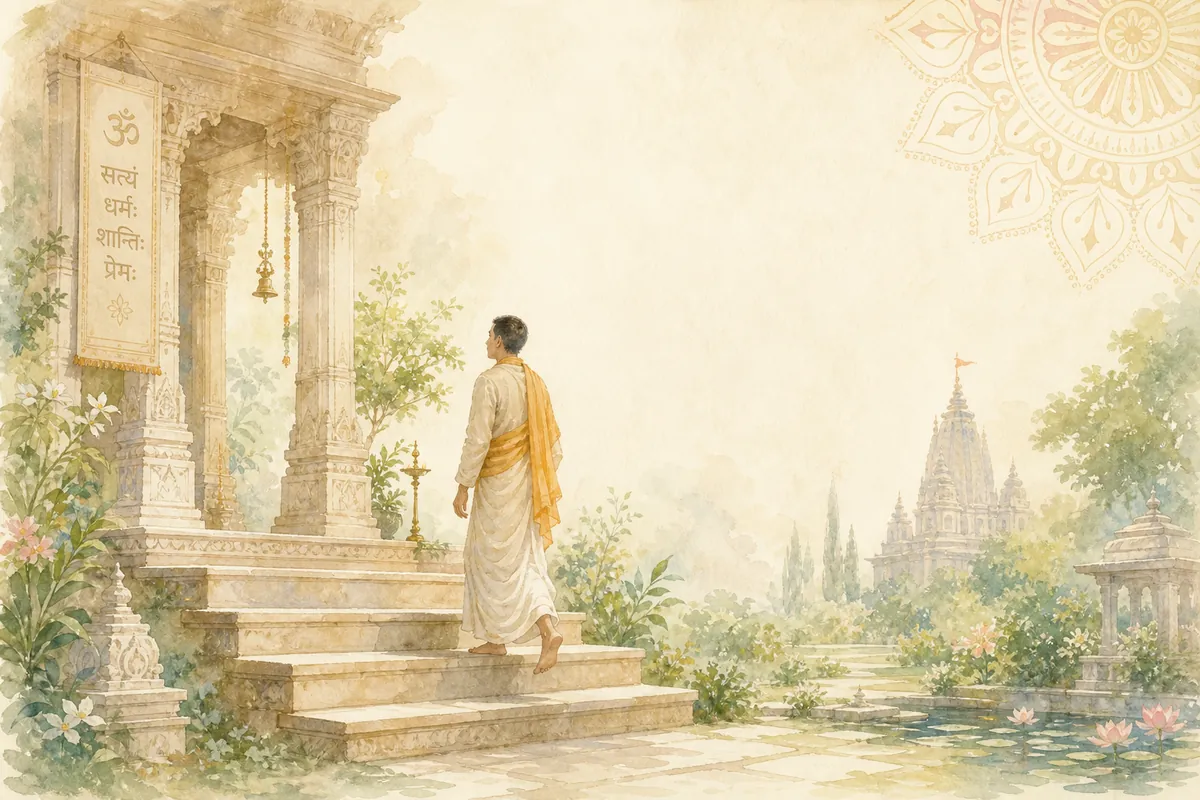
“Charya-pada: ‘The stage of virtuous conduct.’ The first stage, in which a person learns to live righteously and serve selflessly by practicing karma yoga. It is also known as dasa-marga, ‘the path of the servant.’ This is the time when the seeker relates to God as a servant does to a master. Traditional acts of charya include cleaning the temple, lighting lamps, and gathering flowers for worship.”
“Slave of God” is a Christian expression; we may be servants of God, but we do not call ourselves slaves.
At first, we always approach the ashram, the Guru, the Dharma, and the teaching through service, through seva, by seeing ourselves in the role of a sevak, a servant of God. For example, when a novice comes to an ashram, he performs seva while being conscious of this role. Everyone who draws near does so in this way, because it is difficult to see oneself in another role; therefore, the simplest thing we can offer is our karma yoga, our service performed with a pure mind and an open state of devotion, love, and heart.
This is very important, because if it is absent, then although we may do something with our hands, it is no longer karma yoga, seva, or dasya-bhava. A hired worker can also do everything without dasya-bhava, perhaps even better. The whole point of performing seva and simple tasks is to cultivate dasya-bhava within ourselves: an attitude toward God as the Lord, as the One whom you serve, worship, and to whom you give your time, your energy, your shakti.
Even if we directly follow the path of Anuttara Tantra, which is already the fourth and highest pada, this stage is still important for training the mind. When we perform seva and simple tasks, it is very important not to slip into an ordinary, mundane state, but instead to continually elevate the mind from the mundane level to the dimension of a servant of God, to service of the Absolute. This is the very meaning of service and karma yoga. The simplest action can become a means of drawing us closer to God, and what we do is not as important here as the state of mind in which we abide. If our state of mind is right, then everything else done by our hands, feet, and tongue will also be right.
If our attitude is wrong, we may accomplish a great deal, and do so efficiently, but sooner or later we will grow tired of it: our motivation is not right, and our ego will want to obtain fruits and results—but what material fruits or results are there in seva? None. You may arrange a comfortable life for yourself, but that is not what one seeks in the Dharma. Yet when you abide in dasya-bhava during karma yoga and seva, this bhava itself—the dimension of purity, faith, devotion, and love for God—is already the result at that very moment.
Moreover, regardless of what physical fruits and results you have achieved, this bhava is itself the fruit, itself the result. For example, you pull weeds in a state of devotion, and your mind is uplifted; this elevation of the mind is itself the result, the fruit. Then the supervisor comes and says, “You were pulling them in the wrong place.” You can pull them somewhere else, but the fruit of devotion still remains with you—you have not lost it. This is the result of karma yoga.
Worship at this stage is primarily external.
Kriya-pada: the Path of the True Son
“Kriya-pada: ‘Religious actions; the stage of worship.’ The stage of bhakti yoga, of cultivating devotion through the performance of puja and daily sadhana. It is also known as sat-putra-marga, ‘the path of the true son,’ since the soul now relates to God as a son does to his father. The central practice of kriya-pada is the performance of daily puja.”
At the kriya-pada stage, we perform daily worship. Kriya means that we are already doing something: reciting mantras, chanting texts, making offerings; we establish a connection with God through the ishta-devata, through the murtis of the deities; we attune ourselves to the flow of divine grace not through external physical actions, but through subtler energies, receiving the blessing of anugraha.
The kriya-pada sections of the texts describe worship, chanting, the mantras to be recited, and the sequence of ritual practice. For example, in the morning you perform arati and the Dattatreya-stotra, and in the evening arati and the bhajan-mandala—all of this is kriya-pada practice.
However, within kriya-pada practice itself there is a hidden, secret aspect that already belongs to yoga-pada, and within that there is an even subtler hidden aspect that belongs to jnana-pada or anuttara-tantra. Thus, all these actions contain subtler, hidden aspects. To practice means to uncover ever subtler aspects of sadhana.
Yoga-pada: the path of a friend
“Yoga-pada: having matured in the charya- and kriya-padas, the soul now turns to internalized worship and raja yoga under the guidance of the Sadguru. This is a time of sadhana and earnest aspiration toward the goal—the realization of the true Self—and this is sakha-marga, ‘the path of a friend,’ for God is now regarded as a close friend.”
Yoga-pada means that seven days a month or three days a month are devoted to sadhana and yoga, while in the morning, during worship itself, we practice visualization, transformation, and contemplation. In yoga-pada, all sadhana is internal, and we take refuge in God, whom we recognize as inner awareness in the chakras, winds, channels, pranas, nadis, and bindu.
In yoga-pada, all deities are placed within the channels of the body, along with all divine energies; when worship of divine energies is performed externally, transformation still takes place. In yoga-pada, the process of worship unites the worshipper with God to such an extent that a closeness arises, as with a friend, as with someone very dear, and equality gradually emerges between you and God. Equality in the sense that, in yoga-pada, your consciousness rises to the level of God and begins to experience the state of advaita, nonduality.
Jnana-pada: the true path
“Jnana-pada is the stage of wisdom. When the soul attains realization, it gains wisdom and lives beyond the life of the body, blessing all humanity. This stage is also known as san-marga, ‘the true path,’ on which God is the dearly beloved. The Tirumantiram describes the fulfillment of each stage as follows. In charya, the soul develops a close relationship with the ‘world of God’ (salokya). In kriya, it attains ‘proximity’ (samipya). In yoga, the soul attains ‘likeness’ (sarupya) to Him. In jnana, the soul enjoys the ultimate bliss of identity with Shiva (sayujya).”
Jnana-pada means that our mind is now sufficiently clear and pure, and we can apply the view and awareness of advaita, the principles of jnana yoga—shravana, manana, and nididhyasana. We can perform seva and engage in all the preceding padas in the spirit of nonduality. For example, while serving, we can remain in the actionless state of awareness; we can perform worship without dividing it into worship, the worshipper, and the one who is worshipped, in the spirit of nonduality. We can practice yoga while abiding in the view of advaita, combining nondual presence with the methods and techniques of yoga.
This highest path is also called the stage of anuttara-tantra: charya-tantra, kriya-tantra, yoga-tantra, and anuttara-tantra. At the level of anuttara-tantra, the yogin must abide in the dimension of “Aham Brahmasmi,” and the spirit of worship is expressed here in the phrase: “Shivam bhutva Shivam yajet” (You can truly worship Shiva when you yourself become like Shiva, one with Shiva).
At the level of jnana-pada or anuttara-tantra, the distinction between deities disappears, since all deities are manifestations of the principle of Brahman or Paramashiva, and the following phrase is important here: “Shivasya hridayam Vishnuh, Vishnoscha hridayam Shivah” (Shiva is in the heart of Vishnu, Vishnu is in the heart of Shiva, and one who separates them will not attain liberation).
Jnana-pada means seeing the world through the eyes of nonduality, of a single “taste,” through the eyes of the natural state of awareness, and following the path of sahaja-samadhi. It is jnana-pada that opens the door to sayujya-mukti, to the state of turiya, to complete union with the Absolute. Of course, turiya has many levels of its own, and there are different realizations of turiya, but sayujya-turiya is always a realization of turiya.
Salokya-mukti (birth on the divine planes) can occur at the level of svapna. Samipya-mukti (closeness to the ishta-devata), birth in heavenly dimensions, can also occur in the celestial, astral worlds, but sayujya-mukti is always turiya and only turiya. Jnana-pada teaches us how to abide in the dimension of turiya, and laya yoga is a direct introduction to turiya: the comprehension of turiya first at the level of the conceptual mind, then at the level of the contemplative buddhi, followed by abiding in constant turiya and then deepening it to its most profound stages, since there are eight stages of turiya—nijananda, brahmananda, jagadananda, and others.
But at first, of course, no one enters turiya, because entering the dimension of turiya even through the method of direct introduction is incredibly difficult. Initially, we experience something resembling turiya, and what we experience is more likely the state of dreamless sleep (sushupti). But this state is also important: it prepares us for the true experience of turiya.
For those who are unable to enter the state of dreamless sleep while awake, that is, jagrat-sushupti, it is difficult to realize jagrat-turiya, meaning turiya in the waking state through the method of direct introduction. Therefore, those with the greatest understanding first realize jagrat-sushupti; those who are less capable may realize jagrat-svapna, the state of closeness to the subconscious while awake. Those who are unable to assimilate this realize the state of jagrat-jagrat, that is, an intellectual understanding of turiya; they develop philosophical clarity. Using philosophical clarity as a springboard, they learn to contemplate so that they may eventually reach turiya.
The Importance of Understanding the Four Padas
Recognizing the four levels, the four padas, in any spiritual practice and any spiritual tradition is very important. We begin with something external, then we come to understand external worship and external relationships. For example, relationships with the Guru also have four stages, as do relationships with sadhus, with one another, with senior sadhus, and with the ishta-devata. These four padas exist in every lineage, every tradition, every form of yoga, and they can even be found in the Abrahamic, non-Dharmic religions—this is the very logic of the soul’s progress along the path.
The distinctive feature of Anuttara Tantra and Laya Yoga is that they immediately seek to reveal jnana-pada to you, on the assumption that we are already so well prepared that we can perceive it. But in reality, everyone perceives it at their own level. When we feel that we still need the other padas, we descend and practice yoga-pada, because we need yoga in order to perceive that which is lofty; we need to practice concentration and complete attentiveness, and work with the winds, channels, chakras, visualization, and mantras.
When we feel that we are still lacking something, we descend to the level of dualistic worship, ordinary worship, because we need puja, arati, sutra, bhajan-mandala, ritual practices, and theurgical practices. Finally, when we feel that there are karmas that simply cannot be sublimated in any other way, we descend to the lowest, first level—the level of seva (service)—because we need to cultivate many qualities and release many karmas through seva, through service.
Therefore, in the teachings of Anuttara Tantra and Laya Yoga, the methodology for presenting the teaching proceeds somewhat in reverse order, although it does not contradict the generally accepted interpretation of the four padas; it is simply a particular approach. In other words, a lay practitioner may receive the teaching of nonduality and direct introduction, and may even gain a small amount of experience and work with it. Yet one will still have to return to the four padas, because much within requires rethinking and reworking.
The Incompleteness of Individual Padas
Reflecting on the four padas allows us to see the logic of spiritual awakening in any method, any sadhana, and any spiritual tradition. There are spiritual traditions in which the final padas are absent. Karma yoga—good; worship—very good; there is no yoga, and they have simply never heard of jnana, while of those who practice jnana they say, “A philosophical speculator, a Mayavadi”—that is, two padas are simply missing. It is as if there were an excellent car with two front wheels, and you asked, “Where are the other two, the rear wheels?”—“That is Mayavada; those are philosophical speculations”—simply things unknown to them.
Or the opposite may be true: there is yoga, which is very good; in Western yoga centers, everyone practices yoga. Why do they practice yoga, and what is their motivation? Some seek success, wealth, and prosperity; others want a beautiful body—everything is so intuitive because there is no jnana-pada, nor are the preceding padas present—kriya and charya, worship and love of God, the cultivation of devotion, and the state of mind of a servant of God are absent as well.
It turns out that the ego cleverly takes advantage of this, acting as a thief: it simply appropriates it and says, “This yoga is for me, for the body, for success, prosperity, and good fortune in business,” because one pada is present while the other three are not; it is still a car with only one wheel.
There is another situation in which jnana-pada is given. For example, one is told: you are already God, you are perfect, relax and do nothing, abide in this state, do not ask, “How can I do this?” because the question itself is an illusion—continuous direct introduction, and everything is wonderful. But then people leave, return to their everyday affairs, and everyday affairs are karma; then they wait for another opportunity to attend some master’s satsang, to read and listen—nothing but talk about how everything is originally Brahman and how we are perfect.
The discussions seem correct—absolutely correct, using the very same words as the sacred scriptures, with no contradictions—but the three preceding padas, the three preceding wheels, are missing. Karmas are not sublimated, the mind is not pacified, love for God and devotion are not cultivated, the state of dasya (being God’s servant) is not cultivated, and yogic qualities are not developed.
This is just as effective as seating a cat before you, reading tantras and direct-introduction texts to it, and saying, “You are perfect, you are absolute, you are in nonduality.” It will look at you while you speak very intelligently, but then it will run away, catch mice, chase female cats, and live as cats usually do until the next session. You will call it back again, and this may continue for a million years; no one, not a single cat, has ever attained liberation.
There was once a Zen monk, somewhat mad, who had an experience and lived in seclusion. Since he wanted to preach but none of the people would listen to him, he caught cats. He had a small hall, a meditation room, where he seated them in neat rows like monks so that they would meditate, and when they tried to escape, he beat them with a stick.
Often, when Neo-Advaita masters transmit jnana-pada, they say the right things; everything they say is correct, and perhaps many of them have had profound experiences. But when the three preceding padas are absent, it is like a car with only one wheel: it does not work.
Therefore, in the Shaiva tradition, the Dharma is considered complete when these four padas are present. Exactly the same thing exists in Vajrayana Buddhism. At the same time, one cannot deny the fact that certain capable practitioners may rise through even a single pada after receiving direct introduction, because their merits are such that they completed the preceding padas in previous lives and all the necessary qualities have already been formed. This is possible, but rare. Or someone may have completed two padas, or one preceding pada, and begins from the level attained in the past.
Determining Your Level
Here we must also understand for ourselves which padas we have completed and which we have not, which one is most relevant to us in this life and is the most important, and which one is the next for us to master. For example, if your love for God is established and steadfast—that is, if serving God is something natural to you—and if you successfully perform even independent rituals, invocations, and worship practices, if this inspires you and you are ready to perform them constantly, then you have completed the previous two padas and your next pada is yoga-pada.
You will need to develop concentration, purify the winds and channels, learn pratyahara and pranayama, and realize the path of samadhi—at least the samadhi of Raja Yoga—and then move from it to jnana-pada.
If your feeling of love and devotion for God is naturally innate and intuitive, and you derive great pleasure from worship, which also intuitively brings you great pleasure, joy, and merit; if your yogic qualities are strong, so that you can sit in a posture for a long time, have few desires, and possess an ascetic state of mind, this means that in a previous life you realized the three preceding padas. But in this life you need to master jnana-pada, gain a thorough understanding of nonduality, contemplative practices, the teachings of Advaita, and the natural state.
Sometimes a person has an intuitive inclination to perform seva and make offerings; they simply build a temple and constantly give something for the sake of the Dharma. This means they have the samskaras of charya-pada, but they need to master mantra yoga, the ability to perform worship sadhanas, and delve into the initial practices. In other words, one pada has been formed in them, but the remaining three require development.
Thus, depending on their merits, each individual is at one of the pada stages and needs to realize the subsequent stages.
Shaivism
Advaita
Anuttara-tantra
Karma Yoga
Turya
Seva
Jnana-pada
Charya-pada
Kriya-pada
Yoga-pada
Author Гуру
Read 11 times
Articles
Vidya AI
Search
Lectures
October 31, 2026
Mantra of the day
ОМ НИТАЙЕ НАМАХ ОМ Добродетели – поклонение!
Auspicious Times(Rome)
Brahma Muhurta:
04:51 - 05:46
Abhijit Muhurta:
11:32 - 12:14
Sayam Sandhya:
16:46 - 17:28
Mokshada Ekadashi (6 November)
Ekadashi of liberation. Helps to achieve spiritual enlightenment.