Four obstacles on the path to samadhi and methods for overcoming them
31.08.2026
0 мин. чтения
0
Share
copy
search
add
share
We continue examining the prakriyas of Vedanta, prakriya 54, “The Four Obstacles to Attaining Samadhi.”
The four obstacles to attaining samadhi:
laya — fading
vikṣepa — distraction
kashaya — attachment
rasasvada — egotistic enjoyment
The first two obstacles are obstacles you are already familiar with. Laya is fading, a sluggishness of the mind when the object of concentration or the object of meditation slips away. This fading may be either gross or subtle.
For example, you are sitting during meditation on Mahashanti or during iṣṭa-devatā-dhāraṇā, and the mind becomes tired, the object gradually slips away, and you become distracted. Subtle fading means that the object does not slip away, but the mind barely holds on to it, as if in a dream. It seems that you are meditating, but there is some overly dim, dulled state—these are signs of fading (laya); there is no clarity. Meditation imperceptibly loses its brightness, and then you find yourself in such an unclear state altogether. Time passes, and you do not know—perhaps you were asleep, perhaps you were meditating, but you do not remember the objects of meditation. Something was there, but it was all somehow dulled. This is laya (fading).
Vikṣepa, on the contrary, is agitation, distraction from objects caused by constantly interfering thoughts. If the antidote to laya is intensifying concentration, when we must somehow invigorate ourselves and make an effort to concentrate well, then with agitation it is the opposite.
Agitation means that our mind wanders. There is also gross agitation and subtle agitation. Agitation means that our mind constantly loses the object of meditation, jumping to other sensations and other thoughts. The antidote to agitation is relaxation. Our mind is too feverish in some way. We need to relax more and discover more space.
Attachment, kashaya—the antidote to it is viveka. Rasasvada (egotistic enjoyment) during meditation, being captivated by certain wonderful states—the antidote here is not to react; whatever arises, let everything go.
A great many treatises and works have been written about these states. We will gradually study them so that our meditation has no flaws and is gradually corrected, because everyone has flaws in meditation. When we sit down for Mahashanti—you should know this—you are not sitting down in Mahashanti; you are sitting down in flaws. At first there will always be flaws, but this is normal.
Laya and Vikṣepa: From Gross Obstacles to Subtle Ones
The first flaw is fading and agitation (in their gross forms), and during the first years your task is to struggle with them during Mahashanti or during any dhāraṇā or dhyāna on retreat. This is a struggle with gross fading and agitation.
When gross fading and agitation have been overcome, subtle fading and agitation will arise, and in the following years, during Mahashanti and any meditation, you will struggle with them. Then you will overcome them, and if you overcome them, subtler things such as kashaya and rasasvada will arise. All these omissions and flaws in meditation must be known so that you can quickly overcome them by applying the correct antidote. There is a specific antidote for each of them.
The attainment of nirvikalpa-samadhi, together with the stages leading to it, is obstructed by four obstacles called laya, vikṣepa, kashaya, and rasasvada. Laya is the “sleep” of a modification of chitta, resulting from its not remaining on undivided reality.
Undivided reality is Brahman.
Vikṣepa is the abiding of modifications of chitta on something extraneous, resulting from its not remaining on undivided reality.
Agitation and distraction are all synonyms for vikṣepa. Vikṣepa means that our mind constantly generates and projects something, and we are carried away. Our mind is capable of generating any thoughts and any images, and it is capable of traveling through these images, following them—this is vikṣepa.
Vikshepa plays a major role in rebirth. It is precisely in rebirth that the subtle body and the mind possess enormous creative freedom, but this freedom is both an opportunity and a problem. If the mind has not been pacified, then the freedom of the mind manifests in such a way that the slightest mood or state of mind instantly changes the situation.
For example, a person found himself in an intermediate state, and an image of his body had been created for him, but then subtle hidden impressions and tendencies began to emerge, his mood began to change, and the image of his body also began to change.
For example, if his mind became clouded, he was wearing a white suit—and stains appeared on the suit. If he became frightened, snakes appeared beneath his feet. And if lust arose, his clothes disappeared. And if hunger arose, the body began to take on some kind of ugly appearance: a belly appeared, the legs became short, and the neck thin.
All these states of mind, the slightest fluctuations of the mind, the slightest changes, have a direct influence on the subtle world, the subtle body, and the surroundings. This is the projecting activity of the mind.
If, however, the mind is liberated, abides in space, and remains in pure vision, then the yogin retains a beautiful, splendid form. This form is full of divya-bhava, possesses divine attributes, and is full of nonduality; it is connected with the idea of emptiness.
Vikshepa: Cessation of the Projecting Activity of the Mind
The task of eliminating agitation (vikshepa) is to stop the uncontrolled projecting activity of the mind. When we apply an antidote, if we intensify concentration excessively, we will inevitably become involved in thinking. When we strain ourselves and try to restrain too much in order to overcome dullness, drifting, and laya, if we become too absorbed in relaxation, we will instead become dull. Balance is very important—how to maintain a balance between drifting and agitation.
Here we must understand clearly that within us there is mental content: our thoughts, our emotional state, and our sensations. There are also various mental processes, such as intensified concentration, relaxation, and subtle-level cognitive processes. And the whole question is to what extent we can regulate the cognitive processes within our consciousness and free ourselves from mental content.
Mental content consists of hidden inclinations, patterns, fixed ideas, habitual images, and concealed tendencies—all of them exist within us; we are literally saturated and stuffed with them. Contemplation, the self-liberating work of pacifying the mind, humility, mindfulness—all that we do in everyday life is intended to free us from mental content and make us empty.
Before practicing samadhi and the path of the natural state, the yogin must be sufficiently empty, because his lack of emptiness, both in meditation and in sleep, and in the intermediate state, will inevitably manifest as this vikshepa (projecting force).
The Four Guardians of Samadhi: From Laya to Rasasvada
Kashaya is the non-abiding of the modifications of chitta in the indivisible, due to its “paralysis” by its vasanas: passion (raga) and others, which occurs even in the absence of laya and vikshepa. Rasasvada is the “tasting” of the bliss of savikalpa-samadhi by a modification of chitta, due to its not abiding in nondual reality, or the “tasting” of the bliss of savikalpa-samadhi at the moment nirvikalpa-samadhi arises.
When chitta, free from the four obstacles, motionless like a flame without wind, abides solely in Being, in indivisible Chaitanya, such abiding is called nirvikalpa-samadhi. It is said of this: “When laya arises, chitta should be awakened; when distraction of chitta arises, it should, on the contrary, be calmed; if kashaya obstructs, it should be recognized; having attained calmness, one should not waver. One should not experience pleasure, but through wisdom should become unattached to it.”
“Mandukya Karika”
At first, when you meditate, there is simply dullness, blurring, and sluggishness—this is the first guardian that blocks the entrance to samadhi. If you pass through it, for example, by intensifying your concentration, vigilantly maintaining awareness, and managing to sit for a long time without falling asleep or entering a dim, sluggish state.
First, you will pass through gross blurring, when the mind becomes tired and the object simply slips away somewhere. Then the gross blurring will disappear, but subtle blurring may remain, when the object does not slip away, but the mind barely holds it as if in a dream, and the brightness becomes dulled, so that the meditation imperceptibly loses its vividness.
When you pass through this first guardian, you will see that there is no sleepiness, that you can remain in a certain concentration and in a certain vigilance, and this vigilance creates such a vivid intensity of consciousness. Here the second guardian to samadhi will open, preventing your progress or blocking the way to samadhi—this is vikshepa (agitation).
You will see that, because of such concentration, the mind begins to enter into images, and various states begin to be projected. The slightest distraction, and the mind has already gone somewhere, beginning to jump from one state to another. The slightest forgetfulness, and subtle images begin to arise, and you constantly enter into and become absorbed in these images.
Here you need to relax consciousness, give it breadth, give it space, so that these images do not carry consciousness away but are extinguished at the very outset. Here your skills in the natural state, your ability to remain in the view, in open contemplation of space, in integration with the sky, and your habit of being in an expanded state will certainly help you.
When the agitation passes and you attain such a balance, this means that the second guardian obstructing samadhi has been passed. Finally, you come to the third. The third is subtler.
This does not mean that afflictions suddenly arise during meditation—for example, you are sitting in meditation and anger or sexual desire arises. No, although of course that can also happen, but that is generally an issue for beginners. What is meant is that during meditation, subtle layers of the mind are exposed, and these subtle layers of the mind give rise to attachment—an imperceptible, very subtle attachment. All the preceding states are subtler, and here viveka is needed to distinguish these subtle layers of the mind from the object of your meditation—for example, emptiness in mahashanti, the image of the ishta-devata, and so on.
Laya (“dissolution”). The mind is not focused on the object of concentration, that is, on indivisible reality, but due to dispassion it does not become focused on extraneous objects either. Thus, it falls into sleepiness, stupor, and inactivity.
It is believed that meditation in a state of blurring is harmful because it can impair memory. And it was said of Zen monks who spent long periods in such states that they might be reborn as animals. In other words, they meditated diligently, remaining in a state of blurring for decades, and this is a half-asleep state—even lacking the vividness present in ordinary life. In ordinary life, there is a certain vividness due to egoistic activity and desires, whereas they did not even have that kind of vividness, and if this state becomes entrenched, it is worse than ordinary life.
A yogin must make the most determined efforts to overcome such blurring. Ignorance of these instructions is fatal to your meditation.
Question:I have a question—the thing is that when I meditate, most often I accelerate the energy (shakti), and then it makes me enter a state that allows me to enter emptiness or light. Then I can maintain this mind, the blurring, vikshepa, and laya.
How do you accelerate the energy?
Question:With a mantra, let us say. I begin reciting the mantra and for some time simply imagine, that is, visualize, and then shakti increases, and then it turns out that you emerge from the state, and then maintain this state. It allows you to enter a state of emptiness. So then you enter this state and begin to maintain it; that is, I kind of maintain this state rather than trying to enter somewhere. In other words, through myself I enter this state. And is it wrong when shakti is being intensified?
As an antidote, you should intuitively seek out methods. This is not the arousal of shakti—reading a mantra is not the same as arousing shakti. Reading mantras means increasing the frequency of vibrations and heightening bhava—this is normal and correct. Intuitively, you need to seek out how, specifically in your case, you can overcome dullness or agitation. All methods available to you are useful here.
Question: So, one should increase bhava, and then it becomes possible?
Yes. Guru yoga and taking Refuge at the beginning of meditation are all things that increase your bhava, your vibrational frequency, which means that from a higher frequency, from a higher quality of spanda, you can meditate better. Grace is very important at the beginning of meditation.
Victory over Dullness: Antidotes to Laya
Having realized this, the practitioner should abandon the inertia of the mind and make it wakeful again.
We must truly make every effort not to fall asleep during meditation, in order to overcome the first enemy of meditation. We must consider which antidotes will work in our case. Every approach to the mat during meditation is like being called into the ring by an experienced martial artist, and you must approach the mat with the full awareness that this is your battle now. Your task is to win this battle, or at least bring it to a draw.
Losing this battle, when you become distracted and fall asleep, is like the gong sounding: another mahashanti has been wasted. If years, months, and days pass this way, you are constantly suffering defeat, accumulating dissatisfaction; wisdom does not come, and you grow old. This means that, with full responsibility, you must set yourself the task of turning every meditation into a victory over dullness. But to do this, you need to understand that this victory will not come on its own—you must prepare yourself in advance, express a sankalpa, and apply an antidote. Failing to apply an antidote in this case is fatal for meditation.
A simple application of an antidote is to intensify concentration and invigorate the mind. There are various other ways to invigorate the mind, for example:
Concentrating on light
Directing your gaze slightly upward
Meditating with your eyes open rather than closed
In other words, when you feel sleepy and still close your eyes while meditating, this is a sure sign of dullness. You are no longer closing your eyes simply because you are closing them, but because you feel sleepy and cannot keep your eyes open—they close on their own. This is a mistake. As soon as you close your eyes during meditation, you are already entering a state of laya with absolute certainty.
An ancient monk took an awl, placed it beside him, and pricked himself in the thigh during meditation. In the same way, we need to devise a method to overcome such gross dullness, and then subtle dullness.
Overcoming Vikṣepa
Vikṣepa (distraction) is the mind’s failure to remain on indivisible reality and its being distracted by something else. The immediate causes or conditions of distraction may include bodily movements, physical discomfort, labored breathing, fatigue, and so on. The means of overcoming distraction is to calm the mind through patience and perseverance.
We must pay attention—if the mind is agitated by vikṣepa—to relaxation. In a relaxed body, the winds become harmonized; in a relaxed body, prana naturally enters the sushumna, and we can concentrate on the subject we need. In a relaxed body, space opens up, and this opening of space is very important for the mind. To go beyond names and forms, we must give the mind more space.
Overcoming Kashaya
Kashaya (“passion”). When the mind does not remain on the object of concentration, experiences of raga (pleasure), dvesha (hatred, anger), and so on may arise.
What is this? It is when you feel that you are experiencing something on a subtle level. You are sitting, but it seems to you that some vague memories are coming, and the mind seems to be conducting conversations—the mind with someone else, but in reality with itself—and experiencing certain bhavas, initiating an internal dialogue. Even if you have managed to overcome both gross and subtle agitation, some subtle moods still arise, along with a subtle attachment to these moods, and you become involved in them again.
To overcome kashaya, viveka is needed—the ability to focus on discerning pure space, the calm space of awareness, and these subtle passions that fill the mind.
These emotionally charged impulses throw the mind from side to side, like a gust of wind tossing a boat at anchor, and temporarily “paralyze” it.
Instead of concentrating on the meditation object, the mind becomes drawn into various emotional bhavas, subtle vague, formless memories and moods. It is like a little boat in an ocean that tosses it this way and that, and attachment to all these moods arises.
The yogin’s task is to pull the mind out instantly with the help of discerning vigilance, as soon as they arise. From the perspective of anuttara tantra, we must apply self-liberation upon the arising of such states—as soon as they arise, they must be instantly recognized and dissolved.
Having noticed that the mind is distracted by a passionate impulse, one must realize that the nature of this passion is impure, and that its objects are transient, frivolous, and impermanent. Thus, having established through rigorous discernment the insignificance of this passion, one should relate to it neutrally and once again immerse oneself in the object of concentration and meditation.
The principle here is not to react, whatever may arise. Let everything go and leave it as it is. If subtle space is recognized by us—if subtle space is not recognized by us, then with the help of viveka we should simply cut off the unnecessary state.
Rasasvada—the Obstacle in the Form of Pleasure
Rasasvada is an obstacle in the form of pleasure. Having reached the final stage of the eight leading to nirvikalpa samadhi, the adhikarin enjoys the bliss of savikalpa samadhi, ecstasies and visions, and unusual abilities.
Rasasvada is experienced only by yogins of a high level, who are capable of entering savikalpa samadhi. Someone may think: “But it is wonderful to enter savikalpa samadhi. Why is this considered an obstacle?” If attachment arises in you, along with the desire to experience and enjoy the bliss of savikalpa samadhi, this means one thing: you will not progress beyond savikalpa samadhi, and nirvikalpa samadhi is closed to you. This is the fourth guardian preventing entry into nirvikalpa samadhi. This is what is called bliss, clarity, and emptiness. These are very subtle states to which the mind may become attached, and the task is to cut off selfish enjoyment, not to desire to make use of the fruits of nirvikalpa samadhi, not to identify oneself with bliss, not to identify oneself with visions (a vision is clarity), and not even to identify oneself with gross forms of emptiness, to which attachment arises, which do not dissolve anava-mala at all and do not dissolve the “I.” The gross form of emptiness gives rise to attachment, leaves us unchanged, and creates the tendency of a pralaya-kala.
All this stops him on the path, and he forgets that the highest goal has not yet been attained. There is a parable about a man who heard of a treasure hidden beneath a stone. He travels a long way, finds the stone, but sees that the treasure is guarded by a gigantic dragon. A battle to the death follows, and finally the dragon is killed, but the man is seized by such wild joy that he begins dancing around the dragon, forgetting about the treasure itself. To overcome this obstacle, discerning awareness is necessary; one must regard what has been attained as ordinary, that is, impermanent, in contrast to the highest goal—the attainment of the supreme reality (Brahman), liberation, and constant Bliss.
Attachment to Subtle Worlds as an Obstacle to Liberation
Thus, while experiencing various phenomena, the yogin treats them as ordinary and does not allow these experiences to impress him or change his consciousness. As ordinary—these are indeed ordinary experiences that have little significance from the perspective of attaining samadhi. They reveal the subtle world and the subtle body, but, essentially, they reveal nothing, because the subtle world is not an achievement, it is not God, it is not our original goal—it is simply the subtle world. And if the mind overestimates the significance of the subtle world, it easily becomes prey to the subtle world. In the same way, if the yogin overestimates the significance of the mental world or the causal world, he also becomes easy prey to the mental and causal worlds. To become easy prey means that, having established a connection, one is absorbed by it, allowing it to seize and draw in one’s soul. Each world possesses its own psychophysics, its own force of attraction, its own beings inhabiting it, its own appeal, its own enchantment, and its own magical power.
While meditating, the soul must pass through these worlds without being drawn in or enchanted by their magical power and appeal. This is very important, because allowing oneself to become enchanted by yet another world or another layer means missing the mark and failing to hit the target. Instead of turiya, liberation, one enters a kosha—for example, pranamaya kosha, manomaya kosha, vijnanamaya kosha, or anandamaya kosha. In a sense, becoming engrossed in the subtle world is also maya, perhaps something resembling virtual reality. For some, virtual reality may be an advanced level of reality, but for a sadhu, the astral world is the same kind of virtual reality.
If, instead of meditating and abiding in the true state, someone becomes absorbed in news, images, pictures, and virtual-reality films, they are lost. Nowadays, as is well known, many people become lost in virtual reality. They spend years... A laywoman in our community who has the Creed as her guiding symbol—my disciple—had children who grew up while her husband spent several years in virtual reality; he did not notice his children growing up. When he came to his senses, he asked: «How did this happen at all?» He was simply absorbed, went to work, and spent all the rest of his time in virtual reality. Such a state can occur when the soul is seized by the subtle world; then, in the next life, the soul creates the cause to become a spirit of the subtle world, and that is all. Our task is ultimate freedom—freedom in God, freedom from the physical world, freedom from the subtle world, freedom from the mental world, and freedom from the causal world.
Ten Signs of Clarity in Meditation
This is a very subtle line of discernment, sharp as a razor’s edge, and when we meditate, ten signs of clarity manifest. They are also called signs of purification and signs of abiding—these are what kundalini yoga calls the signs of night and the signs of day.
What do these signs indicate? They indicate that the five pranas are beginning to enter the central channel and that we have attained sufficient emptiness and sufficient clarity, so that the winds do not deviate and we are proceeding along the path of liberation. We have gathered our energies, and our energies, just like our consciousness, are liberated through the sushumna.
Five Signs of Purification
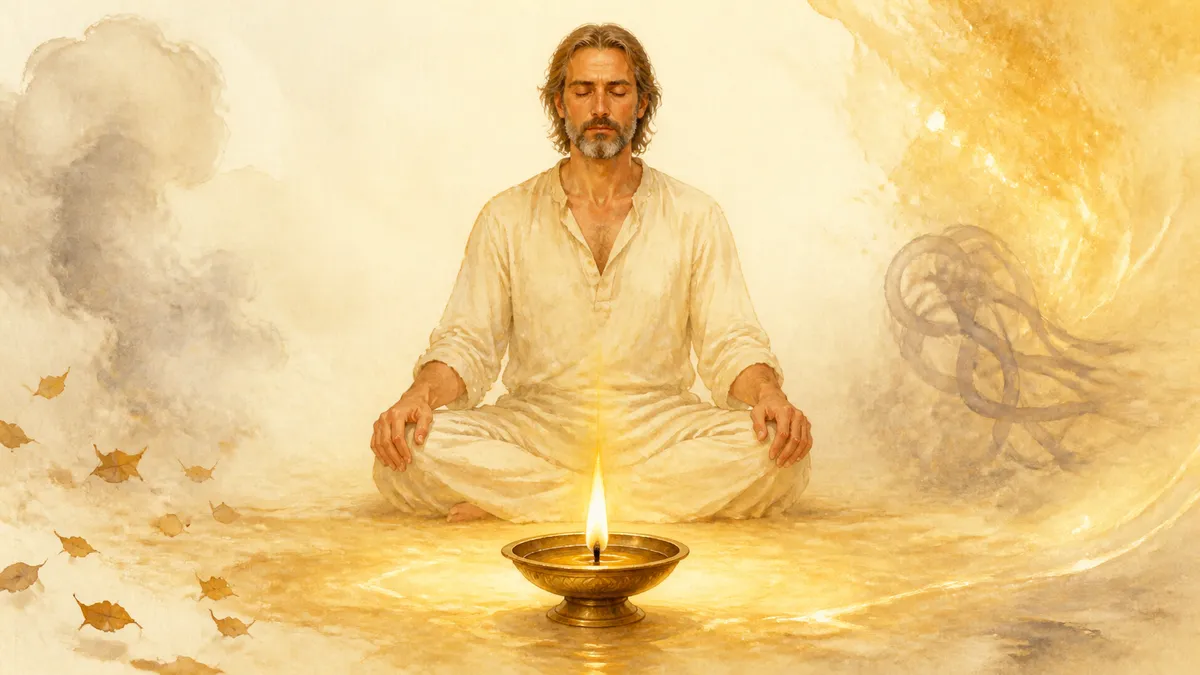
The sign associated with earth is smoke. What it looks like: swirling smoke.
The sign associated with water is mirages. What it looks like: pulsating rays of light, like a drizzle on glass when you look through the glass at something.
The sign associated with fire is fireflies or a snake-like flowing glow. What it looks like: the successive appearance and disappearance of emanations.
The sign associated with air is a burning lamp. How it may be perceived: as rows of lamps or as a dawning sunrise.
The sign associated with space is clouds. How it is perceived: like passing through a sieve of clouds or a mesh, when you feel light breaking through shreds of fog or patches of clouds.
These are the five signs of purification, indicating that the winds have begun to enter. Apana has begun to enter—this is smoke; samana has begun to enter—fire; prana has begun to enter—a lamp; udana has begun to enter the sushumna—clouds, the vision of light breaking through the clouds.
The Five Signs of Abiding
Following this, when you have overcome all these obstacles and have truly entered a sufficiently deep state of meditation or samadhi, five signs of the day, or five signs of abiding, manifest. This means that the purified prana currents have entered the central channel and remain there for a sufficiently long time.
The sign of the earth element’s energy entering is a blazing radiance.
The sign of the water element entering is like a waning moon.
The sign associated with the fire element is the experience of a rising sun within.
The sign associated with the air element is the experience of darkness, an eclipse.
The sign associated with the space element is the experience of a flash, that is, pure light.
Thus, these are signs that our meditation is progressing successfully enough and that we have overcome all the obstacles on the path of meditation.
Subtle Methods for Overcoming Obstacles
There are methods for overcoming gross obstacles, that is, gross dullness and gross agitation, but when we have managed to overcome gross dullness and gross agitation and such subtle things as kashaya and rasasvada remain, there are subtle methods for overcoming the very subtle states that obstruct meditation.
The first is called the “Brahman’s cord”; the second is called the “rope holding a bundle of straw”; the third method is the “child in the temple,” mentally lively as he observes the frescoes; the fourth method is called “the elephant pricked by the thorns of plants.”
The most important of the four methods is the “Brahman’s cord.” The root instructions say:
It is very important that tightening and relaxing remain balanced, so apply them as one braids the Brahman’s cord.
For example, when you meditate, you are often advised to alternate atma-vichara of space and atma-vichara of mahashanti in your schedule; this is the principle of the “Brahman’s cord.” What does it consist in? In maintaining balance. When you concentrate, excessive tension and excessive thoughts may arise. When you relax, on the contrary, drowsiness and dullness may arise, and the task is to maintain this balance for a long time. In other words, if you want to meditate for a long time, you must master not only methods for overcoming initial laya, vikshepa, and kashaya, but also methods for subtly overcoming all these problems.
If during meditation you apply tightening too zealously, your thoughts will wander somewhere else; if you overdo the relaxation, you will sink into dullness, so bring tightening and relaxation into balance. Moreover, beginners first practice tightening in order to cut off the continuous arising of thoughts, and then, when they realize that they have overdone it, they apply relaxation and try not to react to whatever arises. By applying both techniques alternately, try to balance them. If you alternate tightening the mind’s concentration and relaxing it again and again, this technique is called “braiding the Brahman’s cord.”
The instructions associated with the metaphor of the “Brahman’s cord” were created to correct the errors characteristic of the two previous types of practice—tightening and relaxation. The application of tightening and relaxation is based on the assumption that subtle-level dullness and agitation, as well as complex cognitive processes, are the “enemies” of meditation. To perceive these flaws as the “enemies” of meditation means to engage in subtle-level discrimination. At this stage of practice, meditators are advised to abandon such false discrimination through “meditation involving the combined application of tightening and relaxation.” By combining the techniques of tightening and relaxation, the practitioner changes nothing else in meditation. Subtle-level dullness and agitation still arise from time to time. The practitioner continues to use these changing mental factors.
So, you should have a booklet with sankalpas for overcoming dullness and agitation, which it is advisable to read before you sit down for mahashanti each time. Once, back in Divya-loka, I wrote these sankalpas myself, recommended them to the students, and handed them out, but if you do not have one, you need to find it.
Eliminate one with the other whenever necessary. However, a beginner tends to apply intensification and relaxation excessively when they notice dullness or agitation. The way to solve this problem is to shift awareness to something else at the moment when the processes of intensification and relaxation begin to proceed in balance. In this case, the chosen object of meditation becomes the mind itself. The yogin said: “Meditating on the body of wisdom is like weaving the ‘brahman cord.’ Continuously keep the mind authentic and uncontrived. If the mind is established in this state, it will move up and down. When ordinary defiling obscurations arise, change the position of observation and meditate on the co-emergent mind.”
When practitioners are no longer concerned that dullness and agitation might cause them problems, they are no longer inclined to intensify concentration or relax excessively when these faults actually arise. The terms “authenticity, unaltered by artificial activity” and “continuous” are connected with reducing the efforts that practitioners themselves apply to meditation. A closely related meaning is “to leave alone.” When subtle levels of dullness and agitation arise, practitioners who are interested only in “the mind itself,” rather than in any mental events occurring within it, find it easier to “leave alone” these faults. Dullness and agitation continue to arise, but practitioners are now able to use increasingly subtle forms of intensification and relaxation to eliminate them.
Thus, if at the initial stage intensification and relaxation are not connected with abiding in the nature of Mind and are practiced literally in order to extinguish these enemies, then weaving the brahman cord means that we intensify concentration or relax by shifting the focus of attention to the nature of Mind as we recognize it. In this way, we remain in balance and dissolve various subtle obstacles.
Question: Gurudji, so when the mind itself is interesting, rather than the mental processes occurring within it, and severing the “I” from the root of samsara (the ego)—is that the essence? If you are not fixated on yourself, severing the “I” from the ego, and you shift the focus of consciousness to another consciousness, for example, Guru Yoga, that is, to the awareness of higher beings, souls. If you recognize Guru Yoga in the soul as pure space of awareness?
Yes, that is, by doing this you sort of pull it out, and then the mind itself becomes interesting, rather than the mental processes occurring within it. When against this background you maintain a balance between concentration and relaxation, this is the method of weaving the brahman cord. What we are weaving here is our mind. The cord is our mind.
Question: Is it then automatically maintained in balance if this Guru Yoga attunement is maintained correctly?
Yes, ideally, this is the most important thing. As your practice progresses, your struggle with laxity, agitation, subtle attachment, or subtle pleasure—that is, with vikshepa, laya, kashaya, and rasasvada—takes on an increasingly subtle character and is accomplished through abiding in the nature of Mind, natural self-liberation, and natural self-surrender. When you master self-liberation and self-surrender, all these obstacles naturally dissolve. You immerse yourself in bliss, bypassing all these mental complexities; but at the beginning this is impossible, though you should strive toward it.
Practitioners do not resort to subtle-level discrimination that conditions a negative perception of these faults, nor do they make excessive efforts to eliminate them. The metaphor of weaving a cord accurately reflects this process. The author of the commentary explains it as follows: “When the brahman cord is spun, the threads are not allowed to become tangled by pulling them tight. Nor are they allowed to break by loosening the tension. In the same way, when the mind is being ‘spun,’ it is necessary to maintain a balance between intensification and relaxation—this is the best way to understand how they should be applied.” An inexperienced spinner may hesitate, checking whether there is any danger that the threads might become tangled or break, and such an attempt at discrimination disrupts the natural process of spinning. Experienced practitioners apply intensification and relaxation without evaluating the process itself. An experienced spinner handles the threads quickly and without delay.
Quality Meditation: From Practice to Stable Contemplation
We must make quality meditation our goal. We must fight for quality meditation. Why? Because our quality meditation has enemies, and these enemies are subtle. During every session and every retreat, we must fight for our quality meditation and defeat these enemies so that, years later, we can congratulate ourselves on attaining the five initial signs of clarity and entering the dhyanas, savikalpa samadhi, attaining the level of dhyana, and so that these experiences carried over from meditation into life may become the foundation for our contemplative practice in everyday life.
Question: Gurujī, what if one has no inclination toward seated meditation but is inclined toward contemplation in motion—if more happens in motion, as it were, in life in general—are these same signs attainable? Simply through service, in everyday life?
If you contemplate well, so that the winds fill the sushumna and your contemplation is free from distraction, these signs are attainable, but they manifest somewhat differently.
Question: So do they manifest in so-called everyday life or later in meditation?
They manifest later in the fact that although you had no inclination toward meditation, you sit down and meditate easily, and these signs manifest as what I listed. In everyday life, they manifest as lightness of the body, a decrease in the frequency of breathing, a sense of the sushumna being filled, and other such signs, as experiences of various kinds of bliss in the chakras and channels. They are all also connected with energetic processes in the body.
Question: An increase in clarity as well, right?
Absolutely, an increase in clarity is always present. Meditation is always accompanied by clarity, which can be integrated with a variety of situations without being lost or disrupted. This is a sure sign that your contemplation is succeeding. And if you have no inclination toward seated meditation, then, first of all, you should emphasize mindfulness while walking and moving, the mantra, and contemplation with sankalpas in motion; achieve success and stability there, and then transfer this into seated meditation.
Question: So it is observation—simply the beginning of fullness of attention in motion, right?
Usually, traditionally, a person should first sit in a calm state and achieve success while seated, because this is easier, and then stand up, walk slowly and carefully, and achieve fullness of attention, contemplation, and so on. Sometimes it is the other way around, when someone is inclined not to sit but to contemplate in motion; in that case, they master mindfulness and fullness of attention in motion, and then transfer this into a seated posture. Ideally, for you, it should be the case that you are equally successful both while seated and in motion.
Samadhi
Nirvikalpa-samadhi
Viveka
Laya
Chitta
Vikshepa
Kashaya
Mandukya-karika
Rasasvada
Prakriya Vedanta
Author Гуру
Read 14 times
Articles
Vidya AI
Search
Lectures
November 2, 2026
Mantra of the day
ОМ САХАДЖАЙА НАМАХ ОМ Естественному – поклонение!
Auspicious Times(Rome)
Brahma Muhurta:
04:53 - 05:48
Abhijit Muhurta:
11:33 - 12:14
Sayam Sandhya:
16:44 - 17:25
Mokshada Ekadashi (6 November)
Ekadashi of liberation. Helps to achieve spiritual enlightenment.