

There are two main sections in the teaching: antahkarana-laya-chintana, or the section of wisdom, and panchabhuta-laya-chintana, or the section of energy. In the section of wisdom, we speak mainly about the nature of the Mind, contemplation, and meditation, while in the section of energy we speak about pranas and the five elements. Therefore, there are two main branches in laya yoga: in the first, the emphasis is on contemplation and wisdom, and in the second, the emphasis is on pranas, the control of winds, chakras, and so on.
If we speak about our teaching, then we place emphasis on wisdom, on awareness, while pranas and the control of winds are a secondary practice. Therefore, first we try to clarify for ourselves the principle of non-duality and contemplation, to develop mindfulness and concentration, and then to train in controlling the pranas. If we do not understand the principle of controlling pranas at all, then, if we have talent, we may perhaps manage to develop our contemplation well and even attain full awakening; however, most practitioners need to develop the ability to control pranas.
There is a saying: “The rider of the mind rides on the horse of the wind along the roads of the nadi channels.” Our consciousness is like the rider, the pranas are the horse, and the channels are the roads. Depending on where consciousness moves, that is how we feel. Over time, when we have become established in contemplation, we always feel the same, regardless of the state of the energy. But as long as consciousness has not become established, we are still very dependent on the level of energy. If there is little prana, then our consciousness is also in decline. Conversely, if there is enough prana, then the natural state and various subtle levels of experience arise by themselves.
Until we master the depth of contemplation in order to purify all the kleshas, time will pass, so one should also master the pranas. For example, if in five years you achieve a stable padmasana, a two-minute kumbhaka, and the ability to maintain sahita-kumbhaka 12:48:24, then this will be enough to give some attention to working with prana in the practice of tantra. If one begins controlling the pranas abruptly, this will create obstacles, so one should approach the techniques of shat-chakra yoga, kundalini yoga, and kriya yoga smoothly and slowly, so that the body gradually becomes accustomed. If in twelve years you develop the capacity for heat and realize the siddhi of the unity of prana and mind, then it can be said that your practice of controlling the pranas has been successful. When such a state is attained, one can stop practicing kundalini yoga and acquire the ability to move the pranas by the power of contemplation.
The First Stage — Arambha
What should be understood when you control the pranas? Of course, first you purify the nadis and make the body flexible and pliable through asanas. When the nadis are clogged, the wind cannot pass through; because of this, karmas manifest, desires arise, as do tamas or illnesses. But if the nadis are slowly purified by asanas and pranayamas, then your pranas also slowly come into a favorable state.
The purification of the nadis and the awakening of kundalini occur at the stage of arambha (the first stage of kundalini yoga). When this happens, you feel comfortable, you have a sufficient level of energy to no longer experience strong tamas, to digest the food you eat well, and to sleep six hours a day. If you increase kriya yoga, shat-chakra yoga, or kundalini yoga, then heat, sweat, and warmth arise in the body. This can be achieved by any of the three yogas connected with pranas.
Then heat and dardri-siddhi arise in the body, when the kundalini energy awakens, the knots (granthis) are untied, and the karmas corresponding to them are washed away. Outwardly, this manifests in the body beginning to jerk upward. All this, up to samadhi associated with kundalini yoga, is experienced at the first stage, which is called arambha. This stage of kundalini yoga is not difficult for every practitioner to experience.
The period of breath retention should be extended gently and gradually. One should never breathe through the mouth. Also, when performing the practice, one must in every way avoid smoky and other places unfavorable for breathing. If a practitioner is able to hold the breath without strain for two minutes, it is considered that he has fulfilled the minimum requirements on the path to mastering the pranas.
Who has a two-minute kumbhaka on inhalation? Three? Four? Five? Six? Good. This means that in the future, by placing emphasis on the practice of kundalini yoga, you can benefit from it.
A four-minute retention is considered an average indicator. Six or more minutes already constitute the highest requirement. A few words should be said about the signs of the pranas entering the central channel. This occurs when, at some point during meditation, the air begins to flow smoothly and evenly through both nostrils. Then the breathing becomes extremely light and, finally, ceases altogether. However, this phenomenon can also be observed when prana falls or leaks away. In the first case, a person feels that his mind becomes clouded and he grows drowsy; in the second, he cannot achieve a clear, distinct visualization. But when the pranas enter the central channel, these phenomena are not observed. This great difference should always be kept in mind.
Pranas can, of course, enter the central channel not only in kundalini yoga. If you meditate well and your channels are purified, this will happen spontaneously, since the processes in consciousness and energy are interconnected.
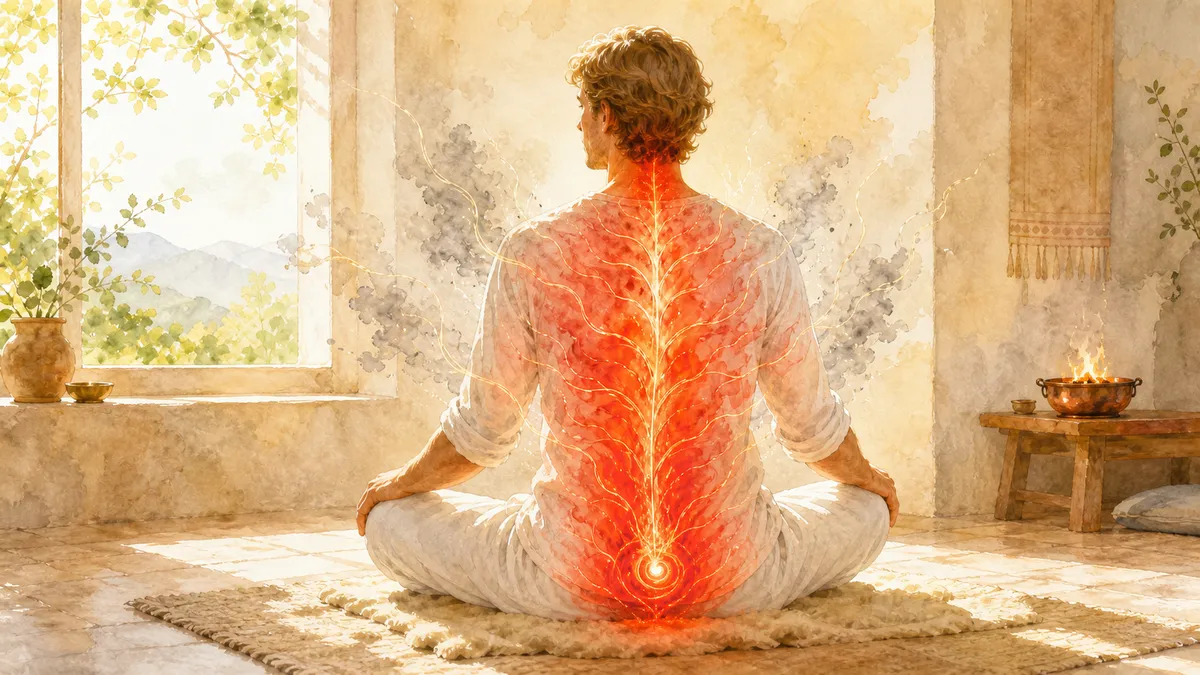
When the energy awakens, mula bandha and uddiyana bandha usually arise spontaneously, and the muladhara chakra heats up. For some time, about six months, one sees dreams that resemble horror films, or dreams in which you have sex with your father or brother (if it is a woman). This is the energy received from the parents awakening; it touches your mind, which is why you see such dreams. Sometimes this energy can rise with great force, and then black or dark gray smoke and crimson-red energy are seen in the area of the tailbone. Or it may be seen in the form of a spiral unfolding and twisting along the spine. All this is accompanied by heating, an increase in body temperature, and a feeling of pain in the clogged areas.
It is precisely through exercises with the body that many knots in the nadis are eliminated. They improve the flow of pranas and bindu in the nadis and also help restore damaged nadis. Therefore, the yogin should study and practice various exercises for the body described in the tantric texts. This is extremely important.
The Second Stage — Tummo (the Stage of Heat)
In kundalini yoga, this is the next stage after the energy has awakened. It is the stage when the element of fire is heated up. This stage is also called “tummo.” It means that our practice has developed, that now the element of fire, having become strong, can move the wind through the nadis, and the mucus that was clogging the nadis is gradually dried up by this element of fire. The stage of heat is in fact a high stage in kundalini yoga. It is believed that if you realize it in twelve years, that will be quite sufficient. This means that subsequently, at this stage, you will be able to move the wind by consciousness alone.
The fire of tummo is the basis of the yoga of heat, therefore it should be visualized with utmost clarity so that this heat actually appears. If the practitioner hopes to achieve significant progress, he must attain a very clear and stable visualization.
There are two main schools: some engage in techniques resembling kriya yoga, shat-chakra yoga, pranayamas, and mudras, while others engage in visualization, when the wind is introduced into the central channel precisely through visualization. We use visualization as such almost not at all, believing that everything artificially constructed, mental, visualized, or fabricated is not worthy of attention. Although others have their own opinion on this matter. For us, during kumbhakas and pranayamas, what is important is not visualization but presence, since the capacity for contemplation in any techniques and the like is the main principle for us.
If a yogin is able to generate the heat of tummo gradually and steadily, this heat will not diminish, and the benefit will be immeasurably great. Even if the weather is extremely cold, the yogin should not wear fur clothing. When it is very hot, he should not go about naked. He should not come too close to fire, stay in the hot sun, blow into a large horn, or breathe through the mouth. If intense heat is generated by itself in a certain part of the body, throughout the whole body, or between the flesh and the skin, the yogin should know that this is a sign of the sudden kindling of the fire of prana. But since this heat is not stable and will soon disappear, he should pay it no attention. It is necessary only to concentrate on tummo in the navel channel and try to introduce the pranas into the central channel.
Obstacles on the Path of Controlling the Pranas
Before we gain control over the pranas and become a true yogin who controls the wind, there are various problems, such as blocked nadis and a low level of prana, which means that there are sexual desires or desires for food and tamas. When the nadis are purified, desires diminish on their own, breathing becomes rare, and you always feel satisfied. If you practice ashvini mudra for thirty minutes every day and eat non-spicy vegetarian food, the svadhisthana chakra is purified, and then sexual desire disappears.
There are also blockages and karmas in the chakras, so these karmas manifest when the wind enters one of the chakras. Even a person’s destiny or character can change depending on which chakra the pranas enter. Those who practice shat-chakra yoga know this themselves: if you concentrate on one chakra for a long time, new qualities and the karma corresponding to them arise in you.
Before such a stage is reached, there are other problems as well, for example an imbalance of the wind, which is especially pronounced in those who meditate a great deal with tension, that is, whose mind has not yet become serene. An imbalance of the wind means that the wind does not enter the central channel, the mind works intensely, there is no serenity, and the upper chakras draw pranas away from the lower ones. This is the most common (one might say, professional) “illness,” especially among followers of Zen or those who practice intensive meditation. However, over time it is eliminated if control of the pranas appears.
The general principle is that the wind should always be kept concentrated in the yonisthana (between the navel and the sexual organ) and this area should always be felt as full. If, however, prana condenses in the head (in the upper chakras) and at the same time moves not through the central channel but through the side channels, then it simply dissipates, there are leaks, and therefore there will always be sluggishness in meditation. When we master the pranas, however, such an imbalance of the wind is not frightening to the yogin. His elements and pranas harmoniously permeate all the channels, so he feels great strength.

Development of the True Tummo Heat
If a yogin feels blissful warmth in the navel center, which gradually intensifies and begins to spread throughout the entire body, he should know that this is the true tummo heat, which greatly increases the production of red and white bindus.
When we perform kumbhaka and mula bandha, we draw apana upward. When we perform jalandhara bandha, we push prana downward. When we perform uddiyana bandha, these two pranas mix and enter the sushumna. When we do this repeatedly, the fire flares up in the manipura.
At first this element of fire may be difficult to control, so the yogin is advised to drink milk with butter so that his body is not consumed by the fire. After some time, control of the fire element is achieved. For example, if one concentrates on the manipura, the fire element gradually subsides, and it flares up only when the yogin wants it to. But before that there may be constant appetite for about two years. If the nadis are purified, however, the fire gradually comes under control.
Then it ceases to be localized somewhere in the abdominal area and is evenly distributed throughout the whole body as a pleasant, tingling warmth at any time of year. When this warmth is achieved, your way of meditating and dreaming changes. If before there was tamas or unconsciousness in dreams because the wind did not reach the chakras or the central channel at night or in meditation, now there is never any tamas, because the fire always moves the wind freely, and therefore your inner sensation also changes. Such a yogin feels great vitality and energy.
If the yogin follows all these instructions but still fails to develop tummo, he should do more exercises with the body.
I have read that the yogi Govindan practiced Kriya Yoga while in fact being half a layman. He even served in the Pentagon. However, he very diligently practiced the kriyas given to him by his Guru, yogi Ramayah. He worked eight hours a day and practiced for eight hours. Thanks to this, he realized continuous consciousness, or sleepless sleep. This means that if we devote sufficient time to kriyas or to concentration and controlling the wind, this state is not lost.

Now regarding the experience of bliss. Generally speaking, experiences of bliss can be divided into four categories. If a yogin feels that his entire body has become soft and smooth, if he experiences delight and pleasure when touching anything, this indicates that he has tamed many nadis in the body. Therefore, this kind of bliss is called the bliss of the nadis.
The bliss of the nadis arises if you regularly practice asanas and kumbhaka, observe the precepts, and preserve your prana without wasting it. Even through the practice of contemplation, the nadis are purified because the wind constantly moves upward through the sushumna.
The ascent of kundalini to the higher chakras
After kundalini has awakened, it rises through the sushumna, untying the knots in the granthis until it reaches the crown of the head. When it reaches the crown, a white light arises in meditation in the ajna chakra, and a golden light in the sahasrara. Clairvoyance, recollection of past lives, or visions of the future arise spontaneously. The subtle body can easily leave the physical body in samadhi through these two chakras, go somewhere, pass through walls, and travel along the streets. This is a common thing if your prana is awakened. At one time, I amused myself in this way when I was bored in retreat.
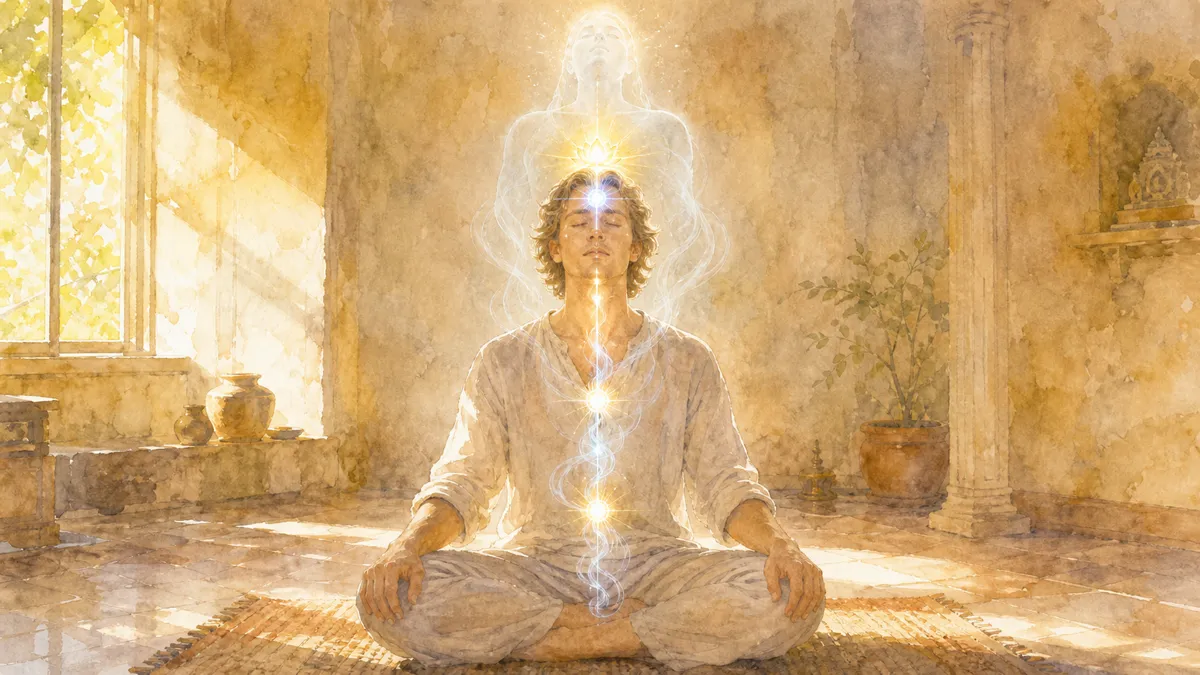
However, the separation of the subtle body is not yet what one should strive for in kundalini yoga. When even more prana rises through the central channel, through the sushumna, and we generate even more red bindu, even more prana enters the sahasrara. The nectar begins to pour forth, not merely drip. A bright golden light arises in the brahmarandhra, and after it a golden vortex appears, descending upon the yogin. Then he can forget about kundalini yoga and simply transfer his consciousness into this descending golden vortex.
In this way he enters a deep state of samadhi and sees his causal body in the form of a round sphere. At first this circle may appear before the eyes for some time and then disappear. It may appear divided into three parts, or in half. Or it flashes in the crown of the head. Then it simply appears as golden dust. If the yogin wants to merge with it immediately, he may not be able to do so.
Finally, when there is enough prana, you can immerse yourself in this space. It is like death, because it is a very deep experience of samadhi. At this time all your illusions depart, and you unite with the karana-sharira (causal body). The heartbeat slows down completely, and you are beyond name and form. This is true liberation through energy. If you are able to remain aware in this light, you will abide as golden light in this vast space. If, however, there is not enough consciousness, you may lose awareness, and this will be dark samadhi (jada samadhi): there will be no breathing, yet your consciousness will be sleeping in this light. It is considered that five hours of abiding in such samadhi is enough to attain personal liberation in kundalini yoga. This is preceded by many exits of the subtle body, the heating of the body, and the awakening of various kinds of kundalini energy.
In accordance with the three channels, three kinds of kundalini rise in the sushumna. Gross kundalini, associated with heat, rises through the sushumna nadi channel. If it rises to the head, it is unpleasant until it has been purified. When your energy is purified and you move to the level of the element of wind, the wind rises through the subtler channel, the vajra nadi; this is the astral body. When your consciousness is purified even further, the energy rises through the chitrini nadi, the channel that conducts light, and you gently enter the light without coarse processes.
Such samadhi and attainment in kundalini yoga is not the final attainment; it is only the very beginning. Of course, it is liberation in a personal sense, the liberation of the mind and energy. However, returning to the body, we see that there are elements in the body that are not liberated; therefore, after attaining such samadhi, the yogin practices in order to raise even more prana to the sahasrara chakra, and then the nectar begins to pour forth like a great stream. Not as if from a bucket, but quite intensely.
Within two years, if the yogin does not interrupt this, such nectar completely saturates all the channels of the body. When this nectar pours onto the chakras, the chakras are filled with bliss; therefore, various kinds of experiences of bliss arise, and then we can truly know what the five spaces in the body mean. When these kinds of bliss are spoken of, they arise as a result of the union of the nectar.
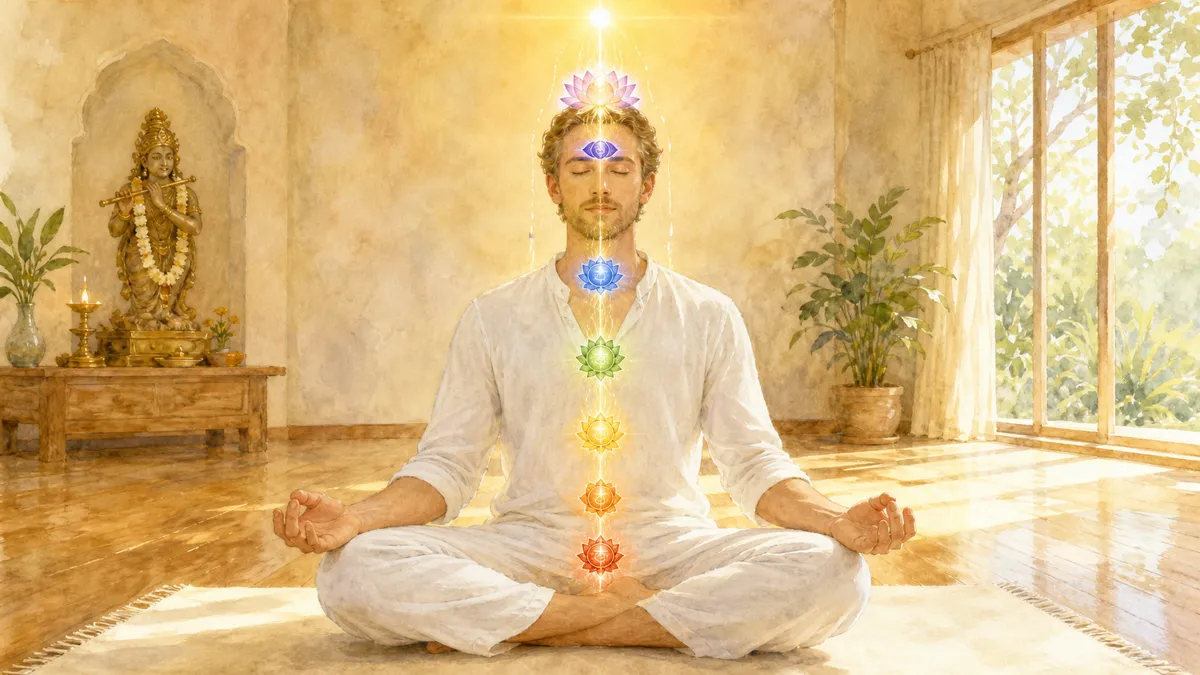
Types of Bliss in Kundalini Yoga
Two types of bliss are spoken of. Ascending bliss can be experienced even at the very beginning, when the energy awakens and gives a sensation of bliss in the svadhisthana chakra and manipura chakra. The second type of bliss is descending bliss, which arises as a result of the energy first having risen and then descended together with the nectar. It is precisely this type of bliss that is deep and nondual.
If the feeling of bliss is felt in a certain part of the body, like the sensation when a person scratches an itchy place, but this feeling is fleeting and soon disappears, then it is said that the yogin is experiencing the bliss of prana.
If a sensation of warmth or ecstasy arises simultaneously throughout the whole body or in a certain part of it, then this bliss is caused by the increase of the red bindu.
Sensations of bliss are mainly connected with the red bindu. The red bindu is the same as kundalini shakti; it is also called maharajas. It is a vast rajasic energy that is condensed in the coccyx. It creates bliss when it rises and unites with the elements in the chakras, and then the elements and chakras seem to come alive; a pulsation of energy and its seething begin.
If you have received initiation into the sutra of “the unity of bliss and emptiness,” then you obviously understand the principle of uniting emptiness and bliss. By emptiness is meant contemplative presence, our empty realization, our empty consciousness, which we have cultivated through meditation and awareness. When such bliss arises in a chakra, we should recognize the emptiness of this bliss, as if literally lowering consciousness into this bliss and piercing it with this emptiness. Then we feel that emptiness can be not only in the mind, but also in the body. A certain kind of space may open wide for us in the region of the heart or in the region of the svadhisthana chakra. This space is saturated with great energy.
The Intensity of Bliss and Control of Bindu
If the sensation of bliss is like the lustful bliss of sexual intercourse, intense and permeating the whole body, then this bliss, called the fire of heat that melts the bindu, can be divided into the following groups according to its degree of intensity. First: if the bliss and desire are so intense that it is very difficult to retain the bindu, this is called male bliss.
If the energy rises strongly, it resembles the energy of sexual desire, since sexual desire and kundalini energy are one and the same energy. If the svadhisthana chakra is not purified, then such desire, even if it was controlled, may intensify for a time. By this time it is absolutely necessary to get rid of all impure thoughts in the mind, to purify the svadhisthana chakra by sitting in padmasana, through ashvini mudra, and so on. Then it will be pure energy, uncolored by any feelings; it will simply rise and heat the body. If it stops in this center and becomes blocked, then the mind begins to yield and vigorously generate various images.
I read that one Swami in India experienced great difficulties when his kundalini awakened. He could not raise it above the svadhisthana chakra. He prayed to the Guru all night, then visualized the Divine Mother, but his mind seemed to have gone mad. Almost losing consciousness, he felt the svadhisthana chakra become purified, and the energy passed upward.
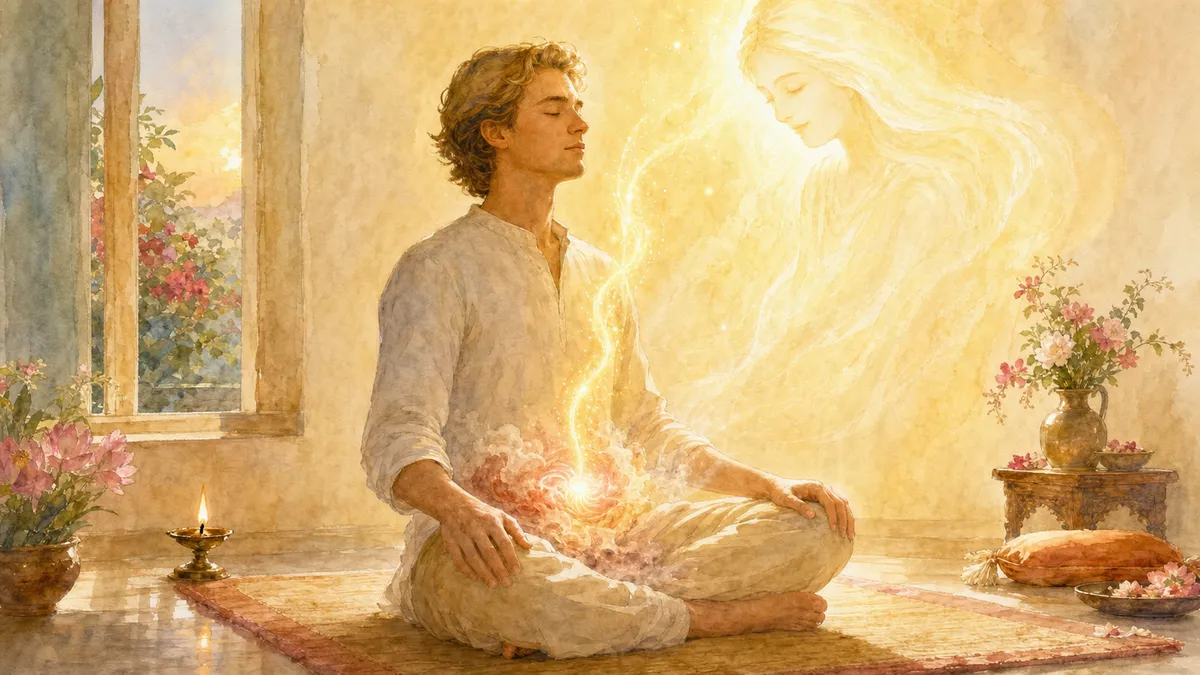
If there is no understanding of contemplation, then the practice of kundalini yoga can confuse the practitioner, because it exposes hidden karmas, gives many experiences, and grants great power to the mind. Therefore, it is assumed that before we begin serious practice, we have already become established as contemplatives, that we have a certain unshakable confidence in the natural state, and therefore our mind will not waver.
If bliss and desire are intense, but not as much as in the first case, and it is easier for the yogi to keep the bindu under control, then this is considered female bliss. If bliss and desire are not as strong as in the first two cases, and the yogi controls the bindu very easily, this is called neuter bliss.
Those who have a good connection with kundalini yoga will be able to practice it in full. For those who have difficulties with the channels and pranas, it will be enough to experience the stage of warmth and to pay attention only to contemplation. In any case, when we practice kundalini yoga, the principle of contemplation is always more important.
