Pure vision and the tenth stage of the spiritual path — education
25.06.2026
0 мин. чтения
0
Share
copy
search
add
share
Commentary on the text of the Mahabharata, the book “Drona Parva,” the tale of the use of the Narayana weapon.
After Arjuna activated the Brahma weapon and neutralized the Narayana weapon that Ashwatthama (the son of Drona) had used, Ashwatthama saw that he had destroyed only one akshauhini of the Pandava army, instead of destroying everything that existed. But that part of the army was destroyed in such a way that the appearance of the slain could not be recognized.
“The son of Drona was deeply saddened. For a minute he reflected on what had happened. And having reflected, he gave himself over to cares and grief. Letting out long and hot sighs, he then fell into deep despondency. Then setting aside his bow, the son of Drona leapt swiftly down from his chariot and, exclaiming, ‘O shame, shame, all this is false!’ he fled away from the battle.
Then on his way he saw Vyasa, the embodiment of the goddess of wisdom herself, the compiler of the Vedas, unstained by sin and with an appearance like the color of a dense rain cloud. And seeing him, the son of Drona, in a fallen voice and deeply grieved, greeted him and spoke these words: ‘Lord! Is this an illusion, or is it a caprice on the part of the weapon? I cannot understand how this can be! How, then, has this weapon of mine proved vain? What was the violation in summoning it into action? Or is this something unnatural, or is it the victory over the three worlds won by the two Krishnas, for they both still live? Apparently, time is insurmountable! Neither the asuras, nor the immortals and gandharvas, nor the pishachas, nor the rakshasas, nor serpents, nor yakshas, nor birds, nor human beings can at all dare to render harmless this weapon released by me! This weapon, however, was able to blaze with its power, destroying only one akshauhini of the army engaged in the affair. So why, then, did it not kill Keshava and Arjuna, both subject to the law of mortals? Asked by me, O divine one, tell me the truth about this!’
Vyasa said:
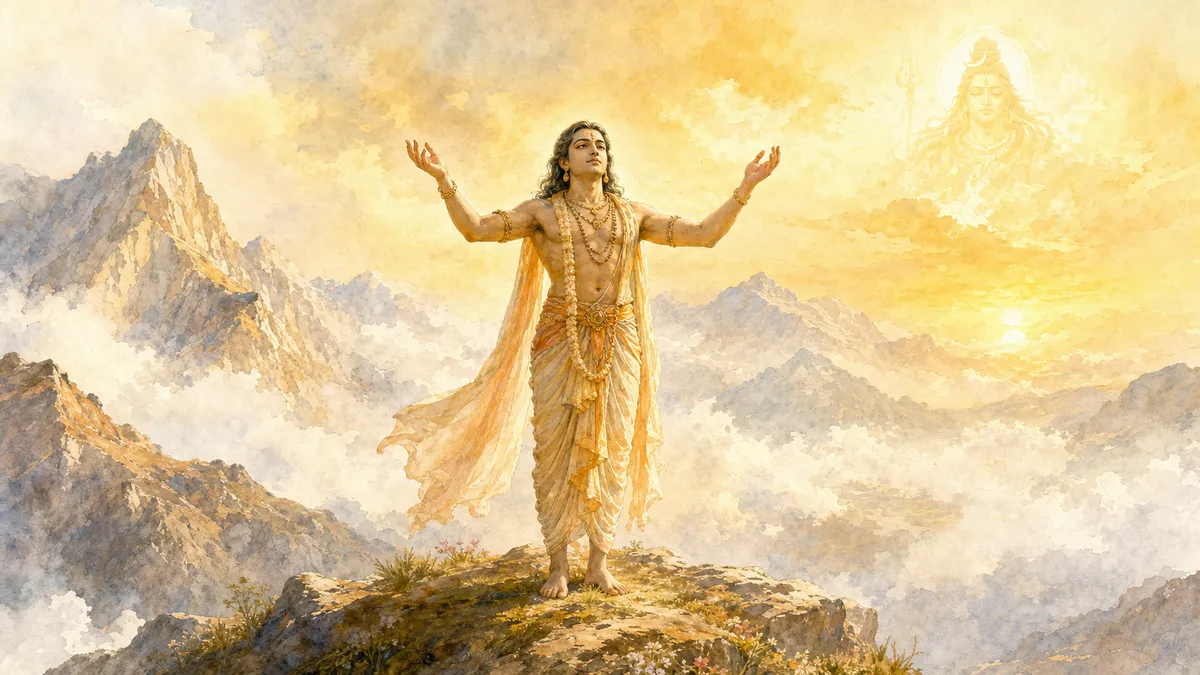
“This matter about which you question me in wonder is of immense importance! I shall tell you everything; listen attentively! He who is called by the name Narayana is the most ancient among the ancient. And for the accomplishment of his purpose, that creator of the universe was born as the son of Dharma. While on Mount Mainaka, he devoted himself to severe asceticism. Filled with great power, like fire or the sun in his radiance, he stood there with his arms raised upward. Lotus-eyed, he mortified himself for sixty thousand years and as many hundreds more, all the while subsisting on air alone. Then, again devoting himself to severe penance of another kind for a period twice as long as before, he filled the space between heaven and earth with the power of his ascetic feat. And when, by virtue of that asceticism, O my son, he became like Brahma, he then saw the Creator of the universe, the primordial source and preserver of the universe, the Supreme Lord, difficult to behold even for the gods themselves, the smallest of the small and the greatest of the great, he who is called Rudra, the Master and Bull among the mightiest, he who instills life into every kind of creation, the unborn and the highest, abiding in the hearts of all beings, moving and unmoving.
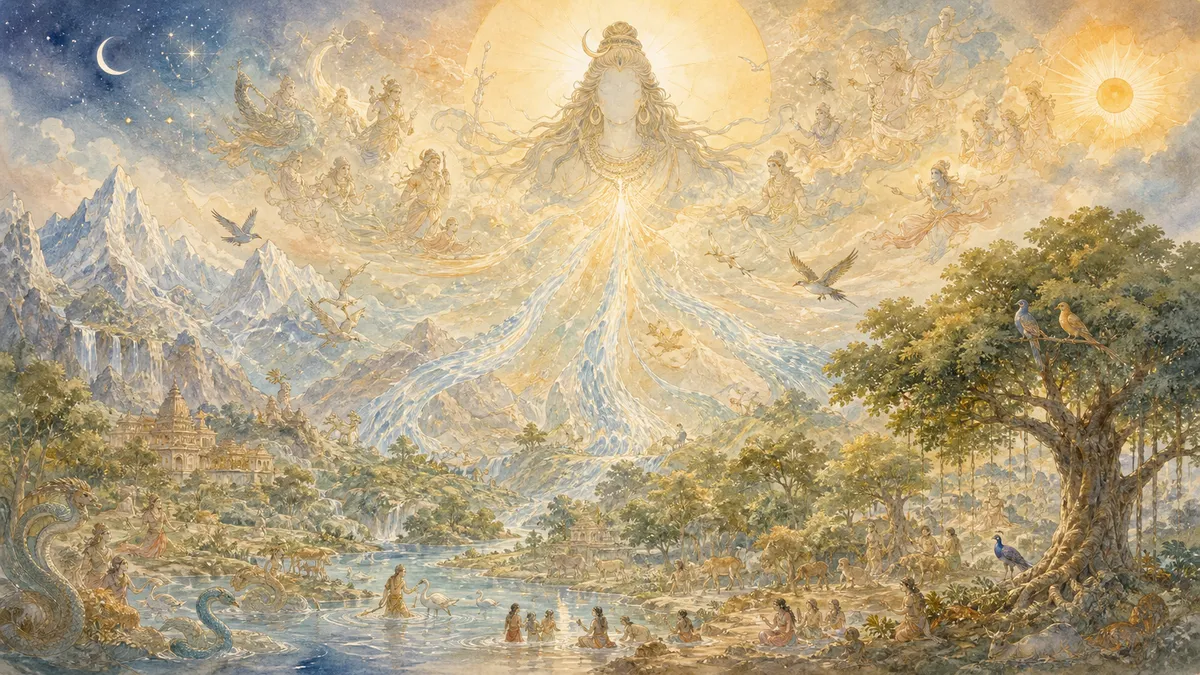
He saw the Lord, irresistible and with an extraordinary number of eyes, furious in anger and great of soul, the Destroyer of All, with a heart benevolently disposed toward the righteous; bearing a wondrous bow and two quivers, clad in golden armor and endowed with boundless power; armed with a mace, a thunderbolt arrow and a shining trident, a battle-axe, a club and an enormous sword; with a braid coiled in the form of a ring and a lunar diadem on his crown, clad in a tiger skin, personifying all-crushing force and with a staff in his hand; adorned with elegant angada bracelets, wearing serpents in place of the sacred thread and surrounded by the various creations of the universe and hosts of evil spirits; having become the One, representing the repository of ascetic feats and highly revered by elders of advanced age with words of desire; he who is water, the sky and the aerial space, the earth, the sun and the moon, the wind and fire, who is the very reflection of the universe.
People of wicked conduct are unable to see him, the Unborn, the crusher of all haters of Brahmins, the primordial source of immortality. Only Brahmins of righteous conduct, when they have been cleansed of sins and freed from the feeling of sorrow, see him with the mental eye. As a result of his ascetic feats and by virtue of his devotion to him, Narayana saw that personification of justice—him, worthy of praise, who had assumed the universal form. And having seen that supreme abode of all kinds of radiance, that god of gods, adorned with a necklace of beads, he, his soul greatly pleased, rejoiced, striving to express this with his words, heart, mind, and body. Then, beholding him, Narayana honored the divine lord, the primary cause of the universe, the bestower of gifts, the mighty one, together with the luxuriously and beautifully formed Parvati, the unborn and unperturbed lord, the hidden essence of all causes, unfading in his power. And at once, bowing to Rudra, the crusher of the demon Andhaka, lotus-eyed Narayana, filled with devotion, began to glorify the Three-Eyed One in these words:
“O most venerable one, the first gods, the creators of all that exists, called Prajapatis, who are now the protectors of the world and who, having entered this Earth—your most ancient creation, O divine lord—protected it before, all have arisen from you! The gods and asuras, the Naga serpents, rakshasas and pishachas, human beings and birds, gandharvas and yakshas, as well as various other beings and the Vishvas—we know that all of them have arisen from you! Everything that is done to propitiate Indra, Yama, Varuna and the Keeper of Treasures, Mitra, Tvashtri, and Soma is in truth intended for you. Form and light, sound and space, wind and touch, taste and water, smell and earth; sensual desire, Brahma himself, the Vedas and the Brahmins, everything that moves and is motionless—all this has arisen from you. The two wondrous and hidden birds (Ishvara and jiva), perceived in thoughts, the sacred fig tree with drooping branches (the Vedas with their various recensions), the seven guardians (the five primary elements of the world, the soul, and the mind), and ten others who support this city (the senses and organs of sense taken together, capable of sustaining the body)—all of them were created by you, yet you are separate and independent from them! The past, present, and future, which are inevitable, flow from you, as do all seven worlds and the universe. Grant your grace to me, who am devoted to you and worship you reverently! Do not harm me by instilling evil thoughts into my soul. You are the soul of souls. He who shares such convictions and knows you as the primordial seed attains Brahman. Out of a desire to honor you, I glorify you, striving to comprehend the One who rides upon the bull, O you distinguished even by the gods! Glorified by me, grant me the boons I desire, so difficult to obtain! And do not refuse me!”
And the blue-throated god (Shiva), whose soul is incomprehensible, holding a mace, diligently praised by the sage Narayana, granted boons to him, the foremost of the gods, who deserved them.
Shiva said: “By my grace, O Narayana, among beings descended from gods and gandharvas, you shall possess immeasurable power and soul! Neither gods nor asuras and mighty serpents, neither pishachas nor gandharvas, nor humans nor rakshasas; neither Suparnas nor Naga serpents, nor Vishvas, nor animals and beasts, will ever be able to withstand your valor! No one, even among the gods, will be able to defeat you in battles! By my grace, no one will in any way be able to cause you pain, neither with a weapon nor with a thunderbolt, nor with fire or wind, nor with anything dry or wet, nor with anything that moves or is immovable! You shall even surpass me myself, should you ever enter into battle with me!”
Vyasa said:
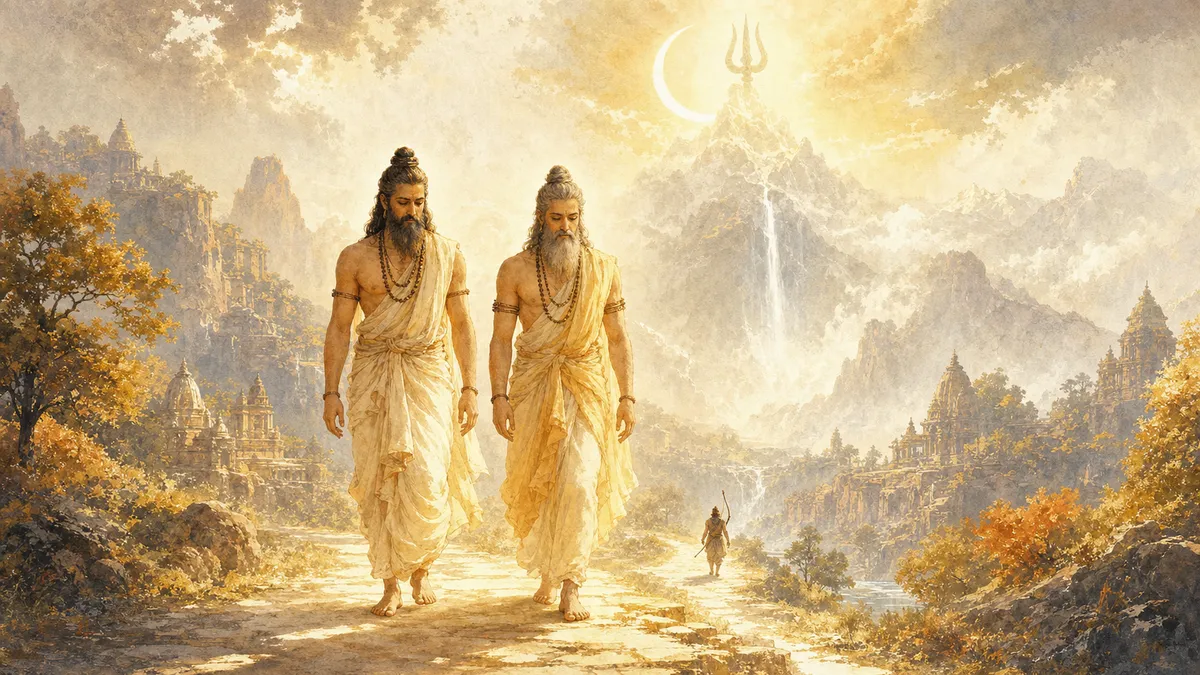
“Know, then, that these gifts were once obtained by the divine Narayana. That very god now wanders the world in the form of Vasudeva, bewildering the universe with his illusion. Through the power of Narayana’s ascetic feats, the great hermit named Nara was born, equal in all things to that deity. Know and always remember that he is Arjuna! Those two sages (Nara and Narayana), regarded as the most worthy in the power of their austerities among the most ancient gods, take birth in every yuga for the sake of furthering the aims of worldly life. You too, O wise one, endowed with great intellect, were born as a portion of Rudra, as the entire fruit of your righteous deeds and great ascetic feats, endowed with great inner power and wrath. In your former life you were endowed with great wisdom and were equal to the god Narayana! Regarding the universe as consisting only of Mahadeva, you emaciated your body with various vows out of the desire to please that god. Assuming the form of a new man, great, radiant, and earthly, you pleased him with prayers, sacrificial libations, and generous offerings, O gracious one! And thus honored by you, that most ancient god was satisfied with you, O sage, and granted you numerous gifts cherished in your heart.
As with those two (Nara and Narayana), so too with you, birth, deeds, ascetic feats, and deep concentration are the highest and most perfect. As by those two, so also by you, in your worship, the great god in the form of the linga is honored in every yuga. This Keshava is a devoted worshiper of Rudra, and he came forth from Rudra himself. He honors the Lord (Shiva), regarding him in the form of the linga as the primordial source of the universe. In Krishna are constantly concentrated the knowledge by which the union of the soul with the supreme Spirit is understood, and the knowledge that makes it possible to see all that is hidden from the eyes. For by honoring him thus with sacrifices, the gods, siddhas, and greatest sages seek the highest and unshakable position in the world. For this Krishna is eternal and must be honored by the performance of sacrifices for him. He himself always honors the Lord (Shiva) in the form of the linga, regarding him as the primordial source of the origin of all beings. The god with the image of the bull on his banner shows exceptional favor toward him.”
Having heard those words of Vyasa, the son of Drona, the mighty chariot-warrior, performed worship of Rudra and regarded Keshava as worthy of the highest respect. With his soul restrained and the hairs on his body standing on end from joyful excitement, he bowed to the great sage and, then setting out toward the army of the Kauravas, made it withdraw for the night’s rest. And at that very time, when after Drona’s defeat in battle the sorrowing Kauravas withdrew from the field, the army on the side of the Pandavas also withdrew, O lord of peoples! Having fought for five days and destroyed an entire army, Drona, that brahman who had perfectly comprehended the Vedas, departed, O king, to the world of Brahma!
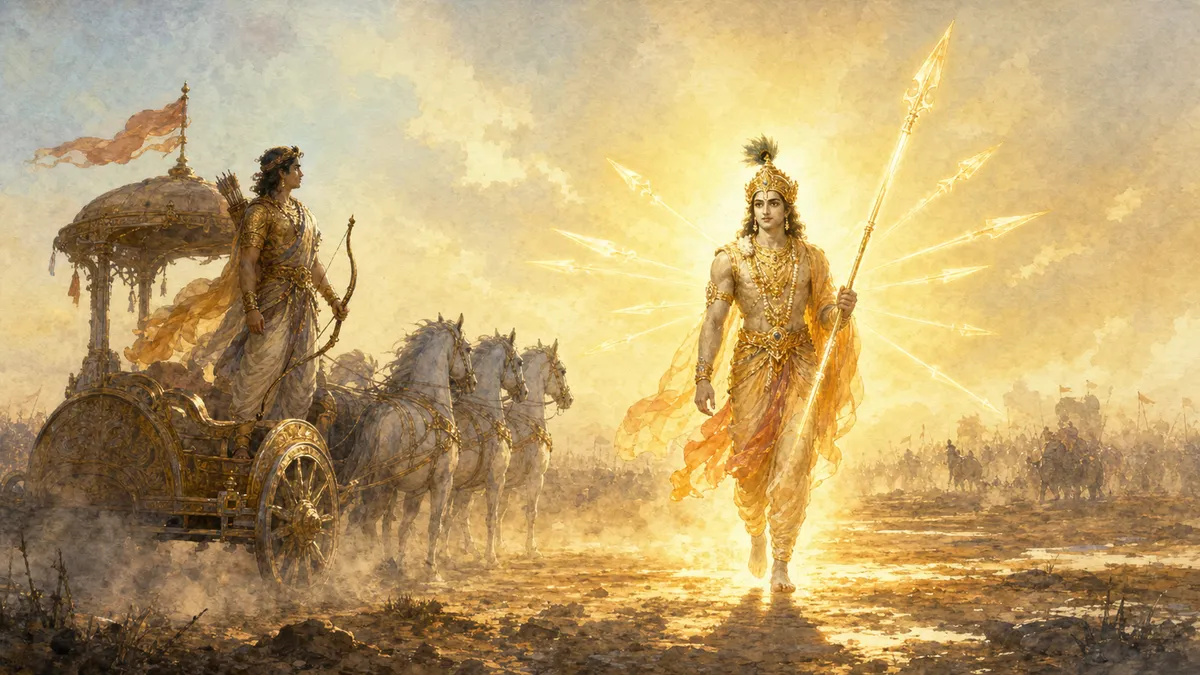
After that unsurpassed chariot-warrior Drona had been slain by the son of Parshata and the Kauravas had suffered complete defeat, Dhananjaya (Arjuna), the son of Kunti, seeing the extraordinary marvel that had brought him his own victory, asked Vyasa, who had happened to come there: “While I was destroying enemies in battle with showers of glittering arrows, I constantly saw before me a man walking ahead, shining brightly, as though endowed with the radiance of fire. Whichever direction he hastened, with spear uplifted, everywhere there my enemies were crushed by me, O great hermit! He did not touch the ground with his feet and never once released his spear. By virtue of his hidden power, thousands of spears issued forth from his spear. All the enemies, in reality crushed by him, people considered to have been crushed by me. Following in his footsteps, I only burned armies already burned by him. O divine one, tell me who that great hero was, the highest of men, with spear in hand, like the sun itself in his inner power?”
Vyasa said:
“You have seen, O Partha, Shankara—the prime cause of the origin of all the Prajapatis, that omnipotent being endowed with great power—the embodiment of heaven, earth, and the aerial space, the divine Lord, protector of the universe, the sovereign ruler and bestower of gifts! Go for refuge to that god, the primordial source of all that exists, the Lord of the universe—to Mahadeva (the great god), endowed with the highest soul, the sole Lord, with matted locks upon his head, the bringer of good; the three-eyed and mighty-armed one, (called) Rudra.
Who else, besides the divine Maheshvara, the mighty archer, that deity who assumes various forms, could then, O Partha, even in imagination have dared to crush that army guarded by Drona, Karna, and Kripa? No one can dare to stand before a warrior in front of whom that divine Lord walks! For there is no being in the three worlds equal to him! Indeed, by his very scent alone, when he is angry, enemies tremble in battle, become senseless, and fall in overwhelming numbers.”
Pure Vision and Levels of Reality
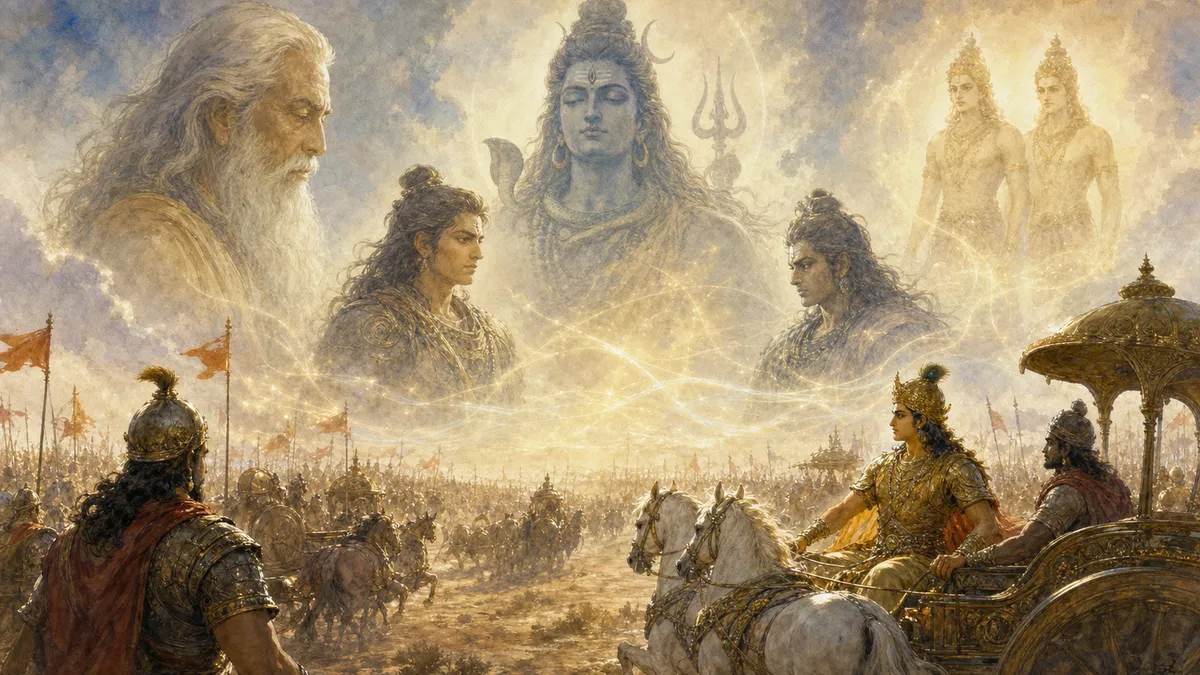
In addition to the dimension of the battle on the field of Kurukshetra, another vision of reality opens up—pure vision. The battlefield of Kurukshetra is a dimension of reality where people and demigods fight, as well as some of the saints and even siddhas, such as Arjuna and Krishna. The lila unfolds in the dimension of the human world. But in another dimension, other lilas also unfold: the plays of wrathful deities—Shiva, manifestations of Nara-Narayana, and others.
Thus, the battle that ordinary mortals saw was seen differently through the eyes of Arjuna and Ashwatthama. Through the eyes of Vyasa, all this was seen even more deeply. This is the manifestation of pure vision at various levels. What an ordinary person takes to be material relations and worldly energies, a sage sees as the play of awakened energies, or deities. And a higher sage sees it as the manifestation of the forces of various deities. This is the depth of pure vision.
The Tenth Stage: Education
Such pure visions begin at the stage of education. This is the next stage after the stage of nurturing has been passed.
It is said as follows:
“When the immortal child—the great moon of awareness—has grown up, the yogi, with care, must give him a worthy education.”
The tenth stage, education, means that awakening has been attained, but it needs development; it cannot yet be left as it is. It will no longer disappear. This child of inner awareness has already grown a little and can take care of its own sustenance. It no longer needs to be fed or watched over, but it must be educated in order to give it wisdom and flexibility. It is like a child who has grown up and can find food and save himself from the cold—that is, he knows how to survive—but he has not yet been taught the rules of etiquette; he cannot be brought into high society or company. Good manners must be instilled in him, and the rules of relationships must be explained. This is the stage of education.
Education means the art of integration. The art of integration is the ability to maintain nondual presence in action, that is, in various life situations, when energy manifests. A yogin practicing at the stage of education, while performing actions, does not become entangled in them, because his heart is empty: he has neither a sense of being the doer nor of doing. This is, in fact, an incredibly high level.
If we take Krishna as an example, then, as you can see, he was not an ascetic, a hermit, or a monk. Moreover, he sometimes engaged in things that people do not understand: why Krishna needed to fight on the field of Kurukshetra; or to have sixteen thousand palaces; to rule Dvaraka, and so on. This was unconventional behavior for a yogi or a sannyasi. But Krishna himself was in a completely different state. It is, at the very least, a state of play.
Beginning from the level of education, a yogin, while performing actions, does not become entangled; he has no sense of being the doer or of doing; he acts resourcefully, but without attachment. He uses relative experience, but does not lose spontaneity and naturalness. He sees differences, but never loses the single “taste” of all things. He may, playfully, set goals, but he does not cling to them. He acts with concentration, but does not become carried away and does not strive anywhere.
The stage of upbringing, as a rule, comes after a deep experience of samadhi has been attained in retreat and this samadhi, as a natural state, can be maintained in everyday life. If it is absent, then there is nothing to bring up. This means it is not the stage of upbringing, but nurturing or gestation. Gestation, nurturing, and upbringing may seem similar; however, they are similar only to laypeople. A true practitioner will never confuse such things. To confuse them is like confusing an old woman with a child, or a young youth with a pensioner. Only a person with poor eyesight, who sees only a silhouette, could confuse an old woman with a little girl. In the same way, an experienced practitioner clearly understands the difference between nurturing, gestation, and upbringing.
The texts say:
“When you eat or drink, become the taste of the food or drink; when you work, become the work. In this way unite contemplation with any actions, abiding in them with the total fullness of awareness. If you suffer, abide in the inseparability of contemplation and suffering. If you fear, fear while contemplating, as though you yourself have become the infinite space of fear. When you abide in fullness, each feeling is like a universe: infinite and incomprehensible, and therefore enlightenment does not diminish. Until blending has been achieved, be careful, as if walking along the edge of an abyss; avoid bad places and strive for peace; guard your spirit and nurture your energy.”
The Importance of a Correct Understanding of the Stages of Practice
What is being discussed here is the following: until you have succeeded in integration, avoid the stage of upbringing, because it can harm you. It is like how a small child must avoid certain adult habits. If he adopts them prematurely, he may become “spoiled.” In the same way, here it is specifically said, “guard your spirit and nurture your energy,” that is, a yogin at the stage of nurturing should not imitate those who are at the stage of upbringing, since he needs to cultivate his contemplation.
“When presence is stable, even obstacles and passions dissolve and benefit the avadhuta. Everything turns into auspicious signs.”
When, however, fullness and perfection in integration have been achieved, then, on the contrary, such a yogin can unite his contemplative presence with various experiences, and they will benefit his training. It is very important to understand the subtleties in these differences and not to make mistakes. Neophytes, those who practice without a teacher, without the tradition of the teaching, make such mistakes in 99 percent of cases, since these things are not easy to understand.
The Stage of Upbringing: Transition to Mature Practice
“Day and night, abiding in sahaja-sthiti, the yogin renounces all actions. Needing no mantras, pujas, or pranayamas, he performs his tapas for years without laziness or distraction. Whatever he comes into contact with, for such a sage everything is sadhana. In sadhana there is neither interruption nor absent-mindedness. What a wonder!”
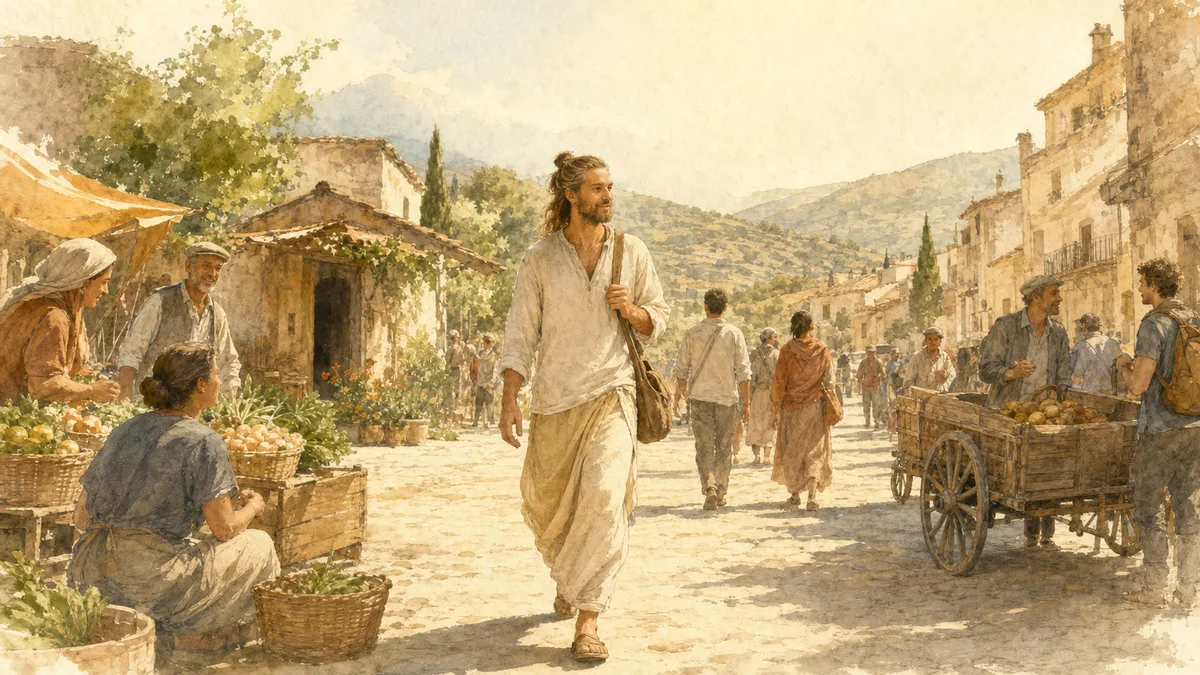
For a yogin, to enter the phase of upbringing means to leave impure karmic vision, to leave the external approach to spiritual life, the division into the sacred and the ordinary, and attachment to programmed sitting meditation. In the process of upbringing, the yogin can unite with different circumstances and situations, acting flexibly and resourcefully. For the practice of upbringing, the yogin leaves strict retreat and trains in contemplation during everyday communication and while traveling; he trains in non-doing while performing diverse actions and expresses himself; he visits crowded places, exercising flexibility; he enters into numerous contacts and life situations. This is like when a child has grown up and, from a nursing infant, has become a boy to whom it is time to instill good manners. The ability to unite with situations and circumstances is an indicator of the maturity of natural contemplation. It is called “resourcefulness without attachment.”
In the text “Lila Yoga Marga” it is said:
“He acts as if not acting; he speaks as if not speaking; he makes plans, but does not dream about them. Acting in the midst of things and events, he is at their center and governs them, like a deity at the center of a mandala. He is focused, but not anxious. He acts spontaneously, intuitively, but not recklessly. He is relaxed, but not lazy. He does not dream, yet all his dreams come true. He desires nothing, yet all his desires are fulfilled. Whether he obtains the result or not, he is always joyful and serene, because he is already in the highest result.”
During cultivation, the perfection of action (behavior) is attained, and the all-accomplishing wisdom is revealed. All-accomplishing wisdom, associated with the element of wind, is believed to be revealed last, since it is the most complex of all attainments.
Practices of the Cultivation Stage
At the stage of cultivation, the yogin goes through the following practices. He learns to blend natural presence with the external elements. The teaching of “tattva-vidya” — integration with the five elements — is truly attained precisely at this stage. Its difference from the initial stages is that at this stage control over the five elements arises, and the yogin can develop certain siddhis: stopping, damming, destruction, dispersion, and so on, depending on which element he unites with.
The yogin unites with earth, water, wind, fire, and space. First he unites with stones, mountains, hills, becoming saturated with their energy, with trees, bodies of water, seas, oceans, lakes, and rivers. Then he learns to receive prana by uniting with the winds. When he has succeeded in uniting with the ordinary manifestations of the five elements, he expands his cultivation to the macro-objects of the universe. He unites with planetary deities, with the energies of the planets of the Solar System, with stars, constellations, giant concentrations of positive and negative prana, galaxies, ruling deities, and universes. In addition, at the stage of cultivation, the yogin unites with such special qualities of the Supreme Source as time, primordial sound, primordial light, and with the global forces (shakti) of the universe: the energy of wisdom, the energy of will, the universal forces of action (creation, maintenance, destruction, concealment, enlightenment). Such a practice of uniting with the elements, universal objects, macro-objects, and universal energies truly lays bare the depth and greatness of the natural Mind and completely eradicates the disciple-yogin’s notion of himself as a residual personality connected with the body.
As the sadhana of cultivation deepens, the yogin receives the experience of darshan of divine beings, much as was described in the “Mahabharata” in the previous lines. He begins to have contacts with the guardians of the universe, with the deities of time, of the four directions, and with various mandalas. Rishis, apsaras, vidyadharas, and siddhas, attracted by his shakti, begin to visit him, becoming his patrons and friends, and if they are spirits of a lesser order, then his devoted disciples or worshippers. All this arises at the tenth stage, the stage of cultivation. This is the stage not of an ordinary monk, but of a saint. Nevertheless, according to the teaching on the sixteen stages, it is only the tenth stage, not the final one.
Read 17 times
Articles
Vidya AI
Search
Lectures
November 3, 2026
Mantra of the day
ОМ САДРЩАЙА НАМАХ ОМ Видящему равно – поклонение!
Auspicious Times(Rome)
Brahma Muhurta:
04:54 - 05:49
Abhijit Muhurta:
11:33 - 12:14
Sayam Sandhya:
16:43 - 17:24
Mokshada Ekadashi (6 November)
Ekadashi of liberation. Helps to achieve spiritual enlightenment.