

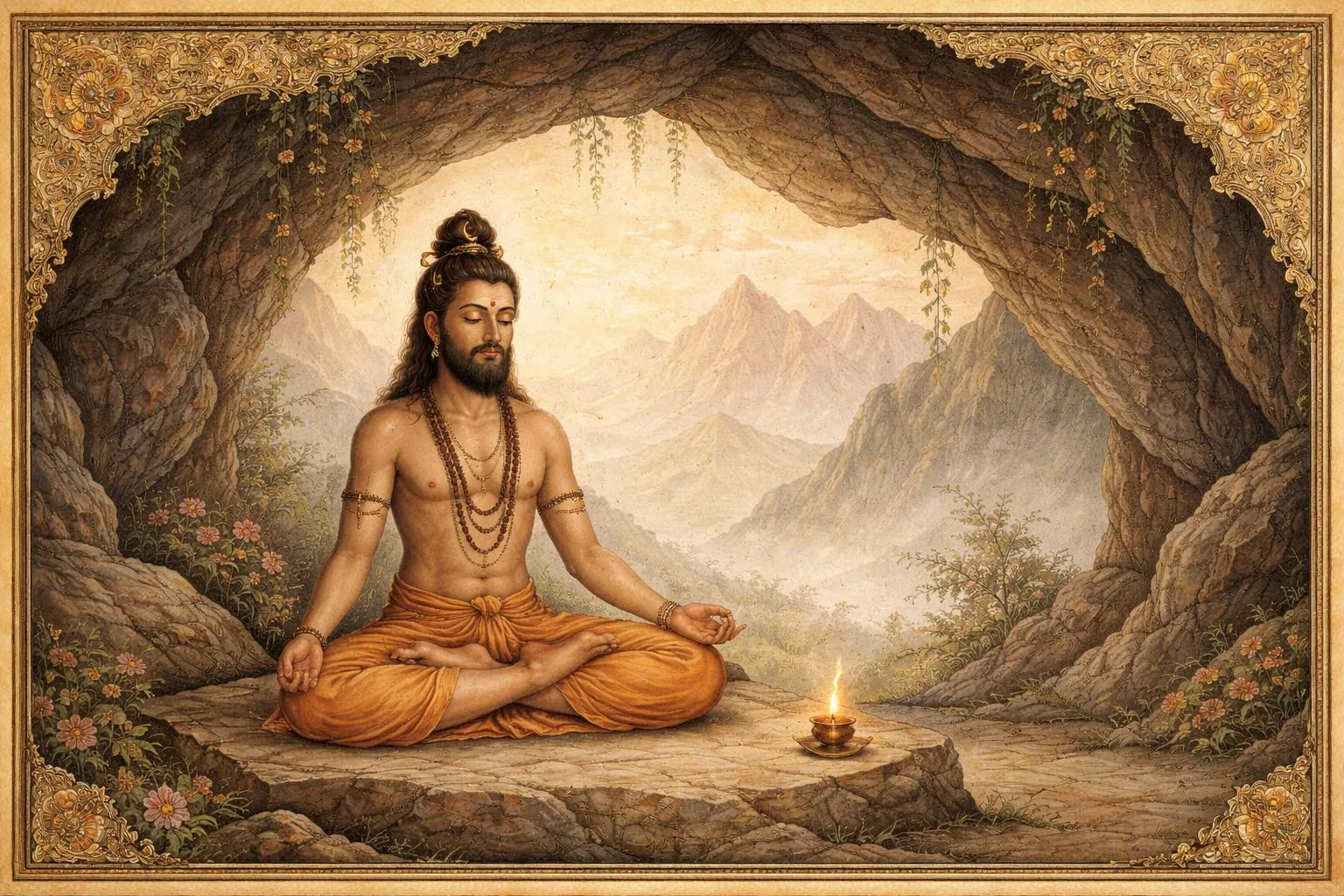
Commentary on the text “Laya-Amrita-Upadesha-Chintamani”
The yogin said:
“Having abandoned samsaric concerns and cast aside desires,
do not confine yourself solely to seated meditation.
Keeping the mind vigilantly relaxed,
leave behind all dreams of the future,
do not recall the past;
then the inner space (chit-akasha)
will merge with the outer space (bhuta-akasha),
forming the inconceivable, infinite maha-akasha
that bestows siddhis.Contemplate That which is inconceivable and infinite,
beyond perception, beyond comprehension,
beyond the Universe, Being, and Non-Being.
Believe in it, understanding it
as inseparable from the Guru.
Contemplating in this way, feel: ‘I am everywhere.’
It is inexpressible,
but we call it laya-tattva.”
Here, the holy yogin gives direct instructions on how to realize natural contemplation.
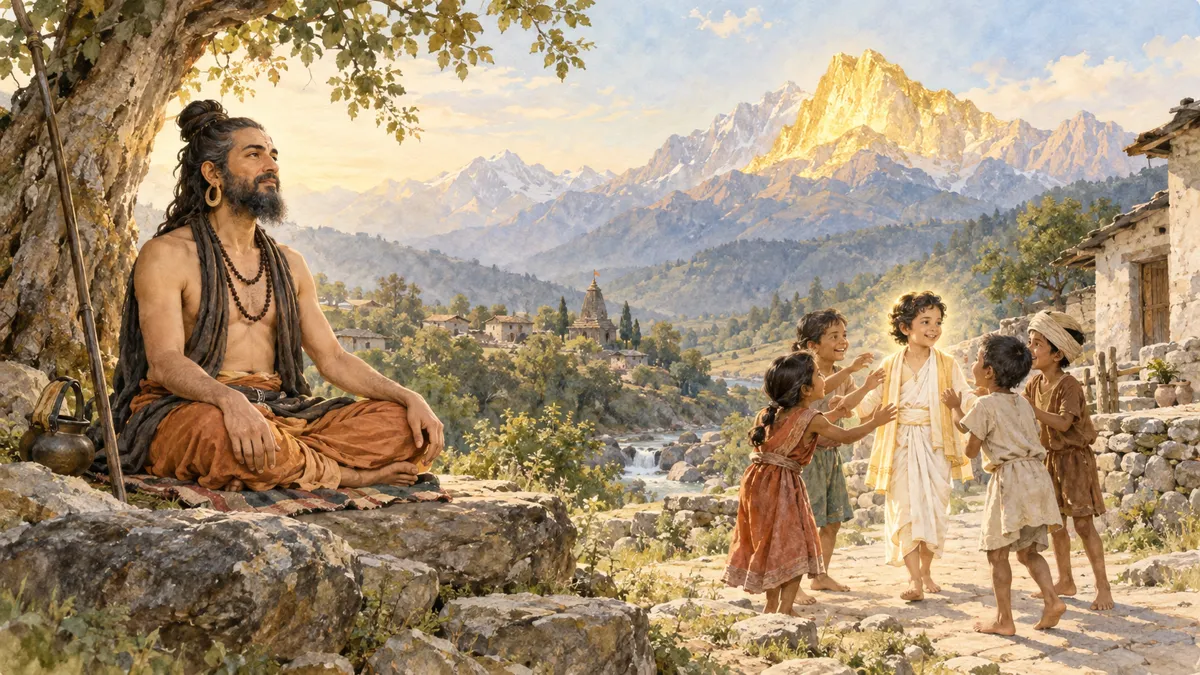
Siddha Gorakshanath, one of the founders of Laya Yoga, attained complete perfection in the practice of the natural state by uniting his mind with energy (prana). It is said that he could freely assume the form of a man, a woman, or an animal, turn a mountain into gold, and materialize anything in this world through the power of his meditative presence. For example, he created an eight-year-old boy to play with the children who brought him gifts, and turned part of a mountain into gold. To this day, there is a city in India named after him—Gorakhpur.
The Natural State Beyond Concepts
It is precisely the natural state that is the source of all realization. When we speak of the natural state, we mean that it lies beyond concepts. Until we understand what it means to go beyond concepts, we may create some new mental construct for ourselves and call it by beautiful names, but it will still be a golden cage. We may absorb various ideas heard from the Teacher or read in the sutras, and reason about self-born Wisdom, primordial awareness, and natural contemplation beyond concepts, while still failing to understand what it means to be beyond concepts.
To be beyond concepts is a fundamentally different plane of awareness, in which you become completely disillusioned with the reality of logical constructs and are cast onto the other side of Being, where no logical constructs are real. This is why it is said that one of the prerequisites, or qualities, of a disciple capable of the highest practice of Laya Yoga is the ability to hold two opposing points of view simultaneously without becoming confused in any way.
When we say that the teaching is beyond concepts, we very often use concepts. It often happens that teachers who preach non-conceptual teachings speak about them more than anyone else. But in fact, this is because it is difficult to understand what non-conceptual consciousness means if you have not prepared your mind. In the siddha tradition, various instructions are used to point to this non-conceptual consciousness.
Paradoxical Questions for Awakening Consciousness
Try answering this question right now: “What is this frog that swallows an elephant?” It is extremely important for you to answer this question. Whether or not you can answer it determines whether or not you will open up your understanding of the natural state so that you can rely on it later. Do not think that answering it is so simple. More than one saint has developed calluses on his buttocks from sitting in meditation in order to answer such a question. If you try to answer such a question using the mind, you will not succeed.
Another question is: “What is the sound of one hand clapping?”
You may meditate on these questions until an answer arises. When it does, you may tell it to me and check how true it is. Usually, if we answer from a relative point of view, using the mind, we are most likely mistaken. The fact is that originally these questions have no answer; nevertheless, they do have an answer if we enter deeply into the state of awareness and allow not our mind but the natural presence to respond to the question. Then the answer will occur. It is not known what it will be, but if the natural state is genuine, then the response will also be genuine. If the response is genuine, the Teacher will give the disciple confirmation; but if it is not genuine, the Teacher says: “Go and contemplate further.”
Such paradoxical sayings used to reveal the profound nature of the Mind are called ullata bamsi. A similar tradition exists in Zen; however, long before Zen arose, there was a tradition of siddhas in which the Master used paradoxical statements, riddles, and illogical expressions in various ways to awaken the disciple’s consciousness. When we are able to give the true answer to the question “What is the sound of one hand clapping?” and to other such tasks, we genuinely understand what it means to be in the state of bhuta-tathata—suchness as it is, beyond concepts. This does not mean that we do not use concepts or that we reject them. Rather, concepts now take their proper place; they no longer captivate us. We know that they arise from the profound source of awareness that gives rise to them, that they are devoid of inherent essence and are like clouds in the sky, while the nature of our Mind is like the sky.
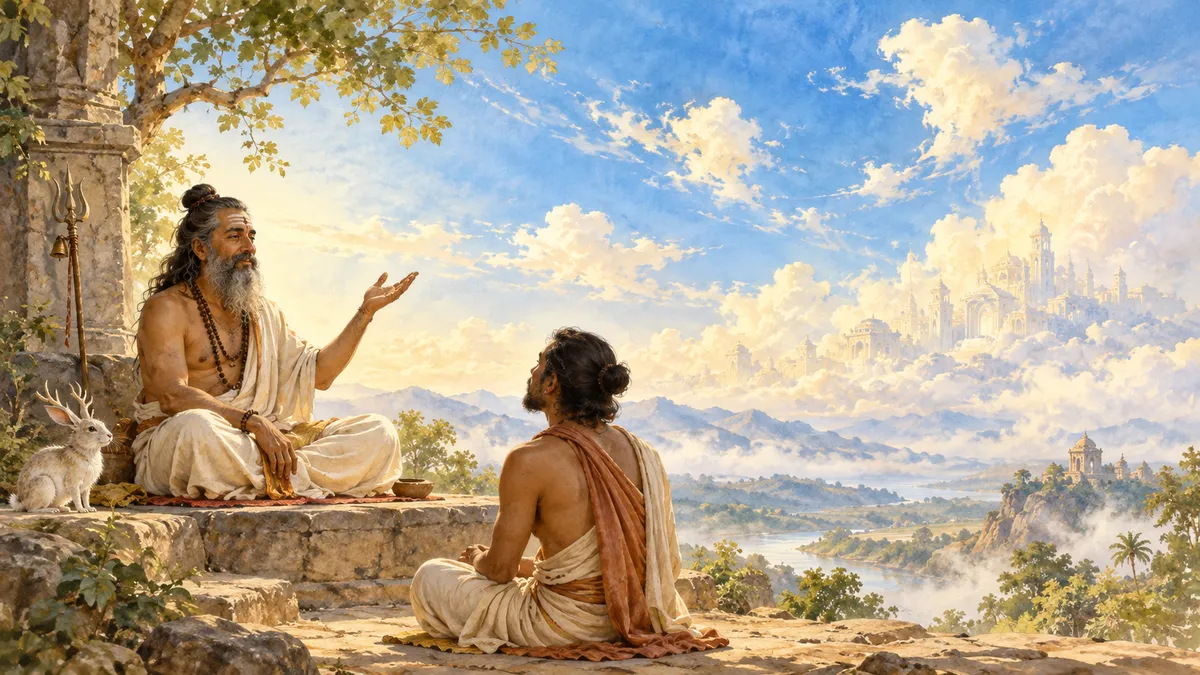
There are other tasks from the same series: “a man walking to the city of the gandharvas,” “a horned rabbit,” “a man in a cave,” and so on.
The Nature of the Mind as a Mirror
The next important concept in Laya Yoga is “pure vision.”
The sutras say, “Sarvam Eva Brahman,” which means “everything is transcendent Reality.” But how is this actually experienced? We are perplexed because this is very far removed from our real lives. Although everything is Brahman, we nevertheless see ordinary people, the earth, and trees, and it does not seem to us at all that these are Brahman. Perhaps saints have realized this, but we see that everything is maya and that we are part of this maya. Therefore, when a person is conditioned by illusion, they abide in ignorance.
It can be said that the nature of our Mind is like a mirror. Everything visible consists of reflections. When we are in the conditioned state of ignorance, we fail to see the mirror and become captivated by the reflections; we wander among projections and then become one of those projections ourselves. To enter true presence and reveal self-born Wisdom means to cease being enchanted by projections and enter the state of the mirror, where reflections cannot stain your nature. This is why the nature of our Mind is compared to a mirror. The mirror may reflect nothing, if we mean the unmanifest aspect, or it may contain many objects—that is, reflect them. Nevertheless, whether it reflects one object or a thousand, it is not stained; it remains the same, and its capacity to reflect does not disappear.
In the same way, our primordial nature is not stained: whether material objects exist, whether there is ignorance or no ignorance, it is always absolute, perfect, and spontaneously pure, without effort or any need to purify it.

The Practice of Pure Vision
Pure vision is when we train ourselves to see the world through the eyes of pure and absolute nature. Do you think that if a truly devout person were struck on the cheek, they would attack their offender with their fists? If they did not turn the other cheek, they would most likely say, “This is a trial from the Lord; this is a trial of my faith, a test of humility.” Such a person sees everything, both good and bad, as a manifestation of God, as God’s will, or as God’s grace. Whether they encounter temptation, hostility from others, harsh living conditions, illness, suffering, and so on, they see everything as a test of their faith and devotion. They do not complain or become confused; they calmly accept it all, looking through the eyes of their faith.
In fact, pure vision is the same thing, but explained in different terms. Since we are guided by the philosophy of Advaita, we must begin to embody it in our lives. If we do not truly embody it in our lives, then the philosophy of Advaita is no more than an abstraction, and its value is no greater than that of a painted meal.
Therefore, pure vision means that we begin trying to see reality in a different way. The sutras say:
“When practicing pure vision, one should regard the entire world as a mandala, as a mystical spiritual space; living beings, other people, and especially those who practice alongside you (Dharma brothers and sisters), as the deities of this mandala; all sounds that are heard, as bhajans or the sounds of mantras; and all actions and situations that occur, as lilas, as the unfathomable play of the energies of the Absolute.”
At first, of course, this is somewhat artificial, because we do not understand it in any other way. But in the true sense, if we practice contemplation correctly, this artificiality disappears, and the mystical dimension of reality truly begins to reveal itself to us; we truly begin to see in this way.
From the perspective of Advaita, houses are not houses, trees are not trees, clouds are not clouds, people are not people, a man is not a man, a woman is not a woman, a dog is not a dog, a mother is not a mother, and a son is not a son. Everything is the transcendent Reality, while all names and forms are no more than labels to which there is no point in becoming attached, because they are part of the samsaric reality from which we are trying to free ourselves.
Often, while abiding in duality, we see many different impure things or things we dislike. Pure vision means that we try to see them in a pure state. When regarding other people, our Dharma friends, we try to see them in a pure way—this is the meaning of samaya. To see in a pure way means not to look for faults in others, not to look for faults in the Dharma, but to regard the Teacher as a pure manifestation and the body as the pure form of a deity. And even if one does not see it that way, one should eliminate the concept of impurity, because our concept of impurity stems from our own ideas.
Absolute Reality is absolute; it is always pure and perfect, since it is Brahman, because Brahman has no flaws. However, when duality and illusions exist within us, we try to project our impurity outward. Then we see what is not there, searching for faults, problems, and impurities. But pure vision means that everything must be regarded from a different perspective. Such vision is compared to arriving on a golden island: when you come to an island made of gold, not even a speck of dirt or sand can be found there, because the entire island is made of gold. In pure vision, we deify everything. First we establish samaya with the Teacher, then we establish samaya with those around us, and finally we try to see everything in an absolutely pure form, including ourselves and the entire world.

There is a parable about this. A farmer once lost his axe. He thought that his neighbor had stolen it, and when the neighbor was returning from work, the farmer saw him and thought, “He walks like someone who stole an axe and looks like someone who stole an axe. He definitely stole the axe!” But after some time, the farmer went to the stable and discovered that the axe was lying in a different place, and then he laughed at himself. And when the neighbor came to visit him, he saw that the neighbor looked like someone who had not stolen an axe and walked like someone who had not stolen an axe.
In the same way, our projections deceive us when our inner duality and impurity are projected outward. We have become thoroughly accustomed to dividing reality on the basis of attraction or aversion, clinging, acceptance, or rejection. Pure vision destroys this tendency because we try to see in the absolute sense.
Divine Play (Lila)
From the perspective of pure vision, everything is no more than the spontaneous play of the energies of the Absolute. This is Divine play (lila); it is free and unconditioned by anything. Whether a bad situation or a good one occurs, it is a lila from which we can draw a certain lesson in clarity.
Other living beings are vessels (upadhis), conduits for this creative play. Naturally, those who transmit the Dharma to you, establishing relationships, samaya, and so forth, should be regarded as the purest and closest vessels. If any adverse situations occur, they should be regarded as fierce or wrathful plays (lilas) of the heavy energies of the Absolute. Nevertheless, they are still perfect and absolute. If subtle, pleasant, and divine situations occur, they are regarded as peaceful lilas of the energies of the Absolute. This is always a manifestation of the creative play of either peaceful or wrathful energies, but all these energies are spontaneously perfect and absolute; they radiate from the empty nature of our own awareness.
By training ourselves to see reality in this way, we arrive at a completely different, paradoxical vision. This is the vision of the Absolute inherent in saints who abide in nonduality. From the saints’ point of view, everything is spontaneously perfect, everything is absolute, everything is pure. Birth and death, vices and virtues, the pure and the impure, the spiritual and the worldly—all of it is beautiful, absolute, perfect, and pure. But we did not see this because we ourselves were captivated by mistaken ideas.

This does not mean that we have a convenient excuse to justify our shortcomings or behave however we please. On the relative level, we must understand that as long as we have a body, we must purify ourselves, observe the commandments, and maintain harmony in our relationships. On the level of the nature of Mind, we cannot say, “What difference does it make whether we eat or not?” We must understand the difference between the relative and absolute dimensions. Yet this vision of nonduality and purity concerns the subtlest layer of our awareness—the nature of Mind. When we speak of the nature of the body, if the body is important to us, then it is important to take its laws into account as well.
In India, there are sadhus who practice ajagara sadhana. Ajagara sadhana consists of the “python” vows, in which an ascetic takes some animal, such as a python, as a model to emulate. He then lies down on the ground and vows not to move for several months or several years, but simply to remain in one place, sustaining only meditation. Sometimes he is fed, and sometimes he is not. Some vow to eat only what is placed in their mouths. If weeks pass without anything being put into their mouths, they still remain motionless, simply continuing to meditate. When a yogi practices in this way, he no longer has a past or a future; he lives entirely in the present. He neither accepts nor rejects reality; whatever happens simply happens. However, to practice such a sadhana, one must at the very least be realized, so that the relative dimension or this body is already a matter of indifference. If you try to practice this from the very beginning, you will most likely feel awful.
We must become inwardly like such a sadhu practicing the “python” vows in order to reveal the natural state. This means that we free ourselves from hopes for the future, understanding that they are fantasies and projections arising from ignorance; we cease clinging to the past, understanding that it consists of various karmas conditioned by our ignorance; and we strive always to remain in the ineffable and incomprehensible here and now, abiding in awareness. When we practice in this way, whatever arises in our consciousness or comes within our perception, we neither accept nor reject it, nor do we judge it; instead, we abide in a state of absolute vision, regarding everything that happens as part of this absolute vision or as the play of this absolute vision.
True purity as the principle of awareness
When we speak of pure vision, this does not mean that we generate some state of artificial purity based on our own attachments or notions of purity. The understanding of purity inherent in the ordinary, conditioned mind differs from the true purity spoken of by the saints. For example, if you see the Om symbol or a deity, it appears holy, sacred, and pure to you; but if you see the corpse of a dead cat or excrement, it will seem impure and vile, and you will feel disgust. Yet the saints say that everything is absolute and pure, and that our liking or aversion, our habit of regarding one thing or another as pure or impure, results from our own inner impurity, which causes us to divide reality into this and that.
Therefore, from the saints’ point of view, genuine purity means the principle of awareness. In other words, true purity is abiding in a state of awareness, while impurity is abiding in a state of unconsciousness, when, instead of being in contact with authentic Reality and seeing it as inseparable from the Source of Being, we habitually apply labels, dividing everything into what we like and what we dislike. This is why saints could revive dead cats and turn excrement into gold, seeing them as absolute. When we possess such inner purity, everything appears divine, everything appears absolutely pure. But when we are subject to ignorance, the mind has a persistent tendency to accept or reject based on past experience. This is precisely what it means to be caught in the grip of our ego.
To abide in a state of pure vision is to see everything as a manifestation of the Absolute. Just as a religious person sees everything as divine, from the perspective of pure vision, we integrate everything with the absolute idea. This enables us to remain steadily in contemplation.
Three Experiences on the Path of Practice
On the path of practicing abiding in the natural state, various experiences arise that can lead an inexperienced practitioner into delusion. These three experiences are described as bliss, clarity, and emptiness. In fact, ignorance of these experiences can become a major problem for a practitioner, causing them to waste decades of spiritual sadhana on illusions instead of progressing correctly.
When we become established in our self-born Wisdom, we come into contact with the Light—the source of Being. This Light is neither light nor darkness; rather, it is the cognizant clarity of our self-born Wisdom. This Light always accompanies us. When we are in ignorance, we have no contact with this Light, and clarity is lost. When we somehow open ourselves to contemplation, this Light gradually grows brighter through transmission. However, until it is purified, we encounter three principal experiences on the path of practice. In Christianity, this can be compared to the concept of “spiritual delusion,” that is, something that tempts the yogi’s consciousness and tries to lead it away from nonduality.
The Experience of Bliss
When contemplation has gained strength, our consciousness begins to expand; it becomes penetrating and extremely intense, and then our view of the world begins to change, as though we were entering another dimension of reality. Everything begins to be perceived psychedelically, bringing great rapture and pleasure. This consciousness is characteristic of gods, not humans. In the human world, unpurified emotions (kleshas) and dualistic thinking (thoughts) dominate the stream of consciousness. In fact, human consciousness consists of constant emotions and thoughts, and people are trapped within their narrow perception of emotions and thoughts. One might say that the minds of living beings in the human world are shriveled and contracted, deeply preoccupied with their own thinking or emotions. Instead of being like the sky, like boundless space, wide open, their minds are constricted because their mental stream is dominated primarily by emotions and thoughts. These dominate because of the strong fixation, “I am this body,” and because of the compulsive habit of identifying with the skandhas of the body.
The consciousness of gods differs from human consciousness. Their emotions and thoughts have been supplanted by meditative experiences (dhyanas); in fact, if one rises slightly above the human world, there are only dhyanas, meditations. Imagine a world composed of geniuses—artists, composers, musicians, creative people—who are continuously immersed in their subtle states and constantly play within these labyrinths. This would resemble the world of the gods of passion: instead of emotions, kleshas, impure perception, and dualistic thinking, they have meditative states (dhyanas).
Similarly, by practicing contemplation, we learn to displace our kleshas and dualistic thoughts through presence. Over time, our presence displaces them, and we begin to experience states resembling those of the gods; then the world around us begins to become psychedelic, and we can derive subtle pleasure from anything.
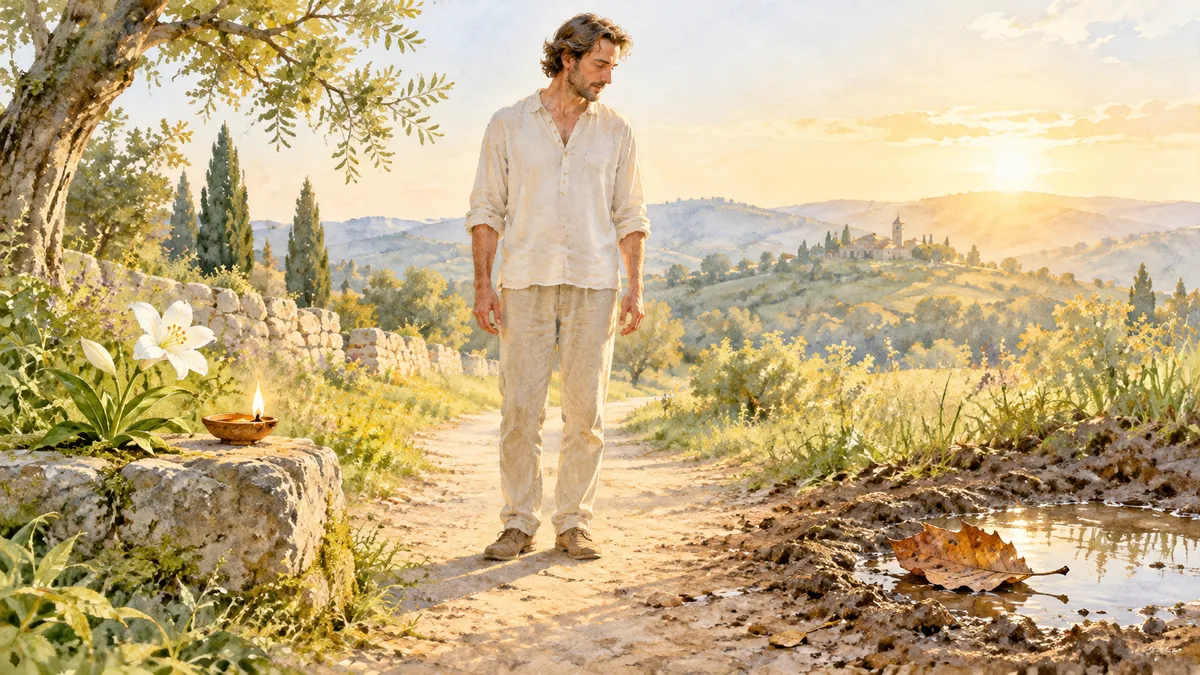
A person with the consciousness of a god of passion may look at a flower and suddenly perceive incredible bliss in it. They may see water moving through its capillaries or discern the flower’s subtle harmony. Imagine that as they look at the flower, it appears to move toward them, growing larger; they can see the tiniest capillaries inside it and feel the profoundest depths of life in that single flower. They think, “Wow...” They are ready to worship the flower and weep over it; the flower gives them immense pleasure that spreads from the center of their chest throughout their entire body, bringing the most exquisite delight all the way to the tips of their hair and fingers.
When such a person hears music, he merges with the state of the music. In his perception, the sounds become three-dimensional. He can transfer his consciousness into them and float along with them, reflecting off objects and sounds. He feels an utterly incomprehensible, wondrous dance within these sounds and floats along with them. Once again, he experiences the greatest bliss. When he sees a sunset, merging with it, he feels all the fire, clarity, and magnificence of the sun, and then he no longer knows whether he is the sun or the sun is him. In the same way, he perceives everything that enters his field of vision and feels the greatest pleasure spreading throughout his body and consciousness. When he eats, he does not eat like an ordinary person; as soon as the food touches his tongue, pleasure permeates every part of his body. He immerses himself in the taste and discovers an immense expanse of taste—an entire universe of taste, in fact. He himself becomes this taste, within which he wanders for an infinite span of time, simply enchanted by it.

Such a state is experienced when you are deeply immersed in contemplation. Then every atom, every object becomes divine, and suddenly you may think, “So this is what Brahman is! Everything is Brahman; everything is divine!” And you feel the desire to remain in this state and simply enjoy it. It is somewhat similar to the state of a drug addict reveling in the experience. The teaching says that this is merely a level of bliss by which one should not become captivated. There is nothing wrong with this bliss; it is an indication of progress. However, if we cease contemplation and simply allow the mind to follow this bliss, it creates the karma to be reborn in the next life as a god of the world of passion rather than attain liberation. The gods of the world of passion have bodies composed of the fire element; they do not experience suffering as humans do and live for tens of thousands of years. However, from a yogi’s perspective, being reborn as a god of passion is unfavorable because it is not realization.
The Experience of Clarity
When we deepen our contemplation, another level of consciousness arises. It is called clarity. Clarity is something deeper; it is unfathomable awareness, the cosmic universal Consciousness projected onto form. At the stage of clarity, simply by looking at a flower or a stone, you can intuitively see the process of the creation and destruction of the entire Universe, beginning with that stone. You have the feeling: “I know everything; I know all the mysteries of the universe; I myself am this unfathomable God.” At this time, immense pride, a state of omniscience, and a sense of self-sufficiency in which you no longer need anything may arise. To remain in such a state means becoming captivated by it and creating the karma to be reborn as a god of the world of form; therefore, such a state is considered a deviation that must be transcended. The gods of the world of form have luminous bodies in the higher world of forms, enveloped in a radiant aura that extends across a vast expanse. They are purer than the gods of the world of passion. However, for a practitioner, becoming caught in such a state instead of abiding in nonduality is unfavorable.
The stage of clarity is also a time when magical abilities are acquired: clairvoyance, clairaudience, the ability to project the subtle body, and so forth. When you see many images or acquire the ability to transfer consciousness to other levels of consciousness, it is also important not to allow it to become caught up in these levels. From the standpoint of nonduality, a true Laya Yoga practitioner is not enchanted upon seeing deities and is not frightened upon seeing demons. Even if he sees the Buddha himself or Dattatreya levitating in the lotus posture and filling the entire universe, he will not leave his true nature; he will not abandon his contemplation. But if a yogi becomes enchanted by these images instead of abiding in nondual contemplation, he loses his true, correct presence.
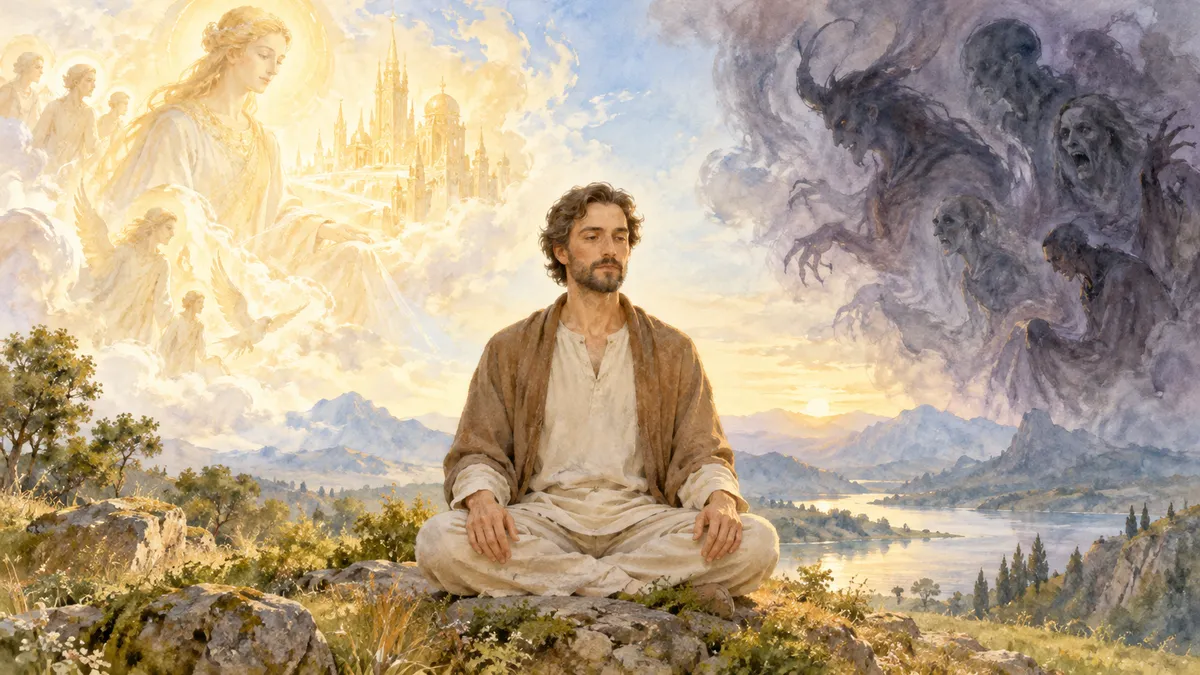
In the course of practice, you may see deities with and without attributes, as well as other beings, saints, siddhas, and so forth. But from the standpoint of correctly abiding in the nondual nature, they should be regarded as manifestations of our own energy, as yet more projections of our primordial Mind. Regarding deities as empty and as projections of our primordial Mind is a principle specific to Laya Yoga that distinguishes it from the lower tantras.
The Experience of Emptiness
Finally, when your contemplation deepens and you have trained yourself to remain in constant presence, you break through to a state of emptiness, or voidness, in which an abyss, the incomprehensible, is seen behind every object. You see that, in reality, there are no walls, no roof, no trees, and no people. The earth, the sky, and everything else are all empty, devoid of inherent existence, without a trace of self-reality. All of this arises from emptiness, yet this emptiness is not empty but is the very essence of Being. The mind then develops a desire to be absorbed into this emptiness and do nothing else. If you allow your mind to grasp at emptiness and it overpowers you, this means that you will create the karma to be reborn as a god of the formless world, a long-lived god in the realm of Arupa-loka (the causal world). Therefore, rebirth in such a realm is also unfavorable for a practitioner, because this is not yet genuine nonduality; rather, there remains a subtle veil of ignorance separating our consciousness from absolute Reality.
Some Tantric schools criticize adherents of the impersonal Brahman and sayujya-mukti (liberation through dissolution), saying that this is not true realization. If this refers to the four formless states, then it truly cannot be called genuine realization.
When we overcome these three kinds of traps and discover the simple state of awareness that is grasped by neither bliss, nor clarity, nor emptiness, and can abide in a state of nondual awareness, whether perceiving objects or not, this may be called the correct practice of contemplation. Every practitioner on the path of Laya Yoga must know these experiences and be able to avoid them. They are very subtle, which means that recognizing them without profound experience is extremely difficult. Therefore, even if such a yogi meditates in retreat for twenty years but lacks the proper instructions, they may easily mistake these subtle illusions for the genuine state of aware presence.
Consciousness Beyond Concepts
“Consciousness beyond concepts” means that, with regard to any concepts, we adopt a position free from extreme views. To be free from extreme views means neither holding the view that things are real in themselves nor adhering to the extreme view that nothing exists at all and that there is only absolute Reality. When we do not follow the extreme views of nihilism and eternalism, we adopt the middle position. The middle position means “neither this nor that.” As soon as we adopt any extreme view in philosophy or theory, it means that we allow ourselves to grasp at certain concepts. This position is similar to Nagarjuna’s Madhyamaka Prasangika school, which asserts eight “nots” concerning views of absolute Reality. In fact, this position existed long before Nagarjuna and is described in the Brihadaranyaka Upanishad and the Chandogya Upanishad, where it is said:
“Brahman is both manifest and unmanifest. It both has form and is formless. It is both perceptible and imperceptible. It is both comprehensible and incomprehensible.”
We do not adhere to any specific views of absolute Reality that could be called absolutist. We hold that absolute Reality is ambiguous, that attempts to describe it are futile, and therefore that the best way to comprehend it is through nonconceptual consciousness.
These are fundamental points in Laya Yoga. If we do not assimilate them, it will be difficult for us to understand what the principle of contemplation means. Laya Yoga itself is based primarily on transmission, while explanations are intended to clarify the transmitted state for us. Transmission means that we attempt to perceive the absolute state directly, without theories. This is also called the “shunyata of the mahasiddhas.” The mahasiddhas were not masters of philosophy; they did not read many treatises. They could give a disciple some object or do something and thus simply point them, without words, toward the perception of absolute Reality. However, to understand this immediately, one must be a very capable disciple.
From the standpoint of the teachings, the light of self-born Wisdom has always existed, but because we cling to our “self,” we are closed to perceiving it. The point of practice is to attain such a degree of contemplation that it continues uninterruptedly. Once it continues uninterruptedly, we must eliminate the very idea of a contemplator; we must remove the final obstacle—the conviction that there is an “I” who practices—because it is precisely this idea that obscures the light of self-born Wisdom.
Even if we perform techniques and meditate, it still resembles trying to pull ourselves out of a swamp by our own hair. For who practices? Who performs the techniques? The same conditioned personality. Even when we make a great effort, our conception of ourselves as a conditioned personality sometimes grows stronger as well. Sometimes even the practice of yoga can become a means of strengthening the ego and our attachment to it, but the true meaning of yoga lies in self-transcendence. Self-transcendence means that we must go beyond the narrow confines of the little “I” in order to perceive our absolute “Self.” But the more effort we make while remaining the little “I,” the more attached we become to perceiving ourselves as the little “I,” and therefore self-transcendence is postponed.
The Principle of Contemplative Non-Action
When we make efforts while practicing techniques and other practices, it is said that we must still unite these efforts with contemplation. There is a great difference in how we perform asanas, pranayamas, and recite mantras: whether we unite them with contemplation or not. If we make any effort without uniting it with contemplation, then we have a future goal and are caught in the hope and fear that arise from our egoistic perception. If we integrate them, this means that while performing asanas, pranayamas, or any other actions, we maintain mindful presence, abiding in the “here and now” without trying to achieve any results. This mindful presence is already the result itself; it is as though we are already sitting on the summit and simply need to remain there. Then we seek nothing and try to achieve nothing, recognizing the absolute perfection of our primordial nature right at this moment.
Suppose you are practicing anapanasati and think, “I wish I could enter samadhi and have experiences sooner. They say anapanasati should produce experiences.” But the experiences do not come, and you feel that you have merely wasted your time and that your legs just hurt. This is the wrong attitude. This happened because you desire something in the future and project it, instead of being in the present moment. But when you practice without expecting results and abide in awareness of the present moment, you are satisfied with your practice every second, no matter how it unfolds, because you assume the position of absolute perfection. Then, suddenly, your subtle experiences of awareness begin to unfold by themselves. Therefore, it is said that a practitioner who has entered the natural state is like a traveler who has climbed to the top of a mountain. Once they have reached the summit, there is nothing more to strive for; they only need to remain on that summit and recognize this natural state as the most absolute, the most transcendent.

When we say that there is nothing more to strive for, this does not mean simply doing nothing and relaxing. If we think this way, that too may be the wrong attitude. Laya Yoga is the principle of contemplative non-action, but it is necessary to clarify what non-action means. If we think that merely remaining in tamas or indulging ourselves is non-action, such an approach does not liberate us. The principle of contemplative non-action concerns the subtlest layer of our awareness, when we understand that no actions and no goals are needed in order to enter the dimension of this level of awareness; we should simply remain in the present moment, trying not to lose it. It is also important whether we lose the state of awareness and become distracted, or are able to maintain it.
Non-doing means that we make the great choice to stop seeking anything within, to cease taking interest in anything other than the primordial state, and to recognize our primordial state as the highest perfection itself, seeking nothing else. We understand that we need to continue establishing ourselves in it. The only issue is that we have not yet become deeply established in it. It is as though we stop moving horizontally and begin moving inward. This does not mean that we cannot practice or study anything on the relative level. We can study methods and practice various techniques; nevertheless, inwardly we must stop seeking anything. Now we practice techniques or study something without setting any goals. It is like a game. We do not allow ourselves to be conditioned by them, because we understand that all techniques, methods, and teachings are inseparable from the natural state; therefore, the main thing is not to lose this natural state.
The Great Decision to Abide in Presence
It is said that a yogi who has made the great decision to abide in the presence of awareness makes a choice that determines the rest of his life. He makes the great decision to abide in great non-doing. This means choosing to be without any choice; it means that we choose to live on another plane of Being. We choose to live open to the world, to perception, to the universe, throwing our consciousness wide open instead of keeping the mind shriveled and conditioned by future hopes, goals, or fears.
One could say that we choose to make no choices; we decide to remain in awareness, when we no longer need to make any decisions. This awareness is what we begin to be guided by. And we trust it alone, regarding it as the essence of the Guru, the Dharma, all Teachings, and as the highest, absolute Being. The more we trust it, the more we begin to open ourselves to it.
We see that there are many subtle parts within us that resist this awareness, that want to live in the old way and cling to what is old, to the past, project the future, or habitually adopt or reject something by attaching labels to reality. Nevertheless, even if this happens, we must still try to abide in this state of primordial awareness beyond acceptance and rejection.
The Light of Self-Born Wisdom
The more we surrender to this light of self-born Wisdom, the more its energy begins to descend upon us; therefore, here practice ceases to be practice in the illusory sense and becomes a transcendent mystical descent.
At first there was our conditioned personality, and we practiced. But when we reach the level of contemplation and rid ourselves of the contemplator, the descent begins. Descent means that the light of self-born Wisdom itself begins to penetrate us, because it has always been there; we simply did not know this and did not trust it. Yet it has always been spontaneously perfect; we simply did not look at it.
When we remove our “I,” our egoistic clinging, and cease resisting this light, it begins by itself to shine and reveal itself within us. “Pratyabhijna” can be broken down as “prati,” “abhi,” and “jnana.” Prati means turning, abhi means face, and jnana means wisdom. That is, wisdom arises within us when we turn to face our true nature. Then our true nature also turns toward us and, in response, begins to send down this light.
Gradually, we learn to surrender more and more to the light of self-born Wisdom. This is called “prapatti”—casting oneself aside. The more we surrender to the light of this self-born Wisdom, the more it penetrates us, eliminating our ignorance, clinging, and kleshas. The question is how much we resist this light of self-born Wisdom. This is called “descent.”
Descent is like the grace of a king who, for no reason other than his own whim, bestows a gift upon a poor man. The poor man may work hard on plantations or in the fields, yet he can barely make ends meet, no matter how hard he tries. Passing by in his carriage, the king happened to see the poor man and tossed him a bag of gold coins. He did it for no particular reason, merely on a whim, to amuse himself.
Something similar happens to us when we reach the level of self-transcendence. When we practice by relying on our own efforts, we may think that we are utterly inept as yogis. Compared with the ancient holy yogis of India, we cannot even sit in the correct posture for long, live in a cave, or walk around naked with our bodies smeared with ash.
Do you think that walking around naked with your body smeared in ashes is abnormal? You are mistaken. In India, it is perfectly normal. Five million holy men in India lead such a way of life; periodically, they gather for the Kumbh Mela festival, where the entire population honors them, after which they bathe in the Ganges. The only possession they carry is a staff. These people have completely surrendered themselves to God and the absolute Truth. Some yogis live in caves, while others, having taken a vow of asceticism, may keep one arm raised toward the sky for five years, making this their service to God.
The Self-Revelation of the Primordial Nature
When we reflect on our qualities as yogis, we see that we are like paupers: we are not yet capable of performing the wonders of ascetic practice, living in a cave, or carrying out complex techniques, and we feel that practicing in this way will not take us very far. However, when we practice self-surrender and self-transcendence, the light of self-born Wisdom suddenly reveals itself to us, without any effort on our part. Even if we do not possess great qualities, this light of the primordial Self can nevertheless reveal itself to us. Why? Because it reveals itself without cause.
It is a mistake to think that the primordial nature can be revealed through effort. Even if you are the greatest ascetic, it is absurd to think that you can create absolute Reality during your short life. It is like thinking that we can create the sun simply by opening our eyes. By opening our eyes, we do not create the sun; we merely enhance our ability to perceive it, while the sun has always existed, even when our eyes were closed.
Therefore, it is a mistake to think that through effort we can attain awakening and that, by cultivating certain qualities, we can reach this primordial Light. The point here is different. When we are sufficiently purified and capable of self-surrender, allowing our ego to capitulate, self-revelation or self-transcendence occurs; then the light of primordial Reality spontaneously begins to pour into us, and it pours into us by the megaton. And then we realize that it has always been there; we simply did not see it.
It is like a mouse sitting on a pile of grain yet suffering from hunger because it does not know that grain can be eaten. Or like a fish swimming in water yet suffering from great thirst because it does not know that water is all around it.
Just as a king spontaneously bestows gold upon a pauper simply by virtue of his innate wealth, so, by transcending our little self, we suddenly discover that our absolute nature spontaneously begins to awaken within us and shine without any effort. That is why it is said to be like grace that simply descends upon us out of nowhere, without cause, even if, on the relative level, we are not great yogis and do not lead a supremely ascetic life. Everything depends on the extent to which we can abide in contemplation, as well as on the extent to which our contemplation leads us to sever egoism and attain self-transcendence. If we do practice asceticism, it concerns awareness alone.

Inner Tapas and the Light of Supreme Grace
On the path of Laya Yoga, one should constantly practice inner tapas. Inner tapas is the uninterrupted maintenance of attentiveness to awareness, a constant presence. Such constant presence burns away parts of our egoic self, as we bring it face to face with our egoism, attachment, aversion, and clinging. When it has sufficiently burned away our samskaras and vasanas, the karmic imprints of the past, this self-transcendence occurs, and we arrive at this revelation. This is also called the light of supreme Grace.
Ramalinga Swamigal often recited this prayer:
“Arut Perum Jyoti!
Light of supreme Grace, pour down upon us!”
In Laya Yoga, the light of supreme Grace refers to the spontaneously existing primordial clarity of our higher Self. By uniting our little self, conditioned by conceptual thought and notions, with this higher Self and completely dissolving it, we can integrate with this light of supreme Grace. The result of such integration is the supreme liberation known as sarupa-mukti.
However, if you practice while dreaming of supreme liberation, once again creating an illusory goal for yourself and striving toward it, instead of simply abiding in the present natural state of awareness, this too will be a delusion. Why? Because when we say that we have resolved to abide in presence, it means that we have resolved to relinquish all goals, including mukti.
Therefore, it is said that a yogi abiding in contemplation neither strives for nirvana nor fears samsara, because he already abides in the dimension of the unity of samsara and nirvana. Of course, this applies only to the subtlest layer of our awareness. On the relative level, it is beneficial to perform preliminary practices, techniques, purification, to control desires, and so forth. However, when it comes to profound awareness, this is precisely the position we take.
It is said that a yogi established in primordial contemplation seeks nothing, because he has already found it. The fear of samsara, death, and rebirth is unknown to him; he is like a tulku or avatar who, if he wishes, takes birth in another body, yet his mind is not fixated anywhere. For him, neither birth nor death exists, and he is not bound by the notion “I am this body.”
